My inspiring English teacher, ‘Windy’ Gale, fixed the aphorism
There are no dull subjects, only dull mind
to the classroom wall.
This supported my own attitude to life of keeping myself perpetually busy. I was an inventor or games amongst my childhood peers and a ‘meddle Sir Mattey’ on protracted visits to grandparents. My grand mother didn’t like her clothes mangle taken to pieces and reassembled in a novel way. But I was busy.
Teenage is the classic period in one’s life for being ‘bored’ – that is entering a state of inaction due to lack of stimulation. This state of inactivity is induced by mental and socio-environmental factors. It is mostly found in predominantly ‘inactive’ people who rely on external forms of stimulation. Their minds have become dull – uninterested in the apparently, uninteresting.
If and when we realise a need to change, then it is down to the individual to break out. Proactivity rarely produces boredom.

Psychologists nominate the state of boredom as a ‘feeling’.
If people, places and / or events induce a state of inactivity in us, then we ‘feel’ bored. This may explain why boredom is hard to identify at first. We will then need to understand it’s causes and take control in order to move out of it’s influence.
A classic way of doing this can be seen in the interaction between a parent and young child. Children often require a boost from outside themselves. They just run out of steam (attention span) and need support. Any or all of the people-place-event factors, need to be manipulated by the parent to provide stimulus to the child to prevent it drifting into a state of boredom.
Does this pattern disappear through adolescence and into adulthood? I fear that as adults, many of us today become even more stuck in the reliance for external stimulation. If you question adults about a simple activity like ‘going to the beach’ – many will reply that they don’t do it because they find it ‘boring’. The beach is a place which indeed provides limited stimulation. In it’s simplest natural state there is just a large volume of empty sky, empty sea and (on a quiet day) – an empty beach.
But if you took a child to this place they would be filled with excitement. Think for a moment of your own endless hours of pleasure spent as a child on a beach…often with hardly any play things, just what nature provided.

Something has happened in our modern Western societies that leaves adults unable to be proactive when the external stimulation of people, place and events is limited to say, ‘a beach’. Late nineteenth century sea-side resorts in the United Kingdom, evolved and thrived on their ability to provide stimulation such as Punch and Judy shows and donkey rides. Today the ‘amusements’ are multiple and complex. You might think that there really is no excuse for being bored on a beach, but apparently there is.
Leo Tolstoy defined boredom as ‘a desire for desires’. I do not agree with this definition as I have already described boredom as a ‘reactive’ rather than a ‘proactive’ state – which surely desire is. The powerful emotion that ‘desire’ is hardly produces any relief from boredom because it is ill equipt to do so. Desires are either realistic or unrealistic and both can be frustrated and denied for reasons out of an individual’s control. This realisation prompted the detached mental state associated with Buddhist philosophy. Sorry Leo old boy, but you are behind the times.
Life has a habit of placing you in a situation that you cannot control or choose. In the nineteenth century you might have to work long hours in a factory for very little reward. There might be a day’s outing to the sea side once a year to relieve the boredom – but that was it.
Factory work is, by definition, repetitive, which is an obvious and common cause of boredom.
I recently took a flight with a well known air line where the cabin crew had a sort of comedy routine to read out.
It was unfunny and in places, in bad taste; ‘the company’s priority is making money over safety‘. Yes, passengers were meant to laugh at that, at a time when Boeing 737 Max 8 airliners are grounded following two fatal crashes.
It appeared to me that the routine was for the benefit of the cabin crew rather than the passengers, because the cabin crew were, well – bored. Can you imagine doing that safety routine with the life jacket and exits, over and over again? Yet these are people who self selected the work as it was ‘exciting’ to travel. Well clearly it isn’t; it gets boring. The people, the places and the events don’t provide sufficient novelty. It’s like a play in which there is only one act, one actor and one set. Life can feel like ‘Waiting for Godot’.
Like all emotions we repress them. Apparently psychologists have discovered that after ‘anger’, boredom is the most repressed emotion.
Even the most proactive, inventive, creative, unpredictable mind finds itself at times running down the endless sets that appear in cartoons like ”Tom and Jerry‘. Or like the scene in The Matrix movie where the character Leo finds himself on an all-white platform, waiting for a train. When he runs down the tunnel he returns to the same platform. Life has this quality in spades and we have to learn to deal with it. We all get bored, even the most active of us.
Psychologists define five levels of boredom ranging from ‘indifferent boredom’ to ’empathic boredom’. They are scalar between one and five. If you wish to know more look here;

I would add that boredom should not be confusded with being frustrated. Being frustrated is like waiting in a queue that hardly moves, in a supermarket or airport. Being bored goes deeper than that as it drills into our emotional state and brings us uncontrollably down, down, down.
This might be why children and adolescents, scream so loudly when boredom hits them between the ribs. For them it’s not always easy to get active – the only known cure. They usually do not have the power to change the cast, the set and the story line in the play of life in which they find themselves.
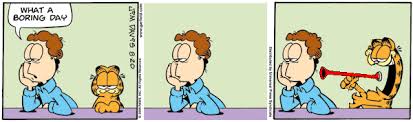
But sometimes you have to wonder, how much of ‘I’m bored’ or ‘are we there yet’ is down them to find a way out of the boredom pit.
I listened to an account on the radio of a female journalist Zehra Dogan, who is an Kurd and an artist working in southern Turkey. She painted the war zone as she saw it and was imprisoned by the Turkish authorities. In jail, her friends and family sent her art materials but these never reached her.
So the journalist / artist made art on bits of bed clothes that she bleached so that the guards did not recognise them. She used coffee, tea, blood and no doubt tears as her medium for expression. In all she was able to take out 300 pieces of work when she was released, which now form a major exhibition.
With the right state of mind, I believe that most humans can overcome the most extreme deprivation by being active. This natural state of mind is what children, teenagers and many adults benefit from being able to conjure; for the world can and will stop spinning for you– if you let it or can’t stop it.
It takes the super hero or heroine to start the world up again but I believe that power is contained within us all because there are no dull subjects.
 Matters Blog