Unexpected Human in the Bagging Area

Serving the machines

It is interesting to observe how the process of shopping has changed over the decades and wonder how this will evolve within the current rush by large corporations to replace humans with Artificial General Intelligence.

For hundreds of years people bought and sold produce in street markets. The social interaction in this daily event provided fresh wholesome local produce at prices that most people could afford including by barter.

If one were to score this system for its social interaction and satisfaction, I would give it 10 out of 10.

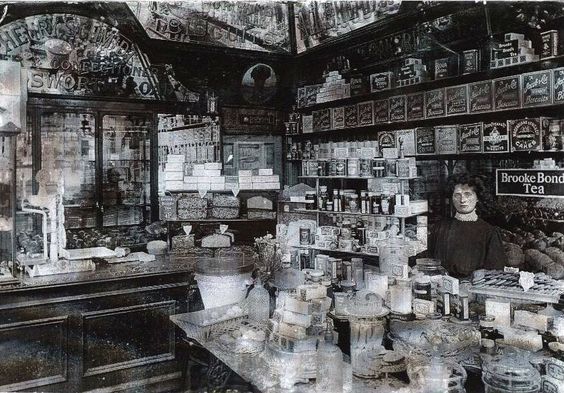
My grandfather was a Victorian and worked in a food emporium in England. The shop assistants stood between the merchandise stacked on shelves and the counter. Customers approached the counter and described what they wanted to the assistant. The food was either processed and weighed on the counter or handed to them in exchanged for payment.

If one were to score this system for its social interaction and satisfaction, I would give it 8 out of 10.

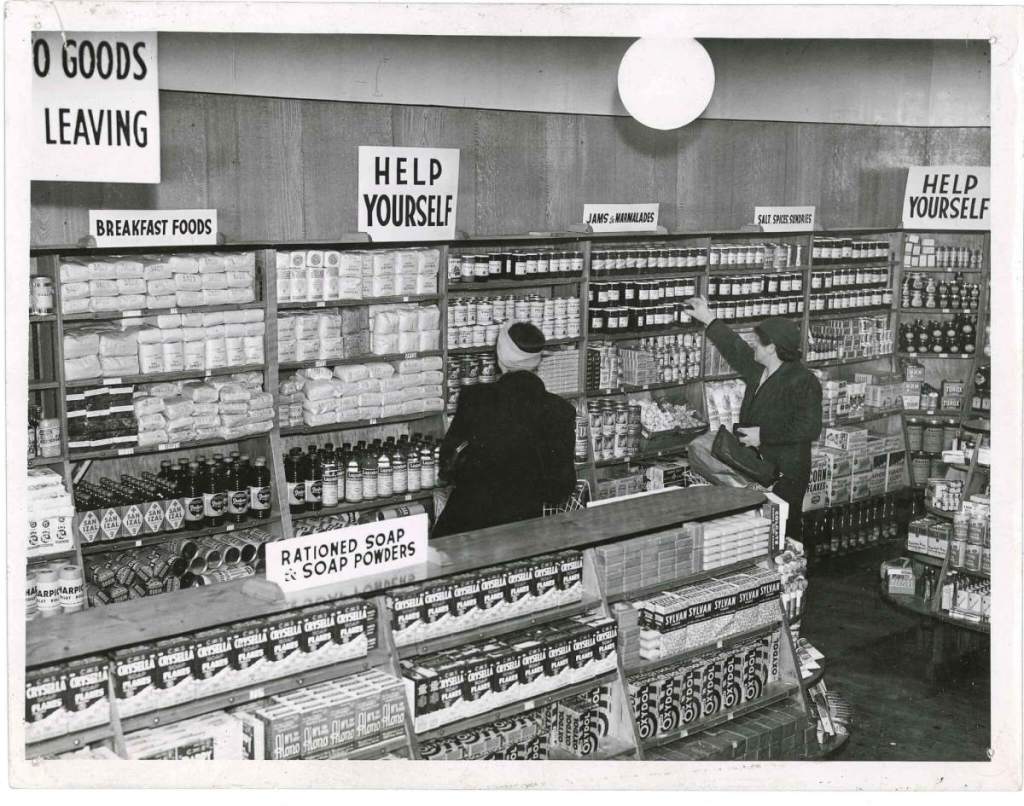
The method of the exchange of goods changed in a revolutionary way in the 1960’s American style ‘supermarket’.

The counter was removed and customers were free to select items from the shelves. They had to place items in a wire basket that they carried to a ‘check out’ for an exchange of money to take place between customer and a friendly check out operator.

If one were to score this system for its social interaction and satisfaction, I would give it 6 out of 10.

(NOTE the ‘rationed soap’ in post war Britain and the lack of fresh produce.)

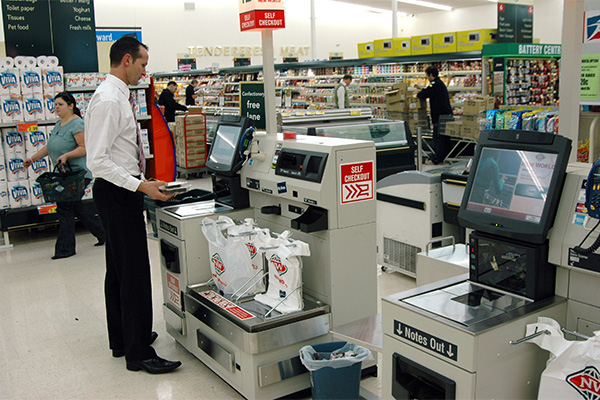
There has since been a move to eliminate the need for the shop to have check out tills. They are being replaced by areas in which the customer completes the whole process of pricing their selected goods, packing and completing payment. No employees for the food companies means higher profit.

picture credit: Waterford Whispers News

If one were to score this system for its social interaction and satisfaction, I would give it 4 out of 10.

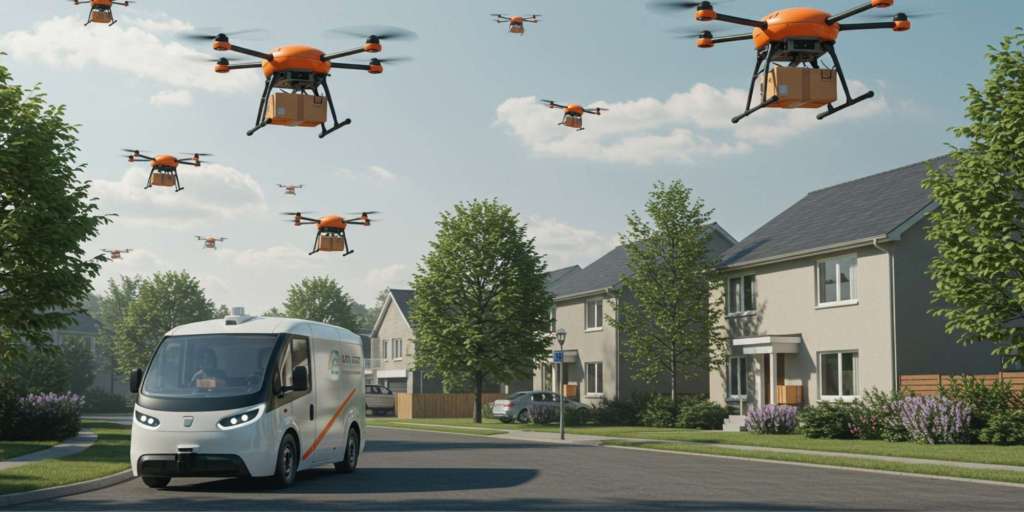
Today the process of the customer leaving home to go shopping is being reduced and perhaps will eventually not happen at all. Instead, goods are selected and paid for virtually online and delivered by human or robot to the customer’s front door. No expensive shops for the food companies means more profit.

picture credit; Efulfillment Service

If one were to score this system for its social interaction and satisfaction, I would give it 2 out of 10.

This is a brief view of shopping as a social science until the present day. Each ‘innovation’ and ‘advancement’ has been conducted principally to boost profits for the company at the expense of customer’s social interaction and satisfaction.  One wonders what will happen next? Will it be a search for more profit or something more sinister?

In my view, life in the future will almost certainly involve Artificial General Intelligence which thankfully has not been matched by human general intelligence, yet. When it does, I expect governments around the world will use the distribution of goods to private customers as a process of exchange not for money, but obedience.

The model of ‘lock downs’ was developed in the ‘pandemic’ of 2020 for what has turned out to be of doubtful benefit. Citizens in countries of all political persuasions were expected to stay at home and not complain. Food, water and medicines could be obtained but movement in public places was surveyed and strictly policed on the grounds of ‘public safety’.

picture credit: VOA

The advantage for governments of this system is that the principal of citizens being free to do what they want, is disallowed. People will not be permitted to consume the quantity and quality of food they can afford, as today. Instead, customers will be told that they can only have what is available. Vital services and goods will be shared out in this way, based on availability rather than need. Various ‘plausible’ reasons will be given for the unavailability of food and groceries such as energy and fertiliser shortages (caused mainly by sinister or negligent and reckless government policies, such as not supporting farmers).

As happened in the Democratic Republic of China during the pandemic, mobile phone apps enable governments to control people; such as free movement to work and shops. This system might easily extend tomorrow into rationing of goods and services for ‘the common good’ and ‘safety’ and ‘unavoidable shortages’ etc.

If one were to score this system for its social interaction and satisfaction, I would give it 0 out of 10.

However, hackers using spybots and malware purchased from the dark web, can be expected to try to outsmart the government smartphone apps. As in all closed systems of exchange, there will emerge a black market. At certain times and places, people will be able to meet pop-up traders selling wholesome local products such as organic chicken eggs, grains and vegetables. Neither AGI nor governments will know anything about it.

The wheel will have turned full circle.

Go Electric!

To go or not to go.

When I was in my first year at University I used to have debates with my parents about the harm made by internal combustion engines. Their reply was that if I did not approve of cars why do I ride in them? The answer was of course that at that time there was no alternative; unless you lived in cities. In London I rode my bicycle with a sign on the back saying ‘no noise, no fumes’ for a decade.

Fifty years later I have won my argument. London has introduced ‘low emission zones’ having recognised that the air pollution from vehicles is harmful to the health of it’s inhabitants.

When I retired in Spain I bought a Spanish made electric bicycle. At first it was great but after five years the battery had lost so much of it’s capacity to fully charge that I had to buy a new one. This cost me about a third of what I had paid for the bicycle. Then the computer had a problem and no e-bike specialist knew how to fix it and the BH factory was closed because of the pandemic. When the motor broke I took my bike down to the recycling centre and said goodbye to it. Never has a bicycle caused me so many problems.

Interestingly, many e-car owners are going through the same experience, only worse. They have invested considerably more money in an e-car than the cost of a bicycle and their anxieties must be proportionately larger.

Properganda or Proper Policy?

I will not list all the of the problems they face but here are a few;

*Recharging the batteries; those without a private drive will find it hard or impossible to charge in the street. Already pavements in cities have electric cables running across the pavement from homes to e-cars overnight.

*Recharging is expensive; unless you are recharging at home using your own photo voltaic panels, you will pay for your electricity.

*Mains electricity at home is not green electricity. In Spain mine is mainly produced by nuclear and gas fired power stations. Only 5% of my electricity is from renewable sources.

*Electricity sent to users via a national grid is highly inefficient, losing about 80% of the energy from the original source. Local power production will one day replace this but not yet.

*Electric cars are cheaper to maintain than internal combustion cars but there is not yet the infrastructure and technicians in place to repair broken e-cars.

*Electric cars are heavy and need expensive tyres.

*Electric car tyres put out more particulate matter into the air than diesel cars produce from their exhaust.

*Electric cars are heavy and some multi-storey car parks and car ferries may have to be redesigned.

*Lythium ion batteries have a risk of spontaneously combusting.

*Drivers of electric cars experience ‘distance anxiety’. For longer trips they will have to stop and find a charging point. While these are being increased in number, there is no strategic control over the number of these points and customer demand. Waiting for a recharge is not satisfactory for people in a hurry.

*If there is a traffic jam for any reason, e-car users could find themselves running out of electricity and being powerless (literally) to do anything about it. Apart from planned road closures and random accidents, extreme weather such as freezing blizzards can stop the traffic and cause deaths. Keeping the lights and heater on is not an option for e-car users.

*As one third of a cars energy consumption in it’s lifetime is consumed in it’s production. It makes sense therefore to make cars that last a long time. A diesel engine can do a million miles as often London taxis do before some are sent off to California for an overhaul and new life. The lifetime of new e-cars is unknown but certainly the batteries will the first to be replaced and that raises the question of where new rare earth materials are going to ethically sourced from…the moon?

At present, many e-car users are in the ‘honey-moon’ phase of ownership but already some are questioning whether their choice was really such a good one.

Car producers are also going through the same questioning process. Major companies such as Ford, General Motors, Apple and Volkswagen are applying the brakes.

It is without question that personal transport (outside of cities) is not going to go away. We love our cars and the convenience, privacy and comfort they provide. With the approach of the era of the self drive cars, users will be able to sit back and enjoy the ride…until a pesky teenager deliberately steps out in front of the car (just for a laugh) and forces an emergency stop…or a car jacker on a lonely road at night! Making moral decisions based on appearance of those stopping cars, is still over the horizon for AI. Does it recognise a police officer in uniform?

And then if you are used to driving over the speed limit (as most drivers are except when they approach a clearly signed speed enforcement camera) then you will find your journey times extended as your AI dutifully follows the traffic laws.

In the meantime drivers are left with the internal combustion engine. There are stories of some drivers who bought e-cars dusting off their old diesels and selling the Tesla.

Toyota appear to be the most ‘customer need’ focused car production company and have asked themselves the question; ‘how can we make the internal combustion engine green?’

Toyota Hydrogen Car

One answer is to use hydrogen as a combustible gas using electrolysis to split water into hydrogen and oxygen. I remember watching this being done on a science television programme back in the 1970’s and thinking then – ‘that is the future’. I was not wrong.

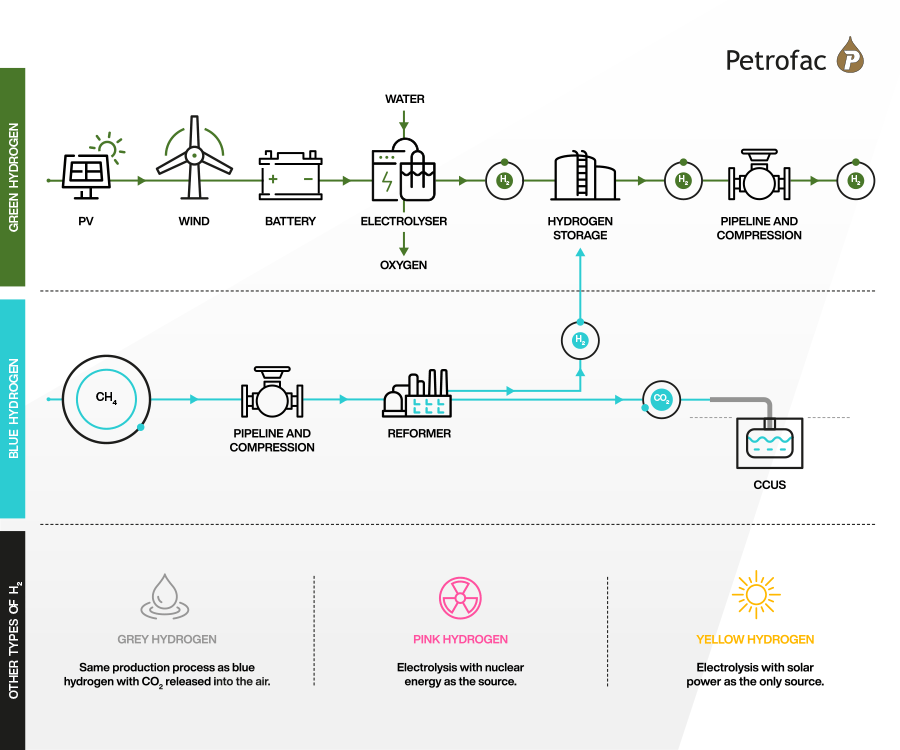
There are nuances regarding how ‘green’ hydrogen production is and the infographic below describes this.

There is another alternative fuel which is ammonia. This is a main component of many fertilisers and is a chemical made of hydrogen and nitrogen (NH3). It can be burnt in a combustion engine as a zero carbon fuel.

This essay has focused on electric cars but clearly heavy transport by train, ship and goods vehicles are substantial polluters are the moment. Hydrogen has always been a preferred route for the development of engines of the future for moving heavy goods around the world.

Science tends to have a momentum of it’s own. New inventions often take the lead in how society uses them and evolves. This new ‘green transport’ debate, raises the questions of how much the government provides subsidies for new enterprises and how important planet sustainability is believed to be by various governments around the world.

If these decisions are devolved to industry leaders it is likely that little will be done as we have observed over the last five decades or so, when ‘global warming’ was first highlighted as an issue. Politicians such as Margaret Thatcher took a very forward looking view as to the health of the planet and the effect of unrestrained industrial production and consumption. Private enterprise so far has followed the policy of ripping the planet apart. Only now is this policy biting back.

Perhaps today, it is down to the individual to vote with their feet. Move into a city, use public transport or a bicycle. Or move to the countryside and fit photo voltaic cells and solar water heaters to your house. Or just do nothing.

It depends how important breathing is to you.

Did You Enjoy Your Meal?

Do you find that when you eat at home, you must put on some loud music to accompany your meal?

I expect that there are many who cannot face eating without background or foreground music or perhaps television, but your writer does not.

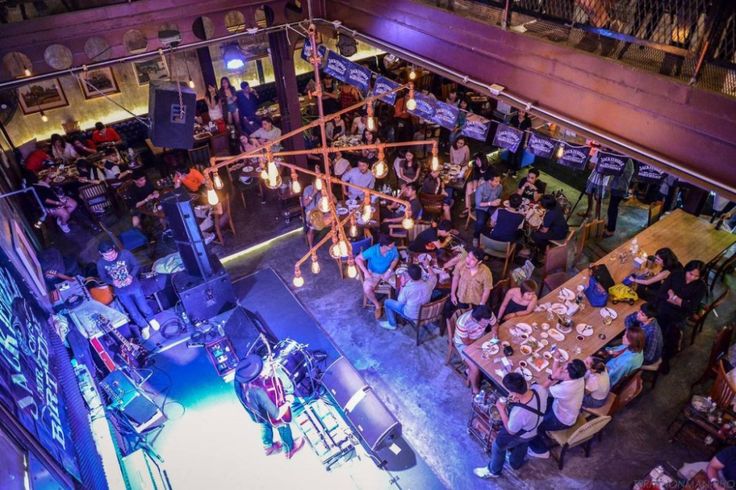
Therefore, for me, it is difficult to go to a restaurant anywhere in the world and enjoy the experience. The problem is that most restaurants seek to please their clients by playing music with apparently, little thought. I can see that their aim is to attract customers and an empty silent restaurant is not going to do that. So they replace the silence and empty tables with music. So when people get hungry and sit down in the restaurant, is this because of or despite of the music ? The restaurant fills up and as the music stays on the people start shouting at each other, just to be heard. The speakers are cleverly placed so that there is no table where the music does not play in their ears.

My question is, are restaurants getting it right?

Let’s imagine that you own a relatively successful restaurant What’s’ your management strategy towards ambient music?

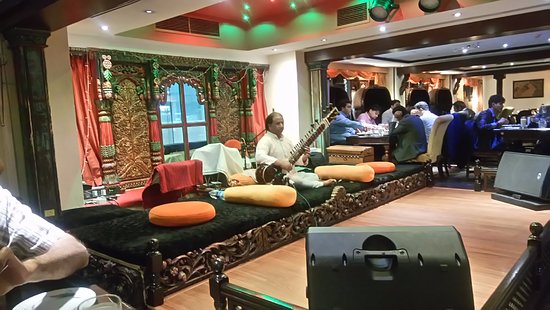
Live, themed music, but look at the size of those speakers!

For starters, how many potential customers walk by your restaurant when they here your musical offering? Is this because they do not like your taste in music? Should they? Who else likes your taste in music? The majority of people? Really? You don’t know? Why not?

Music after all is a very personal thing. Young people are unlikely to want to go to a restaurant playing the classical greats…as are elder people unlikely to want to listen to heavy metal and grunge with their salad. There is no ‘one size fits most’ when it comes to musical taste.

Music cannot only be judged by it’s genre but by the volume that the music is played. There is a type of music intended to be played at a volume just enough to break the silence. In the 20th century this was dubbed ‘musac’ and wafted from ceilings in lifts and shopping centres. Today, there might be ‘ambient music’; a soft mosaic of chords and natural sounds that is so bland that it is hardly noticeable, yet gently calming.

At the other end of the scale there are some people who enjoy and expect music to be loud, and perhaps young people fall into this category, although of course, not all.

So as a manager and owner of a restaurant, how can you attract the maximum number of customers? Do you let the staff play their favourites (as many managers do) or have you understood the need to carefully attract the maximum number of diners.

The decision may not be difficult. If you own a Greek restaurant, do you play Greek music to remind people of their holidays in Greece? It may sound obvious but how often does this happen in your experience?

I once went to an idyllic restaurant on a sandy beach in Kerala, India. The food was delicious but the music was ‘intended’ to please westerners. After suffering ‘Pretty Woman’ by the Whoevers, I handed the waiter my cassette tape of classical Indian music and asked him to play it. The ambiance totally changed. Suddenly I was in India!

If you do not have a natural themed choice of music in your restaurant, how can you know what customers they like? The answer is to ask them. A simple question at the end of their meal about the music instead of ‘did you enjoy your meal?, would be a good start. Alternatively, a questionnaire printed on the place mat / menu enables a more anonymous and comprehensive response. It could include a question on the volume for instance.

A relaxing dining experience?

An obvious consequence to client satisfaction in your dining experience, is to offer some tables where there is deliberately no or very quiet music. This would please those whose taste in music is not ‘mainstream’, as already described. These would be ‘low music’ tables where there are no speakers hanging ominously from above. This particularly makes sense where there is pleasing natural ambient sound such as a river or the sea, birds, or wind in the trees. People need choice and the more people you can attract the more profit, surely?

There is a point where music becomes a contributory factor to noise. This can be defined in decibels, and happens when other sounds in the restaurant are taken into account. People natrually want to talk in restaurants and the level of noise in the restaurant will affect their ability to listen and talk to each other. There is a known effect where people talk above ambient noise levels in order to be heard. As more people talk the louder they have to talk. The effect is ear crunching.

Or perhaps the restuarant music is needed to conceal unwanted sounds. The noise from the kitchen, the TV on the wall, the busy road outside and other local noises that invade your restaurant, might be concealed by music but at a certain point, the music is the only sound in your control as manager. If people are shouting over it they are certainly not listening or enjoying it.

I personally will walk straight passed a restaurants if I do not like their music and or it is too loud. This means I just keep walking, and not because my taste in music is narrow. On the contrary it is very broad, but it is not ‘popular’. I have studied music and can play various musical instruments as well as sing, but given the option for music or not, regrettably my choice would always be the birds in the trees.

Spotted flycatcher Muscicapa striata; picture credit RSPB

The bottom line is, as for most business enterprises; are you offering what people want or what you want to offer to people? Generally, businesses based on personal taste or expectation of the tastes of others to match your own, fail. There is no room for peronsal egos when seeking to serve others. To attract and please people, entrepreneurs in dining or any other business, need to know what people want. Businesses like Mc Donalds and Costa Coffee prospered because they understood this principle and make money.

So, when it comes to musical ambience in the dining experience, what do people want?