Heaven in a Wild Flower

To see a world in a grain of sand, Heaven in a wild flower 19th century poet, William Blake

There is a great deception present in the lives of human beings. We cannot imagine consciousness outside of our own heads. Perhaps the emergence of Artificial General Intelligence is beginning to suggest that this can be the case. We shall see.

In Ancient Egypt and Ancient Greece and Rome, consciousness was understood to naturally inhabit matter. Matter was then defined as the four elements of earth, air, fire and water. Spirit was the fifth element and the one that gave ‘life’ and made all things (mineral, vegetable and animal) feel alive – conscious.
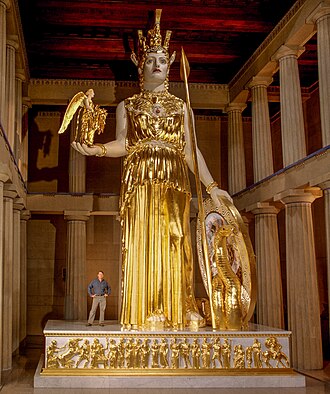
Arthena Parthenos note the elmental picture Wikipedia

In ancient religions, priests would invite spirit to occupy statues made in the form of a human or animal body. If the spirit had archetypal characteristics of both animal and human bodies this was represented such as Thoth and Anubis in ancient Egypt.

For the Greeks and Romans, a statue in a temple or a home shrine was a means of communication with a living god. This was not only vital for daily life but for personal continuity into the afterlife.

In ancient Japan, the religion of Shinto took a simpler animistic relationship with nature. This deep reverence for the natural world is reflected in traditional Japanese arts and crafts. The practice of ‘wood bathing’ in Japan today, is a modern manifestation of becoming deeply energised by the spirit of woodland and individual trees.

The ancient Celts in Western Europe manipulate the invisible energies of the landscape. They controlled them by moving earth and stones to sympathetically increase the power of the ‘earth spirit’. The animals, vegetables and minerals benefited from this bio-electromagnetic energy. Humans in particular rode the energy like a wave in the initiation chambers built into their long barrows and dolmens.
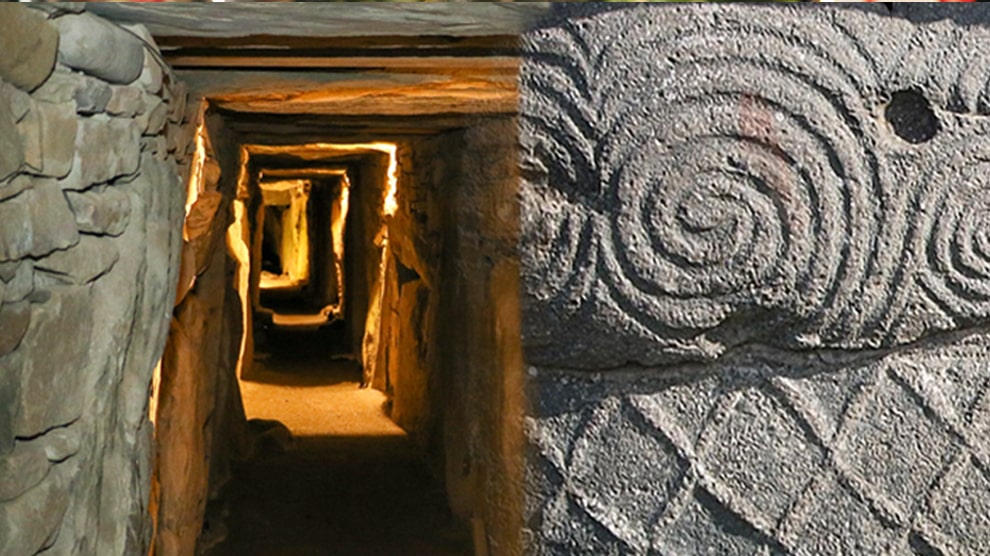
New Grange Ireland Initiation Chambers and Pictograms picture credit: Sky History

In north America the first nation tribes held nature in the high respect that one gives one’s grandmother. They called her Unci Maka and revered the landscape as if it were their own grandmother’s body.

“Every part of this soil is sacred in the estimation of my people. Every hillside, every valley, every plain and grove, has been hallowed by some sad or happy event of days long vanished. Even the rocks, which seem to be dumb and dead as they swelter in the sun along the silent shore, thrill with memories of stirring events connected with the lives of my people, and the very dust upon which you now stand responds more lovingly to their footsteps than yours, because it is rich with the blood of our ancestors, and our bare feet are conscious of the sympathetic touch.”

Chief Seattle in his Treaty Oration of 1854

Sadly, the industrial revolution and the ‘religion’ of scientific materialism turned its back on animistic spirit traditions. People in industrialising countries left the land of their ancestors for what William Blake called ‘dark Satanic mills’. At least fifty per cent of the world’s population today live in cities.
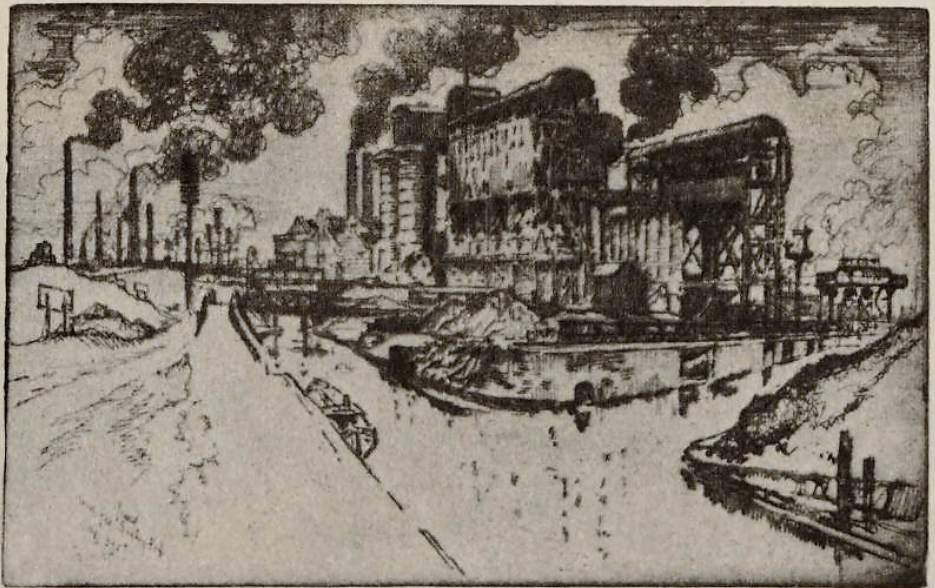
picture credit: Dudley Port etching 1909-by-joseph-pennell – Word Histories website

Nineteenth century scientists such as Sir Isaac Newton reduced the understanding of nature to a series of cause-and-effect mechanisms or ‘natural laws’. It is less well known that he was also open to the possibility that there are more mysteries than conclusions. He studied the ancient art of Alchemy and the Torah for the greater part of his life. Society embraced his scientific discoveries and ignored his spiritual search.

Today, scientists know that matter and energy cannot be reduced to a few laws. The picture is more complex. As in the study of the human body, there is not only anatomy, but physiology – what things are and how they work.

The ‘wood wide web’ describes how tree roots and fungi connect to share information, nutrients, and moisture.

picture credit: Parvati Records Band Camp

In the parallel worlds of nature spirits; fairies, elves, goblins, water spirits and the rest, have always been described as living in communities, not isolation. They mirror organic organisational truths that require co-operation in order to provide the resilience to loss through adversity. A new by-pass has little regard for the unseen.

Nature never discards anything as worthless. In physics, energy is not lost, only turned into another type of energy. Matter will similarly ‘change state’ from solid to gas and never be lost.

It is so in the municipal allotment where sunlight is absorbed by vegetables the remains of which eventually break down into humus for future crops. There is a circular pattern of renewal which today is respected as ‘sustainable’. Nature achieves it without effort, but modern societies struggle to achieve without loss of ‘convenience and comfort’. Even human consciousness is recycled under the same principle and occupies many organic bodies in it’s learning and initiation journeys using the power of physical reality.

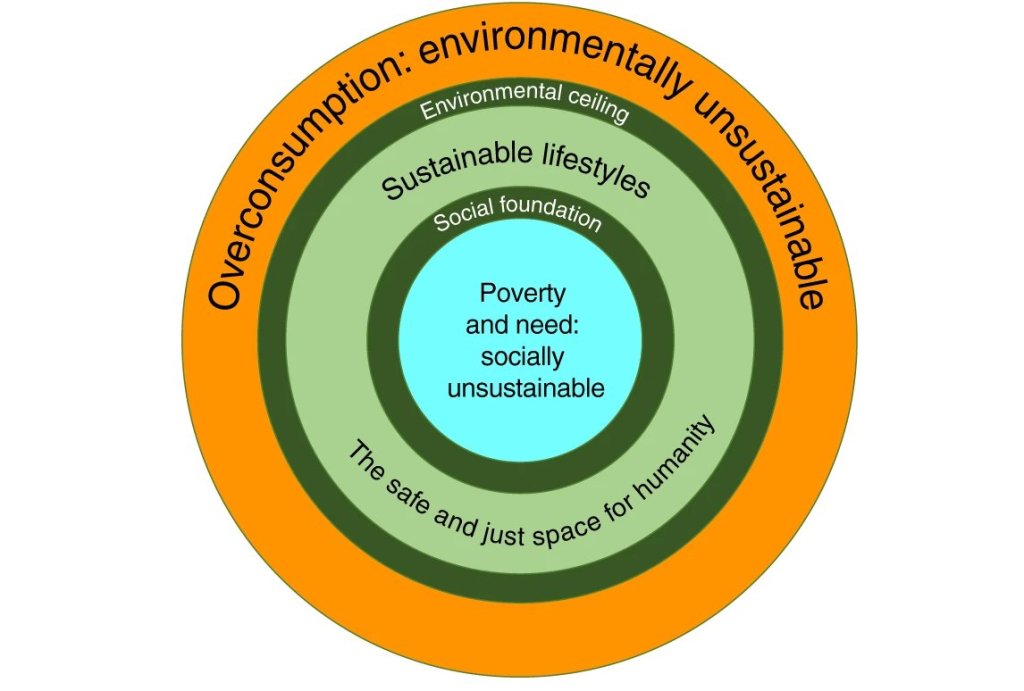
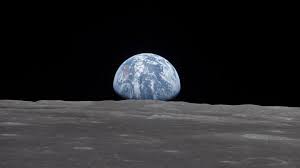
Nature will always provide spiritual and physical nourishment for human beings. However, the supply of the latter is not infinite for the obvious reason that there is only one ‘Grandmother Earth’. Therefore, as the size of the human population seriously threatens the vast eco-systems of the planet either population or ‘standard of living’ or both, must reduce.
picture credit:
International Institute for Sustainable Development

This fact is painful to industrialists and those who benefit from the draining effects on the planet of mass production. As materialist can not conceive of or carry out a solution to the damaged Earth in material terms, space exploration is posited as a way to ‘get more stuff’ even when planets are known to be distant wastelands.

Human populations have already thrived at a sustainable and advanced material standard of living throughout history and around the world. What gave people purpose and comfort was a universal enjoyment of spirit and human consciousness. The extraordinarily high standards of ancient artists, sculptors, musicians and engineers and architects contrasts with modern creations devoid of pulse.

If one challenges what spirit is and what benefits it brings then that is another subject. Suffice to say that the urge to follow a ‘religion’ as a step to a non-material spiritual path is one that is found in even the most so called ‘primitive’ societies.

Curious and disillusioned souls who have been immersed in modern city life travel to hidden pockets of the Amazon rainforest to learn and experience a living spirit world from traditional indigenous shaman and healers through the drug Ayahuasca.

The journey into nature becomes a journey into the hidden areas of oneself and nature is realised as the perfect teacher for that. The religious dogmas of the past are today seen by many as trees that bear no fruit only promises of future fruit.

When William Blake wrote poetry and painted pictures describing his mystical vision and path, society was open to his ideas even if they did not understand. I would argue that this intuitive leap into unknown possibility is required again today so that a complete change of direction for humanity can be achieved.

There is an idea and possible reality of a ‘new earth’ revealing itself at this present time. It is not the planet of old, nor the ideas of our ancestors. It is an escape from a cocoon that is no longer comfortable or at least, no longer sustainable.

Leaving the safety of a cocoon and growing angelic wings; that is a move into the unknown accomplished by butterflies every day.

picture credit: Pinterest

Unexpected Human in the Bagging Area

Serving the machines

It is interesting to observe how the process of shopping has changed over the decades and wonder how this will evolve within the current rush by large corporations to replace humans with Artificial General Intelligence.

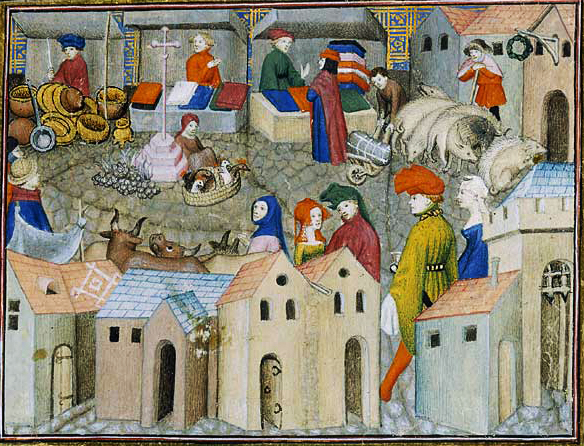
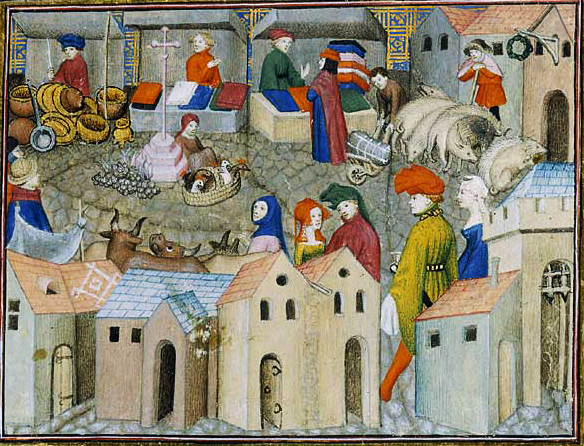
For hundreds of years people bought and sold produce in street markets. The social interaction in this daily event provided fresh wholesome local produce at prices that most people could afford including by barter.

If one were to score this system for its social interaction and satisfaction, I would give it 10 out of 10.

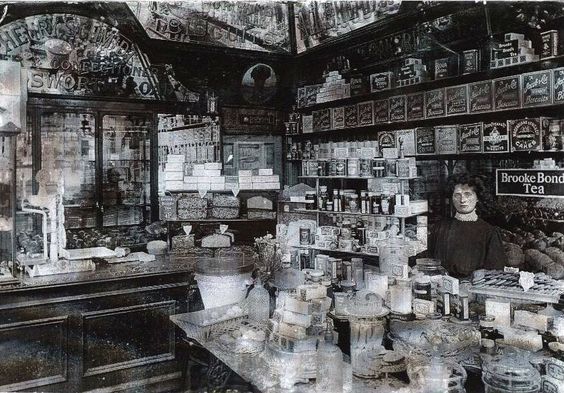
My grandfather was a Victorian and worked in a food emporium in England. The shop assistants stood between the merchandise stacked on shelves and the counter. Customers approached the counter and described what they wanted to the assistant. The food was either processed and weighed on the counter or handed to them in exchanged for payment.

If one were to score this system for its social interaction and satisfaction, I would give it 8 out of 10.

The method of the exchange of goods changed in a revolutionary way in the 1960’s American style ‘supermarket’.

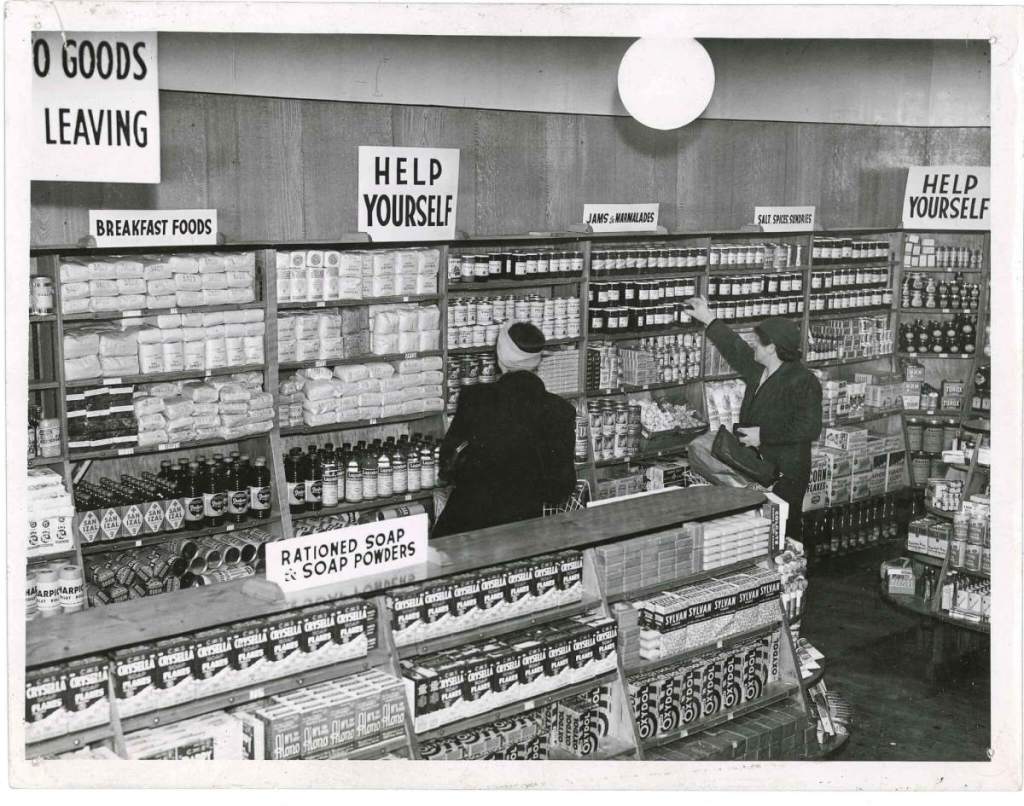
The counter was removed and customers were free to select items from the shelves. They had to place items in a wire basket that they carried to a ‘check out’ for an exchange of money to take place between customer and a friendly check out operator.

If one were to score this system for its social interaction and satisfaction, I would give it 6 out of 10.

(NOTE the ‘rationed soap’ in post war Britain and the lack of fresh produce.)

There has since been a move to eliminate the need for the shop to have check out tills. They are being replaced by areas in which the customer completes the whole process of pricing their selected goods, packing and completing payment. No employees for the food companies means higher profit.

picture credit: Waterford Whispers News

If one were to score this system for its social interaction and satisfaction, I would give it 4 out of 10.

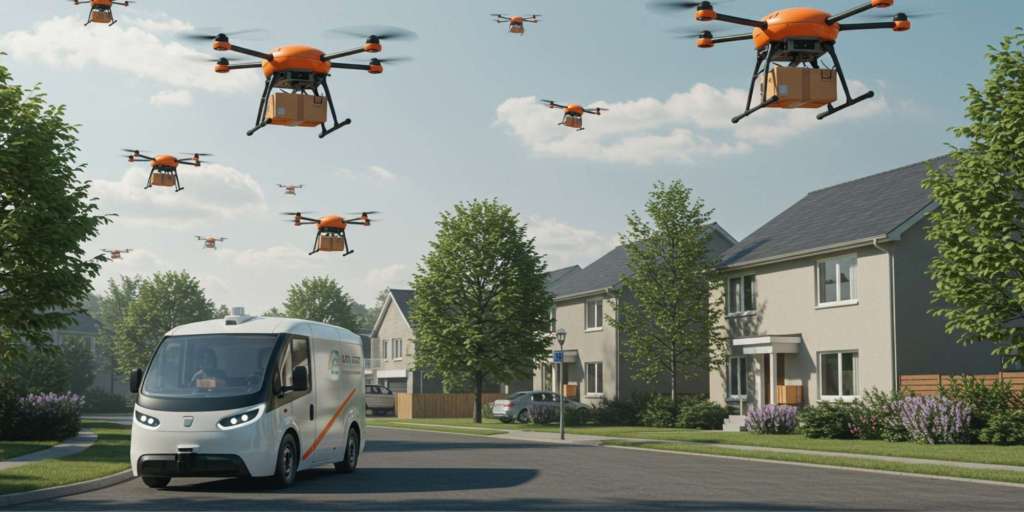
Today the process of the customer leaving home to go shopping is being reduced and perhaps will eventually not happen at all. Instead, goods are selected and paid for virtually online and delivered by human or robot to the customer’s front door. No expensive shops for the food companies means more profit.

picture credit; Efulfillment Service

If one were to score this system for its social interaction and satisfaction, I would give it 2 out of 10.

This is a brief view of shopping as a social science until the present day. Each ‘innovation’ and ‘advancement’ has been conducted principally to boost profits for the company at the expense of customer’s social interaction and satisfaction.  One wonders what will happen next? Will it be a search for more profit or something more sinister?

In my view, life in the future will almost certainly involve Artificial General Intelligence which thankfully has not been matched by human general intelligence, yet. When it does, I expect governments around the world will use the distribution of goods to private customers as a process of exchange not for money, but obedience.

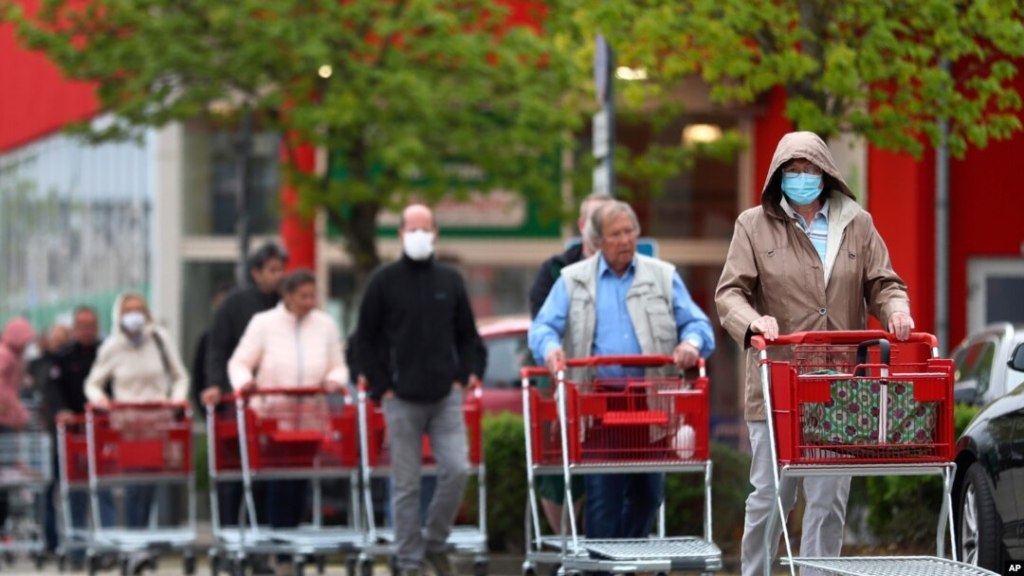
The model of ‘lock downs’ was developed in the ‘pandemic’ of 2020 for what has turned out to be of doubtful benefit. Citizens in countries of all political persuasions were expected to stay at home and not complain. Food, water and medicines could be obtained but movement in public places was surveyed and strictly policed on the grounds of ‘public safety’.

picture credit: VOA

The advantage for governments of this system is that the principal of citizens being free to do what they want, is disallowed. People will not be permitted to consume the quantity and quality of food they can afford, as today. Instead, customers will be told that they can only have what is available. Vital services and goods will be shared out in this way, based on availability rather than need. Various ‘plausible’ reasons will be given for the unavailability of food and groceries such as energy and fertiliser shortages (caused mainly by sinister or negligent and reckless government policies, such as not supporting farmers).

As happened in the Democratic Republic of China during the pandemic, mobile phone apps enable governments to control people; such as free movement to work and shops. This system might easily extend tomorrow into rationing of goods and services for ‘the common good’ and ‘safety’ and ‘unavoidable shortages’ etc.

If one were to score this system for its social interaction and satisfaction, I would give it 0 out of 10.

However, hackers using spybots and malware purchased from the dark web, can be expected to try to outsmart the government smartphone apps. As in all closed systems of exchange, there will emerge a black market. At certain times and places, people will be able to meet pop-up traders selling wholesome local products such as organic chicken eggs, grains and vegetables. Neither AGI nor governments will know anything about it.

The wheel will have turned full circle.

Word War

picture credit: Domestic Violence Co-ordinating Council / Delaware / USA

Is it wrong for a victim to commit a crime against their abuser?

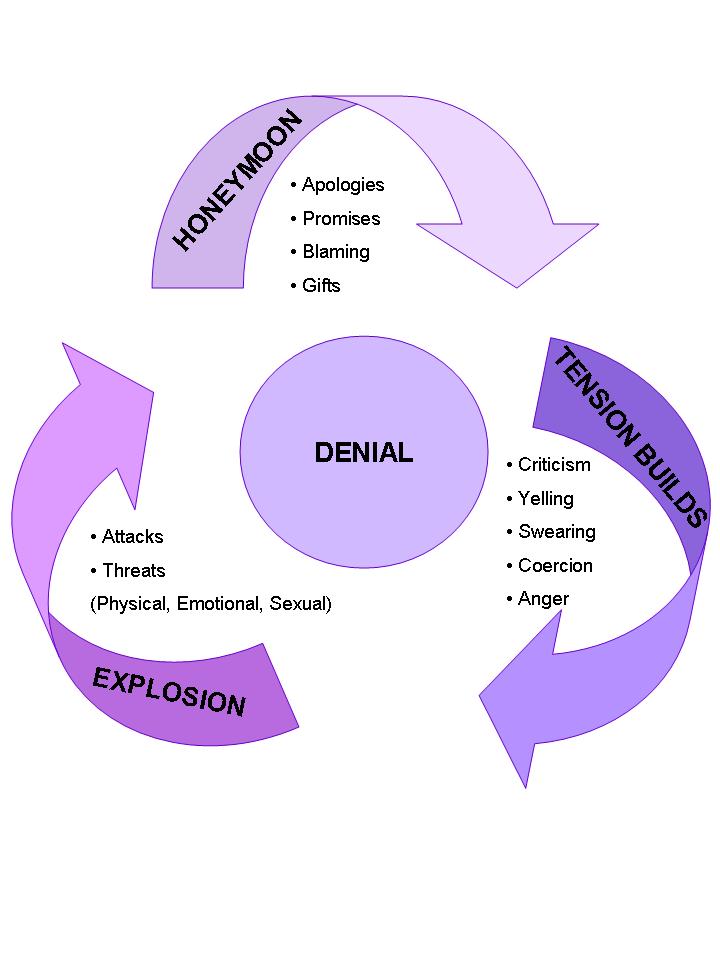
Consider a wife who has suffered various kinds of abuse over many years from her husband. One day she picks up a kitchen knife and stabs him to death. You have seen this story in movies and books many times and one is always split between compassion for the victim and condemnation of their crime of murder.

Now chose a word to describe the action of wife;

Attack? Defence? Pre-emptive? Revenge? Anger? Terrorism?

Most courts would find the wife guilty of murder. Her defence of ‘self-defence’ or ‘after years of abuse’, would be considered as mitigating circumstances and might reduce the sentence significantly.

When children fight they will commonly defend themselves with an accusation; ‘so and so started it.’

They might have been a peaceable victim who was attacked by a bully. In most ethical standards and laws, a violent act permits self defence by the victim. If the bully claimed to have attacked in order to prevent being attacked this is unlikely be regarded as permissible unless the victim had made to strike and the bully blocked the attack before striking back. Children can confuse adults with this simple excuse or ‘defence’ for violence and so do modern leaders!

The abused wife who retaliates in anger is like a country that has suffered abuse from a neighbouring state for many years. If brought to breaking point, the victim state will decide it has had enough of violent attacks and incursions onto their land. They will strike back. The question is, did the victim start the violence by objecting to abuse? Who ‘started it’ becomes almost impossible to define as the origin of the violence and the definition of the first act of violence is difficult to pin point. It probably wasn’t a single agressive act but multiple acts of passive aggression by either party.

picture credit: Communitycommons.org

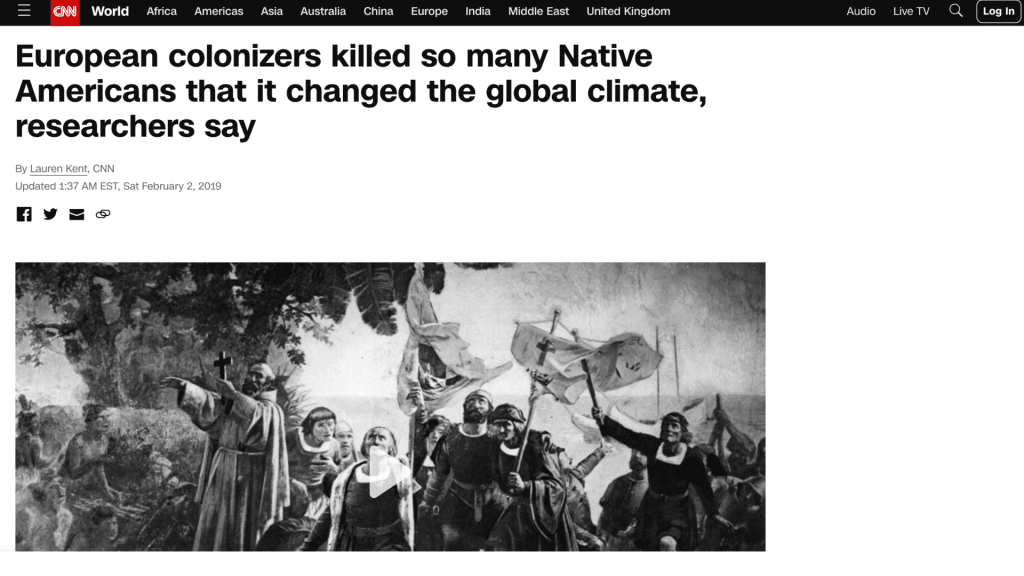
In the eighteenth century, the United States of America slowly dispossessed and committed murder and land theft against the indigenous population as had done other European colonisers before them.

The State of Israel was created by occupying Colonial powers in 1945 from which point onwards to the present day, Israel land stole land from and murdered anyone who was in the way.

Are not both of these examples of the ‘wife-beating husband’ and a continuous ‘they started it’ mentality? How much provocation should original and entitled inhabitants suffer before fighting invaders?

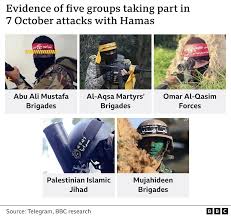
Today the Zionist government in Israel is trying to persuade the world that those who fight back against the genocide of Palestinians, are ‘terrorists’.

Over the decades the words ‘Jewish’ and ‘anti-Semite’ have become used as if by an innocent abused wife. It is certainly a fact that Jewish people have had a hard time through out modern and ancient history. They have been the victims of violent and non-violent abuse in many countries culminating in their attempted genocide by the National Socialist government of Germany in the early 20th century.

picture credit: BBC

When the Zionist government uses the defence today of ‘he started it’, the first question is when it started (certainly not on October 7th 2021) and how to reach a peaceful conclusion for this unhappy hostorical marriage of Jews and Palestinians.

The child in the playground who shouts ‘he started it’ does not realise that there are almost always passive options to violence, even if it is public humiliation or martydom. The Christians will tell you stories about this of their ‘turn the other cheek’ Messiah being murdered by the Jews of that time.

The Zionist government of Israel and the United States of America defend their invasions of Arab states over the last few decades by claiming that they are the innocent victims of ‘terrorism’. But who are the true terrorists?

picture credit: Ryttch Magazine

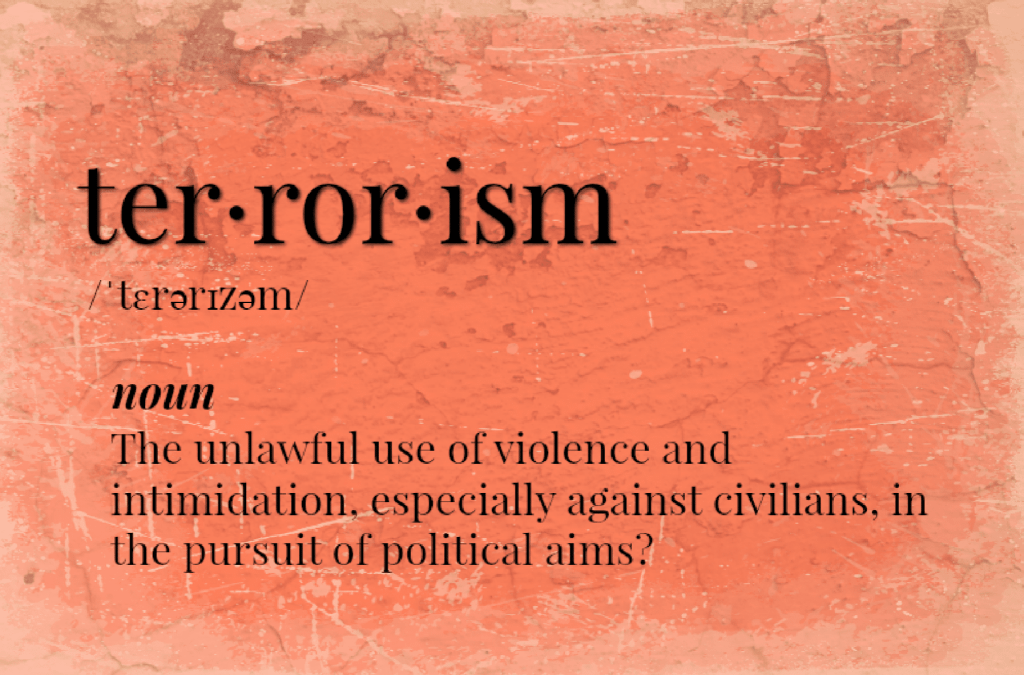
A short detour to examine the word ‘terrorism’ is required. All violence creates fear in the victim but is this terrorism? The term is defined as;

‘…the calculated use of violence, or threat of violence, against civilians or non-combatants to induce fear and coerce governments or societies to achieve political, religious, or ideological goals.’

This is a definition according to AI; so open that it also clearly defines ‘war’ in it’s modern form, with civilians victims rather than military targets. Therefore I believe that ‘terrorism’ is more than this definition. It omits to define who is using this violence against civilians? Is it a nation’s armed forces or a small group of political extremists such as the IRA or ETA in the twentieth century?

Today nation states are deploying their armed forces for extreme ideological goals outside of the international laws of War. By any definition, abandoning law is unlawful and therefore this is terrorism.

As we are examining words used in war, let us consider the difference between ‘killing’ and ‘murder’. You will often hear news reports that civilians have been ‘killed’ by missiles but is this more accurately ‘murder’?

The AI definition of murder is;

‘The unlawful premeditated killing of one human being by another.’

We are told that modern drones and missiles can hit targets with laser accuracy. And yet, photographs of Gaza today are almost identical to photographs of cities ‘carpet bombed’ in WW II.

So if a missile lands on a school or hospital killing civilians, is this a ‘mass murder’ or a ‘mass killing’ – verbally sanitised as ‘collateral damage’? There is clearly a legal question of whether the missile was intended to be launched and targetted so as to cause loss of innocent life.

A soldier killing an enemy soldier is lawful because each expect to fight each other to death but civilians have no such expectation.

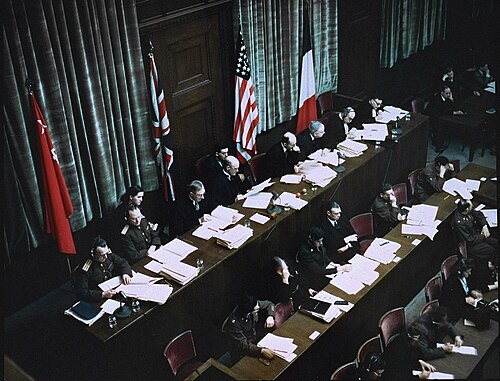
Today countries such as the USA and Israel will argue that they do not respect International Law and Courts of Justice as a sort of ‘get out’ clause. Time will be the judge of this but history suggests they will need good lawyers.

Nuremberg Trials after World War Two

Murdering innocent people should not be a subject for debate in countries that consider themselves ‘civilised’ but today leaders use words in such a way that they feel they can justify the most heinous crimes against humanity, by merely changing definitions. Trump has not declared war against Iran and his missiles and invading troops are a ‘military operation’. As there is ‘no war’ he argues that he does not need Congress to approve going to war on behalf of the people of the United States.

In my view, we all have a responsibility to understand not only what we are told but how we are being told it. Using language to alter truth exists in every language but our primary responsibility must surely be to not to manipulate language for

unholy ends.

You can quote me on this…when we do not stand up; we lie.

Peace Plan for Russia and Ukraine?

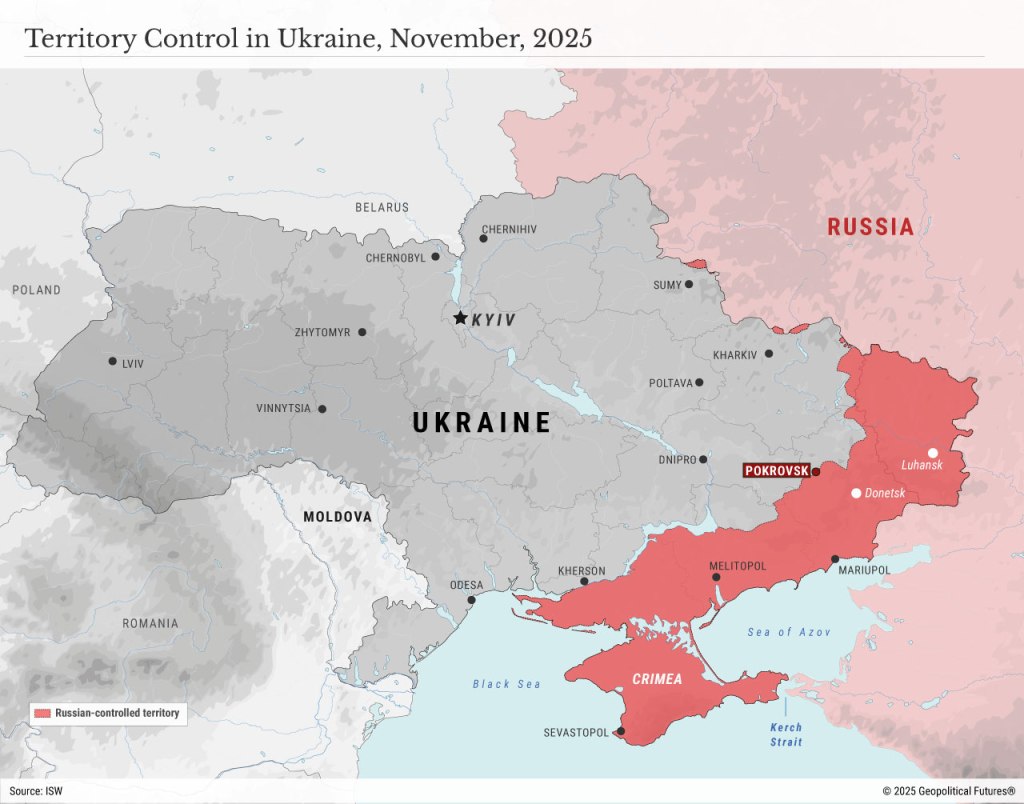
The following is a description of a process that I believe could bypass the current dead lock in peace negotiations. Today Ukraine is understandably against giving up territory for which it’s soldiers have died and, from their perspective, so is Russia.

picture credit: Geo Political Futures

On 11 May 2014 referendums took place under the Russian controlled Donetsk and Luhansk People’s Republics . They asked in essence, whether the population preferred to be Russian or Ukrainian. This initially appears fair towards the citizens as many of whom speak Russian. However, the results were clearly unrepresentative as by then large numbers of loyal Ukrainian’s had fled! The world was given a clear demonstration of how dictators use democracy when and how it suits them.

So, my suggestion is to take another look at this idea of asking the people of these regions the same question, but only after allowing displaced Ukrainian citizens to return safely to their homes and after peace has been declared and sustained. Such a process would have to be supervised by a neutral international organisation such as the United Nations.

This resettlement process should be given an extended period for the social, economic and political ‘dust to settle’; say five years. These parts of Ukraine would remain a demilitarised zone between Russia and Ukraine pending an agreed peace plan for the future. It is wise to acknowledge that Ukraine acts as a buffer zone between Russia and NATO. This has so far kept the two sides apart and long may it be so.

But presently neither Ukraine nor Russia can agree on the border and negotiations involving the United States are deadlocked. In such a case, consulting the people of those disputed regions must be the fairest way to decide.

I would hope that Russia and Ukraine could invite soldiers in a peacekeeping role from non-European and non-NATO countries. The fear of NATO boots so close to Russia is in fairness to Russia, understandable. The Cuban missile crisis in 1962 that threatened full scale global war, was produced by just such a move and to repeat it at least in principle, would be to court extending the war for no clear advantage.

Cuban Missile Crisis 1962 picture credit The Independent

When reaching any peace agreement, diplomats work so that all sides are able to ‘save face’ and some sort of compromise is usually involved.

It should be pointed out to Russia that ‘Special Military Operations’ are not able to gain territory because of their self defined limits of operations. In contrast it is ‘total war’ that annexes neighbouring sovereign states as demonstrated by the German Nazis in the second world war. Ironically, we are told that the original aims of Putin were to eliminate Nazi’s from Ukraine and this story has apparently been the reason why Russian citizens are supporting the invasion of Ukraine. The right wing Azov Regiment in Mariupol were rightly or wrongly set up as the objective for Putin’s SMO. But it is clear that the initial invasion of Ukraine by forces on it’s northern border ‘on exercise’, intended to go straight for Kiev, with the intention of taking over the government.

Fundamentally, the two leaders are entrenched, literally and metaphorically over the old or a new Ukraine border. Therefore, I suggest that both sides should forget resolving their border claims at the present time. Instead, the regions under dispute and their populations, should be placed under the protection of a neutral organisation. There will be a promise and expectation to the citizens who live in those areas that in five years time they will be able to vote in a referendum to decide which country has sovereignty in their region. Immigration of citizens from both countries will have to be based on legal ownership of land and property otherwise illegal settlements will spring up as in Palestine!

Since Russia has already shown it’s willingness to abide by referendums over sovereigty, I would hope that Ukraine agrees to the plan. The delay of five years will allow genuine refugees to return to their homes, local and global economies and social services to ‘normalise’ and some stability to return to the regions. It might take ten or twenty years but this can be decided in the intitial negotiations over the agreement. Ultimately people will be able to vote for the system of government they prefer.

A note of caution when advocating referendums. They can be used to advantage as Putin has already shown. He has a precedent as also Adolf Hitler favoured using rigged, manipulated referendums (plebiscites) to provide a facade of democratic legitimacy to his dictatorship.

On the other hand, U.K. Prime Minister Margaret Thatcher disliked referendums calling them “a device of dictators and demagogues”. But she did submit to a referendum to decide whether the United Kingdom should join the European Economic Community in 1975.

picture credit El Periodico UK Brexit

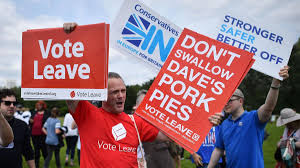
With this in mind, one should therefore treat referedums as carefully as unexploded ordance; the outcome can hurt! After a referendum result there might be left a substantial minority of disgruntled citizens for whom the outcome did not go their way. We saw this in the 2026 UK referendum over the question of whether to stay in the European Union. The result was narrowly in favour of leaving, a view that has reversed itself since. To avoid division and future instability, I suggest that a super majority is required of two thirds of the population before any result becomes law. The 50/50 referendum rule over Brexit was not open to public consultation. Brexit has illustrated however, that a large minority of disgruntled voters become considerably more political astute and active than a contended small majority and the same could occurr in the disputed Ukrainian territories.

To overcome perpetual border disputes, after a referendum has taken place, those uncomfortable with the outcome could be given the opportunity to move, together with generous compensation from Russia; what one might call ‘special military compensation’. Ukrainians could move to new Ukraine and Russian speaking Ukrainians who support the Putin regime could move to Russia.

The Problem Problem

The problem with problems is that their solution requires skilful analysis and creativity.

This is obvious except – who teaches problem solving? Overcoming difficulties is something we expect children to ‘pick up’, as learnt behaviour. By the time we reach adulthood, overcoming complex challenges is assumed to have been mastered. Yet, the problems that we encounter through life, if not solved properly, can have just a devastating effect on our lives as a metaphorical bomb. It is the same for those in charge of large corporations and governments who are known to rely on learning from failure as a somehow justifiable, problem solving technique. The joker advises, ‘try everything until something works’.

There is a story which you are likely to know, about a group of people in a dark room describing an elephant. Each holds and touches a different part of the elephant, which stands patiently; wondering where the light switch is. At the end of their examination each describes the unique part of the elephant that they have examined. None of the participants has an overview of what the whole elephant looks like, so they are all wrong.
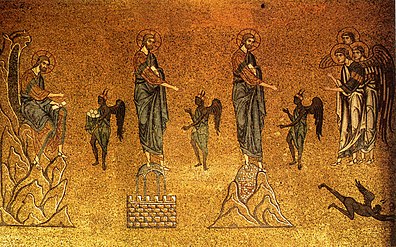
It’s a wise story. What it tells us is that everything is not as it appears. Many things are extremely complex and far larger than our expectations and experience and greater than our abilities to interact with them constructively.

As we go through a physical life on planet Earth, we are constantly challenged. The material world is in a constant state of entropy, causing repeated and unexpected disruption, such as your car breaking down or your body ageing.

Because we are human, our ego’s present us with a story about ourselves which says optimistically, ‘I can cope’ or pessimistically ‘I have to die sometime’. If we took a step back and looked at the problems humans suffer, our sense of ‘everything’s alright’ would be replaced humility without pessimism.

Religions have picked up on this and many require the congregation to fall to their knees in the face of that elephant that sits in our minds; vanity.

Yet, is it not courageous to look adversity in the face and smile? There is an archetype of this model which is ‘the hero’. He or She is a humble human who manages to overcome all sorts of impossible problems and captures the prize! Whether this is Odysseus on his epic voyage or Superman defending New Yorkers; heroes have super natural knowledge and powers.

Or do they?

In native communities, education of children consists of physically showing them the problems of bush-life and how to overcome them. An Australian First Nation child will be shown how to collect honey from trees without being attacked by bees and leaving enough for the colony to survive.

But in modern fast changing societies, complex problems are expected to be solved by those who have no prior instruction or experience. Government ministers frequently display an extraordinary naivety when it comes to their principal role, which is to allocate resources and make laws that solve society’s problems.

The examples are numerous. In the UK and many other nations, people are landing on beaches and demanding asylum; as is their right in most countries. The ‘sticks and carrots’ that have led them there are numerous and complex.

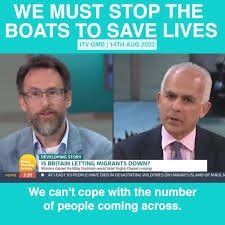
Attempts by nation states such as Spain, Greece, Italy and the United Kingdom to ‘stop the boats’, take hold of merely the elephants tail whilst imagining the little tassel on the end is the elephant. One government suggested that a threat of deportation to a third country will stop people reaching their shores in unsafe boats. Another political party takes hold of the metaphorical elephant’s leg and suggests that putting the organisers in jail will stop the problem; which again will not be ineffective because the elephant is not a leg.

In the Middle East, you have to ask what problem Israel’s government is currently trying to solve with open hostility against it’s neighbours. Problems of the people of the tribe Judea go back millennia, yet the Zionist government repeatedly tries to argue that the present problems started on 7 October 2024. Were it so simple to be true. Were the whole truth be known.

When the Sars-2 Covid virus was ‘mysteriously’ released in 2021/22, the problem was not examined in full, and when a solution was required, the pharmaceutical companies were able to react almost immediately. Inquiries into the response to the pandemic uncover ineffective, wildly expensive responses. Countries that did almost nothing like Sweden, and much of Africa came out the best.

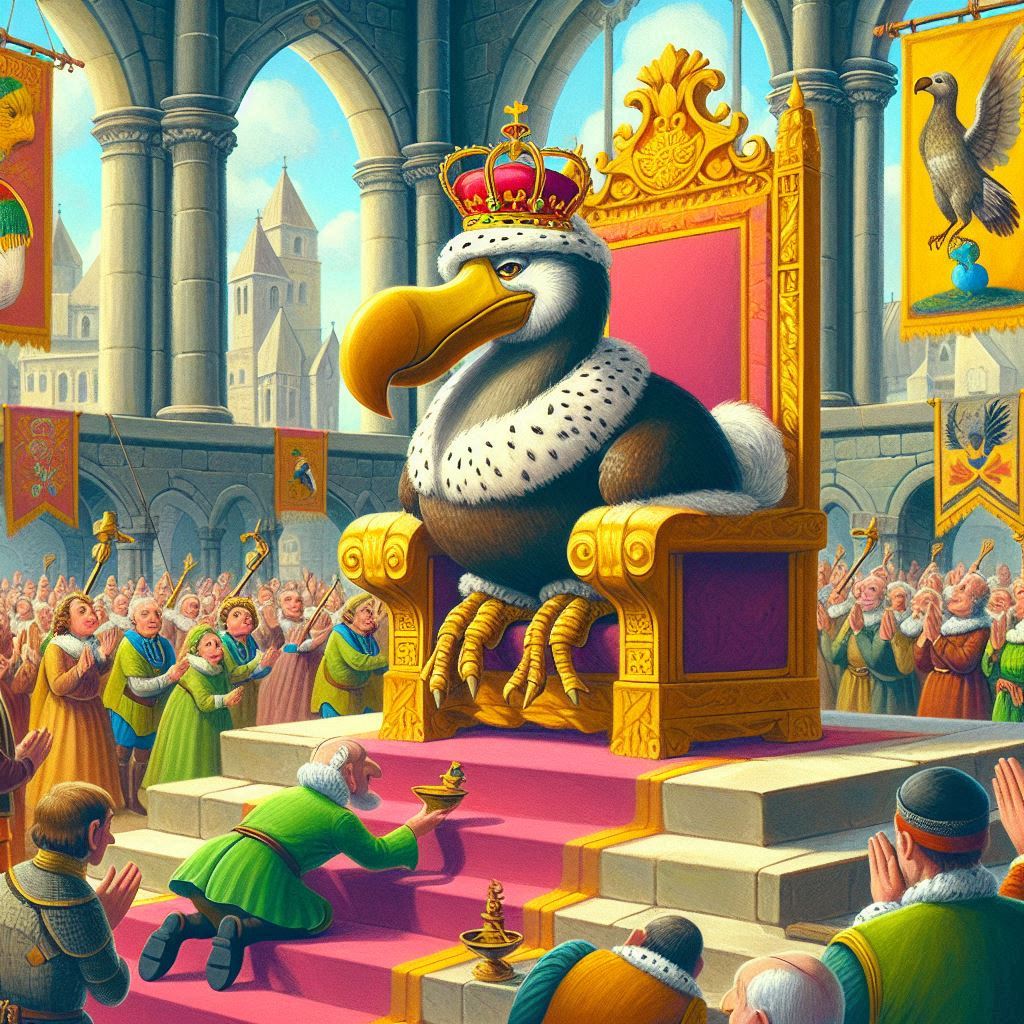
The ‘Do Do’ was a bird that flourished on the island of Mauritius until humans appeared in wooden sailing ships. The hapless birds wandered around in a dream, not expecting to be eaten by hungry sailors. The flightless birds had failed to solve their problem. The Portuguese word ‘do do’ means ‘stupid’ which the birds were not, but victims of those who should have understood sustainability.

Today, humans are facing similar population collapse or even extinction from multiple directions.

In my view, oligarchs and corporations, secret societies, media moguls, ‘big pharma’, the military industrial complex, and international criminal organisations exploit human weakness of poor problem solving by deliberately making problems. Interference in elections, rumour and propaganda, distortion of truth, psychological warfare, hacking, negative suggestion, assassination by ‘dirty tricks’, creating riot and unrest, reducing and disrupting food supplies, and many other techniques, are deployed against unwary populations. All whilst any government that genuinely cares for it’s citizens, is running to catch up.

Understanding the causes of problems is the first step to find a solution. The problem must be understood in every aspect of it’s nature and origin, in a unbiased and factual manner. Then a tested solution that is ‘cost benefit’ proven, has to be found and implemented in a timely manner.

When examining the many problems today, all over the world, you might expect a supposedly neutral and unbiased organisation such as the United Nations to have a department that is expert in defining and solving problems. The Secretariat, the Economic and Social Council and the General Assembly are ideally placed to work in this way, and yet world problems continue to cascade out of control. The United Nations has bravely spoken out early about the genocide in Palestine, but has not stopped it.

Stopping a descending spiral of harm, characteristic of weak problem solving, becomes a battle with a Giant, that even global organisations with their huge resources can not win.

Have we put the Do Do’s in charge?

White Hat Black Hat

In conversation with a friend of mine whose ethical values follow Buddhist philosophy, I was challenged with the idea of killing the mosquitoes in my bedroom at night with a pungent insecticide! ‘It is wrong to kill anything and I should be using a mosquito net to defend myself, not attack’.

To me, if I kill a mosquito, I am preventing it from attacking another person or animal with it’s uncomfortable sting and potential disease transmission, including malaria, dengue fever, Zika virus, chikungunya, yellow fever, West Nile virus, and Eastern Equine Encephalitis. The virus, bacteria or parasite with the disease varies with location in the world of course, however with climate change and species of mosquito: do you feel lucky?

The instruction to preserve life at all costs and in whatever guise, is of course, a dogma contained in many religions but not all. In Christianity the Holy Bible includes the Old Testament describing a blood bath of unholy wars. In the last two hundred years or so, ‘civilised’ humans interpreted Genesis 1,

( And God said, Let us make man in our image, after our likeness: and let them have dominion over the fish of the sea, and over the fowl of the air,)

– -as a licence to kill sentient creatures for sport, vanity and greed.

Even today, western ‘civilisations’ are in the same process of destroying the planet with great efficiency and little conscience. There is a possibility that the translators of the Old Testament should have used ‘steward’ of nature instead of ‘dominion’.

Historically, the planet was not seen as a benign mother in the nineteenth century, except by those who lived close to nature such as the North American First Nation People who were regarded as ‘savages’ by European invaders. Ironically, self styled ‘settlers’ regarded themselves as benign and entitled to lie, break treaties, enter sacred land and commit genocide through war and starvation – all whilst insisting they have moral superiority.

Does this remind you of anything happening today by countries who consider themselves beyond reproach for their actions?

In the ancient Hebrew Ten Commandments we find the instruction not to kill. This was probably meant to refer to human v human – but does it? Could this include insects and small mammals? Like all simplifications, it loses import through lack of detail.

Buddhist teachings could be interpreted that one should have no ‘intention’ to kill. If we kill a virus with our anti-bodies or an ant on the path where we walk without even knowing or controlling this, we are not at fault. To kill to prevent disease or disease spreading is not so plain. We venture then into the quandry of the lesser of two evils.

Because of contradiction and complexity or perhaps, despite of it, religious dogma encourages the following of rules ad absurdum. An example would be nuns of the Jaine religion who spend their days walking and sweeping the path in front of them lest they tread on an insect.

Whilst there is a continuum of intent between conscious and unconscious killing, we have to agree that conscious killing raises the ethical questions. Those who refuse to fight in a national army might agree to become stretcher bearers or another ‘non-combatant’ role. This even though their actions are supporting those who are fighting and killing. ‘Thou shalt not kill, directly or indirectly’ would have been a more relevant commandment to conscientious objectors in any war in my view.

Why would any country seek to start a war, and feel justified morally, is a very relevant question for today. A common cause and justification is the belief that a moral duty of ‘doing good’ is being fulfilled. The irony of this is when both or several parties in a war all use this excuse. Who wears the white hat?

The answer can generally be found through the actions rather than words such as ‘treaties’ and ‘ceasefires’. It used to be that soldiers would fight soldiers and civilian populations were only indirectly affected by war. But since the second World War, technology such as aerial bombardment from the air; drones, rockets and heavy artillery, civilians have become targets.

picture credit: Rocket Guest Hosting

Both or all sides will see themselves as the wearers of the ‘white hat’. Their next ethical choice is to decide the target. Should it be military or civilian? Although the choice is obvious to all but the most morally challenged, much of the warfare we see today is aimed at civilian populations. The offending side continue to lie and break treaties and ceasefires, enter sacred land and commit genocide as if they were actors in the nineteenth century ‘Wild West’ in which religious or any kind of law, did not exist.

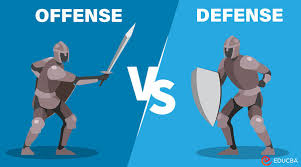
To do this they use words in order to confuse themselves and their followers. Military terms such as ‘offence’ and ‘defence’ sound as if their meanings are simple. But take an example from the Roman Army in ancient times. They carried large shields which are technically, purely defensive. But one of their fighting techniques was to use the shield to rush at the enemy and push them off balance, opening their guard and going for the kill. The short sword or gladius was used principally as a weapon of offence, and yet again, a sword fight includes using the sword in defence, as a shield.

picture credit: ECUCBA

Defence and offence therefore overlap and at times – become one. Politicians can over rule moral objections by calling this one something and the other something else. It is called ‘propaganda’. In this way offence using defence is called defence and defence using offence is called defence. Making use of this confusion in minds who do not question, they argue that since ‘defence’ is allowed in international law, every action is a ‘defence’ even when attacking unarmed women and children.

Leaders today deny or are complicit in targeting civilians, just as the Soviet Union did under the absolute dictator, Joseph Stalin in the Second World War.

After that war, Winston Churchill, the Franklin D. Roosevelt wanted to replace Stalin’s ‘white hat’ (Russia had been an important ally) with a black one under ‘Operation Unthinkable’. They wanted to return Poland to the Polish people as that issue had started the war but Stalin refused and the country became part of the Soviet Union.

History has the ability to make sense of current events as world politics has usually been played out before and the consequences of actions do not have to be learnt through experience. The main variable is of course, new technology. But fundamentally, ethical values should not change and there is not reason why an aversion to violence should not be universal. This has been attempted through the United Nations and International Law but these voices are weak today.

‘War crimes’ being allegedly committed are investigated by those committing the crimes. Permanent members of the UN Security Council are allowed vetoe criticism of their actions on the grounds that they are ‘defending’ someone or something. Detail is avoided.

International Laws are dismissed by countries that have not signed the convention. So external rules, which should embody the highest ethical values, are ineffective.

Where civil laws and natural law fail to be applied, religious and spiritual rules, potentially have a greater influence by bringing about change within each individual. The rule supporting non-violence is the well known, ‘do unto others as you would have them do unto you.’ It’s an uncomplicated way to behave but, with this injunction as guidance and followed, the world today would be a very different place.

Beyond Good and Evil

Genesis gives us the key to opening the door to everything. All we have to accept is that stories in Holy books almost certainly operate at many different levels beyond what is taught to children in Sunday School.

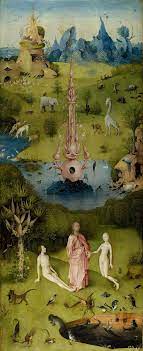
In the story of the original humans in the Garden of Eden, God ‘opens the eyes’ of Adam and Eve as punishment for Eve eating the forbidden fruit of the Tree of Knowledge. For in doing so their eyes are opened to the concept of ‘good and evil’, but we should not be side tracked by wondering what good and evil are. What is being revealed here, in my view, is that the Unity Consciousness of the blissful Garden, split into binary consciousness. If the reader overlooks the reference to newly realised binary opposites, then the message is repeated for reinforcement.

When Adam and Eve see each other naked, for the first time, their consciousness moves from being one, to two. This ‘same but different’ paradox between men and women is the same for all binary thoughts and words. Carl Jung suggested that the minds of men and women differ as metaphorically expressed by the nuanced differnces of their bodies.

The message in Genesis, is not about ‘good’ or ‘evil’ or ‘man’ or ‘woman’; it’s about binary thought; a fataly flawed characteristic.

But thinking in opposites creates an illusion of understanding. This is whispering serpent’…the one that slides down the ladders of thought.

In physics, nothing is black and white; there is just light and an absence of light and everything in between. But using opposites as a sort of ‘algebra’ for thought has enabled modern scientists to deconstruct nature and use it’s methods to make technology.

Batteries consist of negative and positive poles. The brain consists of left and right hemispheres. Breath goes in and out. Humans are born and die. Chromosomes are X and Y.

This is how have un-zipped the polarities that keeps atoms spinning, but there is a catch!

Our thoughts attach to the oversimplified opposites. Left and Right political views are a prime example of extremist views plunging the world into chaos. Edward de Bono introduced the non-binary word Po in his book Beyond Yes and No to express infinite possibility and a practical key to freedom of thought.

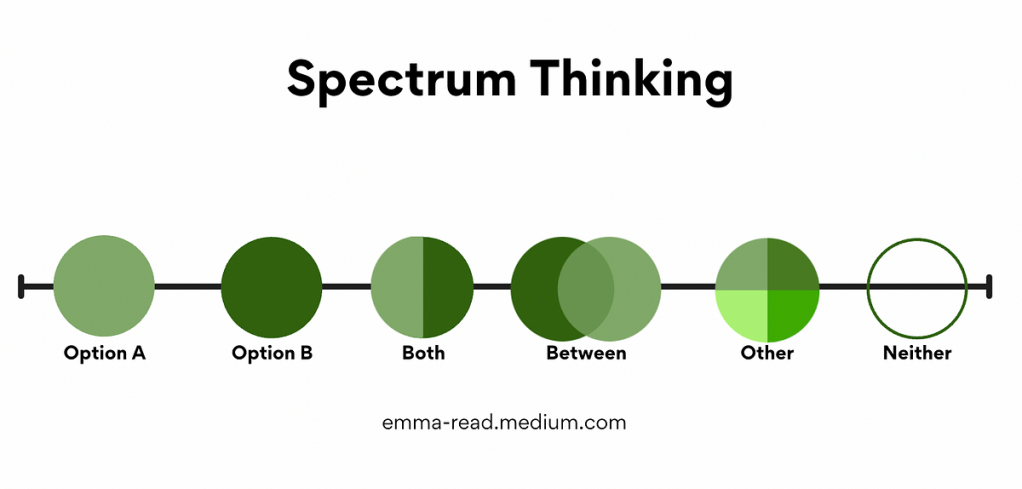
Opposite ideas should only ever be a mere framework for rational thought, otherwise the space in between disturbs ‘certainty’, leading to confusion and conflict. Consider a recent example;

In the United Kingdom, the Supreme Court has just ruled that a woman is a person who was born a ‘biological woman’. In other words, a ‘biological man’ cannot become a woman. This rule provides clarity for the lawyers; but is it true?

I would argue that the model does not fit neatly over reality. When it comes to the provision of public toilets, there will need to be a ‘third space’ for those with particular needs, for instance, those who feel different to their biological gender.

Is not an impossible problem for many ‘third spaces’ already exist as a ‘disabled toilet’. All that is needed now is a gender neutral sign on the door. Something that is not ‘men’ or ‘women’.

We see here that humans are not as simple as the rule of two ‘opposite’ biological genders. Consider the complexity of the body. We have a brain with left and right hemispheres. Each half has a nuanced contrast of functions; rational and creative respectively. Psychologically, each woman has an unconscious animus and each man has an unconscious anima. One in ten of us are left handed; the rest right. In some cultures, left is ‘evil’ and right ‘good’. There have been libraries written on the complexities of gender differences.

But we also experience a range of emotions, almost involuntarily, which can be categorised as ‘expansive’ or ‘passive’ in nature. Anger and valour are expansive and ‘male’, sadness and tenderness are ‘female’ emotions, for example. Of course, men and women have the whole range of emotions in varying degrees beneath the fig leaf.

Finally, the subtlest human characteristic that guides mind, heart and body is ‘intuition’. Albeit a peaceful, almost silent, internal voice, it has a function to guide us when we are lost. Another name for intuition is Soul, and yes, souls can be ‘good’ and ‘evil’ as illustrated in the Old Testament. There is a Bible story in which Joseph experienced wise, prophetic dreams. His soul’s ability to describe the future intuitively through the pathway of dreams is symbolised by his ‘coat of many colours’. Dream messages are not black and white, but as subtle as a colour from the subtle spectrum of light.

This level of subtlety is desperately needed today, in my view, if humankind is ever going to recreate the Garden of Eden on earth through deep compassion and understanding. If we do not, a Wasteland awaits.

Who is the third who walks always beside you? When I count there are only you and I together, but when I look ahead up the white road, there is always another one walking beside you, Gliding wrapped in a brown mantle, hooded. I do not know whether a man or a woman – but who is that on the other side of you?

What the Thunder Said (from line 359) from The Wasteland by T.S. Eliot

An Annual Review

Am I Right?

At the end of several years of Matters Blog, it’s time for a review. As complex as life is, my aim is to express opinions based on common sense rather than personal or political bias. Not only that, but to suggest original and innovative solutions many of which have not been taken from the public domain.

The famous Dunning Kruger Effect states that amateur pundits have a false self image of themselves as knowing it all, while experts constantly doubt. So how did I do?

In 06 August 2018 I identified the shortage of affordable housing in the United Kingdom as a problem and offered a solution. My suggestion was that houseboats are moored on the UK’s inland waterways, rivers and lakes. They avoid the purchase of land and as temporary structures can be removed or replaced as needed. They can be built more quickly than a house and provided in enough numbers would create a stop gap whilst houses are built. The housing crisis had not been addressed by the previous government and the new government is intent on more building houses even though there are not the tradesmen to do it.

In 31 July 2021 the blog ‘HS2 Where?’ listed twenty reasons, including cost, on why the proposed high speed train route between London and Northern cities in England was doomed to failure. In 2024 the Conservative government reduced it’s reach to just Birmingham on the grounds of cost.

In 09 February 2019 I wrote a questionnaire for people who voted for Brexit. Apparently they were insulted at the suggestion they did not understand the consequences of Brexit. The questionnaire was intended to highlight the multi level complexity of the process and predictable effects of the UK leaving the European Union. When Brexiteers are asked today what the benefits of Brexit have been, few list any precise benefit. They say they no longer have to obey EU law and have gained ‘Sovereignty’. Ask how this has affected their lives and they will struggle to give an example.

In my blogs ‘Let Me In’ parts one and two in June 2022 and ‘Head for the Hills’ in December 2022, I examined immigration into the UK via unsuitable boats. The last Tory government made this problem a priority but chose a non-viable solution in an expensive plan to send unsuccessful asylum seekers to Rwanda. The slogan of intention missed out the detail of ‘how to stop the boats’ while their policy probably did the opposite. My suggestions included allowing asylum applications to be made from anywhere in the world to anywhere in the world. That hasn’t happened but the new Labour government have pledged to close down the people trafficking gangs which I also had suggested was long overdue.

In 22 October 2023, I published a blog I had written a week earlier following the attack on Israeli defence forces and civilians by Hammas titled Shalom, Salaam, Peace. I suggested that Hammas, as the vastly inferior force to the IDF, had no means to destroy Israel and were instead baiting Israel to over react to attack. Any ‘destruction of Israel’ would be done by the other Arab nations in defence of the people of Gaza, such as Iran. Since then the Iran backed Houthis in Yemen have taken up this role and significant others. I suggested an Arab leader would appear to take on Israel which has not yet happened.

In 20 February 2023 I wrote a parable called The Holy Forest about the politics of the Holy Land and how Israel will one day realise why people resent and hate the actions of successive Israeli Zionist Governments. I further commented on a better solution to bombing in Gaza as being the use of a multinational force of Special Forces to clear Hammas out of Gaza in my blog War Without End in October 24. To date the tactics of the Israeli Zionist government have not changed or met their stated aims of saving the hostages and destroying Hammas. I called out the genocide of the Palestinian early on in the process and qouted the Israeli post WW2 mantra of ‘Never Again’.

These and other blogs allowed me as an observer to suggest descriptions of complexity and apply problem solving techniques without using the techniques of over simplification, project fear and the illusionist’s destraction.

So thank you to those who click the ‘like’ button and may 2025 give us all hope my observations will become shorter and shorter as those in charge of us work smarter and harder for the benefit of those they serve.

The Road to Hell

Dualistic thinkers (thinking using opposite terms such as black and white) have a problem with the idea of good and evil. Most spend their lives seeking goodness and avoiding evil. It’s a well intended strategy and one promoted extensively by Christians. Jesus the Christ spent forty days and nights resisting temptation by the ‘prince of the world’…the Devil.

The problem is, life is not so simple as good and bad…would that it were! Would that Western thinkers looked over the shoulders of Eastern philosophers who believe that there is no such thing as pure goodness, nor pure evil. (The corollary is that there is no Heaven and no Hell which is also true but perhaps the subject for another essay.)

In the Yin Yang symbol, which is central to Eastern philosophy, good contains a little touch of evil and evil a nudge of good. Sometimes goodness may just be a thin shell containing a large quantity of evil and visa versa. An example might be the Atomic bomb dropped on Hiroshima in the second World War. The world would be a better place if that technology had never existed. What you see, is not always what you get.

The past can provide valuable lessons but here I shall use some examples of ‘dualistic thought’ from current Western political debate; there is a tempting assortment to choose from!

The first woe is, ‘Generalisation’. Politicians are by definition, strategists; taking a broad view and delegating attention to detail to minions. They are therefore prone to declare noble ‘aims’ to please voters, such as to ‘reduce inflation, help the vulnerable, create jobs, improve public services’ etc. etc.

What is not presented for examination is how this aim is going to be achieved.

As an example of using the wrong ‘means’, the previous government in the United Kingdom made an election commitment to ‘stop the boats’. This referred to undocumented migrants crossing the English Channel in dangerously unsuitable boats. This aim was presented as ‘good’ because there had been boats sinking and people tragically drowning. The government’s intention was ‘good’; to save life. If the means to stop the boats was challenged, the questioner was accused of wanting people to drown; they were supporting evil over good. The argument was totally dualistic and as a result over simplistic.

Pretending to be a benign policy without hiding the real reason

The absurdity is that any problem solving plan can be justified as ‘moral’ and ‘benign’ whether it was likely to work or not. It just needs a ‘good’ intention or aim and expects never to be challenged on any other grounds.

The detailed plan to ‘stop the boats’ intended to send failed UK asylum seekers to Rwanda. The plan included breaking international law and expense that did not match the benefit. Worse still it was based on an untested assumption that those willing to risk death by drowning would be put off by a comfortable flight across Africa to free food, health care and accommodation in sunny Rwanda. Asylum seekers from Rwanda would probably not be so pleased as it’s not a safe country by most definitions (but that was a level of complexity too deep to examine). The final cost of this plan was the same as putting up each asylum seeker in the Ritz Hotel in London; an option the Ritz would probably have declined.

My point is that however absurd the detailed plan, the government would repeat it’s justification by asking, ‘do you want people to continue to drown in the English Channel?’ as if that were the only option to achieve their well intentioned aim. Of course it was not the only option but presented as such. In the end the plan was abandoned and hundred of millions of pounds metaphorically thrown into the English Channel at a time when the lack of money in the countrie’s coffers was also a problem.

The new Labour government are now desperately trying to balance the books by not giving pensioners an allowance to heat their homes over the coming winter which they agree is regrettable and may cause death ( i.e. an evil ) but is justified by a need to balance the country’s books (i.e. a goodness )

When politicians are not generalising they present details to prove or disprove a generalisation. A prime example appeared in the news this week during the televised debate between candidates for the forthcoming presidential elections in the U.S. of A.

In this debate between Donald Trump and Kamala Harris, Trump purported that migrants were eating the pets of American citizens in Springfield, Ohio. The response of Harris was the only rational one, which was to giggle. Apparently, this story was currently feeding the confirmation bias of social media zealots, which included a person who considers himself fit to rule the world. Fact checkers and local officials confirmed that the story was not true. But this does not stop those repeating it, who wish it was true.

The problem for those caught up in such an argument is that there may have been just one instance of starving migrants cooking up a street animals on a cold and windy night to feed their children. In the world of political debate not using numbers or arguing over whether numbers are true or not, allows generalisations to pass critical examination because even if there is only one instance, the general statement becomes true, even if totally misleading. It’s a gift to politicians.

picture credit: Peakpx

At the beginning of this essay I referred to eastern philosophy as tending to take a holistic view of events, rather than focus on a particular set of facts. In Surah Al-Khaf in the Holy Quran, Moses meets a figure not named but described as a righteous servant of God possessing great wisdom. Moses watches him damage a humble fisherman’s boat and protests despite being sworn not to question any thing he witnesses. In time, an army passes in need of such boats and ignores the damaged one. The fisherman is able to repair the damage and keeps his boat and his livelihood. There follows other stories where actions are ‘evil’ at first sight, but as circumstances develope, are shown to have been benign.

In conclusion, our world at the present time is full of major choices about which we hear politicians of all persuasions expounding strong views. As humble citizens we have little say in these matters and have to trust those promoting ‘good’ and denouncing the ‘bad’.

Decisions are for reasons suggested above, and in my view, never such a clear cut choice. We assume we make choices based on hard facts, reasonableness and clear routes to known consequences. I contest this assumption and suggest we take a more pragmatic view, summed up in the simple word ‘maybe’.

The Party is Over

The Last Supper?

A dictionary definition of the ‘standard of living’ is ‘the degree of wealth and material comfort available to a person or community’. It is not clear from this short description what is included in the concept other than a level of ‘comfort’. We might think that globally people have adequate essentials of life; food, shelter, water, health…but we know wealth is not evenly distributed.

It follows that not everyone on planet Earth will enjoy the same degree of ‘comfort’. There is an extended range from ‘in dire need of comfort’ to ‘having comfort in excess’.

When watching news reports of natural events that have devastated communities in countries with a low standard of, one feels for the victims. But looked at another way, these communities as used to living with little more than the basics. Their frail houses can be rebuilt. If they are lucky, aid tides them over until crops can be harvested again. What I mean is that this is not total devastation. Such people are survivors because they live simply. Inuit hunters, when given quartz watches, threw them away. When asked why, they replied that they were unable to repair them. It’s a wise principle. Round the world sailors know their boats intimately for the same reason.

In contrast, the ‘city dwellers’ of the world are not survivors. If farm land turns into a desert, as happened in the ‘dust bowl’ in 1930’s United States of America, mass hunger and even death within ‘sophisticated’ populations will result. They are, in the words of the Beatles song, “Urban Spacemen”.

picture credit: science.smith.edu

Most people are aware of the global threats to the citizens of planet Earth in the twenty-first century. We have had a ‘pandemic’ and more may follow, we observe the alarming effects of climate change and it’s consequences such as food shortages and habitat destruction, we have localised wars erupting in different parts of the world and mass migration because of all of these things and others.

When Elon Musk talks of moving to other planets, he must be inferring that there is a strategy to sustain the homo sapien sapiens after global catastrophe. Good luck getting a ticket to ride.

We know that humans have survived global catastrophe before. There are meant to have been at least six global disasters wiping out most of life, but not all. The underground cities found in places like northern Turkey are evidence of how a small number of humans survived.

Kaymakli Underground City Turkey

This time though, high tech city dwellers who casually dial up for food on their phones, are not likely to make underground cities. With half of the world’s population living in cities, the question we should be asking ourselves is, ‘how can we prevent disaster?’

We can all make a difference by taking personal responsibility for the likely causes of a catastrophe. One individual can change the world, however rarely you hear this affirmation. There is a story of a child throwing a stranded star fish back into the sea. When questioned what difference the action made the child answered that it made a difference to the starfish.

Every holiday, every sending of goods and foodstuffs around the world, every activity that involves burning carbon based fuels is, however slightly, connected to the tornado or mudslide or nuclear waste release. Governments appear powerless to prevent destructive human behaviour whilst natural disasters will happen with little encouragement.

Have we believed the ‘cornflake family’ myth that television presented as a social aspiration in the 1960’s? The clichéd happy family. Whilst the USA was busy consuming 25% of the world’s resources, the rest of the world was struggling to mimic the same mistake of non sustainable lifestyles.

picture credit: Resilience.org

A Swedish statistician, the late Hans Roslin described a process of increasing global wealth very lucidly in a TED lecture titled ‘Global Population Growth’ using IKEA boxes. He suggested a general rise in the standard of living even if that was merely a transition from flip flops to a bicycle and from bicycles to holidays abroad. Improved birth control and higher wages lead to smaller families, which stalls the global population rise at 9 or 10 billion, and it may then fall.

The argument is interesting but worryingly fails to take into account the ‘threat’ aspect in a ‘strength, weakness, opportunity, threat’ analysis. What is the point of building a brick house for you family is the sea level rises and floods the land? The threats to an improved global standard of living are so complex in quantity and quality that they can only be left to self adjust in a radical manner…meaning disaster.

China and India and other countries are set on ‘industrialisation’ at any cost and critics in the West are not in a strong moral position to criticise. Something has been attempted to build a cockpit in this out of control vehicle, namely the annual COP talks.

If governments bring about the promises they make at the ‘Conference of the Parties’ (COP) talks – to create a viable future for earth’s future inhabitants – so much the better, but this is by no means certain. The levers and pulleys needed for change on a global scale should have been pulled decades ago and, sadly, were not.

What you will not hear from COP is the conclusion that the economic concept of ever increasing ‘standards of living’ was always a myth because it was unsustainable on a global scale. No single planet can support infinite demand using a finite resources. The COP party conferences are, in my view, overseeing the end of the last supper of consumerism and comfort.

‘Forgive them, for they know not what they do.’