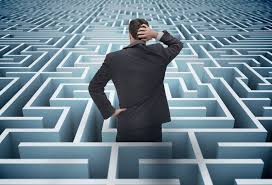
This may sound like digging a spade with a spade or mixing clouds – confusing.
But thinking is a tool and like all tools it needs to be made of high quality materials and regularly maintained.
Thinking was not taught in schools and places of further education. Perhaps it is on the National Curriculum now? If it is not and I was a parent I would want to know why. Because thinking is perhaps the most important of all acquired and learnt skills. Not only because it governs our whole perception of events and things we call – reality – but because it has the tendency to pretend it is not there.
Like a fish swimming in the sea, if you asked it where the sea was, it would not know.
The nearest we get to any sort of scientific reality is through ‘rational’ thought. To be rational is to use logic as a device in which information is chosen to be from a credible source, tested in every manner possible and judged to be useful or not.
Here are some of the ways of thinking that are problematic;
Filtering: when information is presented the thinker chooses either consciously or unconsciously the facts which fit the thinkers prior beliefs.
For example: a person develops a hatred towards a religion and it’s followers. Events around the world which reflect badly on those who may or may not represent that religion, are used as examples justifying extreme behaviour.
Polarisation: Dualistic thought considers only the two extremes of something that in reality has a million levels of degree. An action can be judged as bad when in fact it has some good effects. To judge how far along the see-saw between good and bad is complex and sometimes impossible.
For example: Criminals are sent to jail for an act that is perceived as ‘bad’. If Adolph Hitler had been murdered to stop the war early, was that a ‘bad’ act?
Over-generalisation: The thinker arrives at a conclusion based on sparse or selected facts. The saying ‘one swallow does not make a summer’ describes this. Sometimes political correctness will leap on one very minor aspect of a statement or action and generalise this into something much greater than it is.
For example a group of young girls wearing unsuitable clothing and footwear attempt to climb a mountain; get lost and have to be rescued suffering from hypothermia. Afterwards the politically correct Authorities revue whether to close access to the mountain for reasons of safety.
Mind Reading: Without their saying so, the thinker assumes to know what people are feeling and why they do what they do. This may be particularly directed towards how others feel about you.
For example someone you think of as a friend ignores you when you pass them in the street. You feel offended and decide to cut them out of your friendship circle. In reality they are short sighted (which you did not know about) and on this particular day they were not wearing their contact lenses and therefore did not recognise you.
Catastrophising: The thinker suffers from emotional fears which tell them to ‘expect the worse’. These type of emotional demons can be learnt in an unbalanced way from watching or reading tragic news reported from anywhere in the world. These events are not representative of the thinkers personal risks but never the less influence their decisions.
For example: A plane crashes in on the other side of the world the day before someone frightened of flying is due to fly. They cancel their ticket and take the train. The fact that air travel is the safest method of travel per mile, is ignored.
Personalisation: Another individual, often in authority, makes a decision that affects the thinker in a way that displeases them. The thinker does not refute the actions / decisions of the authority figure with reasoned debate. Instead the thinker personalises matters. In this way they move the debate from a subject they are less likely to win to won that may allow the thinker to ‘triumph’.
For example: A politician decides to allow the building of a nuclear power station contrary to the wishes of the local people. At a public meeting they pillory the politician over his or her personal conduct and private life.
Control Fallacies: You are Under Control
The thinker may feel that they are in a situation over which they have no control. This can lead them to feeling stressed and unable to escape.
For example; A person believes that the authorities are monitoring their behaviour using technology for sinister reasons. This is fictionalised as ‘Big Brother’.
Control Fallacies: You are In Control
The thinker feels that they are responsible for the pain, happiness or other feelings of those around.
For example the hostess of a dinner party is distraught when two of the guests have an argument in the garden.
To be continued…
 Matters Blog