Renaissance of the Renaissance

Where is the wisdom we have lost in knowledge?

Where is the knowledge we have lost in information?                          

Choruses from the Rock by T.S. Eliot

Futures have many directions. They spread into an infinity of possibilities every second of the day. This is true for the micro management of everyday things to the macro management of the planet and the cosmos.

One future is with us now and like all futures – it has been here before. What I am talking about is the tendency for people, science, art, industry, politics to start working together.

This may sound like the norm but in a culture of competition, copyright, industrial secrets, political manoeuvres, artistic repression and exploitation – believe me, working together has not been normal.

Art and science as pure and applied subjects have always led a culture into new possibilities. This was true particularly in Ancient Egypt where the great library in Alexander brought together learning and expression from all over the world. The Buddhist teachers were there and many influential thinkers and scholars of the second and third centuries B.C. It was by all accounts a Universal library a sort of Wikipedia of it’s day.

Lighthouse_-_Thiersch

When a large spectrum of subjects are considered by a single or a collective mind some thing extraordinary happens. The subjects are discovered to have areas in common. For example an astronomer would have a lot to share with a sea captain who navigated by the stars. A surgeon might have plenty to share with an artist trying to understand the human body.

Because the ethos of the library was to discover what beliefs and understanding was held in common and the connections investigated. Information and knowledge are the paths resulting from the investigation of the spaces between what is already known.

It was fitting that Pharos Lighthouse of Alexandria built between 284 and 286 BC spread light ‘across the world’. The metaphor of enlightenment is apt when considering the sharing of knowledge. It is the discovery of electromagnetic radio waves and their ability to carry information – that heralded the global sharing of information today, via the internet.
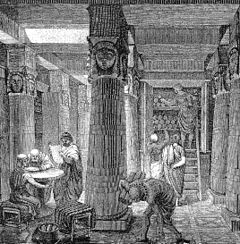
Ancientlibraryalex

With the spread of libraries across the eastern end of the Mediterranean the Alexandrian library fell into disuse and suffered destruction by armies and Christian zealots.

Many of the scholars, artists, sages and seers who frequented the library moved or fled. Using text books and records, often made by Arab scholars, some information and knowledge survived.

One of the nexus’s of the world to which the knowledge travelled, was Venice. It was the terminus of the Silk Road and linked the East with the Middle East and Western Europe.

The Ancient Greek texts on philosophy, astronomy, geometry, mathematics and their interpretation and substantiation by Arab scholars were like gold dust. Most contemporary lines of thought were abandoned in favour of this newly discovered old knowledge – like the Helio centric solar system. Much of it was ‘heretical’ to the church but eventually, the church had to hold it’s tongue. For the burst of colours from the fountain of knowledge were like the precious silks adorning the harlots and aristocratic women of the Venice. Artist and Scientist grew in renown and fame, patronised by wealthy families such as the Medici s. The flower that was opening was to be known as the Renaissance.

Today, despite or perhaps resulting from previous ignorance and prejudice, there is happening a similar flowering – inspired by Universal information and knowledge carried on the electromagnetic sea of the internet.

At the same time over the last few decades, academic institutions ( where the internet was first conceived and initiated ) – these institutions have started to share what they know with each other. This spark is vital to transform information into knowledge, ideas into creations.

For example, archaeologists studying Neanderthal humans are sitting around the metaphoric camp fire of storytelling, with forensic pathologists, palaeontologists, weapons experts, linguists and artists amongst many others – to visualise exactly how they lived.

Gone and the archaeologists who specialise in Western Mediterranean arrow heads for their entire academic careers. Such ‘silo’ thinking inhibits understanding. The arrow head was just a small part of the whole story of how Neanderthal humans lived and gives information but not knowledge.

This is just one example of the interconnections between artists and scientist that is now found in today’s Universities and places of study.

And most telling of all is the recreation of the ‘Renaissance Man’. These are artists or scientists who are also scientists and artists. For just as the first Renaissance created it’s Leonardo de Vinci’s, so we need and have today, our own ‘masters of all knowledge’.

This means considerably more than the previous scientists who wore a trade mark bow tie and long hair. Or  those artists who adopt a mannerism of the scientific method (sharks in tanks) in their conceptualisations.

What it will bring is the fruit from the flower – the seed that will give life to a new plant and perhaps the next Renaissance after the present one.

This fruit is what is known as ‘wisdom’. It is the essence of knowledge, just as knowledge is the essence of information and information the essence of data. There is a fractal that grows and shrinks, but always follows the same pattern.

In this seed the whole future of our civilisation has it’s potential to grow exponentially. We see it on the media everyday – new discoveries, new inventions, new ideas. Let us hope that these seeds will temper our desire for material prosperity, just as the Silk Road became a line of empty caravanserai’s.
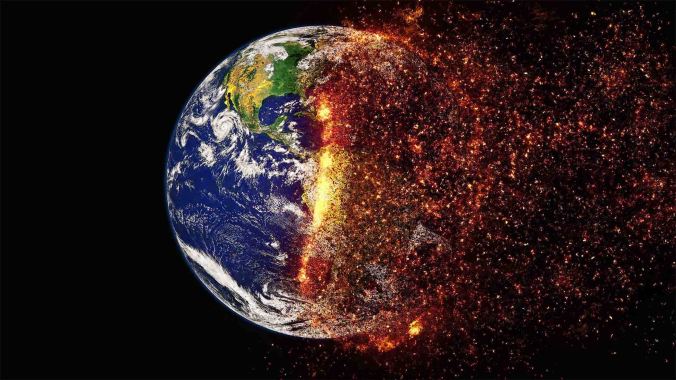
Stable Weather Initiative and Study SWIS

earth12-copy

I have found a rare thing; a blank piece of paper. Since it is no longer produced, on account of the death of trees, writing surfaces are reserved for significant statements. Here is mine.

Even in the twentieth century the authorities knew that the earth’s weather systems were becoming erratic to unstable. I studied climate science in the University of Boston at the end of that century and applied what I had learnt to analysis and interpretation. The United States of America (as it was then known – before global disintegration ) used information gathered from sources hidden deep in the oceans to the outer limits of the atmosphere. This was my ‘bread and butter’ as the saying goes before bread was a luxury of the past.

My best analogy to what ultimately occurred, reducing the earth’s population to the estimated 10,000 currently, is that climate is like an avalanche. There is an imperceptible slow build up of stress within a system over a period of time. It cannot be measured but the signs that it is likely are well known. When the cataclysm occurs and tons of snow and ice hurtles down a mountain taking everything in it’s path – then the survivors look back knowing that what happened was expected.

climate-change-figure-1-1

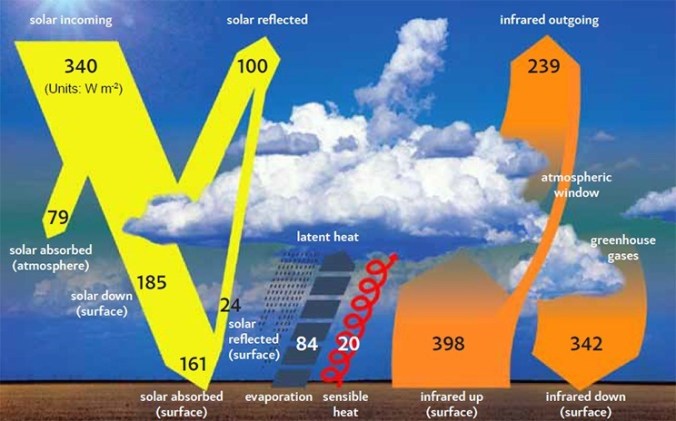
The earth’s climates behaved in precisely the same way. When newspapers talked of ‘climate change’ at the beginning of this century, it was a simplification of the facts. The earth has multiple climates and micro-climates which interface with the local events known as ‘weather’. Even the super computers of the day, ( which we used to carry on our wrists before this happened ) even these computers could not track climate interrelationships, growth and transition with sufficient detail and fluidity. The dynamics of this flux was to be the deciding factor in our government’s miscalculation.

Perhaps the politicians listened more to voters than to those paid to research the subject. No, for sure they did! The popular imagination saw ‘climate change’ as reversible. Stop doing this and you get back to normal. But as with an avalanche in the making, or a glacial crack – the damage was already done.

The radiation from the sun – so called ‘space weather’ – was a particular interest of mine and I admit I should have been the first to issue warnings to the administration. Solar mass ejections were known and monitored but their exact influence on the earth’s atmosphere was guess work at best. When the first of the ten cataclysmic ejections came, we lost not only our ability to monitor but some of our best scientists – along with a portion of the global population. Computers were down, transport stopped, power supplies – in fact anything that needed electricity to function was kerput.

We had weeks of electrical storms. The HARPA grid was one of the earliest to go…one of the few ‘climate influencers’ that was operating at that time. But no amount of intervention on the scale needed was possible. Storms created floods, and floods washed away mountains and cities, quite literally. Tectonic plates moved and water came up from inside the earth to raise sea levels in addition to the melting glaciers and snow fields.

We kind of knew this would happen, but we also knew not to talk too much about it because it was well, just too frightening. Just as skiers will happily spend a day on a mountain after rain the previous night and knowing avalanches could occur.

I was in the Stable Weather Initiative and Study, but it was a bucket put out to catch an ocean. Perhaps the things we did made things worse?

I am coming to the end of both sides of this paper now. So I have to record that the days are still dark. From my view out of the cave on our island there are sometimes views of the sun above. We are hoping for light to re-enter our world before we have grown too weak. If I had any advice for the people of the past and the ‘good times’ they enjoyed, it is to carry on carrying on. For weather, climates and space weather proved just too multi-complex for us to know about. We didn’t evolve in the direction of ‘earth management’ fast enough to counter the forces heading to destroy us. We were a parasite destroying the host but ultimately the host is destroying us.

We are clinging on here living each day on found food and storytelling. Record these days in your books if you find this message. We were the generation ‘damned for all time’ because we allocated our resources to the easy life we had built for ourselves, rather than the planet.

Quick Quick Slow Slow

The British Raj in India was a colossal enterprise, whatever your views on its moral worth. It was set up in 1858 and ended in 1947, lasting almost one hundred years. The creation of the instruments of power and their administration were not simple. They were accompanied over time by the development of education, public health, railways, missions, industry, irrigation and other essential aspects of the colonisation.

The point of interest is the time which this took to establish. To say that it took almost one hundred years would not be an exaggeration. In effect, at the time of the rebellion and the handing back of rule, the process has continued as self rule took control, and continues to do so.

Vast undertakings take vast amounts of time at huge environmental, economic and social costs. The concept of colonisation was not new and had been exercised in many parts of Africa by the British before – so they knew the complexity involved.

Complexity always adds time to tasks whether political or such things as domestic repairs. At a certain point in home DIY for instance, you realise that you don’t know what you are doing or don’t have the skills and ring a professional trades person. The reason is that one person cannot know everything.

So when faced with the intention of a task, it is important to estimate how long it will take. Will it be completed this afternoon or in an hundred years?

Reluctantly – we should apply this understanding to the process of ‘Brexit’.

The initiation and development of the European Union goes back to the 1951 Treaty of Paris and the 1957 Treaty of Rome (although it could be argued that both Napoleon Bonaparte, Adolph Hitler and before them ‘Rome in the West‘ – sought to do the same by means of force rather than persuasion).

The institutions of the Union have themselves developed beyond their original aims of economic unity. The process to the present day has been complex and now involves over half a billion citizens.

It should not be expected to be unreasonable therefore that the process of leaving such an organisation is equally complex. What might be expected?

  1. Rules of leaving as agreed when joining.

  2. The Penalties for leaving as agreed when joining.

  3. The Process of leaving as agreed when joining.

  4. The preparation and planning, instigation, monitoring and completion of leaving.

Which leads to the question, ‘how long is this going to take?’

There appears to have been insufficient consideration during the formation of the European Union, to the process leaving the Union. It was after all, set up in the way of many religions, to attract new members. The unthinkable process of losing members is naturally inclined to become ‘unthinkable’.

The managerial notion of ‘we’ll deal with that at the time’ or ‘a dynamic assessment’ is not a good one when applied to organisations of this size and complexity.

Ordinary citizens can be forgiven for buying into such inane over simplifications as ‘Brexit means Brexit’. In the present western cultures where the idea of the expert is ridiculed and ordinary citizens believe themselves able to understand what they do not understand, a simple question like ‘do you want to leave the European Union‘ is not challenged as in itself, absurd.

Supported by the idea that ‘Britain once ruled over one quarter of the world’ – megalomania takes hold. The simpler the chants of those wishing to ignore complexity, the more supporters rally round.

If the problem was considered in the manner that civil servants are empowered to do, then almost certain more caution would be applied.

What is the aim?

What is already in place to achieve it?

What extra measures are needed to achieve it?

How long will it take to achieve it?

When will we know that the aim is accomplished?

These questions are the roots supporting the tree and like all roots, they extend in directions and distances unknown.

Suffice to say the withdrawal of any state from the European Union requires considerable planning and resources. The planning stage should start at the inception of the Union and be part of the conditions of joining – in order to simplify subsequent negotiations.

Any problems, such as politically sensitive borders, should be required to be solved prior to the start of leaving.

The process of leaving should be phased rather than all aspects negotiated and initiated ‘with immediate effect’.

The phases should be given generous time periods. The spectacle of the United Kingdom repeatedly applying for ‘extensions of time’  merely to start the withdrawal process is not something a manager of even a small company or organisation would be comfortable with.

Each phase would encompass one aspect of being a member of the European Union. In this way, proper consideration of the details of the present and proposed arrangements would be given.

Lessons should be learnt from the withdrawal of the European States from their colonies in Africa. Books could be written on this subject but in essence, there were problems created by the ‘political vacuum’ left after the transfers of power. These problems continue as symptoms at least, to the present day.

In my own way, I return to the reality that humans tend to become victims of their thoughts, rather than the masters.

It is possible to consider the absurd, and not realise that the matter is downright impossible to solve. Thinking itself is an inaccurate process, challenged continually by evidence from ‘the ground’.

So my own view of the process of leaving the European Union would be the phase each aspect and form consensus on this process based on the details of each phase.

To think that the process is simple and can be initiated at the stroke of a pen, has been done before. History as always is our teacher when this has happened.