Where is the wisdom we have lost in knowledge?
Where is the knowledge we have lost in information?
Choruses from the Rock by T.S. Eliot
Futures have many directions. They spread into an infinity of possibilities every second of the day. This is true for the micro management of everyday things to the macro management of the planet and the cosmos.
One future is with us now and like all futures – it has been here before. What I am talking about is the tendency for people, science, art, industry, politics to start working together.
This may sound like the norm but in a culture of competition, copyright, industrial secrets, political manoeuvres, artistic repression and exploitation – believe me, working together has not been normal.
Art and science as pure and applied subjects have always led a culture into new possibilities. This was true particularly in Ancient Egypt where the great library in Alexander brought together learning and expression from all over the world. The Buddhist teachers were there and many influential thinkers and scholars of the second and third centuries B.C. It was by all accounts a Universal library a sort of Wikipedia of it’s day.

When a large spectrum of subjects are considered by a single or a collective mind some thing extraordinary happens. The subjects are discovered to have areas in common. For example an astronomer would have a lot to share with a sea captain who navigated by the stars. A surgeon might have plenty to share with an artist trying to understand the human body.
Because the ethos of the library was to discover what beliefs and understanding was held in common and the connections investigated. Information and knowledge are the paths resulting from the investigation of the spaces between what is already known.
It was fitting that Pharos Lighthouse of Alexandria built between 284 and 286 BC spread light ‘across the world’. The metaphor of enlightenment is apt when considering the sharing of knowledge. It is the discovery of electromagnetic radio waves and their ability to carry information – that heralded the global sharing of information today, via the internet.
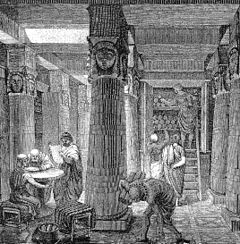
With the spread of libraries across the eastern end of the Mediterranean the Alexandrian library fell into disuse and suffered destruction by armies and Christian zealots.
Many of the scholars, artists, sages and seers who frequented the library moved or fled. Using text books and records, often made by Arab scholars, some information and knowledge survived.
One of the nexus’s of the world to which the knowledge travelled, was Venice. It was the terminus of the Silk Road and linked the East with the Middle East and Western Europe.
The Ancient Greek texts on philosophy, astronomy, geometry, mathematics and their interpretation and substantiation by Arab scholars were like gold dust. Most contemporary lines of thought were abandoned in favour of this newly discovered old knowledge – like the Helio centric solar system. Much of it was ‘heretical’ to the church but eventually, the church had to hold it’s tongue. For the burst of colours from the fountain of knowledge were like the precious silks adorning the harlots and aristocratic women of the Venice. Artist and Scientist grew in renown and fame, patronised by wealthy families such as the Medici s. The flower that was opening was to be known as the Renaissance.
Today, despite or perhaps resulting from previous ignorance and prejudice, there is happening a similar flowering – inspired by Universal information and knowledge carried on the electromagnetic sea of the internet.
At the same time over the last few decades, academic institutions ( where the internet was first conceived and initiated ) – these institutions have started to share what they know with each other. This spark is vital to transform information into knowledge, ideas into creations.
For example, archaeologists studying Neanderthal humans are sitting around the metaphoric camp fire of storytelling, with forensic pathologists, palaeontologists, weapons experts, linguists and artists amongst many others – to visualise exactly how they lived.
Gone and the archaeologists who specialise in Western Mediterranean arrow heads for their entire academic careers. Such ‘silo’ thinking inhibits understanding. The arrow head was just a small part of the whole story of how Neanderthal humans lived and gives information but not knowledge.
This is just one example of the interconnections between artists and scientist that is now found in today’s Universities and places of study.
And most telling of all is the recreation of the ‘Renaissance Man’. These are artists or scientists who are also scientists and artists. For just as the first Renaissance created it’s Leonardo de Vinci’s, so we need and have today, our own ‘masters of all knowledge’.
This means considerably more than the previous scientists who wore a trade mark bow tie and long hair. Or those artists who adopt a mannerism of the scientific method (sharks in tanks) in their conceptualisations.
What it will bring is the fruit from the flower – the seed that will give life to a new plant and perhaps the next Renaissance after the present one.
This fruit is what is known as ‘wisdom’. It is the essence of knowledge, just as knowledge is the essence of information and information the essence of data. There is a fractal that grows and shrinks, but always follows the same pattern.
In this seed the whole future of our civilisation has it’s potential to grow exponentially. We see it on the media everyday – new discoveries, new inventions, new ideas. Let us hope that these seeds will temper our desire for material prosperity, just as the Silk Road became a line of empty caravanserai’s.
 Matters Blog