Time Traveller

Good evening and welcome to another edition of Time Traveller. In this programme we ask a well known personality which seven items they would take into the future as their personal memories of today.

Our guest in the studio with me is Mrs. Teresa May, the recently deposed Prime Minister of the United Kingdom.

Welcome Teresa May and let us start by introducing your first item which is a film you have liked of admired and wish to take into a time in the future.

Well Robin, firstly thank you for inviting me onto your programme and giving me a chance to talk on one of my favourite subjects, myself. My most memorable film would have to be For Whom the Bell Tolls. Politics, as someone once said, is ‘war by another means’ or was that me? Anyway, I recently have discovered just that. I knew that I had a slim chance of achieving anything let alone the Brexit debate. Now with a career worst legacy of a failing health service, failing prison service, failing criminal justice system (in particular the probation service), failing police service, failing education system, failing defence services (those aircraft carriers oh dear), failing transport infrastructure, failing social cohesion, failing high streets and housing provision, failing agriculture and fisheries, failing trade deals, failing immigration policy, failing universal credit benefits system – I feel that there I have done enough for the country that I love (tear). What a pity that even the Houses of Parliament are leaking and in a bad state of repair in particular the Big Ben bell that has not tolled for quite a long time.

big-ben-getting-work-done

Well, what an extraordinary legacy and one which few people could be less proud, so let’s move on. Give us you favourite piece of music that you would take with you into the future.

Ah! Yes well this would have to be one of the places I would like to visit which is the Dark Side of the Moon by Pink Floyd. I believe the Chinese have a little something walking around there already and I would like to make similar ever decreasing circles in the dust bowls and craters so abundant there and not be asked awkward questions by members of the opposition and press.

A fine choice and somewhere we hope you will be able to go and stay perhaps, in the future? Your next choice is to consider a favourite meal that you would want to enjoy on the moon.

Ah! Well that’s a easy one because I expect it will not be so abundant in the future as it is now – good old British ‘fish and chips’. Because with the Fisheries and Farming policies of my previous government will mean that there are hardly any fish left in the seas in the future and no casual labourers to pick the potatoes rotting in the fields.

Extraordinary to contemplate no fish and chips but yes, perhaps you have sown those seeds not least when you were a disastrous Home Secretary who did little to reduce uncontrolled immigration (nervous laugh). So let us move on to your next choice which is a painting you would like to take into the future.

Can I have The Last Supper by Leonardo de Cohen, even though it is painted on a wall?

The whole wall is yours.

Yes, because whilst I don’t think I am Jesus (well not yet anyway) I have to consider my last appearance in the House of Commons and how nice the other disciples, I mean politicians, were to me. There was so much praise for my character and policies, saying how clever I was and how much I had done for the country I love selflessly – I know it was all untrue but what a lovely fantasy.

OK, a good choice and one which will remind you of your prophet like status at least in your own household if you include your cat. So next we have a poem for you to choose and take into the future. What would that be Teresa May?

Well Robin, I am not really one to read poetry mainly because I can’t understand most of it written with so many words missed out. But I think the words of the hymn Jerusalem by William Blake would remind me of the ‘green and pleasant land’ that England once was before my inept environment policies to reduce climate change turned England into a burnt and unpleasant desert.

What about the other countries of the UK?

I can’t see that they will still want to be part of a Brexited desert by then and will have gone off in their own directions to maintain the models of prosperity that I strived for and never achieved.

Great, so nearing the end of the programme we just have two more requests for you. What novel would you bring with you into the future?

That’s a simple one. I’d like the Secret Life of Walter Mitty because I can identify so closely with the main character whose name I forget? Is it Teresa…

No it’s Walter Mitty.

Yes, so there is this fantacist who dreams of all sorts of accomplishments way above his or her real life potential and abilities and creates all sorts of confusion amongst the people around him or her. That so reminds me of the me I love!

Marvellous, how interesting and finally then we have to ask what play you would take into the future.

That would be The Importance of Being Earnest by Oscar Wilde. I have always found in my career as a politician, that it matters little what you say and more how you say it. If you sound unsure of yourself it will show, even if it’s the most obvious and benign policy you are suggesting people will want to shrug it and you off. However if you come up with the most bizarre and unpractical ideas but are completely and utterly earnest in your pursuit of them, well, doors open, as they did for me.

Astonishing. An one luxury item you would like to bring with you into the future you describe so well?

Can I have a Tesla submarine. I do believe that in the future we will no longer be living on the land on account of global desertification and will have moved into the seas to earnestly carry on the destruction of the planet to the very end. Therefore I think a nice shiny Tesla submarine powered by the phosphorescence of tiny planktony things will be the perfect place to contemplate the last days of my life.
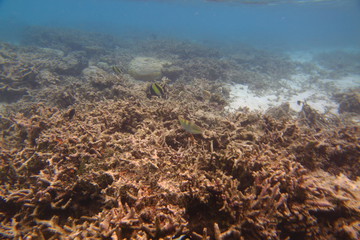
dead coral

A little domed perspex window into a world of dying coral and empty abysses?

Oh, yes, what a wonderful legacy.

Teresa May, thank you for causing all the worlds problems and being on this edition of Time Traveller.
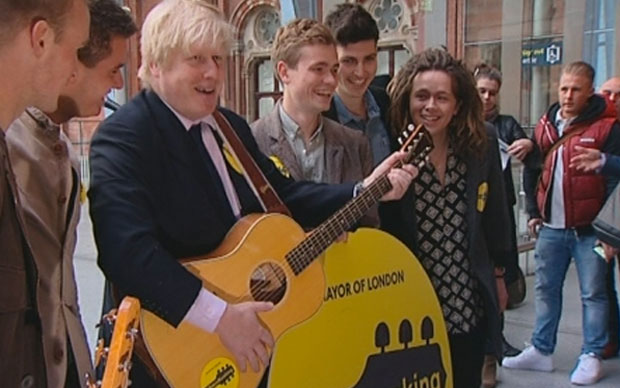
Boris Gump

The End Game for Brexit

Only a vain fool would want to be prime minister of the United Kingdom today. Teresa May was greatly flattered when she was asked to take the poisoned chalice of leadership. Today, 22 July 19 is her last day of holding that chalice.

There was little democracy in the process of electing the new prime minister of the United Kingdom today. Only members of the conservative party were eligible to vote – almost 160,000 of them which is just 0.000625% of the population of the United Kingdom. This process was preferred to a general election for what reason? Could there have been a fear of losing the majority of two seats in the House of Commons and therefore power?

This absence of a sizeable working majority, an apparent inability to consult with like minded partners and her private belief in ‘remaining’, was what ultimately brought down Teresa May, as I see it.

So having decided that the country has no right to choose their next prime minister, ‘they’ decided to pitch a ‘remainder’ against a ‘leaver’ as candidates to – well – leave. Which one do you think was expected…no…intended to win? Yes, the leave campaigner was always going to win.

boris_2877536a

Unfortunately for Boris Johnson, he will have to act out his dreams of being a right honourable politician whilst facing an impossible situation. It’s like arriving at five in the morning at the Glastonbury music festival after an all night concert in which all the bands were booed off stage. Only a single cleaner is to be seen sweeping up debris from the back of the stage.

Come on Boris, get your ukulele out and give us a number!

shouts someone from the crowd. They are not quite sure how he got there but they are willing to sit through one more act before the stage is dismantled.

Vanity makes you so thick skinned you find yourself being handed a battered ukulele (called the Withdrawal Agreement) and tuning it’s three remaining strings. You can now say you have been in a band at Glastonbury 2019, when your grand kids ask you Boris.

But he is not so poor a politician that he has forgotten to organise a bus to take him home. It sits at the back of the stage with the engine just ticking over. The driver leans against an open door dragging on cigarette. This bus has written on the side; ‘no deal’.

Many politicians cringe at the thought of a ‘no deal’ with the danger of a catalogue of unintended consequences emerging from it like the Monty Python one ton weight descending from above. The EU commissioners are expecting the £39 billion pound debt to be paid by the United Kingdom. Failure to do this would leave the UK’s reputation as an honourable nation in tatters, the pound would crash and investors rush to remove capital and businesses from the nation.

Yet Boris has cleverly wrapped up this ‘no deal’ option in a transparent tissue of lies paper. ‘This is on the table so that we have bargaining power’ the public are told. But of course the mere presence of this option means that there would be no deceit if it were decided to be used. After all, the problems faced by Boris Johnson are so unmanageable that ‘throwing the baby out with the bath water’ is an appealing Party ploy.

And when the unexpected consequences start appearing one by one, he can say that none of this was his fault. Third parties such as the EU commissioners and Teresa May and all the other political parties, were the cause of the chaos now falling from the skies.

One such cloud burst, in my view, will inevitably be the countries that make up the United Kingdom seeking independence. I expect Northern Ireland to vote to become part of Eire (and Europe) first. That will pave the way for Scotland to seek independence and perhaps even the north of England!

Boris will be like the male lead in a farce that ends with his trousers around his ankles and a chicken on his head – but then – I expect he would rather like that look.

I am disheartened when I listen to people asked for their views on Brexit on TV. They expect there to be some sort of change after Brexit but rarely state what that might be. The ‘end game’ is lost in the excitement of the ‘present game’.

I am reminded of the ‘independence’ parties held in countries in Africa as the colonial powers withdrew in the 1950’s. The national exuberance and excitement lasted several days. New national flags were flown from windows and vehicles, horns blaring. People danced in the streets all because they were ‘free’ without pausing to think what that meant.

I make no excuse for colonialism which was clearly wrong. But when the European countries left Africa there was a political vacuum. Despots and power hungry ‘leaders’ filled the parliaments and military top jobs. Corruption and victimisation of populations became normal. People found the end game was no better than before – sometimes worse.

I wonder what will be the ‘end game’ for Brexit, once the bunting has been taken down from the streets parties.

Nigel Farage will disappear from the scene because his great ‘oversimplification of the facts’ will be over.

All that will be left will be a resounding silence, little direction in the shape of cleverly managed new prospects.

The EU will treat the UK as positively second class; why shouldn’t they? And America will not save the UK from nasty Europe this time round – unless you think President Trump is a very very good person… very loyal and trustworthy person who loves British Trump…Boris Gump.

Lunar Madness – Apollo ll

On the fiftieth anniversary (20th July 1969) of the first lunar mission and landing on the moon – I dedicate this blog to all explorers.

Has it ever occurred to anyone that the name given to the American space programme to reach the moon, was a bit odd? Apollo is the Greek and Roman god associated with the sun – not the moon. Was it used because the mission to send men to the moon was totally male dominated? The mission objective clearly stated, in the words of President John F Kennedy :

I believe that this nation should commit itself to achieving the goal before this decade is out, of landing a man on the moon and returning him safely to the Earth.

Indeed, there were no female astronauts at that time, apparently on account that they were considered not to have the physical strength and willingness to take risks that men do. Ironically, today female astronauts are known to be physically more suited to space travel and averse to risk taking for the benefit of the entire crew.

The First Astronaut – Apollo (about to launch a thunder bolt)

Apollo_of_the_Belvedere

It is also curious that earth’s Moon is not the only moon in the solar system. All the other moon’s are given the names of gods (except for Uranus which has moon named after characters from Shakespeare plays). The word moon is strangely containing two adjacent spheres! But more importantly Moon or Menses has proto-Indo-European linguistic roots and is older than Lunar which is Latin. Moon is closer to menses and month relating to the female cycle.

It being 1969, the male symbolism prevailed. Apollo had a bow and arrow and was the god of archery – if that is sufficient imagery for a the masculine principle seeking and penetrating the feminine circular target.

A British rocket of the 1960’s for launching satellites was named the Black Arrow. An even more curious historical eponymy is that Stevenson’s 1829 railway engine was also named The Rocket. A symbol Sigmund Freud could also have written a chapter about.

Whatever the reason’s for naming the Apollo mission, the shallowness of the venture is evidenced by the fact that fifty years on no nation has repeated it. The reason is clear. There was no material benefit in going to moon – effectively a desert. Instead in the 1960’s there was a ‘cold war’ between the Soviet Union and the United States of America. The Soviets were ahead of the Americans with the launching of the first unmanned and then a manned earth satellite. The ‘land of the free’ was out to prove its technical, economic and political superiority and they did.

The Scientist’s at the time preferred space missions to be unmanned and crammed full of scientific experiments. Robotics and remote communication meant that manned missions were scientifically speaking – a waste of payload.

But the politicians wanted pictures and pictures / film had to contain an all American explorer laying claim the moon by planting the stars and stripes flag.

As an aside, there is a conspiracy theory that the entire Apollo 11 mission was faked. This was achieved by using a Hollywood film studio to recreate a believable lunar landscape on which actors could land and leap about. Personally I expect there was a ‘back up plan’ to the real lunar landing – given that the mission was highly risky. If the American astronauts crash landed then the political fallout would be as damaging as a successful mission, rewarding. So it is highly likely, in my view, that there was a plan to fake the landing if necessary in the National interest. It is these films and images that are referred to by the conspirers as evidence of a fake landing.

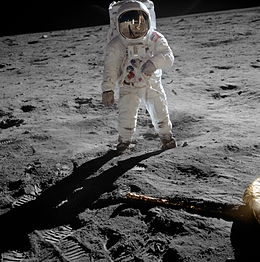
As it turned out, the final descent in the lunar Lander was almost a disaster. There was only another three seconds of fuel in the tank for Buzz Aldrin to land ‘The Eagle’ lunar module.

Buzz Buzz Buzz Busy Busy Busy B

260px-Aldrin_Apollo_11_original

But why did these men risk their lives so publicly and for so little scientific benefit? Clearly as patriots and explorers from a gene pool of risk taking ‘settlers’ – the chosen crew were dedicated to their mission. These were not humans landing on the moon, this was America – The Eagle.

Another great irony was the ‘elephant in the moon’, which was that the destination could hardly be more adverse to human survival. It was known that the Moon was a ball of dust and rock with extreme temperatures and no means to sustain human life. It was and is, more deadly than ‘Death Valley’ in California.

Hardly surprising then that the picture from Apollo missions that brought most gasps from the crew and earth dwellers alike, was the view of the blue planet itself. Seen for the first time from a considerable distance the earth looked both majestic and fragile. A lonely jewel in a forbidding black landscape.

We know today from subsequent unmanned missions to the planets, that the earth remains the only place on which human life can exist without technological reliance. If the reason behind the moon mission was partly to find a suitable ‘life boat’ to use to escape a dying earth – then what we know now gives little hope for the perpetuity of mankind.

Only one of the moons of Uranus will be a suitable place to land when our sun expands and swallows earth in a few billion years time.

For now only Mars appears sufficiently similar to Earth to sustain colonies – but a fragile existence this would be with the need to grow food on a large scale to sustain just a few ‘settlers’. It will be a long while before there is a Mars Mc Donalds and they probably won’t sell burgers.

There is another lesson to learn from history and that is ‘possession’. Traditional declaration of ownership on behalf of a nation by explorers such as Captain James Cook, was the raising of a national flag. No teams of lawyers were necessary historically to defend the rights any indigenous people, who were usually shot if they caused dissent.

Even if no Martians line up to defend Mars from future settlers, there will need to be teams of international and interplanetary lawyers to deem who owns what. Treasures such as mine-able water ice will be precious enough for significant sums of what ever is used for money in the future. If Earthlings continue their war-like ways on other planets, as they do on their precious earth, then there will be a giant step backward for mankind, instead of one forward – a type of lunar madness from whose bourne no man returns.

M – OO – N

Ap – O -11 – O

Hammering in the Screw

Readers of this blog will know that the author is fascinated by the science and art of problem solving. Problem solving is a daily occurrence and yet is rarely taught or even considered as a subject worthy of study.

Problem Solution Success

The brain can acquire an commanding attitude that sometimes dismisses objectifying a problem. Either from previous experience or acquired behaviour – a solution ‘comes to mind’ that is promoted without question. This idea is regarded and defended as the only possible solution and perceived as unquestionably better to any alternative.

Let us take an example from the world of sociology, ethics, law, health and politics. The example I am using is ‘drugs’.

The ‘normal’ response to the problems created by citizens who take drugs, has been for the State to make them illegal.

Avid problem solvers will already have noticed that when the problem has a stack of layers already listed;

Social stability

Economics and Taxation

Ethics and Religion

Law

Health

Politics

– then the solution has to apply at every level of the problem.

It is not difficult to appreciate that the ‘make it illegal’ or ‘bang-em-up’ solution, only addresses one layer of the problems associated with drug taking.

In the 1930’s recession in North America a law against the consumption of alcohol was introduced known as ‘prohibition’. We are probably all familiar with the unintended consequences of this law in handing over the production and supply of alcohol into the hands of criminals. The government lost the taxes associated with the sale of alcohol and little benefit was gained by anyone except the criminal gangs. The law was repealed because it didn’t solve the problem – if there ever was a defined problem!

But even today the Indian States of Bihar, Gujarat, Bagaland are today places where alcohol is banned. Despite this alcohol consumption in India has risen 72.5%* in the last twenty years (*source Wikipedia).

In the United Kingdom in 1971 an act of parliament was passed called the Misuse of Drugs Act. This was heralded as a so called ‘war on drugs’. But because the problem was only considered at one level, the laws have failed to the extent that contemporary analysts are proposing more inclusive solutions to the problem.

Instead of examining these alternative solutions the more general point here is that they need to be wide ranging in their origins and effect. Just taking a narrow attitude such a s ‘law making’ is ineffective.

Therefore a problem solver might examine ‘what is a drug?’ first. In the religion of Islam, a drug is categorised as an ‘intoxicant’ and believers are forbidden to become ‘intoxicated’. This is clever because it does not attempt to list all drugs that are harmful, in the present and future, (as lawyers did in the UK and other Western countries) – it just bans the consequences of any drug. It does not even define the point at which a person becomes ‘intoxicated’. The clerics and interpreters of Sharia law have erred towards ‘zero tolerance’ – and gets a bad press in liberal democracies.

However, it has to be recognised that religious laws can be considerably more effective than  criminal law and overcome the problems associated with criminalising drug addicts.

But even this strand of a solution to drug taking is not completely effective; some Muslims drink alcohol. Therefore a problem solver might attempt to define what degree of success in reducing the consumption of drugs is being aimed at. In a competitive world it is natural to attempt a one hundred per cent success rate, but a reality check is usually needed on what can really be achieved. Is a person ‘intoxicated’ after one beer?

Like all ‘genies’ and malign inventions – once set free they can never be completely put back into the bottle. Perhaps for this reason, in western liberal democracies at least, an increasing level of tolerance is being given to drug use and users.

There is clearly a sliding scale defining drugs, with mild drug taking at one end (coffee, tea, medicines) to hard drug taking at the other (heroine, cocaine, alcohol). Societies assess the positive effects of drugs against the negative such as in the production of medicines. Desired consequences of medicinal drugs are balanced against the side-effects, some of which may be worse than the symptoms of the problem!

Some European countries such as Portugal are treating drug addicts as patients with an illness rather than criminals who will change as a result of punishment. The statistics on the success rates between the two approaches would make interesting comparison. What is of interest for this essay, is how a change of direction and depth in the problem solving process, may be more successful than the previous direction and depth.

Clearly the politicians and law makers (with an knowledge of changing social attitudes) need to be on board with the idea of such changes , as do health and social workers and the criminal justice system.

Any lasting solution has to know what it is trying to achieve and how to measure that goal. It must also take into account how to change and how to control the various strands of the solution involving the multiple agencies within society.

Many people in power like to think they know the solution by some sort of divine gift of seer-ship. This makes them blind to whether the measures they propose will work and by what measure they can be considered effective in their goal.

Reluctance to change is familiar in problem solving and is characterised as a person engaged in digging a hole in the wrong place. When the error is pointed out ‘you won’t find water here mate!’ the digger just digs deeper.

Or when the carpenter only has one tool in the workshop, this tool is used for anything that it can hit. No question is asked whether the metal thing sticking up is a nail or a screw. The problem is a ‘metal thing’ and the solution is the only tool in the workshop.

This type of thinking is clearly insane when viewed analytically – and yet whole societies and national systems of government appear to be digging holes deeper and hitting screws with hammers.

What do you think is the solution?

Problem Solving

English-ish


Now I want you all to come and sit in the story time circle children. Come along now! Timothy! Don’t scrape your chair. No, it is not a Roman chariot crossing the finishing line made of the bodies of slaves, it’s just a chair. That’s right. Thank you boys and girls. Sitting up straaaaaight! Good.

Now this morning we are going to learn some new words. This is part of our Easy English Learning Year 2 book exercise 11. No Jonathan you don’t need your book. Well because it’s a simple lesson so you don’t need your book.

So listening…my arm is up Peter! What can we say to make the sentence ‘the cat sat on the mat’ sound better?

No Simon, dead cats do not sit on mats. Well they sort of fall over – but that is not the point – it is not nice to think of dead cats. No please don’t cry Susan. There isn’t really a dead cat, nor a real cat at all. It’s just something we are trying to talk about and the boys are being silly.

So now, how can we make ‘the cat sat on the mat’ a more interesting thing to talk about?

No ideas? Well has anyone heard their Mummy or Daddy or Carer say ‘to be honest’ before a sentence? You all have! Except you Carol…because your Daddy is in prison. Well that doesn’t mean he is not honest some of the time. Susan , stop crying now and go and help Carol stop crying. And whilst that is happening look this way; and I want someone to try out my suggestion. Wendy…how about you.

Wendy ‘To be honest, the cat sat on the mat.’

That’s really good, thank you Wendy. Do you see class how by saying ‘to be honest’ the meaning of the short sentence sounds more likely to be true than not true? Yes Giles, it might not be true at all. You think there might not be a cat…or a mat. But I am saying in this case there is. All RIGHT! Sorry I didn’t mean to shout. Let me have a hanky please Carol. Thank you.

So, now we can say, ‘to be honest’ in front of any sentence can’t we children? Just like our Mummies and Daddies and Carers do, and don’t they sound clever people when they do? Yes, of course they do and they sound really, well, honest.

Well sometimes grown ups are not honest so by saying ‘to be honest’ makes people believe what they say, John. No, not just amongst Gangsters. Nor criminals like Carol’s Dad. Nor corrupt officials or members of parliament. Look I don’t know why I am saying this. To be honest I want you all to listen carefully. See what I just did to get your attention? Yes, clever wasn’t it?

So, now our simple sentence has become longer.

To be honest the cat sat on the mat.

Who is clever enough to think how we can make this sentence more true sounding? You can Penny? Have a go then and all listening to Penny, class please.

Penny: To be honest, the cat actually sat on the mat.

Well done Penny. How did you know that? Your Mum actually says actually a lot actually? That’s clever of her.

And can you see what Penny has taught us children? Timothy don’t lean back on your chair like that. It’s dangerous. Yes, it is actually dangerous, actually.

So, what other word can we add to our simple sentence?

Your hand was up first Annabel…yes you may be excused but be quick! Anyone else? Simon?

Simon ‘So, to be honest, the cat actually sat on the mat,

actually.’

Good Simon. I don’t think we need two actual actually’s in the same sentence actually…what is it Timothy, put your hand down. Oh, did I just say three actually’s, twice? Well, that’s the good thing about our English lesson today. No one is going to notice how many times you say ‘So’ and ‘to be honest’ and ‘actually’ because everyone is saying these words so many times that it’s difficult to notice them any more.

Yes, even an English teacher like me doesn’t notice them Simon, because they are such useful words and expressions. Grown ups think it is clever to use them so I think you children should learn to say them as well.

No it is not ‘inane padding’ Peter. Who did you hear say that? Your Dad is an English teacher…yes I already know that actually…because he taught me when I was in big school. OK, call it secondary education if you want Peter. I am not going to argue. Well, since you ask, I am trying to make my speech simple for those who are not as fast as you at English, that’s why. Now can we review what we have learnt in our work books? Go back to your tables and open your English books to a new page. Slowly Stephen, it’s not a race! And as you are getting ready I am writing our new improved sentence on the board and I want you to copy it.

Peter. You are not writing? Where is your pen and book? It’s not drivel I assure you. Well there is nothing wrong with ‘the cat sat on the mat’ it’s just that in 2019 it’s a bit old fashioned. It’s much more normal to say, to be honest at the beginning. Even when you are an honest person, yes, even then because the other person might not know how honest you might be. No it’s not an absolute proof of honesty. No, I don’t think I would buy a used car from someone saying this, they could be dishonest just like any other person. It’s just an expression. Yes, possibly an expression that is not true but when it comes to cats and mats it normally, in fact most likely, is true. And that is also why we say ‘actually’ as well, yes. We actually do. We really really really do say actually.

When you do actually get to University to study English, you can write to me in my retirement home and tell me how wrong I was today. Until then Peter I want you to write the word actually on the last page of your exercise book one hundred times.

And the rest of you can go now. No running!

Peter, start actually writing actually.

Every Breath You Take

For about eight years now I have been driving a 2.2 litre diesel estate Toyota. The ‘Top Gear’ television presenters drove a selection of similar cars across Europe to see which went the furthest. Jeremy Clarkson found that his diesel Jag used so little fuel that he ran the air-con and anything else he could to use more fuel. Large cars have space for large fuel tanks, so their range can be phenomenal. Mine will drive from southern Spain to the north coast of Spain without stopping – a journey of 1000km.

Last week I hired an ultra small Toyota Aygo car in the UK; a nice little automatic with a petrol engine. When I came to fill up the tank I was disappointed to find that it had travelled about 45mpg whereas my trustee diesel gives me over 55 mpg.

So why are diesel cars getting such a bad press at the moment? Diesel engines were preferred in 1997 by the European Union as a response to the Tokyo Climate Change Protocol. These engines produce on average 120g of CO2 per km whilst petrol engines reach 200g of CO2 per km. This is because diesel engines cold burn and so use less fuel. These figures do not include the energy used to make and dispose of the vehicle most of which will come from fossil fuels. It makes sense to make cars that last several decades in order to stretch out the environmental impact of production and disposal.

But the problems with just the emissions from internal combustion engines, has been re-defined. Whilst CO2 emissions must continue to be reduced, it has been recognised that the toxic gases and particulates from engines are causing a serious health risk – especially for children.

So when you examine these two types of engines, the toxic gas produced by older diesel cars is Nitrogen Oxide, in various compounds. Petrol cars can reduce this with a catalytic converter whilst diesel cars require particulate filters that are regularly maintained. If they are maintained then the NO gases gases from diesel cars can be reduced by 90%.

Governments have been victims of their own ‘political’ thinking; putting problems into compartments rather than viewing the whole issue and how each aspect of it interconnects.

Complexity challenges even those minds with an expensive private education (i.e. politicians). The lazy solution is to reduce the problem to something people can understand – especially voters.

The bottom line is that neither petrol nor diesel engines should be in use in the 21st century. There should already be ‘electric only’ zones in all urban centres with buses and taxis leading the way.

Cars do not need to be scrapped on account of their motive power source becoming a problem. New zero carbon, zero particulate engines can be retro-fitted – even into fondly maintained ‘classic’ cars. Friends of the Earth believe we need to achieve this in less than a decade, whilst the UK government thinks 2050 acceptable.

When I was a student in London in the 1970’s, I hung a sign under my bicycle saddle with the words;

No Noise, No Fumes’

I didn’t buy a car until I was 30. Was I ahead of my time? No.

Fritchie Early Electric Car

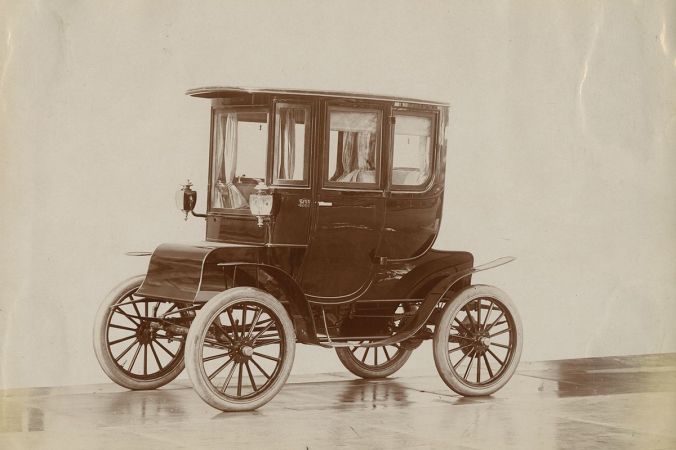
Electric cars had been the brain child of inventors in the 1830s. By 1900, New York City had a fleet of electric taxis. The electric car designed by an American, Oliver Fritchie, could travel 100 miles between charges but it could not compete with the Model T Ford on price or range. The rest, as they say, is history, because in those times governments were oblivious to the consequential problem they were leaving their ancestors – us.

1970’s Electric Car – with only a 40 mile range and apparently you had to stand on the roof.

1974 Electric Car

Today governments spend considerable time and resources in a phoney ‘war’ against terrorism. ‘Phoney’ because conventional troops cannot overcome guerilla tactics – as was proved to be the case in Northern Ireland.

The massive expenditure of public money on this ‘war’ is justified because terrorism grabs the imagination and emotions of voters – by it’s very nature as a font of repeated horrors.

You might be forgiven for wondering which is the greater issue – millions of citizens  (especially the young) dying of lung related diseases caused by internal combustion engines or citizens dying in terrorist related incidents?

When that question is considered statistically – resources should be allocated to each problem in proportion to amount of human misery and suffering it generates. They should not be allocated on the basis of which problem gets most votes and the most media coverage.

Regrettably terrorist acts will generally sell more newspapers than children dying silently in hospitals of lung diseases or adults with heart problems.

Newspapers  inflict the final blow of horror and despair on behalf of the terrorists into the hearts and minds of  victimised populations. Margaret Thatcher knew this and ordered a policy of non-reporting of terror related stories in Northern Ireland.

To his credit, the Mayor of London, Sadiq Khan, has identified the toxic air of his city as a very real and serious contemporary problem. He has made small steps to reduce it – such as charging motorists of the most polluting vehicles to enter the centre of London. The European guidelines on air pollution were exceeded within the first two months in 2018 in London. Is this another reason for the UK to leave Europe? No more awkward tests of the atmosphere in our cities?

When the United Kingdom first became a member of the European Union one of the directives from the European Parliament was for the UK to clean up it’s bathing beaches.

This was duly ignored for the first year. Why should the UK not continue to send it’s children to play on filthy polluted beaches? But the following year the EU reminded the UK of it’s obligation in law. The UK reluctantly (one expects) began to clean up it’s inshore waters; beaches are now awarded Blue Flags for water quality and facilities.

Now in 2019 the River Thames in London has been transformed from a toxic environment in which nothing could live, into a clean river with fish and mammals such as seals – on view from the Houses of Parliament.

So why now should clean air be such an difficult objective for successive governments?

If the problem is short term planning on account of the four year term of office for elected representatives in parliament – then perhaps politicians need to start to deal with the complexity of uniting long term and short term objectives.

The current air pollution problems in the UK are not local – just look at Mombai and Beijing. There has to be consideration – however complex- on how to integrate solutions within complementary European and global strategies and policies.

Clean air has to be one of the most fundamental of human rights. If we cannot wish it on ourselves, how is it likely to ever happen for our long suffering environment?

In the Beginning

Before the Earth was born and the great stars were in the sky, there was a traveller.

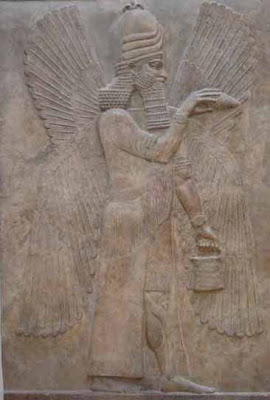
His name was Enki and he was what people now call a ‘god’ although this is not really the case. He is a being, like any other with an idea of himself as a traveller, warrior and hunter. He takes pleasure in his life and meeting other similar beings with whom he passes the time as he pleases.

Sumerian – Enki

Enki

This ‘entity’ or ‘god’ is no more ‘powerful’ than a snail that crawls upon the earth in our present day. For even a snail guards it’s own identity with pride – in the way of any ‘god’.

The ‘gods’ are therefore not interested or indeed able to alter the course of the consciousness of other centres of consciousness that coalesce in identical or alternative dimensions.

So it was that in the very first stages of the formation of a universe in the dimension known as ‘matter’ – Enki had to develop a means of travel – for in the material world it is necessary to move molecule by molecule and the number of these is infinitely great.

He built for himself a sophisticated ‘cocoon’ that enveloped his consciousness. He took the dimensions of this cocoon from nature. So it was that geometry and proportion were made to coalesce in the material world for the first time that was not spontaneous and without ‘will’.

At the moment of his arrival in this dimension – there were already animals and spirits in the form of amalgamated living beings living and parading on the planet he chose. This planet was itself a living being known as ‘Gaia’ and welcomed new entities for the diversity of genetic form that they brought. Enki lived on his own in a large swathe of trees that covered mountains and continents. He plucked animals and birds from their nests at night when his ‘cocoon’ craved replenishment. It was necessary for him to explore new regions and so he set off one day on a journey.

His journey took him out of the forest and across Oceans until he came to a place around which everything spun. He dipped his huge hand into the empty space that was there and pulled out enormous volumes of light and dust that he flung away. At the same time he sang the heavenly scale of one octave and at each pure note, the dust held itself together to form a perfect sphere. These spheres remain even today and are visible travelling in a line around the centre of all mass, known as the Sun.

So Enki worked and at the end of his travails he sat and rested, this being the seventh day. Then he set about creating a sphere to travel around Gaia to keep her strong and stable.

And for the last part of this heavely symphony, Enki set about creating a creature using just the clay at his feet. This creature was was modelled much on Enki’s own proportions and power. But he wanted this being to have more than just strength. He wanted it to have beauty, so he created a smaller replica using the mysterious proportions that govern music and harmony in every dimension that exists in the physical world.

The two being’s were later named Adam and Eve and from this moment on, Gaia had to support the actions of Adam and Eve, based on their desires.

Enki never made himself known to his creations but slipped back to the great forest from which he came. When he needed to know what was occurring in the world that he had made, he connected with the seven planets. Each one resonated at an exact frequency from which the consciousness of minor ‘gods’ travelled. These minor ‘gods’ were not permitted to interfere with the activities of Adam and Eve and their progeny but tasked merely as observers. However as the interest of Enki moved to other dimensions, the minor ‘gods’ took pleasure in interfering. They would even present themselves in apparent material form and give their advice – un-requested more often – on how a certain aspect of a mortals life should proceed.

Naturally as a result of these unimaginable encounters, the mortals began to study their ‘protectors’ and gave them names – which are the names of the seven planets to this day. The mortals concentrated so hard on them that they began to offer sacrifices of mineral, plant and animal form.

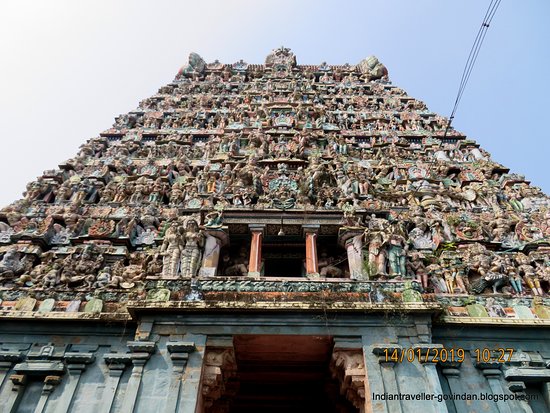
TempleGopuramMars temple-gopuram-mars

They also built resplendent temple’s that followed the divine proportions of their own bodies. In them they placed replicas of themselves as minor ‘gods’ which the eponymous observers could inhabit at will and in doing so occupy both an ‘observing’ position and a surreptitious means to influence mortal proceedings and outcomes.

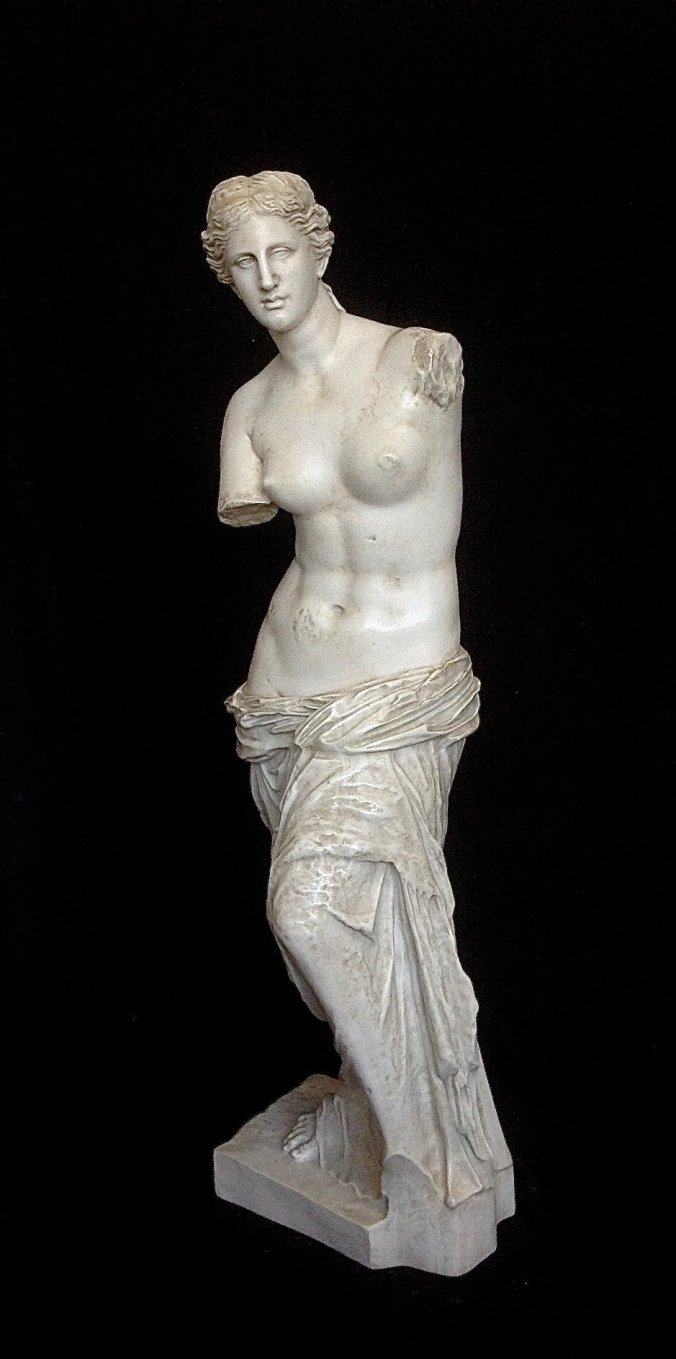
Venus

Venus de Milo

In this manner, the world as we know it today evolved from being influenced from without to within. Individuals have become ‘explorers’ ‘hunters’ and ‘warriors’ in the manner of their and this Universes originator, Enki.

It is hard for them to progress into the next dimension because they devote their resources too much to fighting each other. This trait or compulsion, does them little credit and builds no resilience to explore into the openings of new dimensions. It makes them weak and mistrustful. To this end certain empowered souls have travelled amongst the mortals and introduced the idea that they must emphatically learn to love each other in the manner of their original progenitors, Adam and Eve.

Through this means the future progenitors will progress into what was called a ‘Kingdom’ by one soul traveller. This realm is one where energy vibrates in harmonious patterns and allows consciousness to maintain an idea of a ‘reality’ that is completely separate from the material world. It is hard for the mortals to end their fixation on the material world. Although it is fraught with the laws of decay through chaos and violence, they still find great fascination in it’s beauty and sustaining power over their bodies.

Free of their Gaia-formed bodies, a very few of the mortals have and will evolve, in the manner of Enki, into a dimension that is more benign to their spiritual progress and less centred on ‘earthly’, constructive and de constructive processes.

To open this space they must travel in their minds through the forest of their thoughts to the very centre around which everything rotates. This centre they visualise and name a ‘black hole’ and they fear it as a place where matter and energy disappear. This however is not the case because all energy and matter re-appears in another forest – another garden from which others one day – will also bid to escape.

This is the nature of the Universes of Universes that turn in on themselves perpetually, without end or beginning.