The day is approaching this December 2019 when the good citizens of the United Kingdom of Great Britain and Northern Ireland will have the opportunity to vote in a general election.
The outcome is being described as the most significant for a generation, so you would expect the process to be fair. Certainly, whoever wins is going to perch on the moral high ground of victory and fight off all criticism for a very long time indeed. Whether they will be entitled to be so smug, I suggest, is open to debate.
You see, I have a problem which is; how democratic is the voting system? My quandary as a voter, is that I approve of some of the policies of most of the parties. It should be explained that in the UK there is a left wing party, Labour and a right wing party, Conservative and Unionist. The middle ground is occupied by the Liberal Democrats and Greens. Other nationalist parties represent Wales and Northern Ireland and Scotland.
In the United States of America, the choice is more polarised between the Democrats and Republicans. Let us take this as an example. What if, as a US citizen, you decided that the choice was too small. Who do you vote for if you want to stop climate change but encourage industry? Who do you vote for if you want the state to pay for health care and a prosperous arms industry?
In a Spin About Voting?

My point is that with polarised choices, there is no room for ambiguity that emerges from personal political perceptions and priorities. Worse still the politics of voting reduces to personality rather than policies.
Even in the UK, where the choice is greater, the democratic options are more confusing. Many voters now just spoil their ballot papers by writing ‘I don’t agree with any of this.’ They are being asked to vote for a leader they didn’t take part in selecting – unless they were the tiny minority of party members.
They might distrust all the candidates on offer and feel ambiguous about their policies.
Each party writes a manifesto prior to an election stating their political motives and means. This works to an extent but has the problem for some voters that their may be slipped in controversial motives that the voter does not want to happen. For instance, the Conservatives slipped in having a referendum on continued membership of the European Union. Suddenly it became an issue even though the majority did not think it worth consideration.
Worse still, when parties fail to win a majority in elections, coalitions have to be formed. Italy, Spain, possibly the UK next week, have this problem. Two parties may come together for the sake of forming a government at the price of compromise on their manifestos.
The public will have no choice over how these mixed manifestos will be prioritised. Which policies and method will be forgotten or ignored and which prioritised? Coalition manifestos are not published before an election if considered at all. This can lead to unrealistic expectations by voters when coalition governments are formed, as in the Liberal and Conservative Government in this decade. The direction of the ship will be decided by the Captain and officers, not the crew and certainly not the passengers.
No provisional consideration is given to coalition prior to an election as all parties have to perform the pretence that they are going to win even if it is clear to all that they will not.
The dangerous consequence of this for democracy, that occurs all too often, is that a minority party gains disproportionate power by owning the swing votes. This happened in the present Conservative government who allied with the Democratic Ulster Party and much of the muddle of mixed motives over Brexit has resulted.
In recent elections we have seen and or suspected that the over emphasis on the personality of candidates has given leverage to foreign governments and fake or real ‘whistle blowers’ and ‘news vendors’ questioning the reputations and ethical principles of candidates or even parties. Democracy as we know it is easily undermined by misinformation, view the Nazi propaganda news in 1930’s Germany, if you think this is a new phenomena.
Even the date of an election day can be manipulated to support a particular party in a manner which is clearly not in the interest of fairness. In the present UK election the Conservative government chose the day in which the students from Universities will end term and be returning home for Christmas. Informed young voters are not likely to support the Tories even though the election and it’s issues mostly affects their generation.
Young Voters in the USA Choose Not to Vote
 .
.
Even such a consideration as ‘is it raining’ has been measured to be significant on election days. Sending people to village halls to scribble on a piece of paper has to be reviewed as the majority of citizens in the UK rarely turn out to vote. Some living abroad for over 15 years lose their right to vote.
Lone Voter
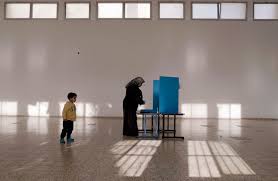
These then, are some of the problems for Democracy. Some people say, ‘well that’s the system we have got’ or ‘it’s the best of a bad lot’ but you have to wonder if the country that prides itself in it’s democratic systems is not kidding itself, it’s citizens and the world.
I am not suggesting that Democracy should be replaced with the pedantic and often corrupt systems of power like Communism or Autocracy. I am suggesting that with the aid of computers and the internet, a more democratic process is available to elect representatives. This is my idea.
Firstly, the party system is out. The in-fighting of politicians instead of their countries best interest, is something most voters are tired of.
Instead, all candidates will put themselves up for election as ‘Independents’. Radical, yes, but read on because they can form parties after election, not before.
They will state their personal political views by placing ten stars against a list of important areas of government. This will be shown to voters as something like this ;
Education *
Health **
Defence ***
Transport *
Law and Order **
Business and Industry *
Farming and Fisheries *
Environment nil stars
Social Housing and Homelessness nil stars
In this list each aspect of legislation and distribution of taxes is prioritised by the candidate, according to their own personal views. They are not under any party pressure to support policies with which they feel awkward about or strongly disagree. They can be honest; a quality in politicians which many voters express their suspicion about.
The candidate has, say, ten stars with which to indicate how which issues they prioritise and the amount of funding they would give in comparison to others.
Now here’s the clever part. Each citizen is given the chance to indicate their priorities and how strongly they feel funding should be allocated to each on their ballot papers. Instead of one cross or tick for a party – which in the twenty first century has to seen as a crude political choice – each voter has the same number of stars as the candidate.
The last piece of this process would have to be constructed from new but it’s not impossible. What I am envisaging is on-line voting from a phone, personal or public computer. In an age when personal internet banking, shopping, even gambling! – is managed with a high degree of security and reliability, it must be possible to create a secure on-line voting application.
Ten issues are listed either as broad areas for consideration or narrow ones. The voter can either ignore these as being worthy of state support ( such as health care in the USA) or indicate a need for state intervention. The strength of these feelings can be indicated by allocating some of the ten stars used to vote with.
It will be impossible to use up more than ten stars or whatever number is allocated to each citizen, but ten is an easy number for most people. Their choice can be re-adjusted until the voter is ready before selecting the ‘VOTE’ button.
For a population familiar with the internet, voting will be accessible, timely, considered, representative and accurately describing personal views.
The final phase of the voting process is for computers to match exactly the views of voters to those of independent politicians. It is already established what the views of the candidates are and matching a set number of candidates (say 300 ) to the views of the citizen public, will be doable for a computer.
The result will be a selection of representatives who will accept office and be fairly representative of public opinion. Being politicians they will almost certainly form party cliques (birds of a feather flock together) but at least the system by which they obtained power, will have been representative.
This could be a sea change for how populations choose those who represents them. With the emphasis moved to policies and issues rather than personalities and power politics, a higher level of honesty and fairness will be achieved.
We have the technology already to achieve this. We just need the thinkers to describe how it can be done – as I have just done. Vote me!
 Matters Blog