One main issue stood out during the campaign in favour of the UK leaving the European Union; restricting the free movement of people, meaning immigration.
Enoch Powell was a politician back in the 1970’s who was strongly opposed to immigration into the UK and warned at that time that entry into the European Economic Community would be a slippery slope into being UK being controlled by Europe.
Economists however will tell you that immigration, the availability of cheap labour, is fundamental to economic prosperity and will site the United States of America as an example. They are not concerned with social integration and interaction however, as are the communities who live with immigrants.
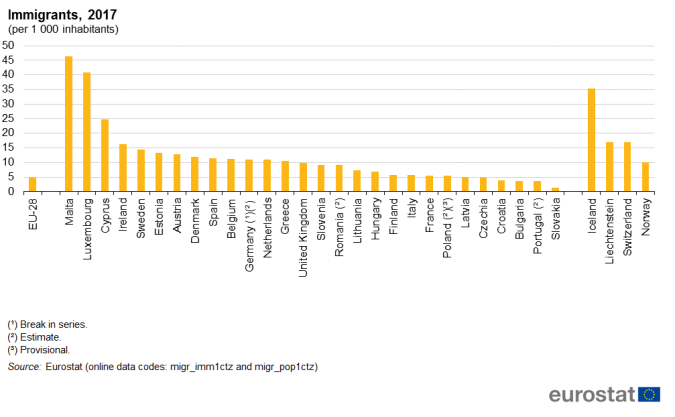
The UK is about half way down the league table of EU countries accepting immigrants
To solve a ‘problem’ you have to first define it which means asking what an immigrant actually is. Is a person with a British passport an immigrant for instance? The answer is yes, so citizens from dual national parents, are allowed to live and work in the UK. British citizens from ex-colonies across the world were awarded British passports, such as those fleeing Uganda and Hong Kong and economic migrants from the West Indies. These movements of British citizens were in the 1970’s are now generally socially integrated into the UK and have been important in creating the prosperity and diversity of today. There was public concern over these immigrants taking jobs and houses and using public services and much of this concern is reflected in the speeches of the right wing politicians at the time such as Enoch Powell.
Was this source of immigration as a result of the UK connections with Europe? The answer is no, since the colonies and returning ex-patriots from countries like Ian Smith’s South Africa were nothing to do with Europe. Two thirds of immigrants to the UK today come from around the world not Europe so any attempt to restrict immigration will need to cast a net wider than Europe.
Even if you just focus on European immigrants into the UK there needs to be a working definition of what an immigrant is. A tourist on a two week holiday is not an immigrant, however they can enter a country legally and ‘overstay’ to work in the ‘underground’ economy i.e. not paying tax and being exploited. More extreme rouses are used such as landing on remote beaches with no papers.
One strand of solving this problem would be government ordering authorities to round up those living in the UK illegally. This would include involving the beleaguered National Health Service who will treat anybody on production of a electricity bill with a name and address. Within this group are criminals involved in people smuggling and modern slavery and sex trafficking – nothing to do with the EU but certainly a problem resulting from lamentably poor UK enforcement of it’s borders.
Students are presently given visas to stay for the duration of their studies and until recently, were given three months to leave after the end of their courses. Somebody in government realised that this was a nonsense, since graduates are highly employable and there is little reason to send them home so quickly. So the law was changed allowing them to remain in the UK for a longer period.
One of the largest movements of immigrants from Europe are migrant workers. These are seasonal workers who travel within Europe to where the wages are highest. They are ‘unskilled’ but vital to farmers and fishing to pick and process fruits of the land and sea. This type of work is not preferred by UK citizens who prefer not to for various reasons, hence a dependence on EU nationals to work in the UK. Even good old British ‘fish and chips’ needs someone to lift potatoes from the flat fields of East Anglia.
None of these types of immigration have yet highlighted how the EU is responsible for a problematic level of immigration into the UK. Indeed people wanting to come and work in your country is an indication of it’s success as an economically and socially prosperous place to live. Unemployment in the UK is very low, compared to 25% for instance in Southern Spain.
The ‘solution’ to the ‘problem’ being offered by the present Tory government is to introduce a points based system of immigration.
Whether this is a solution that fits a problem is open to analysis and debate. If low paid workers are vital to farming and fishing, how will a system favouring highly educated applicants pick potatoes from the fields?
Farmers growing vegetables today want to know from the government how the free movement of migrants is going to work at least by September 2020. If there is no decision and ‘no deal’ then it is not worth farmers planting crops that cannot be harvested in the winter and spring of the following year. Similarly the fishing boats, seeking expansion of their industry following the retaking of UK international waters, will not catch fish that cannot be gutted and frozen on the port side because there are no migrant workers to do it.
The European Union was never a club that gives out free money to it’s wealthy members. It is a club that gives free money to it’s poorest members however and many parts of the poorest parts of Europe such as the Mediterranean nations in the south, have benefited hugely from membership. The EU operates more as Robin Hood than the Sheriff of Nottingham and that is a principle which you would not expect would create an issue for right minded people. However the British people have been persuaded that it is somehow wrong to share their wealth. Being the fifth wealthiest country in the World is not a position that you can use to hide from moral arguments of supporting the poor and weak.
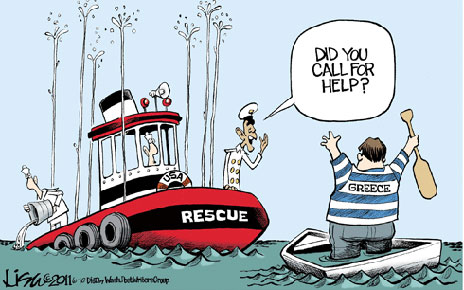
The EU (mainly Germany) went to huge lengths to support Greece when it was about to crash out of the European Union. The newly joined member countries from Eastern Europe are pleased to join as there are not only economic benefits but also gateways out of the social and economic memories of Soviet and Russian styles of government.
With leadership comes responsibility and just on this single issue, of immigration as an indication of lack of national sovereignty, the UK has not taken responsibility but simply blamed Brussels. That argument chimed with voters who we know are generally in favour of being governed by institutions as close to them as possible. Where Brussels is exactly and why millions of British soldiers died fighting two world wars in Belgium is not necessarily something voters are going to consider. Do they know that Ostende and Zeebrugge are about the same distance from London and Westminster as is Birmingham?

They argue instead that the elected members of the European Parliament are unelected and non representative of their views. This despite the fact that only on 5% of all occasions to vote on European policy and law has the UK voted against what was being proposed. In other words, what has been good for the EU is also good for the UK.
Could it be that the present prosperity of the UK, in social, economic, culture, research, security and concern for the environment is largely a result of it’s membership of the European Union?
Could there be a massive slight of hand taking place by the Conservative governments of the last decades, to blame Europe for problems rather than deal with them themselves? Who cares that British children are suffering from poor physical and mental health in numbers which should shock most of the British public?
Who cares about the physically and mentally ill unemployed and homeless occupying the empty town centres of the United Kingdom? Who cares that the public services in the United Kingdom which used to be the envy of the world are now failing? Why does the UK spend one of the lowest proportions of it’s GDP in Europe on public health?
Even just these three problems might been seen as more important that the ‘problem’ of being a member of the European Union.
I fear that the public have been manipulated by a clever slight of hand into facing the wrong issues and blaming the wrong causes.
Any problem with Europe could have been solved within Europe as a full and respected member. Since that proved too difficult for such as David Cameron who spent two weeks prior to the referendum in June 2016 ‘battling for Britain’ – how can we expect Tory governments to introduce policies to protect the weak within it’s own borders, even?
Has anyone projected the consequences of Brexit in the near and distant future – a list that should be under two headings of intended consequences and unintended consequences?
Politicians such as Teresa May held her cards very close to her chest when drawing up her infamous ‘Withdrawal Agreement‘. She argued that she could not let out her plans before negotiation starts, which meant that she received no guidance or feedback on her ‘red lines’ and ideas until it was too late.
You would however expect a ‘Conservative and Unionist Party’ to be comfortable with the strategy of ‘union’. Is there not a blatant contradiction between what they do and how they think. Why would a Unionist party dis-approve of Union within Europe? Is there not evidence of double dealing here? If they argue that the Union within the shores of British Isles and Eire is to what the name refers then is that not again a double standard. And given that Northern Ireland and Scotland voted overwhelmingly to remain in Europe, what is expected happen next in these two countries? Surely the people of these countries are going to want to have their say, including using the Tory ‘referendum’ tool now that it has been used to beat ‘Remainers’ into submission? One unintended consequence of leaving Europe could well be that England and Wales becomes the only working Union left within the United Kingdom – within the next five or ten years.
One in four people in the United Kingdom voted to leave Europe – all 17.4 million of them. But three out of four have not had their preferences and understanding of what the problem is, heard and acted upon. Some of them were too young to vote, some of them didn’t bother to vote, some of them were too old to vote, some of them were too ill to vote, some of them were not meant to be in this country, so did not vote, some of them are ‘foreigners’ so cannot vote and some of them did – just not enough. If you wonder why they didn’t vote it might just be that they didn’t think that European Membership was a the main problem. Perhaps they could see how inept Tory government policies were and that is why a second confirmatory referendum was blocked as an option by the Tories. If you want to win you need to fudge issues and the General Election of 2019 did that in spades against a disunited collection of opposition parties.
Kicking over the sand castle is easy. Just wait until 31st December this year when the Trade and other Agreements between the UK and European Union have not been finalised, and the Tory government will knee jerk into to what it does best, kick over the sand castle again and leave ‘no deal’ on the beach.

And is it just me or why is this process of leaving broken into two parts? Now we have agreed the terms of leaving we have to decide everything else (as if negotiating both at the same time is too difficult). How can you formally leave an organisation without having agreed the terms and conditions of what happens afterwards? This is like taking delivery of a new car, paying in full, receiving the key and log book, registering filling the tank and then sitting down and deciding what colour it should be and what extras should be fitted and what the price is.
 Matters Blog