I personally think Christianity would be a better religion if it recognised itself as a clever patchwork of beautiful stories arranged in a questionable order.
When Jesus was alive, there were many self proclaimed prophets, any of whom might have been chosen to be the ‘true’ prophet; not least of whom was the also immaculately conceived, John the Baptist. He has a following even today who are known as the Johannites. It is said he was the secret prophet of the Knights Templar and such Renaissance notables as Leonardo de Vinci. So who made Jesus – the Christ?
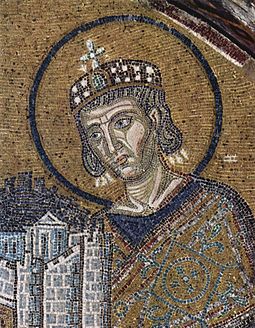
The Roman Emperor Constantine became a follower of Christianity and through the Roman Empires in the East and West at that time, Christianity became the State religion.
Constantine the Great: picture credit Wikipedia
In the process of change and at the Council of Nicaea in 325 AD, various books, were not included in the New Testament. In modern journalistic parlance, a ‘hatchet job’ – but a clever one. Clever because it contained the best of the old and the best of the new. It had to be good to have survived to the present day.
This Council meeting also sought to agree on the principle of a universal date for Easter, although it stopped short of setting down a method for this date to be calculated. After much disagreement this date became established according to the lunisolar calendar. No need to go into detail on this complicated subject here, but bear in mind that it is related to the 21st March in the Julian calendar; that is the vernal equinox.
Most religions are based on ancient ideas, but sometimes opportunities for improvements from new knowledge and reflection are missed.
If you asked a young child about the seasons, you would get a reply that spring is about birth and winter death. Despite this simple truth of natural cycles, Christians are given the story that Jesus died in the spring and was born in the winter. The Bible does not tell us this. Only copying other ancient religions have determined these dates. At the time, when Christianity was seeking dominance as a religion, resemblance to old ways was important in convincing people to adopt the new ways.
So, let us reflect on the story of the birth of Christ and see if it fits best into spring or winter.
picture credit: Pinterest

The Magi followed a star in the East. These astrologers would have known the difference between a star and a planet, but there are theories that in 7 BC in 4th April the planet Venus appears to stop in one place at it’s brightest, due east. Alternatively, Venus is the brightest object in the sky and the three Kings may be an astronomical metaphor. What we do know is that the new prophet was the ‘sun of god’, a bringer of light and love, a new era, who later told us, ‘I am the light of the world.’
In Ancient Egypt the months were determined by the arrival of known stars on the horizon. There were twelve of them, from which our modern months are derived. We have kept the solar calendar of the ancients. When Herod interrogated the Magi, he ‘enquired of them diligently what time the star appeared.’ He wanted to know when the prophet was to be born and the answer they gave was only accurate to within two years (as Herod later ordered the killing of children under that age). Even these astrologers were unclear on when Jesus was to be born.
Joseph and Mary were responding to an edict to go to Bethlehem for a census and pay taxes. This was unlikely to have been arranged in the middle of winter when nights are cold and days shortest.
Mankind’s new spiritual era is symbolised by the birth of Jesus in a cave (not a stable as in some versions of the story). This cave was a well known symbol to the Ancient Greeks, such as Plato, of the human skull and therefore mind. The birth of a child of light in the brain represents a new level of consciousness and the opportunity for mankind to raise their understanding and experience of life. Historically, this is exactly what Christianity achieved, although it could be argued many other religions might have done the same equally well such as Buddhism in the Far East.
Should we ask, why were shepherds were in their fields at night? Any country person will tell you that the time of year when shepherds are working around the clock is in the lambing season – the spring.
Common to many solar and Pagan religions, there are four important landmarks in the calendar. These are the summer and winter solstices and the spring and autumn equinoxes. Most churches face the spring equinox, for the sun rises due east on 21st/22nd March. The Sphinx which turns it back to the pyramid of Cheops in Egypt (and faces all four of these points exactly) faces due east.
So fundamental are these seasons and the new consciousness of light and love to the message of Jesus, that he is even crucified on a form of compass; the cross. That remains his symbol, although many other symbols could have been chosen.
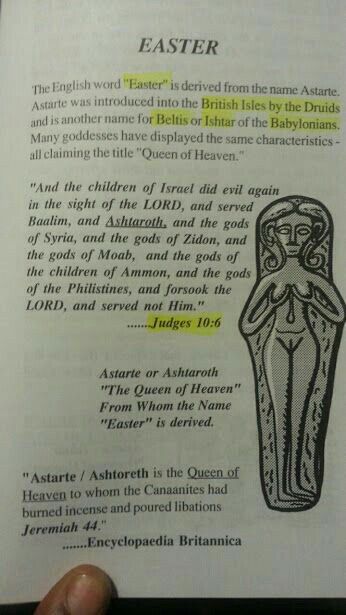
The goddess Ashtaroth or Ishtar of the Babylonians was a fertility goddess. The word ‘Easter’ is probably derived from her name. The conflation of the word ‘east’ into ‘Easter’ should not be overlooked. Her symbol was also a rabbit, on account of their love of procreation, – but Jesus had no connection with rabbits!
Easter is all about looking to the east, for it’s wisdom, it’s new light, new hope and it’s rising sun. It is clear to me that the birth of Christ in the spring of each year represents a message of the dawn of love.
Ressurection with Rising Sun: picture credit Raphael
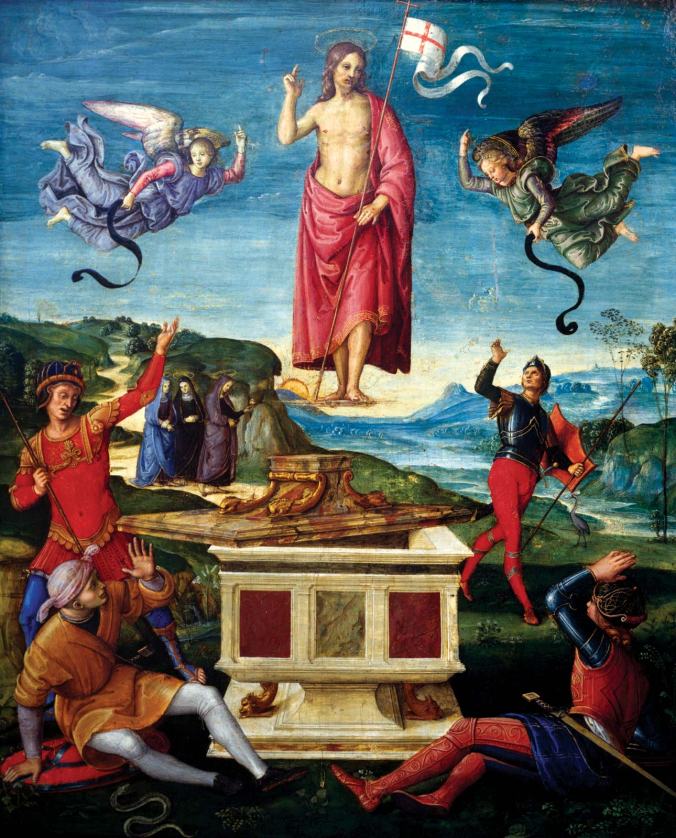
If any of the above is likely to be true, then it would be more convincing if the death and rebirth of Christ fitted the narrative of the winter solstice. I have taken up enough of the reader’s time, so let me suggest that you explore this possibility with an open mind and form your own opinion. To compare the dying and re-birthing winter sun with the dying and re-birthing son of the Father, I found to be a light to enlighten the Gentiles.
 Matters Blog