The Tunnel at the End of the Light


There used to be a car, in the 1950’s called the Ford Popular, endearingly known as the ‘Ford Pop’.

If the model T industrialised the manufacture or cars, it was still only affordable for the middle classes of America.

But the Ford ‘Pop’ bridged that class divide and provided a ‘people’s car’. Germany had done this in the 1940’s with the Volks Wagon Beetle, but Britain took a while to catch up due to a short ‘intermission’ called the second World War.

The greatest car ever built – Ford Popular 1954

picture credit: carandclassic.co.uk

Light Ford Pop 103e 1954 carandclassic

What do you expect from a people’s car? Certainly it is not going to have a chilled drinks cabinet and cigar lighter. Everything was basic, functional and appealing to the common denominator of public taste, availalbe in black, black or black. It was, naturally, very popular and it transported families in comfort from city to beauty spot in large numbers. If you wanted anything other than a can of baked beans, you had to get a pay rise.

Fast forward to today and you can draw a parallel between the dumbing down from ‘the good life ‘ for a few, to ‘dull and ordinary’ for all. The middle classes in both the UK and USA lost their grip on political dominance, because the workers have come out in larger numbers to vote.

In the last decades of the 20th century, politics was complicated. Whilst you didn’t need a degree in political science to understand what was going on – it helped. The whole process of electing representatives on multiple – often contradictory – manifestos, parliamentary debate, Sovereignty, national priorities, international relationships and above all, law amending and making – was baffling to most. So it was left to the ‘Toffs’ from elite universities to speak down to voters in election campaigns to make promises everyone could understand – even if they were expected to forget them later.

Enter the internet in the 21st Century. Whilst you could write the equivalent length of Nelson’s Column on how this availability of information has changed societies across the world, there must be changes.

The most obvious of these is, in my view, the ‘citizen scientist’. In a stealth move worthy of the Great Harry Houdini, ordinary people who never understood science at school, are suddenly ‘on to it’.

If we  regard science as a way of thinking logically about anything – using the ‘scientific method’ to prove or disprove propositions – then everything is up for change and challenge.

Call a friend?

Light NHS Direct

Suddenly people were empowered to not believe their medical Doctors. You look up your symptoms on the internet and then go and tell your Doctor what the problem is how you want to be cured providing it does not involve vaccination. The UK National Health Service even encourages this by creating NHS call centres. The staff follow algorithms in the same way G.P.’s do – perhaps even quicker and certainly without having to catch another disease in the Waiting Room.

The same process has crept into most other areas of professional expertise; people design their own houses, people cook and bake, people make art, play musical instruments, make astrological predictions, indulge in puppy care and kitten care – you name it people do it – and the walls of Jericho surrounding the professional classes have fallen.

Great, you might think. This is democracy at it’s best. People power!

The problem is the obvious one and why even Socrates, warned against empowering the masses.

The problem is that people do not access and use information, knowledge and wisdom in the way that professionals have been painstakingly trained to do. As always it remains true that, things are more complicated than they seem.

It is easy to reduce areas of knowledge to ten ‘top tips’ – how to build your own house- and make it look easy. Speak to anyone who has built their own house and they will describe the most stressful time of their lives, going over time and over budget and still the roof leaks.

Socrates warned that ordinary people did not have the education to be trusted in such things as – voting. Perhaps this is one reason why women in the UK at the turn of the 19th century were still denied a university education and a vote – why this particular prejudice was suffered for so long.

Even with a university education, young men and women in the twenty first century are finding it hard to get a job. When the Blair government in the UK declared an aim to give a top class education to fifty per cent of young people, the ideal appeared noble. But the reality was that ‘degrees’ became so common that they were no longer the doorway into top jobs.

Worse still, with the introduction of University fees in the UK, young people were enslaved into a life time of paying off a high interest debt – all on the promise of ‘earning more’. And governments too are unlikely to get their ‘pound of flesh’ from the deal. Grants to the few worked better in my view.

In primary schools the children of the first decade of the twenty first century were told how clever they are and one day they might be Prime Minister. It was of course a lie told be people who had only become teachers who took holidays at home.

Only a few people ever become Prime Minister- as if we need telling.

The president of the United States for instance, has been described by psychologists as ‘adolescent’. Although he boasts of a ‘very, very, good education indeed’ – he didn’t listen in school and learnt very little. Add to being academically dumb, other short comings which doubters love to list, then you have a candidate appealing to those who are fed up with being talked down to because they are ‘very, very good people indeed’. Fortunately in America there are plenty of these in the southern states.

Trump uses short phrases to plug home a message easy to understand and remember for the masses;

Make America Great!’ ‘America First!’

Johnson does the same; ‘No Deal Brexit!’ ‘Project Fear!’

Their close advisers are no longer civil servants or even elected politicians. They are media savvy individuals who know how to change how voters and party members think. In the UK now there is not even a deputy Prime Minister the PM can discuss strategy with. Instead their is an unelected ‘close adviser’ to whom the PM remains loyal – at least until Brexit is over – despite protests from his own party back benchers.

But the patients have not completely taken over the Mental Health Institution. There is today a swing back towards trusting the middle class professionals. Self build houses leak, Mr Kipling’s cakes taste better, art is not easy. But particularly at this time of crisis, people have seen the highly trained men and women in the health services, battling away for little personal reward and realise, ‘I could not do that’.

Suddenly, the science of Virology is laid out like a patient etherised upon a table, and no one except the professionals understands.

picture credit newseu.cgtn.com

light Neweu cgtn Virology Lab

Because it’s difficult to ‘do the right thing’, science is emerging as a wise advisor to governments. When Boris Johnson gives press briefings he is flanked by non-elected scientists who give ‘advice’. This appears to be a correct and ethical process until you realise that there as many views on a subject as there are scientists. Scientists often disagree with each other’s ‘version of the facts’. They will say that more studies are needed, larger samples, more vigorous methodologies, new measuring instruments and technologies – innovation and discovery!

(A particularly cynical pundit will suggest that governments are setting up someone to blame, when the strategy is seen to have killed thousands because the government policy was late and or wrong.)

This dark secret of science is not so dark and we should demand to know it. Should President Harry Truman have been persuaded to build the Atomic bomb – ending one war and starting a cold one that sits like a dripping glacier, to the present day?

picture credit: atomicheritage.org

Is that a nuclear weapon or are you just pleased to see me?
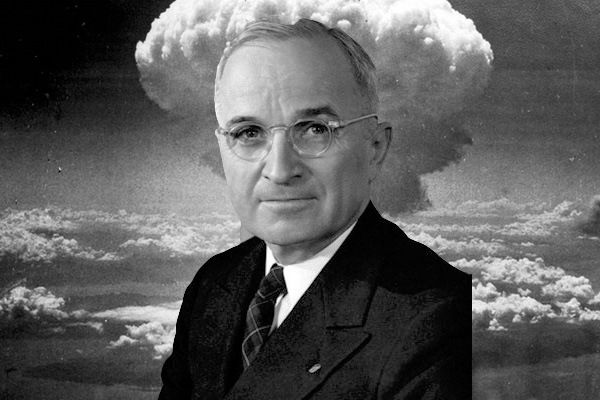
Light Harry Truman atomicheritage org

Who voted for the Atomic bomb? Certainly plenty of people protested against it in hindsight but knowledge, once out of Pandora’s Box, never wants to get back in.

Suddenly ‘the people’ see the scientists as doubtful holders of solutions to problems. Science has mucked things up just as often as it has created a better world.

And if you can’t trust the scientists surely you have to trust the politicians? Unfortunately there are as many political view points are there are sea gulls behind a fishing boat and the only thing you can be sure about is the direction of the boat.

So societies trundle into the twentieth century lead on by TV and radio personalities with regional accents – commoners who you can understand. Everything has been reduced to guessing games that requires no skill because the people tried science and it was even more difficult than at school.

If our politicians are also guessing their way along – without scripts, experience and the wrong pick of scientific views – is this the end of the light?

picture credit: author – unfortunately God moved.
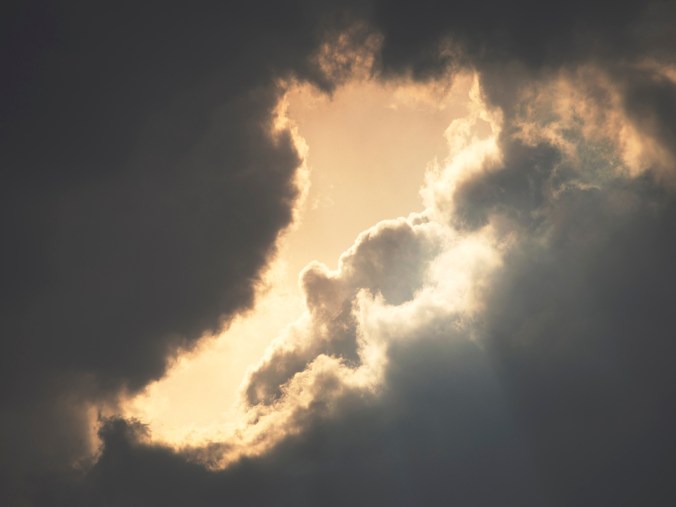
Light through clouds

Cuckoo Cats

There is something very strange about cats. Now don’t get me wrong, I am one of the half of the population who adores furry felines – the other half giving allegiance to cuddly canines. Like Brexit, this is disunity within the United Kingdom, is unlikely to ever go away.

However, let me explore the enigma of cats. I am going to express an opinion that some may find absurd, but I crave their indulgence as I describe the facts as I choose them to be.

Firstly, isn’t it odd that cats turn up in large numbers in Ancient Egypt – getting on for 5000 years ago?

‘Get in you basket – Bastet’

cat-statue-Bastet

So many were mummified, that their swathed remains were once used as a form of domestic heating. There was even a minor god who was a cat – see above. Being a cat in Egypt in those days was probably a pleasant incarnation – provided you kept away from the embalming and mummification factory.

Don't Laugh at the Cat 001

But it is odd that prior to the rule of the pharaohs, domestic cats even existed. Some how the ‘big cats’ of Africa, had been genetically engineered to become ‘small cats’ or ‘pussy cats’. Were lions somehow persuaded to model for the famous Sphinx ( a lion before it was repurposed as a blokes head ) ?

Did big lions take up sitting around the camp fire at night with the nomadic tribes? Were these lions engineered through unnatural selection to become – small, domesticated lions?

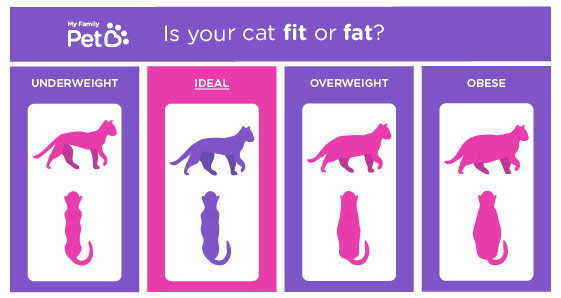
What is also interesting is how small they did not become. There are no mouse size cats. Such a creature would have to put up with a fair fight with the mice – rather than the easy kills the cats enjoy today. Yes, cats were decided to be the size of a human baby – almost exactly – a small mature cat weighing in at around eleven pounds. Picking up a cat and supporting the hind legs by cradling the arms, is exactly how human babies are carried. Cats and babies look up at you and then around the room from a this new view, in exactly the same way.

Warning to cat owners how cats explode if on the wrong diet

cat-weight

It gets more odd. Cats and human babies make the same high pitched screaming sound when requiring attention. Any one who has been accompanied by a cat in a car, on the way to the vets or next ‘forever home’, will know how deeply unsettling the cat will make the car occupants. The whining will be near enough constant and totally disproportionate to the level of comfort the cat is being afforded by the air conditioned, smooth, silent ride. ‘What is your problem!’ you will hear people say both to their babies and their cats. Ultimately, both species get their way, whatever the time of day or night.

Then I realised what was going on with cats. All of this ‘babyishness’ is a deliberate ploy to make humans think, unconsciously, that they are not cats, but babies. It’s a brilliant stroke of unnatural selection, to force humans to ‘take in’ cats – whether welcome or not.

My own experience of cats is that there is no system of choice or purchase when becoming a cat owner. A cat, somehow – from somewhere – turns up and demands entry into your home. Very soon the game starts where it explains to the besotted human that the price of stroking it’s fur is food – regularly and plenty of it.

And in this way, I extend the parallel between cats and babies (who also want food regularly and in vast quantities) to birds. Not just all avians but one species in particular. Can you guess?

‘Doesn’t he look just like his Mum?’

Cat Cuculus_canorus_chick1

Yes, it’s the cuckoo. Well the clue was in the title I know but you might have forgotten it by now. Yes, cats operate in the same way as cuckoos. The name for this technique of seeking foster parents for spare eggs is an ‘obligate brood parasite’. And the cuculos canorus is not the only one playing this game-for-the-innately lazy.

Mother cats push their brood out at some point; into the big wide world. Kittens on Facebook have unaturaly selected to look both frail and fanciable – a kind of Marilyn Monroe come hither look. ‘You want to prrrrrrrrotect me – Mr. Prrrrrrrrrresident’ delivered in husky tones before the high screaming begins in the kitchen post coitus.

No, I am not saying MM was a cat – although ‘pussy cat’ might be the right badge of honour – no, I am saying the kittens / ergo cats, are full on con-merchants, checking out every nook and cranny before calmly adopting a pre-dinner sleeping position in what was once, your private home.

I have four cats whom I adore, and every one of them – I now realise – has obligated itself into my home with the natural charm of a film star come used car salesperson. Thanks to the Ancient Egyptians or whoever first thought up ‘baby sized lions’ – half of the human race has become cat crazed.

The other half of humans? Well they have to own up to the fact that they have adopted a baby sized wolf-monster, that uses every trick in the book -like ‘undying loyalty’ to get the human to obligate as well.

Woof! woof!

The Fishdemic of 2020

big fish little fish

Once upon a time – like now – there was an Ocean full of fish. Over the years some fish grew bigger than others. Eventually there were seven large fish and millions of small ones. The big fish consumed most of the food and lived in the warmest and sunniest parts of the Ocean, leaving the small fish to live in holes in the coral and sea bed. Here they made as much of their lives as they could, but there was constant quarrelling and fighting for territory because they had so little.

The big fish were not happy with this ‘chaos’ amongst the masses so they thought up a plan to keep the little fish in their control. They decided to spread a story that the water was poisoned and the little fish had to stay in their holes and in the sand, to keep themselves and their families safe. To make the story realistic they showed the little fish pictures of hospitals full of little fish dying of poisoned water. This was something that happens all the time in the Oceans but little fish have no idea of how big the problem is and whether they should worry. So the big fish exploited this ignorance and employed scientist fish to show how plastic particles were in the water and little fish were dying. Each day the counter was displayed on their televisions of how many little fish had died that day. Up and up and up went the numbers and the scientists drew graphs to make the problem easier to understand.

The little fish obeyed the strict rules not realising that these numbers of fish die every year and the situation was unfortunate but normal. They stopped doing their work amongst the coral reefs and lived on whatever food the big fish let them have. They felt terribly sorry for themselves. They watched graves of little fish being dug in front of their holes, which was actually a clever plan by the big fish to frighten them more.

The big fish knew that when fish are frightened they are more likely to die and the whole sorry business became self fulfilling.

Eventually, after several months, the big fish allowed the little fish to come out under very strict rules. They took away most of the freedom that the little fish used to enjoy. If there were complaints, the big fish reminded them of how they had solved the problem of the plastic in the water and how arguing and quarrelling amongst the little fish had now stopped.

The big fish kept the little fish alive on crumbs falling from the warm and sunny surface waters where they lived. The seven big fish lived happily ever after.

I am

I am that, I am this, I am

There are three principle perceptions of the human mind. One is not ‘better’ than the other in moral terms, it is just useful to know how one works and experience mental and spiritual states objectively.

The first state of mind is the most common. It is the awareness of something other than self consciousness and is ‘I am that.’ It is the least real of all three and is summed up in the idea of ‘fantasy’. Like all human experience it can be positioned on a calibrated scale from weak to extreme. For example a person watching a narrative such as a film is fantasising, whilst also being aware of their own present mind and body. The fantasy is enjoyable. It fills the potential of unexplored human experience and is fulfilling in the regard of saving time, resources and often personal risk. Imagine watching a film in which the characters visit a wild life reserve in central Africa. There is an experience depicted by characters in the story; one or more of whom, the viewer will identify as being somewhere between ‘likeable’ and ‘I wish that was me’. They might sit in the evening around a camp fire and sing songs with the fire flies scattering in the flames and the crystal stars piercing the ocean black night sky. The roar of a hunting man-eating lion that has attacked several similar parties and is known in the area, sends them rushing to the safety of their vehicles.

I am Safari

This is a typical ‘I am that’ experience. Usually it is benign and is a willing and useful invigorating, promising stimulation to achieve such experiences ‘one time’ for real or just passing the time. It may add the ‘spice’ to an occupation such as those in ‘first responder’ roles experience. But in it’s harmful extreme, it is the illusion that drives a person to commit horrific crimes, such as mass shootings. The fantasy that they have nurtured for possibly most of their lives, finally overtakes their waking personality and they have to act out to achieve satisfaction. Acting out a fantasy is known as ‘psychosis’ and is so common that it is even a defence in law, though not a way of avoiding being withdrawn from society by the State. Humans acting out fantasy for real is not good and needs to be ‘enacted’ within an unreal place such as a modern gamer in ‘virtual reality’. The Ancient Greeks used the word ‘catharsis’ to describe the healing power of mentally exhausting the power of the fantasy over the rational mind, through theatre, songs and stories. Their stories such as Homer’s Odyssey remain powerful descriptions of the rudders, sails and oars of the human mind to this day.

The experience of such fantasy worlds is of course flawed in a very real and obvious way. The objection is ‘this is not you’ or ‘this is not me’ and that is clearly true. If the fantasy of being a world class athlete stimulates a person to become a world class athlete then the fantasy has worked as a transition tool, a stepping stone. But in modern society few get that chance. There is only one winner and one cup, one Oscar, one Nobel Prize. All the rest, in a competitive society, are left with unfulfilled dreams.

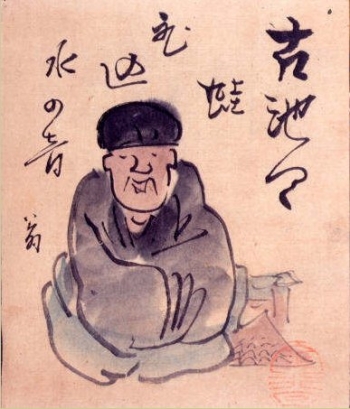
There is another state of mind which overcomes this. It is; ‘I am this’. This is a considerably more profound and rewarding attitude to personal experience. It gives no personal power to ‘the other’ whether these are other people or other activities or other places, times. The simple reward to being ‘I am this’, is realising that mind / personality has no real need to be other than itself. The reward is found in what one truly is. In this state of mind a Zen monk will relinquish identifying with possessions and social status, ‘cleverness’ in intellectual argument and most harmful of all, the allure of the other. Basho, the famous Japanese Zen poet and ascetic, was content with no worldly attachments;

The thief left it behind

The moon at the window

I am Basho

Because mind is realised as a totally personal experience independent of any other thing, the things that mind is not, are described as ‘illusion’ – or the dunna in Sufism, ‘samasara‘ in Hinduism.

The total clarity of ‘I am this’ can be achieved whilst wearing a pin striped suit, or two piece, driving a luxury car and living the a modern life style of ease. It is just that these objects and pleasures are not identified with as being any part of one’s higher self. They are as meaningless as the wind, because the person is continually aware and focused on ‘I am this’. Clearly having wealth and being detached from it, is more difficult than not having wealth and being detached from it. Ascetics have it easy and the Buddha realised this truth after nearly killing his body through starvation. He proposed a ‘middle way’ to truth without physical hardship.

This does not mean believing the fantasy of being a body. The sense of ‘this’ is so fundamental that it excludes one’s own body and body sensations. Buddhists argue quite rationally that if one loses a leg in an accident, one is still complete as a person – therefore we are not our bodies.

The was a song in the 1960’s by Donovan which included the lines;

‘First there is a mountain,

then there is no mountain,

then there is.’

This is a very clear summary of the states of mind being described. The perception of ‘that’ as being real, is seeing the mountain and all it’s mental and emotional associations. These associations are revealed as being mere ‘figments’ of imagination and not real; in which moment the mountain disappears. The relationship between viewer and viewed is realised as just a fantasy.

But of course, the mountain has done nothing through out all of this inner process. It has just done what it has been doing for millions of years – being a mountain.

This is the third state of mind summarised as; ‘I am’. The ‘I am this’ has been dissolved into the mist of the morning by the sun’s rays penetrating the dark night of the soul. The experience of life has become neither object nor subject. Things that were once held as real and true, never were and never will be. The only single experience is to become ‘I’ in the sense that the whole of created things and experience is identical and resonant to what human beings are.

We are not only created in the image of God, we are God and for suggesting this many a Sufi saint and Christian gnostic (Cathars, Templars), was flailed at the stake until death.

The irony was that such holy beings were never in their bodies in the first place and were laughing inwardly, no doubt, all the way to Heaven.