‘On those vast shady hills between America and Albion’s shore,
Now barr’d out by the Atlantic sea, call’d Atlantean hills,
Because from their bright summits you may pass to the Golden world,’
Excerpt from the poem ‘America’ by William Blake
From east to west and north to south there is evidence of a lost continent in the Atlantic Ocean named ‘Atlantis’.
I shall not go deeply into proving or disproving such a continent in this essay, as it is not the main focus. I shall only briefly consider the existence of a ‘Golden world’ in the remants in the landscapes that we see today.
In 1972-3, just as the ‘sleeping prophet’ Edgar Cayce predicted, archaeological evidence of an advanced civilisation was discovered off the coast of Bimini. Huge blocks of stone formed wide pavements stretching up to 1600 feet.
Map of Atlantis by William Scott-Elliott 1910; picture credit Wikipedia
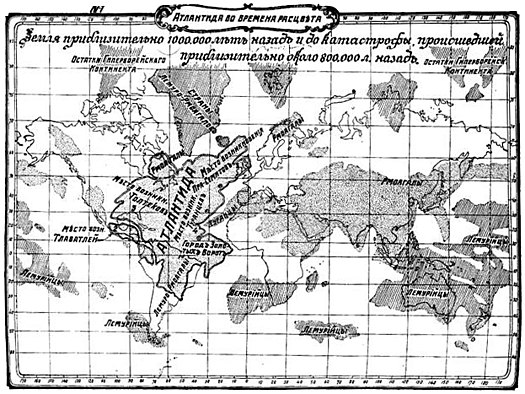
In July and August 1973 an expedition from Pepperdine University in California, discovered paved roads and broken columns in the Bay of Cadiz off the Spanish mainland at a depth of 120 feet.
Plato is perhaps the best known written source of a description of the lost continent situated beyond the Pillars of Hercules which were at the entrance to the Mediterranean sea.
When Atlantis collapsed into the sea amidst earthquakes and catastrophic seismic and volcanic activity, the survivors were those who were able to take to their boats; just as at Pompeii. If the Atlantean s fled in every direction we would expect their ‘footprints’ to appear around the globe and so we do. There are few other good explanations for the existence of pyramids on all of the continents unless they were inspired by one race of people with their own sophisticated knowledge of why and how to build them.
Less obvious, but still meaningful, is the existence of menhirs, dolmens, stone circles running along the western edge of Europe. One example is ‘chambered cairns’ which are large mounds covering narrow passages leading to a central circular room. These are found from southern Spain (Antequera) to the Orkney Islands (Maes Howe) and are identical in design, purpose and function.
The anthropologists identify ‘unknown’ ancestry to some peoples of the western Atlantic coast. One such group are the Guanche from the western Canary Islands. Sadly they are now extinct but records from the 15th Century describe them as tall, massively built with pale brown to white skin.
The people of the Basque country in northern Spain are equally out of place genetically, culturally, linguistically and even by having a rare blood group.
I shall leave this subject here leaving the reader to satisfy their curiosity further about Atlantis.
If we propose that much of the post apocalypse Atlantean knowledge was spread in each direction, in doing so it ‘flavoured’ existing cultures and we should be able to ‘taste’ that ancestry today.
In support of this supposition I shall present two ‘enigmatic hill figures in Southern England. I shall propose that the Atlantean knowledge came indirectly through the civilisation of Ancient Egypt. We know that there was trade in tin, gold, iron and flint between the British Isles and the Mediterranean in the ancient past and that the cultures such as the Phoenicians were expert mariners.
So should it be a surprise to find two ‘giant’ figures scraped into the turf of the chalk hills of Sussex and Dorset?
Giant Number One – The Long Man of Wilmington

The Long Man of Wilmington faces north on the escarpment of the chalk hills known as the Downs, near the village of the same name in E. Sussex, England.
The illustration shows the size of this figure and this should not be overlooked. The Ancient Egyptians also built statues of pharaohs which could only be described as ‘giant’ such as those of Abu Simnel and his Queen, near Karnak.
It is also interesting that the figure is stretched in proportion from head to toe, so that when viewed from below, the foreshortening effect reduces the figure to correct proportions. A similar graphic technique is used in the centre of football pitches for advertising today. The effect leaves the arms appearing too long like an ape but there was a reason for that.
This tells us that the figure was designed to be viewed from the ground in front and below the giant near where the village stands today and possibly where the Priory and Church are. This would have been a place where ceremony and rituals took place within the influence and power of the giant figure.
The other obvious feature is the two ‘staves’ or ‘staffs’ that the figure holds vertically in each hand. The staff is a symbol of office and power and a version of it as a crook was held by Ancient Pharoahs and Christian Bishops today. Aaron held a staff which had ‘magical properties’ for finding water and Moses famously turned his staff into a snake.
These Biblical stories describe a connection with the energy associated with underground and overground water. The nearby River Cuck presents a snaking path to the sea through a series of wide curves and ‘ox bow lakes’ often featured in academic books on Geomorphology.
As a young man I myself have used a divining rod to determine the directions and paths of the underground ‘water lines’ under the Long Man of Wilmington. The ‘water lines’ clearly describe the figure in a manner normally unseen. This opens the question, does the figure attract the water lines or the water lines attract the figure? As a dowser myself I will answer this by saying that the figure is attracting the water lines. Large ancient stones when moved, bring with them the water lines to their new position.
The hill figure is therefore a form of engineering using an as yet, force unexplained by modern science. Clearly though, this figure was designed to empower a community to bring it health and prosperity via a ‘deity’ or ‘god’ or ‘giant’ or ‘angel’ or ‘genii’.
It was only in Victorian times that ‘fairies’ were reduced in size to fit into butter cups without creasing dresses. In reality, nature spirits can be any size, from the size of an atom (from which bombs are made) to that of a planet.
The staffs may symbolise balance, as there are two held identically and remind us of the two pillars at the entrance to King Solomon’s Temple and the symbolism of these valued so much in Freemasonry. They represent the sun and moon or male and female qualities of nature.
An inference to the tools of the acupuncturist is appropriate, since the penetration of the earth by staffs and stakes, stones and monuments is analogous to acupuncture and it’s aim of harmonising energy imbalances and stopping energy leakages.
The earliest dating of the figure accepted by modern archaeologists, is Roman, on account of a similar figure being found on Roman coins. Having said that, the figure of a person holding two staffs or snakes in a similar manner is common throughout the Ancient World.
It is clear that the figure contains few other clues except one important one which is easy to miss and has been the subject of some academic controversy. The question relates to the direction in which the figure of the feet point. A paper entitled ‘The Long Man of Wilmington‘ by E.W. Holden from the Sussex Archaeological Collections Volume 109, 1971 comes down on the side of those who believe the feet correctly both face in one direction.
A whimsical thought came into my mind which is the song title ‘Walk Like and Egyptian‘ from the 1930’s when Prince Tutankhamun had made a reappearance and was influencing taste and design in popular culture. It is noteworthy that perspective was not used in representation and art until the Renaissance in Europe.

Almost all Ancient Egyptian representations of figures are two dimensional and show feet both pointing in one direction. This is clearly no proof of a link to Ancient Egypt but it suggests a connection that may be corroborated by other facts. The first such suggestion is that we see the same depiction of feet in the next figure, the Cerne Abbas Giant.
Giant Number Two – Cerne Abbas, Dorset, England
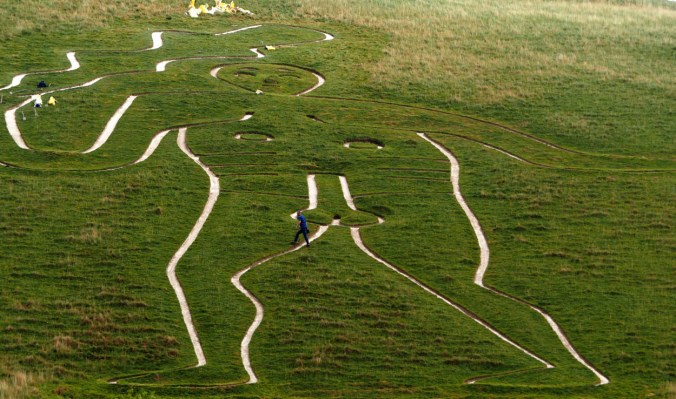
The ancient Cerne Giant at Cerne Abbas, Dorset is having a make-over. Dozens of volunteers and local families have been invited by the National Trust to help reinstate it on the steep hillside. The edges are trimmed and fresh loads of ground up chalk pounded into the markings. It is famous for having its manhood on full display.
All along the chalk hills that stretch from west to east in the south east of England, hill figures are found. The most notable example is the Giant named after the village of Cerne Abbas. He faces west, measures 180 feet (60m) from head to toe and like his Wilmington cousin carries a staff, which he waves this time above his head in a war like manner.

Guy Underwood dated this figure as about 4000 B.C. As can be seen in the diagrams from his book The Patterns of the Past p150, the shape of the figure corresponds with the hidden ‘aquastats’ or energy lines associated with underground water. Above the figure is a rectangular enclosure formed by ditches and mounds. This was possibly used as the meeting place for pagan communal worship and celebration at sacred times of the year. (Contrary to negative propaganda, Pagans are great believers in the family and communal living to produce a harmonious life style respectful of the energy and forms of the great mother, nature.)
If we examine the figure from the top down, the club has the appearance of being made of wood and it’s purpose warring. The arms are outstretched horizontally much in the manner of the Long Man of Wilmington.
The most notable feature of the figure is the erect phallus and perhaps the club is an echo of this also. Local traditions celebrate this overt sexuality such as that if a girl sleeps on the Giant she will have many children. Also it is said, that if a girl walks around the Giant at night she will have a happy marriage. The figure is therefore representing energy and power in a very demonstrative way that country people through time would have understood and respected.

If we accept the premise of a force of nature as yet unmeasured by modern science but recorded in structures for thousands of years across the world, then the Cerne Giant expresses the sexual designs of nature that literally makes the world go round. The feature known as ‘the Mound’ at the same level as the phallus in the figure is to me an erect phallus viewed sideways, giving another sacred feature and area for this power to express itself and interact with humans. It is important to note briefly that this sexual energy, (celebrated as Tantra in the East and the Karma Sutra it’s most famous reference book) can be directly converted to sacred energy within the human body.
As we move down to the feet, again we have the clue that they are two dimensional and both point to the figure’s right, in the manner of the ancients such as the Egyptian figurative artists. Giving a side view of the phallus also shows a need to express a three dimensional form on a flat plane.
The arrival of Christianity came in the form of St. Augustine with missionaries to convert the pagan inhabitants of Cerne in about 700 A.D. Their hill figure we might expect would have shocked the saint as a demonstration of the natural forces that the local people engaged with. He was mocked by them and they tied cow’s tails to the missionaries garments and sent them away. In return the saint put a curse on them to the effect that their children should be born with tails in the future. As he did this a fountain of crystal water appeared and he started to baptize the people and eventually founded Cerne Abbey.
Such an important figure as a saint who practised a form a magic as curses and water divination brought the pagan god into the modern world where profane images are forbidden. Was there a general fear of the unknown and the forces of nature within the landscape? The Christianisation of the sacred landscape by the imposition of Christian buildings declared a new world view based on the crystal clarity of love rather than lust.
What do they Mean?
Both figures describe quite literally the underground energy of the two places they inhabit. They are both local minor ‘gods’ or ‘spirits’ that inhabit a sacred place. They share their powers of fecundity and healing with the local people proven by the reproductive cycles of animals, crops and humanity.
To the sensitive this energy comes as both male and feminine, in the manner that electricity is describe today. The two forces can be kept apart to create a potential difference but ultimately they strive to be drawn together in balance and harmony.
The Long Man of Wilmington describes both of these aspects with the two staffs stretched equally apart of the vertical form of the body. This is most common stance in ancient times and is recorded by many civilisations across the world. It is not proven but a possibility that the Ancient Atlantean race were either familiar with or originated this stance. Their ‘golden world’ of Blake’s vision would have been built of matter and energy in a way that these simple hill figures resemble.
The Cerne Giant is in my view representing the male or positive aspect of this power and is a minor god of considerable power – so much so that the Church had to intervene to contain it. The presence of ribs in the figure, the reference to the spine and the extension of the tail in the human body, could be an occult pagan reference. The Pagan Tree of Life is central to their belief and worship and the human upright form is a representation of itself as a tree. Energy flows through the human body from the base of the spine to the top of the head, connecting earth to heaven through the human form as a kind of ‘fuse’ or cut out.
Alchemical depiction of the Divine feminine balancing the energies of the sun and moon.
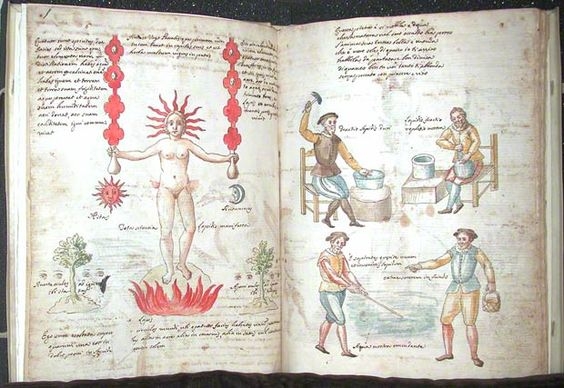
At their inception both figures represent the minor god or spirit who inhabits the place. The god or spirit is attracted to the pervasive energy of the place to fulfil it’s own spirit and in turn, the spirit of the natural world and it’s inhabitants.
In Ancient Egypt, one of the principle gods, Osiris was murdered by his son Seth and his body parts scattered. His wife Isis set about reconstructing the body and found all the parts but for Osiris’s penis.
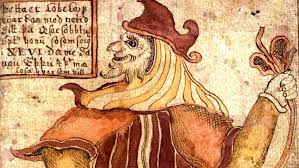
A Roman depiction circa 400 A.D. of Seth with the head of a donkey and staffs.

In a metaphoric way, we might surmise that the ancient language of form and energy mastered by our ancient ancestors, lives on in the remains scattered across the world’s landscapes today.
Many are still energised, some are being re-energised by mystics and seers, and some remain undiscovered.
We live in a time when the power of these ancient gods or spirits are re-emerging. Both the natural male or positive power that brings about change – sometimes through war and conflict as in the Cerne Giant – and the natural feminine power that brings about nurturing, renewal and growth.
At few other times in history has mankind needed the intervention of the natural forces that it has shunned and even destroyed, through exploitation of the natural resources of the planet.
The people of Atlantis reached a similar apotheosis as our own. In the end of their civilisation they were at war with each other and perverted the natural forces to their own self centred ends and pleasure seeking.
In the manner of the Old Testament, they were overwhelmed and destroyed by the angry and vengeful forces of nature. Their continent sank into the ocean and their vane projects destroyed just as could happen in the twenty first century.
There are places for us to visit and pay homage now. To find the ancient power of nature in the sacred places of the landscape and to bring it into our lives through prayer and worship, much as the ancient people of southern England were able to do – perhaps as a memory of our common ancestors – not only the Atlanteans but the whole human family.
And as all glimpses of the past teach us, these are not our times. The two hill figures described are both male and reflect the creative male energy that was forming the societies and consciousness of that time. Further away on the other side of the Atlantic the Navajo Indians had another figure to revere, Changing Woman.
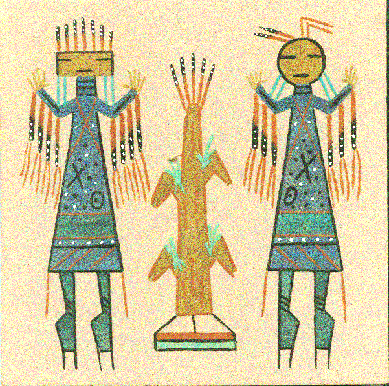
One of the primary characters of Navajo mythology
and religion is Changing Woman who grows old and
young again with the seasons. She represents the
power of the earth and of women to create and
sustain life. Other Holy Women stand at the four
directions: in the East is Earth Woman, in the South
is Mountain Woman, in the West is Water Woman, and in the North is Corn Woman.
Source www.nativeamerican-art.com
The present time is in need of this feminine energy to rebalance the eons of cultures in which the masculine principle of war, metal work and Kings were supreme.
The energy coming from Ancient times now is the Divine feminine that embodies rivers and seas and soft landscapes, water meadows, calling birds and the gentle people for whom love of nature and mankind is supreme.
We can learn from the Atlanteans, who by their mistakes of tampering with the masculine Divine, created an imbalance and brought about their own destruction. The energy of the feminine Changing Woman is calling us now and our ability to respond will be the measure of our success as a species.



 Matters Blog