Is There Anybody There?

A ghost walks into a bar and asks, ‘do you serve spirits?’

Humans have currently been obliged to believe in invisible beings, viruses. We believe that the Corona virus is everywhere as if it were a spirit. The only difference is that with a microscope you can see viruses and know that they exist.

The similarity of this belief to the ancient understanding of the spirit world is uncanny. Modern science has not been able to prove ‘spirits’ exist, therefore we are encouraged to believe that they do not. But logically, not being able to prove something exists, does not prove it does not exist. Perhaps the observer has the wrong sensing equipment or it is not sensitive enough, or too sensitive?

If we take a more rational approach, based on the acceptance that what the ancients believed, may still be true today, we can explore the existence of spirits further.

A friend of mine found himself, many years ago, in a monastery in Tibet. He casually opened a cupboard and was shocked to be staring at a human skull. He closed the door hurriedly and moved on. He returned the next day but the skull had been removed. Had he been seen by a spirit in the skull? The Sumerians of 3250 B.C kept a spirit in their homes, tempted there to occupy a statue, figurine or sometimes – a human skull.

I recently watched the ‘Magic Flute’ by the Master Mozart. The music is wonderful but my principle interest is the story. The first scene in Act One shows three witches destroying a serpent that has captured the hero, Tarantino. The opera sends him through an initiation process from darkness into light. He is able, when necessary, to annul the influences of evil spirits by playing a magic flute.

My own interpretation of the flute is that it symbolises the energy centres of the human body known as seven chakras. The flute plays a seven note scale by vibration of a column of sound and is similar to the hollow human spine in it’s construction.

Such control of energy within the human chakras affects our moods, feelings, physicality and state of mind. When mastered the adept in Tantric Yoga completes the journey from darkness into light.

Tarantino’s companion is a humble bird catcher. He represents the ‘ordinary’ man who goes through live mechanically. He fails the initiation tests preferring wine, women and bird song.

Let us move on to consider spirits outside of the story book, real live spirits. They love to do human things and are generally envious of the joys humans have from living in a physical world. The ancient Greek gods appeal to us because they behave as badly as humans. Lepricorns and other nature spirits adore dancing in rings in the moonlight to fairy fiddles. They look into our dimension with envy for they too enjoy nothing more than ‘wine women and song’.

Just as the ordinary human is enslaved by the five senses, so are spirits enslaved to us. The Genii in the story of Aladdin is in service, not a master. But secretly they long to occupy our living bodies for the same reason that God created the physical world – experience of physicality.

Sometimes they do – when someone is intoxicated for instance; which is the esoteric reason for alcohol being forbidden to Muslims. An intoxicated person often changes character quite noticeably and their bodies have super human strength, causing the North American Natives to name alcohol ‘fire water’.

Carl Jung concluded at the end of his life, that psychological complexes were outside of the human mind. When someone is ‘not themselves’ we should take this quite literally. Many Shamanistic rituals such as Voodoo, concern the removal of malign spirits or the placement of unwanted spirits for malign effects. Even modern Christianity has continued belief in the efficacy of exorcism and certain sensitive priests are trained in it’s practice. If it did not work, surely it would not have continued into the present day.

When a spirit is invited into a body as a Faustian ‘pact with the Devil’, the human party assumes magical powers. They may use these powers for entertainment as a magician or more worryingly, to gain political power. Should we accept the extraordinary rise of Adolf Hitler in 1930’s Germany as at least in part, being due to his thirst for occult powers? Why else did he send expeditions into Tibet and Antarctica, if it was not to gain occult power?

You might wish to believe that the modern psychiatric view that external beings are manifestation of our own minds. A vision of an etheric being by a single observer may occur when there is a conflation of the inner and outer worlds in that persons perception.

‘That way madness lies’

To which my reply is both yes and no. Yes, because all of our perceptions are no more than stimulus, decoded by bodily senses, into electrical pulses which are streamed into the brain. They are no more real than the images on our television sets are real. No, because the Universe is so large that there must be consciousness outside of human minds.

Part of the vanity of humans is the conscious or unconscious belief that we are alone. If we have never seen a spirit then it does not exist, is the false logic. It is false because there are many things we do not see that we use everyday. Our eyes only perceive a small part of the electromagnetic spectrum. We use infra-red ovens in the kitchen without a thought of whether infra-red energy exists. We use the effect and that is proof enough.

So it will come as a shock to humans when beings from other planets in our galaxy, appear on Earth, shaking the hands of heads of State. In doing so they will also shake the belief systems of every society, family and individual to the core. Present dogmas of belief whether in religion or politics or science, will be realised to have been at fault all along. For this reason governments seek to manage the time and place of this information. But it must be revealed and I sense that the present pandemic is building a global consciousness of cooperation that has never existed in history.

Accepting that consciousness exists outside of the human body, whether in spirit form or in another corporeal body, is the next step for humans.

The Old Testament describes how our forefathers experienced gods thousands of years ago but like the magic of the micro wave oven, they did not understand the causes of the manifestations.

Ping

Instant Experts

As knowledge expands through the centuries and decades, one might be forgiven for believing that, eventually, all that is possible to be known, will be known. It might be as a new dam which, after much rainfall, is full.

But like all oversimplified analogies, this one is flawed. As scientists discover more, they discover an infinity of new things. They have a job for life, for their subject reveals more, the further they explore. Hikers experience the same as they approach the apparent crest of a hill, only to discover more peaks beyond, what they call ‘false horizons’.

So, why are modern societies so confident? Well it is my contention that there is a part of the human psyche that is uncomfortable with the idea that it has only partial knowledge. I am referring to the ‘ego’ or ‘small self’. Ego’s have a tendency to take the easy route in life. They are for ever looking for the reward which requires little or no effort. Even dedicated scientists have been known to falsify their observations to promote their theories.

The present adulation of ‘celebrities’ in modern cultures is an example. An ordinary person, as we all are, may become celebrated for winning a competition or race or athletic achievement or something as banal as singing a song. The media and social glitterati turn on this flash of ‘success’ like sharks triggered by the scent of blood. The sometimes reluctant but usually eager victim, is propelled into a new world of abundance and admiration. Parties, limos, sex, money, drugs, interviews and media celebration all describe a voyage from the ordinary into an inflated fantasy world.

The truth behind this ‘yellow brick road’ is that this ‘celebrities’ are no different to any one of us. The only way out of ‘celebrity’ has sometimes sadly, been suicide.

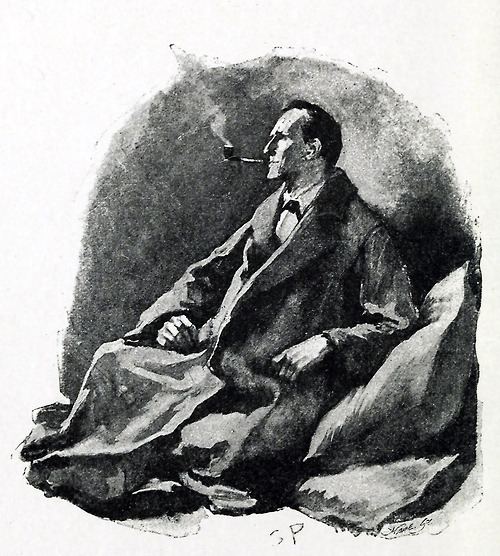
Many fictional characters encapsulate the myth of ‘knowing all’ and the power that brings. A well known example is Arthur Conan Doyle s detective, Sherlock Holmes. Mr Holmes has a super human gift of observation and deduction which puts him way ahead of those not so empowered. Holmes is what today is called a ‘super hero’ because he wins every fight, whether physical or mental. He represents an aspect of the ego that all egos aspire towards; to triumph in every endeavour. When Holmes succeeds again and again, we are programmed to believe that this ‘hero’ is indomitable, all knowing, all conquering.

But Conan Doyle was clever enough to make the character of Holmes in some way, fatally flawed. Holmes lacked emotional intelligence and perhaps compensated for this by using drugs. Even the Ancient Greek heroes such as Achilles, demonstrate after many victories that no person is perfect and die at the hands of their adversaries.

We would do well to remember this today as we observe a new cult of ‘knowing all’ emerging. The true experts in a subject, such as academics and professional practitioners are being degraded as fast as the fools are being upgraded.

Whether you are talking about Presidents or Street Cleaning Operatives, people are being persuaded that they possess the super human powers normally reserved for ‘the experts’.

This illusionary level of confidence has even infiltrated the curriculum in schools. Children are being promised elevated careers way beyond their abilities. The premise appears to be that anybody is capable of anything. If this were true then only the top jobs would be good enough for young people. Filled with false expectations, they go willingly to University and pay for the privilege. At the end of the course, as their application forms are returned from the promised ‘top jobs’, they finally are given a spoonful of reality.

It is an old adage that ‘a little knowledge is a dangerous thing’ and yet this truth is forgotten or ignored today. Persons are deciding to build their own houses and argue with their architects. They diagnose their illnesses and argue with doctors. They become international Statesmen based on bluster and the blood of others.

The origins of this illusion are those employed by the ego when things begin to go wrong; deceit, threats, grabbing, bullying and other methods of gaining power over others. Many dictators today have achieved their position through these means. They continue to use them to remain in power for an indefinite period with extraordinary self delusion that the people like them. Any challenges are fought with a ferocity of a cornered animal for indeed, such people have cornered themselves by taking a false and harmful path.

The was a study by two academics which observed what is termed the ‘Dunning Kruger Effect’. The crux of this study is that people do not understand that they do not know things. It is the nature of how humans acquire knowledge and associated skills that in the beginning they find the subject rather easy. It is not until much later that say, a surgeon, realises the hidden risks, false avenues and areas of the unknown in their specialisation.

People who are not trained initially acquire a false confidence simply because it is impossible for them to know their short comings. A couple building a house might proceed with crayons and a cornflake packet to design their ‘dream house’. They sink their entire savings into the project. As the build progresses they make mistakes that are hugely costly and are driven into deep despair. These mistakes are of course well known pitfalls to professionals and would have known how to avoid making them.

Life teaches us the hard way for the arrogance of the ego by cutting us ‘down to size’. False pride and self confidence built on self deception, succeed in the beginning but slowly the mistakes and falsehoods creep in.

In life we learn that there are no true heroes. We are all vulnerable in our weaknesses and only become strong when we realise this. Instead of being a ‘know all’ we are better advised to ‘know how little we know’ in other words, adopt humility in everything we do.

Until our prizes, awards, honours, celebration, adulation, high office in affairs of state, are given to the meek rather than the bold, society will have the ‘instant experts’ and flawed heroes of that it deserves.

Real heroes are those who work within their limitations and admit mistakes or ignorance. They may not even achieve very much but what they have done has been done honestly.

Listen carefully to your politicians and leaders and see how often they express realistic aims tempered by humility. When a leader promises all and rarely delivers or admits to mistakes, use your vote.