In my blogs I am often critical not of individuals but destructive thought patterns in common use. Thoughts have a life of their own both literally and metaphorically.
I shall ignore the former for now, and we are left with what Professor Carl G. Jung called the ‘collective unconscious’. This concept distinguishes the aptitude of a group of people to have shared unconscious awareness, similar the collective movements of a flock of birds. Sociologists who have studied the actions of rioters note how humans can act with a common purpose, which is part of the legal definition of ‘riot’. More worrying is that individuals are susceptible to consciously break personal moral codes – such as ‘thou shall not steal.’

I witnessed rioters in the Brixton area of south London in April 1981 running out of shops through broken display windows carrying swathes of clothing and other looted ‘goodies’. They were almost certainly not checking clothing sizes or colours when grabbing stuff…they just wanted to steal.
At the present time the news channels are reporting riots in cities around the world. Large numbers of people have decided not to be vaccinated. This has been respected up until now but governments are getting frustrated by the numbers of Covid cases continuing to rise. Vaccination is seen as the solution to disease control even though vaccinated people still spread the virus by touch and in their breath, and vaccinated people are being admitted to hospitals. The principle benefit of vaccination is that you are less likely to die. This is incentive to the individual and managing beds in ICU’s.
What governments principally want is an end of the pandemic – an objective almost certainly shared by 99% of the population. You might ask the question then, ‘if they agree, why are they fighting?’
The problem lies as always in the detail. Generalisations rarely reveal the truth but rather hide it. Is it not absurd that the government representing the people – fights the people? It is not absurd that some people ( whether the majority or not ) disagree with the methods by which the common objective is achieved.
This is the classic ‘the end justifies the means’ thought pattern.
‘Morally wrong actions are sometimes necessary to achieve moral right outcomes’. Wikictionary
The riots in Brixton were race riots by a young black community who felt they were not being given the same opportunities as other races.
They must have been thoroughly committed to their perceived morally high aim to risk skewering their life chances with a criminal record.
The question will always remain in any circumstance, what is the right thing to do?
In order to prevent ‘loss of life’ police in Holland, in the last few days, have been shooting protesters with lethal firearms. For their political masters, this method of achieving fewer deaths by Covid infection justifies the potentially murderous means to control of the population.
In the Western liberal democracies, individual rights of personal choice and freedom have been enshrined in human rights and other laws for decades, whereas the opposite is true in autocratic regimes like communist China. Should we be surprised that personal freedom symbolised by the ‘vaccine or no vaccine’ debate is held aloft as a morally high aim by Western individuals?
‘Actions can be considered right or wrong only in consideration of the morality of the outcome’. This extract from Wikitionary’s definition brings in another twist to the ends and means conundrum. How extreme can you go doing bad things to reach a good thing?
The answer for some is that humans can choose to go as extreme as they want. Terrorists who the night before are stroking their purring cats, will decapitate a human in pursuit of their ‘noble’ political aim, such as creating an ‘Islamic State’.
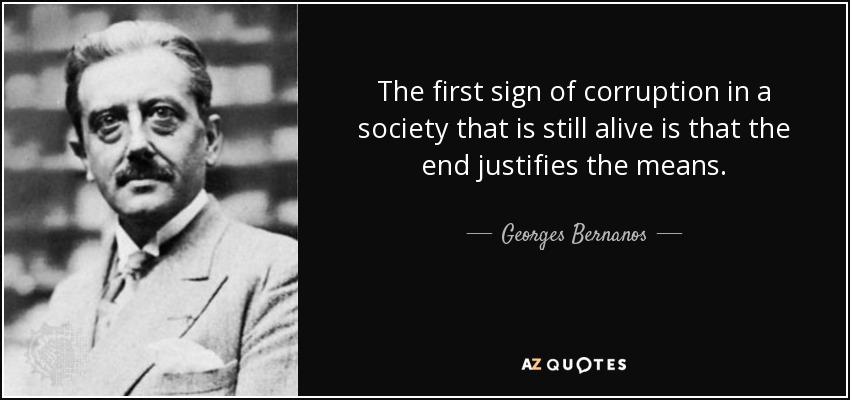
The most hideous of deeds appears to be justifiable in the human mind when ‘a good cause’ is the objective.
How can this stupidity be tolerated? Surely a sense of proportion and restraint should always be part of our understanding? A violent act is disproportionate to an action which is not violent.
This introduces the concept of ‘justifiably’. You might question whether the late Nelson Mandela was justified to commit terrorist acts in support of a political aspiration, acts for which he was jailed. Clearly public opinion changed over the decades as his political aims – the ANC to govern – became reality. He and his comrades were lauded as ambassadors of peace and released and accelerated to high political office.
The other day in the USA, a defendant was found not guilty by a jury of murder of two men and wounding a third using a gun. His defense was ‘self defense’.
Few people – even those untrained in law – will argue against a citizen’s right to defend themselves. It must be one of the most basic of human rights to preserve the life of one’s self…a suitably high moral mountain from which to also defend oneself from criticism.
And yet the most important nuance is being ignored which is – was the level of violence used in the act of self defense, proportionate?
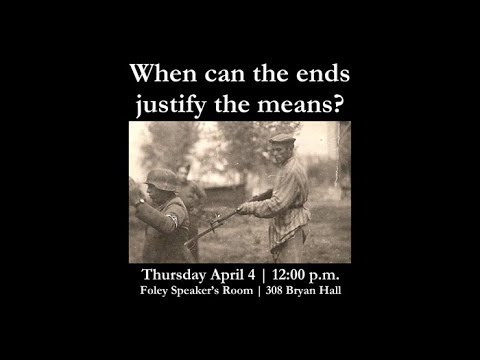
I do not know about the case in the USA however I am baffled as to how a young man under 18 (a child in UK law) is able to be trusted with a lethal firearm and carry it in public at a political demonstration. I am also baffled as to how three men could approach this young man in such a way that the defendant thought they were about to kill him. Were they pointing guns at him? But most of all, I am baffled as to how the accused was able to kill two men and wound another without suffering any injuries himself. Were they unarmed?
In the United Kingdom the legal definition of self defense includes the measure of proportionality. So if someone attacks you in the street with a folded umbrella you may use your umbrella, and even your ‘Avengers’ bowler hat as well, to defend yourself. You may not pull out a knife to defend yourself an umbrella attack. This law is extended to private places so that if you should come across a burglar in your house you cannot shoot them.
I once confronted a burglar in my house when I was working as an architect in London. I used extreme verbal force which clearly scared the hell out of him. I was pretty confident in Shotokan Karate at that time and I had the option to floor him as he ran passed me to jump out of the window. But I was concerned he would fall on the radiator, hit his head and die. So instead I picked up the phone and called the police. Being an artist, I also made a pencil sketch of his face which I gave to police when they arrived. This later turned out to be a ‘dead ringer’ for a suspect a few weeks later.
My point is that proportionality is the greater part of the choice to justify an action. The end is like any future event; open to change and rarely achieved first time or in the expected manner.
We live in an increasingly fake and simplistic world. Public debate and political leadership is being reduced to three word slogans.
Thinking rationally is under threat in my view. If we lose this we will lose our freedoms and our democracies and accept whatever extremity is imposed upon us for ‘noble’ political aims.
The word has always be mightier than the sawn-off shotgun. May it always be so.
 Matters Blog