‘Shake the tree and not the branches‘
Philosophy is the study of tree trunks whereas much of the activity in the modern world is to do with shaking branches. Few attempt to shake the trunk of the tree as advised by the old proverb.
Grasping this concept will make you a philosopher. Breadth of understanding is akin to wisdom because it understands how things operate in their generality. Details fall into place once the correct concept has been initiated. A journey is started by selecting the road.
As a consequence of this ‘universality’ of truthful thought, we should understand what ancient people’s understood about the world – even though they lived millennia ago. Whilst the archaeologist are studying the shards of pots, philosophers are walking in the Palace of the thoughts of those who used them.
For example, the Trinity is a concept as old as the mountains and deserts. Long before the Christians used ‘Father, son and Holy Ghost’, something universal is described by the Trinity. It appears again and again in history as how a complimentary duality creates a mysterious third.
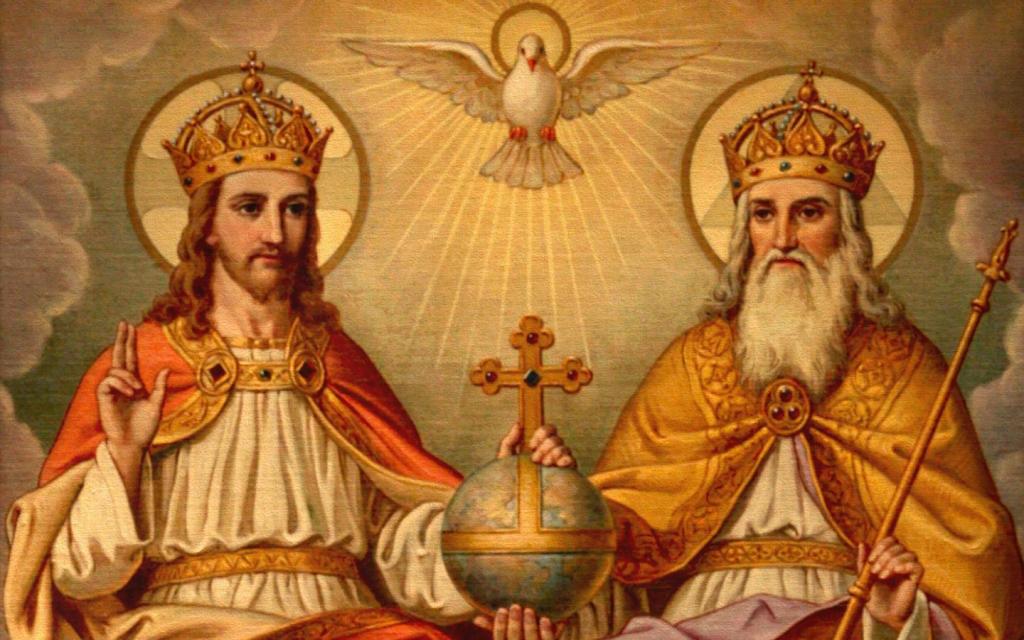
Pythagoras said the numbers are the first thing in nature. The number ‘one’ multiplied by itself, is one, and divided by itself is also, one. It is therefore a very unique expression of the fundamental reality of things. It is the Unity or ‘Godhead’ from which all other numbers are made. It anticipates what in theoretical physics is known as ‘the point of singularity’ or the original source of Creation at or/and, just after the apparent begining of all things.
Next, the One divides itself and creates duality. If the oneness is the perfection of the garden of Eden, then two-ness creates opposite and complimentary systems. The duality of ‘God’ and ‘Adam’ was the splitting of universal perception that God created to know Himself. To understand something it must be viewed from without as well as within.
In geometry, any two points can be connected by a straight line. These two points will always have the potential to be connected by a straight line but only on one spatial plane; meaning, able to move in any direction but not up or down.
We see this expressed in the two dimensional graphical representations of the perceived world in Islamic art and decoration.
The understanding of the triangle as the compilation of the concepts of both one and two, was in my view, one of the greatest achievements in understanding by mankind. Any three points will always make a triangle, a magic formula by any measure.
Both ancient Mayans and Egyptians, understood geometry and it’s value in describing the essence of things. They expressed this most memorably as a three dimensional square pyramid. This shape is so fundamental that it is easy to overlook and become distracted by the infinite and fascinating detail contained in their mathematics and cultural symbolism.
Archimedes famously discovered that the volumes of a cone sphere and drum have volumes in the ratio of one, two and three.
These are no longer puzzles in school exercise books, created for children to repeat without understanding. These are the building blocks of our perception and therefore understanding of the universe, as limited as that may be!
The Freemasons inherited much of their ancient knowledge of how thoughts and things are put together and work. Geometry is most perfectly expressed by buildings. The great medieval cathedrals of Europe continued the expression of geometry and measure contained in these ancient temples and pyramids around the world.

Freemasons represented the power of the three dimensional pyramid as the ‘Eye of God’ or sometimes the capital letter ‘G’. This is found today on the United States dollar bill. A pyramid built in thirteen courses, (twelve plus one – Jesus and his disciples) is topped by an Eye floating in a detached pyramidion. The concept of the ‘fractal’ or ‘all is One’ is expressed so simply that it could not be plainer to see.
The geometric trinity of space, as we experience the physical world, is made infinite and mysterious by a fourth dimension…time. Time is expressed in the physical world as ‘movement’; describe by the polymath Jean Cocteau as ‘the most beautiful thing in nature’. Time is created by man in an attempt to measure movement and like all such attempts may be mere illusion.
Ancient people were intimately connected to the apparent movement of the stars and planets and were able to measure and therefore, predict planetary movements and positions relative to each other and the sun; solstices, equinoxes and other astronomical events. In doing so, they were gaining an experiential knowledge of the Divine or sacred within and without of the physical world. They even joined the ‘dots’ of the stars to make meaningful patterns which today we call constellations. The passing of time was measured as ‘months’ as the twelve constellations of the Zodiac appeared on the horizon for the first time. As different energies were associated with these appearances the ancients knew auspicious moments for human activity which will end well.
The great lines of monoliths, menhirs, cromlechs, dolmens are reminders to us today of how magic is contained within this geometry, meter and movement. It is a magic that powers everything, that we know and experience.
If we are to understand ourselves and thrive on this planet, as did millennia of ancient Egyptian dynasties and Mesopotamian dynasties, we must follow truths that our ancient ancestors expressed and left for us to interpret and understand. The answers to life’s questions were written in stone in order to be ‘flood proof’ for they had an ancient universal memory of ‘the Great Flood’ and catastrophies further back in time.
The simplicity of geometry is akin to the simplicity of truth and how the world is merely a mirror between the smallest and grandest of scales. Add to that our tiny planet’s complex spiralling movements through space and time and other dimensions beyond and the simplicity of one, two, three can be lost – but we lose it at our peril for we are simple creatures of ‘little brain’ as followers of Pooh Bear will understand.
 Matters Blog