Seeing is Unbelieving
There is an intriguing eye test in which the subject looks at a cross and black dot spaced out on a sheet of paper. As the paper is drawn closer, whilst staring at the cross, the black dot disappears.
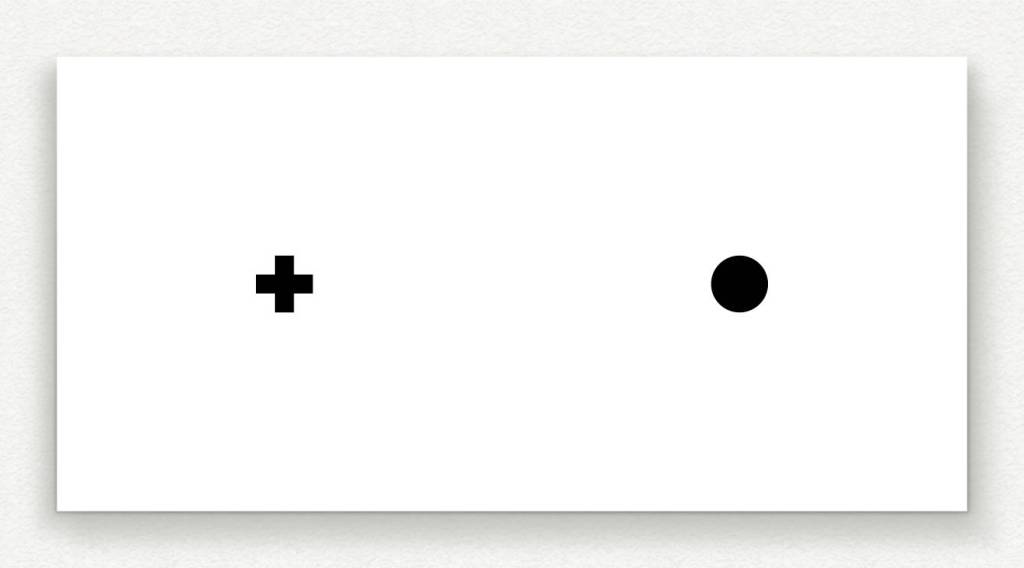
The explanation we know to be the ‘blind spot’ in the retina where the optic nerve enters and fans out. What is intriguing is that the brain is constantly filling in this ‘blind spot’ with information that we are not aware of.
It is the same with white ceilings. If there is a blemish or a stained patch, the brain will ‘see’ the ceiling as perfectly white. What we see is therefore, in some degree, doubtful.
Perhaps it will help us if we define ‘seeing’ and ‘looking’. Most of the time we ‘look’ without discernment. If however we focus our mind on what we are looking at, more information and understanding will become apparent. Artists learn to ‘see’ in order to render every aspect of the subject they are describing to an extraordinarily high degree.
The visual apparatus of humans can be trained, but we should also realise that what the brain does with the information is highly selective.
When two soccer teams play a match, the supporters identify with their own team. If there is an incident where the referee has to make a decision in favour of one side or the other, both sets of ‘witnesses’ i.e. supporters, will be highly biased towards their own side. They will talk about the incident and the injustice of the referee’s decision for weeks afterwards, based on their own biased view.

The Nutmeg News
Witnesses in criminal cases are notoriously biased and the justice system has to record what they saw as objectively as possible. When two witnesses present differing versions of events, which is the truth?
In one extreme case when people on a bus witnessed an incident in Israel, the police used a hypnotist to access what they saw in extraordinary detail. Our brains retain most of what we see, it is just that we blank most of it out unconsciously. Hypnotism retrieves this information in an unbiased way, so that for instance, car registration plates will be remembered.
Unfortunately, we do not have hypnotists to solve our family arguments about who said what to whom and how long this has been going on. Neither do whole nations have access to truthful descriptions of what is going on in the world and dictators exploit this.
It is possible to create a narrative so extreme that it can even be used to start a war with a neighbour. Witnesses to events in the war, even professional reporters, are today regarded as suspect in their reporting because even the media can either intentionally or unintentionally, select the truth according to their editor’s wishes.

Even the photographs and videos are no longer able to be trusted as software is available to alter them.
All of this happens in what we call ‘the physical world’ but of course what we see is not always physical. Take an audience watching a film in a cinema. They are certainly not watching anything ‘real’ in the conventional sense, but they will be completely transfixed by the narrative being played out before them. There may be some self awareness retained as the popcorn in handed around which is similar to the way hypnotised subjects experience what they are viewing, but their focus is mainly in a virtual reality.
Hypnotised subjects reveal much about the complexity of how visual information reaches the mind and how it is interpreted. There is one case referred to in Michael Talbot’s book The Holographic Universe, in which a man is hypnotised and told that his teenage daughter is invisible to him. She stands in front of him and much to the delight of the audience and his giggling daughter, he swears he cannot see her. Then the hypnotists takes out a unique watch and presses it against the back of the young lady. He asks the father details about the watch which he squintsat and reports correctly everything he is asked about the watch.
There is no explanation for this phenomenon, but clearly it shows us that what we see is far more extensive and complicated in it’s mechanics than the diagrams of the eye that we study at school, explain.
In a lifetime a person may experience visual ‘discontinuities’. These generally fall into the concept of ‘extra sensory perception’ such as seeing ghosts, spirits, poltergeist events, psychokinesis. Lorna Burne is a modern mystic who has written books about how she has seen and interacted with angels and archangels since she was a child. Her whole visual world includes angels and spirits which the ‘ordinary’ observer is completely unaware.

Is it right to dismiss those with ‘second sight’ and their experiences or should society be more tolerant and inclusive towards people who in historical times would be regarded as either saints or witches?
Ironically, history has always taught us not to believe our eyes. The whole concept of an invisible God enables us to ‘look inward’ into our hearts and minds. A God who is never revealed is not open to be disproved or proved and yet, humans have sustained the experience of the ‘godhead’ across aeons and continents. The ancient Greeks experienced a world in which minor gods revealed themselves to mortals, and their stories, artefacts and architecture give vivid and consistent accounts of each and their powers to help or obstruct human endeavour.
The Ancient Greeks also believed in the idea that the eye ‘sees’ by projecting energy at the subject in the manner of a torch in a darkened room. Mind was an integral part of the process of seeing to the extent that the observed physical world is capable of being created by the observer.
Quantum physics has rested it’s gaze on exactly this probability; that the observer alters the events that take place right before our eyes. It supports the ‘idealistic’ philosophy in which mind has control of the material Universe. We understand that the Creator or Mind initially created the Universe by thought alone. Now scientists can step down through the different scales in which energy and matter perform their visual effects, and conclude that they personally are part of the experiment.
It is intriguing therefore as ordinary people, to become more sceptical about the ‘reality’ of our world of physicality and factor in our dreams, memories, intentions, ideals, beliefs, expectations, preconceptions in an attempt to grasp the slippery fish we call our world.
 Matters Blog