Taking Things Lightly

‘Angels fly because they take things lightly’

There are two meanings for the word ‘light’ in the English language. The first is ‘something that is not heavy; an easy burden’ and the other is that everyday source of illumination…’light’.

To consider ‘burdens’ first. In the West we tend to acquire information and knowledge at an early age, in a process known as ‘education’. The Victorian roots of this social ideal of free ‘education for all’ has evolved and developed but is still stuck in it’s original root ‘fact learning’ principle. Not useful facts such as what temperature to cook a lasagne but academic facts. Some young people must be highly bemused by this emphasis on information that bears no relation to ‘real life’. Even in later life, adults look back at their school curriculum and realise they have only ever used a tiny fraction of what they were taught.

My generation in the 1960’s, memorised basic multiplication tables and this at least has proved useful, but now most mental arithmetic is obsolete.

picture credit;
Rainbow Resource Centre

Higher education tends to move towards the ‘knowledge’ of things – that is connecting the dots that are the packets of information in order to make sense of things.

Yet the process is remorseless in as much as in an ‘information age’ there is no chance to pause for breath. Knowledge piles up in the library shelves of the mind and collects dust. There is an attempt at some point in life to form ‘opinions’ that cannot be taken down by ‘counter argument’ but it is not easy. There are two sides, we learn, to every conviction.

The very way that we are taught to think encourages the ‘taking of sides’ as politics, sports and even wars, mirror. We have to be in one camp or the other or we risk being in no camp at all.

All of this in my view creates a bonfire of the mind that is a type of collective psychosis. We are literally made ill in the mind, leading to depression in people of all ages and in it’s most extreme manifestation, suicide.

Now I am never one to shine light on a problem without having a personal suggestion as to what the solution might be, so here it comes. It involves challenging the very basic assumption that ‘the more you know the cleverer you are’. Memory ‘quiz shows’ on television…even the IQ test…re-enforce this assumption. The biggest swot gets the prize for remembering stuff but then runs into the green room and bursts into tears because there is no IQ for emotional intelligence. The ageing library in our heads of the unused and forgotten, is testament to how education heads us into unsatisfied and unfulfilled beings.

The technique I use now that I am ‘older and wiser’ is to deliberately ignore and forget most stuff. Like so much compost from the garden of life, I create a huge rotting pile of ‘information,’ and let it create heat on it’s own; somewhere where it will cause no harm.

I have come around to thinking that as children in quite a good place, mentally. We are good at questioning, we do not judge, we do not form opinions, we laugh and cry without fear of judgement and when we are hungry, eat.

A Zen master once wrote;

When I eat I eat, when I sleep I sleep.

Simplicity is a virtue that education demands we forget. And yet, humans enter this world with an infinite capacity for self understanding that has not come from books. The ‘University of Life’ has created many self taught geniuses who might never have risen above the formally educated. Those children who spent their school days looking out of the window can do very well for themselves because they have learnt the power or dreaming.

picture credit; The Marketing Desks

If we need a skill, we watch others and acquire it. It is this process of ‘absorption’ which is how we learn naturally. People living close to the land in ‘indigenous tribes’ never go to school but simply absorb all they need to know from the tribal elders.

Wise people, exude an air of calm and a capacity for understanding that is not directly proportional to the number of years that person has spent in education. Wisdom is more a river than a sea. It is constantly moving in speed and direction. It does not study itself or how close it is to it’s final destination, it just is.

So to move to the second meaning of ‘lightly’. Light is that part of the electromagnetic spectrum of energy which illuminates us physically. Our eyes seek light just as our minds seek illumination. When the mind acquires clarity, clarity acquires the mind, meaning; there is a process that takes humans far beyond any skills that they might be encouraged to learn in ‘normal life’.

And because our bodies are completely interconnected, the light which falls upon the eye and the mind also penetrates the heart. By this I do not necessarily mean emotions, although emotional intelligence is part of it, but the certainty of knowledge and the knowledge of certainty that is perceived through the heart.

As a human clutters the mind during the journey through life, like a monkey in a forest of fruit, so too becomes the heart full of nonsensical impressions. These express themselves primarily through the ego and that part of the mind Buddhists call ‘the monkey mind’. It never stops analysing and repeating words to itself, except when it uses the mouth to force other unsuspecting monkeys to listen to it’s own opinions.

picture credit; dreamactsucceed.blog

You will intuit an ‘enlightened human being’ by the aura of silence and the gentle movements of that person’s body. They will always be completely present. This skill of operating in comparative emptiness to other human beings is needed for moving into parallel dimensional, places that are not apparent to those ‘over busily’ concerned with the physical world.

To the devout, there is only one other dimension worth living in which is the place occupied by Divine love. All other places encountered on this journey are regarded as similar to the ‘dunya’ or ‘maya’ of the physical world in that they have no value and are no more a destination than wind and waves are.

Just as humans can undergo this process of change in a lifetime, so can planets and stars and Universes, all of which have their own lifetimes, albeit on a completely different scale. The energy we know as light is part of the great spectrum of energy that pervades creation, and like all energy, it contains information on a scale incomparable to the largest library on earth.

When humans overcome the limitations of the physical world by becoming one with the physical world, they begin to have access to these ‘Oceans of Knowledge’. This knowledge of certainty is a mere by-product of the greater relationship with love and the loving Creator that is behind all the multiple veils of creation.

In the beginning God created the heaven and the earth. And the earth was without form, and void; and darkness was upon the face of the deep. And the Spirit of God moved upon the face of the waters. And God said, Let there be light: and there was light. Genesis 01:03

The Cave of Light

Roman Barcelona – picture Eportfolios@McCaulay

There is a city plan used by the Romans which is a circle divided vertically and horizontally into four sections. The divisions form streets aligned to the four points of the compass.

The circular form aligned to the cardinal directions had been used by many other cultures before, most notable being the great Henge’s found around the world. Research into these has revealed their astronomical alignments predicted precisely the solar, lunar and stellar cycles. The motivation for understanding these cycles was to appease the instinctive and intuitive desire to be in harmony with nature. Ancient civilisations depended on the cycles of nature for their next meal and their most holy festivals.

There are four principle solar annual events; the equinoxes and solstices. Using the solar calendar the winter solstice occurs in December, the summer solstice in June, the spring equinox in March and the autumn equinox in September; on around 21st and 22nd days of these months.

These correspond with four sacred festivals that originate in ancient times and are celebrated to this day, even if they have morphed from their origins.

In the most simple way we can divide the six months from September to March as being ‘winter’ and the subsequent months as ‘summer’. There are six months of ‘darkness’ and six months of ‘light’ in the broadest of terms.

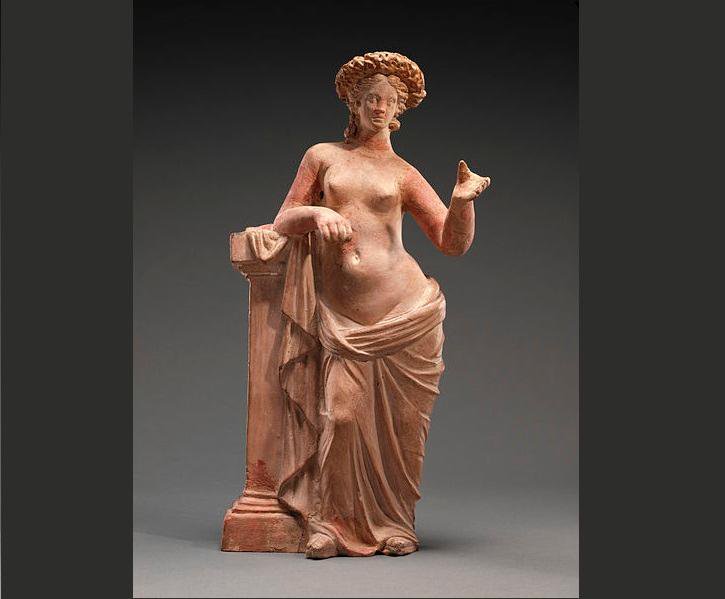
In the myths of ancient Greece and Rome, the goddess Aphrodite or Venus lived in the light or ‘Heaven’ and Persephone in darkness or ‘Hades’. Both were in love with Adonis and appealed to Zeus to decide how they could share him. His decree was that they should have him for six months of each year.

Aphrodite – picture Smithsonian Magazine

The figure of Adonis is in this way critical to understanding the importance of the movement of the seasons in ancient times. Nature lived and died quite literally, as did their harvests, from these forces. If the harvests failed, famine turned nature and cities into wastelands.

April is the cruellest month, breeding

Lilacs out of the dead land, mixing

memory and desire, stirring

dull roots with spring rain

The Wasteland – The Burial of the Dead – (opening lines) by T.S. Eliot

This uncertainty placed enormous importance for people to give proper respect to the ‘gods’ and nature through ritual worship.

Within the solar year are overlaid the twelve ‘moons’ or months within each solar cycle. The phases of the moon and sun combined were known then and to this day, to govern the process from seed to harvest. This is naturally between spring and autumn, the exact length of this season being determined by latitude. Nevertheless, the spring equinox is a date used today to fix the date of the festival of Easter. This is the Sunday after the first full moon after the 21st or 22nd March, proving the importance of the moon combined with the sun in their influence for humans and everything on earth.

We know this because of the plethora of ancient gods and goddess whose lifespans fitted into these celestial cycles. Because spring is the ‘rebirth’ of nature there are corresponding stories incorporating the ‘death and resurrection’ cycle. In the Christian calendar this is known as ‘Easter’ but it is known that that the goddess Astarte preceded this in the ancient Near East. Much later Ostara ( medieval Germanic) gave rise to the traditional Easter symbols of the moon gazing hare and eggs.

Ostara by Johannes Gehrts

What is less well known in our current times is the antithesis of this ‘spirit of new life’. There is a tradition of the deaths of various ancient gods and goddesses at this time; the goring of Adonis by a boar, Dionysus with the first leaves from grape vines, the rape of Persephone and the death of Hyacinthus. Each of these however is given a heavenly reprieve by a resurrection. Adonis was turned into a Myrtle tree, Persephone released from Hades for six months of the year and Hyacinthus turned into a spring flower, the Hyacinth by Apollo – the Solar deity.

Apollo and Hyacinth – picture Wikiart

It was natural therefore when the Roman Church fixed the date for the death and resurrection of the Christ Jesus, to choose the beginning of spring in the celestial manner described above. The church fathers did not need to know about the strong and balanced influence of the sun and full moon at this time of year, but relied upon the old method of supplanting old ways with a new religion using the previous festivals.

Adonis is an interesting mythological character as for many scholars his festival occurred in spring. In the city of Byblos (in modern Lebanon) where he was born and worshipped, the river ran red each year with the spring rains mixed with red earth. This fertility symbol and literal fertility for the fields, remind us of the menstrual cycle in women, bearer of eggs; nature’s cycle is the same as the human cycle.

And yet, according to Rudolph Steiner in his lecture on Easter*, the ‘Festival of Adonis’ was celebrated at the time of the autumn equinox rather than spring.

(*available on You Tube)

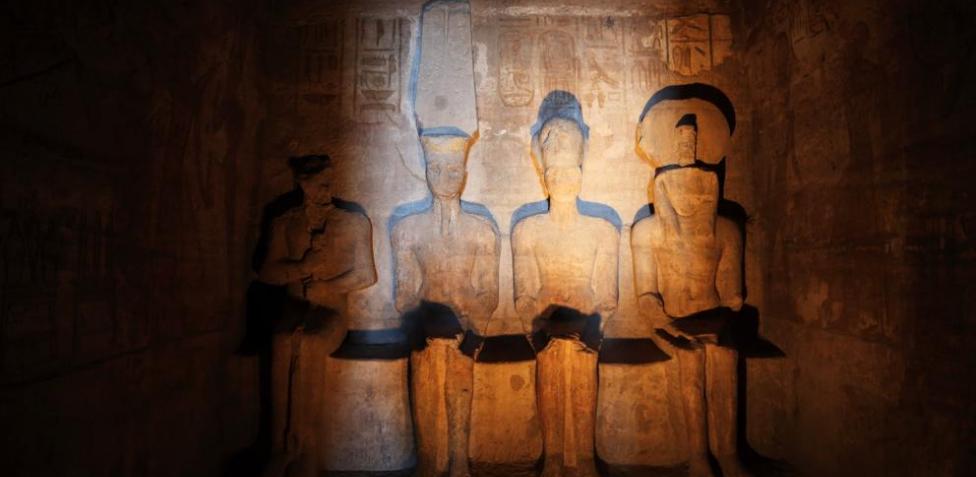
Numerous ancient temples (the Great Temple of Abu Simbel, Egypt) and dolmens (New Grange, Ireland), are aligned to allow the solstice rays of sun to penetrate an entrance passage into a womb like chamber and fill it with life giving light.

Abu Simbel solar solstice – picture La Vanguardia

Steiner describes the ‘Feast of Adonis’ as being conducted by women in pagan societies. They would sow seeds like cress, on a thin layer of soil in a broken pot shard. After tending them during the spring, the summer drought would kill the plants. After two days of ceremonial mourning, these were ceremonially processed on the third day to the sea or a nearby lake to be immersed as an ‘image’ of Adonis. Adonis is therefore a tragic god who is ‘born to die’ as much later was written into the story of the Christ Jesus. Further evidence is contained in Sir James Fraser’s prodigious work The Golden Bough (an anthropological study of Mediterranean religions) claiming the Jesus is a fertility god in the lineage of Adonis.

The Entrance Stone to the Garden Tomb – picture Inspiration Cruises and Tours

The references to dying processes taking three days, is described by Steiner as being a reference to an ancient understanding of the human dying process which also takes three days. The first day completes the death of the physical body, the second the ‘ether’ body and the third the ‘astral’ body. This is an theosophical categorisation similar to the ‘body, soul and spirit’ of the Hermeticists or ‘animal, vegetable and mineral’ of the Idealists. Either way, man and nature take three days for the process of dying or ‘transitioning’.

It is a fact that the dying sun the during winter solstice, stops moving on the horizon for three days, before the days lengthen again. The circular stone rolled over the tomb in which the body of Christ Jesus was moved after a similar number of days, referencing him to be a solar deity; a ‘sun of God’.

The true dates of the life of Christ are not stated in the Bible, although there are a few clues. If we are persuaded to imagine the nativity to take place in the winter, then there are suggestions that state otherwise. The first is that shepherds were out in the fields at night, indicating that they were ‘lambing’ – a season that all farmers know. A ‘census’ of people is unlikely to be held in the dark and cold winter months for practical reasons; the Romans were practical administrators. The ‘star in the east’ is likely to be Venus which is well known by agricultural communities, to rise in the early morning in the East in the spring.

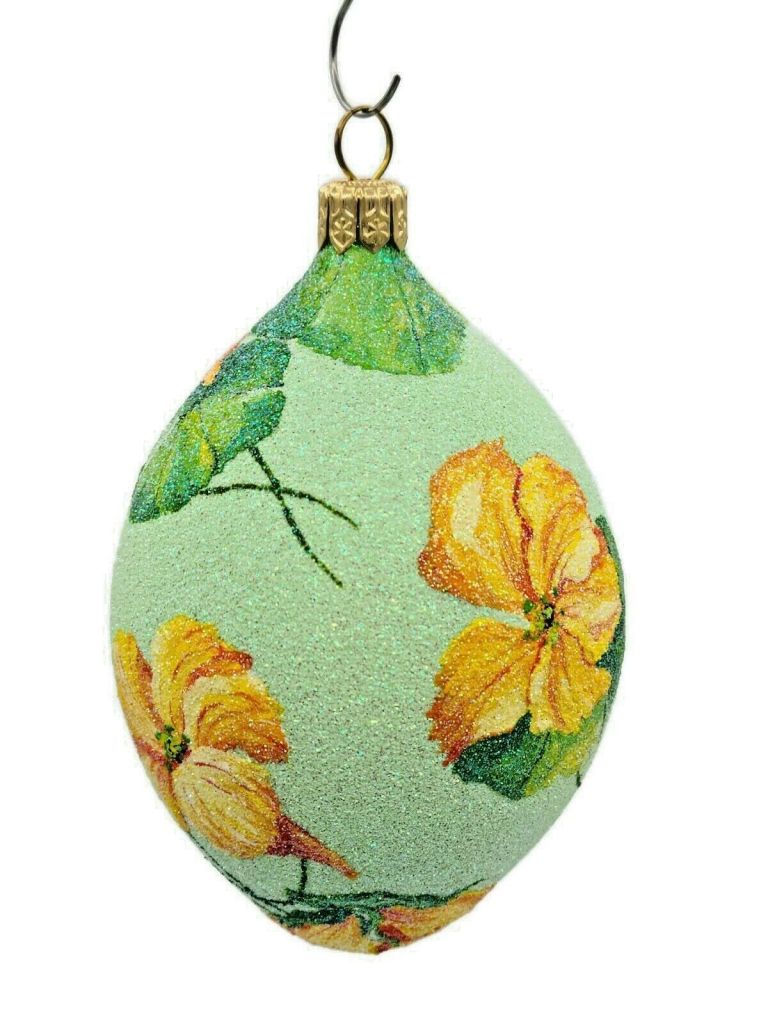
Nastrium Egg – picture The Ornament Emporium

Finally, it is curious how men travelling east were following a star appearing in the east. It is probably, in my view, that this information is coded and the direction east indicates a time of year rather than direction of travel; after all, their direction of travel is not important information to progress the story and a good story teller would omit this. It is only included to complete the sub-narrative.

The east road of the city is of course corresponding to spring on the solar calendar and the time of year you would expect a ‘sun god’ to be born. So, whether the ‘Christ Mass’ is held in the winter, spring, summer or autumn is open to interpretation and would not be contradicted by the Bible.

What modern observers would do well to recognise is not the dogma but the symbolism of the Christian churches. The ‘mass’ is confidentially encouraging congregations to drink blood and eat human flesh on the solar day of the week whilst facing the rising sun.

For me, the symbols are only partly transcendent, as we feel in the energy of spring, while carrying more than a hint of the macabre death and the dying sun/son.

That corpse you planted last year in your garden,

Has it begun to sprout? Will it bloom this year?

Or has the sudden frost disturbed its bed?

poem: The Wasteland 1922 – The Burial of the Dead – T.S. Elliot