An avid follower of the ‘language of the birds’ might have noticed that hEaVEn contains the name EVE. There is even an echo of Eve in EdEn.
This oddity is not necessarily meaningful or intentional, but that is not necessary. It’s just satisfying to think in an intuitive way, like the birds that flitter around us for no reason but give us messages; a process known as the language of the birds. There are things we do not hear and hear in the garden.
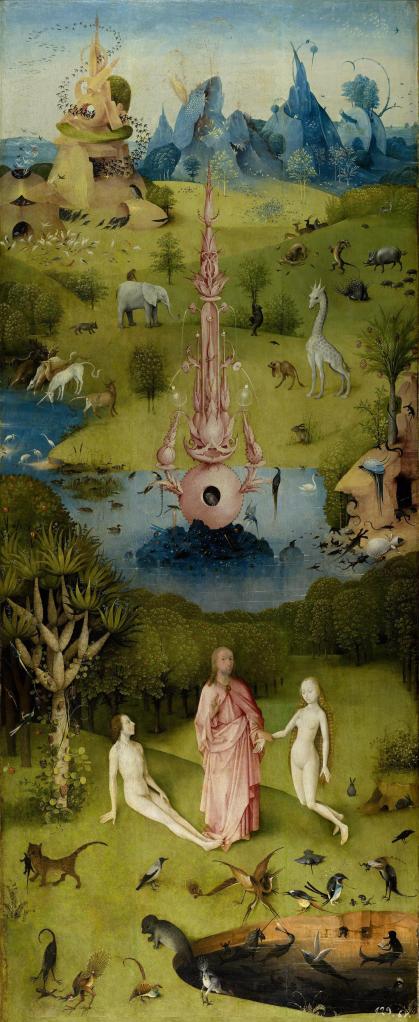
Some feminist friends of mine express the view that mysogeny has it’s roots in the creation story in Genesis. ‘Why is it the woman who disobeys God and eats the apple?’ But to me, as a human being, the gender distinction is another example of how the dualistic mode of thought that started at this very point in time, has created confusion ever since. This dualistic perception is even hard wired into the words we use to describe opposites such as long and short, able and unable, peace and war.
In the Old Testament story about the Tower that was sinfully built in Babel, the consequence is God punishing mankind. This meant that humans no longer understand each other by using one language, but create confusion with multiple languages. If that story was about words then the story of Genesis is God’s punishment making us misunderstand our thought patterns.
And how we think must be far more important than how we speak. I have encountered foreigners who misunderstand me speaking in their language, not because my words were wrong but because they think in a different way. And thinking is not taught in schools. It is assumed children pick up good thinking skills, when there is no reason to assume they will.
Let us find a nice bench and sit for a while in the original Garden of Eden before humans came along. Enjoy a bit of peace. The Biblical creation myth is largely in agreement with the creation according to current earth science; minerals, plants, animals…until, kerpow – a human appears! This is the beginning of the end of a blissful life in the garden (Heaven) because Adam is one of half of what is to become two halves. The garden is singular, the lovers are plural. There are not several gardens all running along the Tigris and Euphrates but just one. This state represents the primal state of mind that spiritual paths aspire towards. For example, in Buddhism the principle ‘All is One’ contains everything anyone needs to know.

In Zen Buddhism the master asks the pupil, ‘what is the sound of one hand clapping?’ The question is nonsense and to correct this we might suppose that God had to create Eve, because you cannot have x without y.
The creation story is more a description of a fall into a highly confusing mode of thought which paradoxically is both ‘confusing’ and ‘enlightening’. Confusion and understanding are, after all, directly connected by a continuum you might call ‘knowledge’; they are different aspects of the same thing. But in dualistic thinking patterns we learn to differentiate and name, compare and contrast. There is always ‘this and that’, which is dualism.
In dual thought patterns adjectives are used only to describe the two extremes of the same thing. For example ‘good’ and ‘bad’ are highly relative situations and things and context and consequences can morph each into the other. And yet most people when asked, will say they prefer good to bad. Have they thought about that? The writings and lectures of the late Alan Watts, who studied Christian theology and Eastern philosophy, returns over and over again to the eastern understanding that there are no opposites, only continuities.

In applied mechanics, physicists will not fall into a dualistic mode of thought. They will not use the words ‘hot’ and ‘cold’ but only degrees of heat. A fridge is cold because it expels heat. It has no measurable relationship with cold because cold is just a place from where heat has been removed. The amount of heat is indeed a continuum, which we look at every time we view a thermometer, which measures heat – thermo – not cold.
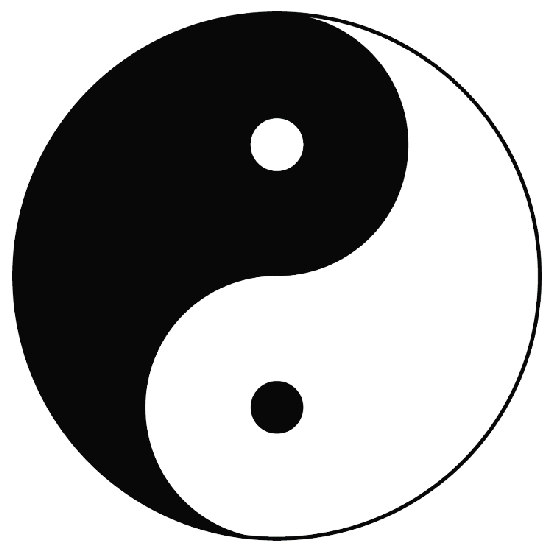
There is another well known symbol which illustrates the unity of ‘opposites’ which is the Chinese Ying Yang symbol. The two opposites of black and white, combine harmoniously in the diagram as two fish chasing each others tails. Most importantly each fish contains a little of the other, represented by a black or white eye.
We are told in Genesis that this dualism is a mode of thinking used by God;
‘and God called the light Day, and the darkness he called Light.’ Genesis 1.6
The whole process of ‘naming’ is formalised to describe a creation that was already there, and at the same time, becoming so.
The word of God (ergo ‘god-like’ mankind) is all-powerful, not just revealing but causing something to come into existence. This is the modern conundrum of quantum physics where the tree falls in a forest and the question is posed whether this event happens if there is no observer.
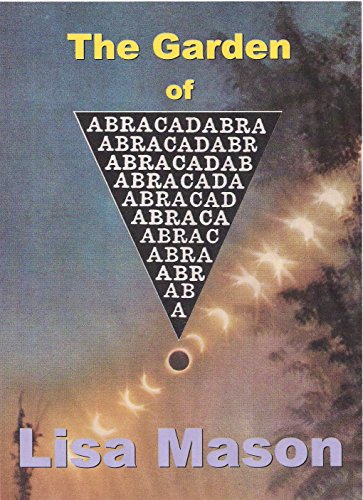
In magick this odd version of reality appears in the word, ABRACADABRA meaning; ‘I will create as I speak.’
The human body has a similar confluence contained in the left and right hemispheres of the brain. Each half has a different function; right is intuitive, left is reasoning. People tend to fall into a bias towards using a half particular to themselves, and we compound this dualism in schools and university degrees, as ‘science’ and ‘art’.
Few realise this is a most unhappy state of mind, or perhaps they do but do not know how to get out of it! When there have been individuals who have learned to use both sides of the brain equally and non-competitively, they bring very special ideas to humanity; so special we call them ‘geniuses’. Leonardo de Vinci, Michaealangelo, Albert Einstein are a few famous examples of the so called ‘renaissance mind’. Thinking back to the introduction to this essay, this is the ‘god-like’ ability imparted to human kind by the Creator.
Albert Einstein, for instance, is famous for realising energy and matter are not different but the same and completely interchangeable using the formula;
e=mc2
– where c is the speed of light – ‘let there be light and there was light’.
Very early Gnostic traditions did not allocate gender to the ‘God-head’ or ‘consciousness’ or ‘mind’ or however you wish to understand the creative consciousness that unraveled as the Universe. And we might add existed before and after creation since there is no ‘before’ and ‘after’ in non-dualism. (Scientists are only now coming around to the idea that the ‘big bang’ was an end as well as a beginning as described for millenniums in the Hindu Upanishads.)
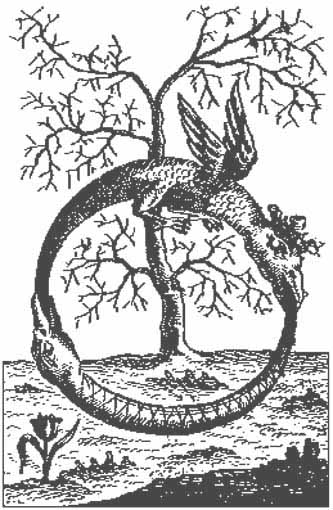
The never ending cosmic cycles and the unity of everything is represented in alchemical manuscripts as the snake forming a circle as it bites it’s own tail. Everything becomes a snake with no head and no tail. A snake is a continuum and of course this consciousness was prior to and initiated, dualistic thought and the contradictions that emanated as a consequence of adopting it.
Every time we spin a coin in the air and ask ‘heads or tails?’ we are a mind locked into the
‘either / or’ mode of thinking.
The key that opens this lock is the word ‘both’. You will often hear in interviews on the radio the journalist asking, ‘is it this or that?’ and the respondent answers, ‘both’. The question is a trap and people who know their subject (which they usually do if they are on national radio) have no problem with contradiction – or rather the illusion of a ‘contradiction’. They then go onto to describe all the aspects of the same problem including the two options contained in the question.
Those who do not understand this, fall into the elephant trap of ‘left politics’ or ‘right politics’ and are unwilling ever to change their bias. In medieval terms ‘they are in Hell’ because they will never understand the totality of what is going on and therefore how to influence affairs and events for the better of all.
And we should remember that the snake in Genesis was coiled around ‘The Tree of Knowledge’. Eve explained to the snake that the tree in the center of the garden they were forbidden to eat from on pain of death.
‘And the serpent said unto the woman, Ye, shall not surely die:
For God doth know that in the day ye eat thereof, then your eyes shall be opened, and ye shall be as gods, knowing good and evil.’ Genesis 3/4
From a purely objective point of view, the snake was right. This truly was the effect of eating the apple. The issue was that eating it was against the will of God. At that moment, it could be argued, Eve was unaware of why God had ordered this as she was in a state of ignorance of the ‘opposites’; she was in blissful ignorance, quite literally. So she can hardly be blamed for not conceiving that knowing good and evil is a liberating but problematic change in human consciousness. It brought god-like power to humans and if we look back at history; it really did.
Humans have used their creative imagination to take to pieces and put back again in new ways, everything we know. It has been a far from easy path as God points out in the following passages of Genesis.
‘Therefore the LORD God sent him forth from the garden of Eden, to till the ground from whence he was taken’.
No longer would grapes fall from the tree into the mouth but toil and hardship would be the lot of humans as punishment.

There came a hippie moment in the 1960’s where ‘rules’ were at last questioned and even abandoned. At the legendary festival of Woodstock, there was a young singer;
We are stardust, we are golden. And we’ve got to get ourselves. Back to the garden. Joni Mitchell – from the song ‘Woodstock’.
Fortunately, getting back to the garden is not impossible. Like all paths this particular human history of which we are all so proud, will lead us back to the beginning again. All directions are the correct directions to take, all mistakes are ultimately correct. If and when we stop dissecting everything, including our own thoughts, we will discover the original state of bliss, second time around.
 Matters Blog