Heaven and Hell

I described in a recent essay about how the knowledge of good and evil was a Divine punishment for the Biblical characters of Adam and Eve. Rather than interpreting this at the Sunday school level as a story, I suggested this was a description of a change of consciousness for mankind from a singularity to polarity.

The polarised (male / female) view of the universe is both a blessing and a curse, that we will continue to endure for evermore. With the power of discernment, man can break down the world into small pieces in order to understand how it works. Sadly at the same moment we lose the very important holistic understanding of the world in the same way that a child dismantling a clock is unable to put it back together.

The universe, the world, our minds, are, after all, interconnected. Any apparent seperation between opposites is a spectre designed to misguide us.

The concept of Heaven and Hell illustrates this apparition well. We are told that they are completely polar opposite places by the preacher in the pulpit, but in reality they are not.

They are the same.

Let me use a well known parable to illustrate. Imagine a large group of people seated around a long dining table. There is food in front of them into which they have to dip their spoons, but there is a difficulty. The spoons have long handles that extend beyond the width of the table. It is impossible to dip the spoon into the food and direct it into one’s mouth.

picture credit; celestialpeach.com

This tantalising situation is a kind of hell for the hungry people. If they remain as they are they will shrivel up and die of starvation. Only when an angelic thought enters one of their heads, does this hell morph into heaven.

The idea is simple. Each person uses their spoon to feed whoever is sitting in front of them.

We experience this frequently in our everyday lives, if we only pause to think. There are those who spend their time acquiring benefit only for themselves whether it is money, time, material possessions, opportunities. They might well become ‘rich’, but in reality they can experience great sadness, emptiness, frustration, loneliness. We can all think of examples of people who ‘had everything’ who committed suicide or went to prison or lost their social standing and friends for one reason or another.

As we go through life we are encouraged to be optimistic and happy from early childhood. And yet we know that some terrible experiences may be laying in wait for us; perhaps not now but perhaps in the next year or ten.

The unfortunate people of Ukraine are an present day example of how everything can go horriblly wrong through no fault of your own. One minute families are living content and comfortable lives and then the big bad wolf extends a paw with claws extended.

It sounds like a fairy tale, yes, in the way that we mean ‘fairies don’t exist’. Traditional children’s stories are false, we tell our young ones, but they are not. These are stories about heaven or hell in true life and how unpredictable it can be. That is why children’s ears prick up when they listen to a traditional ‘fairy story’ like Sleeping Beauty. They know or at least suspect things can go horribly wrong in life and that they need to remember the secret that undoes the evil witche’s spell.

In the beginning, the universe was created by God, or ‘consciousness’ if you prefer, and there was no Heaven or Hell. Only the creation of man and woman created these extremes of human experience. Man cannot ‘blame God’ when things go horribly wrong because there is no script and no intention of God to steer good people away from bad things. The Cosmic Mind is merely a Watcher, like the Watchers in the Book of Enoch or the Extra-terrestial Beings who some believe follow, but are forbidden to interfere with, life on our rare planet.

Rewards for ‘good behaviour’ do not exist in adult life although as children we are brought up to believe this will be the case. It is more that good behaviour by oneself sets an example of good character to others. This ‘example’ has the very strong power to change the behaviour of others, like in the story of the spoon, but some people are so fixated on ‘me and mine’ that they see good character as weakness.

I am convinced that task for humans is not to expect Heaven or Hell as a reward for good or bad behaviour. This is completely opposite to the views Bible thumpers of the middle ages and today!

picure credit: researchgate.com

We should not even try to steer others onto a path of a preferred behaviour by making our own judgements of people or situations. Most of the time, we do not know all the facts of a situation and are just as likely to sink the ship as make it sail into a safe harbour.

The path to Hell is paved with good intentions.

The only beneficial direction to travel is any that enables individuals to be of good character and show others the benefits of this. This in itself is a massive task as we know that the freewill we all have to change situations for the better or the worse, is extremely difficult to live with. It is like the snake in Walt Disney’s version of Rudyard Kipling’sThe Jungle Book‘, with it’s hypnotic spiralling eyes and suggestive, enchanting song, created no doubt with a memory of the Jungle as the Garden of Eden. Humans commit the most appalling acts and ‘self-forgiveness’, learning and moving on are, in my view, the only tools available.
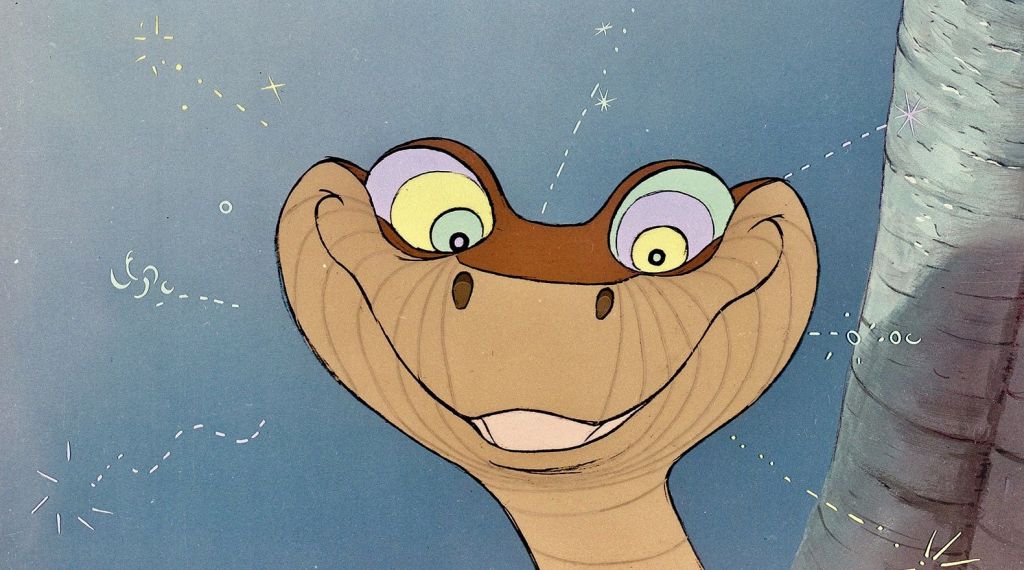
picture credit; waltdisney corporation

Perhaps towards the end of life, a person may be able to sit back with true contentment, on e might say a Heavenly contentment, knowing that they now understand the weakness and power of being human and how quickly we can fall and rise. When you look at the smile of a very old person who has done their share of right and wrong, heaven and hell, you may just glimpse that they understand these ideas are the same place in our souls.

Edvard Much: Old Woman in a Rocking Chair

There was, is and always will be, a Unity; one ‘Consciousness’, one God. Take your pick you agnostics and gnostics; they are both the same.
The Art of Art

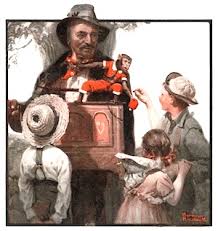
Even a monkey can turn the Organ Grinder’s wheel

picture credit: The Paepae

The following thoughts are likely to flatten the ego’s of some of those who consider themselves ‘artists’. It’s a personal view that is not much talked about, although perhaps many share it. But before I begin I need to emphasise that my argument is not an either/or polarised between this and that or artist and technician. All artists are to some degree technicians and all technicians are to some degree artists. The key here is the phrase ‘to some degree’ which is best described as a sliding scale. Where precisely on the scale is the matter for debate here because frequently I hear of technicians who call themselves artists, partly through vanity but also because of their inability to think without polarisation. Here is an example of what I mean.

The writer once took part in a concert in his local town. There were several musicians, violins, two Chinese pianists, a singer and my own contribution of humorous poems that I had written.

During the interval the performers shared a side room in which to relax. During the conversations I made a remark quite innocently but I immediately realised caused offence to the two pianists. I made to following remark, ‘it’s a great that there is at least one original performer in the concert’. It was meant quite innocently as an observation on the technician / creator dichotomy but clearly I hurt the pride of the musicians who must have been brought up to believe they are artists.

My view is indeed an unusual one but based on sound reasoning which is this. That musicians who are not extemporising but following musical notation by a third party, are fundamentally, copyists. They have learnt to become technically proficient at playing one or more musical instruments through repetition. In my view they are therefore technicians, more than artists.

They will argue that there is an art in the way they ‘interpret’ the composer’s instructions and I would not deny this. Any piece of written music can be played to express the emotions of the musician and in that there is indeed a golden nugget of artfulness. But I would reply that the composer’s contribution is 80% or 90% of the piece and the interpretation of the player is more as a technical expert, somewhere on the line between artist and technician.

Another personal example is from my experience as a young architect. I was being ‘mentored’ by a rather overweight gentleman called ‘Les’ in the Architects and Civil Engineers Department of a well known Corporation. Les smoked a pipe and overflowed the edges of his spinning chair with his large body. One day, an architectural technician came over to Les with some ideas that clearly Les didn’t think much of and sent him away. Les mumbled at me his notion that technicians were no good as designers, to which I replied sagely; ‘knowing the language does not make you a poet’. Les’s pipe almost popped out of his mouth with astonishment and a glimmer of respect that this ‘youngling’ had made a profound observation, and was not a complete fool after all.

An example from another creative art shows how broad this issue is. Consider painters. There are again two types of painters. A ‘copyist’ who copies original works of art, or photographs using a photographic style, and those who create a painting from life or imagination. At the most extreme, a copyist can become a ‘forger’; so skilled are they in mimicking the original artist. However, I would still maintain the artist who creates original art, is 80% to 90% an artist and the copyist is 20% to 10% an artist. A forger must be 100% technician or else be greeted by the police forgery squad in the morning.

Picture credit: thecollector.com
comment: expect an early morning call

The same reasoning works in reverse. Original artists are never completely original. They will have been influenced by their training and life experience in who, what, how, why, when and where they create their art. This will include studying other artists, art history, media, photography and all the other experiences that bombard the senses. They will then knowingly or unknowingly express this in a novel or similar way to others and in this respect their ‘originality’ as an artist is indeed tainted. Only the truly most original and those expressing something of the ‘spirit of the age’, will find critical approval and become famous and founders, or part of, a group of mutually influential artists such as the Impressionists.

Consider how copyright law determines the topic of originality and ownership of an original work of art. I once went to a shop that sold the marine photographs by a photographer from the early twentieth century. The subject matter was mainly the magnificent sailing boats of that time taking part in the Americas Cup circumnavigating the Isle of Wight, England. I bought a book of these photographs and happened to comment to the owner of the shop (who was a descendant of the photographer) that I intended to copy them in water colour. To this he strongly, objected saying that they were protected by copyright law. He misunderstood copyright as only applying to exact copies, not representations, but no matter.

picture credit; jclassyyatchs.com

In this example there is a question of law which is, who has copied what? If the photographs were of just the sea and clouds then the photographer is largely responsible for the image, as nature is created for everyone as what we call today, ‘Freeware’. However when the photograph is principally of an artificial object, then the creator of that object (in this case a marine architect) must be presumed to own the image of the object or at least an ethical ownership of the image. A yacht might take years to design and build and photograph a fraction of a second. The ‘art’ of the photographer is the choice of view, light, background etc. to which some creative input has been made. Read a photography magazine. They are principally technical.

To think of a more exact ‘copying’ using a camera, if you went to the Louvre in Paris and took a picture of the Mona Lisa and started to sell these images, might not the museum object? After all copyright law protects exact copies of images, (not interpretations) and as the photographer has only used technical skill, these would be exact copies. The copyright once belonged to originator Leonardo di Vinci, who being dead, is passed to the current owner of the object.

Artificial Intelligence is now producing completely original images that exceed the creative imagination and technical prowess of even the most skilled artist. These are based on a vast ‘back catalogue’ of natural and man made images from the past that the AI has viewed, remembered and uses to create new art.

picture credit: wired.com

The owner of the AI algorithms might claim ownership of the ‘artificial art’ but the merit is clearly more applicable to the artificial intelligence than the human intelligence. The see-saw of balance between the technical skill and originality is once again subject to scalar opinion.

I personally do not believe the computer programmer who set the AI on the path of gathering and reinterpretation, is any more that a computer scientist. The seemingly ‘random’ connections taking place in the AI to produce originality, is the same process as takes place in neural connections in the brain of the artist but lacks ‘soul’ and ‘consciousness’.

As AI has no legal entity or ‘human right’; what it produces could arguably be without ownership by a human. No doubt the lawyers will debate this matter for the next century!

But in my view, AI is 99.999% technique, that is, a copyist. It has no concept of whether the images it produces are meaningful. When AI is able to prove it has a creative imagination, a soul and consciousness, I will concede.

What Do You Need?

Mahatma Ghandi said;

Earth provides enough to satisfy every man’s needs, but not every man’s greed.

picture credit; Meer.com

It’s not usual for the writer to look into the future. But at this moment in history, there is no need to be psychic to see where the world is heading and the consequences.

We live at a moment in time when change in the standard of living of the ‘developed countries’ is inevitable. The change will be what some would call a ‘reduction’ in this standard; meaning things will not be a cheap and plentiful as they have been in the past. For the rest of humanity the change will be having things that have not been available in the past, what will be an ‘increase’ in their standard of living to include all the essentials.

These are the essentials to life;

Shelter

Food and water

Health and reproduction

Education

Work

What will bring about this change is an increasing scarcity of these five necessities in both the ‘developed’ and ‘undeveloped’ countries, so that sharing of resources will be the only humane political direction.

The previous trend of ‘civilisation’ has been for certain countries to grow richer whilst others get poorer. The ‘master and slave’ Empires of history and the present day, are examples of this.

New technology, and primarily the ability to communicate on a global scale, is an essential part of ‘leveling down’ and ‘leveling up’, the uneven distribution of dwindling resources.

Technology, such as birth control and free health facilities has been changing the global demographic for many decades. As a consequence, families have been having fewer children because infant mortality has drastically reduced.

Smaller families has meant a reducing population in many parts of the world, such as China and parts of Europe.

The process of industrialisation was always founded on a false assumption; that more and more stuff can be made from limited resources. Whether those resources are fossil fuel sourced energy, raw materials, places to store noxious waste products, dwindling natural resources such as rare earth elements and the traditional metal ores.

All of these things and more, have become cheaper and more available but their limited availability and other factors means that the industrial train is about to hit the buffers.

Perhaps sharing more and making more with less and eliminating pollution would have held off this inevitable moment for longer but the global system of human development is too fragile and too complex.

The effect of industrialisation on nature has been ignored for convenience and perhaps not a little arrogance, but nature ultimately strikes back. What is wrapped up in the term ‘climate change’ is the tip of a rapidly melting ice berg of global human catastrophe.

picture credit; Friends of the Earth

Nature has a plentiful and powerful armory with which to fight back. Viruses, extreme weather, planetary warming, desertification leading to wars over scarce resources are and will put great demands on the human population to re-organise.

If humans had any self respect, they would respect this powerful process and become co-operative with nature. It has to, because the option to carry on as before is no longer available; unless wars, mass starvation, migration and pandemic diseases are ‘risks worth taking’.

There are some religious communities such as the Amish in States in the in the United States of America and Canada, who will not directly face fundamental changes to their way of life. Hundreds of years ago they decided for religious reasons that their ‘standard of living’ had reached a level that is sufficient for their needs. The number of Amish people has risen from 100,000 in 1989 to 251,000 and is predicted to increase. Respecting the boundaries of nature is a lesson many have learned, thus avoiding the hard process before being forced to.

An Amish Homestead picture credit Stuff.co.nz

Similarly, there are remote tribes in ‘undeveloped parts of the world who live in harmony with natural places and have done for millennium undisturbed. They have nothing to fear from nature, only their fellow humans.

Industrialised societies have taken far more than their fair share of nature’s bounty. The city dwellers who make up fifty per cent of these societies live on the promise of unlimited food from farms. Unfortunately soil needs constant replenishment when using factory farming methods and fertiliser is becoming increasingly expensive, to a point where growing crops is no longer profitable. City dwellers have become so cut off from nature that they might as well be living on the moon; totally unable to sustain themselves except by trade using ‘money’- a substance you cannot eat.

The dwindling of world resources and the consequences for national economies will require counter intuitive management. People who have more, will have less and people who have less will have more.

Food will no longer be shipped all over the world to satisfy the demand for non-seasonal, exotic, non-local, high protein, artificial fertiliser enhance ingredients.

Wine and olive oil, will not be for sale in shops in countries where wine and olive oil is not produced. Such luxury is only a recent expectation. Nations used to have their own diets and dishes based on local seasonal food. Northern countries drank mainly beer made from local grain crops and southern countries drank wine made from local grapes. Choice in food and drink will become more than halved and people will be grateful for what is available.

Politicians will have an almost impossible task of balancing the overwhelming and impending need for ‘developed’ populations to significantly reduce their ‘standard of living’.

Nobody votes to lose their holiday home/s, luxury car, cheap flights, energy wasteful house and bulging refrigerators. You might think this and you could be right, but when citizens understand the hardship that is the alternative, they will.

And if this sounds depressing then all is not necessarily gloomy, because humans have a unique skill at adaptation, both physically and mentally. Some of the poorest people on earth are also the happiest. Travelers who visit the homes of remote communities that are living off the land (whether forest, steppe or desert), find they are welcomed with dignity and honour and the food in the house is shared equally with them. This food may taste better than any they have had before because it is resourced locally, prepared traditionally and presented with love.

No factory on earth has ever made a product with love so should we be surprise that people who have ‘high standards of living’ often live loveless lives?

Here is that list again;

Shelter; simple, warm, light, organic houses and public buildings and gardens.

Food and water; locally sourced and stored, lovingly prepared and shared.

Health and reproduction; Enough health professionals for populations in order to prevent disease, educate and encourage healthy lifestyles, treated body with the mind and mind with the body, practice traditional medicine and techniques less based on chemicals. Because communities will support the elderly young people will manage the size of families using contraception.

Education; a holistic, approach to giving young people the skills and characters that promote informed and respectful relationships and communities.

Work; local activities that produce goods and services in ways that respect nature and the environment. Labour will not to use more energy and materials than nature can supply and live in a way that gives responsibility to all and shared rewards.

There are many micro-communities already living in this way according to their own religions and traditions. If you are fortunate enough to live near one my advice is sell everything and join them as have done many and joined Amish and similar communities.

You might be happier than at anytime in your life and if you are not happier, well you at least will be the same person you are now.

As so often happens, Hollywood is ahead of the curve and perhaps forcing, as well as, predicting change. There have been many ‘post apocalypse’ films in the last few decades. The apocalypse will only come if it is allowed to. As in most things, the trick is to be pro-active (ahead of the wave) rather than wait for it to swallow us whole.

picture credit; Climate Emergency Institute