(with apologies to Simon and Garfunkel)
There is a revolution happening spearheaded by self-driving electric cars but have the majority of people considered the destination? In the UK there is a target to only sell electric vehicles in car showrooms by 2030. The government’s stated aim is to reduce carbon emissions into the atmosphere and thereby the risk of climate change and global warming. But is stopping killing the planet really their main concern or is there another plan? After all, there have been decades to save the lungs of the world; the Amazon rainforest…
I recently applied for a quotation for a household electricity supply from photovoltaic cells. One of the questions I was asked was, ‘are you going to have an electric car in the future?’ to which I replied ‘no’; which surprised me. I didn’t know I thought that, so I have spent some time to find out why.
I am certainly not convinced by ‘hybrid cars’. Hybrids are by definition, neither likely to be good at one thing or another. I have heard of companies who bought fleets of hybrid cars and then discovered their employees ran them solely on the petrol engines.
We know that one third of the energy a car uses in it’s lifetime, is in it’s construction. This means that converting to electric motors will only ever have an effect on reducing the other two thirds of the energy the car will consume in it’s life. And when electric cars stop for a recharge, how much of the electricity they use has been created without carbon emissions?
A fifty year guarantee and free disposal, would be an interesting strategy for car makers. Owners of ten year old cars in Spain, were written to by the police suggesting that they scrap the car and get a newer ‘more efficient’ model. Demonising petrol and now diesel cars has been government policy in many countries and yet driving more slowly to save fuel and carbon emissions has not.
For instance, when one drives on most European roads at the maximum legal speed you will acquire a line of vehicles behind you waiting to overtake. This despite the increasing costs of fuel and the protests of drivers protesting that they cannot afford it. Perhaps they do not realise that cars travelling substantially over 60mph are consuming up to third more fuel. In the United States of America there a maximum legal speed on highways of 55mph to preserve fuel and increase safety.

There are many options for greener personal transport. This may include driving at reduced speeds, retro fitting emission filters, regular testing and maintenance. My fifteen year old 2.2 litre diesel estate gives me 65mpg. This is better than many ‘state of the art’ hybrid cars. There are diesel engined black cabs built by the London Taxi Company, that have completed one million miles.
It is possible to retro-fit carbon less engines into pre-used cars as a greener option to producing new cars. It’s not something economists will support as making cars makes money, but the pressing immediate need is for reducing global carbon emissions, a direction only governments and the COP meetings have the power to steer our future towards.
The Charge of the Electric Cars

Let us examine the EV (electric vehicle) options currently available and there relative pros and cons.
The first point is that all these vehicles have tyres made of rubber and rubber polymers. These tyres obviously wear out at the same rate as all other tyres. They produce more airborne particulate matter (PM) than either diesel or petrol powered cars according to academic experts on air pollution. We should consider reducing the harmful effects of cars on clean air as well as a cause of climate change. Respiratory problems such as asthma are becoming more common in children in western countries.
Even the plastic used in the construction of a car is a considerable consumer of oil based polymers and not necessarily designed with longevity and ease of re-cycling as benefits in the list of the car’s worth.
When considering emissions we should also note that electricity supplied in national grids is only partly produced by renewable sources (including nuclear) Electricity is still produced by fossil fuel burning power stations. This will gradually improve but the vital question is ‘how quickly?’ The sanctions introduced by both sides in Russian War against Ukraine, is halting the move to stop using fossil fuelled power stations and even more are being built.
Thinking of the causes and effects of this war we should consider rare earth minerals. Ukraine has a significant proportion of these in Europe and China has the greater part of the world’s. The need to set up factories making batteries for EV’s is inevitably contributing to the political uncertainty in the region. After all history shows us that the shortage of resources is one of the most common causes of war.
There are low carbon using and emitting vehicles other than EV’s. Hydrogen fuel cells are a source currently being developed for lorries and trains ( but not domestic cars ) and perhaps this will change in the future.
Compressed gas slowly released into the cylinders of internal combustion engines is a little known option. Buses and taxis in inner cities are ideally suited to this form of power as the emissions from vehicles are just clean air. With local renewable electricity generation powering the pumps that compress the gas, the costs and harmful effects of public transport vehicles could be significantly reduced.
Certainly, all governments need to look more closely at generating electricity locally using photovoltaic (PV) cells. There are existing schemes and proposals which cover such large ‘neutral use’ areas such as car parks, canals, roads and railways with PV cells. Car parks in hot countries require shade as do house roofs and local generation on a large scale could potentially replace the ‘national grid’ concept which is inefficient and subject to damage by storms and strategic security issues.
Also, national grids require sub-stations to reduce the high voltages for domestic use, and lose substantial amounts of electricity during transmission.
Wherever the electricity comes from, it will eventually connect with your electric car at a re-charging point. There are presently two ways to do this. The most practical is in a private garage or driveway at home. Here charging can take place overnight at lower tariffs and ensuring a full charge for the next day. With a range of say, 300 miles per charge, this is the most economic and convenient way to use an EV daily. It can even temporarily power the house in the case of power cuts!
Unfortunately, the majority of householders do not have private parking and private charging. People who live in cities, often have problems parking near to their homes, before even considering parking at a re-charging point. It has been suggested that lamp post might be able to perform this function. However successful a solution is found, the electrical consumption (thousands of watts per vehicle) by used cars overnight, is a demand for which the supply infrastructure is not designed.
Once another tangent. can we expect governments to absorb the loss of tax revenue as fossil fuels become fossils themselves? It seems unlikely and national bureaucrats will refocus their tax collecting efforts to other means, such as taxation by road tolls, replacement tyres and car purchase.
We should always factor in revolutionary and new technology. It is likely that battery technology will produce smaller batteries that charge instantly and require no rare earth minerals; such as ‘capacitor batteries’ that already exist. Or perhaps fuel cells or similar green technologies will take over? What is regrettable is that it has taken this long for battery technology to improve exponentially instead of in small steps. This remembering that electric cars preceded the internal combustion engine and declined as the first choice of motive power at the same time that oil fields were being discovered in California.
Open Your Mouth and Say ‘AI’
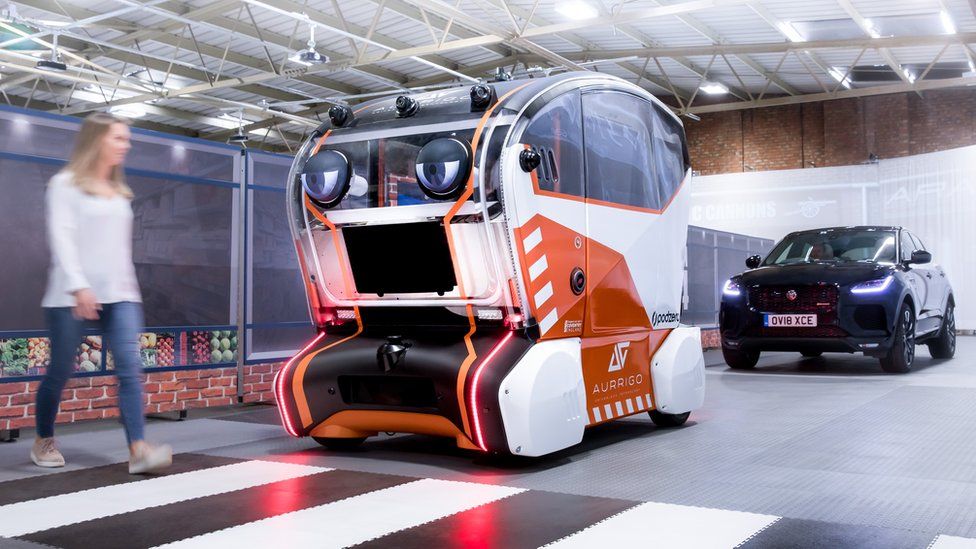
(picture credit BBC News)
We live at a similar cross roads today to the car designers of the nineteenth century. Today it is not so much in material but computer technology leading the way forward. The self drive or robot driven vehicle is slowly metaphorically nudging itself onto the highway out of the acceleration lane. Electric vehicles and self drive technology are a marriage made in the AI equivalent to heaven. We can expect the price of such vehicles to decline rapidly as production is switched from heavy ‘gas guzzler’ to lightweight ‘data driver’. We will be sold self drive cars using the golden words and phrases such as ‘safer’, ‘quieter’, ‘cleaner’, ‘cheaper’, ‘easy maintenance’. Gold lame suited sales personnel will persuade you how almost impossible the self drive car will be to steal and or be used in crime by car thieves. ‘Even you husband will not be able to take it madam!’
The dreaded speeding ticket will be a thing of the past. No one will be going anywhere fast; not unless robot drivers are programmed to leap from their vehicles and fight out disputes with laser guns. Could be fun to watch?
And the price of this revolution is; well, most people accept loss of privacy because they reason that they are not criminals and have nothing to hide. This is indeed true, however AI technology is not really for our generation. It is for our children and our children’s children who may well find themselves governed by criminal governments. Such a suggestion may shock the reader but reflect on the fact that there are governments in over half of the world today who are authoritarian. In other words, the lunatics have taken over the asylum. Much of what they do violates the human right to privacy, family life, fair trial etc. and so called ‘free countries’ are powerless to interfere in the rights of completely bonkers sovereign states to abuse completely sane citizens, in extremis.
For the People’s Republic of China the pandemic panic enabled finding out exactly how far compliant populations can be pressed to submit to severe restrictions in freedom and more sinisterly, how to control those who resist and ultimately rebel.
Now look into the future and imagine your gleaming self drive car parked at the front of your house. Yours partly that is as you probably won’t own it. It will be shared because your government tells you there are not enough resources in the world to make and operate cars for everybody. You don’t mind as you like ‘helping others and the planet’ – the latest government windscreen hologram to appear with your annual mechanical test.
As you place your palm on the car window the door magically slides open. You sit down and watch your favourite magazine programme whilst the car’s computer drives you to the government approved shopping centre. The cost of this journey will be instantly deducted from your phone as you step out of the car. You watch it drive away, safe in the knowledge you have booked for it to return to collect you, at it’s convenience, not yours.
When you paid in advance you also agree to download the latest ‘safety’ patches to make you car work more ‘efficiently’ – in other words to avoid problems from recent traffic collisions caused by hackers. Your magazine subscription will appear on the bill too, as will the subscription to use the car heater in the coming months, and the subscription to use the ‘economy’ settings in the car’s computer. You are trying to save money as the running costs are mounting up but , you reason, all these ‘subscriptions’ were previously just part of owning a car. Who would have thought?
Heaven forbid you criticise these subscriptions on social media and AI picks you out up as ‘anti-government’. For the next time you hail ‘your car’ it will refuse to obey your commands such as ‘let me out!’ You will be told that some ‘correction time’ is required. ‘Proceed to the nearest GECC (Government Education and Correction Centre)’ will be your only option to select on the onboard computer screen.
This collection of absurd and completely fictitious scenarios is written purely ‘for entertainment purposes only’ and ‘bears no resemblance to any future use of artificial intelligence by government or proxy government agencies’.
However, it is obvious that governments around the world today are already using the coercive control enabled by AI in such programmes as high quality data gathering and biometric / facial recognition in particular. Why would the Metaverse pay 19 billion dollars for Watts app? Why did Elon buy Twitter?
If populations embrace the new AI lead technologies in everything from cars to toothbrushes without question; citizen’s freedoms will find their place in the city land fill, beside the rusting pile of internal combustion engines.
Happy motoring!




 Matters Blog