
This essay will explore the philosophical implications of this idea from the insect kingdom, a ‘hive mind’. In a very special way it might enable us to explore the mystery of our own ‘consciousness’ as an individual, in a group, and in spirit. The ‘hive mind’ concept has been more widely understood, since the eponymous non-fiction book by Garett Jones published in 2015.
Today, scientists are exploring the question of how sentient, animals are. They define this as ‘having a sense of self’. Animals, seeing their reflection in a mirror, react as if another animal was present; a being which is non-self. But there are some life forms that move ‘as one’; such as a flock of birds. Their sense of ‘self’ or ‘being conscious of self’ , becomes subservient to their social group’s consciousness. Picture credit below of a bird shape murmuration, to Country Living Magazine;

I would argue that this capacity to act either as a group or individually, is found in nature on a graded scale, that is; solely, partially or totally and every grade between these. In other words, some (if not all living beings) are able to act both individually and collectively at different times depending on the objective.
Let us examine this idea in more detail. I would like to start with the mineral kingdom, as the understanding that minerals in their many forms is conscious, is not so odd. Indeed, most indigenous people’s live comfortably with this concept. However, as this idea may seem ‘odd’ to city living humans, let us start with the vegetable kingdom. This image from the National Forest Foundation shows a map of tree connections.

Certainly trees have a historical place in the line of sentient beings in the cultures of indigenous communities. Modern Japanese today venture into mature forests to absorb the energetic ‘atmosphere’ which they term, ‘tree bathing’. Scientists have discovered that trees communicate with each other through their roots and associated connecting fungi. One tree may tell another, for instance, of a disease or insect infestation, which is attacking it. The other trees then initiate chemicals into their own sap that will protect against this attack to themselves and collectively; a form of viral inoculation and lock down.
J.R.R. Tolkien in his book The Lord of the Rings, imagined a race of giant trees called ‘Ents’ who were as alive as humans. Today the film ‘Avatar’, features a civilisation of other worldly beings whose lives centre on a magnificent sentient tree with enormous spiritual significance to their society.
The insect world is clearly where the idea of a ‘hive mind’ originated. The queen, workers and drones each have their own specialisation which is hard wired into their DNA. As a group, bees communicate on matters of hive survival using dance to express information. Their consciousness could be defined as ‘collective’ for this reason and there is a limited sense of self in each bee; at least enough to ‘speak’ to others.

Ants and termites (above) operate in the same way as specialised entities with specific functions to act for the benefit of the community. The structures they can build are extraordinary in their size and complexity. Surely, only a sense of communal consciousness could maintain this level of concentration on the task and produce something far greater than the individuals power to do so.
Interestingly, some insects are more individualistic. A spider, for instance, generally works alone as it needs space to create it’s webs. Without anthropomorphising, such a creature must surely feel that it is separate from the reality it senses, otherwise it could not ‘plan to catch another life’.
In animals we find a similar spectrum of ‘degrees of self awareness’. The birds are the most well known for acting in flight as if they were one organism in some species. Scientists who have study these ‘murmurations’ have proposed that each bird acts a micro-second after it’s neighbour. This may be the case but it does not rule out a collective consciousness governing their behaviour.
Penguins survive in extreme climates by acting in favour of the community and the individual. Those on the outside of a large formation of birds standing in a blizzard, will be allowed to edge to the centre of the huddle and then start moving towards the perimeter again. This flow gives and even chance to each bird of enjoying the collective heat of their bodies.
At the other end of the spectrum of animals acting individually, is the wild and domestic cat. It appears to have a high degree of sense of ‘self consciousness’ and will act according to it’s own rules and commands. The Lion as the ‘King of the Jungle’ indicates this propensity to act according it’s own survival needs and a sense of ‘self’ compliments the demands of the pride.
The mysterious process of the evolution of the domestication of wild animals gives reason to consider how wild and domesticated animals differ. In what ways are they different mentally, as well as physically? Personally, I believe that domesticated animals have a higher degree of sense of self than their wild relatives. This is because their consciousness is less centred on survival and is able to focus more on itself. It feels both individual and aware of it’s relations with other sentient beings, such as humans and other domesticated animals.
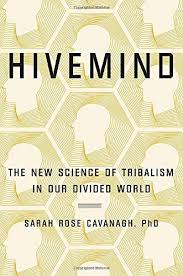
With humans these matters become more complex. I would suggest that we are at the high end of the sliding scale of individuality; that is we are distinctly individual both in appearance and a sense of self or self consciousness. We might identify collective behaviour such as tribal dance or even military tattoos as a ‘hive mind’ ability. But personally, I believe this is merely ‘mimicking’ the hive mind consciousness through repetition. This is to rule out the spontaneous consciousness of the group as a whole but this effect only happens in special moments, as most dancers would assert.
Humans differ also in that we have access to another dimension of consciousness. Professor G.J. Jung called this the ‘collective unconscious’. This concept of a hidden process of motivation in human activity, is at first difficult to understand – which it is by definition of being ‘unconscious’. Humans can not only manipulate consciously, as in politics and advertising, but confuse personal identity with the collective. In other words, our sense of ‘self’ is easily confused. We believe that everything in our mind, is us. For instance, supporters of a team watching a football match become identified at an individual and collective level with the game they are watching. They may have dressed in colours of their team to create this illusion of identification, and will certainly feel to their core the associated feelings of success or failure with the (their) team and it’s individual members.
In other words, humans become confused at a most fundamental level, with what is ‘the hive mind’ and what is their own. There is a comfort and protection in this illusion and it is hard to break. At it’s most malign manifestation, a group of humans will riot and cause damage and injury to others that as individuals, they would never do. In some cases, whole nations can be caused to commit acts to harm other nations, known as war.
The few humans who have leapt out of this illusion are the prophets, saints and mystics. At a spiritual level, such persons have separated their individual sense of ‘self’ and entered what is called the ‘Universal Consciousness’. Such figures are revered in all religions and an example in modern western societies would be Jesus the Christ. He is revered for having ‘died for others’, in other words, to have completely surrendered to the hive mind both in the physical dimension and spiritually.
I would argue that the mineral, vegetable and animal kingdoms also have access to this spiritual / universal dimension of consciousness but not in a sentient way. In other words, they are so limited by their DNA , instincts and highly specialised physical bodies, that they cannot gain discernment of the ‘Universal Mind’ as humans may. We are uniquely able to enter higher dimensions outside of our own bodies. Humans who have physically died and then come back into their bodies recount remarkably similar spiritual experiences, ( including the most ‘hard headed’ scientists ) and their stories abound on social media.

In this spiritual kingdom, there is another, similar hierarchy of self awareness and communal awareness, on this planet.
If one can accept the idea that ‘mentality’ can exist in the ether without physical form, then it becomes easier to understand, if not experience, the other entities or beings, described historically and universally in the spiritual dimension.
These start with the identification of ‘spirits’ which are either of a natural or human origin, move through ‘jinn’ to higher intelligences such as angels and arch angels, and summit in the concept of ‘God’ – or to the non-believers, ‘Universal Mind’.
The concept of hive mind, enables one to grasp the idea of a universal consciousness. All of this, that we see as individuals, is an illusion. It is not ‘us’. Self is merely a manifestation of the infinite consciousness, the great Mind ‘who art in heaven’. It is expressed more perfectly in mathematics than attempts in words, however, geometry is traditionally the closest expression of the Creator’s Mind.
How apt it is then, that when the Great Bee Keeper in the Sky, lifts up the frame containing the honey of heaven, what have our little bees made? – why, a maze of perfect hexagons.
 Matters Blog