In this essay, sex is a verb and gender is a noun.
For the last two thousand years or so, homosexuality has generally been ‘brushed under the carpet’ in an effort for societies to be ‘respectable’ and ‘moral’. But in present times suppression does not work. The technological ‘information revolution’ has lifted the lid of this particular Pandora’s box as it has many others.
The Church of England is presently debating the male / female duality with regard to marriage, and whether same gender marriages, should be sanctioned by the Church. The best the Church can suggest is to give a ‘blessing in church’ to gay couples. But such a lame offering, satisfies neither the lawyers nor the couples in question. A better solution, it seems to me, is to invent a word. After all, words cost nothing and there are plenty out there ready to fit new ideas. I would therefore humbly suggest that gay couples are ‘parried’ and straight couples are ‘married’. In these words I am using the Latin stem words ‘pater’ and ‘mater’. Parried will mean a legal contract with partner, with all the rights, privileges and duties, contained in marriage.
The net result of the adoption of this word, would give the dignity, equality and legal status that gay couples demand and enable church leaders and lawyers to sit back and stop trying to fit an egg into match box.
The issue interestingly raises the question; how are Western societies adapting to issues around gender and sexuality? Clearly they have risen above the hypocrisy, secrecy, guilt and shame, that was prevalent in say, Victorian England. We find in societies around the world, condemnation has been applied to homosexuality and most religions have not always embraced the question to the satisfaction of all parties.
In modern western societies, the sexual freedoms of the 1960’s contributed to the general demand for acceptance of consensual sexual behaviour with few boundaries. Whilst LGBT rights have been slowly engaged by law makers in liberal democracies, certain more conservative institutions and governments have resisted the change.
It is most likely however that eventually, however hard they try, ‘the truth will out’ and it is to this truth that I shall now turn.

Humans, in common with animals, insects and plants, have two general body forms; male and female. Carl G. Jung proposed that the mind of a male had a feminine aspect (the anima) and the mind of a female had a male aspect (the animus). Just as different gender bodies are simultaneously the same and different, the mind is also. In the Eastern traditions, in which Jung was well versed, the mind is completely integrated with the body so this idea is obvious, and today is accepted more generally by western physicians.
A homosexual male may express his femininity in a manner crudely described as ‘camp’; others may not to the same degree. But expression of feminitiy by a male, such as the use of facial make up and brightly coloured clothing, are a fun and harmless expression of self.
In some cases a feeling of disfunctional gender identity, in both males and female, can become so overpowering that the person wishes to change gender. Even very young children, who are totally unaware of what sex is but not gender, can feel they were born into the wrong body and become very unhappy.
What I am building up to is asking the question of those with spiritual authority, such as the Church of England Synod, ‘where have you been?‘ Do these ‘councillors’ and ‘shepherds’ really have so little knowledge of the complexity of human feelings, including in their own. Celibacy in church leaders has been another harmful mechanism merely to ‘brush sex under the carpet’ with the result of sexual expression that has caused harm to others.
Celibacy is a gnostic practice in the East and West, based on raising the life force within the human body for spiritual enlightenment. Ignorantly copying the practice at a superficial level, is like sitting on the back of a Tiger.
Christian clerics and scholars today are having to grapple with the question; ‘what gender is God?’ Once again, language and a lack of the ability to think outside the existing lexicon, made religious scholars and law makers, recourse to dogma and literal interpretation of ‘scripture’.
But a little research into the history of Christianity will reveal that the original Trinity consisted of the Divine Masculine, the Divine Feminine and the Child. This was translated or became for unknown reasons, the Father, the Holy Spirit and the Son respectively. Once again, thoughts were perverted by miss translations at best and the denial of truth at worst. Surely religious truth should provide answers not questions and the words of mystics and gnostics have been repeatedly twisted and misunderstood. The dialogues between Jesus the Christ and his disciples illustrate this process perfectly.

Past religions had in fact, given Christianity the complete concept of the Trinity only with different gods. In Babylon the ‘holy family’ were Semiramis and Nimrod, who gave birth to the Holy Child, Tammuz.
The Abrahamic faiths, Judaism, Christianity and Islam, worship one God, indeed (logically) the same God. So, if God is One, then there can be no question as to what gender God is. God cannot have a gender so does not need a pronoun any more than the sky or moon do. The English language wisely dropped gendered nouns during it’s early development as ‘old English’. The Romantic languages did not do this and curiously these countries where these languages are spoken remained Catholic whilst the Anglo / Germanic countries became Protestant. Perhaps a book has been written about this?!
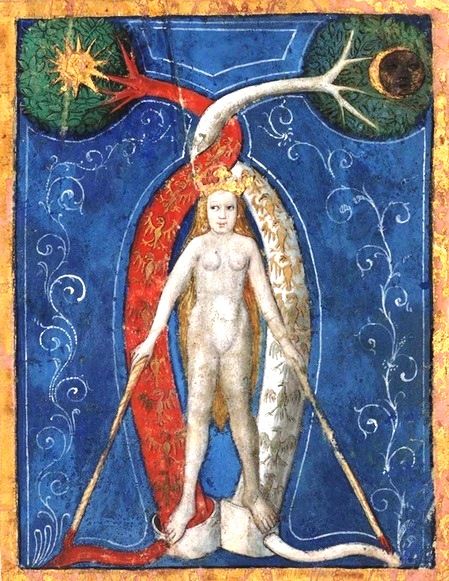
The ‘Divine Androgynous Unity’ has been expressed in many ways through history most notably by the Alchemists of the middle ages, who represented the two genders as the sun and moon. Human beings had bodies of both genders; somewhat comically being visually split in two, right down the middle. But the message was clear. At a non-physical, non-body, level (that is spirit or life energy) humans become complete and transform when their spiritual gender becomes as-God; neutral…Unified.

The Ancient Greeks and Romans, sometimes produced statues of gods and works of art where it is almost impossible to tell which gender the body represents. Indeed the ancient Greeks gave us the word ‘hermaphrodite’ to describe this union of opposite genders in one being and lifted the debate about gender from the physical to the spiritual.
Perhaps you agree that in modern times, there seems to be a general trend towards androgynous beings? Contemporary men have less sperm and testosterone and their voices, in my view, are becoming higher pitched. Artists such as Jason Perry express their own gender ambiguity in appropriate outrageousness and some boys going to school have questioned why they cannot wear skirts. Girls similarly dress in trousers and ties and feel perfectly comfortable. A similar trend is occurring in woman, whose dulcet tones can be heard reading the news or even on the parade ground.

Personally, I believe societies would benefit greatly from observing dispassionately and embracing, this gender neutral transition in all it’s manifestations, whether as sexual preference, gender transformation, religious doctrine or tolerance of gender neutrality.
It is beneficial to remember that gender neutrality in Christianity, produced the ‘immaculate conception of the child’. At a literal and physical level, this concept makes no sense and has to be adopted by the faithful as true only because it is written in a holy book. A more rational approach, ( which the Essenes who instructed Jesus in gnosticism at one time knew), is to interpret ‘the child’ as ‘Divine energy’. They taught gnostic methods of using this energy principally for inner transformation. But in a time when doctors and healers were generally ineffective, natural compassion must have caused Jesus to learn methods to use spiritual energy to heal and even return spirit to bodies that were in the early stages of dying.

The superior nature of ‘the child’ energy over matter, is represented in sacred geometry and architecture. The two smaller doors, openings, towers, flank an identical but scaled up feature which generally, is the practical and symbolic place of entry. In the case of the sacred pillars of Boaz (sun) and Joachim (moon) in Freemasonry imagery and architecture, the space between the pillars is the reality of the sacred energy or ‘light’. The Ancient Egyptian obelisks performed the same purpose in their Temples both metaphorically, and literally. They were power generators, as were the pillars and pyramids.
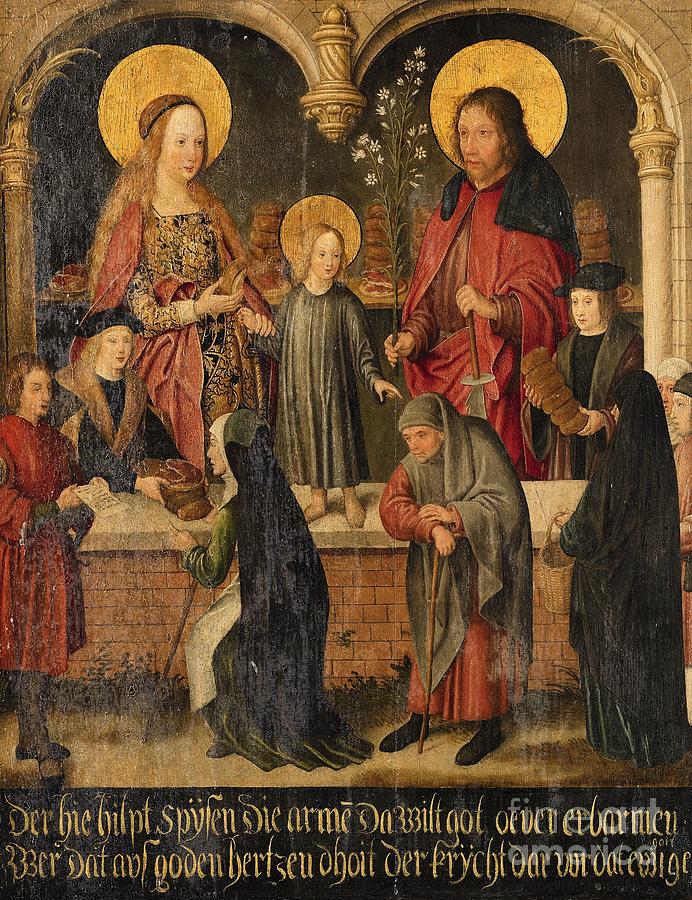
This is why the ‘holy child’ or ‘holy spirit’ is so significant. The ‘father’ and ‘mother’ are not central in the whole picture. They are depicted in Early Renaissance art in particular, as servants of the child, looking on and holding it with devotion and obedience. The holy child is not wearing a pink or blue outfit as happens in modern times, because children and the spiritual dimension that they represent, are gender neutral.
The ‘sexual’ energy that causes humans so much pleasure and grief is that given by the serpent or dragon. It is a realisation of mortality and a ‘fall’, as depicted in the biblical story of Adam and Eve, where physicality takes over from the Divine and perfect spiritual realm.
They started life naked and sans-gender and on realisation of their gender difference, were ashamed.
Gender in it’s many manifestations has a lot to be responsible for in human life, both through the ages and today. But perhaps at this time of rapid changes, the eye of truth is taking over from the eye of denial. It is a great blessing for humans to express the ‘freewill’ that was given to them, the freedom to love each other, without judgement.
 Matters Blog