We Are Forever

From Nowhere to Infinity

Dualistic thinking has a lot to answer for in Western societies. It works in part, but like all approximations, it reaches a point where it is no longer true. What I mean by this I shall illustrated with the following Mullah Nasrudin story.
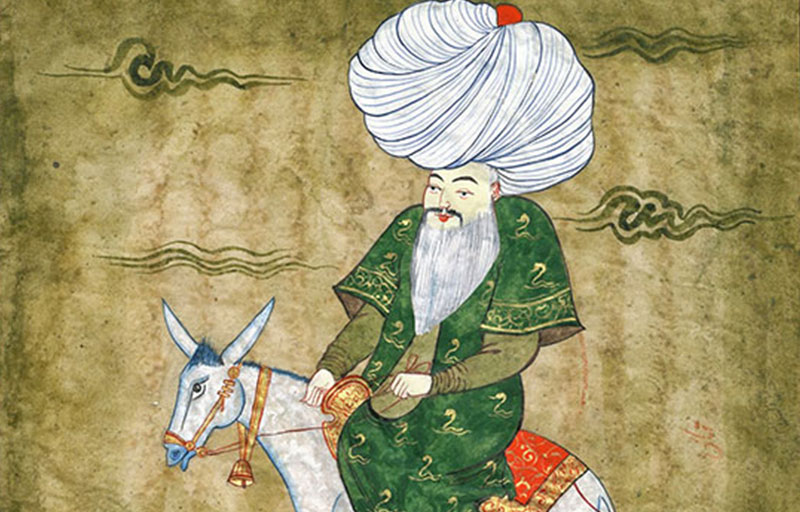
There was once a King who called all his wise men together. He challenged them to come forward with the largest number that they could imagine. They stroked their beards and looked up to the sky but none could come up with an answer. Hearing of this intellectual challenged in the market place the Mullah Nasrudin begged for an audience with the King as he believed he knew the answer. The King granted his wish and the Wise men and courtiers gathered around to hear his answer.

‘The answer is 348’ announced Mullah.

‘Ptah!’ scorned the head of the Wise men, ‘what about 349?’

‘Oh yes,’ replied the Mullah looking rather downcast but then smiling said, ‘at least I was close.’

Counting is useful but when infinity is placed into the calculation, all hell lets loose. To illustrate this point let us consider the ‘Big Bang’ theory of the creation of the universe. Because in dualistic thinking, everything has a beginning and end it is assumed that so must the Universe. Therefore everything we see today was once not existing before the Big Bang, and one day in the future, will no longer exist. But is this idea a product of truthful observation or thoughts restricted by their own boundaries or a ‘thought cage’? Even the concept of ‘time’ is a ‘thought cage’ where an hour has a beginning and an end. This is true for an observer with a clock, but for a person living in a rain forest, is a meaningless idea.

Certainly if we observe how nature works, everything is cyclic including our own bodies. Within the turning of this circle there is a constant rebirth present, which is by any definition ‘infinite’.

Computer science settled on the idea of ‘on’ and ‘off’ ones and zeros. This carried things along for a few decades but then it reached the cage bars. It could no longer expand. So along came quantum computers which used a new premise of ‘on and off’ being present concurrently. To comprehend the extraordinary effect of this, is not within the scope of this essay but be amazed.
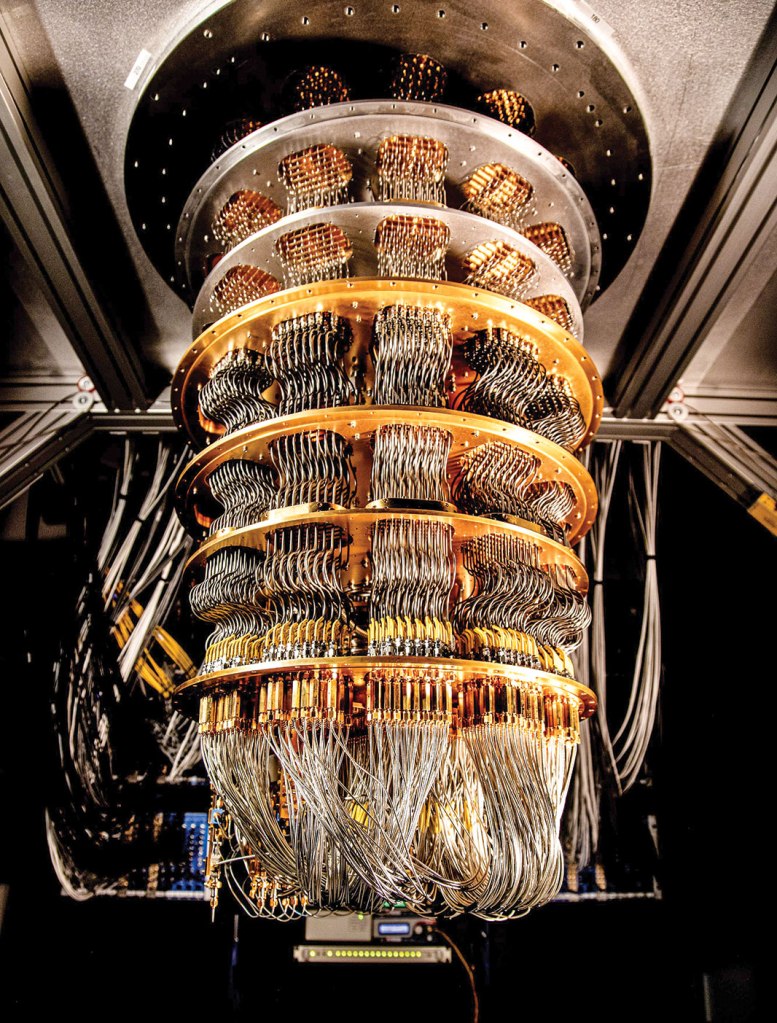
Quantum Computer picture credit: Science Magazine

Perhaps the ‘hippie scientists’ in Silicon Valley had meditated on the Ying Yang symbol for so long that they finally realised, that opposites contain each other. Opposites are not opposite. Beginnings contain ends and ends contain beginnings. This is not a western way of thinking so it took a while for the penny to drop. Off contains on and the other way around, and All is contained in a circular (infinite) whole.

The ‘wheel’ symbol came to the West possibly through the Tarot card named ‘The World’ and itself from the Alchemists depiction of the snake eating it’s tail. Like the spherical rolling ball and the Toroid, these representations of the infinite…a number that has no beginning and no end and no instrument to measure it.

No clock = No start = No time = No end
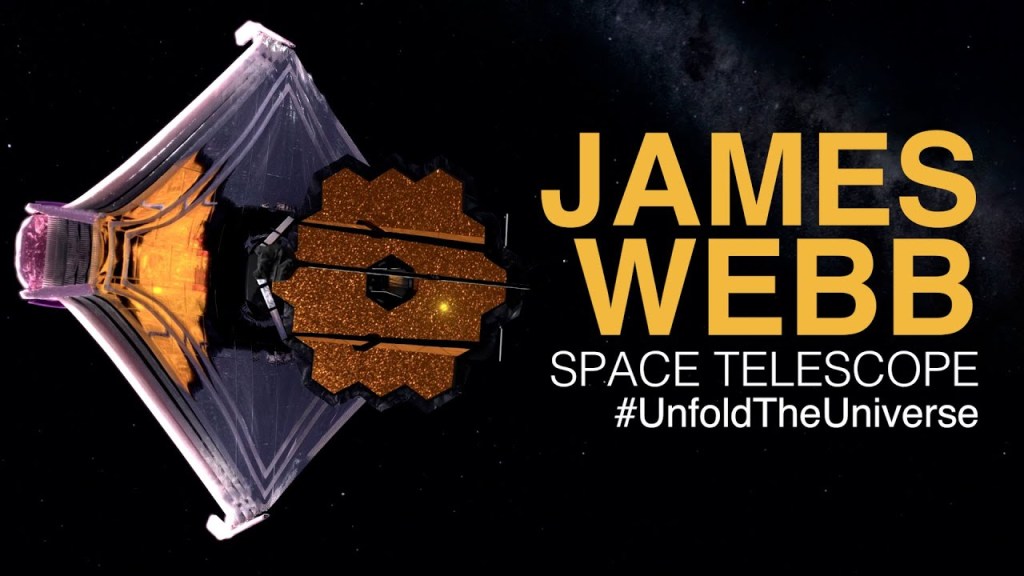
The James Webb Space Telescope has been staring into space for a few years now. Whilst there will always be various interpretations of what is being observed by the telescope, a well known physicist named Roger Penrose has come to some cage breaking ideas around the Big Bang. Apparently the JWST records galaxies as shrinking rather than expanding as predicted by the Big Bang theory. This means that light from these galaxies is not being stretched and, whilst the non-scientiest will not fully understanding this or other evidence of ‘red shifts being overlarge’, Roger Penrose concludes that ‘there was no Big Bang‘ and ‘time does not exist’. There is a video on You Tube featuring an interview with Roger Penrose for those intrigued.

Suffice to say for the purposes of this essay, that this conclusion can potentially change everything we think and feel in Western societies.
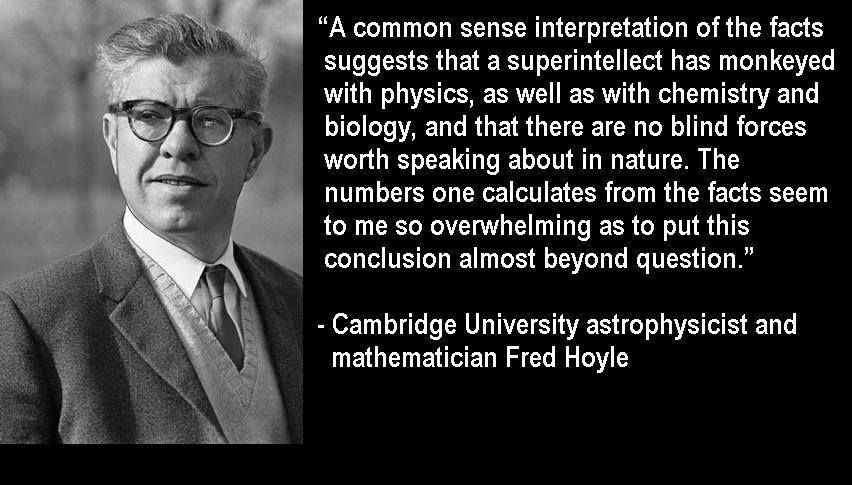
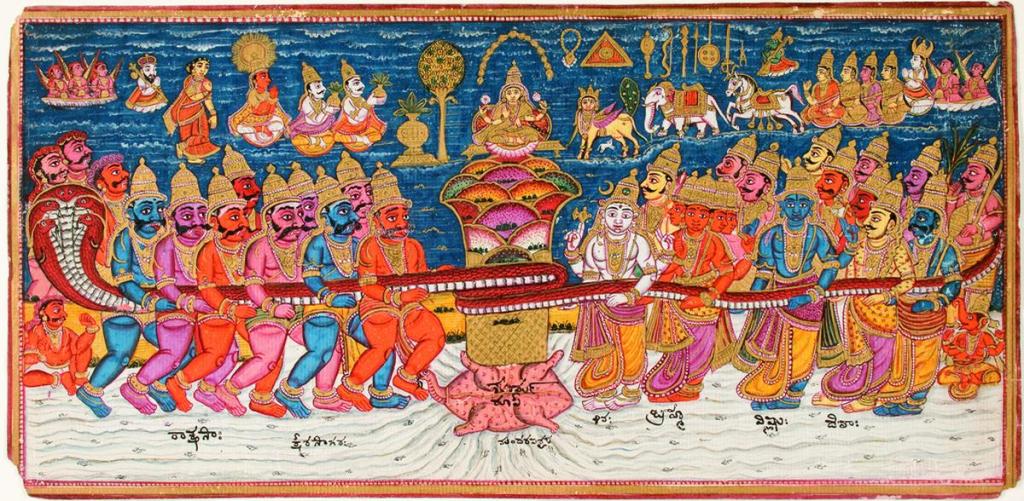
Personally, I have always been a ‘Big Bang’ sceptic and at the risk of sounding smug, I wrote to Sir Fred Hoyle in the late 1970’s suggesting just this. I cited the Hindu story of the ‘Churning of the Ocean of Milk’ imagining space as the ocean of milk. The Churning is brought about in an endless Cosmic tug-of-war between Angels and Demons and a rather discontented snake acting as a the rope. He replied that he had heard of the infinite Universe concept but that he was not convinced.
So what can we learn if there was no Big Bang, provided we are able to agree that this is the more likely theory? Personally I find it rather reassuring that science is able to catch up with what the hitch hikers in the galaxy would simply call ‘common sense’. Obviously you cannot have nothing one day and a whole load of super expanding something in the next nano second. But you can have a whole load of super contracting something becoming a whole load a expanding something.

Put simply this is just like breathing. We breath in and this creates our breath out. Each Universe (and Metaverse and beyond) is an exhalation of dust from dust of the previous cosmic intake of breath. For ‘dust’ also read ‘energy’ as both are interchangeable and that fact is how one can pass through the cosmic nostrils at the moment breathing changes direction.

Add some vibration to the dust and you get waves which in the Old Testament, Genesis calls ‘the Word’. Just as waves on the beach create wave patterns on a sandy beach at low tide, so matter begins to take form.

At a personal level, we are born as spirit (or wave energy if you prefer) into a physical body. Marlo Morgan is an American medical doctor who lived amongst the Real People in Australia. She was initiated into their way of life and ideas in stages;

Female Healer: Do you understand how long forever is?

Marlo Morgan: Yes I understand.

Female Healer: Then we can tell you something else. All humans are spirits only visiting this world. All spirits are forever beings.

Extract from Marlo Morgan’s book ‘Mutant Message Down Under, page 93.

At a few dimensional levels above is the same concept that the Divine Consciousness is within us as infinite consciousness outside of time and space.

With no time and space there is no fixed point for the Divine Consciousness. Logically, with no fixed point (what psychicist invent as ‘singularity’ to explain the Big Bang) there is only forever and ubiquity.

And the ‘Divine Consciousness’ that humans contain in microcosm means that like the Universe we also come and go as spirit moving through matter having a ‘human experience’.

Now that is something to think about and if you are totally blown away by the reassurance the idea brings, it is something to be grateful for.

Australian Aboriginal Painting picture credit: Blanton Museum of Art

Rabbits in Headlights

Understanding decision making

We live at a time when volcanoes of information are filling the sky with an uncertain grey dust and obscuring our horizons.

The internet may have enabled ‘nation to speak unto nation’ but instead of bringing understanding and concordance, the effect appears to be the opposite. People with little knowledge consider themselves expert.

I am often confused when at the end of a presentation the speaker asks the virtual or real audience, what they think. ‘Put your thoughts in the comments below’. Really? Who is the expert here? The speaker or the listener?

So how do we make decisions? What is real and true? What is fake?

With this ‘information age’ came a whole generation of young people who were given high expectations in life. ‘You too could one day be Prime Minister’. Statistically true but probably as likely as falling off a cliff.

Being an ‘expert’ has become raised in esteem at the same time as reducing it’s social value. Numerous professions are being disgraced by the media, such as the police, social workers, school teachers, health workers on the evidence of shocking but isolated incidents. It’s a compelling use of emotional persuasion rather that logical reasoning. Those who struggled to reach beyond a life of manual work, are being rewarded with low wages and flagging public confidence.

How has this happened? How do we decide things, really? Are our opinions being made for us?

There is a book that appeared in a permissive 1971 called ‘The Dice Man’ by George Cockcroft which I thoroughly recommend to adventurous readers. The theme of the book is a psychiatrist who starts to make every personal decision with a die. It’s as simple as that. The ‘moral’ values of this character’s life are eliminated and his behaviour become socially ‘exploratory’.

What the theme of the book shows us is that we make decisions and yet those decisions might as well be random for all the understanding we have about how they came about. One might also question where one is going in life.

To get to the rub here; humans decide using their heads, their hearts, their intuition or just randomly; including omission. Most of the time it’s a combination of all of these in unequal proportion of strength of influence.

If that sounds complicated, it is. And when two humans decide something together it gets a whole load more complicated. When a man meets a woman in a bar and they are both looking for a life long partner and wondering if ‘this is it?’, there is a lot of thinking, feeling, intuition and ‘do I feel lucky?’.

When a married couple are shown a house by an estate agent (or realtor), usually the husband is measuring the garage while the wife is in tears over the beautiful kitchen and views of the garden. Or they may both see nothing about the house that they like. Perhaps the agents description pressed the wrong buttons and they thought they were going to look at something else.

What about political decisions? If you live in a democracy you get a vote, now and again. How do you decide? Those whose tendency is to use their mind to make decisions, may read a party manifesto or listen to the speeches of candidates to form a decision based on information.

The problem with this is that the information is almost always biased. Candidates may have only selected facts that support their policies. This may unknowingly contain information that was generated by a hostile state and fed into the minds of politicians and voters alike. Then the bias is from randomly elsewhere and yet intelligent people base their decisions on it.

People are constantly mislead even by their own governments in the same way. For instance, a government might present as fact something that is not true. This has become prevalent in much of modern politics whether in the USA or the UK. The disgraced ex-prime minister Boris Johnson was known as a compulsive fibber even in his school reports and is still present in his ‘I don’t care’ decision making.

To give another example of biased decision making, only those scientists were quoted during the Sars 2 – Covid 19 pandemic whose ideas supported the policies of governments. For instance, if they were specialists in virology and immunology who thought untested RNA vaccines were the best solution to the problem of hospitals becoming overwhelmed, then they were selected to advise ministers and front with the public in interviews.

The decision making process before during and after the pandemic highlights the many strands to justifying decisions that affected people’s lives and livelihoods. The poor decisions displayed little understanding of how decisions should be made. Perhaps the problem was never hospital capacity but keeping people fit to continue to go to work and for children to study; all by using socially reassuring and cost benefited methods.

Much of the justification of actions by governments during the pandemic was accepted by the general public because persuasion was targetted at the emotions rather than the mind and good old ‘common sense’. Instead the emotion targetted at populations was fear. If governments can persuade their populations that they have to do x,y and z otherwise they will die or cause the deaths of others, then they gain a dominating position.

Proffesor Mark Woolhouse wrote in The Guardian newspaper

At a No 10 briefing in March 2020, cabinet minister Michael Gove warned the virus did not discriminate. “Everyone is at risk,” he announced.

And nothing could be further from the truth, argues Professor Woolhouse, an expert on infectious diseases at Edinburgh University. “I am afraid Gove’s statement was simply not true,” he says. “In fact, this is a very discriminatory virus. Some people are much more at risk from it than others. People over 75 are an astonishing 10,000 times more at risk than those who are under 15.”

The argument ‘get vaccinated or you will be passing a fatal illness on to others’ has also since been proved to be factually incorrect! The drug companies had thought about this but only conducted research using eight (or was it ten) rabbits. As to harms associated with the vaccine, these were strongly denied and anyone suggesting they may cause myocardial disease was discounted as a ‘conspiracy theorist’. This expression has evolved into an emotional criticism rather than showing a basic understanding of the difference between a ‘theory’ and a fact.

Again there has since been found a high percentage of excess deaths in those vaccinated, either causal or temporally correlated; a situation that has not been publicised, explained or apologised for by either drug companies or governments.

The whole ‘pandemic’ situation can be seen with hindsight by the rational mind as a ‘storm in a tea cup’ stirred up initially by a despotic government to whom few other nations openly respect in most other matters, namely the China’s Communist Party.

Pandemic Politics picture credit: The Economist

Was ‘lock down’ ever a better alternative to ‘go to bed’? How did ‘lock down’ ever become acceptable to freedom loving democracies?

Emotionally, many were traumatised by events when they really didn’t need to be, especially by constant fear inducing reporting by the media. The only solution offered to the fear of death, was to be vaccinated.

There were some who didn’t understand the science and didn’t feel the fear but made a decision about whether to be vaccinated based on intuition. These are the people with who are hardest for governments to deal with. Novak Djokovich knew his own mind on the subject of vaccinations and spent time in detention in Australia for his principles.

In summary, most life decisions are far more complex than we have to tools to make. Victorian education was based on fear induced fact learning. Today unrealistically optimistic self belief is taught in schools. Perhaps in the future children and young people will be taught how to gain a rigorous understanding of their psychological, emotional, intuitive and ‘I just feel lucky’ characteristics. Ultimately, understanding oneself with any clarity takes a lifetime to achieve, if at all. Trial and error decision making is really not a good tool for life in my opinion but it happens to an alarmingly high degree not least in those who lead us.

Governments and citizens have become like rabbits caught in the headlights of change. They look left and right for a safe direction to run but like unfortunate lapins, our future depends on making swift, informed, ethical, unbiased, emotionally intelligent, compassionate and inspired decisions for ourselves, our loved ones and those who come after us.

You have one sixteenth of a second to decide. Your time starts now.

Repeat Repeat

A Bomber crew are flying across a desert. Suddenly, all four engines cut out. They have miscalculated their fuel. The pilot sees a small dot of green below and glides the plane down to crash close by. The navigator lays the pilot down in the shade of a palm tree for the pilot has broken his leg. They discuss what to do and the navigator says he will explore at dusk on a bearing of 90 degrees. He does so and comes back in the morning reporting not having found anything. The next night he does the same with the same result. The pilot asks him why he set off in the same direction as the night before. The navigator replies that he wanted to be sure where he was going, by following his footprints.

That’s how many people get around, even those who can loose of their habits but do not. We learn a route and just keep going the same way. Probably the majority of the human population know how to get to only a limited number places, lierally and metaphorically, limiting their life experience.

In defence of this ‘keeping to a well known track’, humans live complex lives and repetition is a coping mechanism. We know that animals act in exactly the same way, scurrying through undergrowth on well worn paths and so doing become meat for hunters.

As humans should we not be more adventurous than animals? Even in our ‘modern’ city lives our culture encourages ‘everyday’ repitition. Many people listen to their favourite music tracks using the ‘repeat’ button the listen over and over again. Some book their holidays the day they return to go back to the same hotel a year later.

Like everything, exploring the unusual starts in our imagination. As creators we can imagine a thing and make it happen. That is very powerful but when a person lacks the ability to ‘think big’ or ‘out of the box’, then how can they progress through life? When you listen to conversation it is common to hear figures of speech such as ‘so’ (to start a sentence with a conjunction!), ‘to be honest’ or ‘in terms of’ repeated endlessly. They lack the ability to string together a line of words imaginatively without using meaningless words and phrases endlessly. Perhaps they are thinking faster than they speak and have never applied themselves to slow down. Perhaps their habitual words have become unconscious and if you challenged them you would only convince them they say ‘you know’ constantly by recording and playing back their conversations.

There is a verbal game show on BBC Radio 4 in which contestants have to speak for a minute without repetition, deviation or hesitation. It is not as easy as it sounds.

Sadly, much conversation involves listening to others giving accounts of situations in which they found themselves in the past. A simple trigger word such as ‘electricity’ will start them off on a story of how their house had no electricity for three days and they ran out of candles and matches they read books by more candles they found under the kitchen sink. If they have a partner, that person will be rolling their eyes because they have heard this story ad infinitum.

Repetition is boring. I said, repetition is boring.

Subtlety though, even something new, can quickly become a mere copy / repeat. The world of fashion for instance, challenges designers to think of some new design that has never been done before even if it is something as mundane as a new fabric design or hue.

‘Everybody, this year, is wearing blue!’

The designs hit the factories which start to make thousands of identical garments. At the office party the bosses wife discovers she is wearing exactly the same dress as his secretary. The secretary should have gone for the pink dress but had been made to feel it was ‘unfashionable’ by those who are paid to ‘set the trends’.

Japanese Soccer Fans pitcture credit: BBC

Happy souls who support a football team will do so with a level of loyalty that has them acting in greater unison than a school of fish; wearing the same football shirt, sitting in the same seat, eating the same hamburgers, singing the same songs.

Originality knows how to run for the hills, if we let it.

Religions are perhaps the strictest social organiser. They demand complete obedience to certain set norms in dress, behaviour and ritual; down to the greatest detail. Repetition of phrases, verses and even complete Holy books illustrates how humans can reduce their super computer brains to being mere SD cards, when prompted.

So what can be done to release humanity from reptition? How do we make the navigator in our heads walk on a bearing of 91 degrees and then 92 degrees each night; until a village is found at 112 degrees?

Sometimes it takes no more than just a mere tweek, to add variety to life. Those who commute to work probably follow the same route each day for years. Yet, there will always be other routes available even if they may take a minute or so longer. There may be alternative means of travel such as walking or riding a bicycle, performing cart wheels or sliding on ice. ‘Walking buses’ for groups of children is an excellent example of how simple changes can invigorate human activity.

Artists have always been beacons of innovative method and expression. Every author sits down and writes a book that no one has read before. It may follow perennial themes of love and war, but the story and characters will be entirely original. The more boundaries of literary norms that are broken the greater the appreciation of the book. James Joyce’s Ulysses is an example of stunningly novel literary…novel.

In every human activity success comes when imagination and the ability to explore the imagination, fuse into the entirely original. This is true for science as well as art, politics, engineering, design, exploration and all things humans reach out to in order to excel.

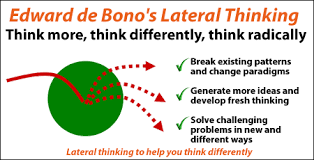
Learning how to think is a subject which is not taught in schools. This must surely be a folly partly produced by those who think repetitively. It is assumed that children already know how to think in the same way they acquire language; by repetition. This is true, of but of course the thinking skills involved in early learning are at risk of being mere copies of adults mechanical patterns of thinking. Psychologists like Edward de Bono created thinking tools that enabled the ability to think into infinity, or at least where no metaphorical human had thought before. Managers in commerce and industry sent their staff to learn his techniques and used them to gain commercial advantage.

If you asked the man or woman in the street to make up a new word in ten seconds, they would probably stumble. If you taught them the technique of substituting one vowel for another the task is simple. For example, ‘cat’ become cet, or cit or cot or cut. There we have two new words with no meaning yet ascribed.

Ask a friend to do something in the next minute that they have never done before and they might well just stare at the ceiling for a minute because that is what they always do when they cannot think. A person for whom imagination has no boundaries will roll up their shirt sleeve, dip their elbow in a tin of custard and write their name on the ceiling.

There we have two ends of the same problem. Thinking and acting via mere repetition and doing the same but in innovative ways. Somewhere in between these two extremes is a happy medium.

The human brain that can engage in acting whilst ‘not thinking’ such as a Zen Buddhist monk, can change their world. The pattern of logical thought becomes short circuited and the meditators brain changes frequency quite literally, to a completely new level.

Even though a Zen Buddhist monastery teaches using repetition, there is a level of awareness that eventually arises of it’s own accord; above the casual and ordinary whilst in the casual and ordinary.

In this way the world which humans perceive becomes unlimited and infinite in it’s possibilities. It is neither repetition nor innovation, but it is something. This insight is captured in the line which the singer Donovan wrote based on Buddhist philosophy;

‘First there is a mountain then there is no mountain then there is.’

How we live ultimately comes down to the energy patterns in our neural pathways; in the brain and spine and various nerve plexuses. How we think is directly related to how our synapses are used to work and from children and according even to gender, we run our own brains in increasingly mechanical ways.

At a more subtle level, our energy centres, or chakras, are also subject to becoming inbalanced due to overuse in one area or another. This is a whole new subject which I explore in another website chakracard.wordpress.com. But suffice to say that we live enclosed in what Don Juan in Carlos Castaneda’s book ‘The Fire From Within’ describes as a ‘luminous egg’. This is our energetic connection with the subtle worlds beyond physicality. This ‘egg’ can also be another boundary which Don Juan calls a ‘cocoon’. He explains , and I will give him the last word;

‘A mere glimpse of the eternity outside of the cocoon is enough to disrupt the coziness of our inventory.’ page 115

Picture credit: Tolteclightwarrior