
A Bomber crew are flying across a desert. Suddenly, all four engines cut out. They have miscalculated their fuel. The pilot sees a small dot of green below and glides the plane down to crash close by. The navigator lays the pilot down in the shade of a palm tree for the pilot has broken his leg. They discuss what to do and the navigator says he will explore at dusk on a bearing of 90 degrees. He does so and comes back in the morning reporting not having found anything. The next night he does the same with the same result. The pilot asks him why he set off in the same direction as the night before. The navigator replies that he wanted to be sure where he was going, by following his footprints.
That’s how many people get around, even those who can loose of their habits but do not. We learn a route and just keep going the same way. Probably the majority of the human population know how to get to only a limited number places, lierally and metaphorically, limiting their life experience.
In defence of this ‘keeping to a well known track’, humans live complex lives and repetition is a coping mechanism. We know that animals act in exactly the same way, scurrying through undergrowth on well worn paths and so doing become meat for hunters.

As humans should we not be more adventurous than animals? Even in our ‘modern’ city lives our culture encourages ‘everyday’ repitition. Many people listen to their favourite music tracks using the ‘repeat’ button the listen over and over again. Some book their holidays the day they return to go back to the same hotel a year later.
Like everything, exploring the unusual starts in our imagination. As creators we can imagine a thing and make it happen. That is very powerful but when a person lacks the ability to ‘think big’ or ‘out of the box’, then how can they progress through life? When you listen to conversation it is common to hear figures of speech such as ‘so’ (to start a sentence with a conjunction!), ‘to be honest’ or ‘in terms of’ repeated endlessly. They lack the ability to string together a line of words imaginatively without using meaningless words and phrases endlessly. Perhaps they are thinking faster than they speak and have never applied themselves to slow down. Perhaps their habitual words have become unconscious and if you challenged them you would only convince them they say ‘you know’ constantly by recording and playing back their conversations.
There is a verbal game show on BBC Radio 4 in which contestants have to speak for a minute without repetition, deviation or hesitation. It is not as easy as it sounds.
Sadly, much conversation involves listening to others giving accounts of situations in which they found themselves in the past. A simple trigger word such as ‘electricity’ will start them off on a story of how their house had no electricity for three days and they ran out of candles and matches they read books by more candles they found under the kitchen sink. If they have a partner, that person will be rolling their eyes because they have heard this story ad infinitum.
Repetition is boring. I said, repetition is boring.
Subtlety though, even something new, can quickly become a mere copy / repeat. The world of fashion for instance, challenges designers to think of some new design that has never been done before even if it is something as mundane as a new fabric design or hue.
‘Everybody, this year, is wearing blue!’
The designs hit the factories which start to make thousands of identical garments. At the office party the bosses wife discovers she is wearing exactly the same dress as his secretary. The secretary should have gone for the pink dress but had been made to feel it was ‘unfashionable’ by those who are paid to ‘set the trends’.

Happy souls who support a football team will do so with a level of loyalty that has them acting in greater unison than a school of fish; wearing the same football shirt, sitting in the same seat, eating the same hamburgers, singing the same songs.
Originality knows how to run for the hills, if we let it.
Religions are perhaps the strictest social organiser. They demand complete obedience to certain set norms in dress, behaviour and ritual; down to the greatest detail. Repetition of phrases, verses and even complete Holy books illustrates how humans can reduce their super computer brains to being mere SD cards, when prompted.
So what can be done to release humanity from reptition? How do we make the navigator in our heads walk on a bearing of 91 degrees and then 92 degrees each night; until a village is found at 112 degrees?
Sometimes it takes no more than just a mere tweek, to add variety to life. Those who commute to work probably follow the same route each day for years. Yet, there will always be other routes available even if they may take a minute or so longer. There may be alternative means of travel such as walking or riding a bicycle, performing cart wheels or sliding on ice. ‘Walking buses’ for groups of children is an excellent example of how simple changes can invigorate human activity.
Artists have always been beacons of innovative method and expression. Every author sits down and writes a book that no one has read before. It may follow perennial themes of love and war, but the story and characters will be entirely original. The more boundaries of literary norms that are broken the greater the appreciation of the book. James Joyce’s Ulysses is an example of stunningly novel literary…novel.
In every human activity success comes when imagination and the ability to explore the imagination, fuse into the entirely original. This is true for science as well as art, politics, engineering, design, exploration and all things humans reach out to in order to excel.
Learning how to think is a subject which is not taught in schools. This must surely be a folly partly produced by those who think repetitively. It is assumed that children already know how to think in the same way they acquire language; by repetition. This is true, of but of course the thinking skills involved in early learning are at risk of being mere copies of adults mechanical patterns of thinking. Psychologists like Edward de Bono created thinking tools that enabled the ability to think into infinity, or at least where no metaphorical human had thought before. Managers in commerce and industry sent their staff to learn his techniques and used them to gain commercial advantage.
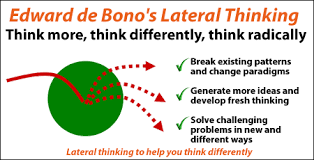
If you asked the man or woman in the street to make up a new word in ten seconds, they would probably stumble. If you taught them the technique of substituting one vowel for another the task is simple. For example, ‘cat’ become cet, or cit or cot or cut. There we have two new words with no meaning yet ascribed.
Ask a friend to do something in the next minute that they have never done before and they might well just stare at the ceiling for a minute because that is what they always do when they cannot think. A person for whom imagination has no boundaries will roll up their shirt sleeve, dip their elbow in a tin of custard and write their name on the ceiling.
There we have two ends of the same problem. Thinking and acting via mere repetition and doing the same but in innovative ways. Somewhere in between these two extremes is a happy medium.
The human brain that can engage in acting whilst ‘not thinking’ such as a Zen Buddhist monk, can change their world. The pattern of logical thought becomes short circuited and the meditators brain changes frequency quite literally, to a completely new level.
Even though a Zen Buddhist monastery teaches using repetition, there is a level of awareness that eventually arises of it’s own accord; above the casual and ordinary whilst in the casual and ordinary.
In this way the world which humans perceive becomes unlimited and infinite in it’s possibilities. It is neither repetition nor innovation, but it is something. This insight is captured in the line which the singer Donovan wrote based on Buddhist philosophy;
‘First there is a mountain then there is no mountain then there is.’
How we live ultimately comes down to the energy patterns in our neural pathways; in the brain and spine and various nerve plexuses. How we think is directly related to how our synapses are used to work and from children and according even to gender, we run our own brains in increasingly mechanical ways.
At a more subtle level, our energy centres, or chakras, are also subject to becoming inbalanced due to overuse in one area or another. This is a whole new subject which I explore in another website chakracard.wordpress.com. But suffice to say that we live enclosed in what Don Juan in Carlos Castaneda’s book ‘The Fire From Within’ describes as a ‘luminous egg’. This is our energetic connection with the subtle worlds beyond physicality. This ‘egg’ can also be another boundary which Don Juan calls a ‘cocoon’. He explains , and I will give him the last word;
‘A mere glimpse of the eternity outside of the cocoon is enough to disrupt the coziness of our inventory.’ page 115

 Matters Blog