The present is the greatest gift
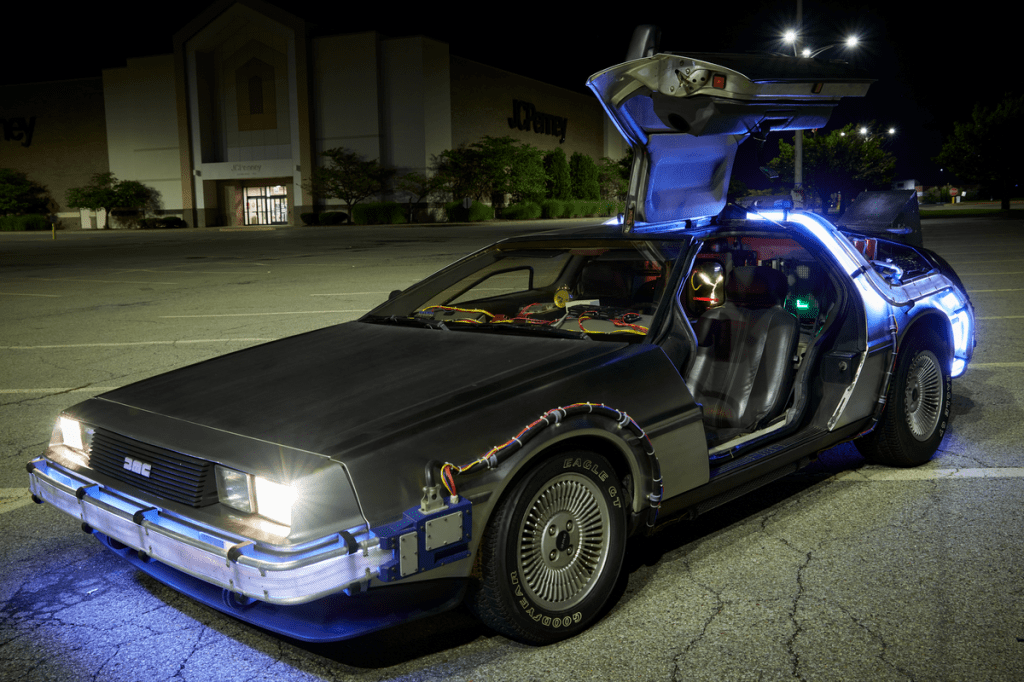
I visited my mechanic at his garage a few weeks ago and was surprised to find the place deserted. But an impressive Delorean sports car sat there with it’s rear engine exposed as if ready for ‘take off’. After a few moments of wonder, the garage owner appeared wiping his hands on a rag. ‘Oh!’ I said, ‘I thought you had gone back to the future!’
He didn’t laugh and had probably heard the joke all morning but it made me think on the film ‘Back to the Future’. What a nonsense premise for a story I always think. Odd that in a society that considers itself rational and scientific, writers are fascinated by illogical impossibilities and their absurd consequences. Such non-real accounts are of course, fiction, and humans have an ability that is often taken for granted; to live in factual and fictional worlds simultaneously.
Films like this such as Disney’s ‘Alice Through the Looking Glass’ introduce concepts of non-linear time that I do not believe children are likely to understand or benefit from. Contrary to Lewis Carroll’s original concept, a character known as ‘Time’ played by Johnny Depp, is central to the story as Alice time travels to change the past.
‘You cannot change the past!’ screams Alice at one point in the film.
The same insight applies to the future…a simple fact that children would do well to be taught at an early age. But of course, science fiction knows no end to the concept of jumping forwards and backwards along the illusion of linear time.

Whilst Western fiction writers are sending their characters off ‘through time’ in absurd contraptions, philosophers and some indigenous tribes like the Dogon, describe a ‘non-linear time’ model in which all pasts, presents and futures exist together.
Just as one needs a map to know a destination, a time traveller needs to know the where and when of a proposed journey. There are many oracle card designers and readers in Western societies today; overtaking the famous ‘Tarot’. An ‘oracle reader’ will use cards to predict ‘the future’ but preface the prediction with ‘this is only one of many futures.’
It would be good for us all, in my view, if we admit that the fourth dimension which we call ‘time’ is a mysterious, filtered perception and, in my view, better left so.
What then? Well, this leaves us with ‘the present’ and we should not feel the lesser for it. Perhaps we should pause and seriously contemplate how much we live in the present and how much in selected memories of past and an imaginary future.
I have noticed how older people, enjoying the last flourish of their lives, tend to talk too much about things that they have done in the past. Sometimes these stories contain humour or valuable life lessons but mostly they are experiences intended to impress rather than amuse or inform.
This phenomena is not only applicable to personal history, but also scholars of global history, politics, religions and any subject that has come and gone.
We tend to understand now, that history is ‘written by the victors’. Writers filter facts in order to record a biased account for intentional or unintentional reasons. Politicians of all colours, do the same. We tend to put previous leaders on pedestals and forget their misjudgements and misdeeds. For example Winston Randolph Churchill was a man whose military mistakes are overlooked for his finer qualities of oratory and leadership. Nelson R. Mandela was an ANC terrorist imprisoned for his acts and yet later was awarded the Nobel peace prize for laying down the foundations of equality of the races and democracy in South Africa. Mother Teresa valued ‘poverty’ so much she rarely distributed the money she was given to the poor. Are these people really good role models for future generations?
The further back into the past one investigates, the more imagination and conjecture colours and shades reality. Religions have a hard time presenting a solid case around revered or ‘holy’ prophets and saints for the same reasons. The main difference compared to politics, in my view, is that for religions, ‘faith’ can be used to excuse the unprovable.
Religious scriptures that do not change endure, because they can be trusted. The dynasties of ancient Egypt could be argued to have remained powerful through thousands of years for this very reason. An nnovatory pharaoh, such as Akhenaten, was overruled by the priests on his death and past traditions restored.
Today academics study the past, apparently for it’s own sake. A cabinet full of Stone Age flints, for instance, is meaningless to the ordinary person. In contrast, the causes and consequences of war might be considered worthy of study and learning lessons, but this rarely happens. For this we pay a price and wars continue to this day.
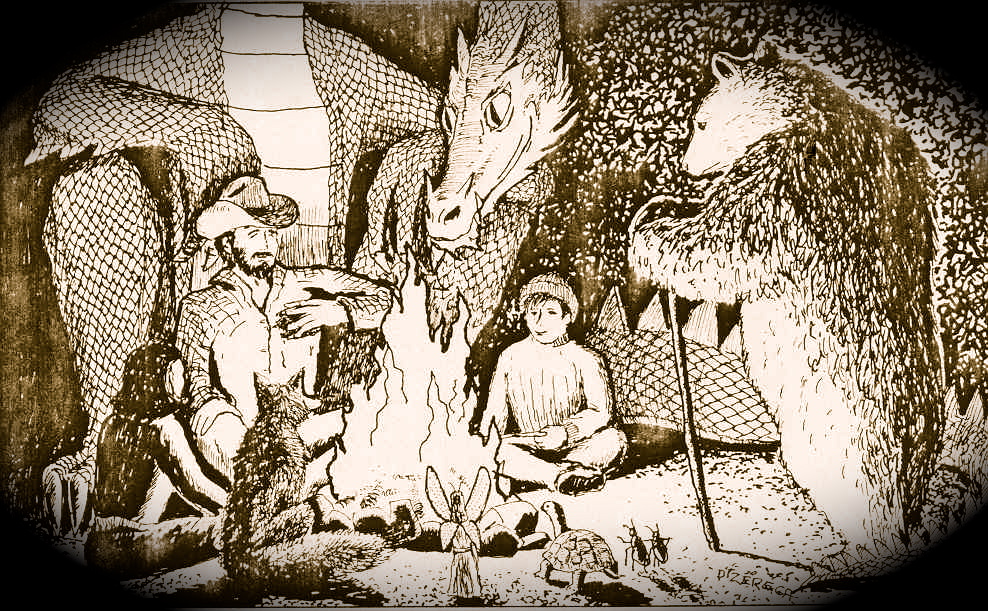
The tales of olden times, told around the camp fire by our ancestors, sustained knowledge and wisdom, whereas today there is little such continuity and consensus for our children.
Past and future are fraught with conjecture, imagination, bias, incomplete facts and false reasoning. I suggest that the value of both the past and future as treated in the West today, is at best limited and at worst, misleading.
Which leaves us with the present. The ancient Greeks had a word for the quality of the present moment which is ‘kairos’. It describes the true value of every moment. When they measured time with solar shadows or lunar observations for purely practical reasons, they called it ‘chronos’. The two were distinct and even turn up in the Holy Bible in Acts 13:18 and 27:9 .
In the East, ancient thinkers have encapsulated the same idea; such as in Zen Buddhism and Taoism. In Zen, the meditator is kept in the moment by being struck with a stick by the teacher, should a student’s mind be observed to be wandering.
But perhaps it is a surprise to find the same understanding also described in the Holy Bible. Ephesians 5, 15-17, James 4 and Psalm 118 all refer to and imply an awareness of the quality of the ‘God filled’ moment. What the ancient Greeks called ‘chronos’ is time as a measured ‘tick’ of time, however this might be done. This, apart from being helpful when arranging appointments, is a double edged concept that creates the stress of having to avoid ‘lateness’ and ‘sloth’ and ‘waste’.
‘What a complete waste of time!’, we say and yet how is this ever possible?

In contrast, the kairos moments embrace all our thoughts and actions and give grace for inspiration to enter a persons soul. Those who only measure time experience the frustration which we call ‘impatience’.
In Western Judaeo-Christian history, there has always been an understanding of not only the right moment to perform an action but a right season. For instance, there are times in the Jewish Astrological calendar that is it wise to start a new enterprise. This is the month of March or Aries in astrology. If one is wishing to start a new business, for instance, then the unique qualities of this part of the solar year, add benefit to the enterprise and make it more likely to succeed.
The contrast between chronos and kairos concepts of time bear a parallel resemblance to a ‘five senses’ life and an ‘inner senses’ life respectively. The majority of the population are primarily engaged in the former; particularly the agnostics who believe that when the watch winds down, it is dead. Non such ‘clockwork minds’ are able to give less importance to the five senses and develop awareness of ‘Mind’. Mind is what is happening within ones body / mind unity, as a microcosm of everything in the Universe.
This ‘universal’ way of life, is one of the many graces obtainable through being sensible of the subtle, ‘unmeasured’, qualities of our soul and being present in it.
The poet and mystic William Blake expressed this most perfectly in his poem
Auguries of Innocence;
‘To see a world in a grain of sand,
And heaven in a wild flower,
Hold infinity in the palm of your hand
And eternity in an hour,’
 Matters Blog