Olympics in Flames

Lord, what fools these mortals be!”

Puck’s line to King Oberon Act 3 Midsummer Nights Dream William Shakespeare

This was going to be an essay titled ‘The Party is Over’ but then the Olympic Games Opening Ceremony 2024 stopped me. It was too extraordinary to ignore and in fact, contained the same messages. I wish the Olympics, the athletes and the people of France and the World come together in love at the conclusion of the Olympic 2024 as was surely the original intention of the games. I express no religious or political views other than universal love. If you do not have ten minutes please slide down to the final conclusion.

The gods on Mount Olympus would have watched the Olympic Games Opening Ceremony 2024 in Paris, with a conflation of amusement and horror.

Personally, I found it pedestrian, disjointed and more than at little weird, and I was not the only one. For a country renowned for its consummate sense of good taste, design, style, and pazzazz; what in Hell  happened?

I shall express views here which some will find far fetched, even disturbing. However, this sideways analysis might explain why standards fell so low.

Those who have read Dan Brown’s book or seen the film The de Vinci Code, will appreciate the power of symbols. The main character played by Tom Hanks, is an academic ‘symbolist’. He unravels symbols as a trail of clues that lead to the truth and this is what I believe was happening at this Olympic Ceremony.

So are there ‘clues’ in the ceremony and if so, what truth is being disclosed?

The Olympian gods used to look down on humanity and create situations. If you were a modern organisation, similarly determined to influence the thoughts and feelings of 29 million remote viewers around the world, this ceremony is the perfect vehicle. Being performed in the ‘city of lights’ was surely an invitation the Illuminati could not refuse?
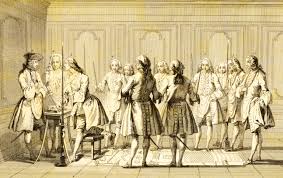
The Illuminati picture credit: National Geographic

I recommend personal research to discover the motives and means of the Illuminati and other cabals, but their aims might be summarised as; ‘to achieve a Global Order through the removal of personal and national freedoms’.

So when you hear on the news that the fibre optic cables serving the high speed trains to the city of Paris have been sabotaged, you wonder why? Curiously, a week or so after the attack, the media are still describing this planned event as ‘vandalism’. No organisation has yet claimed responsibility. You might wonder what reporters are avoiding saying and who has told them not to say it. Was a planned and co-ordinated attack to created fear? Fear of death is the currency of cabals as we witnessed in the recent global pandemic where, again no originator has come forward or been found.

Let them hate us as long as they fear us.’ Caligula

Fibre optic cables carry vast quantities of information over long distances. They send light through gross matter. Cutting off this supply in the four cardinal directions was like cutting off light to the City of Lights; the city of the Sun King, Louis 14th. So similarly ‘cut off from the world’ was Louis, when he moved the Royal Court away from the Parisian minions to Versailles, where he could enjoy a privileged  hedonistic lifestyle.
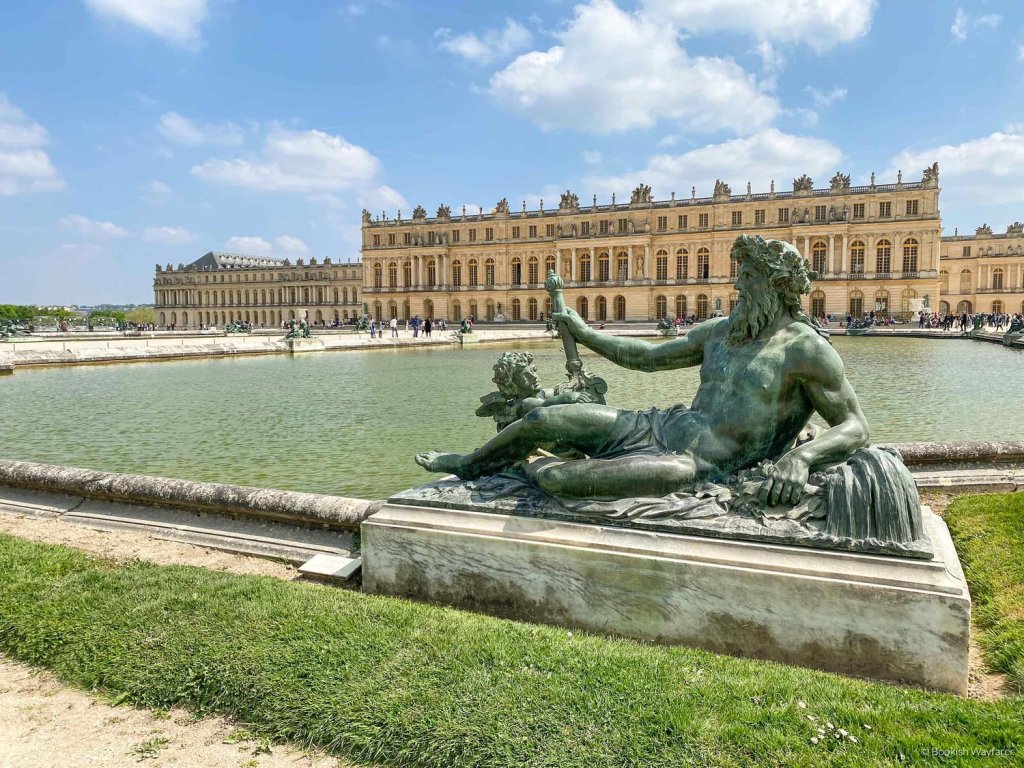
The leaders of the secret societies were closely involved with and led the French Revolution. They would have introduced the ‘Phrygian Cap’ as headgear for the revolutionaries; a symbol of Mithras represented by the bull.

Close observers of the Olympic Opening Ceremony would have noticed the golden head of a bull next to the five Olympic rings at the flag raising ceremony. Should we conclude that Mithras and Revolution is alive and well in modern France?
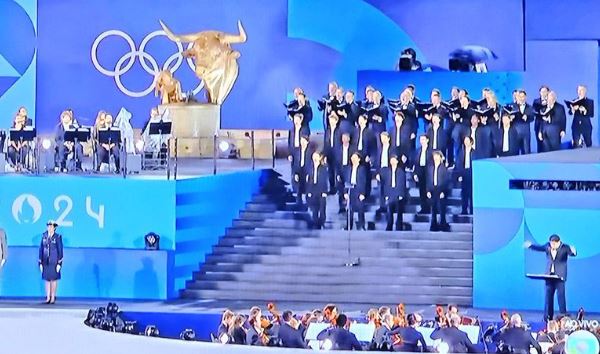
picture credit : Israel 365

The Roman Empire nearly adopted the Mithraic religion as it was popular with it’s soldiers and Mithraic temples can be found under many churches. In myth the bull’s spine sprouts corn and the blood is the wine of animal life. Christianity was chosen as the preferred Roman religion but the similarity of this Mithraic myth to the Eucharist should not be overlooked.

Light is a common symbol of spirituality and Jesus was not the only one who proclaimed to be the ‘light of the world’.

‘How thou art fallen from Heaven, son of the morning’ Isaiah 14:12

There is an old Testament character named Lucifer who the Church Fathers decided to eclipse by conflating Satan and Lucifer and Ahriman as the same beings

But Lucifer, the ‘Light Bearer’, is important today as he represents an ‘imbalance’ of spirituality, a powerful overload of light. We should not consider spirituality as being only goodness, as it can be too weak or too powerful and when either occurs it produces bad things.

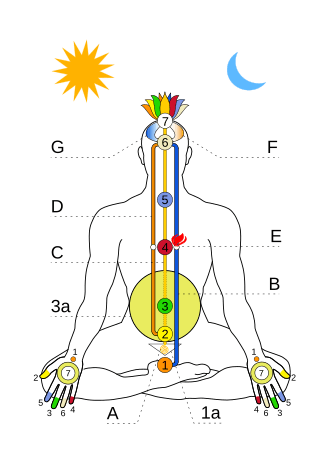
Lucifer was responsible for the loss of the ‘third eye’ represented as the ‘brow or Adjna Chakra’ in Yoga and a Cobra in Ancient Egypt. Without this sensibility humans descend into illusion and delusion. The figure of Marie Antoinette in red in the Ceremony, represents how humans have collectively ‘lost their heads’ or rational thought and are fixed in the bright red base chakra of animal and tribal desires.

Balanced spiritual energy is a good thing, but when it becomes imbalanced it is not. Gautama Buddha discovered this after living an indulgent life in royal splendour, then aestheticism. He found little of spiritual value in either. He became enlightened when he followed what he called ‘the middle way’, which is the philosophy of Mahayana Buddhism today.

In the ceremony, Venus was represented by Beyonce as a feminine spirit of light and beauty with an enchanting voice; as with the Sirens in the voyage of Odysseus. But it was a narcissistic delight in self reflection that audiences were presented with and not the Venusian sacred mirror of ‘self reflection’.
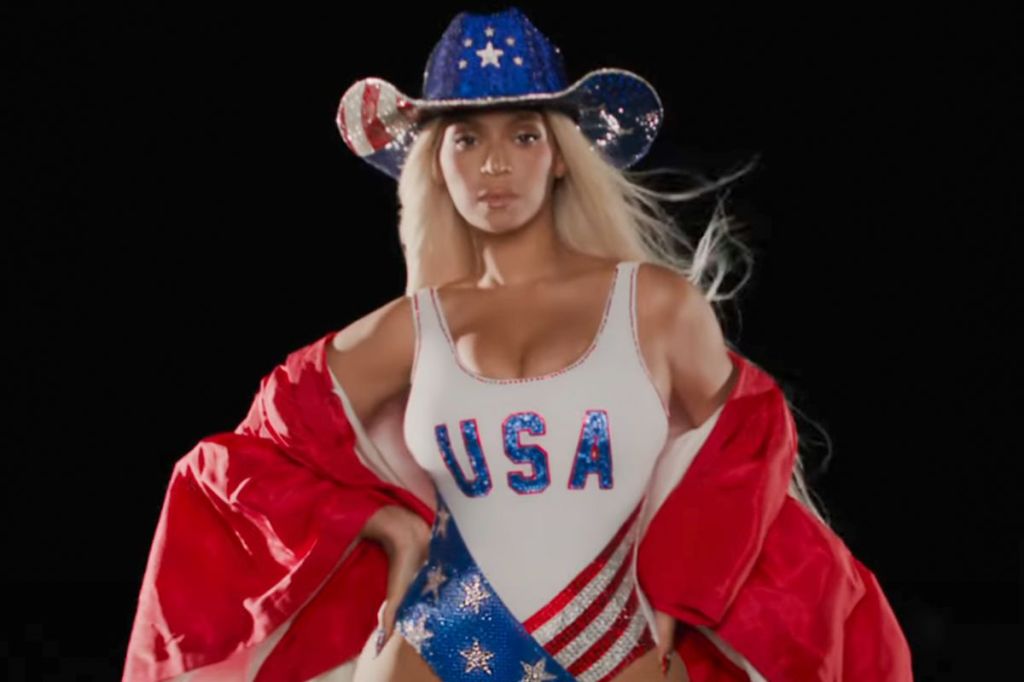
The decent from balanced spirituality into base narcissism is present around the world in social politics today, not least in France where the left and right wing extremists, with no thought of a ‘middle way’ compromise, have recently taken over the government of the country.

The political values of the French Revolution, “Liberty, Equality, Fraternity or Death” were chapter headings in the ceremony as it appeared on television.

The above background information, is intended be some explanation of the following analysis of the Olympic Games Opening Ceremony 2024. Many have reacted to the ‘weirdness’ in the ceremony as something they could not relate to. The French people had given away their tax payers money and freedom of choice to those who created the ceremony; in other words they had given away their power.

You might ask who decided not to have an audience in the Olympic Stadium for this ceremony, as is traditionally the case. The loss in revenue from ticket sales was clearly a loss out weighed by whatever gain you must imagine. Instead of a climaxing parade of athletes before a cheering international audience, bookended by icons of national pride as in the Beijing and London Olympic Games opening ceremonies, there was nothing.

The world was given a ceremony mainly for the global television audience. The consequence was to separate people into individuals or small groups, such as those Parisians poised on balconies over looking the river. Bystanders had a partial view of the ‘ceremony’ unless they watched it on their phones. The revenue and energy created by sporting event stadiums was sacrificed on an unknown altar.

Performers were perched on buildings as individuals, groups of dancers, musicians, circus artists, singers and actors. Without the power of a telescopic lens and amplifiers, these figures were diminutive both visually and inaudible; a subtle expression of ‘disempowerment’ of the people; ‘divided we fall’.
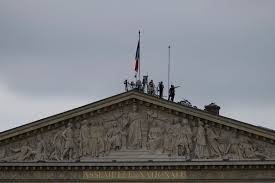
Human performers made small by large buildings – foolish or just poor design?

Those who were clearly happy or at least good at pretending were the various circus and street performers along the route. They at least added enchantment to proceedings; especially the hired ‘global celebrities’. However these Venusian / Sirenesque qualities, come at a price to the observer as already described.

Only by being tied to the mast of his ship could Odysseus avoid a spiritual death on an island of enchantment and delusion. Is that our world today?

The ‘Minions’ or non-privilege populace, were depicted by cartoon characters who proceeded to sink their own submarine, much in the way humanity is today destroying it’s own space craft; planet earth; cheerless and disempowering messages for us all.

Humanity can not complain that it is has not been warned. The Book of Revelation in the New Testament gives warning of the apocalypse and one of the Four Horsemen of the Apocalypse appeared in the Olympic Ceremony riding a metallic White Horse. Wikipedia informs us that;

In John’s revelation the first horseman rides a white horse, carries a bow, and is given a crown as a figure of, conquest perhaps invoking pestilence, or the Antichrist.

picture credit: Hindustan Times

‘Conquest’ we can understand as victory in war and ‘pestilence’ something like the recent pandemic. The arrival of an ‘Antichrist’ is not an anti-Jesus but inverted Christ consciousness; love thyself instead of love others.

Nuclear war has been threatened by politicians and humanity would be the lesser for the intense light of the nuclear explosion – matter into energy. Are we being prepared? Spiritual and or physical death was shown to us repeatedly in the ceremony using various symbols.

A river was chosen as the central location for the ceremony. Rivers are a symbol of the journey from life to death and the Ferryman on the River Styx is perhaps the best known. At the beginning of the ceremony, three children (innocents) follow the light bearer (a football star) underground, the place of Hades or the Underworld denoted by shelves lined with human skulls.

The innocents (you and I) are given the Olympic torch which they pass onto a hooded figure in a rowing boat who takes them back into the world of light or from death into life.

Spectacular laser lights on the bridges and stages announce spectacularly that Lucifer is present above ground.

The use of the bridges that cross the River Seine must have been an enormous disruption to the daily travel of Parisians so there must also have been an overwhelming case for deciding to allow this disruption and disempowerment of ordinary Parisians. What was the benefit?

Were we being invited to remember in the recent history of these bridges that one was the location for the death of Princess Diana? The Pont d’Alma ‘underworld’ road tunnel is capped today with the symbol the Illuminati, a flaming cauldron; which incidentally is a copy of that held aloft over New York by the Statue of Liberty.

The Sacrifice of Diana the Huntress

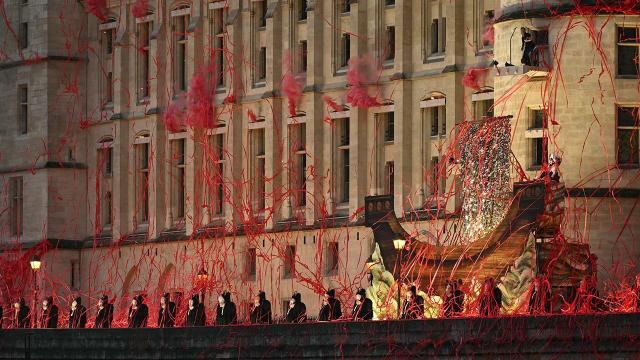
Another Royal death featured in the ceremony was that of Marie Antoinette. Actors appeared at the windows of the Conciergerie. This is a building which served the French Revolution by confining 2,370 prisoners, including Marie Antoinette, prior to horrific public execution by guillotine. The Ceremony could have chosen to avoid this macabre place in the interests of good taste, but instead chose to celebrate the horror.
If you are not convinced by these symbolic references, the next is so obvious that many Christian religious leaders have taken offence. They feel that the story of the Last Super in The Bible was mocked and their faith was being deliberately undermined. The long table on the bridge and the peculiar array of sexually ambiguous characters seated beside it employed frenzied cat walking and dance. The display, for many, was a celebration of sexual licence and depravity and even included children to whom Satanists are particularly attracted as a source of energy. The hermaphroditic characteristics of the figure on the left of Jesus in Leonardo de Vinci’s last supper is discussed in Dan Brown’s book referred to earlier and perhaps inspired the theme…is it Mary Magdelene?

To fulfil the imaginary prophecy of these orgiastic encounters, a near naked Dionysus appears wrapped in fruit on a plate as if about to be consumed by the depraved celebrants. Dionysian rites in Roman times were indeed not for the faint hearted. Was this parade endorsing such rites as an end to modern times?

Using the theme of ‘romance and love’ there were scenes in library where three sexually ambiguous young people made eyes at each other and then a rapid exit into a private room and purposefully closing the door. Families might wonder if a ‘ménage a trois’ is something to celebrate in an Olympic Opening Ceremony if is so, why?

In events such this ceremony, Satanists include symbolic messages for fellow Satanists around the world, in the way the newspaper advertisements once were used for covert communication. They will have been alerted to each message by a principle subversive technique, which is ‘reversal’ of the ordinary such when South Korean athletes were introduced as North Korea. Diplomatic telephones started to ring. An apology was demanded ‘for the next time you organise an Olympic ceremony’. Agreement was made but was ‘human error’ really involved?
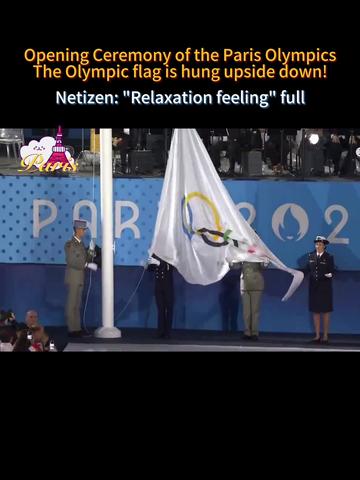
The Universal Sign for Distress at Sea

The most glaring reversal was surely taking the audience out of the stadium for the ceremony. Disguised no doubt as ‘innovative conceptual thinking’ and ‘this is France’ – as President Macron explained- the losses appear to be greater than the overt gains. Why would you prefer funeral paced boats in the rain to the traditional carnival of athletes in previous ceremonies in the dry?

Light into darkness is a theme enjoyed by Satanists and the Olympic Ceremony would not have disappointed them. Whilst in a stadium the encroachment of night is gradually balanced out by artificial lighting, this effect is almost impossible to produce in a city. The clear ‘light of day’ passed into dark obscurity. One conceptual theme was actually called ‘obscurite’ meaning ‘darkness’.

Woe to those who call evil good, and good evil,

Who put darkness for light, and light darkness,

And put bitter for sweet, and sweet for bitter,

Isaiah 5:20

A few days ago, You Tubers were posting Paris at night with large areas in black out. Electricity had been cut off. The only illuminated building was the Basilique Sacre Coeur in Montmartre. There has also been further ‘vandalism’ to fibre optic communication cables in other parts of the country.

In conclusion, if only half of these interpretations are close to the truth, I believe we are being given a warning of future problems, by those who are about to create them.

Snakes and Ladders

The great game of life in which we are mere pawns, operates on many levels. Like fish in a deep ocean, they select a depth in which to live; many in the shallows, some midway and a few in the deep. Where fish live is principally determined by their nature. As humans however, we can choose how deep we go.

In past times many people would never leave the village in which they were born. Today, when travel to the extremes of the Earth is possible, there are still those who live their lives without exploring the world. The opportunity for exploration of the mind is also rarely taken, probably due to this same inertia.

In olden times board games were played such a dominoes, draughts and chess in order to pass the time and stimulate these inert minds! These brilliant teaching devices have sadly, over time, been relegated to the nursery. Presumably they are mistakenly thought to be so shallow that they are suitable only for children, (as if children are shallow!).

A good example where this has happened is the game called ‘Snakes and Ladders’ in England or ‘Chutes and Ladders ‘ in the U.S.A. It is thought to have originated in India some two thousand years ago where the game was called Moksha Patam meaning ‘path to enlightenment’ and Gyan Chauper. The player journeys up the board until reaching the final square which symbolises enlightenment.

The Muslim version was used in the Mughal period in the late 17th and early 18 th centuries. The board is divided into one hundred squares (10×10) representing the one hundred names of Allah.

‘Snakes and Ladders’ was renamed and brought back to England by the British at the end of the Raj around 1890. This Victorian version ditched the ‘enlightenment’ element and seized upon the ‘high moral virtues and low moral vices’ depicted and the consequences of both; virtue rewarded and vice punished! Interestingly, the English phrase ‘back the square one’, probably derived from this game.

The Victorian interpretation of the game persists but for the natural philosopher one may find deeper meanings and interpretations. For instance, the players move step by step or square by square in a monotonous way. The sobering expression, ‘a journey of a thousand miles begins with a single step’ contains this truth.

We can see that the first step on the ladder is the same as the last. Like a marathon runner who collapses at the finish line, the journey has been a seemingly endless repetition steps, like the words of a mantra repeated ad infinitum. Enlightenment does not happen in flash as many imagine.

There are few ‘easy rides’ in life where one is gifted beyond one’s wildest dreams the game does present a few, much to the joy of players! Ladders, which literally express the ‘step by step’ principle, boost pilgrims up to higher squares as a gift, something which we know does happen occasionally in real life, which is called luck.

In the ancient version of the game there are fewer ladders than the snakes. Life in those times was believed to contain more misfortune than good. In modern times the reverse has probably become true although that can change!

Let us think about ladders a moment. Today we might understand them fractals.

picture credit: Complex Fractal by Bukoslav on Deviant Art

It is possible to keep connecting ladders, each new ladder being like a new rung in a higher scale. The sliding combinations of ladders on Fire Engines illustrate how greater heights can be achieved in this way. Ladders have a mysterious quality of being ‘infinite’; disappearing into the clouds like the pantomime ‘Bean Stalk’ which sprouts upwards as a magical fractal. The clouds into which the ladders reach, are commonly depicted as where the ‘giant’ gods live; such a ‘god’ corresponding to the mathematical notion of the infinite expanding for ever beyond the highest number.

Grace from heaven, the ‘golden buzzer of enlightenment’, showers upon life’s winners when they reach the one hundredth square first.

You might expect modern scientific understanding to cancel any insight beyond the moral platitudes, but I would suggest science too embraces the quality of ‘ladders’ in a microscopic dimension.

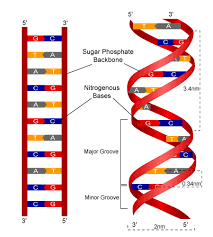
Imagine you are looking down a microscope at a string of DNA in a human cell. We know that it appears like a double spiral ladder with magical rungs that contain infinite quantities of information. These genes stay alive for thousands of years and can be retrieved from an ancient human tooth for instance.

Take this image of a spiralling formation and magnify it many hundreds of times and it will produce an identical image of our solar system spiralling through space and time.

The cycles of the sun and it’s planets also contain information by which astrologers have always been able to predict the future. Solar systems describe this pattern for billions of years, just as DNA lasts well beyond a humble human life span.

Curiously, and perhaps by coincidence rather than connection, modern geneticists describe the existence of ‘junk’ DNA in humans. It is about 97% of all of a our DNA and suggests a large area of knowledge yet to be discovered – possibly not ‘junk’ at all! In parallel and at another rung on the reproduction of infinite expansions, there is an estimated 94% of dark matter in the Universe which is also beyond current understanding.

So much for ladders; let us now consider the ‘slippery snakes’. People with a phobia of snakes often describe them as being ‘slimy’ perhaps because of the way they slide on their bellies. In actual fact snakes are smooth and dry to the touch. The common phobia towards snakes and reptiles probably accounts for why the ‘wicked tempter’ in Genesis, is depicted as a snake. Humans fell from Divine favour and were burdened with freewill, an aspect of the snakes and ladders game that makes it so exciting.

Just as ‘evil’ angels fell from Heaven, so the snakes on the board game take players down the path they so diligently ascended. There are no ‘thank Heaven holds’ that climbers grip onto when in trouble; it’s just ‘go to jail and do not pass Go.’ We have all probably experienced that feeling at some point in our lives. It is wise to introduced children early to this feeling so they recognise it when it hits them in later life!

Here’s a thought. Did the ancients in India know about digital and analogue information? If the ladder is a digital 101010101, then the snake is a complementary analogue wave. We know today that light has this contradictory quality of a particle and wave, and it is extraordinary that the ladders and snakes mirrored this long before modern science.

Life gives us no choice but teaches us that experiencing of ladders and snakes on our ascent are inevitable. If we think deeper than the moral Victorian versions of the game, then there are extraordinary truths. In a spiralling universe, of which our own bodies are microcosms, we can see that opposites unite each other;

we are both light and dark

we are both knowledge and forgetting

we are both climbing and falling

we are both Heaven and Hell

This understanding appears in the ancient Hermetic laws of Hermes Trismegitus. One of these is ‘Polarity’ and the dual and complimentary nature of opposites.

“Everything is dual; everything has poles; everything has its pair of opposites; like and unlike are the same; opposites are identical in nature but different in degree; extremes meet; all truths are but half-truths; all paradoxes may be reconciled.” —The Kybalion .

This is clearly depicted in the caduceus staff of the Roman god Mercury as a double helix of snakes coiling around a staff towards a pine cone representing the pineal gland in the brain. Today this symbol remains one associated with physical health and well being and appears on ambulances in many countries.

In Hatha Yoga, the counter spiralling Ida and Pingala Nadis wind up and down around the spine like snakes and enable the Kundalini energy to rise and activate the pineal gland; thereby entering the heavenly domain depicted originally, above the snakes and ladders board.

If Moksha Patam and other ancient games continue to be appreciated as shallow past times, then in my view, we will all be ‘back to square one’ quicker than you can slide down a snake!

The Zen of Tennis

Some of the best humour occurs in very formal situations in which laughter is forbidden. The exploits of the character of Mr. Bean played by Rowan Atkinson often use this device to create impossibly funny situations. It is like steam in a kettle desperate to burst forth but has to be strictly repressed. When there is a release and realisation moment caused by not using the thoughts which we consider ‘logical’.

Humour is a great tool to ‘lighten up’ human beings. Laughter can lift the burden of everyday life bringing a moment of mental and physical ‘enlightenment’. Such a release and realisation is called satori in the Zen Buddhism; a moment of profound personal realisation.

Stressful situations or periods of life can become overwhelming and confusing. Life brings problems; either seen or unseen, controllable or uncontrollable. It is sometimes hard to understand what troubles us and how to overcome it. One of the functions of ‘sport’, I would argue, is to present a simplified version of life on a ‘level playing field’ and scaled down. Then as a team or individual, the game is to obey a string of simple rules. Then we can demonstrate our personal skills to ourselves and others, and the winner is ‘successful’. A cynic would argue that sport is popular because it removes much of the complexity of the ordinary and promises rewards for very little effort by those who stand on the side lines. The players on the other hand are those most in line to gain benefit from the game.

In an attempt to examine this process in sport, I shall use tennis as an example. Professional players at Wimbledon this July will have to obey these rules;

The male or female players will wear all white clothing. They are permitted to rest between games and take light refreshments. They do not speak to their opponent and there are penalties for taking too long to serve and take rests. The rules of tennis are understood and adjudicated by an umpire whose decision is final.

The audience will sit around the court on tiered seats and must remain quiet and motionless during play; with mobile phones turned off.

So the stage is set and play commences. Professional players have achieved exceptionally high levels of skill but are prone to unforced errors which immediately earn opponents a point.

Like most physical games, there is an equal element of the psychology. Players remain ‘poker faced’ throughout the game. If they let emotion take over such as frustration, their mental detachment can be affected causing errors. To remain focused, players sit between games with eyes closed in meditation ignoring unwanted thoughts and distractions.

Players and audience will experience unexpected and unlikely events during play. The most extraordinary is called a ‘fluke’. An example is when a ball hits the top of the net and just falls over in a way that is impossible for the opponent to intercept and loses the point. What philosophers call ‘chance’ has played it’s hand. In Zen Buddhism this is called a ‘controlled accident’. Both skill and chance have combined so perfectly that the unexpected takes place. Or it might be that a bird lands on the court or the ball shoots off into the audience and is caught spontaneously by an alert tennis fan. The effect is one of surprise, as in a joke. The audience had no expectation of what was about to happen and generally, enjoy a moment of delight.

However skilled the player, sometimes chance can take over their state of mind either amplifying mistakes or skill. Suddenly, it is as if one player can do nothing right and the other nothing wrong. Despite the skill of the players, a players state of mind has broken through and taken control.

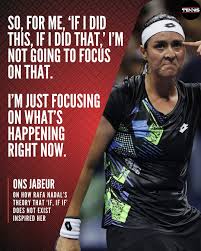
This state of mind could be described as a state of ‘constant readiness’. The mind and body have been prepared by constant repetition and the perfect moment. In that condition a tennis player becomes like a spring ready to uncoil. Sometimes a player will pick up the ball just before it bounces twice and flick it back with an impossibly clever placement in the opponent’s court. Or there is a high volley delivered by the player high above the head when facing away from the net. It’s rare and highly difficult to achieve and win the point but when it happens even the player making the shot should be surprised and inspired by what their mind / body has just done.

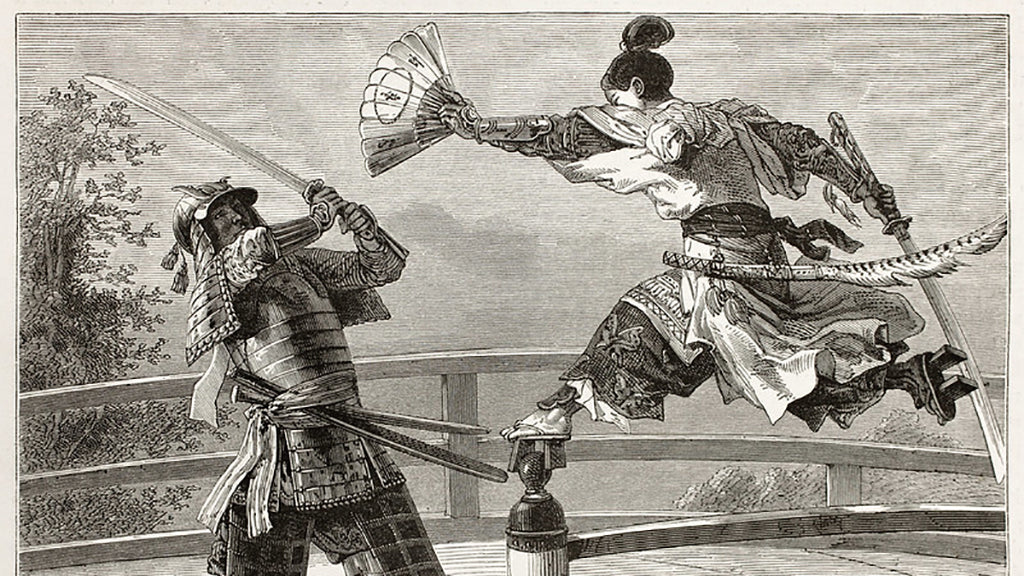
The match, like many individual sports, is like two Samurai performing sword play at an impossible speed and understanding of the unique moment.

One of the skills to be learned in the game of life is spontaneity. Through the application of skill unconsciously – that is without intention – a player can surpass their normal level of play and become quite brilliant.

In the book Zen and the Art of Archery by Eugen Herrigel, the archer must release the arrow without any intention to do so. This ‘unconscious’ technique can become so precise that the arrow can hit a bullseye even with the archers eyes closed. The event is made perfect by not having a response to it in the ego but letting it pass by without reflection; because reflection is not any part of what has just happened and spoils it.

If we let it, our own lives can become spontaneous and unscripted. Even within the many demands on our time, there will be moments – however rare – when we hit a bullseye. It’s a combination of doing the right thing at the right time, perfectly.

In modern life, holidays are intended to have this quality of ‘freedom’ but by definition, spontaneity cannot be planned. Sometimes the intended release from normal life can be spoilt by the literal and psychological baggage that we drag along with us.

I was in an airport a few months ago and jumped into a lift occupied by a young lady. She had with her three of the largest suitcases I have ever seen. I smiled and joked, ‘did you leave anything behind?’ She smiled back. People don’t normally speak to each other in lifts; I broke a rule and created a moment during a journey that was otherwise unmemorable.

Sometimes this gentle humour from those around us will prompt an insight into one’s true nature. It may take several experiences with the same message but eventually, there can be insight.

Ironically, it is children who enjoy the greatest moments of satori and it is that freedom of thought and action that brings so much admiration and delight to adults.

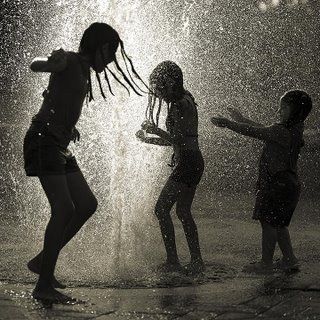
When I was in primary school, our teacher had left her class and a rain storm suddenly broke out. Without a thought the whole class ran out into the rain and danced ecstatically; free from the rules of ‘school’. It was a pure collective satori moment.

This story also expresses a special quality of Zen. This is the realisation of how the most ‘ordinary’ events, can provide the most sublime experiences in life.

A Zen monk was once asked, ‘what is Zen?’ He replied, ‘When I eat I eat, when I sleep, I sleep.’ The questioner was not satisfied with this answer and argued that we all do this. It is normal. The monk replied that when most people eat they are thinking of some other thing and when they sleep they are dreaming.

Zen pupils are introduced to this idea through such formal teaching methods as the Tea Ceremony. Each action and object involved in the ritual is a crucible for realising those things that do not fit into the ‘normal’ and ‘expected’ and ‘overlooked’ or ‘unconscious’ within the routine. It might be a fly entering the room or a lizard falling from the ceiling or a crack in the lid of the tea pot. If you are late for the ceremony and find yourself standing nervously outside, the teacher will judge you on how the moment you choose to enter. That moment will ideally not interrupt the ritual – especially because the choice was spontaneous. The right choice might prompt inner delight, the wrong choice, later admonition.

So the hum drum experience of sport and indeed life, in which moments of deep personal insight occur uniquely, is made richer by the spontaneous and non-reflected moments. Ironically, the more formal, the more repetitive and hum drum the situations we experience are, the more likely the satori moment will just happen.