The Two Mary’s

Resolving the Unresolved

The greatest influence on me as a male child growing up in the 1950’s and 60’s was naturally, my mother. She was my a ‘perfect woman’. To Jungian psychologists, this is the ‘anima’ upon which is modelled the feminine aspect of the male psyche.

But there is also a hidden, darker side to the male’s anima. Ideally hidden from child’s view, it was available in films, newspapers and magazines more openly than it is today. There was a ‘sexual revolution’ going on in the teenage generation above me and all was sex, drugs and rock and roll. ‘Flower (femininity) power’ countered the male Patriarchal aggression of the two world wars. Women were ‘burning their bras’.

Psychologists might view this as a healthy revolt against conformity through open expression of emotion. The mind bending drug culture and sexual freedom of that generation erupted and continues to this day.

The dream goes back to the Garden of Eden and the myths of Christianity. Adam and Eve were exposed to their own nudity and felt shame for the first time; their mutual feelings of new found lust moved into era of ‘covering up’, but the fig leaf was nowhere near big enough. The characters in the Old Testament carried out a lot of begetting and smote-ing. The Ancient World was like the Wild West and it needed a Sheriff to calm things down – Moses.

In the New Testament, Jesus’s mother, Mary, had to be ‘free of original sin’ meaning starting afresh. But how could the mother of the new Christ reproduce without being associated with the shame and guilt of sex? The answer was simple, sophisticated and a mind bender; the mother of Christ is a virgin.

Another convenient proof – after the fact – was provided. Mary’s husband, Joseph, was too old to be a father; so confirming Mary’s ‘immaculateness’. In Renaissance paintings of the Virgin Mary, her guiltless face looks lovingly down upon the infant Jesus, suckling at her breast. All was neatly explained.

Leonardo da Vinci’s ‘Madonna Litta’

The problem is; femininity isn’t like that. There is more than a hint of ambiguity in the archetypal feminine, because it is dark as well as a light; a destroyer as well as a creator.

The church fathers cleverly wrote this contradiction into the script and they did it by depicting ‘Mary Magdalene’ as a prostitute. If Mary and Joseph didn’t ‘do it’, then Mary Magdalene certainly did and according to the Catholic Church, she did ‘it’ plenty. But we might regard this depiction of Mary Magdalene as suspect, not least because the word ‘prostitute’ does no appear in the Bible and because Magdalene or Magdala sported the uncompromising title; ‘The apostle of the Apostles’.
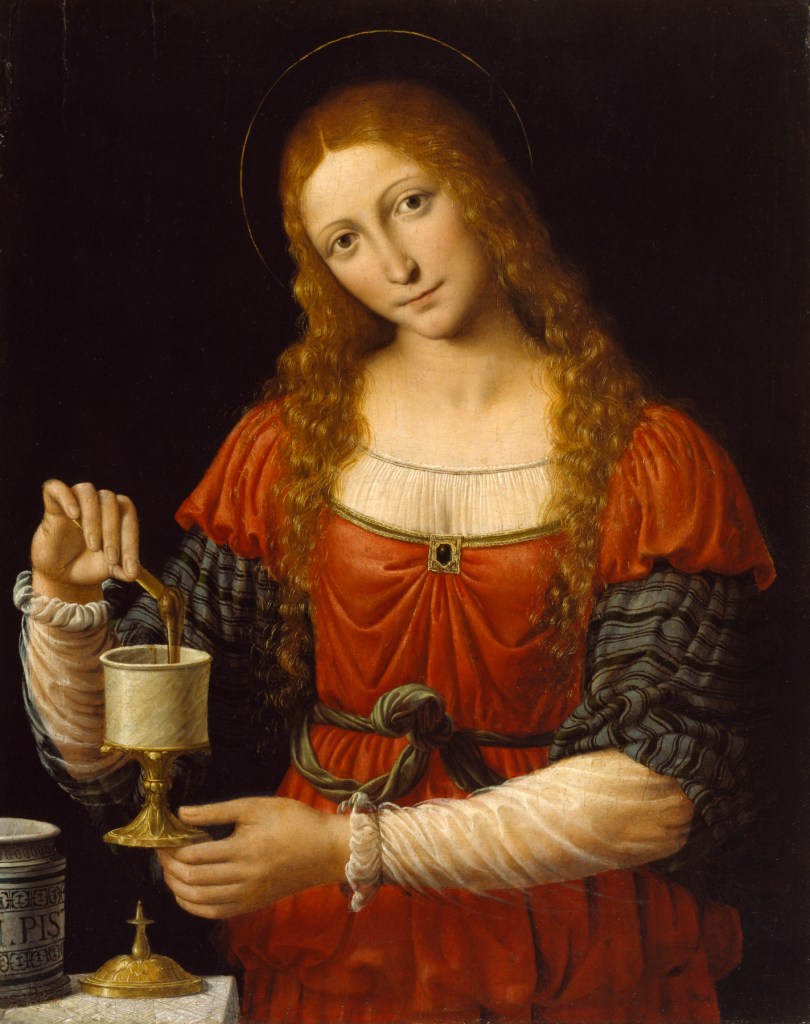
Saint Mary Magdalene by Bernadino Luini – Italy – 1524

How much should we go along with this dichotomy of femininity? Was Jesus in his later life, such a bad character as to keep company with a ‘fallen woman’? The fiction survived until 1969 when the Catholic church declared the Magdalene was not a prostitute after all. But was the damage to women in general irreparable? What were the consequences of this unjustified denouncement of womanhood – ergo the Divine Feminine – by the Patriarchy?

Most frustrating of all about the Magdalene lie is that there had always been another version of her in the Gnostic Gospels or Nag Hammadi Library of the Essenes. In ‘The Gospel of the Saviour’ Jesus describes her as ‘the woman who knows the All’. Jesus must have had many female disciples and it appears that he initiated Mary Magdalene to the highest level. In contrast, the male disciples come over in the Gospels asking dumb questions; you cannot raise the consciousness of those who are not ready – too much ego.

Even Simon Peter was in denial of his faith when asked. In my view Simon Peter, might have been nick named the ‘Rock’ by Jesus because he was spiritually calcified. The Roman Catholic Church in building itself upon the character of Simon Peter, has certainly reflected much of Peter’s stiffness through the centuries.

Mary Magdalene on the other hand was not bland and serves our understanding better as a complementary female counterpart to the male Christ figure. Her wisdom represents that part of the Divine feminine which men find hard to understand. To paraphrase Bob Dylan, she, ‘takes…aches…fakes…just like a woman…with her fog, her amphetamine and her pearls’.

Joan of Arc by Jean Auguste Dominque Ingres 1854

If a further example of the positive anima was needed, then the figure of ‘Joan of Arc’ serves well. She was a saintly virgin with the Creator speaking in one ear and King Charles VII in the other. Joan’s knightly armour represents the code of chivalry brought back by the male knights during the Crusades, a code that held women in the highest esteem and made men bend at the knees in their presence, literally and metaphorically. Joan of Arc was a gender reversed version of knightly chivalry and the reverence owed to perfect womanhood. As a Christlike heroarchetype, she had to suffer an early martyrdom in the hands of the Judas figure – the traitorous Duke of Burgundy. The character of St. Joan, you might feel, is just too goody goody. She needs less fire and more earthiness, more representative of the daily and nightly amours of the common man and woman. In a word; balance.

A more healthy expression of gender roles and spirituality can be found in sculptures of Indian Temples. The depictions of Tantric sexual intercourse in the statues must have made the Victorian missionaries blush. This was not the ‘virginal’ forbidden fruit that created so much male hypocrisy in Victorian society; from Royalty to the gutter creepers. In India we see an understanding and embracing of the spiritual power of sexual energy and an aspiration to achieve immortality through it, for both parties.

Hero Chamunda – Tantra at the British Museum

The two versions of femininity could not be clearer. Whilst the creation of the Raj was believed to be a ‘civilising’ of India and it’s people, the reverse could have been true. The depiction of sacred male and female sexual energy was brought back to Victorian England between the covers of the Kama Sutra and Arthur Avalon’s, ‘Serpent Power’. But their enlightened texts failed to remove the curtains from the legs of pianos of society’s ‘well to do’. Such sexual repression, psychologists now know, creates destructive, unconscious fantasies in the male psyche. A contemporary expression of this was the so called ‘Jack the Ripper’ who murdered prostitutes in Victorian London as readily as the Church burnt ‘witches’ in Mediaeval Europe; probably for the same reasons.

Edvard Munch – Vampire

In Jungian symbology, the negative anima in men is likened to a Vampire that sucks a man’s life blood and by implication, their very Soul; dangerous territory. The term for such a woman in 1930’s, 40 and 50’s was appropriately a ‘Vamp’. Her picture adorned many a barrack room wall. As an aside it is interesting that in the eponymous film, the God-fearing General George E. Patton angrily tore down a soldiers pin-up of Lorraine Bond with the words, ‘this is a barracks not a brothel!’

The evolution of the internet and instant ‘view in private’ pornography, has pushed images of the negative anima onto a new generation young, vulnerable males apparently without consideration of consequences. The pornography and sexual violence on view is far more mentally poisonous than those penny-slot machine Edwardian ladies undressing before voyeuristic butlers. The United Kingdom is currently considering a law to ban the under 16’s from social media, and Australia just dropped the idea.

In 1950’s Britain, the main stream media exploited the saucy postcard ‘seaside’ style of humour, ripe with sexual innuendo. In a sort of uniquely British way, sexual ‘goings on’ were laughed off socially as a bit of ‘slap and tickle’. The ‘Carry On’ films had audiences falling off their seats. Sex and gender jousts were fun and funny.
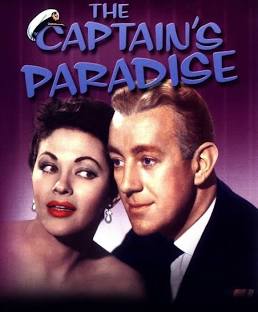
In this vane, Alec Guinness starred in a 1953 film called ‘Captain’s Paradise’. His character was the Captain of a ferry working between Gibraltar and Spanish enclaves in Morocco. The gag was that he had a wife and mistress with opposite and (for him) complementary characters. In Gibraltar his English middle class wife played by Celia Johnson, spent her days engaged in housework and domestic trivia, in preparation for her husband’s return. In the mid point of the ferry voyage, the Captain always turns his domestic wife’s photograph around in his cabin. Once the reverse side is a photo of his exotic lover played by Yvonne de Carlo. She is by nature a hedonistic, sexually alluring young woman who loves to drink and dance the nights away with her sea Captain. In the end it all goes wrong but the point is clear. Men idealise a particular woman who is a projection of both their negative and positive male anima.

It should be acknowledged that the female anima in the male psyche has an equivalent in women which Jung called the animus. The reader is invited to study this yin yang polarity. Let it be enough to know that the sacred dance in the affairs and affairs of men and women is one that can and should be, vital to their individual spiritual transcendence.

As a summing up and because I like an answer of any kind, I quote Joseph L. Henderson in ‘Man and His Symbols’ p. 157;

Any of us can see, of course, that there is a conflict in our lives between adventure and discipline, or evil and virtue, or freedom and security. But these are only phrases we use to describe an ambivalence that troubles us, and to which we never seem able to find an answer.

There is an answer. There is a meeting point between containment and liberation, and we can find it in the rites of initiation that I have been discussing…

…Initiation is, essentially, a process that begins with a rite of submission, followed by a period of containment and then by a further rite of liberation. In this way every individual can reconcile the conflicting elements of his personality: He can strike a balance that makes him truly human, and truly the master of himself.”

In highlighting the two Mary’s the ‘unresolved’ feelings within males needs such resolution. The Christian religion includes these processes in it’s rites of passage; (submission – mass) reconciliation (confession) and liberation (priesthood) but few ‘initiates’ become masters of themselves because, in my view, St. Peter keeps the key to himself. No gnostics may enter!

For me, the ‘sea captain’ of within, cannot and should not, keep up the charade. The individual needs of the women who are subject to anima projection, rightly demand their own initiation path.

The unresolved in worldly affairs takes place in order to illuminate and help us work through the contradictions within us all.

This ‘fight’ – which scales down in simplest of terms to ‘evil and virtue’ – is indeed hard to reconcile and much of the world’s greatest literature and other forms of expression, unpeels this angst before our eyes.

May we all sail on calm seas.

Time

My thoughts were turned to this subject when I scolded my cat Spooky. I shook my finger and looked cross. ‘Naughty! He slunk off guiltily. Just a few moments later he re-appeared and jumped up onto my lap. I realised that the incident had been completely forgotten in his mind, although in mine it was still fresh. I concluded that animals move through a series of disconnected events and are present most, if not all of the time, in the ‘now’. If they remember anything of the past it is only ever locked in their instinctual memory; the place where they store their ability to hunt and fall on four feet.

The Cat Righting Reflex, the perfect ‘Now!’

One might consider the well known psychology experiment by Pavlov who rang a bell before a dog’s meal time and he observed they salivated even though there was no food. Their response to the bell produced an anticipation of food. I would argue that the link is again instinctual memory rather than dogs imagining an event in the future as humans do.

Humans and animals experience time in the present, but humans go beyond this. We will form memories of past events from which we can recall at will. Films featuring an amnesiac character such as the Jason Bourne series of thrillers, show how difficult it is the function socially without memory.

Then we can imagine future events and manipulate in our minds how we will would like them to turn out or not. As children, we learn about danger by experience or parental instruction; ‘don’t put your hand in the fire’. By imagining an unpleasant future outcome, a bad experience can be avoided.

What the past and future have in common is the concept of time. Neither are occurring in the present moment. Therefore, we can argue, that before humans had the concept of time, events were experienced in the moment. Tribal myths and legends, passed on over the camp fire, were the only record of the past.

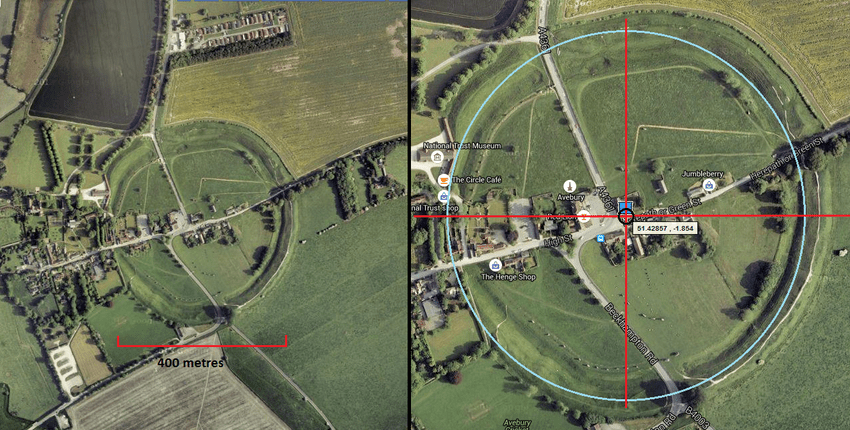
Avebury, England: Larger than Stonehenge containing Sun and Moon circles within a ditch and henge.

But these ‘disconnected events’ were at some time, observed to repeat as patterns. The passing of the seasons was undoubtedly a serious matter. Solar and lunar observatories were built all around the world and the Wiccan solar festivals remind us of this function. Megalithic henges and stone circles are commonly found to be astronomical calendars able to measure and predict the solstices and equinoxes. This was more than for agricultural use as archaeologists believe and relate to complex permutations of universal energies.

Although various crude clocks were used such as sun dials and candles, it was not until the 18th Century when an English clockmaker John Harrison invented the marine chronometer. This was a critical moment in history for it meant that navigation of the seas was made considerably safer. The precise time from an chronometer, reliably indicated the longitude on long sea voyages. When combined with the latitude from the height of the sun at midday, this gave navigators the precise position of the ship. The measurement of time not only fixed points in the day and night, but one’s location. Experiences in known time and space joined together in the age of science and reason.

Ariadne hands the thread to Theseus: depicting the wise aspect of his Anima

There is a story from Ancient Greece concerning Ariadne and her lover, Theseus. Theseus was charged with destroying the Minotaur, a flesh eating monster that lived in the centre of a labyrinth. Ariadne gave Theseus a ball of thread and instructed him to unwind it as he walked through the labyrinth, thereby finding his way out. Theseus successfully killed the Minotaur and escaped to Crete with Ariadne.

Ariadne gave Theseus a novel aid to connect the otherwise confusing experiences in the labyrinth, in a rational and repeatable way. Instead of disconnections which lead to the experience of ‘where am I?’, Theseus was able to rationally and repeatedly connect together these individual events. He was the first of Ariadne’s suitors to avoid being consumed by fierce panic and confusion, and by mastering time and location, escape.

The thread in this story, I suggest, represents Time with a capital ‘T’. Although an abstract concept and therefore not ‘real’ to the five senses, the continuity of experience created by time helps every human on their individual journey.

TI – ME

When we tie (TI-E) our experiences together we are able to overcome the monster within ourselves (–ME) and become our Higher Self.

The Sufi’s have an exercise which is conducted just before going to sleep. The entire day is recounted backwards in as great a detail as possible. There are no ‘conclusions’ or ‘observations’ to be made other than to ‘rewind’ daily experience.

In this way a continuous memory is formed of that day. This technique can be used after the death of the body as an objective review of one’s life is rewound before one’s eyes and beyond into the afterlife. Just as time does not exist in our dreams, so time ceases to be useful after death and we enter the fabled ‘eternity’. The fabled ‘lost souls’ of pergatory are those that have lost control of their ability to consciously move from one experience to another. Some even become locked in a repeated event in as described in the story of Tantalus. His condition was not ‘punishment’ as moralists believe but a state of mind.

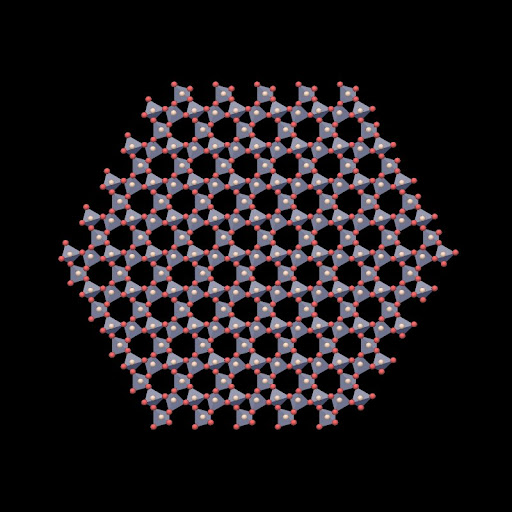
However sophisticated modern technology becomes, it can only ever approach the idea of infinitely fast things, never achieve them. When a quartz crystal has a tiny electric current pass through it it vibrates at 32,768 times a second. Nature is astoundingly constant in this respect and gave us quartz watches and other electronic devices. Just as quartz crystals are tetrahedral arrangements of oxygen and silicon atoms so precise that light passes straight through it, so it vibrates perfectly constantly.

The same clarity of experience is reproduced in spiritual practice by what is called ‘invocation’. In many mystical practices around the world, a student is tasked with the silent recitation of holy words. This ‘mantra’ is recited within the heart whilst experiencing, not negating, ordinary life. It is a task requiring Herculean concentration and effort, taking a lifetime to master, if ever at all.

The effect is to link the events of daily life in the way that an old fashioned movie film has regular cut outs on either side for the projector to connect with and move the film along at a regular speed. The illusion is one of still images that change imperceptibly and at thirty frames per second.

However difficult it is to understand how individual images scroll at speed, we do not need to know. The imperative is that one maintains the ‘I’ or ‘eye’ of the individual light bulb in the projector…whatever the story that is being projected.

Just as Theseus creeps closer to the centre of the labyrinth, so the observer creeps closer to their God within, using the technique of invocation. Like a cat watching a mouse hole, one’s concentration is fixed; mouse or no mouse.

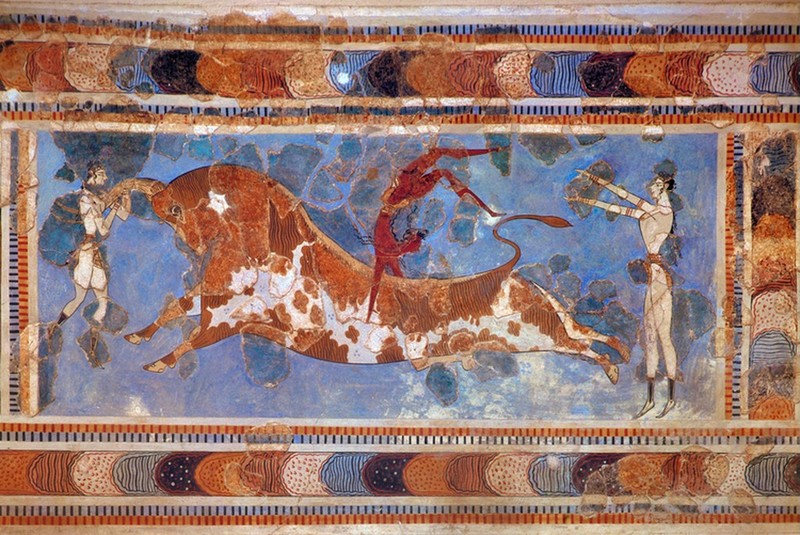
The Taurean Age of Civilisation on Crete, The Minoans

The slaying of the Minotaur in the age of Taurus, was central to the Minoan civilisation. The dark corridors of life have to be travelled so that the God-self can be discovered. The Beast or Minotaur is the same archetype as in the story of ‘Beauty and the Beast’. It is only truly known when love of true Self, slays the hideous ego.

This Jungian psychology is strangely connected to our modern day by the mystery of ‘time’ and the passing of discontinuous events that can warp into psychosis. The illusion of time becomes, in the clinically ‘sane’ at least, a constant ‘glue’ that makes experience appear continuous. But, just as in the beating chambers of the heart, time has an uncanny ability to increase and decrease it’s pace. Wonderful holiday experiences can fade all too soon while interminable waiting in the airport lounge has no end.

Physicists have there own story about this phenomon. In Albert Einstein’s ‘General Theory of Relativity‘, time is described as being something which can lengthen or shorten in it’s relation to space. ‘Time Dilation’ states that as an observer approaches the speed of light, time slows down. An astronaut might therefore return to Earth after a journey to the edge of the Universe at ‘warp speed’ and find that he or she is younger than their children.

Such concerns await us in the future. For the philospher, the task is to get to grips with the every day meaning of the passing of events. Can we keep a grip of the thread laid out to guide us through the labyrinth? Can we slay the monster within?

The Labyrinth in Chartres Cathedral, France: A Message from the Medieval Masons through time
picture credit: Helen Mueller

Earth and Ether

Part Two

‘There is little that cannot be explained in a few sentences;

sentences that may take a life time to understand.’

What is consciousness? Where is consiousness? Who is conscious of what?

The conscious ‘me’ is clearly gifted a material body but is my body me? Clearly not, but there is evidence that the opposite is true. People have clinically died and remained fully conscious outside of the body. To explain this phenomena, consciousness must exist in another medium and that we call ‘spirit’ or loosely in scientific terms, ‘energy’. What type of energy we will come to.

The concept of spirit outside of matter, is central to many world religions. The Christian priest will attend a person dying or conduct an exorcism and a Tibetan Buddhist will say prayers over a cadaver for several days. Curiously, religious representatives do not attend births. Perhaps this is because there is no agreed moment in gestation when spirit enters the foetus but certainly it does.

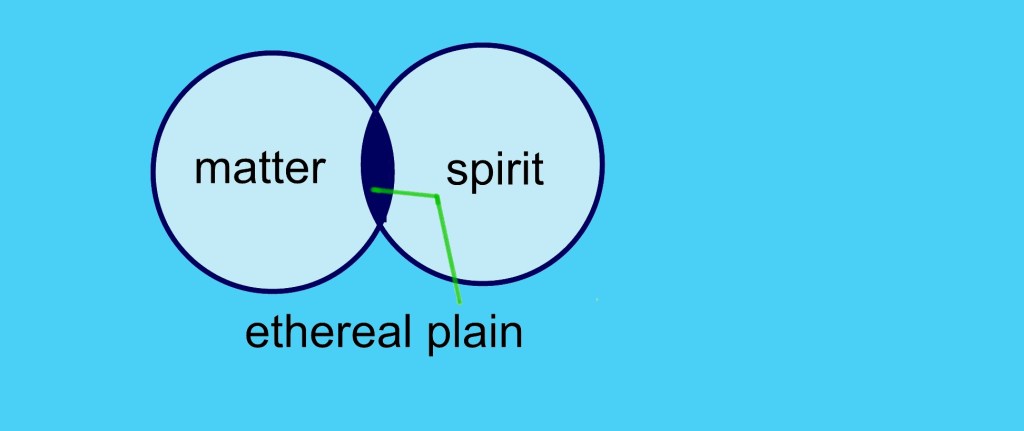
In this Ven diagram, is a simple representation of how matter and spirit lock together and what they share in common. Where matter and spirit overlap is a particular energy which modern science has not yet been able to detect and measure, but which has been described extensively across time and cultures as, ether Chi, Qi, Prana, Orgone, Vril, or when in the earth, the tellurgic current.

This invisible energy creates a portal, a zone where there is connection between both matter and spirit, which I shall term ‘ether’. The stronger the ether, the easier it is for consciousness to move between matter and spirit. There is no scientific proof for this other than that humanity throughout history has devoted vast amounts of time and resources to achieve just this effect in it’s magnificent structures and modes of worship.

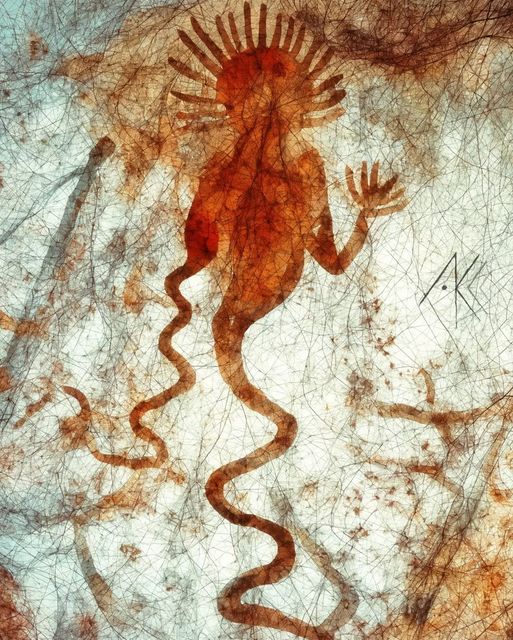
Depiction of Spirit Entity at Altimira, Spain

Forty thousand years ago homo sapiens sapiens conducted Shamanic rituals in cave dwellings. They created their connection with the spirit world by painting on rock walls. Through these superbly representative paintings, spirit was able to enter the cave and infuse each sentient being with it’s presence. There is also a theory that important star constellations were also represented in these paintings. Cave dwellers would have developed a close relationship with star patterns and apparent movement of the night sky when viewing from the mouth of the cave; itself a domed observatory.

Chi is present in all nature and certain places and times amplify it’s power. This can stimulate ‘extra sensory perception’ in humans and a gateway into our material realm for non-corporeal beings. To this end, throughout history, most civilisations have used and enhanced Chi by building sacred buildings and using their unique qualities as ‘places of power’, to use a phrase from the Toltec Shaman, Don Juan in Carlos Castenada‘s books.

In Ancient Greece, elegant statues of gods were placed in Temples to invite the god to be present in the statue. When the monotheistic religions arrived such ‘idol worship’ was forbidden. This fear is a sure sign of how powerful early churches realised living gods occupying statues to be.

Ancient people’s, who today we would call a, seer, prophet, priest, magician, mason, water-diviner or Oracle, helped in the construction of sacred edifices of all kinds. Temples, obelisks, pyramids, causeways, megaliths, dolmens, wells or hill figures and many others can be found today all over the globe, often unseen or unrealised. Many modern authors have studied global alignments of such sacred monuments based on sacred geometry, alignments, distance and time.

Chi is accumulated and or channelled through these structures. Whilst later burials often occurred in or near them, their main function was generally ceremonial and as places of initiation. To amplify the Chi very similar techniques were used based on geometry, astral alignments and tellurgic currents; all of which have the combined effect of accumulating and focusing Chi on the human heart, right brain and pineal and pituitary glands.

Many historical and current researchers have documented and explain aspects of this sacred knowledge. Unfortunately, left brain biased archaeologists usually support only those theories based on matter, historical records and anthropology, without reference to the living spirit that was once sacred to ancient cultures.

My point in this essay is that by introducing the concept of an invisible but omni-present spirit into our understanding of the past, the relationship between our sensory experiences and our right brained, feeling based consciousness, becomes clear.

The more Chi is present both within and without of a human being, the more easily such a person can slip through the mirror into a world beyond. Consider Alice’s famous journey into the mirror and the inverted playing card world of dreams; where right is wrong and wrong is right. Never trust a flamingo.

Less flippantly we might examine how personal direction of thought is directed outward using personal power or Chi. It is the means through which prayer is sent; through the ethereal veil to ‘God’ or Universal ‘Mind’. Alice created her Wonderland by going within or ‘down the rabbit hole’.

Finally, we should appreciate spirit is able to pass through the veil towards humanity, boosted by Chi. A highly experienced ‘Dowser’ or ‘Water Diviner’ in Scotland for instance, describes grave yards as being places of concentrations of earth energy or Chi. This connects the earthly grave with the spirit world to which our consciousness is always connected. The common story of ‘ghosts’ inhabiting graveyards is a good example of the ‘twilight zone’ occupied by all sorts including the disembodied. The particularly time of year for this veil to thin is of course, ‘The Day of the Dead’ in Mexico and ‘All Hallows Eve’ in Christianity. The displays in shop windows of evil ecrutements for children is not something properly understood in my view.

Examples of portals for the spirit, exist in very old houses, natural features such as caverns, springs, geological features such as magmatic intrusions and dikes, towns and cities like Jerusalem.

What happens in such sacred sites and countries connects through grids and alignments to other countries and even around the world. For much of recorded history, the Holy Land played out a spiritual discourse, such as those narrated in the Old Testament and New. This global effect was so strong that the Crusades set out to ‘take’ Jerusalem for Christianity and suppress to the ‘infidel’. The history of these brutal Medieval wars is well known and yet continues to play out, often with the same disregard for the sanctity of life.

One might wonder what it is about this particular part of the globe that makes it a spiritually significant region for the monotheistic religions.

When the prophet Jesus the Christ is described in the Bible as ‘walking on water’, like many biblical narratives it has multiple meanings; some for the initiated and some not. Between the earthly and spiritual planes is what I have described as an ‘etheric’ plane. Ether similar or identical to Chi; it’s exact nature still defined by effect rather than cause.

It is said that Jesus ‘walked on water’ is a metaphor for the transition from the material into the etheric plane. The water represents ether and the body of Christ is his astral, not his physical body. Like much of spirituality, such things can be experienced and mastered during life; so as to ‘store treasure in Heaven’.

One of the functions of this ability to transcend our material bodies is to enable communication of the highest kind between spirit and mortals. Earth has been visited and given benign advice by angels and prophets many times in it’s history and these form the basis of mystery schools and mysticism but unfortunately much of the glory of such knowledge has historically and to this day, fallen victim of the self interest of religious leaders.

A left brain thought bias in the West leads many to consider only logically constructed thoughts, and yet some of the most important decisions we make in our lives originate in the right side of our brains. How we think is as important as what we think.

Finally, one must acknowledge that in the material world and it’s spiritual equivalent, there are tendencies to descend into chaos as well as to rise to perfection. The spirits that facilitate this amongst mankind are the angels and demons respectively. Through their benign and harmful machinations, human life has evolved into it’s present state of scientific materialism and atheism.

What is happening in this present time of uncertainty and human suffering is in my view, a product of ignoring the possibility and presence of non-material realms and those places and times that invite personal and collective ascension.