Beyond Good and Evil

Genesis gives us the key to opening the door to everything. All we have to accept is that stories in Holy books almost certainly operate at many different levels beyond what is taught to children in Sunday School.

In the story of the original humans in the Garden of Eden, God ‘opens the eyes’ of Adam and Eve as punishment for Eve eating the forbidden fruit of the Tree of Knowledge. For in doing so their eyes are opened to the concept of ‘good and evil’, but we should not be side tracked by wondering what good and evil are. What is being revealed here, in my view, is that the Unity Consciousness of the blissful Garden, split into binary consciousness. If the reader overlooks the reference to newly realised binary opposites, then the message is repeated for reinforcement.
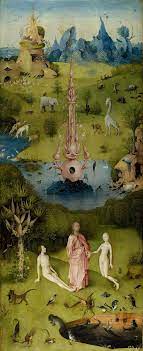
When Adam and Eve see each other naked, for the first time, their consciousness moves from being one, to two. This ‘same but different’ paradox between men and women is the same for all binary thoughts and words. Carl Jung suggested that the minds of men and women differ as metaphorically expressed by the nuanced differnces of their bodies.

The message in Genesis, is not about ‘good’ or ‘evil’ or ‘man’ or ‘woman’; it’s about binary thought; a fataly flawed characteristic.

But thinking in opposites creates an illusion of understanding. This is whispering serpent’…the one that slides down the ladders of thought.

In physics, nothing is black and white; there is just light and an absence of light and everything in between. But using opposites as a sort of ‘algebra’ for thought has enabled modern scientists to deconstruct nature and use it’s methods to make technology.

Batteries consist of negative and positive poles. The brain consists of left and right hemispheres. Breath goes in and out. Humans are born and die. Chromosomes are X and Y.

This is how have un-zipped the polarities that keeps atoms spinning, but there is a catch!
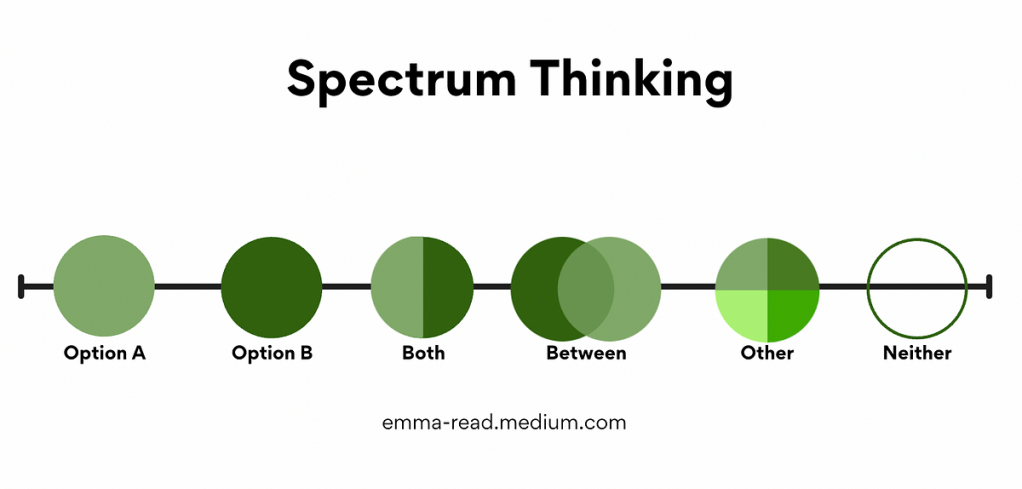
Our thoughts attach to the oversimplified opposites. Left and Right political views are a prime example of extremist views plunging the world into chaos. Edward de Bono introduced the non-binary word Po in his book Beyond Yes and No to express infinite possibility and a practical key to freedom of thought.

Opposite ideas should only ever be a mere framework for rational thought, otherwise the space in between disturbs ‘certainty’, leading to confusion and conflict. Consider a recent example;

In the United Kingdom, the Supreme Court has just ruled that a woman is a person who was born a ‘biological woman’. In other words, a ‘biological man’ cannot become a woman. This rule provides clarity for the lawyers; but is it true?

I would argue that the model does not fit neatly over reality. When it comes to the provision of public toilets, there will need to be a ‘third space’ for those with particular needs, for instance, those who feel different to their biological gender.

Is not an impossible problem for many ‘third spaces’ already exist as a ‘disabled toilet’. All that is needed now is a gender neutral sign on the door. Something that is not ‘men’ or ‘women’.

We see here that humans are not as simple as the rule of two ‘opposite’ biological genders. Consider the complexity of the body. We have a brain with left and right hemispheres. Each half has a nuanced contrast of functions; rational and creative respectively. Psychologically, each woman has an unconscious animus and each man has an unconscious anima. One in ten of us are left handed; the rest right. In some cultures, left is ‘evil’ and right ‘good’. There have been libraries written on the complexities of gender differences.

But we also experience a range of emotions, almost involuntarily, which can be categorised as ‘expansive’ or ‘passive’ in nature. Anger and valour are expansive and ‘male’, sadness and tenderness are ‘female’ emotions, for example. Of course, men and women have the whole range of emotions in varying degrees beneath the fig leaf.

Finally, the subtlest human characteristic that guides mind, heart and body is ‘intuition’. Albeit a peaceful, almost silent, internal voice, it has a function to guide us when we are lost. Another name for intuition is Soul, and yes, souls can be ‘good’ and ‘evil’ as illustrated in the Old Testament. There is a Bible story in which Joseph experienced wise, prophetic dreams. His soul’s ability to describe the future intuitively through the pathway of dreams is symbolised by his ‘coat of many colours’. Dream messages are not black and white, but as subtle as a colour from the subtle spectrum of light.

This level of subtlety is desperately needed today, in my view, if humankind is ever going to recreate the Garden of Eden on earth through deep compassion and understanding. If we do not, a Wasteland awaits.

Who is the third who walks always beside you? When I count there are only you and I together, but when I look ahead up the white road, there is always another one walking beside you, Gliding wrapped in a brown mantle, hooded. I do not know whether a man or a woman – but who is that on the other side of you?

What the Thunder Said (from line 359) from The Wasteland by T.S. Eliot

Francinsense, Gold and Err

Who Stole Christmas?

PREMISE

The Church Fathers have had considerable ‘editorial control’ over what to put in and what to leave out of the Holy Bible. So much was ommitted and added, so should new ‘adjustments’ not be accepted?

OBSERVATION

In 1872 a scholar named George Smith found something remarkable in clay tablets from Nineveh. He was reading in cuneiform the Epic of Gilgamesh in which is described the great flood, God’s punishment for mankind. The suggestion that the Great Flood described in Genesis was just a retelling from ealier Mesopotamian texts, shook Victorian society. They gave Mr. Smith a hard time, as if he was the problem.

Today there is considerable proof that many of the stories in the Old and New Testaments have been subject to editing. We accept that the dates for the Christmas and Easter festivals are not in the Bible. They have been made up. The date for the birth of the Christ child was decided to be December 25th but why?

The Infant Horus: picture credit World History Encyclopedia

Previous gods had been born on this date. There was Horus (Ancient Egypt), Mithra (Persian), Krishna, Zarathustra (Iran), Hercules, Babylonian god Bal (Nimrod), Heracles, Dionysus (Greek), Thammuz (Babylonian) Hermes (Greek) Adonis (Phoenician) and others. All were born of virgins.

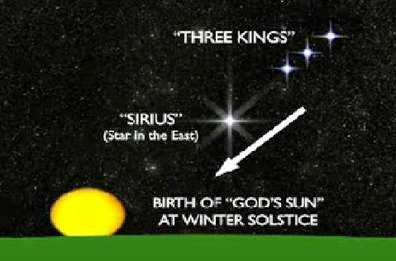
If such a clear plagarism of ancient gods is disturbing, there is a logical explanation based on astronomy. December 22nd is when the sun disc halts its annual progression northwards along the horizon. It then pauses for three days and rises anew on December 25th. This natural phenomenon supports neatly the story of a solar god being born; not dying and miraculously resurrecting but being born at least. Perhaps the birth of Jesus does not fit the story and date of how the ancient gods had been born.

If we investigate the ‘blasphemous’ notion that the Christ child was not born at Christmas then we should be able to find another meaningful astronomical date in the solar year relating to birth. After all, should a Christian festival be based on the Pagan festivals and superstition? The church fathers did, we should remember, hate and demonise Paganism, although Pagans did no worse than love nature and each other.

SUGGESTION

I suggest that the birth of Jesus was in the springtime; the lambing season, when shepherds watched their flocks by night. Consider afresh, the Christian nativity narrative.

The three Kings or Magi seeking Jesus were astrologers. So excited by and certain of their prediction were they, that they set off to find him, I argue, in the spring. They ventured eastwards towards the star Sirius, which rises in the east in March in the northern hemisphere. With their learning they probably knew of the goddess ISHTAR from Babylonia who represented Sirius and was associated with fertility, love and war. Another clue for us today is that in the English language is the word Easter which breaks down into two words; EAST STAR. It also is remarkably similar to the word ISHTAR.

If we dig deeper into pre-Christian gods, we find that in Ancient Egypt the star Sirius was represented by the goddess SOPDET meaning ‘skilled woman’. She was important because her appearance signalled the inundation of Nile and the beginning of their new year. She was sometimes portrayed as a large dog.

picure credit: Tarot Aotearoa

Sopdet was associated with ISIS who was the wife of OSIRIS. Their son HORUS just happened to be born on 25th December; a holy family uncannily resembling a later one. They watch over us even to this day as Sirius (ISIS) in the constellation Canis Minor and her husband OSIRIS, the constellation ORION.

These curious facts add up to support the possibility that the Nativity occurred in the spring and the death and resurrection of Jesus the Christ in mid-winter. Certainly, Bible scholars are unable to qoute verses that deny this, as is anyone to confirm it. The Christian practice of using the festivals and stories of the hated Pagan gods, appears to be the only reason for Christmas and Easter being where they are today.

We cannot deny the association in popular modern culture of ISHTAR and Easter. As a nature godess, she is depicted with with hares and rabbits (famed for their procreative success) and eggs (product of the female hormone Oestrogen). Eggs and Rabbits were omitted from the Holy Bible and yet survive as symbols of birth happening at the time of the great initiator, Aries. Perhaps, some archetypes are too strong to supress.

ENDING

At this time of Easter, instead of celebrating the joys of spring, Christians mourn. Then, in midwinter they celebrate birth.

One wonders whether these important festivals, reversed for the wrong reasons, have unknowingly undermined the modern world? Knowing the basics of life and death, ending and beginning, should support rather than undermine what it is to be a human, whose life is dependent on natural cycles.

I cannot expect anyone to agree with my view but for me, this fundamental reversal of ancient truths has led to our misunderstand and abuse not only of nature, but ourselves.

The mystic Hildegard of Bingham wrote ‘wisdom awakens to wetness and greeness and flowing waters. Wisdom says I am the rain coming from the dew that causes the grasses to laugh with the joy of life’.

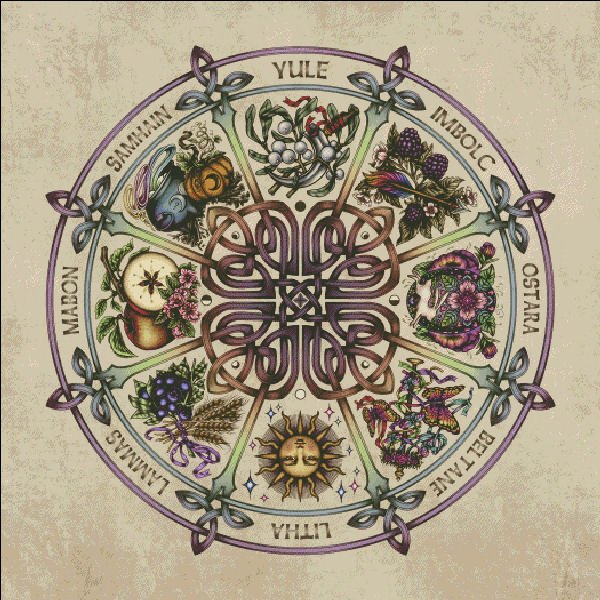
Pagan Wheel of the Year: picture credit Friends of the Forest

Happy Christmas!

True or Not True?

That is the question

picture credit: Australian Academy of Humanities

The world is experiencing mental chaos in the present; not knowing what to believe. The news media is full of reports that appear to contradict even what was said the day before.

It is important therefore, for our thoughts to be as precise as we can and also our words.

As in the title of this essay, ‘truth’ is causing the confusion and we now longer know who to believe.

Numerous politicians are being routinely accused of ‘lying’. If we consider the meaning of the word then is ‘a statement intended to deceive’. Then there are are false ‘facts’ from unreliable sources, which may not be intended to decieve but do.

The famous Dunning Kruger effect states that amateurs are less concerned about understanding a subject than professionals, who have pondered on it for years. The less you know, the easier everything appears to be. The present administration in the United States of America has more than it’s far share of sufferers of this effect, who simplify complexity to below any standard of professional opinion.

There are also things openly ‘fictional’. These may contain some truth but are largely a product of imagination. Novels and films based on truth will declare that names and events are fictional for artistic and legal reasons. What is important is that we are not deceived into believing in fiction. The World’s religions and cults are particularly prone to this absence of adherence to truth, often for no other reason than there are based on the fog of ancient history and managed so as not to embrace the present.

The civil laws of most countries try to be based on ‘the truth, the whole truth and nothing but the truth’. Judges attempt to distinguish between true evidence and false evidence until something is believed to be ‘beyond doubt’. It still makes mistakes even after the most rigorous processes to remove doubt. Dictators who control the judiciary can get away, literally, with murder, using fabricated evidence or just no evidence at all.

What this shows us is that even after the most challenging and examination, ideas can turn out to be mere theory. In science, theories are subject to ‘peer review’ – critical examination by equally well qualified scientists. As the Ancient Greeks understood, theories should not be confused with facts. The present irrational dismissal of a theory because it suggests a ‘conspiracy’ (intent to cause harm) is irrational. To not investigate an accusation for emotional reasons is a clear divergence from truth, but convinces crowds.

‘Facts’ are illusive and can be the product of distortion. A satellite’s instruments may be malfunctioning or incorrectly calibrated. An individual politician may have an unconscious or deliberate bias. The process of believing that ‘climate change’ is true has taken decades, largely because it was contrary to the interests of companies that extract and sell fossil fuels. As with many complex issues, the theory was too large in scope for the general public to understand. Those who should lead opinion, politicians, often use distraction, omission, obfuscation, irrelevance, obstruction and discontinuity to align facts and fictions with political ideas.

Even when we believe something is true, it can still only be ‘relatively’ true. It might be an oversimplification that just happens to work. Basing the worth of money or tokens on gold reserves was just one such ‘truth’ that reassured governments and populations. Today physical or virtual tokens of ‘worth’ are less and less dependable.

Finally, philosophy has an angle on ‘truth’ and how to find it. If science and religions regard truth as constants and dogma, philosophers understand truth as malleable. There is no ‘fixed law’, other than the law that everything changes.

In Zen Buddhism, truth is whittled down to an individual regarding life’s purpose as no more or less than being present and observing; a formula much needed in our present times; especially when things go wrong!

Oh Bush warblers!

Now you have shit all

over my rice cake on the porch. Basho