
“Whoever battles monsters should see to it that in the process he does not become a monster. And when you look long into the abyss, the abyss also looks into you”.
Friedrich Nietzsche
What Nietzsche does not say in this famous quotation from his book ‘Beyond Good and Evil’, is that the monster you perceive making faces at you, is you.
This slightly heretical philosophical view of mine, suggests that our internal world (mind) creates the people, places and things we experience. By extension, for those who believe, humans create God in their own image, because creativity is an attribute of Divinity which they share and reflect.
You are not a person living a life, you are life living a person.
When we look back at our forefathers and ask how they dealt with this conundrum, there are two paths. One is to be blind to the illusion that we must surrender to a higher will or ‘fate’. Alternatively, not surrendering to fate empowers each individual to become the power that is within us and resist all attempts to submit to ‘the Abyss’.
This second option is taken by very few souls, for the hero (which is you) has to venture far from the comforts of home to an unknown place. Consider the humble Bilbo Baggins in Tolkien’s Lord of the Rings as he pulled the heavy Saturnine ring from his finger and threw it into the flaming Abyss. The Whispering One was destroyed and homely order restored.

The metaphor of looking into an abyss was used in a more gentle way for children by Lewis Carroll in his book, ‘Alice Through the Looking Glass’. Alice’s hallucinogenic encounters in a reversed universe reads as a series of random thoughts and dreams, each jostling for centre stage in Alice’s mind; a type of madness but with it’s own rationale.
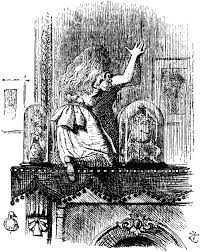
Most of the time Alice is vaguely in control of people, places and things. The reader expects a happy conclusion to the story, but as in life, there is always doubt and the fear of horror.
Jalal Udin Rumi refers to this shattered fractal world as what we might see in a “broken glass mirror”. The metaphor refers to the profound idea that ultimate Truth is one, but when it “fell and broke from the hands of God,” people grasped fragments, each glimpsing a fragment of the whole. There is a paradox here because whilst the part is not the whole, it can be mistaken as such. In reality it is the reflection, the message which is the whole, not the physical fragment.
Religious followers are an example of this literal ‘my partial truth’ mentality. They think they know it all but are deceived. Yet there is a commonality to all human experience. Every person sees through the thin skin of their eyes, the cornea. It is transparent and admits all it sees; good and bad. It is our mind that filters and checks what we see in the trillions of connections it makes continuously; a process that dictates and reinforces our personal and randomly biased out-look on life. This is the human frailty of perception which keeps out some or most of the Divine light.
Bashar is an entity channelled consistently for decades by Daryl Anka and for those who are curious his public Q and A sessions are available on You Tube.

To conceive, receive, and perceive in Bashar’s teachings refers to how we can actively create a personal ‘reality’. We conceive a whispered idea or feeling as like a soft touch from outside of our body. This may simply be what time to eat or an inspirational idea that is life changing. Whatever we conceive in our higher Self, from the alpha to the omega, we have the option to be as God the Creator. Making lunch or making the Universe comes from the same Source and is the same.
The second stage of this process is when we receive the idea into our brain and integrate it into our lives. Bashar advises that this is something that must give us our greatest excitement. No working in a factory, unless you love repetition!
Thirdly, our mind must be aware of perception which is like a faithful horse that we groom daily from childhood. Whilst it provides the feeling of freedom and long journeys into the wilderness, it also limits how we experience life. The world we encounter is a reflection of our consciousness. What we think, we see.
There is an saying by Thoth, Hermes or Hermes Trismegistus which has long been treasured by secret societies is;
‘As within, so without, as above, so below, as the Universe, so the Soul.’
Let me show you three qualities of a symbol.
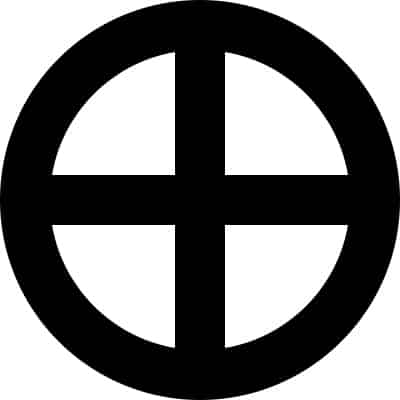
The horizontal line is the line between Heaven and Earth. Just like the mirror between water and air.
The vertical line is the boundary between what we experience as ‘Self’ and what we perceive as ‘not-Self’. This is the illusion we experience as I-dentity.
Where these two lines intersect is the location of the ‘I‘ or ‘eye‘.
In astrology the 90 degree angle is called a ‘square’ or ‘quartile’. When planets share the same quadrant of the zodiac they conflict. One might say they do not see eye to eye. A right angle is discomfort and sure enough we find the cross historically as an instrument of crucifixion. This was not just a Roman engineering solution for crucifying thieves but also those who threatened their evil Empire with the power of the individual.
The Christ was preaching to people that they contained a ‘light within’, when Rome wanted only Rome to be the light, just as the Empire endeavours to keep things today.

picture credit; Architectural Digest
The light – a solar light as within the god Apollo – long before Jesus the Christ – is symbolised by a circle encompassing the four equal lines of the cross within. In my view this symbol is one way of ‘squaring the circle’. This ancient logic puzzle that transfixed the Ancient Greeks has not been solved using geometry, but by moving towards a less logical conclusion. Poetically, the four straight lines can become the parts of a square within the circle. The four / four beat is a masculine marching rhythm that needs to be smoothed and soothed by the feminine, represented by the all embracing circle.
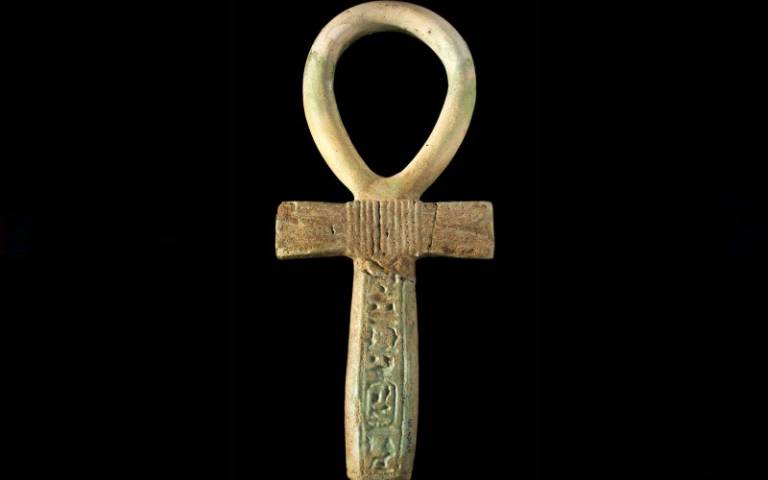
Even the Ancient Egyptian Ankh is a version of this archetypal geometric paradox. It represents the unification of the masculine and feminine coming together as one, in order to align with and receive the Solar spirit of the Divine.
As within, so without, is less quoted than as above, so below. But it expresses the ability of humans to manifest, make real, a reflection of our highest aspirations. This might manifest through a series of unexplainable co-incidental events and chance encounters. If we powerful humans did not believe we can direct chance, we would not play the national lotteries.
The words, ‘serendipity’ and ‘coincidentally’ and ‘synchronistically’ describe this human experience of good or bad fortune. But who is making these choices, Divine Will or us, or both?
We have all been in a situation where we cannot decide what to do. We want a good outcome but do not know how or the best way to achieve it. If you believe in your own creative power as ‘a reflection of God’ then making the best decision is alignment with one’s higher Self.
Tossing a coin may appear random but if you toss three coins several times, you are allowing serendipity to speak to4 you. Oracle cards work in this way and are increasingly popular in Western society today. Personally, I believe they are an aid to personal choice, not makers of choice.
In some cultures the power of the unknown to influence events is described as ‘fate’ but again, I disagree with this concept. To accept fate is to give away one’s own power. Usually, this personal abandonment of responsibility attributes failure or success, solely to the Divine; Mashallah (ما شاء الله).
This ‘victim’ mindset is not endorsed by professional gamblers in Los Vegas. They will have amassed a strong self belief to the extent that they feel they can do nothing wrong. When a such ‘card shark’ or player ‘on a roll’ appears at the tables and starts winning, the management do not stand a chance.

picture credit Nevada Public Radio
We give away our power constantly. Even prayer can be, in my view, an act of giving away personal power to a ‘higher power’. When things don’t go as requested people lose ‘trust’ or ‘faith’ in Divinity, as if prayer is like a menu for you to order food.
If we accept that we are a tiny fragment of the mirror which is God, then man is indeed made in the image of God. We are His reflection and have god-like attributes and abilities that are obscured until we become a polished mirror.
The Taoist and Zen Buddhist concept of polishing a mirror symbolizes the spiritual practice of purifying the mind and heart to achieve clear, undistorted awareness of reality and connection with God or Mind.
As the Universe, so the Soul
 Matters Blog