
Words, good slaves but bad masters.
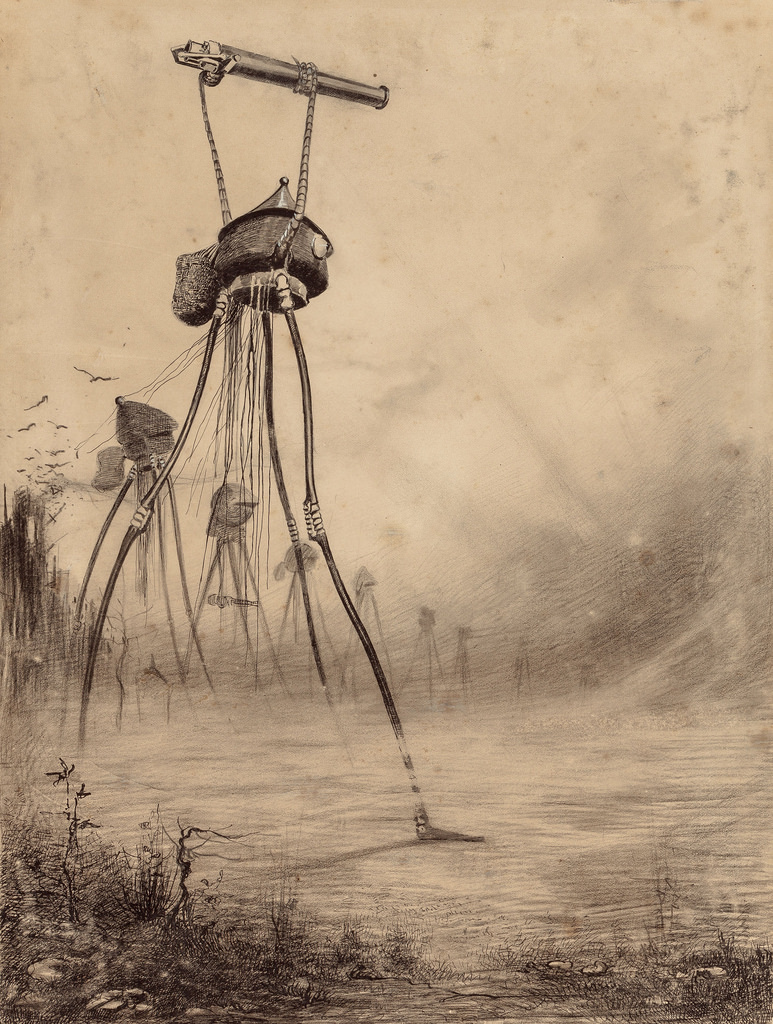
H.G. Wells wrote The War of the Worlds, a story about creatures from another part of the Universe invading the planet Earth and how the humans fought back. Words too can conquer worlds, especially the world in your mind. For this reason, I believe it is vital that we choose words that fit exactly the meaning we intend.
When speaking, we like to believe that we use words to converse clearly with others.
If there are no words in our own language we can create new words in fun and familiar ways. This linguistic phenomena is apparent in the speech of young people. New generations invent their own vocabulary with which to talk behind the backs of adults!
The power of language is it’s ability to open new perspectives on life. A restricted vocabulary will limit thoughts to the point that they no longer serve anyone’s best interest.
Words create our thoughts which can in inturn be inhibited by those words. Imagine a map of a city as a model of your neural pathways. Those journeys we repeat, such as to work, become familiar, almost over used. A map is also constrained by it’s boundaries. It does no show the whole world. The unreachable thoughts are as if in another dimension. Logic cannot venture beyond logic.
I listened to a debate on the radio recently in which scientists were challenging each other over the popular conundrum, ‘which came first, the chicken or the egg?’ They conjectured about birds as dinosaurs and an absurd point in time when the first egg was laid. Only one scientist suggested that change is a gradual process when viewed over long periods of time. No parrot changes colour over night. Evolutionary changes take thousands of years before being noticeable. There is no single moment when chickens and eggs come ‘into being’.
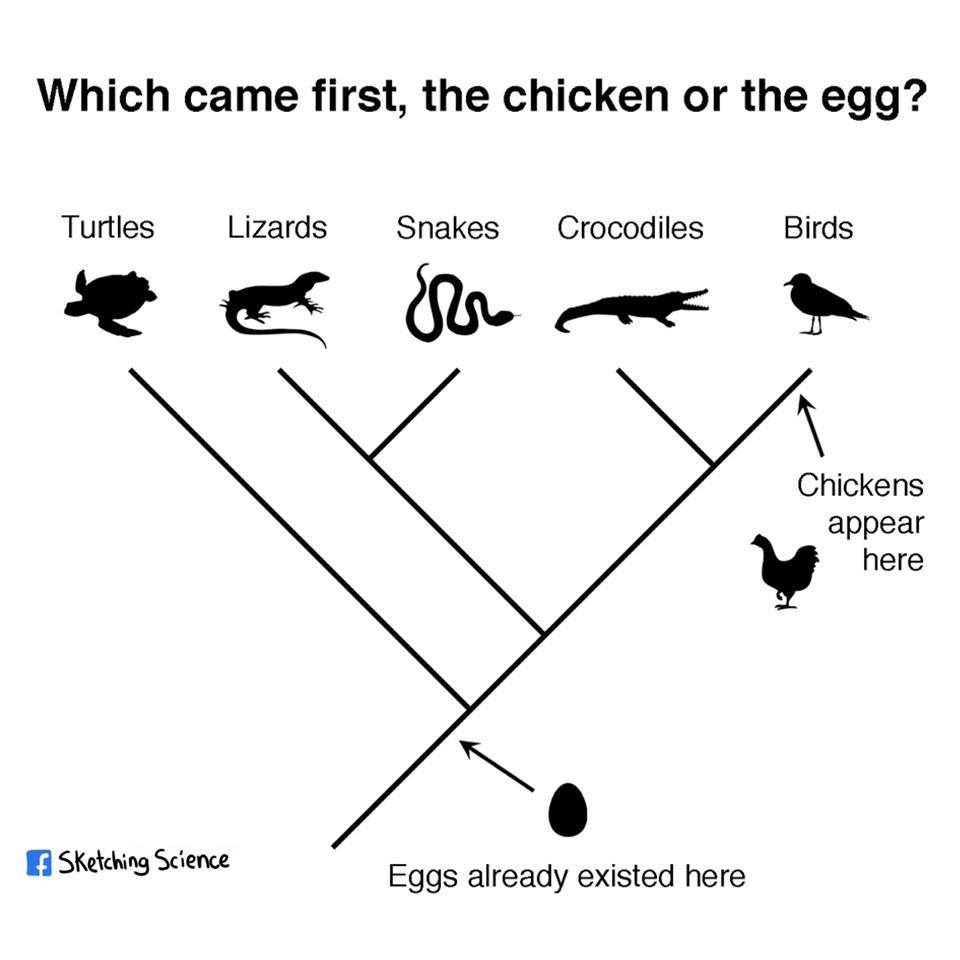
The same is true in astronomy. Do you believe the universe happened in a nano second as the so called ‘big bang’. Scientists are currently theorising that universes expand and contract over vast periods of time. The explosive power of the ‘big bang’ phrase, froze original thinking about how the universe began for decades. The universe was never a chicken, nor an egg…it is obviously both.
Semiotics is the science of language and meaning. In my view, we all benefit from understanding how we structure our thoughts using language and meaning. Here is an exercise;
Imagine a ‘cake’.
There are many categories we can use to describe cakes. There are cakes we sub-categorise by their ingredients such as a sponge cake, fruit cake, carrot cake and oat cake. Then there terms for cake which describe when we eat it, such as birthday cake, Christmas cake or wedding cake. Alternatively the means of production is a description such as home-made or shop-bought. Another way of thinking about cake is the origin of the recipe such as Black Forest, Dundee or French Fancies.
None of these sub-categories describe cake but the word cake includes all of the sub-categories. When we choose which cake is included in which sub-category we use thought to DISCRIMINATE between different cakes. This tool is an important power of mental faculty but unfortunately it’s meaning has changed in common usage. It has become to mean PREDJUDICE and in my view, there is a loss of meaning and ergo understanding, when these two are confused.
Discrimination is an objective skill whereas prejudice is subjective. When we think subjectively we mix emotions with logic. Feelings introduce prejudice for or against something in a way that cannot be explained logically. Insignificant examples are then used ‘prove’ to oneself and others that a prejudice is based on fact in a process known as ‘bias confirmation’.
Bear with me if you think I am stating the obvious but in my view much cultural, ethnic, racial, gender based, geographic, religious and political misunderstanding has it’s roots in how language governs thinking and in particular, prejudice.
A mind which for whatever reason developes a predjudice against a general category of something is in trouble. To use our previous example, it would be wrong to say ‘I don’t like cake’ when what is meant is that you do not like cake with a lot of cream.
When it comes to making prejudices against categories of fellow human beings we hit trouble. Any prejudice is more a product of intolerance, misunderstanding, eliteism, narrow mindedness and other unelightened views in the mind of the observer. However, we hear predjudice views in the news regularly so it is important to unpick how and why they are held.
Consider the term ‘anti-Semitism’. The German journalist Wilhelm Adolph Marr lived at the end of the nineteenth century. He popularised the term ‘anti-Semitic’ to describe anti-Jewish sentiment within political ideology and the general public.

This prejudice towards Jews we know has been present for thousands of years. What was new then was the term, ‘anti-Semitic’. It could be argued that this contributed to the start of the second world war and it remains in common usage today, so did it ever serve the world well?
Let us examine the term. We might question the meaning of the term Semite. Who can define what this means other than an anthropologist? Cynics might suggest the use of the term was a pseudo scientific device to impress and support a prejudice which in turn came from right wing views on eugenics.
Certainly just as ‘cake’ has many sub-categories, so does the word Semite. Historically a Semite might be from a specific geographical location such as Canaan, Judah, Judea, Israel or Palestine.
The term ‘Jew’ is entomologically derived from the tribe of Judea. Then of course there are sub-categories for a Jewish person by religion such as orthodox, conservative or reform. Then there are those who are Jewish but do not practice a religion such as non-practising Jews and those who do not believe in God such as Zionists; who might be Jewish or Christian.
Sometimes language is used to catergorise a ‘people’ and using this categorisation, Semites would be a group who speak Hebrew and / or Aramaic.
The Nazi’s in the 1930’s arbitrarily define a Jew by racial characteristics, not religion, derived from an elitist philosophy of the Aryan race being superior to others on which an extreme predjudice was based.
We might expect a national category of Jew, but the Supreme Court of Israel has determined there is no Israel nationality.
There are other sub-categories of Jewish identity such as by culture, ethnicity and politics, but I hope that I have made the point that the terms ‘Semite’ and ‘Jew’ mean many things to many people depending on what category you choose to define them.

There is a criticism of the term Semite as meaning Jewish by non-jewish people, that it ‘disingenuously’ excludes those who also identify themselves as Semite, such as Arabs. Does the term anti-semite poplarly applied to Jewish people, imply a denial that Arabs are also of Semitic origin?
In my view, the nineteenth century pseudo scientific phrase ‘anti-Semitic’ continues to obfuscate clear thought and sustains predjudice rather than exposing it. It has been used by politicians in particular with the intention including victims of the holocaust and stealing their suffering to gain the moral high ground. Such verbal smoke and mirrors has spawned wars and continues to do so to this day, unquestioned.
In my view, it time to clear our thoughts of words that do not describe precisely what they mean. This is not just a matter of taking sides but simply being clinically clear about where are ideas come from? Are they the product of predjudices? What are the intended and unintended consequences?
To be impartial in a debate that is more a minefield than a cornfield, let us reverse the coin and examine the current term for ‘hatred of Muslims’; Islamaphobia. Again, should we not question the use of this term? Should the psychological term ‘phobia’ really be used to describe a fear of spiders, snakes and Muslims? Clearly confusion, not clarity will result from humans being casually categorised using a word from the science of psychology incorrectly, rather than a clear expression most people understand.
Fortunately, words can serve us to correct such unclear thinking. We can invent new words or phrases in any language and in doing so, say exactly what we mean, fairly and without bias.
It should not be, but if a bigot wishes to describe a group of humans using a term of predjudice, then I suggest that those describing distaste of a sub-category of a human being, should use the prefix ‘anti’. This creates the terms anti-jewish or anti-muslim concisely and without ambiguity. Alternatively, the terms ‘jew hate’ and ‘muslim hate’ in countries where ‘hatred’ is an important aspect of a legal definition and unambiguous to all. The prejudice is clear to all and not spun with fake science. It also makes clear that these are irrational generalisations.
There is a war of the worlds, but it is contained in our heads, not the heads of other people who we may not understand.
In my opinion, the dangerous, self-unaware prejudices that thrive in the emotional biases of current politics, poison the thoughts of otherwise rational and compassionate human beings, and in doing so whole communities. Such hatred of difference is so divisive that it incites violence between one group and another. The simplest example is when governments of countries declare war on each other.
Words are powerful as they form a part of the process whereby we create and sustain our beliefs. How much of the horror that we see in the news today, started as copied or learnt bias, built on an emotional response to an unfiltered stimulus, that slipped under the barrier of compassion towards others.
It is clear to many but sadly not all, that those who express ‘anti’ views in the name of a religion, are not following the most basic rules of the religion they profess to follow.
Fortunately, those who are strongly, even violently prejudiced, are in a tiny minority. The general population do respect and are prepared to learn from, those who are different to themselves. The world’s religions all follow the principle of do-as-you-would-be-done-by.

Speak as you wish to be spoken to




 Matters Blog