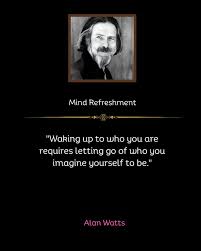
Like many I have often thought about the ‘ego’ and how it fits in with a contemporary search for spiritual enlightenment.
Ego is a term originating from Sigmund Freud and has a technical meaning in psychoanalysis which I shall not include in this essay as there are plenty of psychology books for those interested in a clinical version of the idea.
It’s common usage in English today is to mean that a person is vain and has an unjustified high opinion of themselves, however when we use the word to understand ourselves or ‘what makes us tick’, it has a more constructive purpose.
Ego is Latin for ‘I’ and this sense of ‘I’ works to develope our feelings all through life. I is the observer who perceives through the five physical senses. But this very act of ‘perception’ includes unconscious filtering, predjudices and biases to support what we believe. If this process is unconscious, how sure can we be about the ‘I’ personality we build up through life? How authentic to truth are we?
Whatever ‘I’ is, we can be certain that it rules a great deal of our conscious behaviour; in fact – almost everything.
This is where ‘spirituality’ may start to appeal to a person; to fill this uncertainty and distrust of a fake ‘persona’, accompanied by a suspicion that there must be something beyond personality. The ego is unlikely to admit there is a higher intelligence to it but on surrender of egotistic desires a person can expand their consciousness beyond the everyday.
There are three words which come together to form this expanded version of who we might be; ‘body’ ‘soul’ and ‘spirit’.
It is simple to understand that we are in a body. This was one of the first learning hurdles we had as a baby even though ‘being just a body’ is another of nature’s illusions. You can lose your legs in an accident and still be the same person.
Soul and spirit have various definitions which I shall not explore here. Let us merely propose that beyond our body and senses, there is more that is not within the experience of being me, even if it is mysterious!
In many cultures and traditions the spiritual journey aims to reach an alternative to ego called ‘enlightenment’. Many spiritual leaders claim to have abandoned their egoistic desires and become enlightened. The past remembers such people as prophets and saints but enlightened people are alive today, even if they do not realise it themselves! Perhaps the most beguiling such teacher on the internet is Eckhart Tolle who is candid about his transition into a non-ego driven life and gives gentle and amusing lectures to modern audiences. He does not couch his teaching within terms of any religion unless there is a need to use a specific word or idea. The core of his advice is transferring self guidance away from the ego to the higher self while letting life just happen without needing to control it for desires.
There was a famous Sufi who was stopped by a friend in the street by calling out his name. The Sufi replied, ‘he has gone and I hope he never comes back!’ Dying whilst alive is not part of doctrine in many religions, preferring instead to promise reward after physical death.
In ancient cultures around the world such as Egypt, temples were built mainly for the purpose of placing initiates into a non-egoic state. From here they would leave the body and after three days, just as sun, moon or distant star light fills the chamber, return as a resurrected being. The gnostic Jesus of Nazareth referred to this as being ‘born again’.
One might wonder then what part the ego has in the spiritual quest. Well, clearly the process is not as simple as just abandoning ego.
The truth is that the ego has a particularly strong hold over us, something that it is easy to underestimate. The process of ‘dying’ is anathema to the ego and it will do almost anything to stay alive. Being ‘frightened of dying’ is common for the general population and understandable. We have a choice. Either to be haunted by The Grim Reaper all your life or ‘die before you die’.
The Japanese Samurai in Feudal Japan were spiritually trained as well as being fearless warriors. They entered fights in which they were very likely to be killed for the simple reason that they had overcome the fear of death. What did it matter? The Templar knights in twelth century Europe went through a similar initiation process and were likewise, fearless warriors.
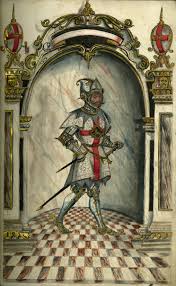
picture credit Middle Temple
So when a person in modern times takes up the spiritual path and accepts that the final destination is an abandonment of ‘I’ and everything, the ego opens it’s playbook of dirty tricks. It will not give up without a fight to the death.
The most blatant of these is to transfer the feeling of ‘I’-ness into a new, highly spiritual ‘I’ personality.
When the ego is transferred to spirituality in this way, all hell can be let loose!
I once stood at a London rail station with some friends. We looked across the concourse to a large group of African Muslims dressed from head to toe in white robes. They were clearly performing the spiritual journey of the Hajj, bound for Mecca. The pilgrims strict dress code to wear white for humility and yet this group clearly ignored the spirit of the dress code. Their robes were over sized and flowing and their headgear voluminous so as to draw attention solely to project their imaginary high status.
The extremist armed groups of all faiths and political persuasions in modern times are twice as deadly and ruthless precisely because their egoistic sense of being ‘right’ holds power over others. The fact their their evil actions are the opposite of the religion their profess blinds them in a way that only the ego knows how to do.
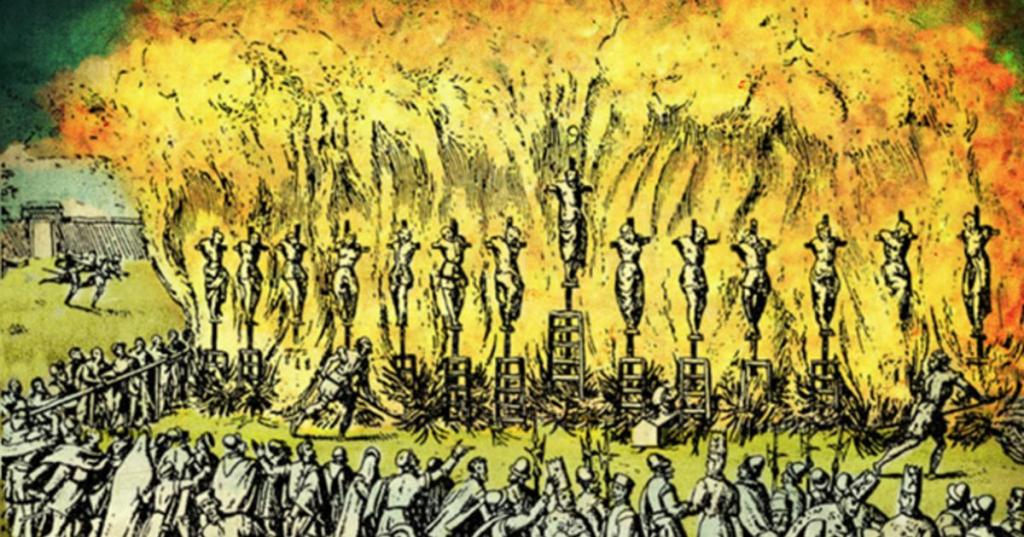
The Spanish Inquisition operated what we might call today a ‘death squad’ against all the Christian principles of compassion and love, for over three hundred and fifty years.
Even peaceful looking cross legged gurus and self style ‘god men’ in India and other with strong spiritual traditions, may secretly hide the fact that they have simply adopted the appearance of being spiritual for a variety of non-spiritual reasons. These might range from obtaining money and property, sexual exploitation of naïve followers, illusions of self importance and power over others.
Their conman techniques include dressing up elaborately clothing, hypnotic music, chanting and dance, illusory tricks such as surgery without incision, strict regimes of ritual, unquestioning obedience, removal of individuals from family and friends, shaming and praise and a thousand other deceits and conceits. It is the pyschology of the cult which promises a way to overcome personal egotistic desires but replaces them with the egotistic desires of the guru.
When ‘abandoning ego’ we are as vulnerable as a crab without a shell and great care is needed to value the role of the ego as something that keeps us going in a difficult even dangerous world. Ego is not something to be abandoned without something more real and more reliable to replace it. It is after all, the motor that gets us up in the morning and sustains us however frail and feint we may feel.
Perhaps the middle way is not to abandon egoistic ‘desires’ but to come to terms with them in such a way that our ego does not pull our higher self along like a dog on a lead. The path to perfection is to separate our consciousness from the ego as described in gnostic teachings. In this state, the ego must do as it is told be the highest benefit of oneself and others.
There are a series of paintings in Zen Buddhism which describe this process, one part of which is called ‘taming the bull’ where the bull is our ego.
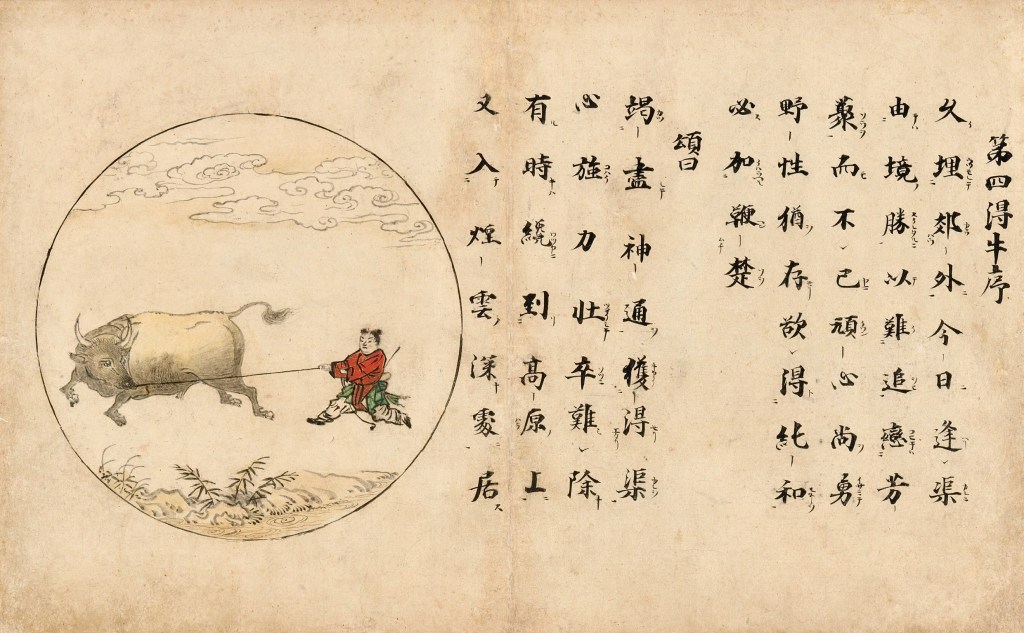
The whip and rope are necessary,
Else he might stray off down some dusty road.
Being well trained, he becomes naturally gentle,
Then, unfettered, he obeys his master.
From “Zen Flesh, Zen Bones” by Paul Reps
The rider of the bull is then, that part of ourselves that has become separate and yet still connected to ego or ‘I’ ness. A connection to spirit without destroying the grounding ego gives us, is achieved through strict objectivity in attention and awareness, just as in the expression, ‘in the world but not of it.’
This enables our state of being to move into the ‘higher-self’ or ‘infinite consciousness’; our eternal and infinite connection with ‘all that is and ever shall be’ . It is attained not by the ‘achievements’ that we are encouraged to aim for by society, but by removal of our ‘imitation self’ or ‘personality’. Surrender, non-attachment and the knowledge of forgetting, are just three tools from the wisdom schools of the past which steered seekers of self knowledge long before the modern schools of psychoanalysis and psychiatry.
You are already It, except it is not You.
 Matters Blog