Back to the Garden

An avid follower of the ‘language of the birds’ might have noticed that hEaVEn contains the name EVE. There is even an echo of Eve in EdEn.

This oddity is not necessarily meaningful or intentional, but that is not necessary. It’s just satisfying to think in an intuitive way, like the birds that flitter around us for no reason but give us messages; a process known as the language of the birds. There are things we do not hear and hear in the garden.

Hieronymus Bosch

Some feminist friends of mine express the view that mysogeny has it’s roots in the creation story in Genesis. ‘Why is it the woman who disobeys God and eats the apple?’ But to me, as a human being, the gender distinction is another example of how the dualistic mode of thought that started at this very point in time, has created confusion ever since. This dualistic perception is even hard wired into the words we use to describe opposites such as long and short, able and unable, peace and war.

In the Old Testament story about the Tower that was sinfully built in Babel, the consequence is God punishing mankind. This meant that humans no longer understand each other by using one language, but create confusion with multiple languages. If that story was about words then the story of Genesis is God’s punishment making us misunderstand our thought patterns.

And how we think must be far more important than how we speak. I have encountered foreigners who misunderstand me speaking in their language, not because my words were wrong but because they think in a different way. And thinking is not taught in schools. It is assumed children pick up good thinking skills, when there is no reason to assume they will.

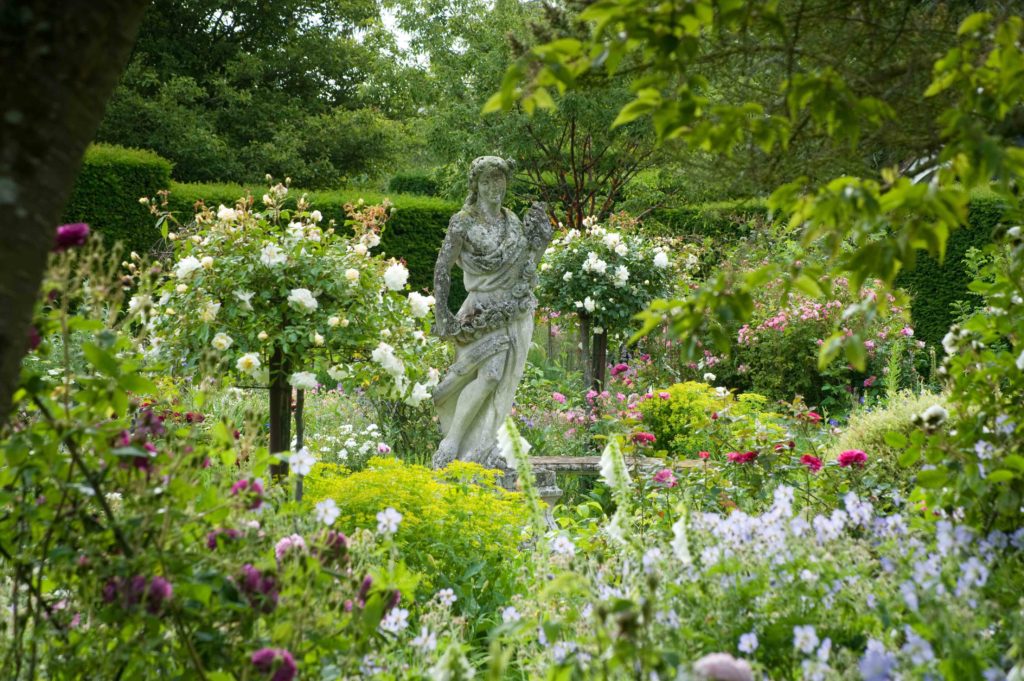
Let us find a nice bench and sit for a while in the original Garden of Eden before humans came along. Enjoy a bit of peace. The Biblical creation myth is largely in agreement with the creation according to current earth science; minerals, plants, animals…until, kerpow – a human appears! This is the beginning of the end of a blissful life in the garden (Heaven) because Adam is one of half of what is to become two halves. The garden is singular, the lovers are plural. There are not several gardens all running along the Tigris and Euphrates but just one. This state represents the primal state of mind that spiritual paths aspire towards. For example, in Buddhism the principle ‘All is One’ contains everything anyone needs to know.

A Zen Garden

In Zen Buddhism the master asks the pupil, ‘what is the sound of one hand clapping?’ The question is nonsense and to correct this we might suppose that God had to create Eve, because you cannot have x without y.

The creation story is more a description of a fall into a highly confusing mode of thought which paradoxically is both ‘confusing’ and ‘enlightening’. Confusion and understanding are, after all, directly connected by a continuum you might call ‘knowledge’; they are different aspects of the same thing. But in dualistic thinking patterns we learn to differentiate and name, compare and contrast. There is always ‘this and that’, which is dualism.

In dual thought patterns adjectives are used only to describe the two extremes of the same thing. For example ‘good’ and ‘bad’ are highly relative situations and things and context and consequences can morph each into the other. And yet most people when asked, will say they prefer good to bad. Have they thought about that? The writings and lectures of the late Alan Watts, who studied Christian theology and Eastern philosophy, returns over and over again to the eastern understanding that there are no opposites, only continuities.

Alan Watts picture credit; Stillness Speaks

In applied mechanics, physicists will not fall into a dualistic mode of thought. They will not use the words ‘hot’ and ‘cold’ but only degrees of heat. A fridge is cold because it expels heat. It has no measurable relationship with cold because cold is just a place from where heat has been removed. The amount of heat is indeed a continuum, which we look at every time we view a thermometer, which measures heat – thermo – not cold.

picture credit: Researchgate

There is another well known symbol which illustrates the unity of ‘opposites’ which is the Chinese Ying Yang symbol. The two opposites of black and white, combine harmoniously in the diagram as two fish chasing each others tails. Most importantly each fish contains a little of the other, represented by a black or white eye.

We are told in Genesis that this dualism is a mode of thinking used by God;

‘and God called the light Day, and the darkness he called Light.’ Genesis 1.6

The whole process of ‘naming’ is formalised to describe a creation that was already there, and at the same time, becoming so.

The word of God (ergo ‘god-like’ mankind) is all-powerful, not just revealing but causing something to come into existence. This is the modern conundrum of quantum physics where the tree falls in a forest and the question is posed whether this event happens if there is no observer.

In magick this odd version of reality appears in the word, ABRACADABRA meaning; ‘I will create as I speak.’

The human body has a similar confluence contained in the left and right hemispheres of the brain. Each half has a different function; right is intuitive, left is reasoning. People tend to fall into a bias towards using a half particular to themselves, and we compound this dualism in schools and university degrees, as ‘science’ and ‘art’.

Few realise this is a most unhappy state of mind, or perhaps they do but do not know how to get out of it! When there have been individuals who have learned to use both sides of the brain equally and non-competitively, they bring very special ideas to humanity; so special we call them ‘geniuses’. Leonardo de Vinci, Michaealangelo, Albert Einstein are a few famous examples of the so called ‘renaissance mind’. Thinking back to the introduction to this essay, this is the ‘god-like’ ability imparted to human kind by the Creator.

Albert Einstein, for instance, is famous for realising energy and matter are not different but the same and completely interchangeable using the formula;

e=mc2

– where c is the speed of light – ‘let there be light and there was light’.

Very early Gnostic traditions did not allocate gender to the ‘God-head’ or ‘consciousness’ or ‘mind’ or however you wish to understand the creative consciousness that unraveled as the Universe. And we might add existed before and after creation since there is no ‘before’ and ‘after’ in non-dualism. (Scientists are only now coming around to the idea that the ‘big bang’ was an end as well as a beginning as described for millenniums in the Hindu Upanishads.)

The Ouroboros Tree

The never ending cosmic cycles and the unity of everything is represented in alchemical manuscripts as the snake forming a circle as it bites it’s own tail. Everything becomes a snake with no head and no tail. A snake is a continuum and of course this consciousness was prior to and initiated, dualistic thought and the contradictions that emanated as a consequence of adopting it.

Every time we spin a coin in the air and ask ‘heads or tails?’ we are a mind locked into the

‘either / or’ mode of thinking.

The key that opens this lock is the word ‘both’. You will often hear in interviews on the radio the journalist asking, ‘is it this or that?’ and the respondent answers, ‘both’. The question is a trap and people who know their subject (which they usually do if they are on national radio) have no problem with contradiction – or rather the illusion of a ‘contradiction’. They then go onto to describe all the aspects of the same problem including the two options contained in the question.

Those who do not understand this, fall into the elephant trap of ‘left politics’ or ‘right politics’ and are unwilling ever to change their bias. In medieval terms ‘they are in Hell’ because they will never understand the totality of what is going on and therefore how to influence affairs and events for the better of all.

And we should remember that the snake in Genesis was coiled around ‘The Tree of Knowledge’. Eve explained to the snake that the tree in the center of the garden they were forbidden to eat from on pain of death.

‘And the serpent said unto the woman, Ye, shall not surely die:

For God doth know that in the day ye eat thereof, then your eyes shall be opened, and ye shall be as gods, knowing good and evil.’ Genesis 3/4

From a purely objective point of view, the snake was right. This truly was the effect of eating the apple. The issue was that eating it was against the will of God. At that moment, it could be argued, Eve was unaware of why God had ordered this as she was in a state of ignorance of the ‘opposites’; she was in blissful ignorance, quite literally. So she can hardly be blamed for not conceiving that knowing good and evil is a liberating but problematic change in human consciousness. It brought god-like power to humans and if we look back at history; it really did.

Humans have used their creative imagination to take to pieces and put back again in new ways, everything we know. It has been a far from easy path as God points out in the following passages of Genesis.

‘Therefore the LORD God sent him forth from the garden of Eden, to till the ground from whence he was taken’.

No longer would grapes fall from the tree into the mouth but toil and hardship would be the lot of humans as punishment.

Joni Mitchell – picture credit; Reverbnation

There came a hippie moment in the 1960’s where ‘rules’ were at last questioned and even abandoned. At the legendary festival of Woodstock, there was a young singer;

We are stardust, we are golden. And we’ve got to get ourselves. Back to the garden. Joni Mitchell – from the song ‘Woodstock’.

Fortunately, getting back to the garden is not impossible. Like all paths this particular human history of which we are all so proud, will lead us back to the beginning again. All directions are the correct directions to take, all mistakes are ultimately correct. If and when we stop dissecting everything, including our own thoughts, we will discover the original state of bliss, second time around.

Watching Grass Grow

I do not normally watch football matches. The reason is simply that I find them slow and the match result often unsatisfying. More on this later. One the other hand I can be persuaded to watch any sport where England takes part in a sporting final and where there is a high likelihood of a match of equals.

So I sat down to watch the European Final of Womens Football 2022 last night. History, we were told, was about to be made.

But first, some game theory. Many games simulate military strategy and football is no different. Each side has an area to defend. The resources of each side are matched with no particular advantage to either other than their own esprit de corps, skill and strategy. With these resources, the sides must defend at the same time and with the same force, as attack.

What happens when one side is considerably less skilled and less determined in it’s aim than the other…is that the more skilful side wins convincingly.

This gives rise to a certain inevitability as to the outcome giving the supporters and participants of the losing side enormous disappointment. Their expectations of winning were shown to be based on false confidence in their own ability.

This is why sides which are equal in every way, provide the greatest challenge to the players and entertainment to the supporters.

The game of football, however, provides a disappointing set of rules that restricts uncertainty and the excitement that comes from the expectation of gaining a winning advantage at any moment.

What works most against football being entertaining, is the system of low scoring. A 0-0 result is not uncommon and only slightly better is a draw of say 1-1. Ideally a score should reflect the skill of a side as closely as possible and in low scoring games, it is unlikely to do this. In fact sometimes the better side may lose due to some random misfortune such as an injury or poor refereeing decision, giving rise to indignation amongst players and supporters; the phenomenon of a ‘pitch invasion’ by angry supporters must happen more in football than any other sport.

If we examine how well high scoring games reflect the process of a match and outcome, such as tennis or cricket or snooker, players have a chance to change the course of the game almost every time they touch the ball. The better player or side will almost certainly be identified by the final score and both sides feel fair play has taken place.

Compare this with football, where much of the play and touch of the ball results in no particular advantage to either side. Players often kick the ball back into their own area rather than forward. They engage in a series of safe passes in which the ball moves between players of the same side with little risk of losing possession. During this time the grass grows another micro millimeter.

Losing possession is not even a great disadvantage to either side. Goal keepers regularly kick the ball away high in the air with only limited accuracy as to where it is going to land. The opposing side might intercept the landing with a header which is so uncontrolled that possession changes side yet again.

The prospect of the ball moving around the pitch in this manner gives no reward to either side. Players compensate for their frustration by taking a risk of injury to themselves or other players, with aggressive tackles. The result is that play stops whilst a fallen party rolls around theatrically on the ground in order for the referee to take the matter more seriously than is warranted. Medical teams are permitted to run onto the pitch to give ‘treatment’ that in olden days consisted of squeezing a wet sponge over an affected area and today consists of more elaborate physiotherapy, ICU teams and trauma psychologists.

So the game stops and starts with as much randomness as a demolition ball and certainly not as interestingly. At the end of 45 minutes of nothing, both sides rush off as if they need a break. During this time supporters argue or fight or get more drunk, and players are given a victory talk by their coaches and managers and anyone else who happens to be in the dressing room, telling them all to ‘work together as a team’ and ‘get the ball in the back of the net’.

At the end of another 45 minutes of lawn care, neither side has managed to kick the ball into the exceedignly large space enclosed by the goal posts. One almost gets the feeling that even if the opposing side was not present, a team working on it’s own to move the ball from one end of the pitch to the other and then between the goal posts, would find the challenge irritatingly difficult.

At the end of the game one side may have by some fluke, scored a goal and this sometimes unearned (even an own goal), event is considered enough in the Football Association rule book, to warrant deciding which is the better side.

Sweet FA

In the likely event of a draw, the most frustrating spectacle of a ‘penalty shoot out’ is commenced. Each side takes it in turns to stand right in front of the goal posts and kick the ball past the goal keeper. The success of this depends largely on randomness on behalf of the boot of the player, the arrangement of worm-casts, damage to the pitch over the penalty taking position, the strength and direction of the wind, the strength, height and direction of the sun, the clarity of mind of the players ( after brain damage caused by heading the ball too frequently in their career ) the clarity of mind of the goal keeper who has to guess which way the kicker is going to kick, and the conflicting chants of two opposing tribes of supporter.

In order for any game to avoid such a spectacle of chance to ‘decide’ the result of previous vain and worthless endeavours, I strongly suggest that a new system of continuous assessment is introduced.

This means that points will be awarded more often.

So to improve football certain changes might occur;

  1. Use a point based system instead of counting goals.
  2. Award 3 points for a goal, 2 for a corner and 1 for a side throw or hitting one of the football posts and horizontal bar by skill or fluke. This will keep the ball in play and the game moving and require skill and concentration.
  3. Increase the size of the goal or remove the goal keeper completely.
  4. Reduce or increase the number of players. For instance there could be one additional player coming on for each side every ten minutes. After half time players leave the pitch in the same way.
  5. Change the size of shape of the ball. A ball as large as the players would be hilarious if nothing else.
  6. Change the number of balls. Two balls could be in play at the same time, or twenty.
  7. Allow hitting the ball with a fist instead of the head (to preserve brains)
  8. Break the game down into more parts as in tennis, so that an uneven number of wins is required of sub parts of the game rather than have just the one result.
  9. Permit obstacles on the pitch such as sand pits and water holes and or circus perfomers.
  10. Give each player a giant inflatable hammer with which to hit each other.

There are no doubt many other variations to the rules of football that would create far greater entertainment. The key change to make however is to get rid of the unsatisfactory scoring system.

Games are invented by mankind and not received from God, and should never be subject to dogma. It’s okay to change / improve the rules.

People who resist change it is said, are willing to accept change only so long as the new version is the same as the old.

Flippant? Not really. Consider how after centuries of having male only matches, females are now also playing the game of football. Trouble is, it’s just more of the same.

Flippant? Then consider that football in this analogy illustrates how the human mind is resistant to change even when a particular mode of human behaviour and rules is clearly in need of improvement. Then, when change is finally accepted, it is often no change at all but the similitude of change.

Did You Enjoy Your Meal?

Do you find that when you eat at home, you must put on some loud music to accompany your meal?

I expect that there are many who cannot face eating without background or foreground music or perhaps television, but your writer does not.

Therefore, for me, it is difficult to go to a restaurant anywhere in the world and enjoy the experience. The problem is that most restaurants seek to please their clients by playing music with apparently, little thought. I can see that their aim is to attract customers and an empty silent restaurant is not going to do that. So they replace the silence and empty tables with music. So when people get hungry and sit down in the restaurant, is this because of or despite of the music ? The restaurant fills up and as the music stays on the people start shouting at each other, just to be heard. The speakers are cleverly placed so that there is no table where the music does not play in their ears.

My question is, are restaurants getting it right?

Let’s imagine that you own a relatively successful restaurant What’s’ your management strategy towards ambient music?

Live, themed music, but look at the size of those speakers!

For starters, how many potential customers walk by your restaurant when they here your musical offering? Is this because they do not like your taste in music? Should they? Who else likes your taste in music? The majority of people? Really? You don’t know? Why not?

Music after all is a very personal thing. Young people are unlikely to want to go to a restaurant playing the classical greats…as are elder people unlikely to want to listen to heavy metal and grunge with their salad. There is no ‘one size fits most’ when it comes to musical taste.

Music cannot only be judged by it’s genre but by the volume that the music is played. There is a type of music intended to be played at a volume just enough to break the silence. In the 20th century this was dubbed ‘musac’ and wafted from ceilings in lifts and shopping centres. Today, there might be ‘ambient music’; a soft mosaic of chords and natural sounds that is so bland that it is hardly noticeable, yet gently calming.

At the other end of the scale there are some people who enjoy and expect music to be loud, and perhaps young people fall into this category, although of course, not all.

So as a manager and owner of a restaurant, how can you attract the maximum number of customers? Do you let the staff play their favourites (as many managers do) or have you understood the need to carefully attract the maximum number of diners.

The decision may not be difficult. If you own a Greek restaurant, do you play Greek music to remind people of their holidays in Greece? It may sound obvious but how often does this happen in your experience?

I once went to an idyllic restaurant on a sandy beach in Kerala, India. The food was delicious but the music was ‘intended’ to please westerners. After suffering ‘Pretty Woman’ by the Whoevers, I handed the waiter my cassette tape of classical Indian music and asked him to play it. The ambiance totally changed. Suddenly I was in India!

If you do not have a natural themed choice of music in your restaurant, how can you know what customers they like? The answer is to ask them. A simple question at the end of their meal about the music instead of ‘did you enjoy your meal?, would be a good start. Alternatively, a questionnaire printed on the place mat / menu enables a more anonymous and comprehensive response. It could include a question on the volume for instance.

A relaxing dining experience?

An obvious consequence to client satisfaction in your dining experience, is to offer some tables where there is deliberately no or very quiet music. This would please those whose taste in music is not ‘mainstream’, as already described. These would be ‘low music’ tables where there are no speakers hanging ominously from above. This particularly makes sense where there is pleasing natural ambient sound such as a river or the sea, birds, or wind in the trees. People need choice and the more people you can attract the more profit, surely?

There is a point where music becomes a contributory factor to noise. This can be defined in decibels, and happens when other sounds in the restaurant are taken into account. People natrually want to talk in restaurants and the level of noise in the restaurant will affect their ability to listen and talk to each other. There is a known effect where people talk above ambient noise levels in order to be heard. As more people talk the louder they have to talk. The effect is ear crunching.

Or perhaps the restuarant music is needed to conceal unwanted sounds. The noise from the kitchen, the TV on the wall, the busy road outside and other local noises that invade your restaurant, might be concealed by music but at a certain point, the music is the only sound in your control as manager. If people are shouting over it they are certainly not listening or enjoying it.

I personally will walk straight passed a restaurants if I do not like their music and or it is too loud. This means I just keep walking, and not because my taste in music is narrow. On the contrary it is very broad, but it is not ‘popular’. I have studied music and can play various musical instruments as well as sing, but given the option for music or not, regrettably my choice would always be the birds in the trees.

Spotted flycatcher Muscicapa striata; picture credit RSPB

The bottom line is, as for most business enterprises; are you offering what people want or what you want to offer to people? Generally, businesses based on personal taste or expectation of the tastes of others to match your own, fail. There is no room for peronsal egos when seeking to serve others. To attract and please people, entrepreneurs in dining or any other business, need to know what people want. Businesses like Mc Donalds and Costa Coffee prospered because they understood this principle and make money.

So, when it comes to musical ambience in the dining experience, what do people want?

Let Me In – part two

Most European countries have at least one land border with another country. But the UK is an island and this proved a great strategic advantage for the British, stopping intending visitors like Napoleon and Hitler. The English Channel is now one of the busiest shipping lanes in the world so you might think that crossing it without being noticed and at least avoided, would be difficult.

This makes you wonder how seriously the borders of the UK are watched when rubber boats arrive who could be invaders from a hostile country. Dorset Police went out and bought three boats, which doubled the patrol capacity for the whole of the UK. Interestingly the Royal Navy have become involved…but only recently.

This essay is not principally about the UK. The plight of those wishing to enter it, is merely intended as an example of similar situations all over the world, such as Cubans wishing to enter the USA.

With climate change, scarcity of food, water and raw materials, wars, disease, corruption, rogue governments and other factors, the world needs to apply a united strategy to those affected. The mass movements of populations needs to be handled co-operatively and competently.

So let us re-focus the problem in the English Channel and consider how a strategy can be formulated and implemented rather than narrowed to a single issue.

Le Manche – as seen from France

Firstly there needs to be a ‘triage’ of emigrants who turn up at the in French sea ports and coastal towns. They will either be in the ‘criminal’ group (5) or one of the other groups listed in Let Me In – part one, and it is of primary importance to identify them in the interests of all countries.

They may well be pretending to be seeking asylum in the UK and will have worked carefully on a fictitious cover story. If and when known criminals are identified by security services, it is imperative that they are dealt with. Those who are known to be linked to crime, war crimes, terrorism, extremism etc. may already have international warrants for their detention enabling their immediate extradition to other countries. In doing harder, what governments should already be doing, there is no longer a temptation or excuse to treat the greater majority of genuine migrants, as criminals.

The ‘people trafficking gangs’ and their leaders clearly, also need to identified and put on trial. Good police work should be capable of locating and monitoring them by using surveillance and sting operations to infiltrate their organisations and make arrests. If this has ever happened it has not hit the headlines. Do more resources need to be aimed towards identification of the gang leaders? They may be linked to other organised crime such as drugs, sex trafficking, terrorism and the rest. This is just bread and butter policing and yet it does no appear, at least, to happen.

The sale of the boats and safety equipment which takes place in the Calais markets and Marine supply shops, could be licensed and stricly monitored by CCTV, forcing traffickers to transport this equipment from elsewhere. This will not stop them, but it will increase the risk of being caught in possession of it and having to spin improbable yarns to police.

Security services have teams scanning the dark web for extremists, terrorists and their associated criminal networks. Little is made public about this work; no doubt for good reason, but there needs to be some publicity if only to reassure the public on both sides of the channel that there is a raft of measures operating to close what is happening down. Why is it so difficult?

Post Brexit, the French north coast became a border of the European Union. As such it will have been given substantially greater security measures than the internal borders within the EU. If 440 people leave the coast in one day and there are 20 people on each boat, then that is 22 boats! The English Channel crossings are made in broad daylight from busy coasts. Do the general public, commercial and leisure users of ports and marine facilities report suspicious activity? Is there a Coastguard hotline to report such craft? If you ask Google this question the answer is yes; 1-888-373-7888, but it’s in the United States of America.

If we consider new technologies then it has become practical and effective to search for and monitor suspicious activity using drones. These will provide real time intelligence and enable land and sea based patrols to investigate in a timely manner. They can also be used to verify reports from the general public before allocating resources. Drones could be used on both sides of the English Channel. It is likely that members of the public with an interest in using drones, could work alongside coastguard officers; reducing costs and releasing officers for duties that require their legal powers and skills. (There will also be a spill over benefit help catch smugglers and other illegal activity.)

Migrant Boat – picture credit France 24

Crossing the Dover Strait from Calais depending on, wind and tides, speed of vessel etc. is going to take at least three to four hours. Crossing the shipping lanes is fraught with danger as all sailors know. This means that it is important to intercept emigrant boats before leaving the relative safety of the inshore waters. Maritime law requires interception of a such a vessel to be taken directly to the nearest safe place. If emigrant boats are allowed to stray too far towards the centre of the Channel this can become an issue between UK and French authorities. Should boats be turned around as they approach the other side of the channel (as the USA Coastguard does to Cuban refugees) or should a border be enforced in the centre of the Channel? Is this idea remotely practical in any case when emigrants dangle their children over the water as a threat to intercepting authorities or simply just jump into the water. At one point the Home Secretary Priti Patel wanted boats physically turned around, not appreciating or perhaps caring, how dangerous confrontations at sea are.

Newspaper articles and even presidents of countries will try to persuade the public that all or most emigrants are all criminals but statistically, the majority will fall into one of the other four groups already described.

Many will probably be without documentation often through no fault of their own. This issue could be solved by the often suggested policy of ‘creating safe routes’ and simply issuing temporary documentation. These can include biometric identification as is reasonably required by the UK government. (Scanning finger prints is part of process of identification of the known or wanted criminals and will already have been done. It takes a few minutes, not months, to do for each person.) The Prime Minister has lauded the idea of ‘safe routes’ in debate, but in reality the only safe routes the UK has set up are for Ukranian Nationals and a restricted number of Afghans.

My principle point, as I have almost certainly missed out many details and parts of a more general strategy simply because I am just writing this as a lay observer, is that controlling the mass movements of undocumented people is a complex issue. Enormous co-operation between nations is required, the sort of relationships that the European Union was partly set up to achieve.

There is an ‘elephant in the room’ however and they is why the UK is a honey pot to emigrants. Why do individuals and families wish to come to the UK so very badly they will risk their savings and their lives to get there? Perhaps the answer includes the facts that English is a lingua franca for many, it has given out UK passports following it’s Empire days (e.g. Hong Kong), it has a free health service based solely on residency and has a generous welfare system into which there is no immediate requirement to pay, in contrast to most other European countries.

picture credit: AA Milne and Walt Disney

The UK public might be proud of these humane and welcoming promises but it is cruel to dangle the carrot without letting go of it just as the donkey has finally completed the journey and this is precisely the strategy of the present government in most cases. In my view this is a slippery slope to the UK losing it’s reputation for fairmindedness.

This essay has been long and covered at lot of ground. This has been deliberate and well done if you have reached this far! My aim has to be to outline only the broad spectrum of issues around the mass movement of people around the globe, using the UK as a sorry example of ineptitude.

Governments ignore complexity at their peril. It is always tempting for policticians who often are vastly under qualified for the roles they attempt to do and say as little as possible. This is all very well for the ordinary person who knows they have no idea about international polictics, but leaders are expected to be better than this. The detail is most often where policies go wrong and ignoring detail is much the same as devil worship, for does he not love the same?

Let Me In – part one

Governments have to identify goals which are desired by their supporters and decide the means by which these goals can be achieved.

This simple statement makes sense, until the details and the means are examined in depth. Specifically, the means may not either be effective, or worse, they bring about unintended consequences which may cause harm.

An example of this is happening in the United Kingdom right now over the issue of immigration.

Voters in the Brexit referendum of 2014 had many concerns and one was a perception (stoked up by the media over inadequate public services and poor town planning rather than economists) that immigration into the UK was a problem. Brexit was posited as a means to ‘take control of our borders’. Unfortunately the ‘problem’ was incorrectly perceived in my view and I will explain why.

Economist promote immigration as it promotes growth and prosperity. The Tory governments of the last decades have known this and Home Secretaries such as Teresa May, did little to control immigration. Why would you when you need foreign workers? But after Brexit voted against the free movement of people within the European Union, unemployment in the UK now stands at 1.3 million.

picture credit; I Volunteer International

The present argument by the Johnson government, is that the ‘problem of immigration’ is the number of people who die on inadequate boats whilst trying to cross the English Channel. This emotive argument correctly demonises the illegal traffickers but fails to approach the problem from a strategic perspective. If they used safe boats would that be okay? Is this a sea worthyness of boats problem?

The absurdly narrow focus on what the problem is and how to solve it, only satisfies voters who are content with a simplistic problem / solution statement. To gain a full grasp of the problem, I shall outline as best I can, the breadth of the issue of mass movements of people into the UK and how improved ‘control’ of the borders of the UK could be achieved.

Firstly, there are five types of emigrants;

  1. Those escaping hardship in their own countries through famine, war, climate change through no fault of their own.
  2. Skilled and unskilled economic emigrants who are seeking work and higher remuneration.
  3. Political emigrants who are escaping persecution by their own government because of their political views and acts and seek political asylum.
  4. Emigrants who are seeking to be re-united with their families; a group that includes children travelling alone.
  5. Those outside of the law in any country involved in subversive and or illegal activities, either in the interests of their own government or for criminal motives.

For each of these groups, there has to be a specific solution to their desire to emigrate to another country to live and work. But before I examine these, there is one further beneficial general approach.

The conditions in countries which people are seeking to leave own a large part of the problem. You might expect diplomats from countries likely to become unwilling hosts to emigrants to spend a large part of their time and resources in working on this problem with other governments. I personally suggest this should include processing asylum claims in local embassies (excepting when appropriate, political emigrants) and issuing temporary visas on ’emergency passports’ to enable safe travel using conventional means. Buying a 50 euro airline ticket instead of paying people traffickers, is no financial burden on the UK government and puts illegality out of business. It is certainly less than chartering an aircraft for 500,000 pounds to take the unwilling to Rwanda, but who am I to point this out?

But let us assume that all the targeted aid and supportive diplomatic steps have been taken and people are still desperate to leave their own countries. What interventions are available and appropriate for each of the five types identified above?

Group 1. Escaping hardship;

  • In the short to medium term, build refugee camps.
  • Identify suitable locations for these and provide appropriate support.
  • Have international protocols and means in place to be ready for the next global catastrophe, through non-political global organisations that are trusted by those seeking help.

Group 2. Economic migrants;

  • Maintain physical border controls so that border crossings can be managed and legal crossings enabled.
  • Put in place means to screen those with and without documents to confirm identity, purpose, ability for self support and seek work opportunities or evidence offers of employment.

Group 3. Political emigrants;

  • These should be identified by host countries only, as they will not wish to be intercepted by the countries they leave.
  • They may be oblidged to cross borders by illegal means in order to remain safe.

This group is likely to be used by group 5 (criminals) so particularly high security measures and screening methods will have to be used by potential hosting countries.

Group 4. Seeking family re-union;

  • Set rules for family members to be able re-unite after non-self imposed trauma legally and permanently.
  • Have facilities and protocols in place to process unaccompanied children.

This group would benefit from being able to apply for a visa and /or residency before leaving their own country.

Group 5. Criminals; This is the group that makes it necessary to have strict controls on all the rest.

  • They need to be identified at the earliest opportunity and dealt with according to international law and extradition agreements, much of which may need revue and extending in scope to fit the present movement towards a ‘global community’ rather than nationalist self interest.

You can appreciate that these principles apply to most emigration and immigration, and examples abound in today’s current affairs. To keep this essay focused I shall use just the example of immigration into the UK and the policy that the government believes will stop people crossing the English Channel in unsuitable craft.

My first point is a fault in the government’s argument. They state that the aim is to stop people drowning in the English Channel. Clearly no person is going to be against this. However their method is to deter people getting into unsafe boats and how strong a deterrent this is going to be, is unproven. The counter argument suggests the policy is ineffective and costly, at which point government ministers will accuse those against the policy of being ‘in favour of allowing people to drown in the English Channel’.

Unfortunately this extremely poor level of debate and problem solving has been carried over from the Brexit referendum in 2014. The focus of the ‘benefits’ of Brexit was on immigration, stating a desire to reduce numbers entering the UK. Not surprisingly, by being no longer a part of Europe the interests of the Mayor of Calais became no longer aligned with the UK. The solution for the French to the problems around refugee camps in Calais, was to do as little as possible to stop migrants leaving for the UK. For this reason they expressed no interest in accepting UK money for extra police and border controls on French territory. Such measures are popular with voters but are again ineffective. Emigrants who have already made long journeys are expert at avoiding detection. Effective ‘strong borders’, require measures in place similar to those between North and South Korea and it is unreasonable for Calais to accept machine gun posts, razor wire and mine fields along it’s beaches.

picture credit; All That is Interesting

So after the UK government has stopped accusing France of being ‘uncooperative’ rather than understanding the points about motive and means just made, the brutal ‘one size fits all’, send-emigrants-to-Rwanda solution is put in place. The British public – who have traditionally been internationally respected for being fair minded – are expected to accept that denying the human rights of desperate men, women and children will deter others from entering the UK illegally.

On the first day that this policy started the plane carrying eight emigrants, was grounded by the European Court of Human Rights and 440 people crossed the English Channel successfully in the other direction. Even after a year of this policy in operation – is it really likely that there will be fewer people crossing the English Channel in boats and if so how many fewer? Is denying human rights as a deterrent really acceptable?

In my view the government’s problem solving ability would hardly be accepted in a school debating society.

to be continued

Snakes Alive!

Serpent worship in some form has permeated nearly all parts of the earth.

Manly P. Hall

The 20th century author and mystic, Manly P. Hall then cites these examples of ‘serpent worship’ in his best known book, ‘The Secret Teachings of All Ages’.

Serpent mounds of the American Indians

Python; the great snake of the Greeks

Druids; sacred serpents

Scandinavia; Midgard snake

Burma Siam Cambodia; Nagas

Jews; brazen serpent

Orpheus; mystic serpent

Greek; snakes at the Oracle of Delphi

Egyptian Temples; sacred snakes, Uraeus coiled on foreheads of Pharaohs and priests

But clearly, from this general idea, there is plenty of detail to fill in. For ‘worship’ and ‘the use of symbols to express something greater than words’, are very different things. None of above list, in my view, are examples of worship of snakes as minor or major deities. They function rather as ‘tools’ for expression of energy and ‘symbols’ of natural law in some way.

Perhaps if we examine the snake as a symbol first, it will help us understand the root and branch of what universal and cultural expressions are being made.

The snake is of course a reptile and different from the mammalian kingdom by laying eggs and having cold blood. We know that reptiles are one of the earliest forms of life and are quite distinct from homo sapiens sapiens. However there is a ‘reptilian’ part of our brains that organises our most basic instincts and therefore we are not so far apart.

The snake moves in a most compelling way that even today makes human jump out of their way instinctively. Most snakes are poisonous and this memory is both in our bodies and our minds.

We should not be surprised that this poisonous aspect of snakes gives them power beyond their size, in fact the smaller snakes are often the most dangerous to humans. Alternatively the snakes that outsize humans several times are able to coil their bodies around us and crush us to death.

We should expect them therefore to be associated with ‘evil’ in our minds.

In addition the shape of snakes and how they move is fascinating to watch. They move on land and water as a ‘standing wave’, the tail taking exactly the same path as the rest of the body and the head.

Waves express energy as static and active states. We watch alternating current on our instruments as a sine wave and are immediately reminded of a snakes powerful and scintillating shape. They appear to move without moving and like energy have an ‘invisibility’ about them.

On a grand scale we see snakes represented in the landscape as rivers curling through flat plains and underground as coiling springs rising to the surface or plunging into the ‘underworld’.

Most compelling of all is the way in which this ‘earth energy’ or ‘chi’, ‘ki’ or ‘prana’, is coiled at the base of the human spine. Through yogic practices (the path to union with the Divine) as described by Arthur Avalon in his classic book ‘Serpent Power‘, human beings can experience the uncoiling of this energy vertically through the chakras and nadis associated with the spinal column and it’s rampant tower of nerves.

When we have ‘spine tingling’ experiences through realisation or fear, we can feel this primal energy and experience being intensely alive.

Not only in these peak moments but also the every day health of the body depends on the balance and even flow of prana as expressed in our every breath. Becoming unwell may have many causes but the return to health involves re-balancing of the powerful creative and destructive processes of living beings.

When we watch waves building and crashing on a beach we are able to tune to this understanding of a most basic truth of nature. Life is given and taken away. The caduceus is a rod entwined by counter coiling serpents is a symbol of this used even today in medicine.

Perhaps the most intriguing and unspoken parts of the human body in which the serpent is expressed, is the male penis which is able to coil and stand erect like a cobra. In it’s standing moments it is able to literally express Prana in the life creating process as a most god-like creative experience of the human body. It literally creates the life of a new being and gives a surge of energy (experienced as ecstasy) so powerful that it enables a soul to be ‘kick started’ into this physical world.

The Ancient Egyptians depict the standing penis unselfconsciously in their wall paintings, but certain prudish visitors to these depictions chose to deface and remove them whenever they could! Perhaps they were influenced by the story in Genesis told in gilded form to wide eyed children.

The story of Old Testament the serpent in the Garden of Eden perpetuates the negative associations of the serpent as a symbol.

But the Tree of Knowledge of good and evil, thou shalt not eat from it; for in the day that thou eatest thereof thou shalt surely die. Genesis 2:17

And the argument of the serpent made to Eve giving her reason to disregard God’s command is clever (and reminds us of the ‘fake news’ of today!)

For God doth know that in the day that ye eat thereof, then your eyes shall be opened, and ye shall be as gods, knowing good and evil. Genesis 3:5

Interestingly the first example we are given of knowing good and evil is Adam and Eve realising they are naked and feeling this as an ‘evil’ to be redressed by ‘doing good’. They make ‘aprons’ to cover their genitals – a tradition echoed in the Masonic symbols of modern times.

Certainly Adam’s ‘serpent’ is so banished as rapidly as is tried today to the ‘fake news’ distributor.

We might also interpret that this sacred ‘knowledge’ is both a curse and a blessing. For accompanying the descent of human beings from eternal life (Heaven) into the physical world (a garden), they do indeed acquire the awareness of duality represented by the two extremes ‘good’ and ‘evil’.

The dualistic form of thinking is a serpent with so many heads, humans cannot work out which one is real and we are turned to stone; made useless. This understanding is contained in the Greek myth of the goddess Medusa with her head made of serpents.

Psychologically we have descended from the bliss of ‘oneness with God’ to a psychotic state in which we cannot determine the difference between dream and reality, happiness and sadness, toil and rest, gain and loss, good and bad. Our lives are lived in this constant confusion created by a dualistic outlook; believing all things are polarised.

We have to look to the Eastern religions for the veil of this dualistic perception to be lifted. In Zen Buddhism they would only see the whole serpent, not it’s head or it’s tail or it’s body. The real world is a cosmic Unity; a place described as the original Garden of Eden or state of bliss.

Some alchemical gnostics in the West knew this truth and the symbol of the serpent swallowing it’s tail is the expression of this truth, as not told in the Bible.

The serpent’s tale is then one of great complexity throughout history, well beyond what Manly P. Hall describes as being an ‘object of worship’. It appears as a figure holding two serpents in the manner of a pair of scales, with as much regularity as any other. The scales represent objective judgment; the giving of balanced views and feelings which we call wisdom.

It tells us we are not necessarily ruled only by our heads and the compulsions that we imagine derive from our thoughts, but rather we are a function of the coiling energy paths and nexuses in our own bodies. These are neither right nor wrong, good nor bad, but merely the experience of being neither an unborn human being, nor a dead one.

Taking Things Lightly

‘Angels fly because they take things lightly’

There are two meanings for the word ‘light’ in the English language. The first is ‘something that is not heavy; an easy burden’ and the other is that everyday source of illumination…’light’.

To consider ‘burdens’ first. In the West we tend to acquire information and knowledge at an early age, in a process known as ‘education’. The Victorian roots of this social ideal of free ‘education for all’ has evolved and developed but is still stuck in it’s original root ‘fact learning’ principle. Not useful facts such as what temperature to cook a lasagne but academic facts. Some young people must be highly bemused by this emphasis on information that bears no relation to ‘real life’. Even in later life, adults look back at their school curriculum and realise they have only ever used a tiny fraction of what they were taught.

My generation in the 1960’s, memorised basic multiplication tables and this at least has proved useful, but now most mental arithmetic is obsolete.

picture credit;
Rainbow Resource Centre

Higher education tends to move towards the ‘knowledge’ of things – that is connecting the dots that are the packets of information in order to make sense of things.

Yet the process is remorseless in as much as in an ‘information age’ there is no chance to pause for breath. Knowledge piles up in the library shelves of the mind and collects dust. There is an attempt at some point in life to form ‘opinions’ that cannot be taken down by ‘counter argument’ but it is not easy. There are two sides, we learn, to every conviction.

The very way that we are taught to think encourages the ‘taking of sides’ as politics, sports and even wars, mirror. We have to be in one camp or the other or we risk being in no camp at all.

All of this in my view creates a bonfire of the mind that is a type of collective psychosis. We are literally made ill in the mind, leading to depression in people of all ages and in it’s most extreme manifestation, suicide.

Now I am never one to shine light on a problem without having a personal suggestion as to what the solution might be, so here it comes. It involves challenging the very basic assumption that ‘the more you know the cleverer you are’. Memory ‘quiz shows’ on television…even the IQ test…re-enforce this assumption. The biggest swot gets the prize for remembering stuff but then runs into the green room and bursts into tears because there is no IQ for emotional intelligence. The ageing library in our heads of the unused and forgotten, is testament to how education heads us into unsatisfied and unfulfilled beings.

The technique I use now that I am ‘older and wiser’ is to deliberately ignore and forget most stuff. Like so much compost from the garden of life, I create a huge rotting pile of ‘information,’ and let it create heat on it’s own; somewhere where it will cause no harm.

I have come around to thinking that as children in quite a good place, mentally. We are good at questioning, we do not judge, we do not form opinions, we laugh and cry without fear of judgement and when we are hungry, eat.

A Zen master once wrote;

When I eat I eat, when I sleep I sleep.

Simplicity is a virtue that education demands we forget. And yet, humans enter this world with an infinite capacity for self understanding that has not come from books. The ‘University of Life’ has created many self taught geniuses who might never have risen above the formally educated. Those children who spent their school days looking out of the window can do very well for themselves because they have learnt the power or dreaming.

picture credit; The Marketing Desks

If we need a skill, we watch others and acquire it. It is this process of ‘absorption’ which is how we learn naturally. People living close to the land in ‘indigenous tribes’ never go to school but simply absorb all they need to know from the tribal elders.

Wise people, exude an air of calm and a capacity for understanding that is not directly proportional to the number of years that person has spent in education. Wisdom is more a river than a sea. It is constantly moving in speed and direction. It does not study itself or how close it is to it’s final destination, it just is.

So to move to the second meaning of ‘lightly’. Light is that part of the electromagnetic spectrum of energy which illuminates us physically. Our eyes seek light just as our minds seek illumination. When the mind acquires clarity, clarity acquires the mind, meaning; there is a process that takes humans far beyond any skills that they might be encouraged to learn in ‘normal life’.

And because our bodies are completely interconnected, the light which falls upon the eye and the mind also penetrates the heart. By this I do not necessarily mean emotions, although emotional intelligence is part of it, but the certainty of knowledge and the knowledge of certainty that is perceived through the heart.

As a human clutters the mind during the journey through life, like a monkey in a forest of fruit, so too becomes the heart full of nonsensical impressions. These express themselves primarily through the ego and that part of the mind Buddhists call ‘the monkey mind’. It never stops analysing and repeating words to itself, except when it uses the mouth to force other unsuspecting monkeys to listen to it’s own opinions.

picture credit; dreamactsucceed.blog

You will intuit an ‘enlightened human being’ by the aura of silence and the gentle movements of that person’s body. They will always be completely present. This skill of operating in comparative emptiness to other human beings is needed for moving into parallel dimensional, places that are not apparent to those ‘over busily’ concerned with the physical world.

To the devout, there is only one other dimension worth living in which is the place occupied by Divine love. All other places encountered on this journey are regarded as similar to the ‘dunya’ or ‘maya’ of the physical world in that they have no value and are no more a destination than wind and waves are.

Just as humans can undergo this process of change in a lifetime, so can planets and stars and Universes, all of which have their own lifetimes, albeit on a completely different scale. The energy we know as light is part of the great spectrum of energy that pervades creation, and like all energy, it contains information on a scale incomparable to the largest library on earth.

When humans overcome the limitations of the physical world by becoming one with the physical world, they begin to have access to these ‘Oceans of Knowledge’. This knowledge of certainty is a mere by-product of the greater relationship with love and the loving Creator that is behind all the multiple veils of creation.

In the beginning God created the heaven and the earth. And the earth was without form, and void; and darkness was upon the face of the deep. And the Spirit of God moved upon the face of the waters. And God said, Let there be light: and there was light. Genesis 01:03

The Cave of Light

Roman Barcelona – picture Eportfolios@McCaulay

There is a city plan used by the Romans which is a circle divided vertically and horizontally into four sections. The divisions form streets aligned to the four points of the compass.

The circular form aligned to the cardinal directions had been used by many other cultures before, most notable being the great Henge’s found around the world. Research into these has revealed their astronomical alignments predicted precisely the solar, lunar and stellar cycles. The motivation for understanding these cycles was to appease the instinctive and intuitive desire to be in harmony with nature. Ancient civilisations depended on the cycles of nature for their next meal and their most holy festivals.

There are four principle solar annual events; the equinoxes and solstices. Using the solar calendar the winter solstice occurs in December, the summer solstice in June, the spring equinox in March and the autumn equinox in September; on around 21st and 22nd days of these months.

These correspond with four sacred festivals that originate in ancient times and are celebrated to this day, even if they have morphed from their origins.

In the most simple way we can divide the six months from September to March as being ‘winter’ and the subsequent months as ‘summer’. There are six months of ‘darkness’ and six months of ‘light’ in the broadest of terms.

In the myths of ancient Greece and Rome, the goddess Aphrodite or Venus lived in the light or ‘Heaven’ and Persephone in darkness or ‘Hades’. Both were in love with Adonis and appealed to Zeus to decide how they could share him. His decree was that they should have him for six months of each year.

Aphrodite – picture Smithsonian Magazine

The figure of Adonis is in this way critical to understanding the importance of the movement of the seasons in ancient times. Nature lived and died quite literally, as did their harvests, from these forces. If the harvests failed, famine turned nature and cities into wastelands.

April is the cruellest month, breeding

Lilacs out of the dead land, mixing

memory and desire, stirring

dull roots with spring rain

The Wasteland – The Burial of the Dead – (opening lines) by T.S. Eliot

This uncertainty placed enormous importance for people to give proper respect to the ‘gods’ and nature through ritual worship.

Within the solar year are overlaid the twelve ‘moons’ or months within each solar cycle. The phases of the moon and sun combined were known then and to this day, to govern the process from seed to harvest. This is naturally between spring and autumn, the exact length of this season being determined by latitude. Nevertheless, the spring equinox is a date used today to fix the date of the festival of Easter. This is the Sunday after the first full moon after the 21st or 22nd March, proving the importance of the moon combined with the sun in their influence for humans and everything on earth.

We know this because of the plethora of ancient gods and goddess whose lifespans fitted into these celestial cycles. Because spring is the ‘rebirth’ of nature there are corresponding stories incorporating the ‘death and resurrection’ cycle. In the Christian calendar this is known as ‘Easter’ but it is known that that the goddess Astarte preceded this in the ancient Near East. Much later Ostara ( medieval Germanic) gave rise to the traditional Easter symbols of the moon gazing hare and eggs.

Ostara by Johannes Gehrts

What is less well known in our current times is the antithesis of this ‘spirit of new life’. There is a tradition of the deaths of various ancient gods and goddesses at this time; the goring of Adonis by a boar, Dionysus with the first leaves from grape vines, the rape of Persephone and the death of Hyacinthus. Each of these however is given a heavenly reprieve by a resurrection. Adonis was turned into a Myrtle tree, Persephone released from Hades for six months of the year and Hyacinthus turned into a spring flower, the Hyacinth by Apollo – the Solar deity.

Apollo and Hyacinth – picture Wikiart

It was natural therefore when the Roman Church fixed the date for the death and resurrection of the Christ Jesus, to choose the beginning of spring in the celestial manner described above. The church fathers did not need to know about the strong and balanced influence of the sun and full moon at this time of year, but relied upon the old method of supplanting old ways with a new religion using the previous festivals.

Adonis is an interesting mythological character as for many scholars his festival occurred in spring. In the city of Byblos (in modern Lebanon) where he was born and worshipped, the river ran red each year with the spring rains mixed with red earth. This fertility symbol and literal fertility for the fields, remind us of the menstrual cycle in women, bearer of eggs; nature’s cycle is the same as the human cycle.

And yet, according to Rudolph Steiner in his lecture on Easter*, the ‘Festival of Adonis’ was celebrated at the time of the autumn equinox rather than spring.

(*available on You Tube)

Numerous ancient temples (the Great Temple of Abu Simbel, Egypt) and dolmens (New Grange, Ireland), are aligned to allow the solstice rays of sun to penetrate an entrance passage into a womb like chamber and fill it with life giving light.

Abu Simbel solar solstice – picture La Vanguardia

Steiner describes the ‘Feast of Adonis’ as being conducted by women in pagan societies. They would sow seeds like cress, on a thin layer of soil in a broken pot shard. After tending them during the spring, the summer drought would kill the plants. After two days of ceremonial mourning, these were ceremonially processed on the third day to the sea or a nearby lake to be immersed as an ‘image’ of Adonis. Adonis is therefore a tragic god who is ‘born to die’ as much later was written into the story of the Christ Jesus. Further evidence is contained in Sir James Fraser’s prodigious work The Golden Bough (an anthropological study of Mediterranean religions) claiming the Jesus is a fertility god in the lineage of Adonis.

The Entrance Stone to the Garden Tomb – picture Inspiration Cruises and Tours

The references to dying processes taking three days, is described by Steiner as being a reference to an ancient understanding of the human dying process which also takes three days. The first day completes the death of the physical body, the second the ‘ether’ body and the third the ‘astral’ body. This is an theosophical categorisation similar to the ‘body, soul and spirit’ of the Hermeticists or ‘animal, vegetable and mineral’ of the Idealists. Either way, man and nature take three days for the process of dying or ‘transitioning’.

It is a fact that the dying sun the during winter solstice, stops moving on the horizon for three days, before the days lengthen again. The circular stone rolled over the tomb in which the body of Christ Jesus was moved after a similar number of days, referencing him to be a solar deity; a ‘sun of God’.

The true dates of the life of Christ are not stated in the Bible, although there are a few clues. If we are persuaded to imagine the nativity to take place in the winter, then there are suggestions that state otherwise. The first is that shepherds were out in the fields at night, indicating that they were ‘lambing’ – a season that all farmers know. A ‘census’ of people is unlikely to be held in the dark and cold winter months for practical reasons; the Romans were practical administrators. The ‘star in the east’ is likely to be Venus which is well known by agricultural communities, to rise in the early morning in the East in the spring.

Nastrium Egg – picture The Ornament Emporium

Finally, it is curious how men travelling east were following a star appearing in the east. It is probably, in my view, that this information is coded and the direction east indicates a time of year rather than direction of travel; after all, their direction of travel is not important information to progress the story and a good story teller would omit this. It is only included to complete the sub-narrative.

The east road of the city is of course corresponding to spring on the solar calendar and the time of year you would expect a ‘sun god’ to be born. So, whether the ‘Christ Mass’ is held in the winter, spring, summer or autumn is open to interpretation and would not be contradicted by the Bible.

What modern observers would do well to recognise is not the dogma but the symbolism of the Christian churches. The ‘mass’ is confidentially encouraging congregations to drink blood and eat human flesh on the solar day of the week whilst facing the rising sun.

For me, the symbols are only partly transcendent, as we feel in the energy of spring, while carrying more than a hint of the macabre death and the dying sun/son.

That corpse you planted last year in your garden,

Has it begun to sprout? Will it bloom this year?

Or has the sudden frost disturbed its bed?

poem: The Wasteland 1922 – The Burial of the Dead – T.S. Elliot

Seeing is Unbelieving

Seeing is Unbelieving

There is an intriguing eye test in which the subject looks at a cross and black dot spaced out on a sheet of paper. As the paper is drawn closer, whilst staring at the cross, the black dot disappears.

The explanation we know to be the ‘blind spot’ in the retina where the optic nerve enters and fans out. What is intriguing is that the brain is constantly filling in this ‘blind spot’ with information that we are not aware of.

It is the same with white ceilings. If there is a blemish or a stained patch, the brain will ‘see’ the ceiling as perfectly white. What we see is therefore, in some degree, doubtful.

Perhaps it will help us if we define ‘seeing’ and ‘looking’. Most of the time we ‘look’ without discernment. If however we focus our mind on what we are looking at, more information and understanding will become apparent. Artists learn to ‘see’ in order to render every aspect of the subject they are describing to an extraordinarily high degree.

The visual apparatus of humans can be trained, but we should also realise that what the brain does with the information is highly selective.

When two soccer teams play a match, the supporters identify with their own team. If there is an incident where the referee has to make a decision in favour of one side or the other, both sets of ‘witnesses’ i.e. supporters, will be highly biased towards their own side. They will talk about the incident and the injustice of the referee’s decision for weeks afterwards, based on their own biased view.

picture credit;
The Nutmeg News

Witnesses in criminal cases are notoriously biased and the justice system has to record what they saw as objectively as possible. When two witnesses present differing versions of events, which is the truth?

In one extreme case when people on a bus witnessed an incident in Israel, the police used a hypnotist to access what they saw in extraordinary detail. Our brains retain most of what we see, it is just that we blank most of it out unconsciously. Hypnotism retrieves this information in an unbiased way, so that for instance, car registration plates will be remembered.

Unfortunately, we do not have hypnotists to solve our family arguments about who said what to whom and how long this has been going on. Neither do whole nations have access to truthful descriptions of what is going on in the world and dictators exploit this.

It is possible to create a narrative so extreme that it can even be used to start a war with a neighbour. Witnesses to events in the war, even professional reporters, are today regarded as suspect in their reporting because even the media can either intentionally or unintentionally, select the truth according to their editor’s wishes.

picture credit; World Press Freedom Index

Even the photographs and videos are no longer able to be trusted as software is available to alter them.

All of this happens in what we call ‘the physical world’ but of course what we see is not always physical. Take an audience watching a film in a cinema. They are certainly not watching anything ‘real’ in the conventional sense, but they will be completely transfixed by the narrative being played out before them. There may be some self awareness retained as the popcorn in handed around which is similar to the way hypnotised subjects experience what they are viewing, but their focus is mainly in a virtual reality.

Hypnotised subjects reveal much about the complexity of how visual information reaches the mind and how it is interpreted. There is one case referred to in Michael Talbot’s book The Holographic Universe, in which a man is hypnotised and told that his teenage daughter is invisible to him. She stands in front of him and much to the delight of the audience and his giggling daughter, he swears he cannot see her. Then the hypnotists takes out a unique watch and presses it against the back of the young lady. He asks the father details about the watch which he squintsat and reports correctly everything he is asked about the watch.

There is no explanation for this phenomenon, but clearly it shows us that what we see is far more extensive and complicated in it’s mechanics than the diagrams of the eye that we study at school, explain.

In a lifetime a person may experience visual ‘discontinuities’. These generally fall into the concept of ‘extra sensory perception’ such as seeing ghosts, spirits, poltergeist events, psychokinesis. Lorna Burne is a modern mystic who has written books about how she has seen and interacted with angels and archangels since she was a child. Her whole visual world includes angels and spirits which the ‘ordinary’ observer is completely unaware.

picture credit; Southerbys

Is it right to dismiss those with ‘second sight’ and their experiences or should society be more tolerant and inclusive towards people who in historical times would be regarded as either saints or witches?

Ironically, history has always taught us not to believe our eyes. The whole concept of an invisible God enables us to ‘look inward’ into our hearts and minds. A God who is never revealed is not open to be disproved or proved and yet, humans have sustained the experience of the ‘godhead’ across aeons and continents. The ancient Greeks experienced a world in which minor gods revealed themselves to mortals, and their stories, artefacts and architecture give vivid and consistent accounts of each and their powers to help or obstruct human endeavour.

The Ancient Greeks also believed in the idea that the eye ‘sees’ by projecting energy at the subject in the manner of a torch in a darkened room. Mind was an integral part of the process of seeing to the extent that the observed physical world is capable of being created by the observer.

Quantum physics has rested it’s gaze on exactly this probability; that the observer alters the events that take place right before our eyes. It supports the ‘idealistic’ philosophy in which mind has control of the material Universe. We understand that the Creator or Mind initially created the Universe by thought alone. Now scientists can step down through the different scales in which energy and matter perform their visual effects, and conclude that they personally are part of the experiment.

It is intriguing therefore as ordinary people, to become more sceptical about the ‘reality’ of our world of physicality and factor in our dreams, memories, intentions, ideals, beliefs, expectations, preconceptions in an attempt to grasp the slippery fish we call our world.

Democracy by Numbers

There is a system of ‘painting by numbers’ for novice painters which gives great looking results using very basic skills. A picture created by a professional is divided into sections of say, seven different hues and tones. Each is given a number between one and seven and all the novice painter has to do is fill in each section of the canvas with the appropriate colour or hue.

The majority of the world is now governed by autocratic leaders. In the previous decades of the twentieth century this was not the case but recently the tipping point was passed and autocrats now ‘rule the world’ – or do they?

You see, what I am doing here is making an error of thinking committed by ‘democratic thinkers’, whereby there there are only two possibilities – most or least. What is the ‘most’ or majority, becomes the ‘status quo’ for the oversimplified reason that ‘most people want it’.

It’s a beguiling argument because it simplifies everything into one overgeneralisation, hitting contradictory nuances and unintended consequences right between the eyes with a knock out punch.

At our peril. Because in my view we should always go one layer deeper into what a ‘majority’ is and what effects it will have on the government of a country.

To go back to a basic definition of democracy;

Control of an organization or group by the majority of its members.

So let’s see how self styled Western democracies fit this definition.

The first glaring contradiction is the rise of the super rich, super powerful entrepreneurs like Bill Gates, Elon Musk and others.

These and their lesser known ilk, now constitute one percent of the population of the world and yet, influence most of it and control at least 25% of it, directly or indirectly. Elon Musk created an electronic car when most American motor manufacturers, except Ford, were going out of business. You could also question; how comfortably does a software engineer sit in the theatre of mass vaccination?

Democracy in this 1% of world leaders, (which is what they are by any definition) does not exist. No one voted for any of them or the technologies that they pushed to the top of the mountain.

So there we have brush No.1. Paint in all the areas with the number one on your painting.

The next significant number is No. 50. This is the magic ‘tipping point’ in any democracy that defines the majority. Once you have this number of voters and ‘a few more’ then you control everything.

Or should they? Well, if we are thinking about ‘free elections’ in western democracies then these never really happen for the simple reason that a large number of people prefer not to vote. In some countries, this problem is countered by making it illegal not to vote…but this makes most liberally minded people uncomfortable… as does the idea of someone under a certain age voting. What right does a sixteen year old have to have an opinion on a country’s energy policy, a policy that is likely to affect them for the rest of their lives unlike an eighty year old who can vote but probably doesn’t have that long left to live.

Then there is the management nuance created by a 51% to 49% result. Imagine you survive a plane crash into the Pacific Ocean. You are bobbing up and down in a life raft with 8 passengers who look to you, the only member of crew to survive. They discount you as their leader as you are just a ‘trolley dolly’. Four of them argue that we should all start paddling. Four say we should stay put, so they all look to you for the casting vote. You know that whichever option you support there is going to be trouble. If everyone starts paddling there will be four who will not be putting their back into the effort. Worse still, they will begin to moan about what a waste of effort it is and how the rescuers will now not find you. The effect on moral is catastrophic. The same will happen if you follow the option to stay put and there is no sign of rescue.

If you think this is an unlikely scenario then just look at ‘Brexit’ and how the 48% to 52% vote (by those who bothered to get out of bed that morning because they thought Brexiteers would never win) has and is, panning out.

picture credit; Are We Europe

The third number on our palette is No.100. This is the colour for the 100% majority in favour. The rule in this version of democracy is that unless everyone agrees, nothing will get done. For this reason autocrats favouring the mere appearance of democracy whilst carry on as a despot, imprison the opposition (or worse) and create voters who are too frightened to vote against another ten years of tyranny.

Anyone who has lived in a family will know how this works and the misery it causes. Dad decides we are all going to the seaside, whilst Mum objects because she has an old friend to meet and Kitty wants to go on a school museum trip and Jazz wants to play in the local soccer team finals. Dad overalls and the family go to the seaside and all have a miserable time. The next day, they all go off in their individual directions and all is well.

Rarely do countries have the same interests and ideals in common which is why it is difficult for the European Union gain consensus in the 27 member countries. The only way is to ‘water down’ the proposal to such an extent that it causes no offence to anyone, but of course such vague proposals then become open to misinterpretation or biased interpretation from then on.

Most blatantly the United Nations Security Council gives the right to ‘veto’ any proposal to all of it’s seven member countries. This means that if one of them is committing war crimes somewhere outside it’s own country, it can veto any criticism and carry on.

So far I have placed three colours on the palette; 1% of unelected powerful people, 51% majority who upset the rest and the 100% who want their own way.

It would be reasonable to ask at this point ‘what does work?’, for democracy is meant to be the foundation stone of modern western civilisation.

Well, the only variation of the rules of democracy that does work in my view, is the requirement for a ‘super majority’. In this system it is recognised that the 51/49 split is unfair and becomes unworkable.

picture credit; Hype and Stuff

A super majority is therefore anything over a 60/40 or 66/34 split.

It’s subtle to understand at first but comes closer to what might be called ‘common sense’ management. If there are four in the family car heading off to the seaside, at least three are happy to be there and soon the fourth finds that perhaps it wasn’t such a bad idea after all or at least, it’s a fair deal.

If the super rich entrepreneurs and Oligarchs were compelled to pay 99% taxes, their power to influence would be taken away and their wealth fed into the poorest people in societies, creating the greatest benefit for most. Most of the super rich might well find that living off 1% of their wealth actually made them happier human beings or at least, that it was a fair deal. After all, Robin Hood was far more popular than the Sheriff of Nottingham.

If Russia is committing war crimes then the Security Council of the United Nations should have to power to act to investigate the allegations and call a cease fire or put in UN troops until the heat of battle dies down, and common sense prevails. Five to Two in favour is a reasonable super majority; get over it Russia and (abstaining) China.

To return to the ‘painting by numbers’ analogy, we can see that one coat of one hue paint is simple, but creates no work of art. Once the notion of ‘government by the people’ is broken down to examine the question ‘how’, several hues of interpretation present themselves. We must be bold because in calling everything ‘democratic’ we are committing the sin of over-simplifying.

Yes, they are all democratic but the devil is in the ‘how’ you create your democracy. You will need nuanced thinking to make things work whether on the small family scale or at a national level. The more colours in your painting the more it’s going to be a master piece and less like an amateur filling in spaces.