For about eight years now I have been driving a 2.2 litre diesel estate Toyota. The ‘Top Gear’ television presenters drove a selection of similar cars across Europe to see which went the furthest. Jeremy Clarkson found that his diesel Jag used so little fuel that he ran the air-con and anything else he could to use more fuel. Large cars have space for large fuel tanks, so their range can be phenomenal. Mine will drive from southern Spain to the north coast of Spain without stopping – a journey of 1000km.
Last week I hired an ultra small Toyota Aygo car in the UK; a nice little automatic with a petrol engine. When I came to fill up the tank I was disappointed to find that it had travelled about 45mpg whereas my trustee diesel gives me over 55 mpg.
So why are diesel cars getting such a bad press at the moment? Diesel engines were preferred in 1997 by the European Union as a response to the Tokyo Climate Change Protocol. These engines produce on average 120g of CO2 per km whilst petrol engines reach 200g of CO2 per km. This is because diesel engines cold burn and so use less fuel. These figures do not include the energy used to make and dispose of the vehicle most of which will come from fossil fuels. It makes sense to make cars that last several decades in order to stretch out the environmental impact of production and disposal.
But the problems with just the emissions from internal combustion engines, has been re-defined. Whilst CO2 emissions must continue to be reduced, it has been recognised that the toxic gases and particulates from engines are causing a serious health risk – especially for children.
So when you examine these two types of engines, the toxic gas produced by older diesel cars is Nitrogen Oxide, in various compounds. Petrol cars can reduce this with a catalytic converter whilst diesel cars require particulate filters that are regularly maintained. If they are maintained then the NO gases gases from diesel cars can be reduced by 90%.
Governments have been victims of their own ‘political’ thinking; putting problems into compartments rather than viewing the whole issue and how each aspect of it interconnects.
Complexity challenges even those minds with an expensive private education (i.e. politicians). The lazy solution is to reduce the problem to something people can understand – especially voters.
The bottom line is that neither petrol nor diesel engines should be in use in the 21st century. There should already be ‘electric only’ zones in all urban centres with buses and taxis leading the way.
Cars do not need to be scrapped on account of their motive power source becoming a problem. New zero carbon, zero particulate engines can be retro-fitted – even into fondly maintained ‘classic’ cars. Friends of the Earth believe we need to achieve this in less than a decade, whilst the UK government thinks 2050 acceptable.
When I was a student in London in the 1970’s, I hung a sign under my bicycle saddle with the words;
‘No Noise, No Fumes’
I didn’t buy a car until I was 30. Was I ahead of my time? No.
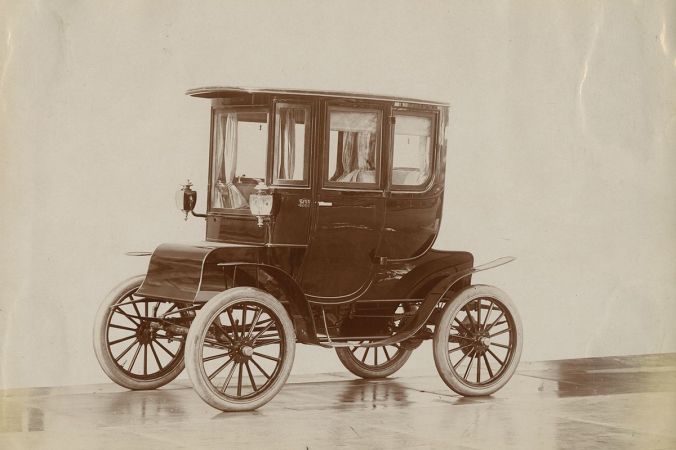
Electric cars had been the brain child of inventors in the 1830s. By 1900, New York City had a fleet of electric taxis. The electric car designed by an American, Oliver Fritchie, could travel 100 miles between charges but it could not compete with the Model T Ford on price or range. The rest, as they say, is history, because in those times governments were oblivious to the consequential problem they were leaving their ancestors – us.
1970’s Electric Car – with only a 40 mile range and apparently you had to stand on the roof.

Today governments spend considerable time and resources in a phoney ‘war’ against terrorism. ‘Phoney’ because conventional troops cannot overcome guerilla tactics – as was proved to be the case in Northern Ireland.
The massive expenditure of public money on this ‘war’ is justified because terrorism grabs the imagination and emotions of voters – by it’s very nature as a font of repeated horrors.
You might be forgiven for wondering which is the greater issue – millions of citizens (especially the young) dying of lung related diseases caused by internal combustion engines or citizens dying in terrorist related incidents?
When that question is considered statistically – resources should be allocated to each problem in proportion to amount of human misery and suffering it generates. They should not be allocated on the basis of which problem gets most votes and the most media coverage.
Regrettably terrorist acts will generally sell more newspapers than children dying silently in hospitals of lung diseases or adults with heart problems.
Newspapers inflict the final blow of horror and despair on behalf of the terrorists into the hearts and minds of victimised populations. Margaret Thatcher knew this and ordered a policy of non-reporting of terror related stories in Northern Ireland.
To his credit, the Mayor of London, Sadiq Khan, has identified the toxic air of his city as a very real and serious contemporary problem. He has made small steps to reduce it – such as charging motorists of the most polluting vehicles to enter the centre of London. The European guidelines on air pollution were exceeded within the first two months in 2018 in London. Is this another reason for the UK to leave Europe? No more awkward tests of the atmosphere in our cities?
When the United Kingdom first became a member of the European Union one of the directives from the European Parliament was for the UK to clean up it’s bathing beaches.
This was duly ignored for the first year. Why should the UK not continue to send it’s children to play on filthy polluted beaches? But the following year the EU reminded the UK of it’s obligation in law. The UK reluctantly (one expects) began to clean up it’s inshore waters; beaches are now awarded Blue Flags for water quality and facilities.
Now in 2019 the River Thames in London has been transformed from a toxic environment in which nothing could live, into a clean river with fish and mammals such as seals – on view from the Houses of Parliament.
So why now should clean air be such an difficult objective for successive governments?
If the problem is short term planning on account of the four year term of office for elected representatives in parliament – then perhaps politicians need to start to deal with the complexity of uniting long term and short term objectives.
The current air pollution problems in the UK are not local – just look at Mombai and Beijing. There has to be consideration – however complex- on how to integrate solutions within complementary European and global strategies and policies.
Clean air has to be one of the most fundamental of human rights. If we cannot wish it on ourselves, how is it likely to ever happen for our long suffering environment?
 Matters Blog