The Good Life

There is a remarkable pair of photographs on the BBC website today. They show satellite images of eastern China, Hong Kong and Japan. The images are filtered to show the intensity of air pollution. The January 2020 image shows ‘business as usual’ and the principal cities and urban conurbations are highly coloured from yellow to high risk, red. The February 2020 image shows no coloured areas at all! The air is clean because production in the factories has stopped. Ironic that such a gift to the populations, of sunshine and clean air occurs when millions are in quarantine.

The message we can draw is not how contagious viruses are – we know that. No, the message so plain to see is ‘slow down and stop!’

slow-down poster

The industrial tenets of, ‘more and faster’ for profit and a promise of prosperity for all, are also familiar to us. Humans deserve a good life so the growth of benefits from industrialisation, cannot be denied. Over one hundred and fifty years ago people started to leave the land and live in cities. This process means that now about half the populations of most countries live in cities.

In response industrial production is speeding up, as robots and AI are literally taking over from humans. The only question is; at what point is ‘a good life’ reached?

A casual observer in a modern metropolis, might perceive a collective sadness in the faces of passers by – anxious to reach their individual destinations. If asked if their life is a ‘good life’ – I wonder how they would reply?

picture credit: WithPause.com

Snail credit With Pause

When I was a student in London in the mid-70’s, I took part in a ‘slow walk’. A collection of willing volunteers met at the north end of Hammersmith Bridge and lined up across the wide pavement. We set of in a bunch like marathon runners, only it took us three or four hours to reach the south side of the bridge – a distance of maybe three hundred metres.

Slow walking took discipline at first, but soon became strangely normal. My mind felt completely relaxed. I might as well have been in meditation – in fact, I was.

picture credit: Londr.com

hare and tortoise credit Londnr

That was part of my ‘good life’ when I had time to be fast or slow and chose the latter. There are in the present day, many experiences of ‘slow living’ available as an alternative to the human ‘race’. There is slow food, slow travel, slow cities, slow schools, slow books, slow living and slow money. See www.slowmovement.com and tell your friends!

In 2020 humanity is crossing the threshold where too much – too fast – too wrong – is damaging the planet and as a consequence, ourselves. Whether it is air pollution, sea level rising, food shortages, water shortages – industrialisation is ‘biting back’ the hands that turn the handle.

Sloww-Slow-Living-Synonyms-Infographic

This latest virus Covid 19, is amongst other things, a firm message for humans to ‘slow down and stop!’ Perhaps those confined to a room for two weeks, will draw a positive from the experience. ‘Not doing’ can alter expectations significantly. If ones normal expectations are unrealistic then the distress that comes from failure to satisfy those expectations, will never be encountered. Success or shall we say, contentment, comes from watching a spider cross a floor or a raindrop slide down the window; experiences usually never observed and enjoyed.

We will inevitably all discover that less and slower is more!

Somewhere between the extremes of fast and slow, is where humans can find the ‘good life’ they seek. How close to ‘slow’ do you dare to go?

Fifty Shades of Green

Since 1990 the world has produced as much carbon dioxide in the atmosphere as in all the previous years. The world has a problem from the unrestrained burning of fossil fuels for average temperatures are rising despite the environmental strategies of government and international agreements.

If you replaced one power station burning fossil fuels everyday until 2100 with 1500 wind turbines you might stop the problem. As this is unlikely to happen, the extinction of current civilisation has begun. New ways of removing carbon from the atmosphere is the only technology that will reverse this process. Technology at present has no such solution.

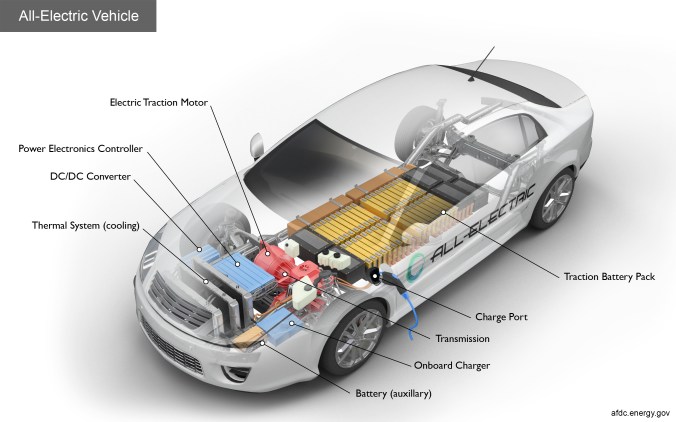
Why are is technology failing us? Consider the partial solution of transport powered by electricity.

electric car workings

I have to expose the myth that electric vehicles are good for the environment.

This may come as a shock to those who have invested in a hybrid car so reach for a box of tissues as it gets worse.

Perhaps I am being a little harsh on what is a welcome prospect for the future of personal transport but it has to be said. I do not anticipate that the luxury of personal transport is going to go away in the future what ever form it will take. Certainly populations in countries like China, India and Africa feel resentment when those countries who have created the problem require them to forgo the benefits of owning a car.

Efforts to eulogise public transport as the future are futile because people know how good it is to control their own transport. This is not to say that public transport has no place in the future. On the contrary, it should be spearheading the technology that drives vehicles without causing air pollution and greenhouse gases. Sadly in most modern cities it is not. Taxis, buses and trains are still burning fossil fuel in all but the most innovative urban centres.

Decades ago, buses in Amsterdam were running on compressed gas. Cylinders like divers use were positioned under the floor of the bus and charged with compressed air overnight. During the day, the engine turned over using the kinetic energy from the compressed air. The discharge from the exhaust was of course pure air. What happened to this idea, I do not know, but it shows how many technological advances have been left in the urban gutter.

Part of the drive to promote electric vehicles, has been the demonisation of cars using the infernal combustion engine. Whilst these engines are clearly a remnant of the past, they exist and continue to be mass produced. The transition to the new technologies needs to be managed. Most government strategies however, are well intentioned but ineffective.

For instance, in Spain the police write to the owners of cars which are ten years old or above and suggest they get a petrol engine car. Whilst we must admire the green agenda of the government the manner in which it is being promoted is clearly misguided. Firstly, any such agenda should be European wide and not just promoted by one country. The desired outcome should be measured and confirmed as achieving what is intended. Ending the life of any vehicle after just ten years is wasteful because one third of the energy used by a vehicle in its’ lifetime is used in the manufacturing process. So whatever the motive power, cars should be designed to be in use for several decades, if they are to be considered as green.

The impasse that scientists have met when designing batteries for cars is yet another inhibitor to any mass take up of electric motive power. I own an electric bicycle and after four years I had to buy a new battery at about one quarter of the cost of the original bicycle and battery. Present day lithium ion batteries require rare earth elements that will only become more expensive to obtain in the future. Their mining and processing in African states is not environmentally managed. Some electric cars are sold without the batteries as they are provided with the car under a leasehold arrangement. The cost of the battery for my bicycle per mile is about the same as if I had a motor bike and had been buying petrol. I expect electric cars which are touted as being run for a few pence per mile are actually more expensive to run than vehicles running on fossil fuels. Batteries do not last as long as the Duracell bunny would have you believe.

It’s the same lie that is used to promote nuclear power stations as providers of cheap electricity. It is cheap if you discount the astronomical cost of building and decommissioning the power stations, costs which normally governments pay presumably in order to promote the industry and hidden agendas of manufacturing weapon grade uranium. The political games between Iran and North Korea and the USA are a current example of these smoke and mirror politics in which no citizen is the winner.

Faith in the ‘electric car’ as the future of personal transport is misguided for this reason. A car that needs a battery is still being run on fossil fuel, just one step removed. I refer to oil, gas and coal fired power stations that produce the majority of the electricity in most European countries. A car which is plugged into a national grid, is merely acquiring energy made from burning fossil fuels.

If a householder has a contract with an electricity supplier claiming to provide electricity from renewable sources only, then that would be the ideal. But as things stand, local and national governments are in the process of providing charging points right across their respective countries. They fail to see the lesson from the beginning of the twentieth century where electric cars could not compete with the new internal combustion engine when it came to range of travel. It was then and is still, a problem.

As I write this the battery for my bicycle is being charged from the photo voltaic panels attached to my house. Not only dirty electricity but the whole idea of ‘national grids’ is wasteful and expensive. In the future, electricity will be generated locally and stored in ‘gravity batteries’ and similar solutions.

Hybrid electric vehicles are still causing pollution and therefore not a solution for the zero carbon future. Totally electric vehicles being recharged from recharge points in towns is impractical and the hunt for even a parking space is proof of that. Charging by induction when stationary for long periods is possible but waiting times need to be considerable as the process is slow. Roads, car parks and even railway tracks with photo voltaic cells as the road structure and surface will produce electricity locally even when the sun is not shining but charging batteries from these sources is just impractical as already stated.

There is and has been for decades, a better alternative to battery driven vehicles. The hybrid cars being manufactured and subsidised by governments today require a grid of charging points. Should the very large cost of these be paid or subsidised by governments? Who ethically should pay? Those rich enough to be able to afford current electric cars or tax payers who are going to get little or no return.

The question is similar to the quandary faced by consumers in the 1980’s when Video Recorders were appearing in the shops. Which is better, VHS or Betamax? Although the latter was a better quality product, VHS won.

So to all those early adopters looking at battery driven vehicles, I suggest they hold on for the next generation of hydrogen fuel cell powered cars. The energy from these hydrogen is green and relatively very cheap. Used in conjunction with the high torque electric motors like those developed by Tesla and motor racing engineers, these vehicles will provide every comfort and convenience currently enjoyed by the generation who were brought up with fossil fuels.

electric car hydrogen-fuel cell

As has happened many times before with new technology the wrong decisions (for the nation and environment) are made by governments to promote agendas popular with voters instead of just letting the best patent win. So my advice is keep your present car on the road for as long as you can. In five to ten years, new technology will be available at a reasonable price. There will be cars designed to last a whole life with little maintenance. Just don’t expect to be allowed to drive it.

That pleasure will be a thing of the past as well!

Space Wars

Butch Cassidy and the Sundance Kid is an enduring story of two bank robbers in the Wild West. In the film of the same name they are played by the good looking duo of Paul Newman and Robert Redford. They swagger through the film to a jolly accompaniment by Burt Bacharach (including Rain Drops Keep Falling on my Head) from one fruitful explosion to another. Inevitably the Federal authorities catch up with them and they manage to escape over the border into Mexico by the length of a horses tail. In Mexico they make a resolution never to rob a bank again, such has been the horror of their last experience. They realise they now have a clean slate to start their lives again. What happens next has always fascinated me. They start robbing banks in Mexico. A few bank robberies later, they die in a hail of Mexican army bullets.
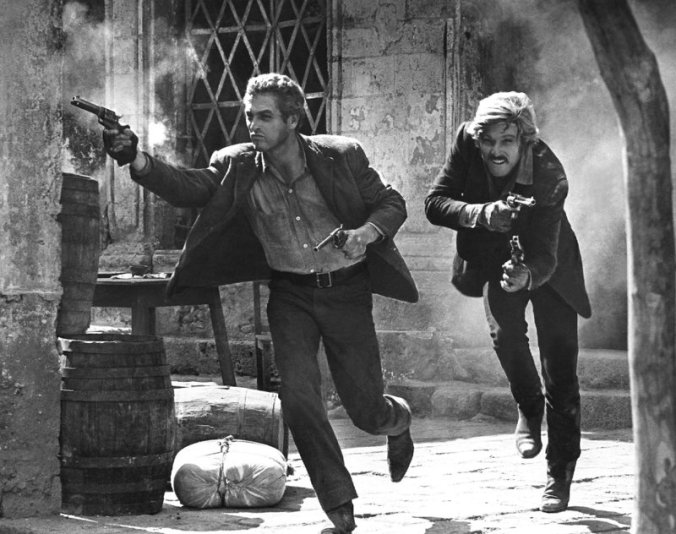
butch_cassidy_and_the_sundance_kid1

The moral of this story in my view, explains a lot about the worst side of human nature. Remember that these are bad men even though they are played by a couple of smoothies. Humans find it very difficult to change their inner motivations, methods and objectives.

At present humans are plundering planet earth of her wealth. They have been doing it for a long time but now the scale and speed of the robbery is unprecedented. The villains have a plan;

‘Let’s start robbing again in space’.

China, Russia, the USA, Europe, even India have space programmes.

Why does India have a space programme when many of it’s rural villages don’t even have one flushing toilet and a sewer? The answer is complicated of course but one reason has to be the promise of new sources of raw materials; what in Klondike in the Wild West was nicknamed the ‘gold rush’. True to human greed for natural resources, these countries and others are not unaware of the promise of minerals ripe for harvesting from other planets and moons.

Without a World Government with an enforcement arm, it is hard to see how this rush into space and the allocation of unclaimed resources, will not turn into a laser gun fight.

On the 1st July 2019 the United States of America declared a new arm in it’s Defence Services; the Space Development Agency. Will the USA move itself into the role of World Government Peace Enforcement in space – like it has tried to enforce the non-proliferation of weapons of mass destruction on Earth? Will the USA being armed in space be accepted by those being told they cannot do the same? Bear in mind the present difference of opinions between the USA and North Korea and Iran.

The USA may or has assumed a role of Sheriff or ‘protector’ of the valuable scientific, communications and defence satellites already in orbit around the earth. This role is enhanced by the prospect of the new 5G satellites being privately launched – over 2000 in number – to provide fast internet to rural communities around the globe. Who asked for 5G is a subject for another blog. In democracies, no one votes for what private enterprise decides needs doing for profit. Arms manufacturers usually lobby for war.

It just happens because science and technology get the smell of cordite and can’t stop themselves blowing a few banks, and a few more and a few more. Ethics committees don’t carry.

The hugely wealthy entrepreneurs, Elon Musk (BFR) and Jeff Bezos (Blue Origin) both have their own visions for space exploration and travel. Will they be taking pot shots at each other across the craters on the moon or work together?

The space exploration of the 1960’s was famously driven by bitter competition between the Soviet Union and the USA. The latter likes to think it won the race but in the end what came out of those missions was a desire to monitor the earth from space, not keep going to the moon. This mutual desire and pooling of resources and know-how, evolved into a co-operative project which is the International Space Station.

Not surprisingly today, Russian and China want to co-operate in space and ban space weapons and they both signed a treaty in 2008 on the Prevention of the Placement of Weapons in Outer Space.

On 21st October 2017, the first committee of the United Nations discussed the non-placement of weapons in space. 122 countries voted in favour of such a ban and five against, which included Georgia, Israel, the USA, Ukraine and France. 48 countries abstained, including the European Union.

The reasons for co-operation disarmament in space are obvious so let us consider reasons for having weapons in space.

There may be attempts by rogue states or state sponsored dissident groups, to interrupt or destroy or threaten to do this to civilian or military satellites.

positions of satellites at time of publishing were correct but may have moved now
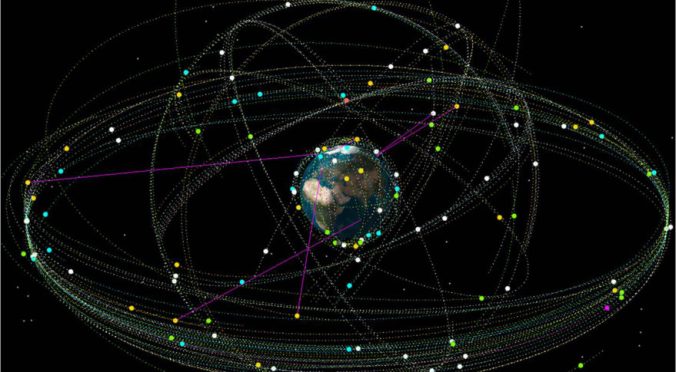
satellites

The problem with this argument is that a rogue state, or state sponsored dissident group, is being lawful in it’s actions in one view and unlawful in another. Robin Hood was by some definitions, a terrorist. Black and white hats are for cowboy films. The hats in space wars are multi-coloured and nuanced.

For instance, a GPS satellite is used for civil purposes and military. So is the mobile phone network and satellites and direct satellite communications used in those areas where there is no mobile telephone network.

You can describe the action as good or bad depending on which facts you select to present. The criticism is that the ‘threat’ that the threat on which the military base their plans and actions, can be exaggerated for funding approval reasons and, or just plain politics. A government likely to declare war on false intelligence on earth is just as likely to do the same in space. Different place, same gunmen.

There is also a non-military threat; namely asteroids. These are objects that enter the earth’s solar system from outer space and may be on a collision course with earth. The possibility is that a weapon of some kind may be able to alter the course of the asteroid. Comparing the then with now, money would be better spent on protecting the earth from humans rather than asteroids in my view, that threat being more immediate.

The last Hollywood blockbuster myth is one that has appeared on cinema screens since movies were invented – alien invasion. I call this a myth since my belief is that any civilisation that has found and is watching us for malign reasons would have acted by now. Because they have not I conclude that they are benign and waiting for humans to become spiritually aware enough to stop wanting to destroy the planet and each other.

Little Blue Men (and perhaps some ladies)

kind aliens

This is Butch and Sundance story yet again. The question for governments and billionaire entrepreneurs in search resources and a life boat for planet earth is;

Should we spend our time and money on fighting each other in space, or on protecting the earth and building a sustainable future?

I know what my answer would be because I have seen the statistics about life on Mars and in my view, it’s a hell not worth visiting.

I hope and expect we will forget Mars as an objective in the next decade, as future space based telescopes spy out so called, exo-planets. Astronomers now believe it likely that most stars have a system of orbiting planets based on observations of light from those stars. The new generation of telescopes will find new exo-moons. With so many new places to visit that are in the ‘Goldilocks‘ range of environmental factors similar to earth, man in the future will be spoilt for choice for places to colonise.

Those who choose to live in such places will have one important choice above all others. Shall we take guns to these places? My advice,based on Butch and The Sundance, is don’t.
Green Gold

Once upon a time there was a human baby. It grew and became strong and healthy. Then, after about sixteen years, an extraordinary thing happened to the body. A great cloud of poisonous smoke filled the lungs. Toxins began to flow around the body and various organs responded with panic. Unfortunately, there was also an amount of ‘satisfaction’ associated with this smoke. The organs argued with the brain telling it to stop allowing breathing smoke.

The body continued to breath smoke and rumours spread that the lungs were turning black at the edges and in a few years they would become diseased and not function at all.

The organs decided to challenge the lungs and were astounded by the reply. The lungs said that the rumours were all ‘lies’ and that they should mind their own business. The organs could see that the health of the whole body was there business, but the toxin had spread and the name of the toxin was ‘stupidity’.

Picture copyright credit: Ranger Rick

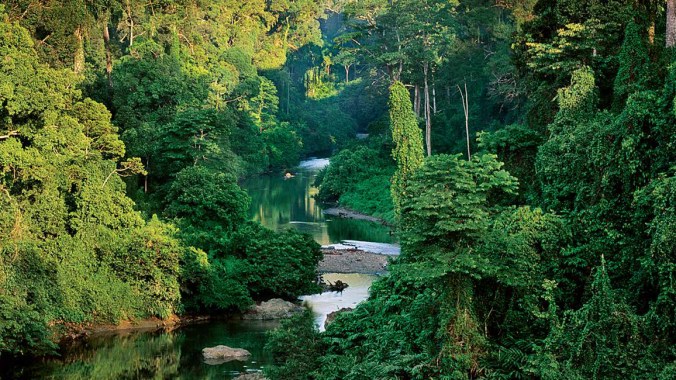
Dec-2015-Rainforest

Today, in August 2019 the ‘lungs of the world’, being the Amazon rain forest, are on fire. The country with the largest number of fires is Brazil. There are over 25,000 according to the BBC News website, which has little reason to misreport the problem and used the National Institute for Space Research as their source. The President of Brazil, Mr. Jair Bolsonaro, has responded with a volley of denials and obfuscation, of the type that we hear so often from right wing leaders today. But he, does have an interest in denying the size of the problem and that no other countries have a right to be concerned. He sees the forest as a resource for mining and logging and agriculture, which from a purely economic development point of view, it is. The problem for the ‘rest of the world’ is that the blinkered thinking that accompanies ‘national interests’ is in the wrong century. In a world where sharing global opportunities and problem solving is becoming ‘normal’, the attitudes from the nineteenth industrialist capitalist governments and entrepreneurs, prevails in Brazil. Interestingly Mr Bolsonaro accused the President of France Mr Macron, of being just such a ‘colonialist’ while the reverse if true. Mr Bolsonaro is ripping the heart out of his own country in just the way the colonialists used to do in their greed for natural resources.

The Amazon rain forest contains many layers of richness. Not least are the million or so indigenous people who’s very lives depend of the forest. When I was in school we were taught that the forest people practised a technique of farming known as ‘slash and burn’. Tiny pockets of forest would be cleared and crops planted for one or two seasons before the thin soil could produce no more. Then the people moved on and the forest and it’s animals were able to re establish the ecosystem.

What is happening now is the early stages of desertification.

picture copyright credit: straitstimes.com

rain forest desert

The world cannot allow it’s lungs to die. Although much well intentioned re-afforestation has taken place in the northern hemisphere, the small scale and the type of trees planted means that the effect on the rise of carbon dioxide in the atmosphere is not enough. The Amazon rain forest is the only place where the carbon dioxide can be absorbed on the scale needed to prevent a rampant rise in the average temperature of the planet.

So what is the solution? Clearly the rain forest has to be saved for current and future generations. The Brazilian government are only responding to the promise of economic prosperity for their country and citizens. They might be persuaded to change their short term destructive policies if they made more money by not destroying the forest.

I suggest then that it is sold, square metre by square metre to the rest of the world. Who would buy it? Well not governments but ordinary people. I believe that people would willingly purchase a few square metres as they can at present buy micro land on Scottish estates to gain the legal title of ‘Lord’.

The area of the rain forest in Brazil is 477 698 000 hectares (source: brazil.org.za). One hectare equals 1000 square metres, so if you sold one hectare to 1000 buyers at 100 US dollars each, you make 100,000 dollars per hectare. This is 47,769,800,000,000 US dollars! Even if only ten per cent of the rain forest is sold in this way, that is 4,776,980,000,000 US dollars. I expect that is more than miners, loggers and farmers are going to pay in tax to the government in a thousand years!

The process to purchase your piece of rain forest could be standardised and completed as any legal process of acquiring land title; either as an owner or tenant. The only extra clause / covenant purchasers would be required to agree to is that they will permit the land to remain pristine or allowed to ‘re-wild’ as much as that is possible. Each individual would be limited in the number of square metres they could buy to prevent devious exploitation. The price of the land might be double or even triple what a logging company or beef farmer is going to gain in the few years the land would be productive. Any tenancies could be renewed every ten years or so, if not sold freehold and the Brazilian government will be able to spend the money on the prosperity of it’s citizens as it wishes.

Picture copyright credit: Rainforest Foundation

rainforest mining

Attempts to ‘mine’ or exploit the forest on a large scale would be a legal nightmare on account of the number of owners or tenants whose location and consensus would be difficult to obtain!

In this way however, the business of Brazil would become the business of the rest of the world. By keeping the rain forest from becoming a desert, Brazil maintains it’s indigenous population, fauna and flora and become a gate keeper on the world’s increasing need to store carbon dioxide. It is likely in the future that these will become of greater economic value to Brazil than the nineteenth century approach of logging, mining and ranching. Perhaps shares could be bought in each tree for the carbon it absorbs to enable ‘carbon neutral’ deals to be made with polluters like air lines and industry.

Brazil has a unique and irreplaceable resource to benefit all it’s people, indigenous and settlers. There is a fable about a goose and a golden egg, that President Bolsonaro would be wise to inform his economic advisers to integrate into national policy before the land is worthless to anybody for anything. 

Lunar Madness – Apollo ll

On the fiftieth anniversary (20th July 1969) of the first lunar mission and landing on the moon – I dedicate this blog to all explorers.

Has it ever occurred to anyone that the name given to the American space programme to reach the moon, was a bit odd? Apollo is the Greek and Roman god associated with the sun – not the moon. Was it used because the mission to send men to the moon was totally male dominated? The mission objective clearly stated, in the words of President John F Kennedy :

I believe that this nation should commit itself to achieving the goal before this decade is out, of landing a man on the moon and returning him safely to the Earth.

Indeed, there were no female astronauts at that time, apparently on account that they were considered not to have the physical strength and willingness to take risks that men do. Ironically, today female astronauts are known to be physically more suited to space travel and averse to risk taking for the benefit of the entire crew.

The First Astronaut – Apollo (about to launch a thunder bolt)

Apollo_of_the_Belvedere

It is also curious that earth’s Moon is not the only moon in the solar system. All the other moon’s are given the names of gods (except for Uranus which has moon named after characters from Shakespeare plays). The word moon is strangely containing two adjacent spheres! But more importantly Moon or Menses has proto-Indo-European linguistic roots and is older than Lunar which is Latin. Moon is closer to menses and month relating to the female cycle.

It being 1969, the male symbolism prevailed. Apollo had a bow and arrow and was the god of archery – if that is sufficient imagery for a the masculine principle seeking and penetrating the feminine circular target.

A British rocket of the 1960’s for launching satellites was named the Black Arrow. An even more curious historical eponymy is that Stevenson’s 1829 railway engine was also named The Rocket. A symbol Sigmund Freud could also have written a chapter about.

Whatever the reason’s for naming the Apollo mission, the shallowness of the venture is evidenced by the fact that fifty years on no nation has repeated it. The reason is clear. There was no material benefit in going to moon – effectively a desert. Instead in the 1960’s there was a ‘cold war’ between the Soviet Union and the United States of America. The Soviets were ahead of the Americans with the launching of the first unmanned and then a manned earth satellite. The ‘land of the free’ was out to prove its technical, economic and political superiority and they did.

The Scientist’s at the time preferred space missions to be unmanned and crammed full of scientific experiments. Robotics and remote communication meant that manned missions were scientifically speaking – a waste of payload.

But the politicians wanted pictures and pictures / film had to contain an all American explorer laying claim the moon by planting the stars and stripes flag.

As an aside, there is a conspiracy theory that the entire Apollo 11 mission was faked. This was achieved by using a Hollywood film studio to recreate a believable lunar landscape on which actors could land and leap about. Personally I expect there was a ‘back up plan’ to the real lunar landing – given that the mission was highly risky. If the American astronauts crash landed then the political fallout would be as damaging as a successful mission, rewarding. So it is highly likely, in my view, that there was a plan to fake the landing if necessary in the National interest. It is these films and images that are referred to by the conspirers as evidence of a fake landing.

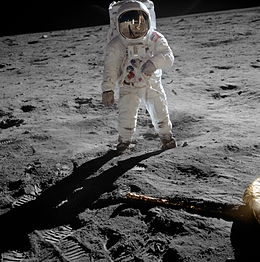
As it turned out, the final descent in the lunar Lander was almost a disaster. There was only another three seconds of fuel in the tank for Buzz Aldrin to land ‘The Eagle’ lunar module.

Buzz Buzz Buzz Busy Busy Busy B

260px-Aldrin_Apollo_11_original

But why did these men risk their lives so publicly and for so little scientific benefit? Clearly as patriots and explorers from a gene pool of risk taking ‘settlers’ – the chosen crew were dedicated to their mission. These were not humans landing on the moon, this was America – The Eagle.

Another great irony was the ‘elephant in the moon’, which was that the destination could hardly be more adverse to human survival. It was known that the Moon was a ball of dust and rock with extreme temperatures and no means to sustain human life. It was and is, more deadly than ‘Death Valley’ in California.

Hardly surprising then that the picture from Apollo missions that brought most gasps from the crew and earth dwellers alike, was the view of the blue planet itself. Seen for the first time from a considerable distance the earth looked both majestic and fragile. A lonely jewel in a forbidding black landscape.

We know today from subsequent unmanned missions to the planets, that the earth remains the only place on which human life can exist without technological reliance. If the reason behind the moon mission was partly to find a suitable ‘life boat’ to use to escape a dying earth – then what we know now gives little hope for the perpetuity of mankind.

Only one of the moons of Uranus will be a suitable place to land when our sun expands and swallows earth in a few billion years time.

For now only Mars appears sufficiently similar to Earth to sustain colonies – but a fragile existence this would be with the need to grow food on a large scale to sustain just a few ‘settlers’. It will be a long while before there is a Mars Mc Donalds and they probably won’t sell burgers.

There is another lesson to learn from history and that is ‘possession’. Traditional declaration of ownership on behalf of a nation by explorers such as Captain James Cook, was the raising of a national flag. No teams of lawyers were necessary historically to defend the rights any indigenous people, who were usually shot if they caused dissent.

Even if no Martians line up to defend Mars from future settlers, there will need to be teams of international and interplanetary lawyers to deem who owns what. Treasures such as mine-able water ice will be precious enough for significant sums of what ever is used for money in the future. If Earthlings continue their war-like ways on other planets, as they do on their precious earth, then there will be a giant step backward for mankind, instead of one forward – a type of lunar madness from whose bourne no man returns.

M – OO – N

Ap – O -11 – O

Every Breath You Take

For about eight years now I have been driving a 2.2 litre diesel estate Toyota. The ‘Top Gear’ television presenters drove a selection of similar cars across Europe to see which went the furthest. Jeremy Clarkson found that his diesel Jag used so little fuel that he ran the air-con and anything else he could to use more fuel. Large cars have space for large fuel tanks, so their range can be phenomenal. Mine will drive from southern Spain to the north coast of Spain without stopping – a journey of 1000km.

Last week I hired an ultra small Toyota Aygo car in the UK; a nice little automatic with a petrol engine. When I came to fill up the tank I was disappointed to find that it had travelled about 45mpg whereas my trustee diesel gives me over 55 mpg.

So why are diesel cars getting such a bad press at the moment? Diesel engines were preferred in 1997 by the European Union as a response to the Tokyo Climate Change Protocol. These engines produce on average 120g of CO2 per km whilst petrol engines reach 200g of CO2 per km. This is because diesel engines cold burn and so use less fuel. These figures do not include the energy used to make and dispose of the vehicle most of which will come from fossil fuels. It makes sense to make cars that last several decades in order to stretch out the environmental impact of production and disposal.

But the problems with just the emissions from internal combustion engines, has been re-defined. Whilst CO2 emissions must continue to be reduced, it has been recognised that the toxic gases and particulates from engines are causing a serious health risk – especially for children.

So when you examine these two types of engines, the toxic gas produced by older diesel cars is Nitrogen Oxide, in various compounds. Petrol cars can reduce this with a catalytic converter whilst diesel cars require particulate filters that are regularly maintained. If they are maintained then the NO gases gases from diesel cars can be reduced by 90%.

Governments have been victims of their own ‘political’ thinking; putting problems into compartments rather than viewing the whole issue and how each aspect of it interconnects.

Complexity challenges even those minds with an expensive private education (i.e. politicians). The lazy solution is to reduce the problem to something people can understand – especially voters.

The bottom line is that neither petrol nor diesel engines should be in use in the 21st century. There should already be ‘electric only’ zones in all urban centres with buses and taxis leading the way.

Cars do not need to be scrapped on account of their motive power source becoming a problem. New zero carbon, zero particulate engines can be retro-fitted – even into fondly maintained ‘classic’ cars. Friends of the Earth believe we need to achieve this in less than a decade, whilst the UK government thinks 2050 acceptable.

When I was a student in London in the 1970’s, I hung a sign under my bicycle saddle with the words;

No Noise, No Fumes’

I didn’t buy a car until I was 30. Was I ahead of my time? No.

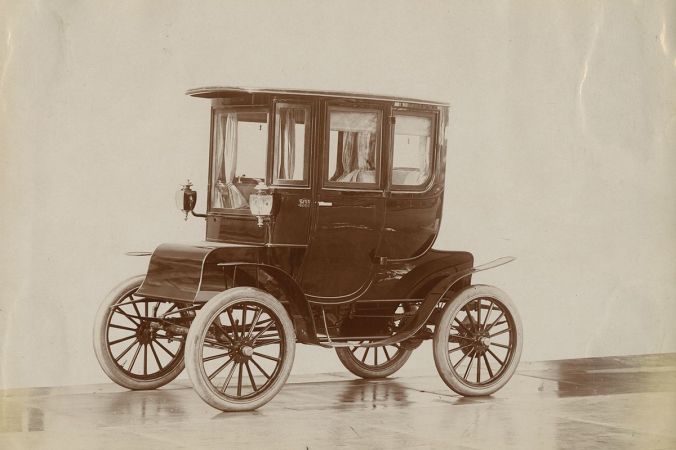
Fritchie Early Electric Car

Electric cars had been the brain child of inventors in the 1830s. By 1900, New York City had a fleet of electric taxis. The electric car designed by an American, Oliver Fritchie, could travel 100 miles between charges but it could not compete with the Model T Ford on price or range. The rest, as they say, is history, because in those times governments were oblivious to the consequential problem they were leaving their ancestors – us.

1970’s Electric Car – with only a 40 mile range and apparently you had to stand on the roof.

1974 Electric Car

Today governments spend considerable time and resources in a phoney ‘war’ against terrorism. ‘Phoney’ because conventional troops cannot overcome guerilla tactics – as was proved to be the case in Northern Ireland.

The massive expenditure of public money on this ‘war’ is justified because terrorism grabs the imagination and emotions of voters – by it’s very nature as a font of repeated horrors.

You might be forgiven for wondering which is the greater issue – millions of citizens  (especially the young) dying of lung related diseases caused by internal combustion engines or citizens dying in terrorist related incidents?

When that question is considered statistically – resources should be allocated to each problem in proportion to amount of human misery and suffering it generates. They should not be allocated on the basis of which problem gets most votes and the most media coverage.

Regrettably terrorist acts will generally sell more newspapers than children dying silently in hospitals of lung diseases or adults with heart problems.

Newspapers  inflict the final blow of horror and despair on behalf of the terrorists into the hearts and minds of  victimised populations. Margaret Thatcher knew this and ordered a policy of non-reporting of terror related stories in Northern Ireland.

To his credit, the Mayor of London, Sadiq Khan, has identified the toxic air of his city as a very real and serious contemporary problem. He has made small steps to reduce it – such as charging motorists of the most polluting vehicles to enter the centre of London. The European guidelines on air pollution were exceeded within the first two months in 2018 in London. Is this another reason for the UK to leave Europe? No more awkward tests of the atmosphere in our cities?

When the United Kingdom first became a member of the European Union one of the directives from the European Parliament was for the UK to clean up it’s bathing beaches.

This was duly ignored for the first year. Why should the UK not continue to send it’s children to play on filthy polluted beaches? But the following year the EU reminded the UK of it’s obligation in law. The UK reluctantly (one expects) began to clean up it’s inshore waters; beaches are now awarded Blue Flags for water quality and facilities.

Now in 2019 the River Thames in London has been transformed from a toxic environment in which nothing could live, into a clean river with fish and mammals such as seals – on view from the Houses of Parliament.

So why now should clean air be such an difficult objective for successive governments?

If the problem is short term planning on account of the four year term of office for elected representatives in parliament – then perhaps politicians need to start to deal with the complexity of uniting long term and short term objectives.

The current air pollution problems in the UK are not local – just look at Mombai and Beijing. There has to be consideration – however complex- on how to integrate solutions within complementary European and global strategies and policies.

Clean air has to be one of the most fundamental of human rights. If we cannot wish it on ourselves, how is it likely to ever happen for our long suffering environment?

Stable Weather Initiative and Study SWIS

earth12-copy

I have found a rare thing; a blank piece of paper. Since it is no longer produced, on account of the death of trees, writing surfaces are reserved for significant statements. Here is mine.

Even in the twentieth century the authorities knew that the earth’s weather systems were becoming erratic to unstable. I studied climate science in the University of Boston at the end of that century and applied what I had learnt to analysis and interpretation. The United States of America (as it was then known – before global disintegration ) used information gathered from sources hidden deep in the oceans to the outer limits of the atmosphere. This was my ‘bread and butter’ as the saying goes before bread was a luxury of the past.

My best analogy to what ultimately occurred, reducing the earth’s population to the estimated 10,000 currently, is that climate is like an avalanche. There is an imperceptible slow build up of stress within a system over a period of time. It cannot be measured but the signs that it is likely are well known. When the cataclysm occurs and tons of snow and ice hurtles down a mountain taking everything in it’s path – then the survivors look back knowing that what happened was expected.

climate-change-figure-1-1

The earth’s climates behaved in precisely the same way. When newspapers talked of ‘climate change’ at the beginning of this century, it was a simplification of the facts. The earth has multiple climates and micro-climates which interface with the local events known as ‘weather’. Even the super computers of the day, ( which we used to carry on our wrists before this happened ) even these computers could not track climate interrelationships, growth and transition with sufficient detail and fluidity. The dynamics of this flux was to be the deciding factor in our government’s miscalculation.

Perhaps the politicians listened more to voters than to those paid to research the subject. No, for sure they did! The popular imagination saw ‘climate change’ as reversible. Stop doing this and you get back to normal. But as with an avalanche in the making, or a glacial crack – the damage was already done.

The radiation from the sun – so called ‘space weather’ – was a particular interest of mine and I admit I should have been the first to issue warnings to the administration. Solar mass ejections were known and monitored but their exact influence on the earth’s atmosphere was guess work at best. When the first of the ten cataclysmic ejections came, we lost not only our ability to monitor but some of our best scientists – along with a portion of the global population. Computers were down, transport stopped, power supplies – in fact anything that needed electricity to function was kerput.

We had weeks of electrical storms. The HARPA grid was one of the earliest to go…one of the few ‘climate influencers’ that was operating at that time. But no amount of intervention on the scale needed was possible. Storms created floods, and floods washed away mountains and cities, quite literally. Tectonic plates moved and water came up from inside the earth to raise sea levels in addition to the melting glaciers and snow fields.

We kind of knew this would happen, but we also knew not to talk too much about it because it was well, just too frightening. Just as skiers will happily spend a day on a mountain after rain the previous night and knowing avalanches could occur.

I was in the Stable Weather Initiative and Study, but it was a bucket put out to catch an ocean. Perhaps the things we did made things worse?

I am coming to the end of both sides of this paper now. So I have to record that the days are still dark. From my view out of the cave on our island there are sometimes views of the sun above. We are hoping for light to re-enter our world before we have grown too weak. If I had any advice for the people of the past and the ‘good times’ they enjoyed, it is to carry on carrying on. For weather, climates and space weather proved just too multi-complex for us to know about. We didn’t evolve in the direction of ‘earth management’ fast enough to counter the forces heading to destroy us. We were a parasite destroying the host but ultimately the host is destroying us.

We are clinging on here living each day on found food and storytelling. Record these days in your books if you find this message. We were the generation ‘damned for all time’ because we allocated our resources to the easy life we had built for ourselves, rather than the planet.

The Cash Back of Notre Dame

Fortunately there were no casualties or deaths, following the fire that ripped through the roof of Notre Dame cathedral last week. People held their breath as they watched the ancient temple’s walls and windows silhouetted against towering flames.

When the last embers died, Parisians were stunned. It cannot be put into words what buildings sometimes represent to nations, and that certainly applies to this one. And yet, what has happened here?

An old building, medieval in places, has lost it’s roof and some of it’s treasures. Were we expecting Notre Dame to last for ever? If not, is a catastrophe like this not statistically likely? Nothing lasts for ever, unless you build like the Ancient Egyptians built their pyramids. So with that in mind, thanks can be given for what remains and the task of reconstruction ahead. In my view, there has been a kind of cleansing. Fire purifies, in the alchemical sense. It removes the dross and leaves the precious.

I heard on the news that architects will be invited to present a way to do this. Personally, as an architect, I would reconstruct the profile of the collapsed tower in structural glass. Light would pour into the building in a way that was never intended. Gothic has a taste for the shadows and dark spaces penetrated by beams of mysterious light from beyond. So I would use a layer of intelligent ‘glass’ that is able to form coloured images or colour blocks, in the way that an LED TV screen does. It will be able to change from black opaque to white opaque and all the colours in-between. In addition it will be able to describe moving coloured images. I would like to introduce the possibility of creating holograms high above the heads of the congregation and visitors. These might be on religious themes or taken from famous works of religious art. Really, the content could be decided by whoever has the right and the power to do so, with hopefully a chance for citizens to have their input too.

The place would be a source of spiritual refreshment from the inside and from out. That to me, surpasses the cluster of ancient roof timbers.

But all this is but a dream without funding – and should it be funded or left as a ruin because right now, we have more important things to do? What do I mean?

Enter the financiers. Men of high reputation and wealth, pledging billions of tax deductible Euros – although they say that the tax benefits are not a consideration. Suddenly money is available to repair a national monument which was not there to support war victims in Yemen or desperate refugees who move about the globe to escape poverty and politics and climate change. Some people are angry about that.

To me, some precious lives in Notre Dame cathedral survived. They are both priceless and with little monetary value. They are the inhabitants of the three bee-hives on the roof. Perhaps twenty thousand bees, frightened of smoke, kept indoors out of harms way. An ancient instinct to avoid forest fires kept them safe. I expect they are now carrying on their excursions into city parks and gardens to collect the golden pollen that makes their hives so special.

I am old enough to remember summer days and driving along motorways and fast roads collecting insects. They would die attached to the wind shield en-mass and their sticky bodies were hard to remove. Radiator grills and headlamps were similarly encrusted.

Today, forty percent of known insect species are extinct. When you drive, no insects appear on the wind shield for they are not there. One can only assume that modern farming practices using chemicals against so called ‘pests’ are largely to blame. Perhaps there is climate change and loss of habitat in the the list of causes as well.

If I had billions of Euros and I was considering giving back what I had, I would probably spend it on creating a world worth living in for our children and young people.

A brave few are presently sitting in the streets of London highlighting that there is an ‘extinction event’ in progress which has been and is, largely ignored.

I happen to believe they are right. The earth has been through six or seven known extinction events in it’s life. The fact that we are living in one now is as scary as it gets. Yet all the signs are clear to see; the loss of insects being one of them. The creatures at the base of the food chain are easily overlooked and yet the whole of the pyramid of life depends on this base layer. Without bees, Albert Einstein said, the world would end in four years.

What do we need from the wealthy individuals and States with money to invest? What do we really need? Space travel? One day, perhaps a single potato will cost a billion Euros. When it is the last one on the planet and it could keep you alive for two more days, it would be worth it.

Perhaps the loss of Notre Dame cathedral is a taste of things to come, as planet earth demands it’s ‘cash back’; the Promethean debt. For like Promethius we have stolen the special knowledge that fire represents, from the Gods. Now they want their due.