Francinsense, Gold and Err

Who Stole Christmas?

PREMISE

The Church Fathers have had considerable ‘editorial control’ over what to put in and what to leave out of the Holy Bible. So much was ommitted and added, so should new ‘adjustments’ not be accepted?

OBSERVATION

In 1872 a scholar named George Smith found something remarkable in clay tablets from Nineveh. He was reading in cuneiform the Epic of Gilgamesh in which is described the great flood, God’s punishment for mankind. The suggestion that the Great Flood described in Genesis was just a retelling from ealier Mesopotamian texts, shook Victorian society. They gave Mr. Smith a hard time, as if he was the problem.

Today there is considerable proof that many of the stories in the Old and New Testaments have been subject to editing. We accept that the dates for the Christmas and Easter festivals are not in the Bible. They have been made up. The date for the birth of the Christ child was decided to be December 25th but why?

The Infant Horus: picture credit World History Encyclopedia

Previous gods had been born on this date. There was Horus (Ancient Egypt), Mithra (Persian), Krishna, Zarathustra (Iran), Hercules, Babylonian god Bal (Nimrod), Heracles, Dionysus (Greek), Thammuz (Babylonian) Hermes (Greek) Adonis (Phoenician) and others. All were born of virgins.

If such a clear plagarism of ancient gods is disturbing, there is a logical explanation based on astronomy. December 22nd is when the sun disc halts its annual progression northwards along the horizon. It then pauses for three days and rises anew on December 25th. This natural phenomenon supports neatly the story of a solar god being born; not dying and miraculously resurrecting but being born at least. Perhaps the birth of Jesus does not fit the story and date of how the ancient gods had been born.

If we investigate the ‘blasphemous’ notion that the Christ child was not born at Christmas then we should be able to find another meaningful astronomical date in the solar year relating to birth. After all, should a Christian festival be based on the Pagan festivals and superstition? The church fathers did, we should remember, hate and demonise Paganism, although Pagans did no worse than love nature and each other.

SUGGESTION

I suggest that the birth of Jesus was in the springtime; the lambing season, when shepherds watched their flocks by night. Consider afresh, the Christian nativity narrative.

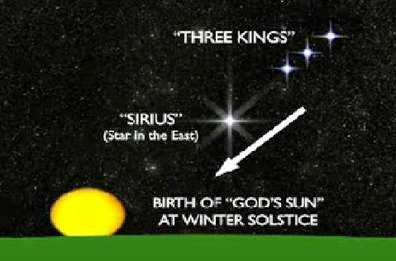
The three Kings or Magi seeking Jesus were astrologers. So excited by and certain of their prediction were they, that they set off to find him, I argue, in the spring. They ventured eastwards towards the star Sirius, which rises in the east in March in the northern hemisphere. With their learning they probably knew of the goddess ISHTAR from Babylonia who represented Sirius and was associated with fertility, love and war. Another clue for us today is that in the English language is the word Easter which breaks down into two words; EAST STAR. It also is remarkably similar to the word ISHTAR.

If we dig deeper into pre-Christian gods, we find that in Ancient Egypt the star Sirius was represented by the goddess SOPDET meaning ‘skilled woman’. She was important because her appearance signalled the inundation of Nile and the beginning of their new year. She was sometimes portrayed as a large dog.

picure credit: Tarot Aotearoa

Sopdet was associated with ISIS who was the wife of OSIRIS. Their son HORUS just happened to be born on 25th December; a holy family uncannily resembling a later one. They watch over us even to this day as Sirius (ISIS) in the constellation Canis Minor and her husband OSIRIS, the constellation ORION.

These curious facts add up to support the possibility that the Nativity occurred in the spring and the death and resurrection of Jesus the Christ in mid-winter. Certainly, Bible scholars are unable to qoute verses that deny this, as is anyone to confirm it. The Christian practice of using the festivals and stories of the hated Pagan gods, appears to be the only reason for Christmas and Easter being where they are today.

We cannot deny the association in popular modern culture of ISHTAR and Easter. As a nature godess, she is depicted with with hares and rabbits (famed for their procreative success) and eggs (product of the female hormone Oestrogen). Eggs and Rabbits were omitted from the Holy Bible and yet survive as symbols of birth happening at the time of the great initiator, Aries. Perhaps, some archetypes are too strong to supress.

ENDING

At this time of Easter, instead of celebrating the joys of spring, Christians mourn. Then, in midwinter they celebrate birth.

One wonders whether these important festivals, reversed for the wrong reasons, have unknowingly undermined the modern world? Knowing the basics of life and death, ending and beginning, should support rather than undermine what it is to be a human, whose life is dependent on natural cycles.

I cannot expect anyone to agree with my view but for me, this fundamental reversal of ancient truths has led to our misunderstand and abuse not only of nature, but ourselves.

The mystic Hildegard of Bingham wrote ‘wisdom awakens to wetness and greeness and flowing waters. Wisdom says I am the rain coming from the dew that causes the grasses to laugh with the joy of life’.

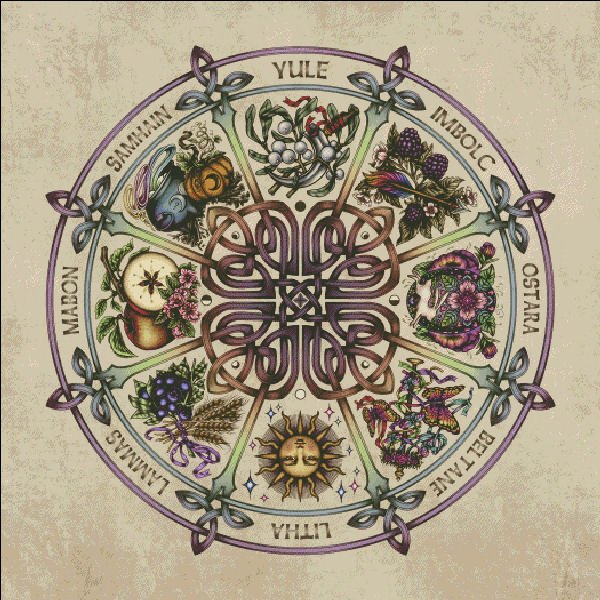
Pagan Wheel of the Year: picture credit Friends of the Forest

Happy Christmas!

Truth Against the World

or “Duw y Digon” ; an ancient Welsh Druid Motto

Swinside Stone Circle picture credit: Wikipedia

The first authority over our personal truth that we encounter is within the family. Losing power to others is an experience that we mainly survive, but should this loss influence us beyond childhood?

Most social organisation, whether it be for religion, employment, education, health, defence or politics, consists of submitting to the will of others; what is termed ‘the greater good’.

It’s a system that Western societies inherited from their forefathers. Consequently, most forms of government rely on the obsequence of the masses; the most extreme example being communism where the interest of the State trumps individual rights.

Even in democracies, the majority is granted authority over the minority; however small the difference. The assumed ‘unchallengeable constant’ is, that all people have the same intelligence, education achievement and wisdom. Socrates was at odds with such a premise two millennia ago!

The question is not whether to submit to authority or not. Someone, somewhere will have a hold over you. The question is not then, how clever are they? The challenge for all of us is not to give away all of our freedom but just to ‘render to Caesar what is Caesar’s’ (Matthew 22:21).

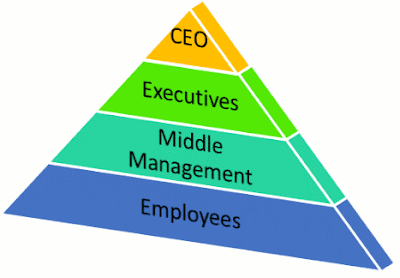
Authority manifests itself in social systems most commonly as a pyramid shaped hierarchy. In politics there will be an ‘overlord’ such as a President or Prime Minister, Chancellor or Chairman or Monarch.

Below the ‘head of government’ there are layers of middle ranking politicians. Unelected bureaucrats disseminate and legislate the strategies of the politicians. The general population occupy the lower part of the pyramid believing they are represented by those above and give away their power.

The military use an undemocratic system of organisation. There is a self organising ‘pyramid of power’. The organisation discourages individuals from thinking for themselves, requiring unquestioning obedience to orders from those higher in rank.

Take this ‘pyramid organisation’ model and transfer it to other social organisations and we see control by a minority of leaders;

Religions – Popes, Priests, Rabbis, Imams, Shaman

Companies – Managing Directors, CEO’s, Owners and Oligarchs

Education – Ministers of State, Head Teachers, Professors, Chancellors

Health – Ministers of State, Hospital managers, General and Specialist practitioners.

There have been exceptions to this ‘hierarchy of merit’. Google, for instance, practised an egalitarian approach to management for a while. At meetings, no individual oversaw proceedings. Each had a theoretical ‘equal say’. What happened in reality was that the person with the strongest personality and loudest voice controlled the meeting, rather than the person or persons with the best ideas.

So far we have considered how hierarchical organisations function. Now let us view the issue from another angle. Is it not the case that there have been in history, two types of leaders; good ones and bad ones?

This may sound trite, but it is an important distinction!

High ranking politicians for example, make promises about what they will do in government if elected. Few discuss the means by which they will achieve this objective. In this way, ‘making America great again’ fails to include a description of what greatness is, how it is going to be achieved and who is going to benefit. It even fails to describe what is meant by ‘America’. Does that include Canada, Greenland, Mexico and South America? Or does it just mean U.S. (us)? Such vague leadership is historically the breeding ground of disappointment at best and catastrophe at worst.

We know in Europe there have been good monarchs and bad monarchs. The last good monarch in England is said to have been King John of England (1166 – 1216). He was persuaded to give his royal power to his Barons. ‘Good King Wenceslas’ was good but European Kings and Queens were too often flawed by greed, anger, adultery, criminality such as murder, drug dependency, jealousy, war warmongering, excess tax demands, madness, religious dogma and bigotry, black magic and worse.

Good and bad are of course not always simple to define. In modern times political ideologies have split voters between the right and left. This is true in both the United States of America and an increasing number of European countries.

To summarise; in democracies people they to vote for who they regard as good leaders. The definition of ‘good leaders’ is unlikely to be agreed upon!

A creative thinker might desire moving power away from this divided collective schizophrenia.

A stabilising element of this unstable social organisation, is truth. For millennia, humans have obeyed whatever ‘truth’ those to whom they have given their personal power. They have been obliged to trust those who claim to be their superiors but in fact they are just acting out their weaknesses and lies! Hans Christian Anderson’s literary folk tale entitled ‘The Emperor’s New Clothes’ mocks the absurdity of delusional leaders and describes the masses failing to speak the truth to power.

Eventually, authority without truth, declines and falls. The Roman Empire is one of the best examples of this. So is there benign alternative to the many shades of autocracy?

In the North American indigenous tribes there was an interesting alternative form of leadership and wise counsel. People of the tribe would sit in a circle to debate important decisions on equal terms. To prevent them all speaking at once, a single feather was handed around in turn and whoever held the feather was permitted to say their truth without interruption. This was called ‘goose leadership’ after the manner of geese in flight that take turns to hold the point position at the front of the flocks V formation.

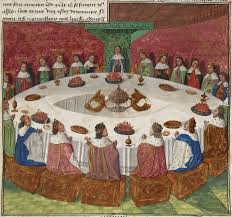
The legendary King of Britain, King Arthur, declined autocratic rule. He changed his throne into a round table for himself and his knights. In doing so he showed he was prepared to listen to others. Debate was valued for the truth of others, independent of their rank. Perhaps this was Arthur’s metaphorical sword of truth, ‘Excalibur’; released from stone hard systems of government.

As the internet today spreads it’s influence around the globe (another Round Table), disparate individuals try to speak their truth, honestly without fear or favour; so called ‘free speech’.

Humans of all races, have more in common than differences and thrive when not divided by powerful ruling minorities. Even the languages that once divided, are now being instantly translated by artificial intelligence. The ‘wisdom of the crowd’ is the ability of large groups of people to come to a benign consensus of how life is best lived.

A recent survey was made in the United Kingdom asking young people for their favourite word in 2024. It was not ‘artificial intelligence’, but ‘kindness’. The fact that the coming generation have this truth already in their hearts is good news for the population of the world in 2025…and world leaders would be wise to graffiti this word across their round tables.

Peace Begets Peace

Most people hate war, especially soldiers, so why does it happen?

The problem is that war is an option of last resort. Ideally, all other options have been explored before war happens, but from then on, politics is ‘extended by other means’, to paraphrase the Prussian General Carl Von Clausevitz. War will persist until it is possible to stop it; a process far harder to achieve than starting it!

Each conflict is a set of unique circumstances and different ways to reach a peace. At worst the war will become one of attrition and it becomes impossible for both sides to continue. Alternatively, political and public support for a war wanes or perhaps an overwhelming third force compels surrender.

You would like to think that ‘how to stop a war’ is taught in military academies, but such executive decisions are more likely made my politicians rather than military leaders and politicians usually have no experience of ‘conflict resolution’ at this scale. Even in wars which have been wars of attrition, the conclusion of war requires considerable diplomatic skill. For if one side is forced into conditions of surrender that are too onerous and dishonourable, the process of recovery becomes excessively hard and national pride will almost certainly wish to seek redress sometime in the future.

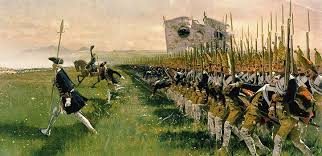
The world might have learnt this lesson at the conclusion of the first world war, which was one of attrition and the intervention of a third party; the USA. The armistice terms demanded by the Allies, were so severe that they left a ticking time bomb, ready to start of the second world war.

picture credit: Family Search

The present war in Ukraine has been described by some as the beginning of the third world war, but there is another view. It could be argued that what is happening in Ukraine since 2004, when Russia annexed parts of Ukraine and later the Crimean peninsula, is an unfinished rumble from the second world war.

In that war, an American General raced against the Russians to roll his tanks into Berlin ; General George Patten. The politicians tolerated his outspoken gaffs, because he was a superb military leader. Patten was of the opinion that the allies should continue to Moscow and finish the war for good.

The politicians ignored his advice and the United States spent the next few decades fighting the influence of communism in what became known as, Mc Carthy era. Countries such as Cuba, China, Russia and Vietnam caused considerable headaches for the American politicians and military; awakening a culture of suspicion of ‘reds under the bed’.

There is an argument that the present war in Ukraine is unfinished communist expansionism in Europe. President Putin justified invading sovereign Ukraine to the Russian people, by stating that his strategic aim is to defend Russia against an expanding NATO threat. The two allies of the second world war were now facing each other; just as General Patten envisaged was needed to end the war.

The technology of war inevitably played it’s part in this conclusion. The use of the Atomic bomb by the USA in the Far East, brought the conflict there to a sudden halt. Communist sympathisers within the Allies, gave the secrets of the atom bomb and the Soviet Union. They speedily test fired an exact copy of the American atomic bomb, shocking the world. This mutual threat has forced an unsteady world peace ever since, dubbed ‘the Cold War’. Despite the efforts of the International Atomic Weapons Agency, set up to prevent the proliferation of nuclear weapons. Nine or so countries now have them and others want it.

It is important to realise that after the fall and fragmentation of the Soviet Union, Ukraine was left with fifteen pressurised water reactors of Russian VVER design and importantly, Soviet era strategic nuclear weapons.

Three of these ex-Soviet countries were persuaded to give up their nuclear weapons in the Budapest Memorandum on Security Assurances. Belarus, Kazakhstan and Ukraine agreed to give up their nuclear weapons between 1993 and 1996. The nuclear powers overseeing this process were the Russian Federation, the United States and the United Kingdom. They agreed not to use military force or economic coercion against these three countries unless for self defence or in accordance with the Charter of the United Nations.

The diplomats and lawyers who wrote the Budapest Memorandum were perhaps, not clear about what constitutes ‘self defence’. Most strategists and tacticions, know that the principle of striking the enemy before they hit you, creates an element of surprise that can bring about an early victory. Putin’s original ‘Special Military Operation’ was exactly this but, unfortunately for him, it didn’t knock out his opponent with the first punch. The surprise was Putin’s.

Putin constantly cites NATO as a growing threat, especially after the fall of Viktor Fedorovych Yanukovych, Ukraine’s president from 2010 to 2014. Yanukovych had promised the Ukrainian people in his election manifesto, that Ukraine would apply to join the European Union or at least set up special trade agreements which would lead to this. But after a phone call from the Kremlin, he renaged on this promise and there were riots in the streets. These were violently suppressed by the government leading to over 100 deaths. Yanukovych fled to Russia and Volodymyr Zelenskyy was elected president on the promise of European integration. Europe responded with indirect support.

Ukraine is a convenient buffer state for NATO because it has arguably, prevented World War III. It has so far, been a narrow escape for all, provided Trump isn’t elected and gives in to the Russians. The USA has not been good the diplomacy of war and should have learnt some important lessons, such as from the war in Vietnam.

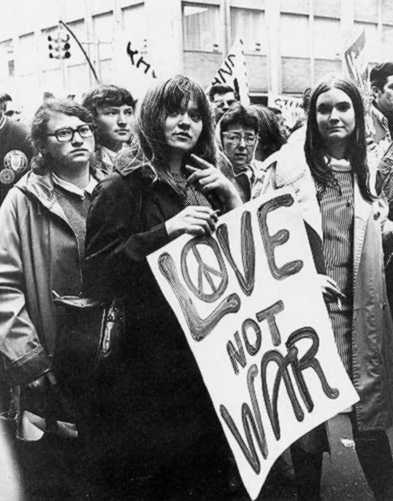
picture credit: Shoeleather History

An indignant generation of young people in the United States rebelled against the war in Vietnam as it was played out graphically on their television screens. Newspaper reporters photographed the horror of war; photographs which stunned Americans and the world alike. Young men angrily burnt their call up papers in front of crowds of anti-war protesters as four successive Presidents presided over an unwinnable war. In a way, the protesters against this and later wars (such as the invasion of Iraq by the US and coalition forces in 2003) stuck their flag in the moral ‘high ground’. War was wrong.

Awakenings of conscience and consciousness happen at the individual level long before parliamentarians hear and reflect the ‘mood of the nation’. If war is going to be rejected as a method of ‘problem solving’, there has to be a global realisation of the immorality and futility of using violence against a fellow human being. It would be idealistic to suggest that this could happen in the near future but perhaps there is, a greater possibility for change than now, than there ever has been.

In my view, change will only happen with the introduction of a ‘third force’ which might be a charismatic world leader from this or another solar system, new technology or a third force with the means to eliminate humans, shared global problems of a catastrophic nature or just a spiritually and / or morally inspired realisation that violence is wrong.

picture credit: Physics World

The reference to ‘another solar system’ may have surprised readers! But the presence of advanced beings on earth is hardly a secret any more. The problem is that they are being characterised as violent and a threat to mankind. The narrative of ‘global security’ by successive U.S administrations, introduced ‘Star Wars’ under the Reagan and a whole new defence wing under Trump called the Space Development Agency. Hollywood has aided and abetted a global fear of invasion of ‘beings from outer space’ who wish humans harm.

The reality as described in Dr. Steven Greer’s film, ‘Close Encounters of a Fifth Kind’, is that highly evolved beings are watching and guiding us until we become peaceful towards each other and them.

Such a change of morals and consciousness is not a vain hope. There have been historical precedents. The crucifixion of one man in Roman Palestine, started a new religion based on love and compassion for all other people, including enemies.

Since then, sadly, religions have done as much to cause war as to prevent it. Countries at war, often claim that ‘God is on their side’ and yet logically, this cannot be true. Humans have free will and with that, responsibility.

The path to a planet where there is no war, is ultimately not in the hands of the politicians, lawyers, military leaders, religious leaders or industry; the arms industry has shown multiple times throughout history, that it is more interested in shares than ploughshares. The only possible novel outcome to being a victim of unrestrained violence, is for individuals to do nothing.

As the famous poster put it; ‘what if there was a war and nobody came?’

Mahatma Gandhi used non-violent protest to the British Raj, because that was how he was as an individual. His passive resistance, proved to be all that was needed to bring down the mighty British Raj in India. Peaceful overwhelming influence is an extraordinary power. When it fails, it makes powerful martyrs but when won, makes lasting peace. There will be a moment in the future for this to take place and until then we must wait.

White Lies Matter

When I was a boy I had an aunt who had been a Baptist missionary in, what was then, the Belgium Congo and is now the Democratic Republic of Congo.

This gives you a clue that this was the 1950’s and Africa was still largely in the hands of European countries. She and her husband were captured and managed to escape prison and return to England. I remember her telling me once, that ‘black people are not as intelligent as white people’. Fortunately I had never seen a black person at that age. But it was one of many ‘white lies’ I have heard.

I use this anecdote to show how the morality of generations evolve and change. After the second world war and the fight against fascism, opinions of others based on their race, religion, disability, sexuality were liberalised. The Nazis and to some extent Victorians, believed in eugenics and the creation of a ‘master race’ – completely opposite of what today we call ‘respect for diversity’.

My own skin colour I will not reveal here, as it changes with my exposure to the sun and is therefore of little relevance, and my race is – human.

The permission to abuse another human being, on account of their perceived inferiority must go back to ancient Sumer, Abyssinia, Egypt, Greece and Rome. Throughout the Middle East and the Classical world, people were either royal, free or slaves. This was a ‘perfectly normal’ set up and no doubt solved the problem of what to do with prisoners from conquered lands, as well as deciding who was going to do the washing up.

A Chain Gang in Ancient Rome

B Ancient-Rome-Roman-Slave-1024x682

When Europe adopted Greek and Roman classicism in the Renaissance they stole and copied statues of gods and Emperors; more as decorative pieces of sculpture, rather than because they admired the shameful behaviour of minor gods and Emperors.

But this model undoubtedly had an effect on the human consciences. How else could slavery have remained legal until the eighteenth century? When Europe was exploiting the West Indies and needed slave labour, Africa was convenient for it’s ships to pick up more slaves, and yes, sometimes from Africans ready to sell their enemies.

In those times much of the riches of the Western cultures came from the sweat, blood and tears of slaves. We know this, so – have we changed?

I personally think that we have, but not totally. I see people from all over the world living and working in European cities. There are high achievers and low achievers in any society, depending on how you measure ‘achievement’. But more importantly, people all over the world today are better fed, more likely to survive birth, and more likely to be educated and have access to health care. There are obviously exceptions to all of these but I am describing a trend. There are graphs produced by physicians and social scientists like the late Swedish academic Hans Rosling, that tell us this.

There is room for everyone on the planet according to the Professor

B hans rosling

But the devil is, as always, in the detail. Racism endures in the minds of people of all races. There is a saying ‘birds of a feather stick together’ and as a description of human social behaviour, this remains largely, true.

The European collective unconscious has a lot of skeletons in it’s museum vaults and these continue to rattle to the present day.

Clearly, national institutions continue to exert power that is prejudicial towards it’s citizens on account of race, religion, gender, sexuality, disability – despite the introduction of many laws, certainly in Europe, to correct this.

Personally I do not think new laws change societies of themselves, there has to be more. Even after the late Martin Luther King Jnr. gave his inspirational speeches in the 1960’s; sixty years later there are still statues of slave traders in European cities and military bases in the southern states of the USA named after confederate generals.

Head of Martin Luther King Junior in MLK Park, Buffalo, New York State

B Head in MLK Park

Whilst it is correct to record and preserve the facts of history and heritage, much of what our forefathers thought was ‘acceptable’ is nothing to be proud of today. Museums and history books must be  trusted and treasured so that they enable future generations to learn from the past. This will, at best, inspire an imperative to practice compassion towards one another today, because we got it wrong in past.

Therefore it is clearly the responsibility of those with the power to do so, to make regular assessments of local and national institutions and weed out any ‘honouring’ of the past, of which we should be ashamed, without hiding truth.

The African Americans and many allies, are presently leading the charge against their prejudicial treatment, but the lesson has global implications.

There is not a single human being on the planet including myself, who would not benefit from keeping a constant check on personal behaviours towards others that reveals some irrational prejudice, and immediately correct it.

Some argue that doing nothing is also acting with prejudice and perhaps they are right. Laws can be broken by act or omission, so can our personal integrity. The saying goes something like; ‘evil thrives when the good guys do nothing’.

And it is a fact that people of all colours, creed, tribe and what ever distinction you choose, have done nothing for a very long time. The history of post colonial Africa contains many shameful periods of genocide.

For example, in the Democratic Republic of Congo between 1997 and 2003, five million people were killed. If you read an article in the Guardian Newspaper website entitled ‘Wars Will Never Stop’ it quotes a young fighter who was dying in hospital of his shocking injuries from a local skirmish with a rival faction of his rebel group;

I was just a foot soldier so I don’t really know why we were fighting,” he said. “There are lots of reasons I think …. I don’t think the wars here will ever stop. They will probably get worse.”

The question has to be asked, where were the protests of outrage from people of African heritage in their adopted countries all over the world?

Who did nothing when 800,000 people were slaughtered in Rwanda in just one hundred days in 1994?

Rwandan Genocide

B rwanda-genocide

 We all have to be careful that they are not being stirred up and manipulated for political reasons. In Rwanda the principle tool for the stirring up of hatred was the public radio.

All societies have to guard against the publication of false information or the abscence of true information. For instance, it is curious that the size of the problem of ‘deaths in police custody’ is not published, despite a law in the United States of America requiring them to be so. The Death in Custody Reporting Act of 2013 went into effect in December 2014, but official figures have never been made public. The reason is either that these figures will prompt national outrage and shame, or lead to a conclusion that the problem is much smaller than it is being made to seem.

Clearly, one death is too many, but national figures covering 500,000,000 people have to be published openly, especially when feelings are running high as they are now.

The core problem is contained in the hearts of those who nurture hatred towards other human beings, for whatever reason. It does not matter if the hatred is black against black or white against black or black against white or white against white. The issue, in my view, is not an identification with a race or class, or creed, but the level of willingness of each human being to allow their love for all of humanity, to rise above everything else.

‘Hate cannot drive out hate, only love can do that.’  Dr. Martin Luther King Junior

Don’t Fence Me In

This the title of a wonderful old song sung, I think by Bing Crosby. It’s all about the exploration of the west in nineteenth century North America. After millennia of humans and animals roaming free, cattle ranching introduced ‘ownership’. The Native American Indians didn’t understand it and gave away their lands before they realised they would have to fight and ultimately die for the ‘reservations’ that were left for them.

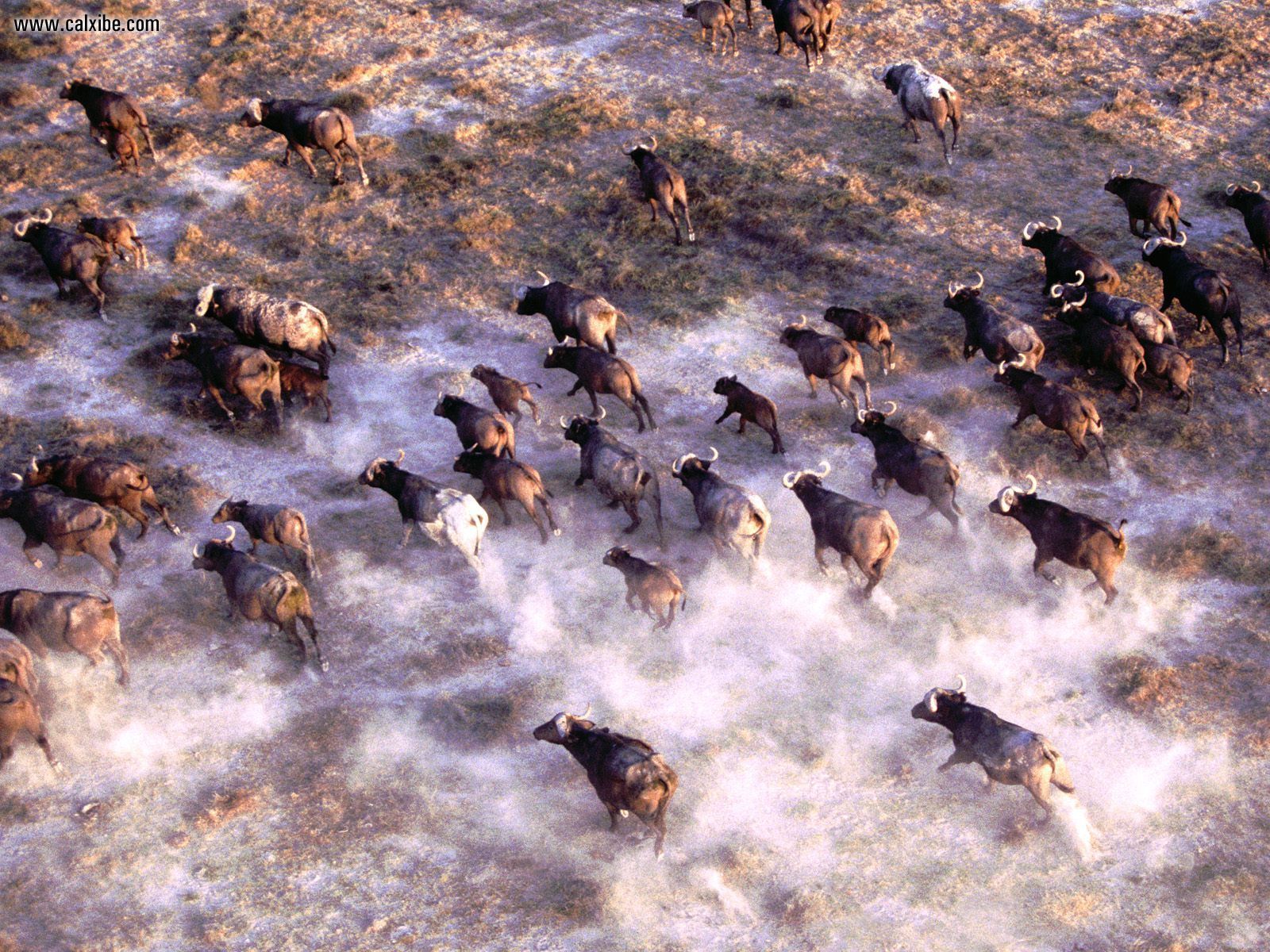
picture credit; WallpaperWeb.com

Stampede_African_Cape_Buffalo_Herd

It is an paradox that man craves freedom but loves boundaries. Astronauts report on viewing earth from space, that it appears as one planet. There are no political boundaries that we are so used to see on global maps. Boundaries are ultimately arbitrary. They serve only the tribal mentality of ‘them and us’ present in early man and persisting, almost unconsciously, to the present day.

The poet Robert Frost wrote a poem which included the line, good fences make good neighbours. This concept, at one end of the spectrum of possible combinations of freedom and enclosure, works – but only temporarily. Eventually, because of tribalism and greed, a fight breaks out.

When the British realised the rule of India by a distant Queen of England was over, they were faced with the problem of handing over a sub-continent to self rule. A problem because the Muslims and Hindus were at each others’ throats. If the British left there would be a blood bath. So they drew an arbitrary border on a map and created a new country, Pakistan. Like the creation of the Berlin walls, it divided families, created mass migration, a loss of homes and livelihoods and riots and slaughter. Tribalism, whether under religious or any other banner, is never good for all. Today India and Pakistan face each other with tolerant hostility, with a hundred nuclear missiles each, ready to wipe out each other and the rest of us. As an afterthought little Kashmir remains a flashpoint where this could happen. When you draw political maps, you had better know what you are doing for now and the next thousand years.

When the UK made the minority vote decision (only a quarter of the population voted in favour of Brexit ) to leave it’s partners in Europe, it had not considered the effects this would have on Northern Ireland and Scotland. The border in Eire was created centuries before to create a ‘non catholic’ portion of Ireland that could be controlled from England. The political reasons for it’s connection with United Kingdom are changing, and a likely consequence of the UK seeking ‘independence’ is losing Northern Ireland to the Irish and Scotland to the Scots.

Virus’s, and all the malign forces that nature unleashes on humanity; virus’s do not respect political boundaries. It takes two weeks for a virus to travel around the globe. The only way to extinguish a virus is for each person to crawl into their own cave and stay there. They may die or they may survive. In this situation one is not even aware that one’s neighbours, also potentially dying, are on the other side of the wall.

When this current Covid-19 pandemic is over, as it will be, the nations of the world should take stock. They need to seek to understand the lessons that come from such a pandemic, for virus’s are a greater problem than terrorism and extremism and wars and all our man made horrors. In 1919 the second wave of Spanish Flu killed everyone who caught it.

Surely, world leaders must learn that humanity has more to gain from co-operation and tolerance towards all living beings, whether animal or human. There are no boundaries in nature except those created by habitat and when there is enough habitat to go around, everyone is happy. When large populations move to escape political or natural upheavals, these people are ourselves coming in the other direction.

In Europe, the European Parliament and non-governmental organisations like the WHO, have failed to create a strategy to cope with immigration. Countries on the edges of Europe such as Greece and outside such as Lebanon are full to bursting point. Now Greece is shooting warning shots into the sea at immigrant boats.

In the United States, the solution to immigration from Southern American failing states, is of course ‘a wall’. As if we had not learnt from history how the Berlin wall was pulled down and how Palestine was shrunk into walls – good walls rarely make good neighbours.

Mankind craves to be free and this moment in history is a time for humans to come out of their caves and obeyance to tribal rules. Instead of hating and fighting each other, we are in a position to see the greater picture from above, where barriers do not exist. There is only humanity, and the sooner we treat the planet and each other with humanity, the sooner we will lose the feeling of being ‘fenced in’.

Is God King?

Alan Watts recounts the following anecdote in one of his erudite lectures entitled ‘The Nature of God and Death’;

An astronaut was asked on returning to earth, ‘did you see God?

‘Oh, yes,’ was the reply.

‘Tell us more about what you saw.’

‘She was black.’

When the Pilgrim Fathers sailed over the horizon, their great mission was to escape the rule of monarchy. Things from which we try to escape however, have an unnerving habit of following us around. So it was for the first settlers in the green and pleasant shores of eastern North America. Without a ‘lord and master’ or ‘father’ figure, everything would be much better, right?Pilgrim-Fathers-painting-Mayflower-Bernard-Gribble

The irony, in their religious beliefs, was that their metaphor for the Divine was a King. If it is odd that the Divine is restricted to being conceived as the masculine principle, we can forgive Biblical writers for being restricted by their own language. There are few words ascribed to neutral or ‘combined’ genders in most languages and unfortunately this has narrowed the way we think. ‘God the Queen’ would have been a very strange concept to Christians of most ages although they only had to refer back to ancient Egypt to broaden their views. The King Osiris was married to Queen Isis, who is often depicted with their infant son, Horus on his mother’s knee. The ‘Holy Family’ represent an all inclusive metaphorical Deity who is active and present throughout the entire biological process of pro-generation, as well as present throughout the entire cosmic process of creating the Universe. The origins of Judeo -Christian beliefs in the religion of Ancient Egypt, are preferred to be ignored despite clear paths of provenance.

It is a fact that religions per se, do not thrive on original thought. The Pilgrim Fathers were accepting of the fact that no one had thought to include the Pilgrim Mothers in the title of their congregation. They were also content to worship a ‘God the King’ even though the autocratic system of government was so abhorrent to them. Monarchs have a power over their subjects which ranges between the benign and malign, depending on the character, mood and carbuncles of the monarch. In a way, the freedom sought by the Pilgrim Mothers and Fathers, was a philosophical freedom as well as a temporal one. They felt justified in asserting their own free will over any other will.

Face-of-God-

But since the Christian God is one that has given ‘free will’ to his and her subjects, it is open to debate as to whether they were escaping God or a religious restriction of the concept of the Divine pedalled by an all powerful Church, usually in temporal cahoots with a monarch.

For political rather than religious reasons, the Constitution of the United States of America was written with precisely this abhorrence of the ‘all powerful King’ in mind. Judges and Representatives of the people were given tripatied power. No one person should wield political power over the people. For this reason the people were given the free to bear arms and form militias should the politically powerful become malign – in their view.

If government on earth is a mirror of celestial politics you have to wonder whether Angels are similarly empowered to zap their superiors with cosmic ray guns?

This did, of course, happen in the leaves of the Old Testament and the dualistic nature of even Angelic creatures is contained in the story of Beelzebub and his rebellious angelic army challenging the Divine ruler. The rest, as they say, is history.

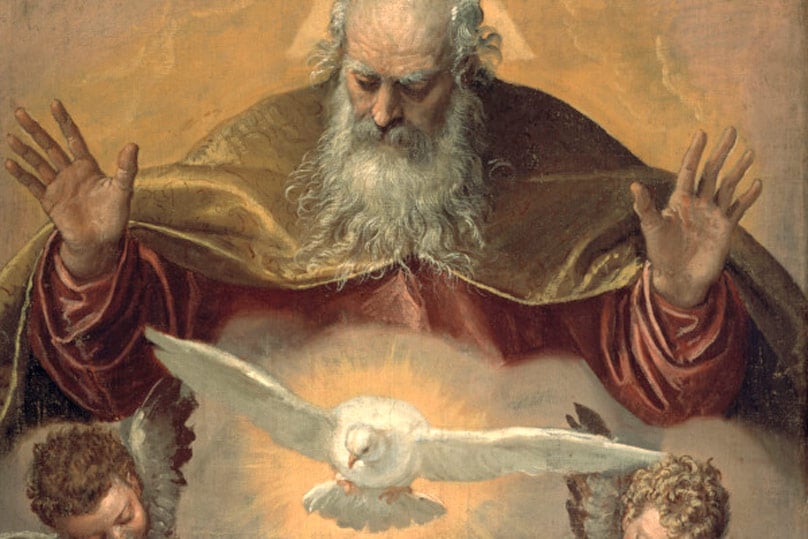
God with grey beard and dove

So to return to the question of whether the Divine Being is a white Anglo Saxon male, the answer is, clearly – doubtful. Long white beards aside, human kind has created the monotheistic God in his own image, and since King James and the other chroniclers of the good book were egotists, God has always been what psychologists call a ‘projection’.

This is fitting since much of the Universe is no more than an projection of the Universal consciousness. In this the Divine Feminine and Masculine principles interplay as a sort of fantasy dance – the gyrations of Kali and Shiva – who create and destroy in equal measure.

Eve and Godess

We depict any Godhead as male at our peril. If Jesus used the metaphor ‘Father’ it was not an implication of gender that was intended but the figure of the pro-generator. Jesus was fond of metaphors since mystics find the language of the market place appropriate to use to describe higher concepts. The parables he told contain metaphors which strongly describe unspeakable ideas in the sense that words are not enough. The return of the Prodigal Son to his father is describing the process of individuation within a maturing human being – the path which if followed leads to a union with the Divine. The ‘fat calf’ which we are all in danger of becoming during our easy lifestyles on earth, has to be slain and consumed.

When you eat remember this of me.

The errant son evolves to become a father. An errant daughter evolves to become a mother. An errant non-gender specific person becomes a vother*.

(*Using the principle of ‘ the infinite abundance of thought’ to make up words where missing – Vother is a neutral person.)

Light through clouds

So, no, God is not King, nor even a humble father. These were always crude metaphors, crudely carved by restrictive words and dualistic thought. The ancients and the religions of the Far East such as Buddhism and Hinduism, have no difficulty conjuring up ambiguous and contradictory Godheads who break and write as many rules as they can. Reality is not polarised, with one half favoured over the other. Neither does an authority figure ‘reign in heaven’ or anywhere else. Such prosaic concerns are respected by mystics but dismissed as irrelevant to higher task of the search for Divine Union.

Render unto Caesar the things that are Caesar’s;

The ( perhaps ) unpalatable truth to many, is that we the people are king, if only for a day or our humble fifteen minutes of fame. Even if only glimsped once in this lifetime it is my belief that;

Ours is the Kingdom, for ever and ever, Amen.

Whilst it is unfair to criticise the Pilgrim Fathers with the benefit of a good deal of hind sight, one has to wonder what would have happened if they had re-assessed their religion as well as their politics. If their aim in leaving Europe was to seperate from the percieved corruption of the Church of England they had an oppurtunity to wipe the slate of indoctrination clean completely. As unlikely as it was in 1620 for such a shift in belief, if the early church leaders had met and discussed universal outlooks with the native people and their holy men, they might have made some radical philosophical discoveries. At least it is possible for a present day comparison to be made.

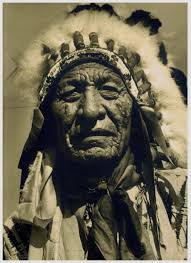
black elk

The Holy Man of the Oglala Sioux, Black Elk, is described as understand God in the following way;

‘Black Elk learned that whoever found a centre also became the centre of the universe and that is where God dwells…By placing himself at this centre which is simultaneously physical, spiritual and metaphorical, he encountered the Great Mysterious One…the centre of oneself becomes the centre of the universe. The centre of the earth and the centre of the person are one and the same.’

‘Finding All Things in God’ by Hans Gustafson published by Lutterworth Press

The All Seeing I

There are quite a number of theories as to why an all seeing eye above a pyramid, appears on the dollar bill.

dollar bill eye

Clearly there are masonic connections with the originators of the United States of America and the original intention. There may have been as many as twenty one signaturees of the American Constitution who were Freemasons.

They largely reflected anti monarchist views and promoted European Enlightenment ideals of liberty and self governance. God was not encapsulated in a ‘religion’ but seen as an entity who largely left humanity to it’s own devices, whilst keeping a benign watch on things.

Also, the ‘eye’ on the dollar bill is clearly disembodied; without the arms and legs. This ideal of the Creator is more akin the gnostic view, than the Christian.

The symbol shows rays coming from the eye in all directions. This is important. Firstly the rays are coming from the eye, not into it. It is therefore akin to the sun and akin to the Ancient Egyptian deity Ra.

Whilst the human eye is perfectly adapted to receive and focus electromagnetic energy in the wavelength of light, modern science does not support the idea that eyes emit light. Yet in Ancient Greece, Plato and Socrates believed the eye was an organ that emitted a ‘fire’ to produce a ‘visual touch’ sensation. This reversal of what is today ‘the norm’ is not as nonsensical as it may seem. In ancient times the physical world was seen more as a system of energies, rather than the solid physical forms of today. Given that perception then it is quite possible that a human can feel with the eyes by emitting energy. We have all probably had the experience of someone watching us from behind or from a distance whom we cannot physically see.

The other symbol is the truncated pyramid above which the eye floats. The pyramid has thirteen courses and this number is repeated in other symbols present. It’s significance to the designers was clearly important and probably has several interpretations. Personally I would view it as a unification of the numbers one and three, one being the Godhead and three the Holy Trinity – in Christian symbolism which the Freemasons were most likely to use. At another level one interpretation I find interesting is by Swaller de Lubicz who said that thirteen is ‘the manifestation of the good or bad generating power’.

Swaller de Lubicz is a renowned investigator of the sacred sites of Ancient Egypt whose theories were unorthodox but very interesting. His book ‘The Temple in Man‘ is recommended.

In the Old Testament of the Bible and Torah, God is just such an energy that passes judgement and destroys that which it does not approve. Although this image of the Creator is at odds with the New Testament, for the Jews and many other societies, God is not just ‘Mr. Nice Guy’.

In science, the physical universe is in a constant process of decay known as ‘entropy’ and creation; with entropy ultimately being the winner. Even our own bodies reflect this state, and one day our bodies will expire, despite constant renewal processes.

So the eye at the top of the pyramid is more likely, in my view, to be an ‘Old Testament’ eye. Whilst man has freewill to make mistakes and good judgements, so does the Creator. Divine intervention does not, in theory, take place however in a contradictory way is does. God permit cities to be destroyed as does man.

The all seeing eye of God is not just protection, as worn by many as a symbol in the Middle East and known as the ‘evil eye’ or more accurately – protection from evil.

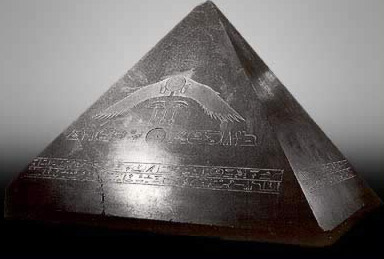
So, why a pyramid and why one without a point? Most pyramids are pure representations of the geometric pyramid form. To do otherwise is rare but there is one and it is well known. It is the so called Pyramid of Cheops on the Gaza Plateau in Egypt. This was one of the first to be built and many of the latter pyramids were pale imitations. There has never been a ‘pyramidion‘ stone and it was constructed to have a flat platform at the summit.

pyramidion1

In my personal researches, I have come to the notion that pyramids were constructed to accumulate electromagnetic energy (amongst other reasons). This was done using rock which conducts ions and between anodes and cathodes. In the base of the pyramid are underground water courses associated with the river Nile. These bring in positive ions to the pyramid to be draw upwards through the centre. They were never intended to be emitted from the point of the pyramid as most others do, because other uses of the energies were being made in the chambers.

Suffice to say that I believe most pyramids were constructed to emit a steady stream of electromagnetic energy, from a height and in all directions, to other pyramids. This was a world wide network as evidenced by the presence of ancient pyramids on all the continents, including Antarctica!

A Pyramid and Tesla Tower with similar construction

Pyramid and Tesla Tower

The concept of ‘mobile phone’ masts as a network of transmitters and receivers of information encoded microwaves, is something most a familiar with in the modern world. It should not be so extraordinary to imagine such a network existed in the past using more primitive materials but with sophisticated, intuitive software.

The pyramids were transmitters and receivers between computers. If you wonder how computers existed so long ago, I am of course referring to the human brain, a computer so multi complex that it will be several decades, perhaps never, when it is replicated by scientists.

A form of ‘telepathy’ is plausibly existent between people such as twins or even husbands and wives, who finish each other’s sentences.

The ‘all seeing eye’ or ‘all knowing eye’ is therefore quite plausibly something contained not only in the mind of God but also His construction, humans.

The Ancient Egyptians denoted the Eye of Horus as in the diagram below. There is a convincing connection between this stylised image of the eye and the cross section of the human brain. This includes the pineal gland where our ‘extrasensory perception’ originates and is known as the ‘third eye’ – another illusion to the number three.

eye of horus

The ‘eye’ is also at a poetic level the ‘I’ or feeling of individual identity within the multiverse symbolised by the number 3 or the Trinity. I and 3 is of course code for, 13. The American Constitution protects the political and human rights of the individual and was fundamental to the creation of a free state which the USA has enjoyed for centuries, (at least in it’s imagination, when such issues as slavery are concerned.)

You can see, therefore that the information contained as they say in ‘plain sight’ on such a lowly item as a bank note is the perfect place to maintain a profound cognisance intended by the ‘Founding Fathers’, never to be forgotten.

Renaissance of the Renaissance

Where is the wisdom we have lost in knowledge?

Where is the knowledge we have lost in information?                          

Choruses from the Rock by T.S. Eliot

Futures have many directions. They spread into an infinity of possibilities every second of the day. This is true for the micro management of everyday things to the macro management of the planet and the cosmos.

One future is with us now and like all futures – it has been here before. What I am talking about is the tendency for people, science, art, industry, politics to start working together.

This may sound like the norm but in a culture of competition, copyright, industrial secrets, political manoeuvres, artistic repression and exploitation – believe me, working together has not been normal.

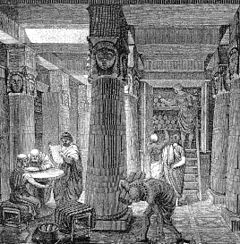
Art and science as pure and applied subjects have always led a culture into new possibilities. This was true particularly in Ancient Egypt where the great library in Alexander brought together learning and expression from all over the world. The Buddhist teachers were there and many influential thinkers and scholars of the second and third centuries B.C. It was by all accounts a Universal library a sort of Wikipedia of it’s day.

Lighthouse_-_Thiersch

When a large spectrum of subjects are considered by a single or a collective mind some thing extraordinary happens. The subjects are discovered to have areas in common. For example an astronomer would have a lot to share with a sea captain who navigated by the stars. A surgeon might have plenty to share with an artist trying to understand the human body.

Because the ethos of the library was to discover what beliefs and understanding was held in common and the connections investigated. Information and knowledge are the paths resulting from the investigation of the spaces between what is already known.

It was fitting that Pharos Lighthouse of Alexandria built between 284 and 286 BC spread light ‘across the world’. The metaphor of enlightenment is apt when considering the sharing of knowledge. It is the discovery of electromagnetic radio waves and their ability to carry information – that heralded the global sharing of information today, via the internet.

Ancientlibraryalex

With the spread of libraries across the eastern end of the Mediterranean the Alexandrian library fell into disuse and suffered destruction by armies and Christian zealots.

Many of the scholars, artists, sages and seers who frequented the library moved or fled. Using text books and records, often made by Arab scholars, some information and knowledge survived.

One of the nexus’s of the world to which the knowledge travelled, was Venice. It was the terminus of the Silk Road and linked the East with the Middle East and Western Europe.

The Ancient Greek texts on philosophy, astronomy, geometry, mathematics and their interpretation and substantiation by Arab scholars were like gold dust. Most contemporary lines of thought were abandoned in favour of this newly discovered old knowledge – like the Helio centric solar system. Much of it was ‘heretical’ to the church but eventually, the church had to hold it’s tongue. For the burst of colours from the fountain of knowledge were like the precious silks adorning the harlots and aristocratic women of the Venice. Artist and Scientist grew in renown and fame, patronised by wealthy families such as the Medici s. The flower that was opening was to be known as the Renaissance.

Today, despite or perhaps resulting from previous ignorance and prejudice, there is happening a similar flowering – inspired by Universal information and knowledge carried on the electromagnetic sea of the internet.

At the same time over the last few decades, academic institutions ( where the internet was first conceived and initiated ) – these institutions have started to share what they know with each other. This spark is vital to transform information into knowledge, ideas into creations.

For example, archaeologists studying Neanderthal humans are sitting around the metaphoric camp fire of storytelling, with forensic pathologists, palaeontologists, weapons experts, linguists and artists amongst many others – to visualise exactly how they lived.

Gone and the archaeologists who specialise in Western Mediterranean arrow heads for their entire academic careers. Such ‘silo’ thinking inhibits understanding. The arrow head was just a small part of the whole story of how Neanderthal humans lived and gives information but not knowledge.

This is just one example of the interconnections between artists and scientist that is now found in today’s Universities and places of study.

And most telling of all is the recreation of the ‘Renaissance Man’. These are artists or scientists who are also scientists and artists. For just as the first Renaissance created it’s Leonardo de Vinci’s, so we need and have today, our own ‘masters of all knowledge’.

This means considerably more than the previous scientists who wore a trade mark bow tie and long hair. Or  those artists who adopt a mannerism of the scientific method (sharks in tanks) in their conceptualisations.

What it will bring is the fruit from the flower – the seed that will give life to a new plant and perhaps the next Renaissance after the present one.

This fruit is what is known as ‘wisdom’. It is the essence of knowledge, just as knowledge is the essence of information and information the essence of data. There is a fractal that grows and shrinks, but always follows the same pattern.

In this seed the whole future of our civilisation has it’s potential to grow exponentially. We see it on the media everyday – new discoveries, new inventions, new ideas. Let us hope that these seeds will temper our desire for material prosperity, just as the Silk Road became a line of empty caravanserai’s.

Quick Quick Slow Slow

The British Raj in India was a colossal enterprise, whatever your views on its moral worth. It was set up in 1858 and ended in 1947, lasting almost one hundred years. The creation of the instruments of power and their administration were not simple. They were accompanied over time by the development of education, public health, railways, missions, industry, irrigation and other essential aspects of the colonisation.

The point of interest is the time which this took to establish. To say that it took almost one hundred years would not be an exaggeration. In effect, at the time of the rebellion and the handing back of rule, the process has continued as self rule took control, and continues to do so.

Vast undertakings take vast amounts of time at huge environmental, economic and social costs. The concept of colonisation was not new and had been exercised in many parts of Africa by the British before – so they knew the complexity involved.

Complexity always adds time to tasks whether political or such things as domestic repairs. At a certain point in home DIY for instance, you realise that you don’t know what you are doing or don’t have the skills and ring a professional trades person. The reason is that one person cannot know everything.

So when faced with the intention of a task, it is important to estimate how long it will take. Will it be completed this afternoon or in an hundred years?

Reluctantly – we should apply this understanding to the process of ‘Brexit’.

The initiation and development of the European Union goes back to the 1951 Treaty of Paris and the 1957 Treaty of Rome (although it could be argued that both Napoleon Bonaparte, Adolph Hitler and before them ‘Rome in the West‘ – sought to do the same by means of force rather than persuasion).

The institutions of the Union have themselves developed beyond their original aims of economic unity. The process to the present day has been complex and now involves over half a billion citizens.

It should not be expected to be unreasonable therefore that the process of leaving such an organisation is equally complex. What might be expected?

  1. Rules of leaving as agreed when joining.

  2. The Penalties for leaving as agreed when joining.

  3. The Process of leaving as agreed when joining.

  4. The preparation and planning, instigation, monitoring and completion of leaving.

Which leads to the question, ‘how long is this going to take?’

There appears to have been insufficient consideration during the formation of the European Union, to the process leaving the Union. It was after all, set up in the way of many religions, to attract new members. The unthinkable process of losing members is naturally inclined to become ‘unthinkable’.

The managerial notion of ‘we’ll deal with that at the time’ or ‘a dynamic assessment’ is not a good one when applied to organisations of this size and complexity.

Ordinary citizens can be forgiven for buying into such inane over simplifications as ‘Brexit means Brexit’. In the present western cultures where the idea of the expert is ridiculed and ordinary citizens believe themselves able to understand what they do not understand, a simple question like ‘do you want to leave the European Union‘ is not challenged as in itself, absurd.

Supported by the idea that ‘Britain once ruled over one quarter of the world’ – megalomania takes hold. The simpler the chants of those wishing to ignore complexity, the more supporters rally round.

If the problem was considered in the manner that civil servants are empowered to do, then almost certain more caution would be applied.

What is the aim?

What is already in place to achieve it?

What extra measures are needed to achieve it?

How long will it take to achieve it?

When will we know that the aim is accomplished?

These questions are the roots supporting the tree and like all roots, they extend in directions and distances unknown.

Suffice to say the withdrawal of any state from the European Union requires considerable planning and resources. The planning stage should start at the inception of the Union and be part of the conditions of joining – in order to simplify subsequent negotiations.

Any problems, such as politically sensitive borders, should be required to be solved prior to the start of leaving.

The process of leaving should be phased rather than all aspects negotiated and initiated ‘with immediate effect’.

The phases should be given generous time periods. The spectacle of the United Kingdom repeatedly applying for ‘extensions of time’  merely to start the withdrawal process is not something a manager of even a small company or organisation would be comfortable with.

Each phase would encompass one aspect of being a member of the European Union. In this way, proper consideration of the details of the present and proposed arrangements would be given.

Lessons should be learnt from the withdrawal of the European States from their colonies in Africa. Books could be written on this subject but in essence, there were problems created by the ‘political vacuum’ left after the transfers of power. These problems continue as symptoms at least, to the present day.

In my own way, I return to the reality that humans tend to become victims of their thoughts, rather than the masters.

It is possible to consider the absurd, and not realise that the matter is downright impossible to solve. Thinking itself is an inaccurate process, challenged continually by evidence from ‘the ground’.

So my own view of the process of leaving the European Union would be the phase each aspect and form consensus on this process based on the details of each phase.

To think that the process is simple and can be initiated at the stroke of a pen, has been done before. History as always is our teacher when this has happened.