The Church Fathers have had considerable ‘editorial control’ over what to put in and what to leave out of the Holy Bible. So much was ommitted and added, so should new ‘adjustments’ not be accepted?
OBSERVATION
In 1872 a scholar named George Smith found something remarkable in clay tablets from Nineveh. He was reading in cuneiform the Epic of Gilgamesh in which is described the great flood, God’s punishment for mankind. The suggestion that the Great Flood described in Genesis was just a retelling from ealier Mesopotamian texts, shook Victorian society. They gave Mr. Smith a hard time, as if he was the problem.
Today there is considerable proof that many of the stories in the Old and New Testaments have been subject to editing. We accept that the dates for the Christmas and Easter festivals are not in the Bible. They have been made up. The date for the birth of the Christ child was decided to be December 25th but why?
The Infant Horus: picture credit World History Encyclopedia
Previous gods had been born on this date. There was Horus (Ancient Egypt), Mithra (Persian), Krishna, Zarathustra (Iran), Hercules, Babylonian god Bal (Nimrod), Heracles, Dionysus (Greek), Thammuz (Babylonian) Hermes (Greek) Adonis (Phoenician) and others. All were born of virgins.
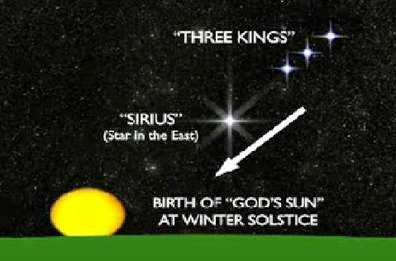
If such a clear plagarism of ancient gods is disturbing, there is a logical explanation based on astronomy. December 22nd is when the sun disc halts its annual progression northwards along the horizon. It then pauses for three days and rises anew on December 25th. This natural phenomenon supports neatly the story of a solar god being born; not dying and miraculously resurrecting but being born at least. Perhaps the birth of Jesus does not fit the story and date of how the ancient gods had been born.
If we investigate the ‘blasphemous’ notion that the Christ child was not born at Christmas then we should be able to find another meaningful astronomical date in the solar year relating to birth. After all, should a Christian festival be based on the Pagan festivals and superstition? The church fathers did, we should remember, hate and demonise Paganism, although Pagans did no worse than love nature and each other.
SUGGESTION
I suggest that the birth of Jesus was in the springtime; the lambing season, when shepherds watched their flocks by night. Consider afresh, the Christian nativity narrative.
The three Kings or Magi seeking Jesus were astrologers. So excited by and certain of their prediction were they, that they set off to find him, I argue, in the spring. They ventured eastwards towards the star Sirius, which rises in the east in March in the northern hemisphere. With their learning they probably knew of the goddess ISHTAR from Babylonia who represented Sirius and was associated with fertility, love and war. Another clue for us today is that in the English language is the word Easter which breaks down into two words; EAST STAR. It also is remarkably similar to the word ISHTAR.
If we dig deeper into pre-Christian gods, we find that in Ancient Egypt the star Sirius was represented by the goddess SOPDET meaning ‘skilled woman’. She was important because her appearance signalled the inundation of Nile and the beginning of their new year. She was sometimes portrayed as a large dog.
picure credit: Tarot Aotearoa
Sopdet was associated with ISIS who was the wife of OSIRIS. Their son HORUS just happened to be born on 25th December; a holy family uncannily resembling a later one. They watch over us even to this day as Sirius (ISIS) in the constellation Canis Minor and her husband OSIRIS, the constellation ORION.
These curious facts add up to support the possibility that the Nativity occurred in the spring and the death and resurrection of Jesus the Christ in mid-winter. Certainly, Bible scholars are unable to qoute verses that deny this, as is anyone to confirm it. The Christian practice of using the festivals and stories of the hated Pagan gods, appears to be the only reason for Christmas and Easter being where they are today.
We cannot deny the association in popular modern culture of ISHTAR and Easter. As a nature godess, she is depicted with with hares and rabbits (famed for their procreative success) and eggs (product of the female hormone Oestrogen). Eggs and Rabbits were omitted from the Holy Bible and yet survive as symbols of birth happening at the time of the great initiator, Aries. Perhaps, some archetypes are too strong to supress.
ENDING
At this time of Easter, instead of celebrating the joys of spring, Christians mourn. Then, in midwinter they celebrate birth.
One wonders whether these important festivals, reversed for the wrong reasons, have unknowingly undermined the modern world? Knowing the basics of life and death, ending and beginning, should support rather than undermine what it is to be a human, whose life is dependent on natural cycles.
I cannot expect anyone to agree with my view but for me, this fundamental reversal of ancient truths has led to our misunderstand and abuse not only of nature, but ourselves.
The mystic Hildegard of Bingham wrote ‘wisdom awakens to wetness and greeness and flowing waters. Wisdom says I am the rain coming from the dew that causes the grasses to laugh with the joy of life’.
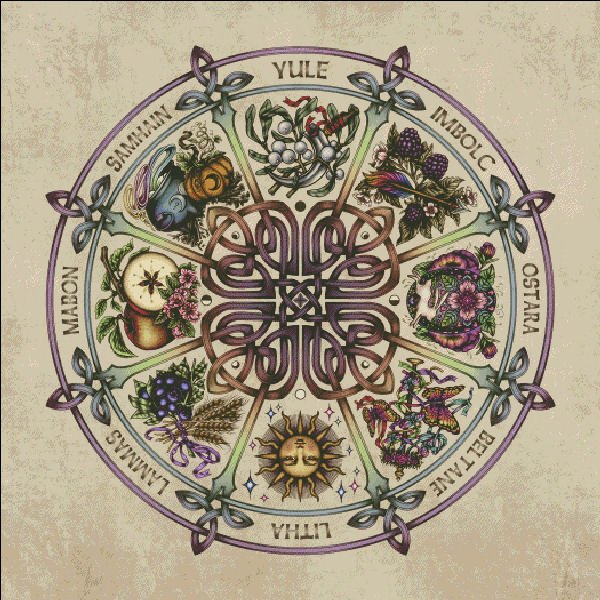
Pagan Wheel of the Year: picture credit Friends of the Forest
The world is experiencing mental chaos in the present; not knowing what to believe. The news media is full of reports that appear to contradict even what was said the day before.
It is important therefore, for our thoughts to be as precise as we can and also our words.
As in the title of this essay, ‘truth’ is causing the confusion and we now longer know who to believe.
Numerous politicians are being routinely accused of ‘lying’. If we consider the meaning of the word then is ‘a statement intended to deceive’. Then there are are false ‘facts’ from unreliable sources, which may not be intended to decieve but do.
The famous Dunning Kruger effect states that amateurs are less concerned about understanding a subject than professionals, who have pondered on it for years. The less you know, the easier everything appears to be. The present administration in the United States of America has more than it’s far share of sufferers of this effect, who simplify complexity to below any standard of professional opinion.
There are also things openly ‘fictional’. These may contain some truth but are largely a product of imagination. Novels and films based on truth will declare that names and events are fictional for artistic and legal reasons. What is important is that we are not deceived into believing in fiction. The World’s religions and cults are particularly prone to this absence of adherence to truth, often for no other reason than there are based on the fog of ancient history and managed so as not to embrace the present.
The civil laws of most countries try to be based on ‘the truth, the whole truth and nothing but the truth’. Judges attempt to distinguish between true evidence and false evidence until something is believed to be ‘beyond doubt’. It still makes mistakes even after the most rigorous processes to remove doubt. Dictators who control the judiciary can get away, literally, with murder, using fabricated evidence or just no evidence at all.
What this shows us is that even after the most challenging and examination, ideas can turn out to be mere theory. In science, theories are subject to ‘peer review’ – critical examination by equally well qualified scientists. As the Ancient Greeks understood, theories should not be confused with facts. The present irrational dismissal of a theory because it suggests a ‘conspiracy’ (intent to cause harm) is irrational. To not investigate an accusation for emotional reasons is a clear divergence from truth, but convinces crowds.
‘Facts’ are illusive and can be the product of distortion. A satellite’s instruments may be malfunctioning or incorrectly calibrated. An individual politician may have an unconscious or deliberate bias. The process of believing that ‘climate change’ is true has taken decades, largely because it was contrary to the interests of companies that extract and sell fossil fuels. As with many complex issues, the theory was too large in scope for the general public to understand. Those who should lead opinion, politicians, often use distraction, omission, obfuscation, irrelevance, obstruction and discontinuity to align facts and fictions with political ideas.
Even when we believe something is true, it can still only be ‘relatively’ true. It might be an oversimplification that just happens to work. Basing the worth of money or tokens on gold reserves was just one such ‘truth’ that reassured governments and populations. Today physical or virtual tokens of ‘worth’ are less and less dependable.
Finally, philosophy has an angle on ‘truth’ and how to find it. If science and religions regard truth as constants and dogma, philosophers understand truth as malleable. There is no ‘fixed law’, other than the law that everything changes.
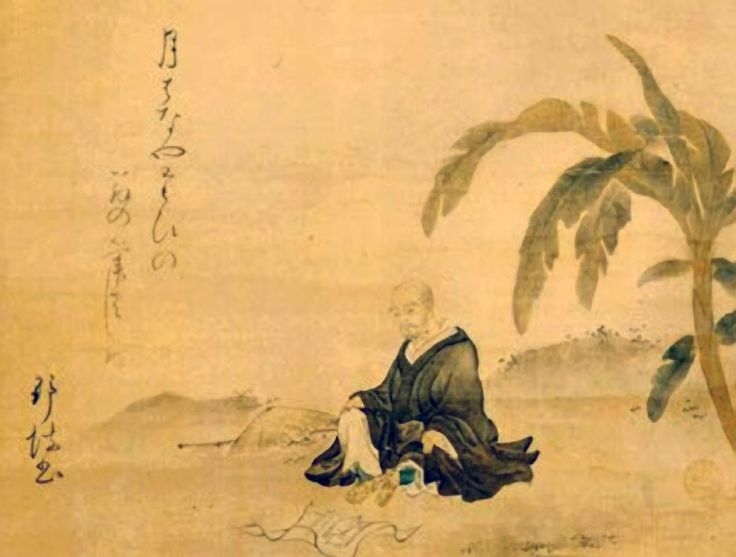
In Zen Buddhism, truth is whittled down to an individual regarding life’s purpose as no more or less than being present and observing; a formula much needed in our present times; especially when things go wrong!
For centuries, Europe was dominated by Empire building around the world. In the Twentieth Century the Empires, such as the British Empire, finally broke down and gave autonomous sovereign states their freedom back. It might have appeared that the age of ’empire building’ was over, but that is far from the case.
In the Twenty First century it is clear that Empires are back. Key to the once powerful British Empire had been the Navy and control of the seas around the world. Today the vulnerable global ‘key points’ are canals and pinch points in shipping lanes. The Houthis in Southern Yemen potentially control the infamous Straits of Hormuz; gateway to the Red Sea and Suez Canal. They will stop attacking Israeli shipping, they say, when Israel stops attacking Gaza. Neither the British, USA or Israel have tested this, preferring to extend the genocide in Gaza and attack Yemen, than take the Houthis at their word.
One of the strategic reasons for the establishment of a pro-Western State in the Middle East in 1948 (Israel) was, and still is, control of the Suez Canal. In 1956 the British, French and Israelis sought to gain control of the Suez Canal when Egypt nationalised it, moving their tanks from the Gaza Strip into Egypt. In my view, this imperative has never gone away.
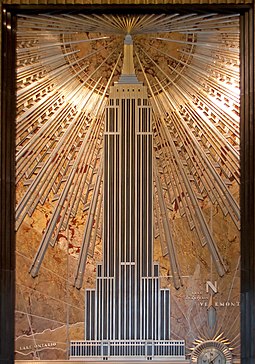
The Empire State Building, New York
MAGA? America is already ‘great’. It consists of a continent joined by an isthmus at Panama; again, a critical shipping route. The republic of the United States of America has a ruling president who wants to expand it’s 50 State Empire northwards and south. ‘Look at this arbitrary line between the USA and Canada,’ mocks Donald Trump, as if it means nothing just because it is straight. If it was meaningless, then Canada could claim the USA, as perhaps could Mexico and Denmark, but because of international law and common sense, they do not.
Putin wants the old Union of Soviet Socialist Republics back and China the island of Taiwan. Should then the British march back into India and Pakistan?
Should the French re-take French speaking Algeria?
Should Japan be given back it’s ‘Imperial’ territories in mainland China?
Should Italy claim back it’s Empire around the Mediterranean?
The list of historical reversals is absurd to all but the greedy and unpopular politicians who seek to stay in power indefinitely by empire building. Opponents are fed to the lions.
Today, Gibbon’s ‘The Fall of the Roman Empire’ is a critical read for the Trumps and Putins and Shi Jinpings of this world.
It is available in eight volumes and was read by a famous world statesman when he was twenty years old; Winston Churchill.
Now he knew a thing or two about world statesmanship and his preference for ‘jaw jaw instead of war war’.
The first authority over our personal truth that we encounter is within the family. Losing power to others is an experience that we mainly survive, but should this loss influence us beyond childhood?
Most social organisation, whether it be for religion, employment, education, health, defence or politics, consists of submitting to the will of others; what is termed ‘the greater good’.
It’s a system that Western societies inherited from their forefathers. Consequently, most forms of government rely on the obsequence of the masses; the most extreme example being communism where the interest of the State trumps individual rights.
Even in democracies, the majority is granted authority over the minority; however small the difference. The assumed ‘unchallengeable constant’ is, that all people have the same intelligence, education achievement and wisdom. Socrates was at odds with such a premise two millennia ago!
The question is not whether to submit to authority or not. Someone, somewhere will have a hold over you. The question is not then, how clever are they? The challenge for all of us is not to give away all of our freedom but just to ‘render to Caesar what is Caesar’s’ (Matthew 22:21).
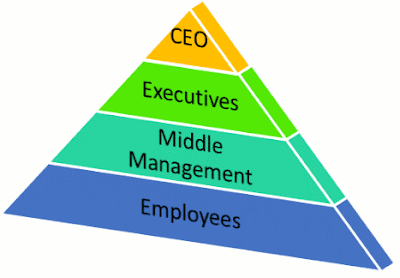
Authority manifests itself in social systems most commonly as a pyramid shaped hierarchy. In politics there will be an ‘overlord’ such as a President or Prime Minister, Chancellor or Chairman or Monarch.
Below the ‘head of government’ there are layers of middle ranking politicians. Unelected bureaucrats disseminate and legislate the strategies of the politicians. The general population occupy the lower part of the pyramid believing they are represented by those above and give away their power.
The military use an undemocratic system of organisation. There is a self organising ‘pyramid of power’. The organisation discourages individuals from thinking for themselves, requiring unquestioning obedience to orders from those higher in rank.
Take this ‘pyramid organisation’ model and transfer it to other social organisations and we see control by a minority of leaders;
Religions – Popes, Priests, Rabbis, Imams, Shaman
Companies – Managing Directors, CEO’s, Owners and Oligarchs
Education – Ministers of State, Head Teachers, Professors, Chancellors
Health – Ministers of State, Hospital managers, General and Specialist practitioners.
There have been exceptions to this ‘hierarchy of merit’. Google, for instance, practised an egalitarian approach to management for a while. At meetings, no individual oversaw proceedings. Each had a theoretical ‘equal say’. What happened in reality was that the person with the strongest personality and loudest voice controlled the meeting, rather than the person or persons with the best ideas.
So far we have considered how hierarchical organisations function. Now let us view the issue from another angle. Is it not the case that there have been in history, two types of leaders; good ones and bad ones?
This may sound trite, but it is an important distinction!
High ranking politicians for example, make promises about what they will do in government if elected. Few discuss the means by which they will achieve this objective. In this way, ‘making America great again’ fails to include a description of what greatness is, how it is going to be achieved and who is going to benefit. It even fails to describe what is meant by ‘America’. Does that include Canada, Greenland, Mexico and South America? Or does it just mean U.S. (us)? Such vague leadership is historically the breeding ground of disappointment at best and catastrophe at worst.
We know in Europe there have been good monarchs and bad monarchs. The last good monarch in England is said to have been King John of England (1166 – 1216). He was persuaded to give his royal power to his Barons. ‘Good King Wenceslas’ was good but European Kings and Queens were too often flawed by greed, anger, adultery, criminality such as murder, drug dependency, jealousy, war warmongering, excess tax demands, madness, religious dogma and bigotry, black magic and worse.
Good and bad are of course not always simple to define. In modern times political ideologies have split voters between the right and left. This is true in both the United States of America and an increasing number of European countries.
To summarise; in democracies people they to vote for who they regard as good leaders. The definition of ‘good leaders’ is unlikely to be agreed upon!
A creative thinker might desire moving power away from this divided collective schizophrenia.
A stabilising element of this unstable social organisation, is truth. For millennia, humans have obeyed whatever ‘truth’ those to whom they have given their personal power. They have been obliged to trust those who claim to be their superiors but in fact they are just acting out their weaknesses and lies! Hans Christian Anderson’s literary folk tale entitled ‘The Emperor’s New Clothes’ mocks the absurdity of delusional leaders and describes the masses failing to speak the truth to power.
Eventually, authority without truth, declines and falls. The Roman Empire is one of the best examples of this. So is there benign alternative to the many shades of autocracy?
In the North American indigenous tribes there was an interesting alternative form of leadership and wise counsel. People of the tribe would sit in a circle to debate important decisions on equal terms. To prevent them all speaking at once, a single feather was handed around in turn and whoever held the feather was permitted to say their truth without interruption. This was called ‘goose leadership’ after the manner of geese in flight that take turns to hold the point position at the front of the flocks V formation.
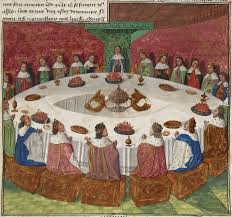
The legendary King of Britain, King Arthur, declined autocratic rule. He changed his throne into a round table for himself and his knights. In doing so he showed he was prepared to listen to others. Debate was valued for the truth of others, independent of their rank. Perhaps this was Arthur’s metaphorical sword of truth, ‘Excalibur’; released from stone hard systems of government.
As the internet today spreads it’s influence around the globe (another Round Table), disparate individuals try to speak their truth, honestly without fear or favour; so called ‘free speech’.
Humans of all races, have more in common than differences and thrive when not divided by powerful ruling minorities. Even the languages that once divided, are now being instantly translated by artificial intelligence. The ‘wisdom of the crowd’ is the ability of large groups of people to come to a benign consensus of how life is best lived.
A recent survey was made in the United Kingdom asking young people for their favourite word in 2024. It was not ‘artificial intelligence’, but ‘kindness’. The fact that the coming generation have this truth already in their hearts is good news for the population of the world in 2025…and world leaders would be wise to graffiti this word across their round tables.
Listening to a science programme on the Radio just now, I heard a amazing fact about Michael Faraday, the great early 19th century scientist. Apparently he was an ardent believer in God as well as a scientist. Unlike his contemporarys, he did not believe in molecular theory and the concept of the ‘atom’, which came from the ancient Greeks. He instead said that matter is where ‘lines of force meet’.
The other great scientist from whom much understanding of electricity today came, was Nicola Tesla in the late 19th century. One of his most famous sayings is; “If you want to find the secrets of the universe, think in terms of energy, frequency and vibration.”
These are not lightweight scientists. Most of our modern technology we owe to these two men.
The idea of ‘lines of force meeting’ immediately suggests the concept the ‘hologram’ although they were not known in Faraday’s time. Several beams or ‘layers’ of energetic force containing information that the human brain interprets as ‘an object’ is precisely what a hologram is. It is a huge leap but one made succinctly by Michael Talbot in his book, ‘The Holographic Universe’, to suggest that everything that we perceive as matter is a hologram.
Mystics have been saying for centuries that matter consists mainly of ‘nothing’ and modern physics now also states this as true. Some scientists are even questioning whether the electron, proton and neutron are just energy. This combined with the observations by astrophysicists that the Universe consists of 94% so called ‘dark matter’ suggests that we know little about what we sense to be most real, matter.
If one thinks of the ‘table of elements’ as a good proof of matter, then Faraday’s theory of there only being ‘lines of force’ does not contradict the possibility of chemical ‘elements’. Elements might simply be unique combinations of ‘lines of force’ which harmonise to produce the illusion of a ‘solid’.
Sound provides a more tangible analogy as it too is energy with fixed frequency and vibration coming together as single notes, or harmonic layers that produce unique chords when in combination.
But our brains are taught only to interpret the electrical signals from our five senses. From childhood we learn to see these patterns as a solid ‘reality’ but like all illusions, sometimes we miss notice the illusionists slight of hand and mastery of distraction.
For example, we might all have seen something in a flash which a few micro seconds later turns out to be not what we thought. It might be a leaf being blown across the road which a driver sees as a mouse or bird for a brief moment. Or a child’s kite flying high above that a walker mistake for a hovering bird of prey; even for a split second.
Such moments are ‘discontinuities’. The Ancient Celts understood this and certain places, such as the hills of Southern England known as the Downs, were described as ‘thin’, meaning localities where the boundary between ‘solid reality’ and ‘parallel dimensions’ create experiences of the metaphysical (beyond matter) realm. A church going shepherd, in the 19th century is said to have seen a vision of Jesus above these hills in the sky, which would probably have been forgotten by now had not many in the local village seen the same vision and the newspaper article from the time still framed on a wall in Firle Church.
My point is simply that, if we can accept the suggestion that the Universe is simply ‘energy, frequency and vibration’ many of the ‘anomalies’ that modern science cannot explain, suddenly become easier to understand and even, accept as true.
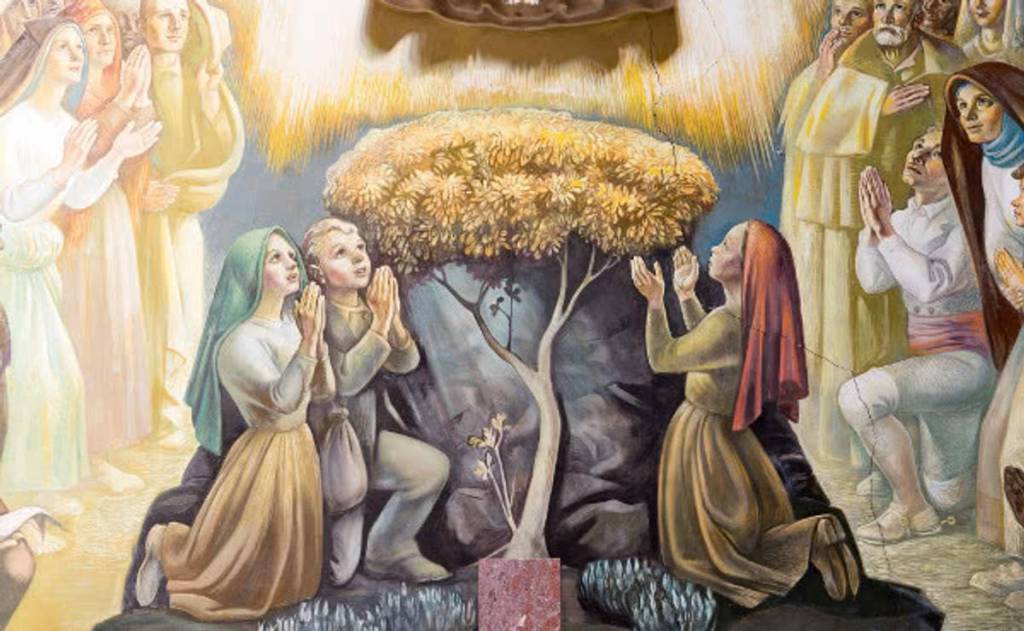
We do not all have to become mystics to believe and practise this. What a shepherd can see we can all see. So can we all see what children saw in the village of Fatima in Portugal in 1917 – a vision of ‘Our Lady of Fatima’ – as did hundreds of the inhabitants of Fatima on several occasions.
Santa Hosemaria in Fatima, Portugal picture credit: Opus Dei
I was sitting in the waiting room this afternoon whilst my car was being serviced. I had been meditating, and it was with a single point of attention that I was eating an apple when the garage mechanic burst into the room. The conversation went like this;
‘You are eating sweets.’
‘No I am not.’
‘You are eating a sweet apple.’
‘Yes.’
We probably exchange brief moments of an imagined reality with others, more often than we think. The phenomena of what is called as ‘telepathy’ which I would suggest is more subtle that ‘reading the thoughts in others’.
In my view, two people can experience the same ‘energetic patterns’ at the same time. In the above example this was the feeling experience of ‘sweetness’ observed in a split second by two non-connected but open minds. The mechanic had not seen the apple, only received the feeling of ‘sweetness’.
Mothers will probably have had many examples of understanding a child’s needs without conversation; even and especially when the infant has not yet learnt to speak.
A mother and child are indeed a wonderful metaphor for the scientific understanding that Faraday believed, that everything is merely ‘lines of force’ meeting; something natural philosophers term ‘love’. Following this reasoning I would argue that this is why when humans follow (without expectation of reward), their highest excitement, then they will create the energetic Universe that will provide them with their highest reward. Most people’s highest excitement is simply known as love and with this vibration was and is created, the Universe – and is why it is said that; ‘God is love’.
At the end of several years of Matters Blog, it’s time for a review. As complex as life is, my aim is to express opinions based on common sense rather than personal or political bias. Not only that, but to suggest original and innovative solutions many of which have not been taken from the public domain.
The famous Dunning Kruger Effect states that amateur pundits have a false self image of themselves as knowing it all, while experts constantly doubt. So how did I do?
In 06 August 2018 I identified the shortage of affordable housing in the United Kingdom as a problem and offered a solution. My suggestion was that houseboats are moored on the UK’s inland waterways, rivers and lakes. They avoid the purchase of land and as temporary structures can be removed or replaced as needed. They can be built more quickly than a house and provided in enough numbers would create a stop gap whilst houses are built. The housing crisis had not been addressed by the previous government and the new government is intent on more building houses even though there are not the tradesmen to do it.
In 31 July 2021 the blog ‘HS2 Where?’ listed twenty reasons, including cost, on why the proposed high speed train route between London and Northern cities in England was doomed to failure. In 2024 the Conservative government reduced it’s reach to just Birmingham on the grounds of cost.
In 09 February 2019 I wrote a questionnaire for people who voted for Brexit. Apparently they were insulted at the suggestion they did not understand the consequences of Brexit. The questionnaire was intended to highlight the multi level complexity of the process and predictable effects of the UK leaving the European Union. When Brexiteers are asked today what the benefits of Brexit have been, few list any precise benefit. They say they no longer have to obey EU law and have gained ‘Sovereignty’. Ask how this has affected their lives and they will struggle to give an example.
In my blogs ‘Let Me In’ parts one and two in June 2022 and ‘Head for the Hills’ in December 2022, I examined immigration into the UK via unsuitable boats. The last Tory government made this problem a priority but chose a non-viable solution in an expensive plan to send unsuccessful asylum seekers to Rwanda. The slogan of intention missed out the detail of ‘how to stop the boats’ while their policy probably did the opposite. My suggestions included allowing asylum applications to be made from anywhere in the world to anywhere in the world. That hasn’t happened but the new Labour government have pledged to close down the people trafficking gangs which I also had suggested was long overdue.
In 22 October 2023, I published a blog I had written a week earlier following the attack on Israeli defence forces and civilians by Hammas titled Shalom, Salaam, Peace. I suggested that Hammas, as the vastly inferior force to the IDF, had no means to destroy Israel and were instead baiting Israel to over react to attack. Any ‘destruction of Israel’ would be done by the other Arab nations in defence of the people of Gaza, such as Iran. Since then the Iran backed Houthis in Yemen have taken up this role and significant others. I suggested an Arab leader would appear to take on Israel which has not yet happened.
In 20 February 2023 I wrote a parable called The Holy Forest about the politics of the Holy Land and how Israel will one day realise why people resent and hate the actions of successive Israeli Zionist Governments. I further commented on a better solution to bombing in Gaza as being the use of a multinational force of Special Forces to clear Hammas out of Gaza in my blog War Without End in October 24. To date the tactics of the Israeli Zionist government have not changed or met their stated aims of saving the hostages and destroying Hammas. I called out the genocide of the Palestinian early on in the process and qouted the Israeli post WW2 mantra of ‘Never Again’.
These and other blogs allowed me as an observer to suggest descriptions of complexity and apply problem solving techniques without using the techniques of over simplification, project fear and the illusionist’s destraction.
So thank you to those who click the ‘like’ button and may 2025 give us all hope my observations will become shorter and shorter as those in charge of us work smarter and harder for the benefit of those they serve.
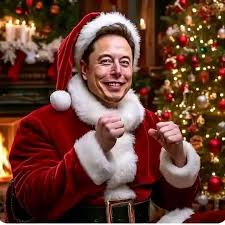
What do you associate with Christmas? A man who masquerades as someone else? A cascade of unwanted gifts? The start of a new era? Time-off to be free?
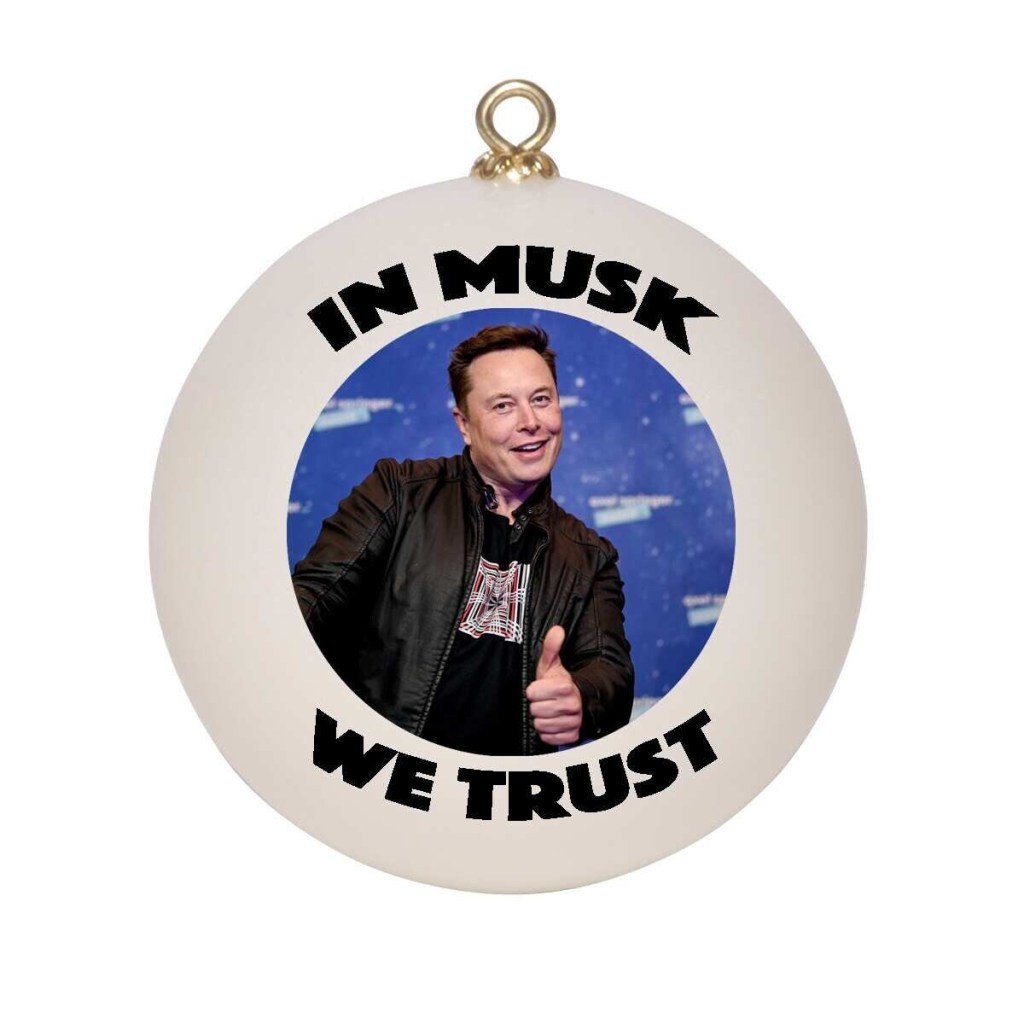
Well all of these things happen already. The man who hides a knowing smile behind a big bearded mask goes by the name of Elon Musk. He doesn’t declare any deception, but the gifts he brings us might make us question what his motives are. Is Father Noel the bringer of benign presents for the whole world? How is this even possible for one person?
We know arch deception is best done in plain view.
But if you were up to no good would you use a brand name with questionable meaning and associations – X? The ‘X’ comes from the Greek letter Chi, which is the first letter of the Greek word Christós (Ancient Greek: Χριστός, romanized: Khristós, lit. ‘anointed, covered in oil’), which became Christ in English.
So when Xmas comes you suspect Father Noel to smile contentedly to himself. He gifted his son to this world with the name ‘X Æ A-12’. What does the X branding mean? The cross is a symbol of crux i-fiction or the story that Jesus died on the X. The ‘A twelve’ he said in interview, are the twelve archangels. The AE is pronounced ‘ASH’. Is that “ashes to ashes?” Really?
The ancient Swastika purlioned by the Nazis, is still used by far right parties and is banned from public display in many countries for that reason; but it is basically an X. Broken relationships produce ex-lovers, ex-husbands and ex-wives. The films that were too disturbing to show to children used to be given an X certificate. To flee you run for the eXit. Let us face it, X is not nice. So why did Father Noel choose such a negative symbol, as did the Russians scrawl ‘Z’ on their ‘Special Operation’ fighting vehicles in Ukraine?
Imagen: Daniëlle Futselaar (artsource.nl) & IAU / CPS
A personal history of Father Noel, describing his business and political activities is available on Wikipedia. Suffice to say here that he has, and will bring, many gifts to spread around the global Christmas tree. Of particular interest is something in the realm of the angels known as Starlink and is a constellation of low earth orbit satellites. These provide internet access to previously disconnected areas of the planet, but the question has to be asked, who approved this? The USA authorities gave permission to proceed, but other world leaders were not consulted – unless or have just acquiesced in an unreported global plan. Internet access is a two edged sword, it’s darkest edge being ‘control of the masses’. Social media platforms are already known to be causing harm to the sanity of young people. Far from being a ‘fairy Godfather’ the service Starlink provides has already been switched on and off in different parts of the world for political rather than commercial reasons; it happened in Ukraine. And if the argument is that this political tool serves only the good of humanity and will not cause harm, remember the beard and friendly chuckle could be false.
Father Noel is the CEO of an extraordinary number of large, innovative companies. How can one person control so much? In politics, the President or leader of a country, delegates the matters of state to lesser politicians and civil servants.
Against the advice of his wife and in an ‘unelected’ sort of way, Noel has accepted a post in the forthcoming Trump administration. Should we seriously wonder how he can find the time? Who are his deputies and more importantly, who are his bosses? Is he a puppet hiding the machinations of a hidden Cabal set on control of the World’s population?
What were Father’s Noel’s motives for buying ‘Twitter’ at a loss of billions of dollars? Father Noel defends this vehicle for ‘free speech’ people around the globe. All are able to insult each other without risk of retribution. One is reminded of the story in the Old Testament of the ‘Tower of Babel’ where a universal language and subsequent understanding was replaced with global misunderstanding. Free speech without boundaries is, in my view, corrosive, not freedom.
Such concerns may not be spoken in mainstream media but examination of what Noel’s other companies do, all point to the removal of the freedom of the individual under the guise of doing good.
The transition from the internal combustion engine to the electric car supports the ethically ‘green’ agenda. Therefore it is good…yes? No. There are many contradictions about the benefits of electric cars which I explore in a previous blog. The main problem is that electricity from the national grid is principally from fossil fuels and nuclear power, both of which pollute the planet. Further more it is generated centrally and distributed inefficiently across national grids causing massive wastage and high prices.
Electricity is only truly ‘green’ when it is produced locally by carbon neutral sources such as solar panels, wave, wind, geo-thermal, hydro electric etc. Nicola Tesla’s ‘free universal energy’ patent might also be worth bringing out into the sunshine. The inventor of alternating current and many other innovative technologies, deserves naming a company after him producing free energy.
In my view, the closeted reason for electric vehicle production is that driver-less cars have to be powered by electricity. Cynically, we can already see that such electric cars are expensive and limited in number. When there are only electric cars allowed, they will have to be shared in ‘car pools’. Infringement of any national law will result in the removal of a citizen’s access to the government controlled car pools. The individual freedom of ownership and choice of where and when to travel, will be taken away.
Mechanised personal transport began in the early 20th century, mainly for the rich and privileged. It was never an option for the working classes. Now, once again, people are not buying electric cars because they cannot afford them. No Tesla X for you this Christmas!
But Father Noel has worse ‘freedom busting’ surprises in his sack.
Neuralink is described in Wikipedia as; ‘Neuralink aims to integrate the human brain with artificial intelligence (AI) by creating devices that are embedded in the brain. Such technology could enhance memory or allow the devices to communicate with software.’
Just as electric cars are presented as a noble way to ‘save the environment’, so too are brain implants presented as a noble way to overcome neural diseases. This repeated ‘cover story’ or being solely for the public good, should make us look for the problem it really intends to solve.
picture credit: Pinterest
Neuralink should have our frontal corteX’s shivering with apprehension.
Throughout history, personal thoughts have been the last bastion of individual freedom and until now, could never be interfered with or removed. Historically, prisoners in appalling conditions for what ever reason, clung onto their sanity by remaining in charge of their minds, their emotions and in some cases, their religious faith. Whatever kept them free kept them alive.
Father Noel is on record warning that Artificial Intelligence requires strict global control otherwise it will replace humans. As there is no such global co-ordination to erase this problem and it is unlikely ever to be so, the AI genii is already out of the elegant gift box.
At least Father Noel’s lawyers can say that he did warn us.
Artificial Intelligence in robots and our cell phones, is already learning to do things better than humans and scarily well. The origins of digital images, sounds or thoughts can no longer be trusted. AI is already taking over human employment and might ultimately lead to humans dependent on government handouts or ‘universal basic income’. If that happens, personal freedom will be severely dependent on governments and the elites. No play, no pay.
Will the rule of global law be enforced by robots? As much as this question sounds like science fiction, Hollywood has already shown us robot versus human wars.
The Matrix Trilogy builds up to an epic battle between robots and humans, as does brilliantly I Robot, starring Will Smith. But the most chilling of all horrors has to be the original Blade Runner starring Harrison Ford. In a dystopian future, rogue robots have merged with human society for evil purposes and the Blade Runners have to hunt and destroy them. The ending has an unexpected twist. The ‘replicant’ robots become so advanced that they have developed sophisticated emotional intelligence. One female robot learns to love and the protagonist robot shows compassion to Ford’s character and commit suicide rather than kill him.
The question we have to ask ourselves is, how far away is all of this and what can we do to avoid it coming true? Brain implants, driver-less cars and humanoid robots that kill humans are already real.
Democracy rarely questions technological ‘progress’. Innovation is has an impetus of it’s own. It’s a form of ‘soft war’ and we have to ask, ‘against whom?’
Whilst Father Noel is not completely responsible for these developments as other companies and countries are working towards similar objectives, X is and will continue to be a world leader. Like the fabled ‘snake oil’ salesman, what we are being offered is just a bottle containing a liquid which gives little or no benefit.
The salesman tricks us all by offering a noble universal cure to problems; especially problems we did not know existed. We hand over our dollars willingly and as we do, our freedom.
And to remind you of the meaning of X; The ‘X’ comes from the Greek letter Chi, which is the first letter of the Greek word Christós meaning; ‘anointed, covered in oil’.
‘A Merry Christmas to us all; God bless us, everyone!’
The greatest influence on me as a male child growing up in the 1950’s and 60’s was naturally, my mother. She was my a ‘perfect woman’. To Jungian psychologists, this is the ‘anima’ upon which is modelled the feminine aspect of the male psyche.
But there is also a hidden, darker side to the male’s anima. Ideally hidden from child’s view, it was available in films, newspapers and magazines more openly than it is today. There was a ‘sexual revolution’ going on in the teenage generation above me and all was sex, drugs and rock and roll. ‘Flower (femininity) power’ countered the male Patriarchal aggression of the two world wars. Women were ‘burning their bras’.
Psychologists might view this as a healthy revolt against conformity through open expression of emotion. The mind bending drug culture and sexual freedom of that generation erupted and continues to this day.
The dream goes back to the Garden of Eden and the myths of Christianity. Adam and Eve were exposed to their own nudity and felt shame for the first time; their mutual feelings of new found lust moved into era of ‘covering up’, but the fig leaf was nowhere near big enough. The characters in the Old Testament carried out a lot of begetting and smote-ing. The Ancient World was like the Wild West and it needed a Sheriff to calm things down – Moses.
In the New Testament, Jesus’s mother, Mary, had to be ‘free of original sin’ meaning starting afresh. But how could the mother of the new Christ reproduce without being associated with the shame and guilt of sex? The answer was simple, sophisticated and a mind bender; the mother of Christ is a virgin.
Another convenient proof – after the fact – was provided. Mary’s husband, Joseph, was too old to be a father; so confirming Mary’s ‘immaculateness’. In Renaissance paintings of the Virgin Mary, her guiltless face looks lovingly down upon the infant Jesus, suckling at her breast. All was neatly explained.
Leonardo da Vinci’s ‘Madonna Litta’
The problem is; femininity isn’t like that. There is more than a hint of ambiguity in the archetypal feminine, because it is dark as well as a light; a destroyer as well as a creator.
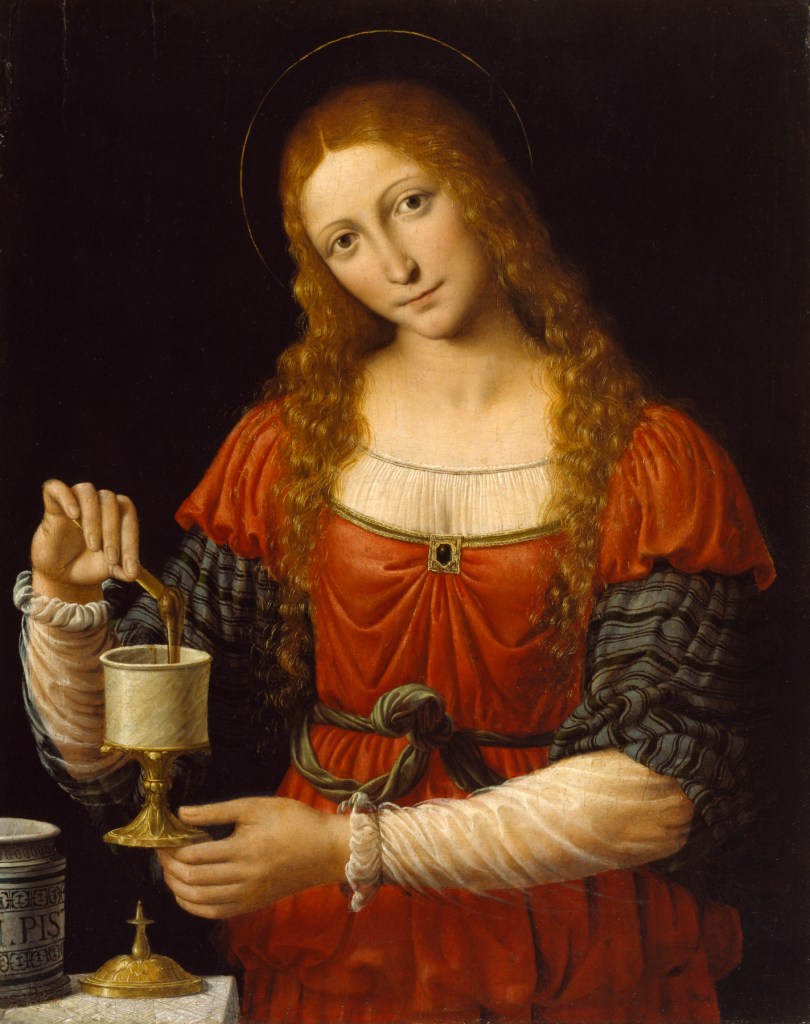
The church fathers cleverly wrote this contradiction into the script and they did it by depicting ‘Mary Magdalene’ as a prostitute. If Mary and Joseph didn’t ‘do it’, then Mary Magdalene certainly did and according to the Catholic Church, she did ‘it’ plenty. But we might regard this depiction of Mary Magdalene as suspect, not least because the word ‘prostitute’ does no appear in the Bible and because Magdalene or Magdala sported the uncompromising title; ‘The apostle of the Apostles’.
Saint Mary Magdalene by Bernadino Luini – Italy – 1524
How much should we go along with this dichotomy of femininity? Was Jesus in his later life, such a bad character as to keep company with a ‘fallen woman’? The fiction survived until 1969 when the Catholic church declared the Magdalene was not a prostitute after all. But was the damage to women in general irreparable? What were the consequences of this unjustified denouncement of womanhood – ergo the Divine Feminine – by the Patriarchy?
Most frustrating of all about the Magdalene lie is that there had always been another version of her in the Gnostic Gospels or Nag Hammadi Library of the Essenes. In ‘The Gospel of the Saviour’ Jesus describes her as ‘the woman who knows the All’. Jesus must have had many female disciples and it appears that he initiated Mary Magdalene to the highest level. In contrast, the male disciples come over in the Gospels asking dumb questions; you cannot raise the consciousness of those who are not ready – too much ego.
Even Simon Peter was in denial of his faith when asked. In my view Simon Peter, might have been nick named the ‘Rock’ by Jesus because he was spiritually calcified. The Roman Catholic Church in building itself upon the character of Simon Peter, has certainly reflected much of Peter’s stiffness through the centuries.
Mary Magdalene on the other hand was not bland and serves our understanding better as a complementary female counterpart to the male Christ figure. Her wisdom represents that part of the Divine feminine which men find hard to understand. To paraphrase Bob Dylan, she, ‘takes…aches…fakes…just like a woman…with her fog, her amphetamine and her pearls’.
Joan of Arc by Jean Auguste Dominque Ingres 1854
If a further example of the positive anima was needed, then the figure of ‘Joan of Arc’ serves well. She was a saintly virgin with the Creator speaking in one ear and King Charles VII in the other. Joan’s knightly armour represents the code of chivalry brought back by the male knights during the Crusades, a code that held women in the highest esteem and made men bend at the knees in their presence, literally and metaphorically. Joan of Arc was a gender reversed version of knightly chivalry and the reverence owed to perfect womanhood. As a Christ–like heroarchetype, she had to suffer an early martyrdom in the hands of the Judas figure – the traitorous Duke of Burgundy. The character of St. Joan, you might feel, is just too goody goody. She needs less fire and more earthiness, more representative of the daily and nightly amours of the common man and woman. In a word; balance.
A more healthy expression of gender roles and spirituality can be found in sculptures of Indian Temples. The depictions of Tantric sexual intercourse in the statues must have made the Victorian missionaries blush. This was not the ‘virginal’ forbidden fruit that created so much male hypocrisy in Victorian society; from Royalty to the gutter creepers. In India we see an understanding and embracing of the spiritual power of sexual energy and an aspiration to achieve immortality through it, for both parties.
Hero Chamunda – Tantra at the British Museum
The two versions of femininity could not be clearer. Whilst the creation of the Raj was believed to be a ‘civilising’ of India and it’s people, the reverse could have been true. The depiction of sacred male and female sexual energy was brought back to Victorian England between the covers of the Kama Sutra and Arthur Avalon’s, ‘Serpent Power’. But their enlightened texts failed to remove the curtains from the legs of pianos of society’s ‘well to do’. Such sexual repression, psychologists now know, creates destructive, unconscious fantasies in the male psyche. A contemporary expression of this was the so called ‘Jack the Ripper’ who murdered prostitutes in Victorian London as readily as the Church burnt ‘witches’ in Mediaeval Europe; probably for the same reasons.
Edvard Munch – Vampire
In Jungian symbology, the negative anima in men is likened to a Vampire that sucks a man’s life blood and by implication, their very Soul; dangerous territory. The term for such a woman in 1930’s, 40 and 50’s was appropriately a ‘Vamp’. Her picture adorned many a barrack room wall. As an aside it is interesting that in the eponymous film, the God-fearing General George E. Patton angrily tore down a soldiers pin-up of Lorraine Bond with the words, ‘this is a barracks not a brothel!’
The evolution of the internet and instant ‘view in private’ pornography, has pushed images of the negative anima onto a new generation young, vulnerable males apparently without consideration of consequences. The pornography and sexual violence on view is far more mentally poisonous than those penny-slot machine Edwardian ladies undressing before voyeuristic butlers. The United Kingdom is currently considering a law to ban the under 16’s from social media, and Australia just dropped the idea.
In 1950’s Britain, the main stream media exploited the saucy postcard ‘seaside’ style of humour, ripe with sexual innuendo. In a sort of uniquely British way, sexual ‘goings on’ were laughed off socially as a bit of ‘slap and tickle’. The ‘Carry On’ films had audiences falling off their seats. Sex and gender jousts were fun and funny.
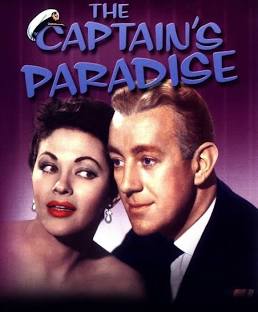
In this vane, Alec Guinness starred in a 1953 film called ‘Captain’s Paradise’. His character was the Captain of a ferry working between Gibraltar and Spanish enclaves in Morocco. The gag was that he had a wife and mistress with opposite and (for him) complementary characters. In Gibraltar his English middle class wife played by Celia Johnson, spent her days engaged in housework and domestic trivia, in preparation for her husband’s return. In the mid point of the ferry voyage, the Captain always turns his domestic wife’s photograph around in his cabin. Once the reverse side is a photo of his exotic lover played by Yvonne de Carlo. She is by nature a hedonistic, sexually alluring young woman who loves to drink and dance the nights away with her sea Captain. In the end it all goes wrong but the point is clear. Men idealise a particular woman who is a projection of both their negative and positive male anima.
It should be acknowledged that the female anima in the male psyche has an equivalent in women which Jung called the animus. The reader is invited to study this yin yang polarity. Let it be enough to know that the sacred dance in the affairs and affairs of men and women is one that can and should be, vital to their individual spiritual transcendence.
As a summing up and because I like an answer of any kind, I quote Joseph L. Henderson in ‘Man and His Symbols’ p. 157;
“Any of us can see, of course, that there is a conflict in our lives between adventure and discipline, or evil and virtue, or freedom and security. But these are only phrases we use to describe an ambivalence that troubles us, and to which we never seem able to find an answer.
There is an answer. There is a meeting point between containment and liberation, and we can find it in the rites of initiation that I have been discussing…
…Initiation is, essentially, a process that begins with a rite of submission, followed by a period of containment and then by a further rite of liberation. In this way every individual can reconcile the conflicting elements of his personality: He can strike a balance that makes him truly human, and truly the master of himself.”
In highlighting the two Mary’s the ‘unresolved’ feelings within males needs such resolution. The Christian religion includes these processes in it’s rites of passage; (submission – mass) reconciliation (confession) and liberation (priesthood) but few ‘initiates’ become masters of themselves because, in my view, St. Peter keeps the key to himself. No gnostics may enter!
For me, the ‘sea captain’ of within, cannot and should not, keep up the charade. The individual needs of the women who are subject to anima projection, rightly demand their own initiation path.
The unresolved in worldly affairs takes place in order to illuminate and help us work through the contradictions within us all.
This ‘fight’ – which scales down in simplest of terms to ‘evil and virtue’ – is indeed hard to reconcile and much of the world’s greatest literature and other forms of expression, unpeels this angst before our eyes.
My thoughts were turned to this subject when I scolded my cat Spooky. I shook my finger and looked cross. ‘Naughty! He slunk off guiltily. Just a few moments later he re-appeared and jumped up onto my lap. I realised that the incident had been completely forgotten in his mind, although in mine it was still fresh. I concluded that animals move through a series of disconnected events and are present most, if not all of the time, in the ‘now’. If they remember anything of the past it is only ever locked in their instinctual memory; the place where they store their ability to hunt and fall on four feet.
The Cat Righting Reflex, the perfect ‘Now!’
One might consider the well known psychology experiment by Pavlov who rang a bell before a dog’s meal time and he observed they salivated even though there was no food. Their response to the bell produced an anticipation of food. I would argue that the link is again instinctual memory rather than dogs imagining an event in the future as humans do.
Humans and animals experience time in the present, but humans go beyond this. We will form memories of past events from which we can recall at will. Films featuring an amnesiac character such as the Jason Bourne series of thrillers, show how difficult it is the function socially without memory.
Then we can imagine future events and manipulate in our minds how we will would like them to turn out or not. As children, we learn about danger by experience or parental instruction; ‘don’t put your hand in the fire’. By imagining an unpleasant future outcome, a bad experience can be avoided.
What the past and future have in common is the concept of time. Neither are occurring in the present moment. Therefore, we can argue, that before humans had the concept of time, events were experienced in the moment. Tribal myths and legends, passed on over the camp fire, were the only record of the past.
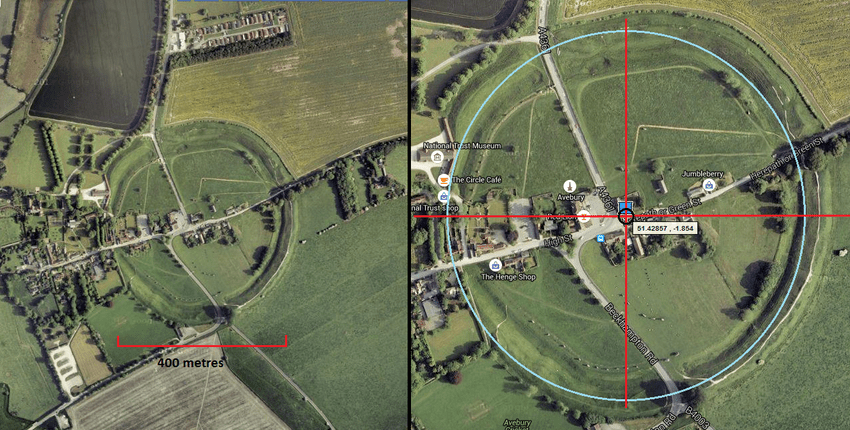
Avebury, England: Larger than Stonehenge containing Sun and Moon circles within a ditch and henge.
But these ‘disconnected events’ were at some time, observed to repeat as patterns. The passing of the seasons was undoubtedly a serious matter. Solar and lunar observatories were built all around the world and the Wiccan solar festivals remind us of this function. Megalithic henges and stone circles are commonly found to be astronomical calendars able to measure and predict the solstices and equinoxes. This was more than for agricultural use as archaeologists believe and relate to complex permutations of universal energies.
Although various crude clocks were used such as sun dials and candles, it was not until the 18th Century when an English clockmaker John Harrison invented the marine chronometer. This was a critical moment in history for it meant that navigation of the seas was made considerably safer. The precise time from an chronometer, reliably indicated the longitude on long sea voyages. When combined with the latitude from the height of the sun at midday, this gave navigators the precise position of the ship. The measurement of time not only fixed points in the day and night, but one’s location. Experiences in known time and space joined together in the age of science and reason.
Ariadne hands the thread to Theseus: depicting the wise aspect of his Anima
There is a story from Ancient Greece concerning Ariadne and her lover, Theseus. Theseus was charged with destroying the Minotaur, a flesh eating monster that lived in the centre of a labyrinth. Ariadne gave Theseus a ball of thread and instructed him to unwind it as he walked through the labyrinth, thereby finding his way out. Theseus successfully killed the Minotaur and escaped to Crete with Ariadne.
Ariadne gave Theseus a novel aid to connect the otherwise confusing experiences in the labyrinth, in a rational and repeatable way. Instead of disconnections which lead to the experience of ‘where am I?’, Theseus was able to rationally and repeatedly connect together these individual events. He was the first of Ariadne’s suitors to avoid being consumed by fierce panic and confusion, and by mastering time and location, escape.
The thread in this story, I suggest, represents Time with a capital ‘T’. Although an abstract concept and therefore not ‘real’ to the five senses, the continuity of experience created by time helps every human on their individual journey.
TI – ME
When we tie (TI-E) our experiences together we are able to overcome the monster within ourselves (–ME) and become our Higher Self.
The Sufi’s have an exercise which is conducted just before going to sleep. The entire day is recounted backwards in as great a detail as possible. There are no ‘conclusions’ or ‘observations’ to be made other than to ‘rewind’ daily experience.
In this way a continuous memory is formed of that day. This technique can be used after the death of the body as an objective review of one’s life is rewound before one’s eyes and beyond into the afterlife. Just as time does not exist in our dreams, so time ceases to be useful after death and we enter the fabled ‘eternity’. The fabled ‘lost souls’ of pergatory are those that have lost control of their ability to consciously move from one experience to another. Some even become locked in a repeated event in as described in the story of Tantalus. His condition was not ‘punishment’ as moralists believe but a state of mind.
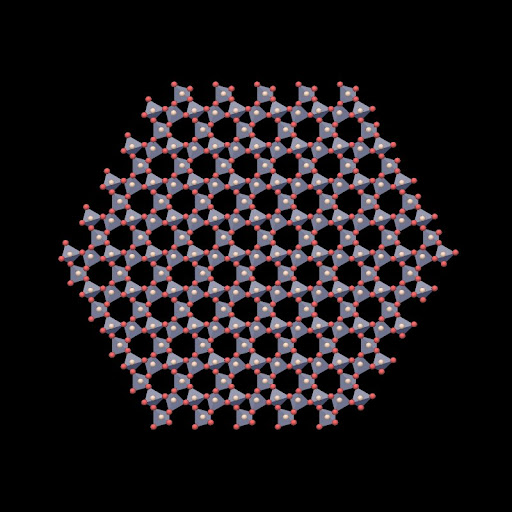
However sophisticated modern technology becomes, it can only ever approach the idea of infinitely fast things, never achieve them. When a quartz crystal has a tiny electric current pass through it it vibrates at 32,768 times a second. Nature is astoundingly constant in this respect and gave us quartz watches and other electronic devices. Just as quartz crystals are tetrahedral arrangements of oxygen and silicon atoms so precise that light passes straight through it, so it vibrates perfectly constantly.
The same clarity of experience is reproduced in spiritual practice by what is called ‘invocation’. In many mystical practices around the world, a student is tasked with the silent recitation of holy words. This ‘mantra’ is recited within the heart whilst experiencing, not negating, ordinary life. It is a task requiring Herculean concentration and effort, taking a lifetime to master, if ever at all.
The effect is to link the events of daily life in the way that an old fashioned movie film has regular cut outs on either side for the projector to connect with and move the film along at a regular speed. The illusion is one of still images that change imperceptibly and at thirty frames per second.
However difficult it is to understand how individual images scroll at speed, we do not need to know. The imperative is that one maintains the ‘I’ or ‘eye’ of the individual light bulb in the projector…whatever the story that is being projected.
Just as Theseus creeps closer to the centre of the labyrinth, so the observer creeps closer to their God within, using the technique of invocation. Like a cat watching a mouse hole, one’s concentration is fixed; mouse or no mouse.
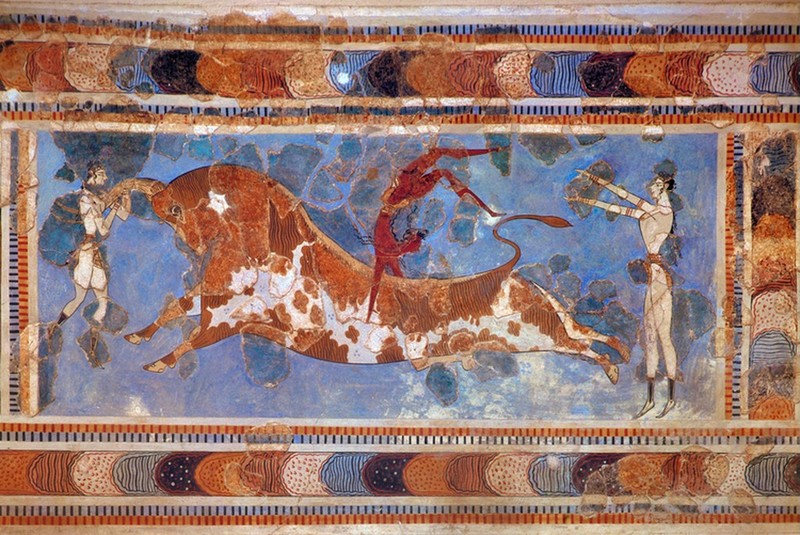
The Taurean Age of Civilisation on Crete, The Minoans
The slaying of the Minotaur in the age of Taurus, was central to the Minoan civilisation. The dark corridors of life have to be travelled so that the God-self can be discovered. The Beast or Minotaur is the same archetype as in the story of ‘Beauty and the Beast’. It is only truly known when love of true Self, slays the hideous ego.
This Jungian psychology is strangely connected to our modern day by the mystery of ‘time’ and the passing of discontinuous events that can warp into psychosis. The illusion of time becomes, in the clinically ‘sane’ at least, a constant ‘glue’ that makes experience appear continuous. But, just as in the beating chambers of the heart, time has an uncanny ability to increase and decrease it’s pace. Wonderful holiday experiences can fade all too soon while interminable waiting in the airport lounge has no end.
Physicists have there own story about this phenomon. In Albert Einstein’s ‘General Theory of Relativity‘, time is described as being something which can lengthen or shorten in it’s relation to space. ‘Time Dilation’ states that as an observer approaches the speed of light, time slows down. An astronaut might therefore return to Earth after a journey to the edge of the Universe at ‘warp speed’ and find that he or she is younger than their children.
Such concerns await us in the future. For the philospher, the task is to get to grips with the every day meaning of the passing of events. Can we keep a grip of the thread laid out to guide us through the labyrinth? Can we slay the monster within?
The Labyrinth in Chartres Cathedral, France: A Message from the Medieval Masons through time picture credit: Helen Mueller
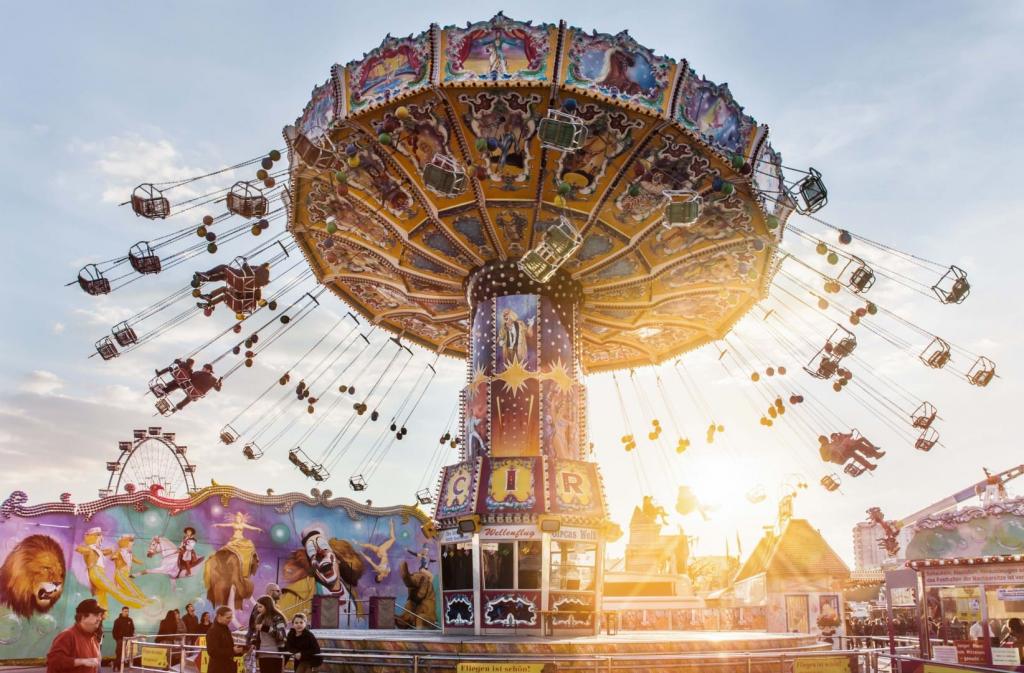
Everyday life can be intoxicating. Events carry us along as though we were riding a giant merry go round in an exhilarating Fun Fair. We spin and spin in the whirlpool of coloured lights and sound. We catch glimpses of people riding other horses and try to connect with a wave and a scream. And occasionally, we catch sight of a loved one stood watching on the side.
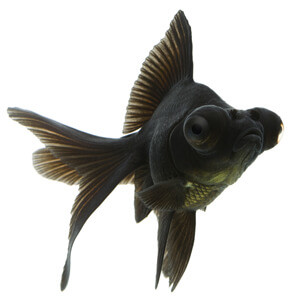
Perhaps fish have a similar experience in the wonderful underwater world of spectacular coral reefs. But if you were able to ask them about water, they would deny all knowledge of it.
picture credit: Wilkins Safety Group
The human Fairground shares this same irony. The people of earth, mostly deny there is anything other than matter and the pleasures that, if we are lucky, it facilitates. Surely there can be nothing better than an ice cream and holding hands with a loved one.
Yet we know as we age, that life is not like a fairground at all. We can have upsetting experiences from which we have no defence. We can fall and perhaps never get up. Just as the fish are subject to water temperature, tidal surges, currents and long periods of calm; so humans are at the mercy of unseen forces.
The point is a simple one. That there are many levels of experience. The simplest and the most common is to believe that human life is one of sensual pleasure. Some religious people reverse this and live a life of abstinence, without realising that they must be as attached to going without pleasure as others are to pleasure.
Today both scientists, philosophers, intuitive s, artists and mystics explore the idea that in parallel with ‘normal life’ is ‘spirit’ or ‘energy’. Einstein expressed this in his formula E = mC2 in other words, matter can be exchanged for energy and visa versa. It’s not really anything new. Indigenous people around the world and the ancient civilisations have and continue to connect with worlds of ‘spirit’.
To realise this is equivalent to the fabled fish becoming aware of water.
picture credit: Caring For Pets
Spiritually aware humans travel two paths. In the material world they have to learn to achieve some kind of tranquility, which is hard. In the spiritual world their aim is the same and lessons from the former can be applied to the latter. This is described in the Hermetic Law of Correspondence; ‘As above so below, as below so above.’
This knowledge is not new but perhaps is in sharper focus now than any other time in recent human history, at least in the last thousand years. The rather hollow platitudes of most religions and their exponents are giving way to ideas of ‘spirituality’ and ‘energy’. There is silent revolution taking place. Forces unknown are lifting humanity from it’s experiential squalor through such means as naturally occurring energy in the earth and the heavens.
In this ‘spiritual realm’ are what we might term ‘thoughts, messages, knowing, feelings’ and all the untouchable, invisible intelligences that suffice our daily inner experience.
picture credit: Medium
In the science fiction film The Matrix, there is a character called ‘Smith’. He identifies as an algorithm or programme that can replicate itself in any other programme in the Matrix; depicted as a world of illusion as already lives in computers. This programme is immensely powerful and frightened only of the love and truth contained in the hero character, Neo.
We should ask ourselves how real our lives are and ponder on that which we find. In the modern world we sometimes feel mesmerised by the power play of politics and the cultural, religious and social conditioning that we accept as is ‘normal’. It’s what we learnt in our first seven years of life.
Yet there are very destructive spiritual forces that operate against our best interests and try to take over our ‘normal’ world in the same manner that Smith acts like a malignant programme in a computer. This is revealed today as the organisations made up of the powerful and wealthy elite, whose conscious or unconscious function is to spread chaos and division in the populations of the world.
An example would be the political movement known as ‘Black Lives Matter’. Whilst most reasonable people support any and all communities and social groups subject to unfair and degrading treatment by others, we have to ask who created BLM, and who is funding it? Why were those who self identify by the colour black selected to become an activist organisation and not, for instance Hispanics, Asians, Indigenous Peoples and any other of the racial or social group who are wrongly discriminated against. Surely, common sense says that all lives matter, equally?
Any thought engineering whirlpool becomes meaningless the more it is given rational consideration. ‘We all matter and we all support each other’ would be a sentiment closer to the ideal of universal mutual love that most rational people support.
Beyond the ‘moral high ground’ that is so readily occupied by the ‘politically correct’, we might observe a more sinister motive; to separate ethnic groups so that they fight each other. Hatred and destruction triumphs in the guise of goodness.
Such ‘Smith’ programmes are increasingly prevalent today. The most obvious is the war in the middle east at the moment. Culturally and spiritually, those fighting each other have more in common than they have differences. The ongoing dispute of today must have been clear to the British when they ‘gave’ Palestine to the Jews and Zionists in 1948. The Palestinians did nothing to deserve to be ejected from their homes and land. At the time the gesture was doubtless made on a wave of sympathy for the Holocaust survivors but over decades has revealed itself to be a recipe for disaster. Again, we observe a malignant programme which was readily absorbed like a black suited, self reproducing ‘Smith’.
This process is not just visible in world politics and human discourse. There are many ‘natural’ disturbances and weights seeking to counterbalance and overturn human society. Examples would be astronomical, astrological and environmental changes that are producing enormous stress within human societies; particularly to those without the power to protect themselves from harm.
I believe that these malignant ‘thought forms’ or ‘evil spirits’ can be overcome by the spiritually aware and empowered. Beyond any identification with a particular religion or political persuasion, the power of love in the spiritual dimension is very capable of overcoming hatred.
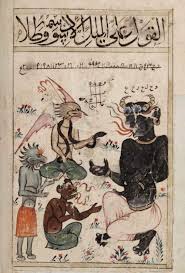
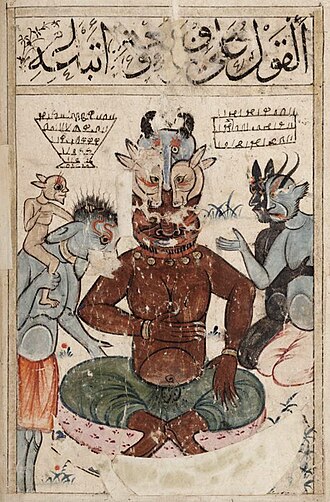
Kitab Al Buhan – Demons
Like the human body, spirit has and is an immune system. Whilst disease (or unease) may attack repeatedly from many directions, a spiritual person enveloped by love is indomitable. Not only that but as love is universal, it too can replicate and stretch out to every cell in the Universe and protect whatever disturbs celestial harmony. Right now it has an Herculean task, and incumbent upon every human being is to pay attention and respond.

























 Matters Blog