The Problem Problem

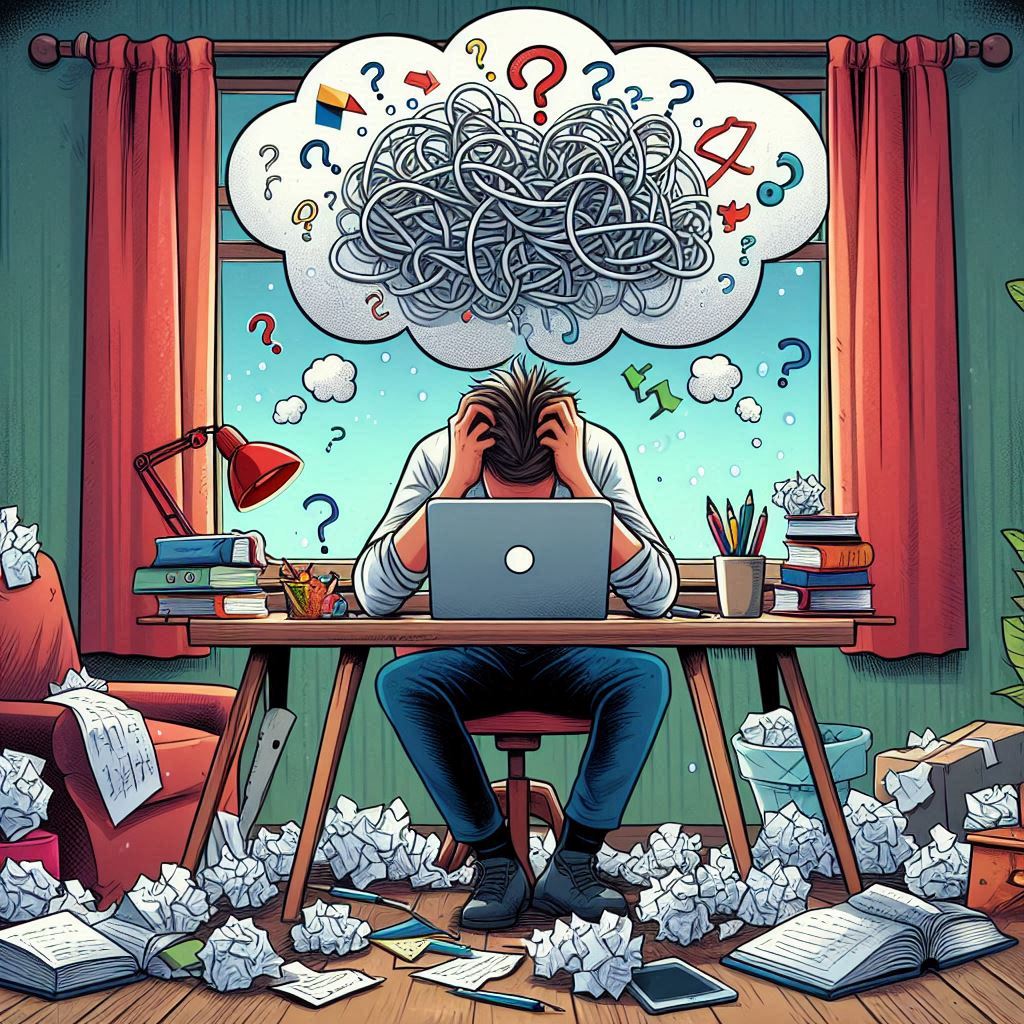
The problem with problems is that their solution requires skilful analysis and creativity.

This is obvious except – who teaches problem solving? Overcoming difficulties is something we expect children to ‘pick up’, as learnt behaviour. By the time we reach adulthood, overcoming complex challenges is assumed to have been mastered. Yet, the problems that we encounter through life, if not solved properly, can have just a devastating effect on our lives as a metaphorical bomb. It is the same for those in charge of large corporations and governments who are known to rely on learning from failure as a somehow justifiable, problem solving technique. The joker advises, ‘try everything until something works’.

There is a story which you are likely to know, about a group of people in a dark room describing an elephant. Each holds and touches a different part of the elephant, which stands patiently; wondering where the light switch is. At the end of their examination each describes the unique part of the elephant that they have examined. None of the participants has an overview of what the whole elephant looks like, so they are all wrong.

It’s a wise story. What it tells us is that everything is not as it appears. Many things are extremely complex and far larger than our expectations and experience and greater than our abilities to interact with them constructively.

As we go through a physical life on planet Earth, we are constantly challenged. The material world is in a constant state of entropy, causing repeated and unexpected disruption, such as your car breaking down or your body ageing.

Because we are human, our ego’s present us with a story about ourselves which says optimistically, ‘I can cope’ or pessimistically ‘I have to die sometime’. If we took a step back and looked at the problems humans suffer, our sense of ‘everything’s alright’ would be replaced humility without pessimism.

Religions have picked up on this and many require the congregation to fall to their knees in the face of that elephant that sits in our minds; vanity.

Yet, is it not courageous to look adversity in the face and smile? There is an archetype of this model which is ‘the hero’. He or She is a humble human who manages to overcome all sorts of impossible problems and captures the prize! Whether this is Odysseus on his epic voyage or Superman defending New Yorkers; heroes have super natural knowledge and powers.

Or do they?

In native communities, education of children consists of physically showing them the problems of bush-life and how to overcome them. An Australian First Nation child will be shown how to collect honey from trees without being attacked by bees and leaving enough for the colony to survive.

But in modern fast changing societies, complex problems are expected to be solved by those who have no prior instruction or experience. Government ministers frequently display an extraordinary naivety when it comes to their principal role, which is to allocate resources and make laws that solve society’s problems.

The examples are numerous. In the UK and many other nations, people are landing on beaches and demanding asylum; as is their right in most countries. The ‘sticks and carrots’ that have led them there are numerous and complex.

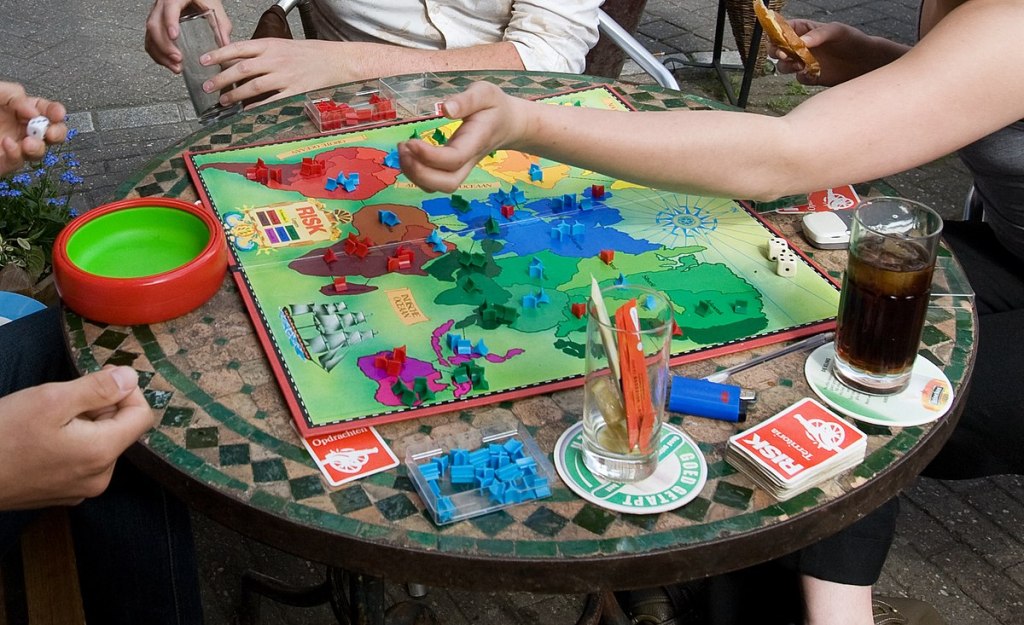
Attempts by nation states such as Spain, Greece, Italy and the United Kingdom to ‘stop the boats’, take hold of merely the elephants tail whilst imagining the little tassel on the end is the elephant. One government suggested that a threat of deportation to a third country will stop people reaching their shores in unsafe boats. Another political party takes hold of the metaphorical elephant’s leg and suggests that putting the organisers in jail will stop the problem; which again will not be ineffective because the elephant is not a leg.

In the Middle East, you have to ask what problem Israel’s government is currently trying to solve with open hostility against it’s neighbours. Problems of the people of the tribe Judea go back millennia, yet the Zionist government repeatedly tries to argue that the present problems started on 7 October 2024. Were it so simple to be true. Were the whole truth be known.

When the Sars-2 Covid virus was ‘mysteriously’ released in 2021/22, the problem was not examined in full, and when a solution was required, the pharmaceutical companies were able to react almost immediately. Inquiries into the response to the pandemic uncover ineffective, wildly expensive responses. Countries that did almost nothing like Sweden, and much of Africa came out the best.

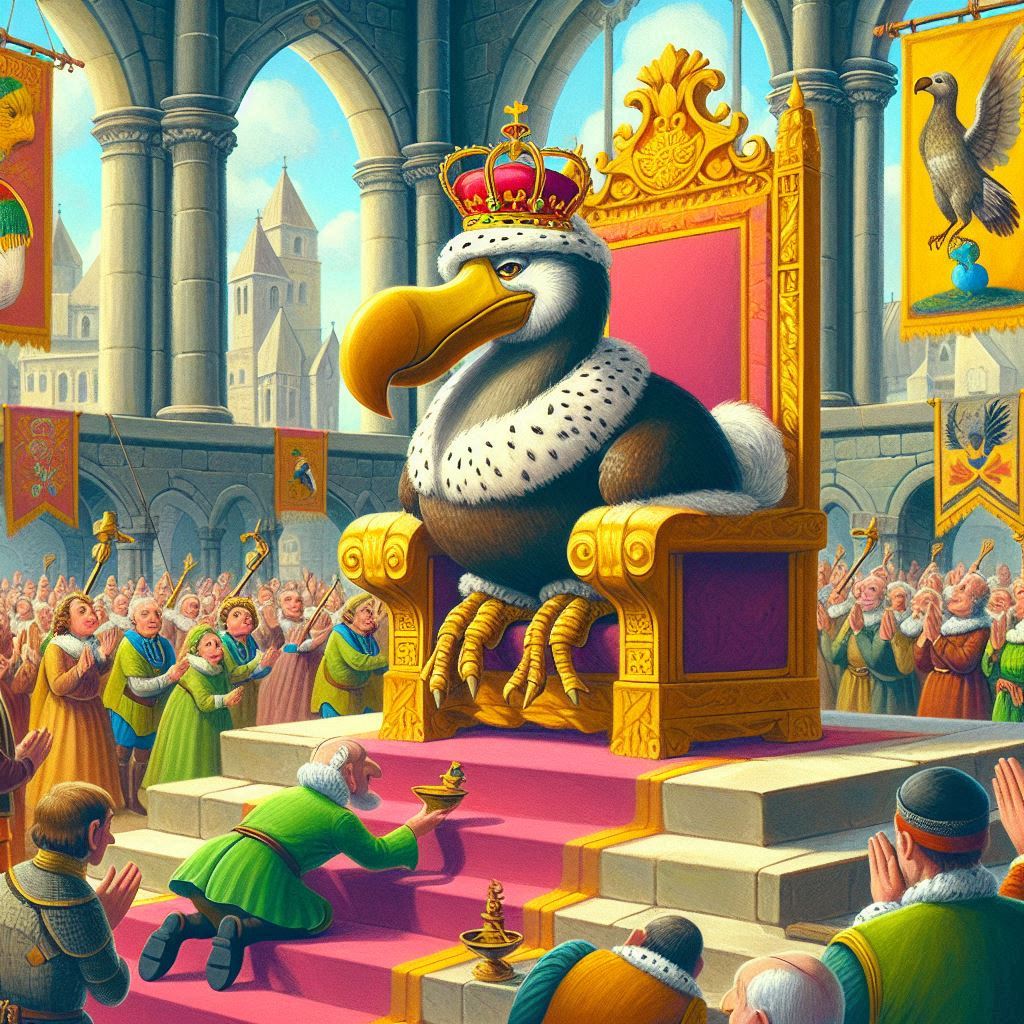
The ‘Do Do’ was a bird that flourished on the island of Mauritius until humans appeared in wooden sailing ships. The hapless birds wandered around in a dream, not expecting to be eaten by hungry sailors. The flightless birds had failed to solve their problem. The Portuguese word ‘do do’ means ‘stupid’ which the birds were not, but victims of those who should have understood sustainability.

Today, humans are facing similar population collapse or even extinction from multiple directions.

In my view, oligarchs and corporations, secret societies, media moguls, ‘big pharma’, the military industrial complex, and international criminal organisations exploit human weakness of poor problem solving by deliberately making problems. Interference in elections, rumour and propaganda, distortion of truth, psychological warfare, hacking, negative suggestion, assassination by ‘dirty tricks’, creating riot and unrest, reducing and disrupting food supplies, and many other techniques, are deployed against unwary populations. All whilst any government that genuinely cares for it’s citizens, is running to catch up.

Understanding the causes of problems is the first step to find a solution. The problem must be understood in every aspect of it’s nature and origin, in a unbiased and factual manner. Then a tested solution that is ‘cost benefit’ proven, has to be found and implemented in a timely manner.

When examining the many problems today, all over the world, you might expect a supposedly neutral and unbiased organisation such as the United Nations to have a department that is expert in defining and solving problems. The Secretariat, the Economic and Social Council and the General Assembly are ideally placed to work in this way, and yet world problems continue to cascade out of control. The United Nations has bravely spoken out early about the genocide in Palestine, but has not stopped it.

Stopping a descending spiral of harm, characteristic of weak problem solving, becomes a battle with a Giant, that even global organisations with their huge resources can not win.

Have we put the Do Do’s in charge?

Whirled Without End

The beginning of now

When we look at the art of ancient times it is striking how the world is represented in two dimensions. From the beautiful court scenes from Mogul India, Japanese and Chinese evocations of nature, the wall paintings of Egypt and Mayan and Aztec relief sculptures of Central America.

At the same time and for too long, the world was conceived as a flat plain. If you travelled too far you would fall off. It’s an understandable world view, yet the believers in this theory never questioned how deeply a well could be dug before a hole appeared.

This perceptual paradigm was founded in a vague adherence to the dominion of the Divine Male. The Old Testament God was a man – naturally. Animals marched into Noah’s perfectly measured Ark, 2×2 and cells have been splitting that way ever since.

Roman armies marched in two step time and in battles formed orderly squares allowing all round defence.

Sacred buildings were rigidly formal and measured, such as the Parthenon in Ancient Athens. The Ancient Egyptians were equally inspired by formal and exact right angled geometry.

This male principal permeated the theory of design and practice and in doing so formed a reliable and solid ground work for our modern era.

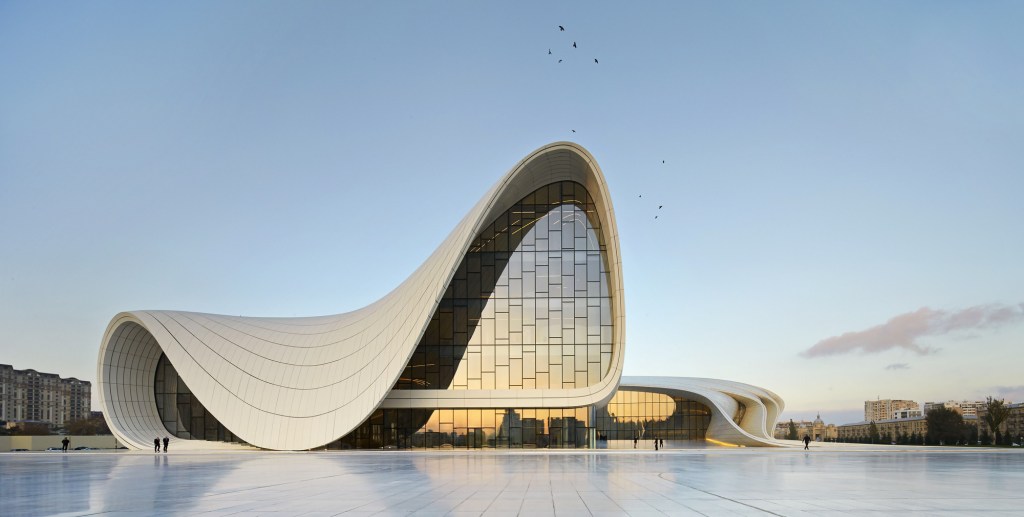
When I became a student of architecture the tutors ask us on our first day what we would bring to architecture. Somewhat naively and immodestly I said I would bring the curve back to architecture. Even headlights on cars in the 1970’s, headlamps on cars were changing from being round to square.

I had a feeling of a ‘brave new world’ which indeed has happened even if I had to let the brilliant Iraqi architect Zaha Hadid, steal my thunderbolts.

picture credit: Arch Daily

As a boy I used to cycle down to the south coast of England where the land meets the sea in tall chalk cliffs. Creeping along the grass to perch on the precipice to look down at the black pebble beaches far below, I was like a seer peeping over the edge of a flat world, into a third dimension.

Whether we see it or not, we are also now creeping warily into a fourth dimension represented by the principal of the ‘sacred feminine’.

This has nothing to with ‘Votes for Women’, a movement that swelled at the beginning of the nineteenth century perhaps as a natural protest against the male principled dominance of society since for ever. The First world war was perhaps, the last breath of that male principal. It briefly stopped the feminine protests and sent women to factories to build the instruments of war, but the corner had been turned. Women drove buses and ambulances and had tasted freedom from domesticity.

Mothers watched their sons march into the sunset, over the horizon and would never forgive the folly of the male Generals and politicians.

If you hold a ball in front of a child and ask, ‘where does this ball begin?’ the child will look at you as if you only have half a brain and explain that a ball has no beginning.

The question is a Koan and like all koans, challenges the rational, logical and formal pathways of thought.

Many dogmatic religious thinkers hold to the notion that the world could possibly end and proponents of this will present you with a date. Presently it is 13th August 2025 ‘according to Nostradamus’ and this date will, no doubt, pass without incident just as did the Christian Calendar’s year 2000 BCE.

Learning about the sacred feminine is a ‘learning curve’ upon which we still struggle, like young penguins sliding ungracefully up the steep slopes of an iceberg.

Ask an Astrophysicist when the Universe began and they will generally reply based on the so called ‘Big Bang’ theory. Yet the question is as absurd as guessing when and how the Universe will end. Anticipating the common sense of children observing the universe, I would expect they will say it never began and will never end.

That is the beauty of the child’s mind. It still retains the influence of the Divine Mother, before it is sent to the (male) military styled regime of education.

Yet I feel the influence of the Divine Feminine is more influential in modern Western societies than ever before. Parliaments and Judge’s benches are becoming equally filled with women as men.

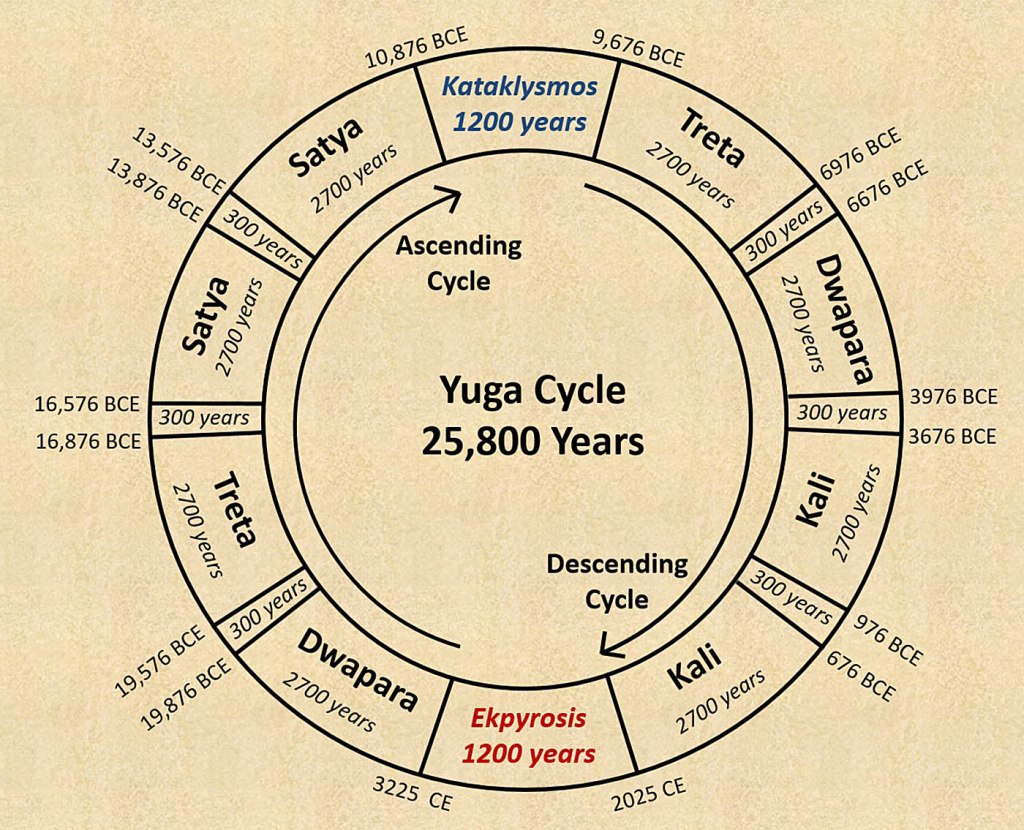
From Ancient India we are given the map of the idea of the cyclic Yugas; eras circling around 25,000 years in which the world is alternately destructive and creative.

picture credit: Ancient Inquiries

In the view of many, the Age if Aquarius is happening now and introducing the Feminine Principal into all areas of life and knowledge. Exceptions abound of course, as the process is gradual and takes two steps back for each three forward.

The benefit for humankind will be to realise when the pendulum is suspended equally between the two Divine Genders. Modern Feminism becomes flawed when and if it tips the balance too far and unnaturally dominates the male principal.

In Ancient times there are a limited number of symbols that appear in wall paintings and petroglyphs literally, around the world. One of them is the spiral. This remains one of the most easy to comprehend illustrations of an idea that defies logic; infinity. A spiral apparently starts from nowhere and disappears into nowhere.

If something were an mass moving through a void, it would need a circular motion combined with a constant, weak tangental vector, nudging it ever off a circular orbit out of sight.

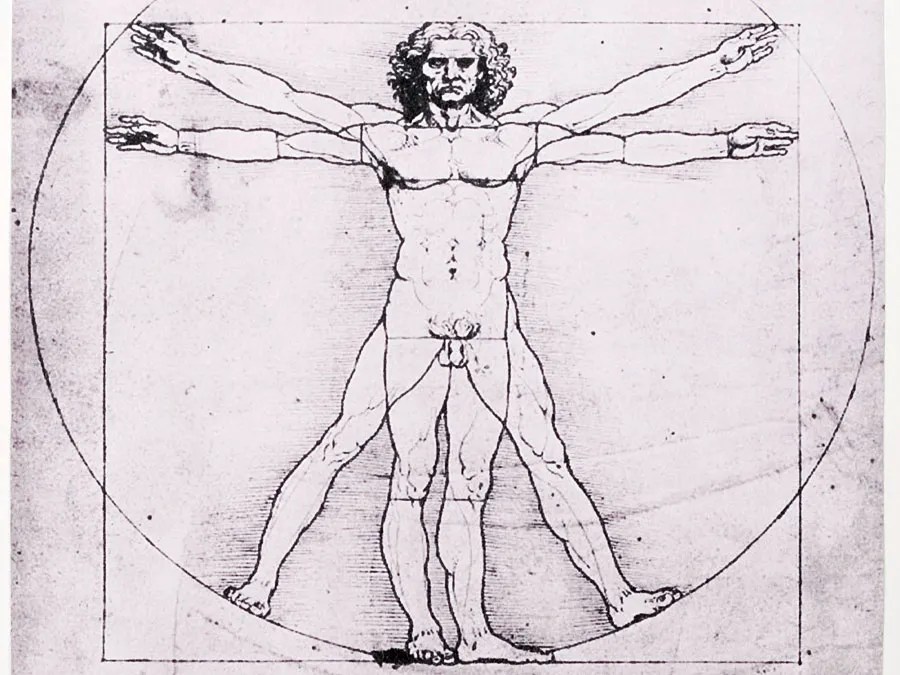
For a time in history, philosophers were perplexed with the puzzle in geometry of ‘squaring the circle’; famously illustrated by Leonardo de Vinci in his depiction of the ‘Vitruvian Man‘.

picture credit: Britannica

Yet in my view the spiral is a better symbolic representation of that state in matter and spirit, where the feminine is truly in harmony with the male.

In every aspect of nature, from the principals of the growth of the fractal tree and sea shores, to the spiralling movements of the moons, planets, stars, galaxies and universes, we can measure in observation the wonder of creation by two complementary Divine potter’s hands; one male, one female.

Humans were made from clay on the spinning potter’s wheel and the principal known as the anima mundi, is the final result of Divine genius – the Soul of the Whirled.

Beyond Good and Evil

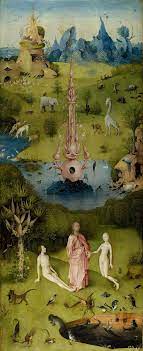
Genesis gives us the key to opening the door to everything. All we have to accept is that stories in Holy books almost certainly operate at many different levels beyond what is taught to children in Sunday School.

In the story of the original humans in the Garden of Eden, God ‘opens the eyes’ of Adam and Eve as punishment for Eve eating the forbidden fruit of the Tree of Knowledge. For in doing so their eyes are opened to the concept of ‘good and evil’, but we should not be side tracked by wondering what good and evil are. What is being revealed here, in my view, is that the Unity Consciousness of the blissful Garden, split into binary consciousness. If the reader overlooks the reference to newly realised binary opposites, then the message is repeated for reinforcement.

When Adam and Eve see each other naked, for the first time, their consciousness moves from being one, to two. This ‘same but different’ paradox between men and women is the same for all binary thoughts and words. Carl Jung suggested that the minds of men and women differ as metaphorically expressed by the nuanced differnces of their bodies.

The message in Genesis, is not about ‘good’ or ‘evil’ or ‘man’ or ‘woman’; it’s about binary thought; a fataly flawed characteristic.

But thinking in opposites creates an illusion of understanding. This is whispering serpent’…the one that slides down the ladders of thought.

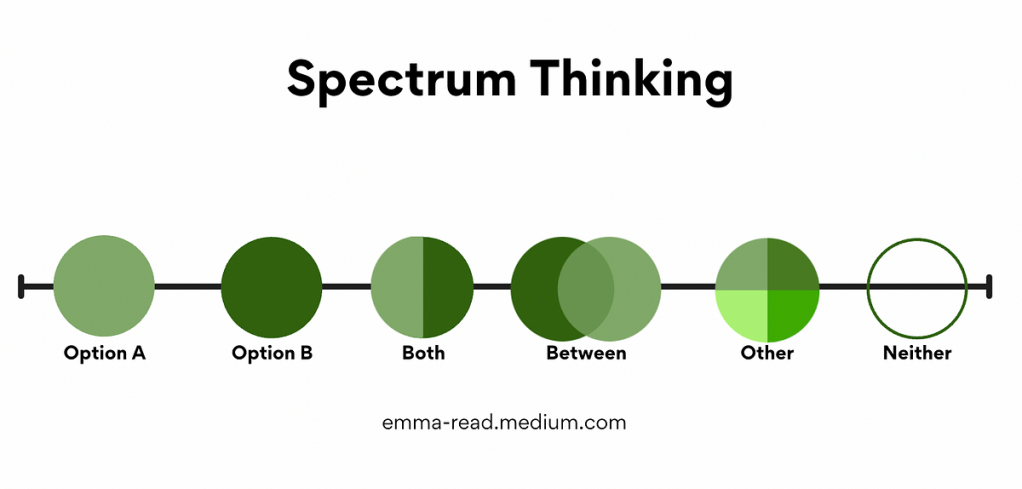
In physics, nothing is black and white; there is just light and an absence of light and everything in between. But using opposites as a sort of ‘algebra’ for thought has enabled modern scientists to deconstruct nature and use it’s methods to make technology.

Batteries consist of negative and positive poles. The brain consists of left and right hemispheres. Breath goes in and out. Humans are born and die. Chromosomes are X and Y.

This is how have un-zipped the polarities that keeps atoms spinning, but there is a catch!

Our thoughts attach to the oversimplified opposites. Left and Right political views are a prime example of extremist views plunging the world into chaos. Edward de Bono introduced the non-binary word Po in his book Beyond Yes and No to express infinite possibility and a practical key to freedom of thought.

Opposite ideas should only ever be a mere framework for rational thought, otherwise the space in between disturbs ‘certainty’, leading to confusion and conflict. Consider a recent example;

In the United Kingdom, the Supreme Court has just ruled that a woman is a person who was born a ‘biological woman’. In other words, a ‘biological man’ cannot become a woman. This rule provides clarity for the lawyers; but is it true?

I would argue that the model does not fit neatly over reality. When it comes to the provision of public toilets, there will need to be a ‘third space’ for those with particular needs, for instance, those who feel different to their biological gender.

Is not an impossible problem for many ‘third spaces’ already exist as a ‘disabled toilet’. All that is needed now is a gender neutral sign on the door. Something that is not ‘men’ or ‘women’.

We see here that humans are not as simple as the rule of two ‘opposite’ biological genders. Consider the complexity of the body. We have a brain with left and right hemispheres. Each half has a nuanced contrast of functions; rational and creative respectively. Psychologically, each woman has an unconscious animus and each man has an unconscious anima. One in ten of us are left handed; the rest right. In some cultures, left is ‘evil’ and right ‘good’. There have been libraries written on the complexities of gender differences.

But we also experience a range of emotions, almost involuntarily, which can be categorised as ‘expansive’ or ‘passive’ in nature. Anger and valour are expansive and ‘male’, sadness and tenderness are ‘female’ emotions, for example. Of course, men and women have the whole range of emotions in varying degrees beneath the fig leaf.

Finally, the subtlest human characteristic that guides mind, heart and body is ‘intuition’. Albeit a peaceful, almost silent, internal voice, it has a function to guide us when we are lost. Another name for intuition is Soul, and yes, souls can be ‘good’ and ‘evil’ as illustrated in the Old Testament. There is a Bible story in which Joseph experienced wise, prophetic dreams. His soul’s ability to describe the future intuitively through the pathway of dreams is symbolised by his ‘coat of many colours’. Dream messages are not black and white, but as subtle as a colour from the subtle spectrum of light.

This level of subtlety is desperately needed today, in my view, if humankind is ever going to recreate the Garden of Eden on earth through deep compassion and understanding. If we do not, a Wasteland awaits.

Who is the third who walks always beside you? When I count there are only you and I together, but when I look ahead up the white road, there is always another one walking beside you, Gliding wrapped in a brown mantle, hooded. I do not know whether a man or a woman – but who is that on the other side of you?

What the Thunder Said (from line 359) from The Wasteland by T.S. Eliot

Francinsense, Gold and Err

Who Stole Christmas?

PREMISE

The Church Fathers have had considerable ‘editorial control’ over what to put in and what to leave out of the Holy Bible. So much was ommitted and added, so should new ‘adjustments’ not be accepted?

OBSERVATION

In 1872 a scholar named George Smith found something remarkable in clay tablets from Nineveh. He was reading in cuneiform the Epic of Gilgamesh in which is described the great flood, God’s punishment for mankind. The suggestion that the Great Flood described in Genesis was just a retelling from ealier Mesopotamian texts, shook Victorian society. They gave Mr. Smith a hard time, as if he was the problem.

Today there is considerable proof that many of the stories in the Old and New Testaments have been subject to editing. We accept that the dates for the Christmas and Easter festivals are not in the Bible. They have been made up. The date for the birth of the Christ child was decided to be December 25th but why?

The Infant Horus: picture credit World History Encyclopedia

Previous gods had been born on this date. There was Horus (Ancient Egypt), Mithra (Persian), Krishna, Zarathustra (Iran), Hercules, Babylonian god Bal (Nimrod), Heracles, Dionysus (Greek), Thammuz (Babylonian) Hermes (Greek) Adonis (Phoenician) and others. All were born of virgins.

If such a clear plagarism of ancient gods is disturbing, there is a logical explanation based on astronomy. December 22nd is when the sun disc halts its annual progression northwards along the horizon. It then pauses for three days and rises anew on December 25th. This natural phenomenon supports neatly the story of a solar god being born; not dying and miraculously resurrecting but being born at least. Perhaps the birth of Jesus does not fit the story and date of how the ancient gods had been born.

If we investigate the ‘blasphemous’ notion that the Christ child was not born at Christmas then we should be able to find another meaningful astronomical date in the solar year relating to birth. After all, should a Christian festival be based on the Pagan festivals and superstition? The church fathers did, we should remember, hate and demonise Paganism, although Pagans did no worse than love nature and each other.

SUGGESTION

I suggest that the birth of Jesus was in the springtime; the lambing season, when shepherds watched their flocks by night. Consider afresh, the Christian nativity narrative.

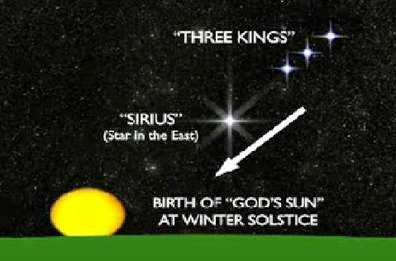
The three Kings or Magi seeking Jesus were astrologers. So excited by and certain of their prediction were they, that they set off to find him, I argue, in the spring. They ventured eastwards towards the star Sirius, which rises in the east in March in the northern hemisphere. With their learning they probably knew of the goddess ISHTAR from Babylonia who represented Sirius and was associated with fertility, love and war. Another clue for us today is that in the English language is the word Easter which breaks down into two words; EAST STAR. It also is remarkably similar to the word ISHTAR.

If we dig deeper into pre-Christian gods, we find that in Ancient Egypt the star Sirius was represented by the goddess SOPDET meaning ‘skilled woman’. She was important because her appearance signalled the inundation of Nile and the beginning of their new year. She was sometimes portrayed as a large dog.

picure credit: Tarot Aotearoa

Sopdet was associated with ISIS who was the wife of OSIRIS. Their son HORUS just happened to be born on 25th December; a holy family uncannily resembling a later one. They watch over us even to this day as Sirius (ISIS) in the constellation Canis Minor and her husband OSIRIS, the constellation ORION.

These curious facts add up to support the possibility that the Nativity occurred in the spring and the death and resurrection of Jesus the Christ in mid-winter. Certainly, Bible scholars are unable to qoute verses that deny this, as is anyone to confirm it. The Christian practice of using the festivals and stories of the hated Pagan gods, appears to be the only reason for Christmas and Easter being where they are today.

We cannot deny the association in popular modern culture of ISHTAR and Easter. As a nature godess, she is depicted with with hares and rabbits (famed for their procreative success) and eggs (product of the female hormone Oestrogen). Eggs and Rabbits were omitted from the Holy Bible and yet survive as symbols of birth happening at the time of the great initiator, Aries. Perhaps, some archetypes are too strong to supress.

ENDING

At this time of Easter, instead of celebrating the joys of spring, Christians mourn. Then, in midwinter they celebrate birth.

One wonders whether these important festivals, reversed for the wrong reasons, have unknowingly undermined the modern world? Knowing the basics of life and death, ending and beginning, should support rather than undermine what it is to be a human, whose life is dependent on natural cycles.

I cannot expect anyone to agree with my view but for me, this fundamental reversal of ancient truths has led to our misunderstand and abuse not only of nature, but ourselves.

The mystic Hildegard of Bingham wrote ‘wisdom awakens to wetness and greeness and flowing waters. Wisdom says I am the rain coming from the dew that causes the grasses to laugh with the joy of life’.

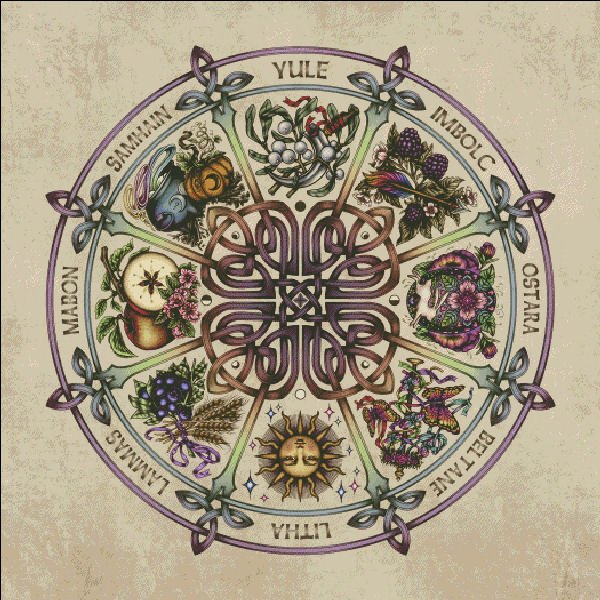
Pagan Wheel of the Year: picture credit Friends of the Forest

Happy Christmas!

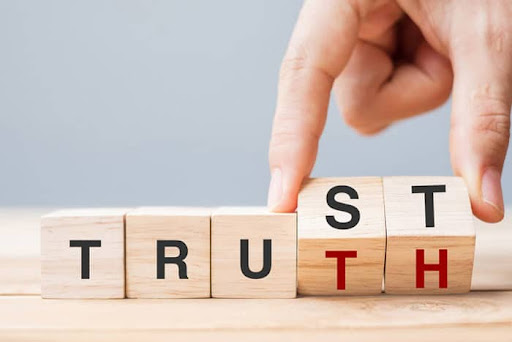
True or Not True?

That is the question

picture credit: Australian Academy of Humanities

The world is experiencing mental chaos in the present; not knowing what to believe. The news media is full of reports that appear to contradict even what was said the day before.

It is important therefore, for our thoughts to be as precise as we can and also our words.

As in the title of this essay, ‘truth’ is causing the confusion and we now longer know who to believe.

Numerous politicians are being routinely accused of ‘lying’. If we consider the meaning of the word then is ‘a statement intended to deceive’. Then there are are false ‘facts’ from unreliable sources, which may not be intended to decieve but do.

The famous Dunning Kruger effect states that amateurs are less concerned about understanding a subject than professionals, who have pondered on it for years. The less you know, the easier everything appears to be. The present administration in the United States of America has more than it’s far share of sufferers of this effect, who simplify complexity to below any standard of professional opinion.

There are also things openly ‘fictional’. These may contain some truth but are largely a product of imagination. Novels and films based on truth will declare that names and events are fictional for artistic and legal reasons. What is important is that we are not deceived into believing in fiction. The World’s religions and cults are particularly prone to this absence of adherence to truth, often for no other reason than there are based on the fog of ancient history and managed so as not to embrace the present.

The civil laws of most countries try to be based on ‘the truth, the whole truth and nothing but the truth’. Judges attempt to distinguish between true evidence and false evidence until something is believed to be ‘beyond doubt’. It still makes mistakes even after the most rigorous processes to remove doubt. Dictators who control the judiciary can get away, literally, with murder, using fabricated evidence or just no evidence at all.

What this shows us is that even after the most challenging and examination, ideas can turn out to be mere theory. In science, theories are subject to ‘peer review’ – critical examination by equally well qualified scientists. As the Ancient Greeks understood, theories should not be confused with facts. The present irrational dismissal of a theory because it suggests a ‘conspiracy’ (intent to cause harm) is irrational. To not investigate an accusation for emotional reasons is a clear divergence from truth, but convinces crowds.

‘Facts’ are illusive and can be the product of distortion. A satellite’s instruments may be malfunctioning or incorrectly calibrated. An individual politician may have an unconscious or deliberate bias. The process of believing that ‘climate change’ is true has taken decades, largely because it was contrary to the interests of companies that extract and sell fossil fuels. As with many complex issues, the theory was too large in scope for the general public to understand. Those who should lead opinion, politicians, often use distraction, omission, obfuscation, irrelevance, obstruction and discontinuity to align facts and fictions with political ideas.

Even when we believe something is true, it can still only be ‘relatively’ true. It might be an oversimplification that just happens to work. Basing the worth of money or tokens on gold reserves was just one such ‘truth’ that reassured governments and populations. Today physical or virtual tokens of ‘worth’ are less and less dependable.

Finally, philosophy has an angle on ‘truth’ and how to find it. If science and religions regard truth as constants and dogma, philosophers understand truth as malleable. There is no ‘fixed law’, other than the law that everything changes.

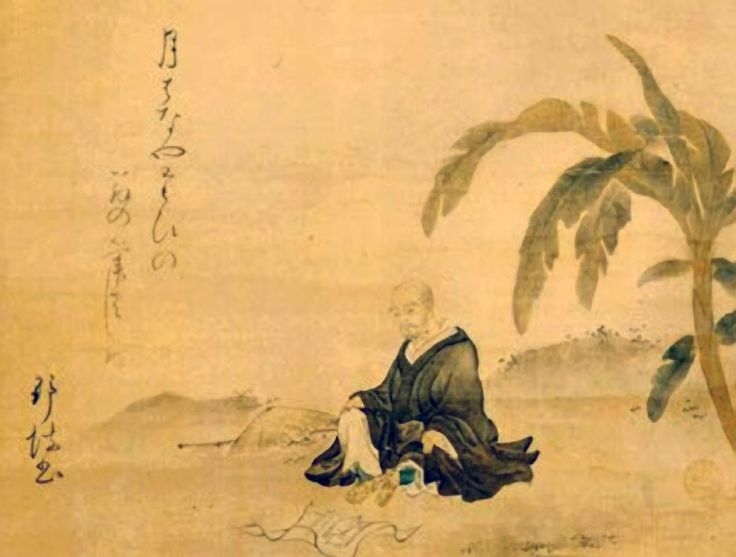
In Zen Buddhism, truth is whittled down to an individual regarding life’s purpose as no more or less than being present and observing; a formula much needed in our present times; especially when things go wrong!

Oh Bush warblers!

Now you have shit all

over my rice cake on the porch. Basho

The Empires Strike

For centuries, Europe was dominated by Empire building around the world. In the Twentieth Century the Empires, such as the British Empire, finally broke down and gave autonomous sovereign states their freedom back. It might have appeared that the age of ’empire building’ was over, but that is far from the case.

In the Twenty First century it is clear that Empires are back. Key to the once powerful British Empire had been the Navy and control of the seas around the world. Today the vulnerable global ‘key points’ are canals and pinch points in shipping lanes. The Houthis in Southern Yemen potentially control the infamous Straits of Hormuz; gateway to the Red Sea and Suez Canal. They will stop attacking Israeli shipping, they say, when Israel stops attacking Gaza. Neither the British, USA or Israel have tested this, preferring to extend the genocide in Gaza and attack Yemen, than take the Houthis at their word.

One of the strategic reasons for the establishment of a pro-Western State in the Middle East in 1948 (Israel) was, and still is, control of the Suez Canal. In 1956 the British, French and Israelis sought to gain control of the Suez Canal when Egypt nationalised it, moving their tanks from the Gaza Strip into Egypt. In my view, this imperative has never gone away.

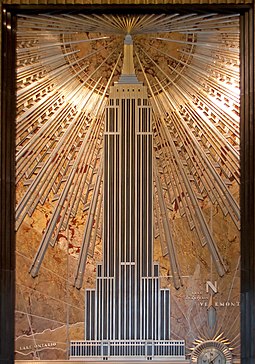
The Empire State Building, New York

MAGA? America is already ‘great’. It consists of a continent joined by an isthmus at Panama; again, a critical shipping route. The republic of the United States of America has a ruling president who wants to expand it’s 50 State Empire northwards and south. ‘Look at this arbitrary line between the USA and Canada,’ mocks Donald Trump, as if it means nothing just because it is straight. If it was meaningless, then Canada could claim the USA, as perhaps could Mexico and Denmark, but because of international law and common sense, they do not.

Putin wants the old Union of Soviet Socialist Republics back and China the island of Taiwan. Should then the British march back into India and Pakistan?

Should the French re-take French speaking Algeria?

Should Japan be given back it’s ‘Imperial’ territories in mainland China?

Should Italy claim back it’s Empire around the Mediterranean?

The list of historical reversals is absurd to all but the greedy and unpopular politicians who seek to stay in power indefinitely by empire building. Opponents are fed to the lions.

Today, Gibbon’s ‘The Fall of the Roman Empire’ is a critical read for the Trumps and Putins and Shi Jinpings of this world.

It is available in eight volumes and was read by a famous world statesman when he was twenty years old; Winston Churchill.

Now he knew a thing or two about world statesmanship and his preference for ‘jaw jaw instead of war war’.

The Faraday Way

Listening to a science programme on the Radio just now, I heard a amazing fact about Michael Faraday, the great early 19th century scientist. Apparently he was an ardent believer in God as well as a scientist. Unlike his contemporarys, he did not believe in molecular theory and the concept of the ‘atom’, which came from the ancient Greeks. He instead said that matter is where ‘lines of force meet’.

The other great scientist from whom much understanding of electricity today came, was Nicola Tesla in the late 19th century. One of his most famous sayings is; “If you want to find the secrets of the universe, think in terms of energy, frequency and vibration.”
These are not lightweight scientists. Most of our modern technology we owe to these two men.

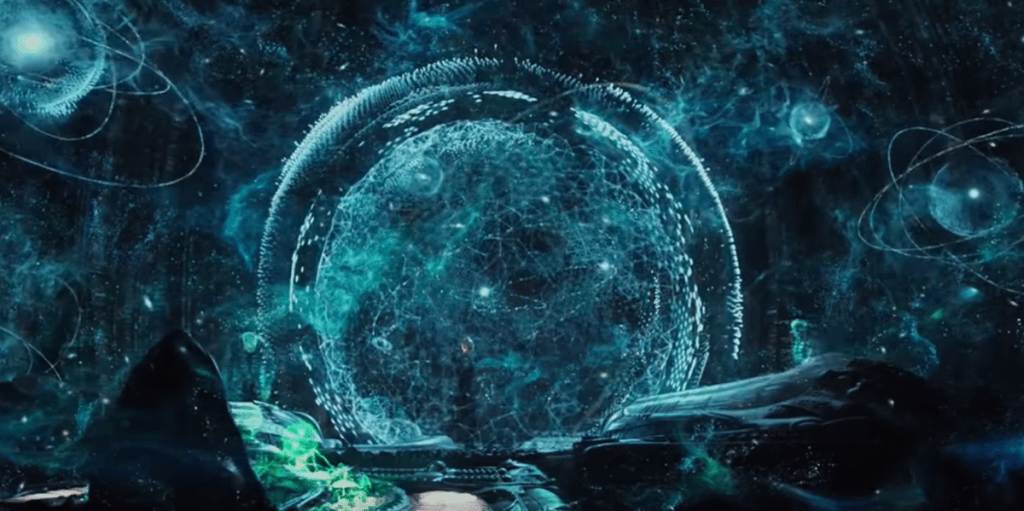
The idea of ‘lines of force meeting’ immediately suggests the concept the ‘hologram’ although they were not known in Faraday’s time. Several beams or ‘layers’ of energetic force containing information that the human brain interprets as ‘an object’ is precisely what a hologram is. It is a huge leap but one made succinctly by Michael Talbot in his book, ‘The Holographic Universe’, to suggest that everything that we perceive as matter is a hologram.

Mystics have been saying for centuries that matter consists mainly of ‘nothing’ and modern physics now also states this as true. Some scientists are even questioning whether the electron, proton and neutron are just energy. This combined with the observations by astrophysicists that the Universe consists of 94% so called ‘dark matter’ suggests that we know little about what we sense to be most real, matter.

If one thinks of the ‘table of elements’ as a good proof of matter, then Faraday’s theory of there only being ‘lines of force’ does not contradict the possibility of chemical ‘elements’. Elements might simply be unique combinations of ‘lines of force’ which harmonise to produce the illusion of a ‘solid’.

Sound provides a more tangible analogy as it too is energy with fixed frequency and vibration coming together as single notes, or harmonic layers that produce unique chords when in combination.

But our brains are taught only to interpret the electrical signals from our five senses. From childhood we learn to see these patterns as a solid ‘reality’ but like all illusions, sometimes we miss notice the illusionists slight of hand and mastery of distraction.

For example, we might all have seen something in a flash which a few micro seconds later turns out to be not what we thought. It might be a leaf being blown across the road which a driver sees as a mouse or bird for a brief moment. Or a child’s kite flying high above that a walker mistake for a hovering bird of prey; even for a split second.

Such moments are ‘discontinuities’. The Ancient Celts understood this and certain places, such as the hills of Southern England known as the Downs, were described as ‘thin’, meaning localities where the boundary between ‘solid reality’ and ‘parallel dimensions’ create experiences of the metaphysical (beyond matter) realm. A church going shepherd, in the 19th century is said to have seen a vision of Jesus above these hills in the sky, which would probably have been forgotten by now had not many in the local village seen the same vision and the newspaper article from the time still framed on a wall in Firle Church.

My point is simply that, if we can accept the suggestion that the Universe is simply ‘energy, frequency and vibration’ many of the ‘anomalies’ that modern science cannot explain, suddenly become easier to understand and even, accept as true.

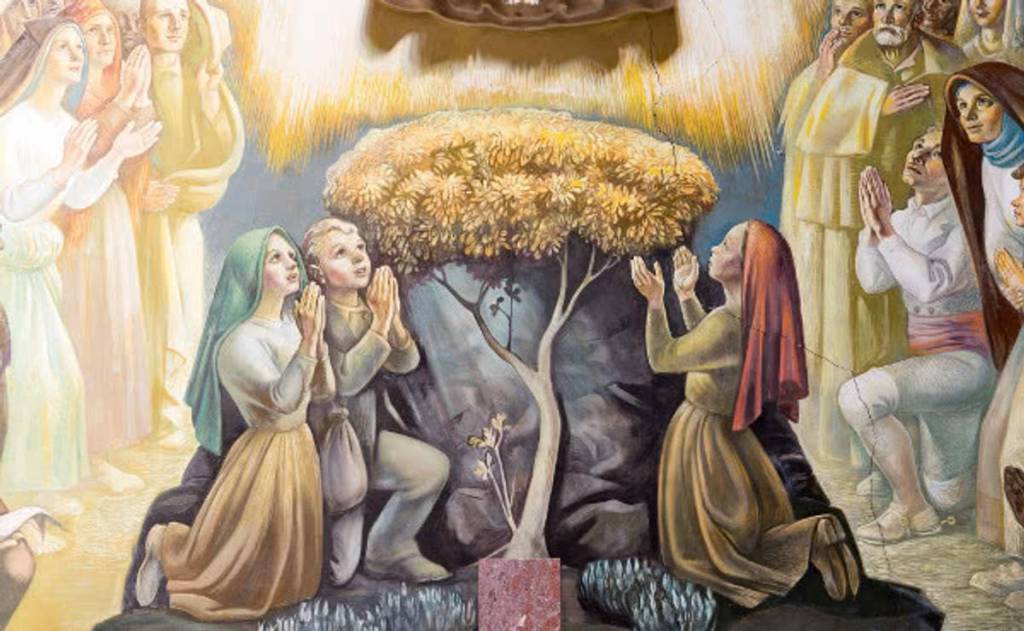
We do not all have to become mystics to believe and practise this. What a shepherd can see we can all see. So can we all see what children saw in the village of Fatima in Portugal in 1917 – a vision of ‘Our Lady of Fatima’ – as did hundreds of the inhabitants of Fatima on several occasions.

Santa Hosemaria in Fatima, Portugal picture credit: Opus Dei

I was sitting in the waiting room this afternoon whilst my car was being serviced. I had been meditating, and it was with a single point of attention that I was eating an apple when the garage mechanic burst into the room. The conversation went like this;

‘You are eating sweets.’

‘No I am not.’

‘You are eating a sweet apple.’

‘Yes.’

We probably exchange brief moments of an imagined reality with others, more often than we think. The phenomena of what is called as ‘telepathy’ which I would suggest is more subtle that ‘reading the thoughts in others’.

In my view, two people can experience the same ‘energetic patterns’ at the same time. In the above example this was the feeling experience of ‘sweetness’ observed in a split second by two non-connected but open minds. The mechanic had not seen the apple, only received the feeling of ‘sweetness’.

Mothers will probably have had many examples of understanding a child’s needs without conversation; even and especially when the infant has not yet learnt to speak.

A mother and child are indeed a wonderful metaphor for the scientific understanding that Faraday believed, that everything is merely ‘lines of force’ meeting; something natural philosophers term ‘love’. Following this reasoning I would argue that this is why when humans follow (without expectation of reward), their highest excitement, then they will create the energetic Universe that will provide them with their highest reward. Most people’s highest excitement is simply known as love and with this vibration was and is created, the Universe – and is why it is said that; ‘God is love’.

Time

My thoughts were turned to this subject when I scolded my cat Spooky. I shook my finger and looked cross. ‘Naughty! He slunk off guiltily. Just a few moments later he re-appeared and jumped up onto my lap. I realised that the incident had been completely forgotten in his mind, although in mine it was still fresh. I concluded that animals move through a series of disconnected events and are present most, if not all of the time, in the ‘now’. If they remember anything of the past it is only ever locked in their instinctual memory; the place where they store their ability to hunt and fall on four feet.

The Cat Righting Reflex, the perfect ‘Now!’

One might consider the well known psychology experiment by Pavlov who rang a bell before a dog’s meal time and he observed they salivated even though there was no food. Their response to the bell produced an anticipation of food. I would argue that the link is again instinctual memory rather than dogs imagining an event in the future as humans do.

Humans and animals experience time in the present, but humans go beyond this. We will form memories of past events from which we can recall at will. Films featuring an amnesiac character such as the Jason Bourne series of thrillers, show how difficult it is the function socially without memory.

Then we can imagine future events and manipulate in our minds how we will would like them to turn out or not. As children, we learn about danger by experience or parental instruction; ‘don’t put your hand in the fire’. By imagining an unpleasant future outcome, a bad experience can be avoided.

What the past and future have in common is the concept of time. Neither are occurring in the present moment. Therefore, we can argue, that before humans had the concept of time, events were experienced in the moment. Tribal myths and legends, passed on over the camp fire, were the only record of the past.

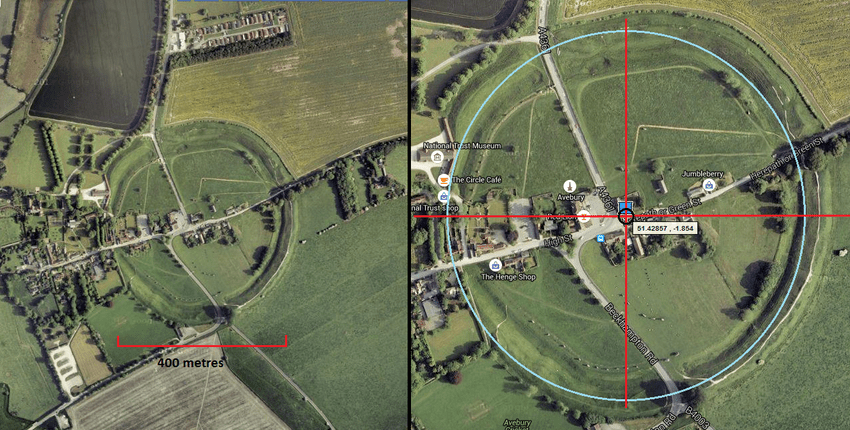
Avebury, England: Larger than Stonehenge containing Sun and Moon circles within a ditch and henge.

But these ‘disconnected events’ were at some time, observed to repeat as patterns. The passing of the seasons was undoubtedly a serious matter. Solar and lunar observatories were built all around the world and the Wiccan solar festivals remind us of this function. Megalithic henges and stone circles are commonly found to be astronomical calendars able to measure and predict the solstices and equinoxes. This was more than for agricultural use as archaeologists believe and relate to complex permutations of universal energies.

Although various crude clocks were used such as sun dials and candles, it was not until the 18th Century when an English clockmaker John Harrison invented the marine chronometer. This was a critical moment in history for it meant that navigation of the seas was made considerably safer. The precise time from an chronometer, reliably indicated the longitude on long sea voyages. When combined with the latitude from the height of the sun at midday, this gave navigators the precise position of the ship. The measurement of time not only fixed points in the day and night, but one’s location. Experiences in known time and space joined together in the age of science and reason.

Ariadne hands the thread to Theseus: depicting the wise aspect of his Anima

There is a story from Ancient Greece concerning Ariadne and her lover, Theseus. Theseus was charged with destroying the Minotaur, a flesh eating monster that lived in the centre of a labyrinth. Ariadne gave Theseus a ball of thread and instructed him to unwind it as he walked through the labyrinth, thereby finding his way out. Theseus successfully killed the Minotaur and escaped to Crete with Ariadne.

Ariadne gave Theseus a novel aid to connect the otherwise confusing experiences in the labyrinth, in a rational and repeatable way. Instead of disconnections which lead to the experience of ‘where am I?’, Theseus was able to rationally and repeatedly connect together these individual events. He was the first of Ariadne’s suitors to avoid being consumed by fierce panic and confusion, and by mastering time and location, escape.

The thread in this story, I suggest, represents Time with a capital ‘T’. Although an abstract concept and therefore not ‘real’ to the five senses, the continuity of experience created by time helps every human on their individual journey.

TI – ME

When we tie (TI-E) our experiences together we are able to overcome the monster within ourselves (–ME) and become our Higher Self.

The Sufi’s have an exercise which is conducted just before going to sleep. The entire day is recounted backwards in as great a detail as possible. There are no ‘conclusions’ or ‘observations’ to be made other than to ‘rewind’ daily experience.

In this way a continuous memory is formed of that day. This technique can be used after the death of the body as an objective review of one’s life is rewound before one’s eyes and beyond into the afterlife. Just as time does not exist in our dreams, so time ceases to be useful after death and we enter the fabled ‘eternity’. The fabled ‘lost souls’ of pergatory are those that have lost control of their ability to consciously move from one experience to another. Some even become locked in a repeated event in as described in the story of Tantalus. His condition was not ‘punishment’ as moralists believe but a state of mind.

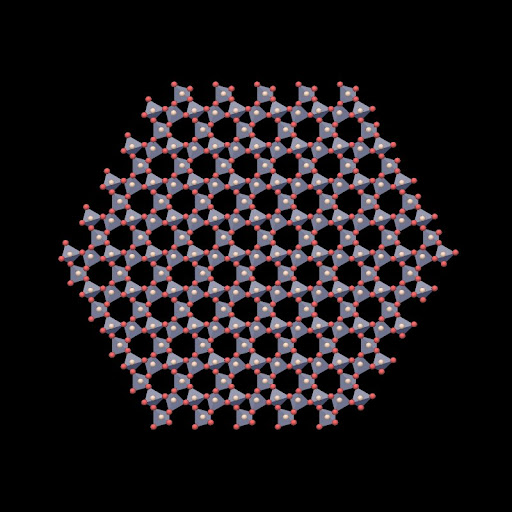
However sophisticated modern technology becomes, it can only ever approach the idea of infinitely fast things, never achieve them. When a quartz crystal has a tiny electric current pass through it it vibrates at 32,768 times a second. Nature is astoundingly constant in this respect and gave us quartz watches and other electronic devices. Just as quartz crystals are tetrahedral arrangements of oxygen and silicon atoms so precise that light passes straight through it, so it vibrates perfectly constantly.

The same clarity of experience is reproduced in spiritual practice by what is called ‘invocation’. In many mystical practices around the world, a student is tasked with the silent recitation of holy words. This ‘mantra’ is recited within the heart whilst experiencing, not negating, ordinary life. It is a task requiring Herculean concentration and effort, taking a lifetime to master, if ever at all.

The effect is to link the events of daily life in the way that an old fashioned movie film has regular cut outs on either side for the projector to connect with and move the film along at a regular speed. The illusion is one of still images that change imperceptibly and at thirty frames per second.

However difficult it is to understand how individual images scroll at speed, we do not need to know. The imperative is that one maintains the ‘I’ or ‘eye’ of the individual light bulb in the projector…whatever the story that is being projected.

Just as Theseus creeps closer to the centre of the labyrinth, so the observer creeps closer to their God within, using the technique of invocation. Like a cat watching a mouse hole, one’s concentration is fixed; mouse or no mouse.

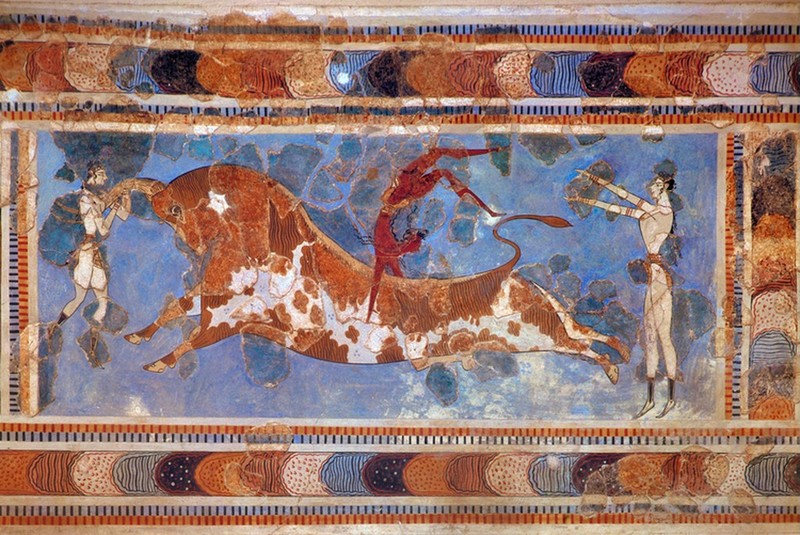
The Taurean Age of Civilisation on Crete, The Minoans

The slaying of the Minotaur in the age of Taurus, was central to the Minoan civilisation. The dark corridors of life have to be travelled so that the God-self can be discovered. The Beast or Minotaur is the same archetype as in the story of ‘Beauty and the Beast’. It is only truly known when love of true Self, slays the hideous ego.

This Jungian psychology is strangely connected to our modern day by the mystery of ‘time’ and the passing of discontinuous events that can warp into psychosis. The illusion of time becomes, in the clinically ‘sane’ at least, a constant ‘glue’ that makes experience appear continuous. But, just as in the beating chambers of the heart, time has an uncanny ability to increase and decrease it’s pace. Wonderful holiday experiences can fade all too soon while interminable waiting in the airport lounge has no end.

Physicists have there own story about this phenomon. In Albert Einstein’s ‘General Theory of Relativity‘, time is described as being something which can lengthen or shorten in it’s relation to space. ‘Time Dilation’ states that as an observer approaches the speed of light, time slows down. An astronaut might therefore return to Earth after a journey to the edge of the Universe at ‘warp speed’ and find that he or she is younger than their children.

Such concerns await us in the future. For the philospher, the task is to get to grips with the every day meaning of the passing of events. Can we keep a grip of the thread laid out to guide us through the labyrinth? Can we slay the monster within?

The Labyrinth in Chartres Cathedral, France: A Message from the Medieval Masons through time
picture credit: Helen Mueller

The Human Mirror

Everyday life can be intoxicating. Events carry us along as though we were riding a giant merry go round in an exhilarating Fun Fair. We spin and spin in the whirlpool of coloured lights and sound. We catch glimpses of people riding other horses and try to connect with a wave and a scream. And occasionally, we catch sight of a loved one stood watching on the side.

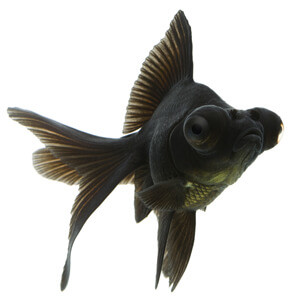
Perhaps fish have a similar experience in the wonderful underwater world of spectacular coral reefs. But if you were able to ask them about water, they would deny all knowledge of it.

picture credit: Wilkins Safety Group

The human Fairground shares this same irony. The people of earth, mostly deny there is anything other than matter and the pleasures that, if we are lucky, it facilitates. Surely there can be nothing better than an ice cream and holding hands with a loved one.

Yet we know as we age, that life is not like a fairground at all. We can have upsetting experiences from which we have no defence. We can fall and perhaps never get up. Just as the fish are subject to water temperature, tidal surges, currents and long periods of calm; so humans are at the mercy of unseen forces.

The point is a simple one. That there are many levels of experience. The simplest and the most common is to believe that human life is one of sensual pleasure. Some religious people reverse this and live a life of abstinence, without realising that they must be as attached to going without pleasure as others are to pleasure.

Today both scientists, philosophers, intuitive s, artists and mystics explore the idea that in parallel with ‘normal life’ is ‘spirit’ or ‘energy’. Einstein expressed this in his formula E = mC2 in other words, matter can be exchanged for energy and visa versa. It’s not really anything new. Indigenous people around the world and the ancient civilisations have and continue to connect with worlds of ‘spirit’.

To realise this is equivalent to the fabled fish becoming aware of water.

picture credit: Caring For Pets

Spiritually aware humans travel two paths. In the material world they have to learn to achieve some kind of tranquility, which is hard. In the spiritual world their aim is the same and lessons from the former can be applied to the latter. This is described in the Hermetic Law of Correspondence; ‘As above so below, as below so above.’

This knowledge is not new but perhaps is in sharper focus now than any other time in recent human history, at least in the last thousand years. The rather hollow platitudes of most religions and their exponents are giving way to ideas of ‘spirituality’ and ‘energy’. There is silent revolution taking place. Forces unknown are lifting humanity from it’s experiential squalor through such means as naturally occurring energy in the earth and the heavens.

In this ‘spiritual realm’ are what we might term ‘thoughts, messages, knowing, feelings’ and all the untouchable, invisible intelligences that suffice our daily inner experience.

picture credit: Medium

In the science fiction film The Matrix, there is a character called ‘Smith’. He identifies as an algorithm or programme that can replicate itself in any other programme in the Matrix; depicted as a world of illusion as already lives in computers. This programme is immensely powerful and frightened only of the love and truth contained in the hero character, Neo.

We should ask ourselves how real our lives are and ponder on that which we find. In the modern world we sometimes feel mesmerised by the power play of politics and the cultural, religious and social conditioning that we accept as is ‘normal’. It’s what we learnt in our first seven years of life.

Yet there are very destructive spiritual forces that operate against our best interests and try to take over our ‘normal’ world in the same manner that Smith acts like a malignant programme in a computer. This is revealed today as the organisations made up of the powerful and wealthy elite, whose conscious or unconscious function is to spread chaos and division in the populations of the world.

An example would be the political movement known as ‘Black Lives Matter’. Whilst most reasonable people support any and all communities and social groups subject to unfair and degrading treatment by others, we have to ask who created BLM, and who is funding it? Why were those who self identify by the colour black selected to become an activist organisation and not, for instance Hispanics, Asians, Indigenous Peoples and any other of the racial or social group who are wrongly discriminated against. Surely, common sense says that all lives matter, equally?

Any thought engineering whirlpool becomes meaningless the more it is given rational consideration. ‘We all matter and we all support each other’ would be a sentiment closer to the ideal of universal mutual love that most rational people support.

Beyond the ‘moral high ground’ that is so readily occupied by the ‘politically correct’, we might observe a more sinister motive; to separate ethnic groups so that they fight each other. Hatred and destruction triumphs in the guise of goodness.

Such ‘Smith’ programmes are increasingly prevalent today. The most obvious is the war in the middle east at the moment. Culturally and spiritually, those fighting each other have more in common than they have differences. The ongoing dispute of today must have been clear to the British when they ‘gave’ Palestine to the Jews and Zionists in 1948. The Palestinians did nothing to deserve to be ejected from their homes and land. At the time the gesture was doubtless made on a wave of sympathy for the Holocaust survivors but over decades has revealed itself to be a recipe for disaster. Again, we observe a malignant programme which was readily absorbed like a black suited, self reproducing ‘Smith’.

This process is not just visible in world politics and human discourse. There are many ‘natural’ disturbances and weights seeking to counterbalance and overturn human society. Examples would be astronomical, astrological and environmental changes that are producing enormous stress within human societies; particularly to those without the power to protect themselves from harm.

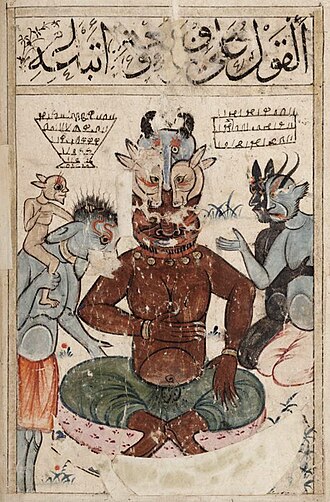
I believe that these malignant ‘thought forms’ or ‘evil spirits’ can be overcome by the spiritually aware and empowered. Beyond any identification with a particular religion or political persuasion, the power of love in the spiritual dimension is very capable of overcoming hatred.

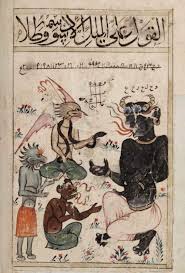
Kitab Al Buhan – Demons

Like the human body, spirit has and is an immune system. Whilst disease (or unease) may attack repeatedly from many directions, a spiritual person enveloped by love is indomitable. Not only that but as love is universal, it too can replicate and stretch out to every cell in the Universe and protect whatever disturbs celestial harmony. Right now it has an Herculean task, and incumbent upon every human being is to pay attention and respond.

picture credit : A-Z Qoutes

The Road to Hell

Dualistic thinkers (thinking using opposite terms such as black and white) have a problem with the idea of good and evil. Most spend their lives seeking goodness and avoiding evil. It’s a well intended strategy and one promoted extensively by Christians. Jesus the Christ spent forty days and nights resisting temptation by the ‘prince of the world’…the Devil.

The problem is, life is not so simple as good and bad…would that it were! Would that Western thinkers looked over the shoulders of Eastern philosophers who believe that there is no such thing as pure goodness, nor pure evil. (The corollary is that there is no Heaven and no Hell which is also true but perhaps the subject for another essay.)

In the Yin Yang symbol, which is central to Eastern philosophy, good contains a little touch of evil and evil a nudge of good. Sometimes goodness may just be a thin shell containing a large quantity of evil and visa versa. An example might be the Atomic bomb dropped on Hiroshima in the second World War. The world would be a better place if that technology had never existed. What you see, is not always what you get.

The past can provide valuable lessons but here I shall use some examples of ‘dualistic thought’ from current Western political debate; there is a tempting assortment to choose from!

The first woe is, ‘Generalisation’. Politicians are by definition, strategists; taking a broad view and delegating attention to detail to minions. They are therefore prone to declare noble ‘aims’ to please voters, such as to ‘reduce inflation, help the vulnerable, create jobs, improve public services’ etc. etc.

What is not presented for examination is how this aim is going to be achieved.

As an example of using the wrong ‘means’, the previous government in the United Kingdom made an election commitment to ‘stop the boats’. This referred to undocumented migrants crossing the English Channel in dangerously unsuitable boats. This aim was presented as ‘good’ because there had been boats sinking and people tragically drowning. The government’s intention was ‘good’; to save life. If the means to stop the boats was challenged, the questioner was accused of wanting people to drown; they were supporting evil over good. The argument was totally dualistic and as a result over simplistic.

Pretending to be a benign policy without hiding the real reason

The absurdity is that any problem solving plan can be justified as ‘moral’ and ‘benign’ whether it was likely to work or not. It just needs a ‘good’ intention or aim and expects never to be challenged on any other grounds.

The detailed plan to ‘stop the boats’ intended to send failed UK asylum seekers to Rwanda. The plan included breaking international law and expense that did not match the benefit. Worse still it was based on an untested assumption that those willing to risk death by drowning would be put off by a comfortable flight across Africa to free food, health care and accommodation in sunny Rwanda. Asylum seekers from Rwanda would probably not be so pleased as it’s not a safe country by most definitions (but that was a level of complexity too deep to examine). The final cost of this plan was the same as putting up each asylum seeker in the Ritz Hotel in London; an option the Ritz would probably have declined.

My point is that however absurd the detailed plan, the government would repeat it’s justification by asking, ‘do you want people to continue to drown in the English Channel?’ as if that were the only option to achieve their well intentioned aim. Of course it was not the only option but presented as such. In the end the plan was abandoned and hundred of millions of pounds metaphorically thrown into the English Channel at a time when the lack of money in the countrie’s coffers was also a problem.

The new Labour government are now desperately trying to balance the books by not giving pensioners an allowance to heat their homes over the coming winter which they agree is regrettable and may cause death ( i.e. an evil ) but is justified by a need to balance the country’s books (i.e. a goodness )

When politicians are not generalising they present details to prove or disprove a generalisation. A prime example appeared in the news this week during the televised debate between candidates for the forthcoming presidential elections in the U.S. of A.

In this debate between Donald Trump and Kamala Harris, Trump purported that migrants were eating the pets of American citizens in Springfield, Ohio. The response of Harris was the only rational one, which was to giggle. Apparently, this story was currently feeding the confirmation bias of social media zealots, which included a person who considers himself fit to rule the world. Fact checkers and local officials confirmed that the story was not true. But this does not stop those repeating it, who wish it was true.

The problem for those caught up in such an argument is that there may have been just one instance of starving migrants cooking up a street animals on a cold and windy night to feed their children. In the world of political debate not using numbers or arguing over whether numbers are true or not, allows generalisations to pass critical examination because even if there is only one instance, the general statement becomes true, even if totally misleading. It’s a gift to politicians.

picture credit: Peakpx

At the beginning of this essay I referred to eastern philosophy as tending to take a holistic view of events, rather than focus on a particular set of facts. In Surah Al-Khaf in the Holy Quran, Moses meets a figure not named but described as a righteous servant of God possessing great wisdom. Moses watches him damage a humble fisherman’s boat and protests despite being sworn not to question any thing he witnesses. In time, an army passes in need of such boats and ignores the damaged one. The fisherman is able to repair the damage and keeps his boat and his livelihood. There follows other stories where actions are ‘evil’ at first sight, but as circumstances develope, are shown to have been benign.

In conclusion, our world at the present time is full of major choices about which we hear politicians of all persuasions expounding strong views. As humble citizens we have little say in these matters and have to trust those promoting ‘good’ and denouncing the ‘bad’.

Decisions are for reasons suggested above, and in my view, never such a clear cut choice. We assume we make choices based on hard facts, reasonableness and clear routes to known consequences. I contest this assumption and suggest we take a more pragmatic view, summed up in the simple word ‘maybe’.