You may say I’m a dreamer But I’m not the only one I hope someday you’ll join us And the world will be as one John Lennon ‘Imagine’
There is an awareness of the prospect of a ‘New World Order’ in many modern western societies. It is ‘globalism’ by another name and assumes that for the eight billion or so inhabitants of planet earth, ‘one size can fit all’. We clearly see this in the communist countries such as China, where citizen’s rights are subordinate to the rights of society; ‘the lowest common denominator is best for everyone’ philosophy.
Astronauts in the International Space Station may enjoy a global view over breakfast and be filled with wonder at the planet without political boundaries and cultural differences.
But of course geo-politics is not as simple as the view from space implies. If we were to break down how societies are structured the categories might look like this;
…language, religion and ethics, race, class, cultural background, education, wealth, geographic placement, access to technology and food and so the list goes on. Societies are highly complex when viewed through the lens of a microscope.
There is an indigenous North American saying that, ‘it is easy to be brave from a distance’.
They should know, for their initiation tasks for young ‘braves’ were daunting to the point of life threatening. When poised to jump into a river from a high cliff, suddenly life looks and feels different from ten minutes ago.
This illusion of safety is becoming dominant in many Western societies in the modern times. Citizens go about their daily tasks in relative comfort because of the security that their State promises. Citizens will never be poised on the edge of a metaphorical cliff – so they believe.
We create a ‘safe distance’ around ourselves; living in a tiny bubble of the known and familiar. It is comforting and provides, what in general systems theory is known as ‘homeostatis’, or
‘The aim of systems theories is to create homeostasis, or a favorable person–environment fit, in that the individual interacts and responds to her/his environment where interactions and change are contributing to positive growth and development and social functioning.‘ ScienceDirect.com
The whole approach to reassurance given by crew to passengers on an aircraft is based on this principal. In a short briefing it is explained that the aircraft could crash in which case here’s a whistle, otherwise, drinks are available from the trolley.
Airliines pretend flyiing is safe, but if we think critically they could do more. For instance, why are children not given child seats as is the general law for cars? Why are companion and service animals so difficult to cater for? A disabled passenger will have their expensive wheelchaire thrown into the hold and they have to stagger to their seat; if they are lucky with extra legroom – at an additional cost. How quickly passengers embark and disembark, is mostly about money for airlines.
Life in western societies is rather like this problem that airlines have when people have unique expectations and needs. The tendency then is humans are herded like lost sheep and most of the time, we oblidge.
Fortunately, what stops the world from wobbling off it’s axis is a counter force which we call ‘co-operation’. Humans emerged successfully from the ‘natural selection’ disaster movie of prehistory by co-operating with each other. Instead of becoming the lone predator like tigers, they became pack hunters, like wolves.
So here is the good news. If generalisations and lack of detail are the centrifugal forces that tend to pull society apart, then co-operative forces are the centripetal reaction, keeping us all together.
A list of these co-operative forces would be something like this;
...written laws and national constitutions that describe and give rights to citizens, shared wealth and resources such as public services, pensions and private insurance, shared territory such a public spaces and open borders, shared fauna and fauna in natural ecosystems, shared technology and scientific research, shared buildings such as blocks of apartments and entertainment facilities, shared national infrastructure, shared human resources in education, health, armed services, politicians…the list is longer.
Those enjoying the re-assurance of a Western lifestyle, are aware of other countries where the centrifugal forces are actually pulling societies apart. We know there are wars, famine, plague and natural disasters, criminal and terrorist organisations, happening somewhere else on our shared planet all the time but we chose to do nothing at worst or give to charity at best. We rationalise our choice as ‘someone else’s problem’ because we were lucky enough to have been born in a bubble.
picture credit: Hedgeye
For the few who do take on responsibility for those less ‘fortunate than themselves’ is more they can do. If they have a set of skills applicable to a particular emergency they can join a charity or non-government organisation. Usually and sadly, such as in earthquakes or flooding, help arrives too little too late. Disaster relief warehouses do not exist at every air and sea port in the world. Instead it can take days for supplies to be shipped and taken overland to those as serious risk of harm, instead of hours. Governments and or those who caused the disaster lie about the cause and solutions that are in place such as is happening in Gaza in Palestine at this present time.
In this way disasters can be diverted from public attention; played down because ‘we’ are not the victims. Our lives continue with a good standard of living, fuel in the service stations, government workers in the social services providing education, health and the rest. The shops are open and we go to work.
Or so it appears, because of the illusion with which we are presented and which we choose to believe; we genuinely think we are brave, upright, honest, caring citizens.
That is until our borders are rushed by people without documents who risk their lives to get help, banks close, world shipping halts, a serious pandemic any other disastrous global event such as, well, global warming…
Arizona Border picture credit: APnews
Then the problem in western countries becomes, ‘how do we keep our way of life?’, because we assume, our lives and standard of living will continue unchanged.
Here is a long bamboo and here is a short one Ts’ui-wei Zen Master
Many western thinkers find it difficult to understand that war and peace are the same. This is because in dualistic thinking there are only two ‘opposite’ words to describe a broader thing for which there is no single word. This dualism and is a clear example of how words determine thoughts, in the same way that roads define journeys.
Consider this koan; when there is no war and no peace, what is there?
In order to construct a bridge that combines the extremes of ‘war ‘ and ‘peace’, one needs to use a phrase which is a paradox; a statement that contradicts itself. The concept of ‘soft war’ for instance, opens a whole new spectrum of possibilities around the ideas of ‘non-violence’. War has historically been the option used by humans to solve disagreements between ‘tribes’. At a higher level of consciousness however, it is possible to achieve the same ends without firing a single arrow. So let us look more closely at this paradox.
I propose a definition of soft war as, ‘the acquisition of state assets and benefits by peaceful means.’ Because surely, state violence as a means to an end should be far behind us in this twenty first century. Nobody has ever really won a war, when you study world history.
Presently, various state players are heading off to the moon. The initial batch of astronauts will need to be real estate agents, taking photographs and writing up a hot and cold, air-less deserted blob, as enticingly as they can for prospective nation clients.
Donald Trump pronounced publicly the creation of the United States Space Force as a department of the Air Force when he was President. Apart from the odd logic of the Air Force fighting in places with no air, one intention is clearly to use violence to acquire lunar assets and benefits for the United States of America. At least this time round there will be no natives and Buffalo to slaughter; assuming they are not hiding on the far side of the moon.
Will a World Space Peace Treaty be conceived before star wars break out?
There is some optomism in the idea that many people no longer believe in using violence to solve problems. An example of this common sense are the students presently demonstrating on the lawns of Columbia University in New York, in sympathy with the oppressed Palestinian people. The compelling argument for such a new vision is that when war became ‘industrial’, it became toxic; nuclear, radiological, biological and chemical.
Loving life and hating killing machines does not imply hating any particular racial or religious group as some oponents argue.
In the sixteenth century soldiers used to dress up in smart uniforms, line up in ranks or ships and shoot each other. Nasty but consensual. Since the ‘industrial’ methods of war emerged in the twentieth century, the victims of war largely became non-consensual civilians. Whole cities were flattened without recourse to any apparent ethical imperative and since it’s use in the second World War, this tactic has been repeated in countries like Vietnam, Lybia, Georgia, Iraq, Syria, Ukraine and now Gaza. Industrial War uses attrition of the civilian population as a means to an end. I will suggest somewhat optimistically, that these examples are the last batch of evil against humanity by humanity. Because there is an alternative and it is called ‘soft war’.
Peace does not mean peace. In ‘peacetime’ some level of pan national aggression is taking place but in secret. Most States use this means in ‘peacetime’ to subvert other States. After the second World War this was called a ‘Cold War’. In the USSR long term strategies were initiated to acquire more States. This I describe in my blog called ‘The World is Spinning Out of Control’ published on 14th December 2022. To save you looking back,
I list the Soviet’s four stages of this process from ‘demoralisation’ to ‘destabilisation’ to ‘crisis’ to ‘normalisation’. In the 2020’s we are well into the ‘crisis’ era. Putin’s Russia in my view is just the USSR Lite.
For those who think the recent Covid 19 Sars 2 pandemic was a spontaneous health crisis, hopefully they have modified their view based on the hindsight of the evidence since then. I strongly believe the pandemic was a dress rehearsal in which future governments control populations against their will. China displayed this more blatantly than most other countries because that is what communism is good at. If you wonder why free thinking democracies used ‘lock down’ and ‘tracking’ contrary to their sacred principle personal freedom, we need to think beyond the official simplified narrative.
Control by governments of their citizens historically, used to be by the threat of force (Iran and other autocracies excepted) but there are more subtle althernatives. Money has always ‘made the world go round’ and soft war uses money as a primary tool. The application of sanctions by one nation over another is a slow process that puts pressure on populations long before governments are persuaded to change an offending policy. Presently all eyes are on digital currencies. As they transfer the power of purchase from governments to individuals, many state leaders are preparing national digital currencies. Once governments acquire control of their own population’s money, they are all powerful. No money, no dinner.
There are many other ways to bring populations to ‘crisis’ and it is happening now in ever increasing degrees. China is producing chemicals that make artificial opioids and flooding America with fentanyl; something the CCCP deny. Vast numbers of America citizens are now addicted to fentanyl. This drug is so harmful that President Biden has just signed off a law called the ‘Fend Off Fentanyl Act’.
‘Drugs and Alcohol’ because alcohol is not a drug – really?
Covertly undermining the health-hospitals-production-tax revenue, of nations using viruses and addictive harmful drugs is a clear example of ‘soft war’. In a liberal society, public safety measures and permitting populations the freedom to experience pleasure from drugs (legalising cannabis for instance), might be welcomed but the reality is frightening.
Even prescribed drugs can have a similar effect if delivered in large enough quantities, such as in a pandemic. ‘Excess deaths’ in the nations who licenced untested mRNA vaccines, have been inexplicably and worryingly high since 2020. Governments are not looking too deeply into why this has happened which raises a natural suspicion of what was really going on and why.
These are both perfect examples of ‘soft war’. In psychological terms they are ‘passive aggressive’ techniques producing a collective irrational fear of a problem such as disease. Humans are easy to ‘destabilise’ from their preferred condition of ‘tranquillity’ because we are not good at thinking. If we were, why would we ever put on a uniform and go off the commit a genocidal war, as thousands of Israeli’s are doing at this time? They who were the ‘prisoners’ in Nazi Germany are now the ‘guards’ in what they have left of Palestine. And if you do not understand this reference have a look at the ‘Stanford Prison Experiment’ on Wikipedia. Humans are easy to manipulate so that they think they are doing good when the opposite is the case. Not only the victims are manipulated but the oppressors too. The snake chases it’s tail.
The growing phenomenon of mass movements of refugees and economic migrants by legal and illegal means, is impossible to control. Mass movement of people over open borders into populations that are not welcoming, is both the product of complex factors such as climate change and, one must suspect, deliberate crisis creation to subvert sovereign states. The sight of governments arguing vehemently over migration such as within the European Union, brings much satisfaction to those who desire to covertly divide and conquer.
Who could be doing this? Well, The World Economic Forum for instance are notorious for stating ‘you will own nothing and you will be happy’. The clue is in their title…’World’. The World Health Organisation has likewise produced a plan that takes away a sovereign states right to decide how to protect the health of their own populations in a pandemic. The WHO will make the decisions for them;
“Member States of the World Health Organization have agreed to a global process to draft and negotiate a convention, agreement or other international instrument under the Constitution of the World Health Organization to strengthen pandemic prevention, preparedness and response.” source: WHO website posting 23 June 2023
These and other soft war players do indeed have the world in their sights. Events such as climate change and the destruction of eco-systems worldwide will enable gaining assets and benefits of self serving ‘entities’, by non-violent means. Clearly, blaming the apparently uncontrollable ( such as ‘nature’ ) is a convincing way of cloaking covert methods of destabilising nation states. Despite well meaning conservation projects, humans have never intended to protect nature and it’s processes that support life on earth. If they had, action would have been taking place to stop it decades ago, in the same way that tobacco companies would have stopped selling cigarettes decades ago, if they had wanted to.
At the centre of all this complexity is the individual human. How can they be expected to understand the deep state and hidden cabals. Most humans are well behind the future curve of our species preferring life as it is. The ‘activist’ minority are also prey to covert manipulation. Instead of raising the roof to stop being cynically manipulated, activist groups, for instance, protest against the slavery of the nineteenth century, whilst ignoring modern slavery. There are those who complain against the loss of ‘black lives’ in the USA, whilst ignoring the supply of American made weapons and the killing of thousands in Haiti, on America’s doorstep. In fact there are racially predudicially discriminationing inspired genocides and pogroms all around the world in present time. But our anger against these is re-directed towards historical injustice and horrors, like the holocaust. History is as an oppurtunity to learn and forgive if we wish to keep our sanity. I cannot be responsible for the sins of my father, only my own.
Such shingle issue civil rights campaigners may not be fully aware of who has started and funded their organisations and what the true motives of their benefactors are. ‘Destabilisation’ and ‘crisis’ are easily achieved by creating well meaning protest movements that actual don’t make sense when the right questions are asked. Investigative journalists used to cover these stories but today their editors pull their punches and a good question is ‘why’?
It is apparently all to easy to get into the heads and their hearts of people and this is the most subtle and worrying aspect of soft war. As Artificial Intelligence looms menacingly, waiting to take over from heart centred humans, humans need to keep strict intellectual, rule based, control. War is increasingly being delivered by anonymous robots such as drones and unpiloted aircraft, in order that no service personnel are hurt and responsibility can be denied.
In a non-ethical, world ‘robot wars’ could be seen as the summit of success by those who believe violence within a species justifies the end.
And yet, ‘ethical concerns’ can ironically also become a cloak to disguise the overpowering of other states by non-violent means. China has displayed a mastery of this over the recent decades. It has used it’s massive wealth to enter foreign countries in Africa and around the world, offering to construct major infrastructure and lending poor nations the money to do it. When the port or whatever is completed, after a while, the other country finds it cannot repay the interest on the loan. China then offers to purchase the port or other project and completes it’s own agenda of using the port for commercial and military dominance.
This process has the same effect of acquiring the assets and benefits of another country in an apparently benign way. Indeed, it might be ethical if China did not ultimately intend to use these assets for military purposes. Looking at the size and sophistication of the Chinese Air, Land, Sea and Space Forces, it becomes obvious that such force will one day be used in offence.
Chinese Expansion picture credit: Research Gate
Russia is expanding (against ‘genocide in Georgia’ and ‘Nazis’ in Ukraine so all ‘legal’) in the same way. Their sights are also on the last great continent to be developed, Africa. By implanting mercenaries and aid into African countries to stabilised them. They are welcomed as many such as have become disillusioned with help from other states such as in French ex-colonies, like Niger.
War has not yet been perceived as moribund. In the same way that Chinese Shaolin monks learn martial arts that are completely ineffective against any firearm, so modern states display out of date weapons in their annual parades. Even the mighty aircraft carriers require a fleet to defend them from innovative methods of attack such as supersonic cruise missiles. The loss of a carrier to any nation would be catastrophe and their production and use, certainly under an ‘America First’ government, is a paper dragon. It is not likely to frighten those who know all about dragons.
Can we conclude that neither open violence nor passive aggression are acceptable in an peaceful world? The alternative was conceived by such historical world leaders as Mahatma Gandhi; to simply use the protest power of the people to alter harmful government policies.
In my view what is needed to stabilise human society before it spins out of control, is an axis of ethical commitment that is so strong it will prevent the world from wobbling. What that will be, we await to see but I expect it will involve, people centred leadership and a universal, spiritually inspired set of values.
The situation in the Middle East is spiralling out of control. The question leaders would do well to ask their advisers is ‘how do we de-escalate?’
The attack on the Iranian Diplomatic compound in Damascus, Syria, was almost certainly the work of the Israeli’s. They have not confirmed or denied this, probably because such an attack was not ‘self defence’ by any definition; unless ‘kill all your enemies’ is now defined as such.
The effect however, was to stir up the sleeping bear called Iran and it’s proxies. Why Israel wanted to do this is for them to answer.
Iran have retaliated a few days ago, with a demonstration of their ability to overwhelm Israeli air defences with decoy drones and missiles of various types. Naively, Israel thinks this was not just domestic crowd pleasing and sabre rattling, but a full on attack that they heroically repelled. This self congratulation is another indication of Israel getting it wrong. If nothing else, compare the costs of a drone and a missile to down it and simple arithmetic tells you that Israel could not defend itself against any repeated daily attacks from Iran. Not if your income is from tourism and oranges.
Israels next move might be another ‘retaliation’, thus sustaining a deadly game of international ping pong.
The situation is absurd.
The beginning of this conflict goes way back into the sands of time; even before the creation of Israel after the second world war by the Allies. The intention then was to create a pro-West fortress in the Middle East; particularly for protection of the Suez Canal. This was characterised as love and compassion for secular Zionist and religious Orthodox Israeli’s, after their attempted genocide in the second world war.
If you ask a class of Palestinian school children to write an essay on all the good things Israel has done for them and their families, they might be sucking on their pencils more than writing.
Love and compassion towards your neighbours has not been in Israel’s strategy book. So if the present government of Israel want to know what has caused so much hatred towards it’s people, the lack of love and compassion towards it’s neighbouring States since 1948, has to be at the top of the list.
So how should Israel proceed? In my essay entitled ‘Shalom, Salaam, Peace’ published on this site on 22 October 23 and written a week earlier, I cited the need for a proportionate response to the attack on Israel by Hammas on 7th October 23.
I said that the best tactic for Israel, was to send it’s Special Forces into Gaza to clear the buildings of Hammas fighters one by one. This would have protected innocent civilians and preserved the infrastructure for future habitation.
We know the opposite has happened.
It is not too late for the Netenyahu government to look back and remember what it’s stated aims are in this war. Number one is to get back the hostages taken by Hammas on 7th October and number two is to destroy Hammas.
I believe Israel now needs to forget about provoking Iran and focus on it’s original aims.
The Israeli Defence Force has shown itself to be the third rate Army described in my earlier essay and this is why so many civilians and so few Hammas fighters have been killed. Hostages have not featured in daily fighting except when IDF soldiers shot three waving a white flag.
Now would be a good time for the IDF to ask for support from Israel’s allies. Let us say there are five western countries prepared to send in one hundred Special Forces troops each; specialising in hostage retrieval. These can then start at one end of Gaza and using Intelligence led tactics, move through every building and tunnel until they reach the other side of Gaza. They will find hostages on the way and safely return them to Israel. The IDF could be used in a supporting role to occupy strategic positions as they are taken, stopping Hammas from filling up the vacuum.
The medieval siege tactics against civilians could end and urgent supplies allowed to pass into Gaza whilst this operation is taking place.
Clearing a city in this way is far safer than bombing it. The IDF have been fighting through rubble at an enemy that has had time to prepare defensive positions. An impossible task, even for competent soldiers.
Getting out the hostages is an achievable aim, destroying Hammas is not. Unfortunately, Israel chose a fight it could not win because small terrorist organisations such as Hammas, ISIS and Al Qaeda retreat and pop up somewhere else. Killing innocents, is the best way of recruiting enemies. Tragically, this is one of the few things the IDF have been good at.
Once the hostage aim has been achieved and a new government has been installed in Gaza, replacing Hammas and other organisations such as the Palestine Liberation Organisation; it will be possible to form new aims. This will hopefully be under a new Israeli government (with the present one under investigation for war crimes and historical allegations from before the war).
With support from other countries Israel, could aim to build a harmonious relationship with Palestine and it’s people. Until this is achieved, no participant in the present chaos, will know why it is doing what it is doing.
At some point in it’s evolution, humanity has to decide whether to accept violence or not.
At present, it appears we accept violence within certain rules. We say that if you did not initiate the violence, then you can be violent towards the aggressor, to any degree. This is called ‘self defence’ and few can think of an alternative. But why should defence be more morally right than attack? Can either be justified? What is the difference, morally?
Suppose you were a citizen of the United States of America and you own a gun and know how to use it. You are woken in the middle of the night by a noise downstairs. You arm yourself and go down to investigate. You see a dark figure and shoot. At this moment you believe you are acting in self defence, as is your right. You switch on the lights and to your horror you see the body of your teenage son lying on the floor. He was creeping back into the house after a secret night drinking with his friends. This is not fiction. This happens.
Just because the law enables a gun to be the solution to your ‘problem’, was this the only solution? Were there other more proportionate actions you could have taken? Yes, you could have switched on the light before you shot at a higher risk to your own life, or you could have called the police. You could have just done nothing. Each approach is problematic but only one invites heart break.
I lived in a country where only specialist police carry guns, England. Good peace keepers should be skilled at talking down a potentially violent situation. It’s a technique and can be learnt. Now many officers carry a Taser non-lethal gun as well as non-lethal CS gas. Non-lethal is a practical half way to non-violence.
Between attack and defence there are a thousand grey variations. The best option is always somewhere between total war and total defence; not either or. Ultimately they both are characteristics of the same thing; violence.
Fortunately most sovereign countries do not attack each other and a state of peace exists. But we know that peace is a fragile situation, where historical, economic and political rivalry bubbles away under the surface like a dormant volcano. Violence has to be contained for peace to exist and this is created using ‘deterrence’. Joining forces with another group of nations is one method of deterring attack. Not being a threat is another and here we realise that it is impossible to deter another nation without them being scared of you. Russia is presently in this conundrum with it’s relationship to NATO countries.
We watched as Russia reached a tipping point and claimed that Ukraine had a Fascist army. Historically, the communists (Soviet Union) and fascists (Nazi Germany) were enemies and this history still clearly carries some import as ‘justification’. By fighting ‘fascists’ Putin possibly feels he has his predecessors moral high ground on his shoulder. Coupled with a perceived threat from an expanding NATO and Ukraine moving towards joining the European Union; Putin is clever though and he does not use the word ‘war’ or ‘attack’. He insists he is acting in ‘self defence’ to NATO’s growing threat and his military action is just a ‘special operation’.
Words are master deceivers and suit Putin well. Because two words, ‘attack’ and ‘defence’ are the same thing; a resort to violence is claimed to be justified.
Zionist politicians in Israel have more or less done the same thing. They have an historical antagonism towards the people of Palestine whom they have been squeezed into smaller and smaller enclaves. Any similarity between this and the Warsaw Ghetto in the Second World War is of course, purely coincidental. The question is whether Palestinian or Isaraeli fighters are defending their country by attacking their neighbour. Defence quickly escalates into violent action that can get wildly out of control. The question of ‘proportionate’ use of violence (an eye for an eye) is the current debate.
So how can non-violence ever replace violence? The answer is it probably can’t whilst humans are attached to a materialistic and territorial lifestyle which they guard with weapons. In this respect humans are less sophisticated morally than most animals who rarely fight their own species to the death.
We learn to deal with violent conflict as children in the school playground. When we become adults we are expected to rise above violence as a solution to problems.
Two boys start fighting in the playground. A huddle of eager spectators quickly forms around them. These bystanders are too immature to try to pull the boys apart and instead encourage them. A stronger third party with moral responsibility for order is required; a teacher.
The teacher breaks up the mob and marches the two boys off to the headmasters office.
‘He started it!’ is a common defence from children. Their false logic is that when attacked there is no other response than a defensive counter attack. There is usually an option to run.
If we change the scale of our example, to that of governments and countries, you will find that ‘he started it!’ is also used as a justification for the use of violence by sovereign states. Only a third party intervention from a body with higher moral and political authority has the power to stop and settle wars. After the horrors of the second world war the League of Nations and subsequently United Nations was created to step into this role. The objective voice of world opinion should, in theory, make the warring parties ‘see sense’ and the more mature aim of seeking a peaceful resolution.
The United Nations and the United States of America, could go to the preesnt Israeli Zionist government and point out that killing innocent women and children in Gaza is morally unjustifiable. Putin could be hauled into the headteacher’s office by the United Nations, but has not.
Mahatma Gandhi lead a nation using moral authority based on non-violence. He wanted the British to leave India and for Indian people to govern themselves. His tactics using moral discipline, diplomacy and example turned out to be more powerful than the military might of the British Raj.
War was described by Carl von Clausewitz as ‘ the extension of politics by other means.’ Personally, I would be more precise and describe war as the extension of politics by violent means. This creates the logical possibility that peace is the extension of politics by peaceful means.
Of course, peace is an abstract idea and never completely exists but there is a place close to total peace which might be reached using skilled, non-lethal force.
To use a personal example, when I was a boy at school, I never sought to fight. When I was inevitably confronted aggressively, I stepped forward, put my leg behind the thigh of the aggressor and pushed him to the ground. Yes, it was violent but it only hurt a bully’s pride.
This was the extension of politics by peaceful means, meaning no one was hurt. Later in life I came across Aikido. This an unusual martial art in that it enables winning a fight without confrontation. For this reason it requires no strength and is ideal for women and the elderly.
An interesting example was given me by one of the teachers. He was on an ice-rink when he felt a hand going into his pocket and pulling out his wallet. Instinctively he grabbed the wrist of the thief and continued the forward movement of the pickpocket’s body. The result was to send him rapidly across the ice rink. In Aikido, the art is to avoid conflict using simple non-aggressive moves that eventually tire out or restrain the opponent until help arrives or submission.
City dwellers would do well to learn the tactics of pickpockets even if they do not feel able to defend themselves physically. Usually they work in teams in crowded places and choose victims carefully. This is done by the ‘spotter’. Then the thief moves in using much the tactics of the illusionist in a theatre to distract and act deftly. Then a third party intervenes by preventing escape or creating another distraction.
Governments would do well to learn from these examples at a micro scale of conflict. Having a clear aim is vital to managing any violent unsolicited action. The method of conducting the conflict and ending it with minimum force and casualties for both attacker and defender and vital. Fast and deft military moves have time and time again proved their worth on battle fields.
When Napoleon wanted to teach the Zhar of Russia a lesson for breaking their pact of unity in 1812, he formed an army and headed for Moscow. Contrary to most other opponents Napoleon had fought, the Russians did not line up and wait to be shot or cut down by flanking cavalry. Instead they conducted an extraordinary retreat, burning everything in their wake. Only when Napoleon reached Moscow did they choose their moment to swiftly counter attack. Napoleon’s army fled in disarray and only 5% of the original army returned to France.
Sun Zhu in his famous book on military tactics said, ‘engage with the ordinary, win with the extraordinary’. A little side stepping and originality can nimbly avoid a cataclysmic confrontation like Ukraine v Russia. ‘Give some ground,’ is one solution.
Special forces, such as the British Commando’s came to the forefront of military tactics in the Second World War, where small teams of four men used guerilla tactics against an unprepared enemy. Casualties for the attacking side were minimal compared to strategic gain.
Ultimately the choice is not whether to attack or defend but to avoid unecessary violence by what ever means possible. There are always alternatives that require imagination and focused problem solving techniques in exactly the same way the animals avoid killing their own species. There is no ‘perfect’ state of non-aggression where humans in their present terratorial state of consciousness are concerned. Perhaps in the future, peace will break out and violence will never be the preferred problem solving option. In the words of , ‘what if there was a war and nobody came.’
“Ah! There is the rub.”
A Samurai was famous throughout his kingdom for his skill in battle and duels. This notoriety inevitably brought unwanted attention in the form of young swordsman. They were all eager to beat this Samurai and steal his fame and title.
One day the Samurai was on a large trading ship with a number of other passengers. As he stood staring at the water, he was approached by an impetuous young swordsman. He immediately challenged the Samurai to a duel amidst a string of insults. The Samurai looked him up and down and said he was busy. The young swordsman became more effusive so the Samurai agreed to a duel on an island they were passing. He told the young man to get into the small boat being towed by the ship and they would fight on the island. The swordsman immediately slipped down the rope and looked up expectantly. The Samurai cut the rope with his sword and the young man spun away in the wake of the ship.
In 2001 on September 11th there was an attack on the World Trade Centre in the city of New York and simultaneously other locations critical to national security. Many United States of America citizens felt threatened in their own country for the first time; horror was not happening somewhere else. President George W. Bush famously declared a ‘war on *error’ and many sympathetic and perhaps frightened nations, rallied to the clarion call.
The problem was, what is a *errorist? Is it an individual, a group, an army, a State or just a cause?
A definition of *errorism is;
‘The unlawful use of violence and intimidation, especially against civilians, in the pursuit of political aims.’
This definition creates an ambiguity as it so broad, it includes conventional warfare between countries. But perhaps all ‘war’ is a form of *errorism? At the other extreme, one person acting alone can be a *errorist. Attacks by one or many are high risk missions usually against a considerably superior force.
*errorism is mostly a means of engendering fear in a population for political aims and in my view is a tactic distinct from total war.
I list below five examples historical examples of *errorist conflicts. The question I am asking myself is ‘how could these have been better dealt with?’. The conclusion I reach is not what you might expect, given the cost that individuals and nations pay in efforts to ‘eliminate’ the *errorist/s.
In Rwanda there was a mass murder carried out by one tribe against another. Even next door neighbours became enemies overnight and were dealt with brutally.
The Irish Republican Army emerged from Southern Ireland against Northern Ireland using terror tactics. After three decades of getting nowhere with violence the IRA joined the government under the name of their political wing; Shin Feinn and a peace treaty ‘The Good Friday Agreement’ signed.
A Coalition of Nations invaded Afghanistan on 7th October 2001. After a couple of decades they departed unceremoniously, leaving the Taliban extremists to form a government.
The Green Peace ship ‘Rainbow Warrior’ was sunk by two agents of the French government in New Zealand’s Auckland Harbour as it threatened French projects in the region. The agents were sent to jail and Rainbow Warrior II was launched.
The Archduke Ferdinand was assassinated by a Serbian in an act of terror that started the First World War, due to a complex system of Treaties within Europe.
In these examples it can be seen that the *errorist is unlikely to achieve their aim by the use of violence, whilst civilian populations suffer most. Governments also fail to ‘come out on top’ during protracted campaigns against politically motivated *errorists. If the head of the mole is hit, another one pops up.
The challenge, in my view, is one of problem solving: a subject assumed to exist where it often does not. Yes, if your country is attacked you use force to repel the attack, but when the enemy disappears as the smoke rises from the scene of carnage, who are your armies expected to fight? The best they can do is ‘patrol’ and in the process be picked off by an unseen enemy. So what would a ‘problem solver’ do?
If I can use the metaphor of the problem of driving a nail into a piece of wood, we may view it from a different perspective; a tried and tested problem solving technique.
(1) There are those who would argue that a hammer is too brutal and something soft, such as a banana should be used. The United Nations Peace Keeping Force during the Rwandan genocide in 1963/4 are an example of this. Because of strategic priorities and orders ‘not to fire unless in self defence’ they were powerless to stop the atrocities Hutu’s atrocities against the Tutsi.
(2) After decades of effort with little success, the person hitting the nail gets tired. The British Army during the decades of the Northern Ireland ‘troubles’ failed to achieve their aim of keeping the United Kingdom safe from *errorism. The two sides finally came together and shook hands as both finally realised the futility of violence.
(3) In Afghanistan the original nail turned into one of a multitude. As fast as nails can be driven in, others appear unexpectedly. Both the Russian invaders and the Coalition Armies failed to fight effectively against the guerrilla tactics of the Mujahidin and Taliban respectively. The Coalition was beaten militarily and politically, as was the USA in Vietnam.
(4) The nail fails to be driven in one stroke. The *errorists are detained, tried, put in prison but released before their sentences expired. The sinking of the Green Peace ship is an example of this. The building of a new ship to replace the old is an example of the futitily of violence.
(5) Sometimes the hammer produces an unintended spark which sets fire to the whole workshop. The assassination of the Arch Duke Ferdinand igniting the first World War is an example of this.
How our metaphorical nail got there in the first place and whether a skilled carpenter would have more success, or removing the wood from the nail, or not using a hammer, are just a few of the options unlikely to be considered.
What today is termed ‘soft politics’ must be a viable option to the ‘alpha male locking of horns’ approach of the past. Certainly there are lessons from the past which have repeatedly failed to be learnt.
In present times, matters which you might consider to be of the most extreme importance to individuals and nations are put in the hands of politicians and bureaucrats. If there are wise advisers in government or opposition or in the civilian population, they might be ignored or suppressed (prison) or ‘eliminated’ (deportation or execution). This process compounds the dissent in civilian populations.
In the 21st century one would hope that solving problems by direct confrontation is no longer an option. Wars are expensive and if for no other reason than this, governments need to face up to those who commit *errorist acts against them with the answer to a simple question; where did this come from? In my view, unpicking the answer is the beginning of a solution.
Perhaps all war is *errorism and as Winston Churchill suggested, ‘Jaw Jaw’ is how to solve all the problems. Perhaps warfare in general is the error? How cleverly Mahatma Gandhi reclaimed the jewel of the British Empire with just a loin cloth and spinning wheel.
It is important to also recognize the attacks by Hamas did not happen in a vacuum.
The Palestinian people have been subjected to 56 years of suffocating occupation.
They have seen their land steadily devoured by settlements and plagued by violence; their economy stifled; their people displaced and their homes demolished. Their hopes for a political solution to their plight have been vanishing.
But the grievances of the Palestinian people cannot justify the appalling attacks by Hamas. Andthose appalling attacks cannot justify the collective punishment of the Palestinian people.”
picture credit: Israel Hayom
“Excellencies,
The situation in the Middle East is growing more dire by the hour.
The war in Gaza is raging and risks spiralling throughout the region.
Divisions are splintering societies. Tensions threaten to boil over.
At a crucial moment like this, it is vital to be clear on principles — starting with the fundamental principle of respecting and protecting civilians.”
“Protecting civilians does not mean ordering more than one million people to evacuate to thesouth, where there is no shelter, no food, no water, no medicine and no fuel, and then continuing to bomb the south itself.
I am deeply concerned about the clear violations of international humanitarian law that we arewitnessing in Gaza.
Let me be clear: No party to an armed conflict is above international humanitarian law.”
I
picture credit: Reuters Third Reich Concentration Camp
Authors comment; ‘Of all the nations of the world, which would be most expected to understand the horror of ‘collective punishment’ by right wing extremist governments?’
Israel’s response to Antonio Gutteres;
Israel’s response
‘Israel’s Foreign Minister Eli Cohen, in his address to the council, criticised the secretary general’s remarks. After being told by a reporter at a stakeout later that Guterres stood by his statement, the Israeli minister said: “There is no cause for this, and shame on him.”
Cohen then refused to meet with Guterres, writing on X (formerly known as Twitter) that “there is no place for a balanced approach. Hamas must be erased off the face of the planet.”‘ source: Euronews 24/10/23
There is a deadly game of chess being played before the whole world at the moment. Like all chess matches, the out come depends on the ability of both players to see the intentions of the other.
To the casual observer, Hamas control Palestine but it should be remembered that they do not represent the people of Palestine. Their stated aim is to eliminate Israel, but they lack the means to do this. They only have rockets and assault rifles. By any definition, they are a guerrilla army only capable of performing hit and run operations. They have no chance of winning against the larger and better equipped Israeli Defense Force.
But perhaps there is a clue in this ‘David and Goliath’ situation, as to the strategy of Hamas which few commentators have expressed. Most see only a heinous attack on innocent Israelis attending a music festival close to the border with Palestine.
A second clue is that some of those injured, killed and taken hostage by Hamas are from other countries than Israel. Why were multi-national civilians targeted…could it be to call other nations to arms? Will the USA come to collect it’s own, as it always does?
Why have Hamas behaved so provocatively? Taking on Israel’s extreme right wing government is surely madness.
Or is it?
Israel’s principle justification for retaliation is that ‘we have a right to defend ourselves’. Certainly there are those of the Hebrew faith who justify violence, but only in self defense. That part is not in doubt, but then the issue becomes ‘by what means may one defend a country?’ At present it appears that the ‘the end justifies the means’ thinking model (which I covered in a previous blog as a deeply flawed argument), is being used by Israel to react militarily without respect for Palestinian civilians. Why would you take down an entire residential block in order to take out a Hamas cell?
In criminal law, self defense is generally defined as using equal force in response to the attacker but no more; in other words proportionate. It also allows the defender to strike first. Is Hamas defending Palestine or the IDF defending Israel, or both? When did this war begin?
Despite Israel starting from what can only be described as an intelligence failure of Biblical proportions, Israel say they know precisely where Hamas fighters operate from. No doubt Israeli agents, human intelligence sources and proxy parties in Gaza, report daily on which buildings are used for what purpose.
For the last few decades it has been permissible and proportionate for Israeli troops to enter Gaza and the West Bank, and search these places from which Hamas operate. Tactically, they could go in using high quality intelligence, superior numbers and firepower and the element of surprise. They then might work there way floor by floor, room by room engaging in a firefights when taking fire. These are basic anti-terrorist tactics as practiced by Special Forces all over the world. Has this been done by the IDF? Or has Israel developed a conscript army capable only of walking up and down beside fences, sniping at kids throwing stones and controlling road blocks? Partly true perhaps, but it has a professional officer corps who must now lead their troops into the Gaza Strip against a cornered and dug-in militant force on it’s own territory. The IDF need to show the world it can win.
But the use of artillery and missiles to flatten civilian areas of Gaza and medieval siege tactics, indicates that Israel lacks the ability to use proportionate and intelligence led forceto ‘defend itself’.
There is a bigger and more nuanced picture here. Hamas may be extremists using tactics of terror against Israeli civilians, but they know they will never destroy Israel on their own. The ten thousand or so Hamas fighters are not an army capable of open warfare. Instead, in my view, their operations are designed to shock and disgust the whole world. They know precisely how historically Israel will react to hostage taking and murder of their civilian population. In my view, this is what should have made Israel pause and think ‘are we being played here?’
Have Hamas lured Israel into a trap, knowing exactly how to make their enemy go into a rage of self righteousness? Hamas want Israel to respond without regard for civilian life, hospitals and schools in what is often described as an ‘open prison camp’. Hamas are scarily prepared to set up a situation in which innocent Palestinian women and children will be slaughtered without mercy by Israel because, in my view, it intends to shout out a ‘call to arms ‘across the Sunni Muslim and Shia Persian (Iran) countries of the region.
It is obvious that mice do not attack bears unless they have a trick up their sleeve and one trick is that the mice do not care how many non-combatant mice the bear will slaughter. The more the better because the mice know some friendly bears who need to be so outraged that they will join in with the fight.
Presently Hamas sit safe from harm in their tunnels and basements with, I suspect, hidden glee, because the Israeli bear is about to walk into the Bear Pit. Hamas are evil but not stupid. They know that they have friendly armies nearby who are watching closely. Egyptians, for instance, may explode with self righteousness as the pile of Palestinian bodies grows. These are fellow Muslims; brothers and sisters. No more ‘peace be with you’ and ‘Shalom’. This is Old Testament stuff and Joshua will come up to the walls of Jericho once more with his horns and Arc of the Covenant, but this time, to try to destroy Israel.
Hezbollah in Lebanon may join in along with Iran. Egypt might not but who knows? Russia and Syria might. The Muslim countries could make a formidable army of a size not seen since the second world war. This, I believe, is the real aim and strategy of Hamas and to date, everything is going according to plan. Proof of which is gathering of the opposition such as the US Gerald R. Ford Carrier Strike Group (and others) and Amphibious Task Forces positioning currently themselves in the Eastern Mediterranean. Israel can still summon it’s US and Western allies, especially with a U.S. presidential election looming.
But if Israel attracts too much condemnation from U.N. security Council members and other world leaders, it could find it’s status and raison d’etre seriously challenged…as may be prayed for by Hamas. The watching world leaders do not have to side with Hamas when condemning Israel, but they will seek to protect Palestinian civilians, for whom there is has been decades of sympathy worldwide.
The, as yet, unrealised but possible turn of events of this toxic and inflammable political mixture, is the effect of the emergence of a charismatic Islamic leader. These figures pop up at important crossroads in history and this likelihood is no doubt, somewhere in the CIA playlist. Alexander the Great, Napoleon, Hitler…These figure heads gather their military power and come down on their enemies in a whirlwind of destruction. The Muslims are expecting the Iman Mahdi, real or impersonated, and this could be a real factor in forthcoming events.
A Muslim army with a new leader would leave organisations like Hamas and Hezbollah on the sidelines of a global conflagration, such as has not seen for decades. Remember that those who conducted the second World War and knew the importance of avoiding a third at all cost, have now passed on. With that loss, so has much the resolve and memory of politicians to avoid another world war at all costs. That is dangerous.
Another unspoken factor is that the Middle East has a completely different culture to the West and ‘democracy’. Failed foreign interventions, as happened in living memory in Afghanistan and Iraq, show that fighting in a foreign land against religious or political fighters using guerrilla tactics and dictators, distanced from your own country with stretch military supply lines, does not work. Vietnam was the same.
Israel depends largely on the USA for it’s existence and Palestinians on foreign aide.
A ‘two State solution’ depends on peace, fair distribution of land and resources and mutual tolerance. How far we are away from that is subject to debate but it deserves a chance.
Islam is a religion of peace and tolerance. When it is hijacked by extremists who use fake moral virtues to hide their real intentions and justify immoral acts, these actions are neither peaceful nor tolerant. Love and tolerance is at the heart of Christian and Jewish religious ethics making reconcilliation an achievable ideal objective with the right leadership; which is not present at the moment.
In my view the way forward for Israel is to punish Hamas using international law rather than the ‘eye for an eye’ spiral of violence that we are witnessing. There is virtue in seeking peace with honour for all sides, but who will make this happen?
We live at a time when volcanoes of information are filling the sky with an uncertain grey dust and obscuring our horizons.
The internet may have enabled ‘nation to speak unto nation’ but instead of bringing understanding and concordance, the effect appears to be the opposite. People with little knowledge consider themselves expert.
I am often confused when at the end of a presentation the speaker asks the virtual or real audience, what they think. ‘Put your thoughts in the comments below’. Really? Who is the expert here? The speaker or the listener?
So how do we make decisions? What is real and true? What is fake?
With this ‘information age’ came a whole generation of young people who were given high expectations in life. ‘You too could one day be Prime Minister’. Statistically true but probably as likely as falling off a cliff.
Being an ‘expert’ has become raised in esteem at the same time as reducing it’s social value. Numerous professions are being disgraced by the media, such as the police, social workers, school teachers, health workers on the evidence of shocking but isolated incidents. It’s a compelling use of emotional persuasion rather that logical reasoning. Those who struggled to reach beyond a life of manual work, are being rewarded with low wages and flagging public confidence.
How has this happened? How do we decide things, really? Are our opinions being made for us?
There is a book that appeared in a permissive 1971 called ‘The Dice Man’ by George Cockcroft which I thoroughly recommend to adventurous readers. The theme of the book is a psychiatrist who starts to make every personal decision with a die. It’s as simple as that. The ‘moral’ values of this character’s life are eliminated and his behaviour become socially ‘exploratory’.
What the theme of the book shows us is that we make decisions and yet those decisions might as well be random for all the understanding we have about how they came about. One might also question where one is going in life.
To get to the rub here; humans decide using their heads, their hearts, their intuition or just randomly; including omission. Most of the time it’s a combination of all of these in unequal proportion of strength of influence.
If that sounds complicated, it is. And when two humans decide something together it gets a whole load more complicated. When a man meets a woman in a bar and they are both looking for a life long partner and wondering if ‘this is it?’, there is a lot of thinking, feeling, intuition and ‘do I feel lucky?’.
When a married couple are shown a house by an estate agent (or realtor), usually the husband is measuring the garage while the wife is in tears over the beautiful kitchen and views of the garden. Or they may both see nothing about the house that they like. Perhaps the agents description pressed the wrong buttons and they thought they were going to look at something else.
What about political decisions? If you live in a democracy you get a vote, now and again. How do you decide? Those whose tendency is to use their mind to make decisions, may read a party manifesto or listen to the speeches of candidates to form a decision based on information.
The problem with this is that the information is almost always biased. Candidates may have only selected facts that support their policies. This may unknowingly contain information that was generated by a hostile state and fed into the minds of politicians and voters alike. Then the bias is from randomly elsewhere and yet intelligent people base their decisions on it.
People are constantly mislead even by their own governments in the same way. For instance, a government might present as fact something that is not true. This has become prevalent in much of modern politics whether in the USA or the UK. The disgraced ex-prime minister Boris Johnson was known as a compulsive fibber even in his school reports and is still present in his ‘I don’t care’ decision making.
To give another example of biased decision making, only those scientists were quoted during the Sars 2 – Covid 19 pandemic whose ideas supported the policies of governments. For instance, if they were specialists in virology and immunology who thought untested RNA vaccines were the best solution to the problem of hospitals becoming overwhelmed, then they were selected to advise ministers and front with the public in interviews.
The decision making process before during and after the pandemic highlights the many strands to justifying decisions that affected people’s lives and livelihoods. The poor decisions displayed little understanding of how decisions should be made. Perhaps the problem was never hospital capacity but keeping people fit to continue to go to work and for children to study; all by using socially reassuring and cost benefited methods.
Much of the justification of actions by governments during the pandemic was accepted by the general public because persuasion was targetted at the emotions rather than the mind and good old ‘common sense’. Instead the emotion targetted at populations was fear. If governments can persuade their populations that they have to do x,y and z otherwise they will die or cause the deaths of others, then they gain a dominating position.
Proffesor Mark Woolhouse wrote in The Guardian newspaper
And nothing could be further from the truth, argues Professor Woolhouse, an expert on infectious diseases at Edinburgh University. “I am afraid Gove’s statement was simply not true,” he says. “In fact, this is a very discriminatory virus. Some people are much more at risk from it than others. People over 75 are an astonishing 10,000 times more at risk than those who are under 15.”
The argument ‘get vaccinated or you will be passing a fatal illness on to others’ has also since been proved to be factually incorrect! The drug companies had thought about this but only conducted research using eight (or was it ten) rabbits. As to harms associated with the vaccine, these were strongly denied and anyone suggesting they may cause myocardial disease was discounted as a ‘conspiracy theorist’. This expression has evolved into an emotional criticism rather than showing a basic understanding of the difference between a ‘theory’ and a fact.
Again there has since been found a high percentage of excess deaths in those vaccinated, either causal or temporally correlated; a situation that has not been publicised, explained or apologised for by either drug companies or governments.
The whole ‘pandemic’ situation can be seen with hindsight by the rational mind as a ‘storm in a tea cup’ stirred up initially by a despotic government to whom few other nations openly respect in most other matters, namely the China’s Communist Party.
Pandemic Politics picture credit: The Economist
Was ‘lock down’ ever a better alternative to ‘go to bed’? How did ‘lock down’ ever become acceptable to freedom loving democracies?
Emotionally, many were traumatised by events when they really didn’t need to be, especially by constant fear inducing reporting by the media. The only solution offered to the fear of death, was to be vaccinated.
There were some who didn’t understand the science and didn’t feel the fear but made a decision about whether to be vaccinated based on intuition. These are the people with who are hardest for governments to deal with. Novak Djokovich knew his own mind on the subject of vaccinations and spent time in detention in Australia for his principles.
In summary, most life decisions are far more complex than we have to tools to make. Victorian education was based on fear induced fact learning. Today unrealistically optimistic self belief is taught in schools. Perhaps in the future children and young people will be taught how to gain a rigorous understanding of their psychological, emotional, intuitive and ‘I just feel lucky’ characteristics. Ultimately, understanding oneself with any clarity takes a lifetime to achieve, if at all. Trial and error decision making is really not a good tool for life in my opinion but it happens to an alarmingly high degree not least in those who lead us.
Governments and citizens have become like rabbits caught in the headlights of change. They look left and right for a safe direction to run but like unfortunate lapins, our future depends on making swift, informed, ethical, unbiased, emotionally intelligent, compassionate and inspired decisions for ourselves, our loved ones and those who come after us.
You have one sixteenth of a second to decide. Your time starts now.
Humans are social animals and their historic ascent to the top of the food chain, came largely from this instinct to act as a group.
We should not be too conceited about this however as many creatures live as a ‘colony’. When a wolf pack moves across ground in line, the strongest animals lead and follow and the weakest take a place in the middle for safety. Penguins form a dynamic huddle to survive the sub-zero winds. Those on the perimeter continually shuffle towards the centre before going back the edge.
Even insects such as drone bees, protect future of the colony in the shape of the Queen, above their own lives.
Humans, however, have a freedom to ignore the ‘greater good’ and act purely in their individual interests. The result is clearly apparent in ‘western’ societies, where the wealthy thrive and the poor strive to survive. Heroic characters such as Robin Hood of Nottingham, epitomised this ‘greater good’ principle and heroically stole from the rich to give to the poor.
As the R.M.S. Titanic cut through the icy waves, part of the wealthy owner’s focus was to beat the record time for a crossing of the Atlantic by an ocean liner. The White Star Line needed to beat the competition. This desire and it’s consequences, as we know, seeded catastrophe.
Ironically, when it came to individuals on the sinking ship, there was an honourable decorum, and the men generally helped the women and children onto the lifeboats. ‘Me first’ as an instinct for survival was selflessly over ridden by the ‘common good of the species’ and the orchestra played on.
These philosophical reflections on social morality shine a revealing light on what is happening today in western societies.
A certain candidate for the forthcoming elections for the president of the USA, has the campaign slogan, ‘America First’. This highlights the paradox between the rights of the State and the individual. There is an implied promise that by making America ‘great again’, each and every citizen will get a fair share of the apple pie.
But there is no promise and if the homeless of ‘down town America’ stopped to think about this vague contract, they might not vote for the orange Orang U’tang again.
Governance along lines of the good of all and sharing, or socialism if you want, was part of the American Declaration of Independence. The King of Great Britain was characterised as the Sheriff of Nottingham in the Robin Hood story. He was a tyrant, as had most British Kings been since Alfred the Great.
The governance of a nation by one person ironically contained a great advantage for the common people. If you remove the tyrant Monarch, you end his reign in one swing of the sword. But today, ‘treason for the common good’ is not so simple. With the many levels of power in modern democracies, the monster has many self regenerating heads.
You might find yourself slashing and lunging at the Military Industrial Complex, the Deep State, the Secret Societies, the Elected Government, the Illuminati, the Billionaire families and the Tech Billionaires, the Banks including the Central Reserve, the numerous Institutions of State (some declared and some not), the Dark Web, major organised crime…the list goes on. If it is hard to fight a royal monster with one head, it’s near impossible to fight one with many.
But revolution rarely results in lasting peace. It generally creates a lull whilst the monster just grows another head.
In the United Kingdom of Great Britain and Northern Ireland, in 2016 there was a referendum for change. The question was whether the State should remain part of the European Union. As the fifth richest nation in the world at that time, the citizens of that country saw the EU as a kind of Robin Hood, that took from the rich countries and gave to the poor ones. When they asked the question, ‘what is in it for me?’ their was silence. So just over half of those who were motivated by this ‘injustice’ to vote, voted for ‘independence’ or ‘us first’. They were persuaded that a country that turns it’s back on it’s 27 neighbours is going to be much better off and if not better off, British. Again, there was an expectation that what benefits the Nation will ‘trickle down’ to the individual.
picture credit: Sunday Mirror
Seven years on, poverty is such a problem in the UK that the poor, go to food banks in order to survive. If they become ill, their beloved NHS will send to the end of a very long line of the sick and dying. If they can no longer afford to pay the monthly mortgage payments or rent, they will have to sofa surf whilst waiting in an even longer line for ‘social housing’. Either that or a cardboard box under a bridge. These and many other social failures herald an era where the State is run by the prosperous with little deference to the deprived.
Russia and China look on with interest. A divided community of European Nations and a division between the USA and Europe pulls, the trigger of the starting pistol for their plans. The communist system embraces the principle of reducing individual wealth so that everyone is equally poor, or at best, equally good party members.
If they ever existed in Communist regimes, the rights of the individual were banished during the SARS -2 , Covid 19 pandemic. Those who view social ‘lock downs’ as a rehearsal, will be wondering what is coming next. If the richest want to abandon ship, at this moment in time they cannot move their money out of China. Control of money by the State, is a very modern way to control the individual.
The citizens of Western democracies are discovering that cash machines are disappearing from the high streets…as are the high streets. States are setting up digital currencies giving them complete control over the individual. Freedom to travel is being restricted to 15 minute zones and autonomous cars will not be driven by citizens but the Ministry for Citizen Movement. Even the right to decide what goes into their own bodies, once held as sacrosanct, was rescinded during the Covid pandemic.
At a time when individuals find themselves in a world that presently stumbles from one crisis to another, they must ask themselves if these world problems are real and if so, do they want the solution being offered by the State?
There is no system of governance that is perfect be it right or left wing. This is because organisation has to incorporate change of social and individual values, swinging sometimes to the left and at other times to the right. Like the shuffling penguins in an Arctic huddle, an penguin may experience extreme cold for a period of time before it’s turn to shuffle to the warm centre again.
picture credit: Birdwatching Magazine
Democracies are the nearest system of governance to this ideal, as they generally swing from left to right every set number of years. But it’s not a smooth series of transitions and often change is poorly managed. Social housing was sold off in the 1980’s in the UK and no government of any description has sought to bring it back. The result is a housing shortage crisis.
At a global level, there is a ‘climate crisis’. Nations of the world are being asked to join together in overcoming an imminent threat to each and every citizen of the world. Right wing politicians in individual rich countries like the UK, argue that they only caused 1% of the emergency so they do not have to help the rest of the world. Again we hear the ‘me first’ argument but upscaled to global proportions.
The West does not have control of the Equatorial Rain Forests and the benefits they bring to climate change. Neither does it have control of the American Meridional Overturning Circulation (AMOC) and rising sea temperatures and melting polar ice, nor the new hole in the Ozone Layer over northern Arctic regions.
This blue and green spinning space ship is racing towards a metaphorical iceberg. In the rush for the life boat known as Space X and other wildly hopeful Mars missions, you might discover that there is a new component in human evolution. It is called ‘the survival of the richest’, otherwise known as ‘me first’.
Most people hate war, especially soldiers, so why does it happen?
The problem is that war is an option of last resort. Ideally, all other options have been explored before war happens, but from then on, politics is ‘extended by other means’, to paraphrase the Prussian General Carl Von Clausevitz. War will persist until it is possible to stop it; a process far harder to achieve than starting it!
Each conflict is a set of unique circumstances and different ways to reach a peace. At worst the war will become one of attrition and it becomes impossible for both sides to continue. Alternatively, political and public support for a war wanes or perhaps an overwhelming third force compels surrender.
You would like to think that ‘how to stop a war’ is taught in military academies, but such executive decisions are more likely made my politicians rather than military leaders and politicians usually have no experience of ‘conflict resolution’ at this scale. Even in wars which have been wars of attrition, the conclusion of war requires considerable diplomatic skill. For if one side is forced into conditions of surrender that are too onerous and dishonourable, the process of recovery becomes excessively hard and national pride will almost certainly wish to seek redress sometime in the future.
The world might have learnt this lesson at the conclusion of the first world war, which was one of attrition and the intervention of a third party; the USA. The armistice terms demanded by the Allies, were so severe that they left a ticking time bomb, ready to start of the second world war.
picture credit: Family Search
The present war in Ukraine has been described by some as the beginning of the third world war, but there is another view. It could be argued that what is happening in Ukraine since 2004, when Russia annexed parts of Ukraine and later the Crimean peninsula, is an unfinished rumble from the second world war.
In that war, an American General raced against the Russians to roll his tanks into Berlin ; General George Patten. The politicians tolerated his outspoken gaffs, because he was a superb military leader. Patten was of the opinion that the allies should continue to Moscow and finish the war for good.
The politicians ignored his advice and the United States spent the next few decades fighting the influence of communism in what became known as, Mc Carthy era. Countries such as Cuba, China, Russia and Vietnam caused considerable headaches for the American politicians and military; awakening a culture of suspicion of ‘reds under the bed’.
There is an argument that the present war in Ukraine is unfinished communist expansionism in Europe. President Putin justified invading sovereign Ukraine to the Russian people, by stating that his strategic aim is to defend Russia against an expanding NATO threat. The two allies of the second world war were now facing each other; just as General Patten envisaged was needed to end the war.
The technology of war inevitably played it’s part in this conclusion. The use of the Atomic bomb by the USA in the Far East, brought the conflict there to a sudden halt. Communist sympathisers within the Allies, gave the secrets of the atom bomb and the Soviet Union. They speedily test fired an exact copy of the American atomic bomb, shocking the world. This mutual threat has forced an unsteady world peace ever since, dubbed ‘the Cold War’. Despite the efforts of the International Atomic Weapons Agency, set up to prevent the proliferation of nuclear weapons. Nine or so countries now have them and others want it.
It is important to realise that after the fall and fragmentation of the Soviet Union, Ukraine was left with fifteen pressurised water reactors of Russian VVER design and importantly, Soviet era strategic nuclear weapons.
Three of these ex-Soviet countries were persuaded to give up their nuclear weapons in the Budapest Memorandum on Security Assurances. Belarus, Kazakhstan and Ukraine agreed to give up their nuclear weapons between 1993 and 1996. The nuclear powers overseeing this process were the Russian Federation, the United States and the United Kingdom. They agreed not to use military force or economic coercion against these three countries unless for self defence or in accordance with the Charter of the United Nations.
The diplomats and lawyers who wrote the Budapest Memorandum were perhaps, not clear about what constitutes ‘self defence’. Most strategists and tacticions, know that the principle of striking the enemy before they hit you, creates an element of surprise that can bring about an early victory. Putin’s original ‘Special Military Operation’ was exactly this but, unfortunately for him, it didn’t knock out his opponent with the first punch. The surprise was Putin’s.
Putin constantly cites NATO as a growing threat, especially after the fall of Viktor Fedorovych Yanukovych, Ukraine’s president from 2010 to 2014. Yanukovych had promised the Ukrainian people in his election manifesto, that Ukraine would apply to join the European Union or at least set up special trade agreements which would lead to this. But after a phone call from the Kremlin, he renaged on this promise and there were riots in the streets. These were violently suppressed by the government leading to over 100 deaths. Yanukovych fled to Russia and Volodymyr Zelenskyy was elected president on the promise of European integration. Europe responded with indirect support.
Ukraine is a convenient buffer state for NATO because it has arguably, prevented World War III. It has so far, been a narrow escape for all, provided Trump isn’t elected and gives in to the Russians. The USA has not been good the diplomacy of war and should have learnt some important lessons, such as from the war in Vietnam.
picture credit: Shoeleather History
An indignant generation of young people in the United States rebelled against the war in Vietnam as it was played out graphically on their television screens. Newspaper reporters photographed the horror of war; photographs which stunned Americans and the world alike. Young men angrily burnt their call up papers in front of crowds of anti-war protesters as four successive Presidents presided over an unwinnable war. In a way, the protesters against this and later wars (such as the invasion of Iraq by the US and coalition forces in 2003) stuck their flag in the moral ‘high ground’. War was wrong.
Awakenings of conscience and consciousness happen at the individual level long before parliamentarians hear and reflect the ‘mood of the nation’. If war is going to be rejected as a method of ‘problem solving’, there has to be a global realisation of the immorality and futility of using violence against a fellow human being. It would be idealistic to suggest that this could happen in the near future but perhaps there is, a greater possibility for change than now, than there ever has been.
In my view, change will only happen with the introduction of a ‘third force’ which might be a charismatic world leader from this or another solar system, new technology or a third force with the means to eliminate humans, shared global problems of a catastrophic nature or just a spiritually and / or morally inspired realisation that violence is wrong.
picture credit: Physics World
The reference to ‘another solar system’ may have surprised readers! But the presence of advanced beings on earth is hardly a secret any more. The problem is that they are being characterised as violent and a threat to mankind. The narrative of ‘global security’ by successive U.S administrations, introduced ‘Star Wars’ under the Reagan and a whole new defence wing under Trump called the Space Development Agency. Hollywood has aided and abetted a global fear of invasion of ‘beings from outer space’ who wish humans harm.
The reality as described in Dr. Steven Greer’s film, ‘Close Encounters of a Fifth Kind’, is that highly evolved beings are watching and guiding us until we become peaceful towards each other and them.
Such a change of morals and consciousness is not a vain hope. There have been historical precedents. The crucifixion of one man in Roman Palestine, started a new religion based on love and compassion for all other people, including enemies.
Since then, sadly, religions have done as much to cause war as to prevent it. Countries at war, often claim that ‘God is on their side’ and yet logically, this cannot be true. Humans have free will and with that, responsibility.
The path to a planet where there is no war, is ultimately not in the hands of the politicians, lawyers, military leaders, religious leaders or industry; the arms industry has shown multiple times throughout history, that it is more interested in shares than ploughshares. The only possible novel outcome to being a victim of unrestrained violence, is for individuals to do nothing.
As the famous poster put it; ‘what if there was a war and nobody came?’
Mahatma Gandhi used non-violent protest to the British Raj, because that was how he was as an individual. His passive resistance, proved to be all that was needed to bring down the mighty British Raj in India. Peaceful overwhelming influence is an extraordinary power. When it fails, it makes powerful martyrs but when won, makes lasting peace. There will be a moment in the future for this to take place and until then we must wait.


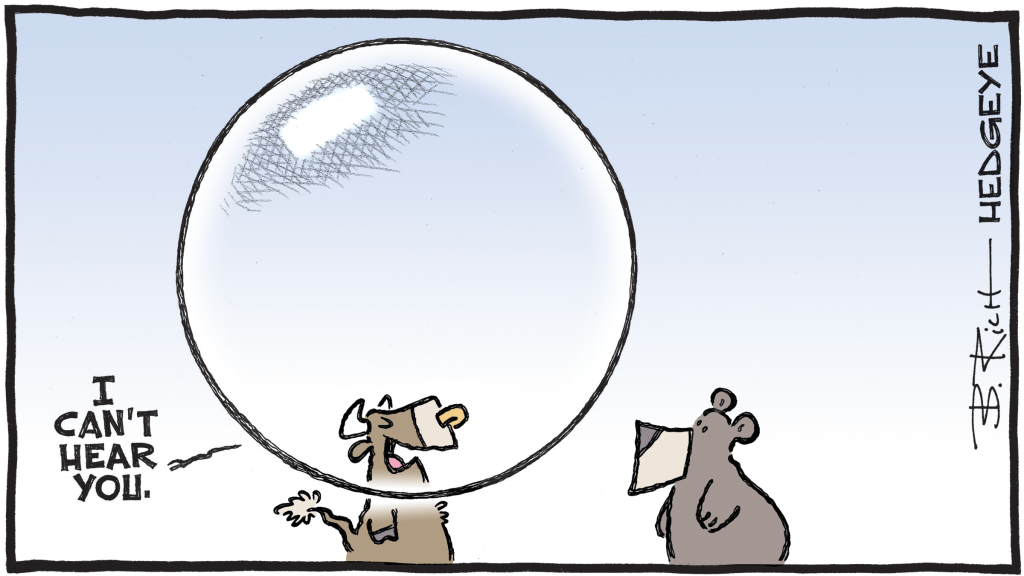
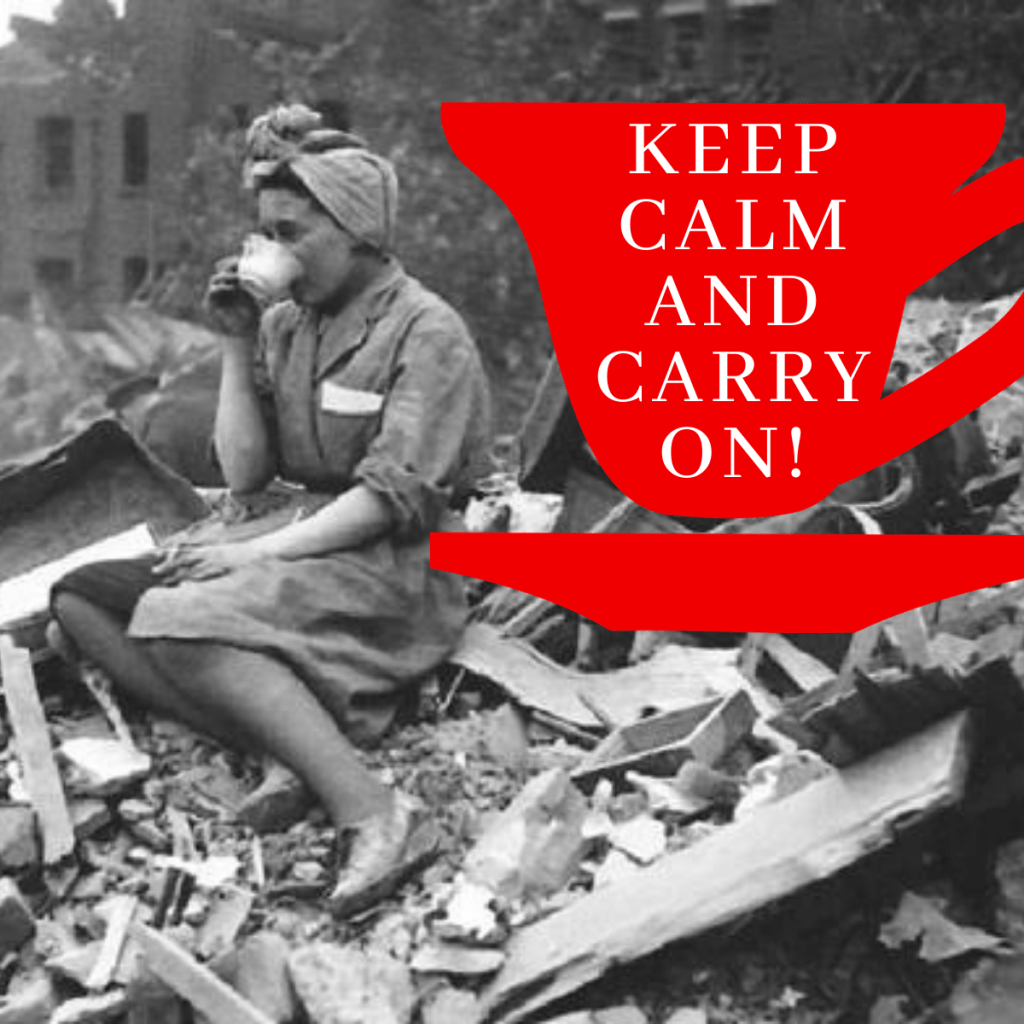
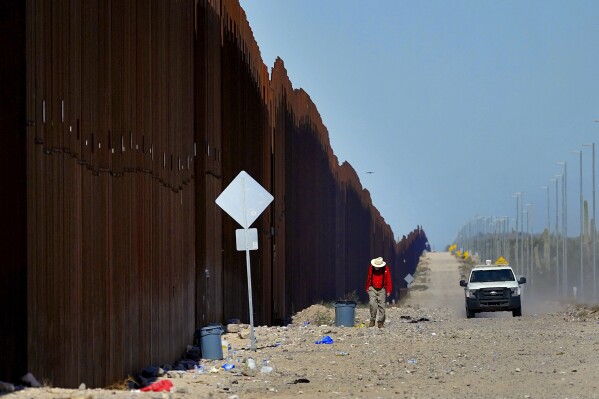


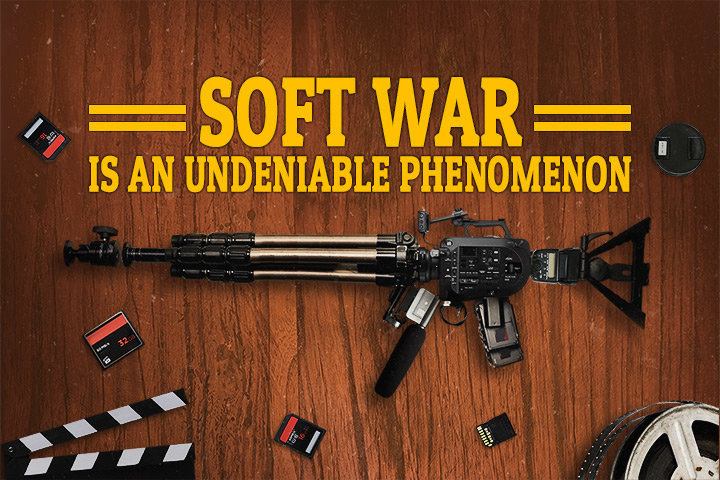



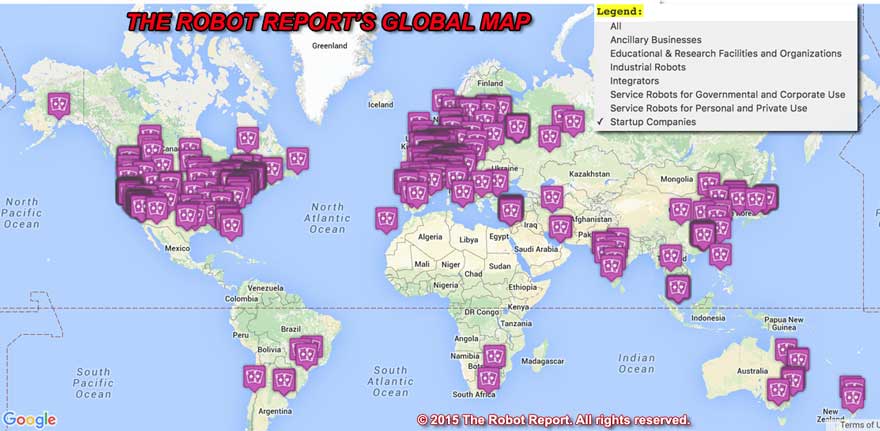


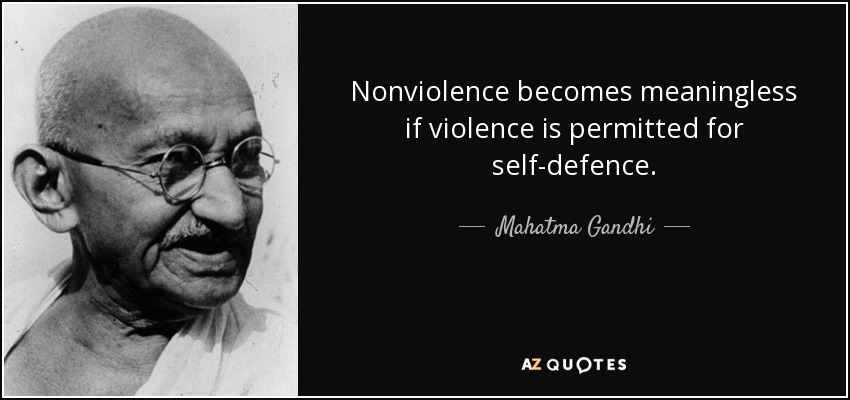

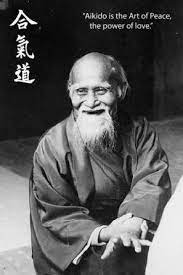


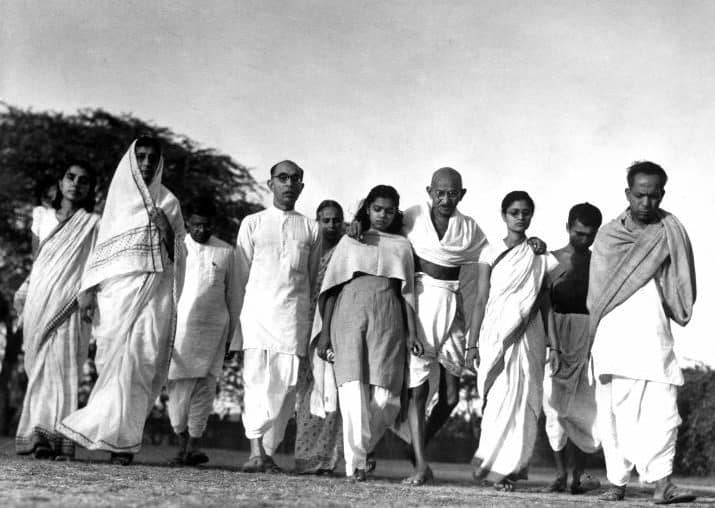


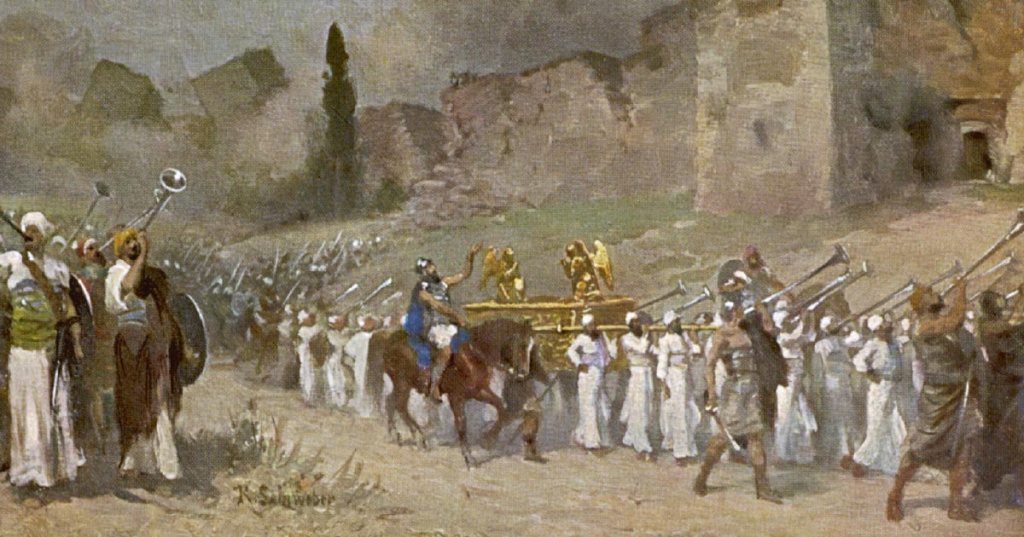
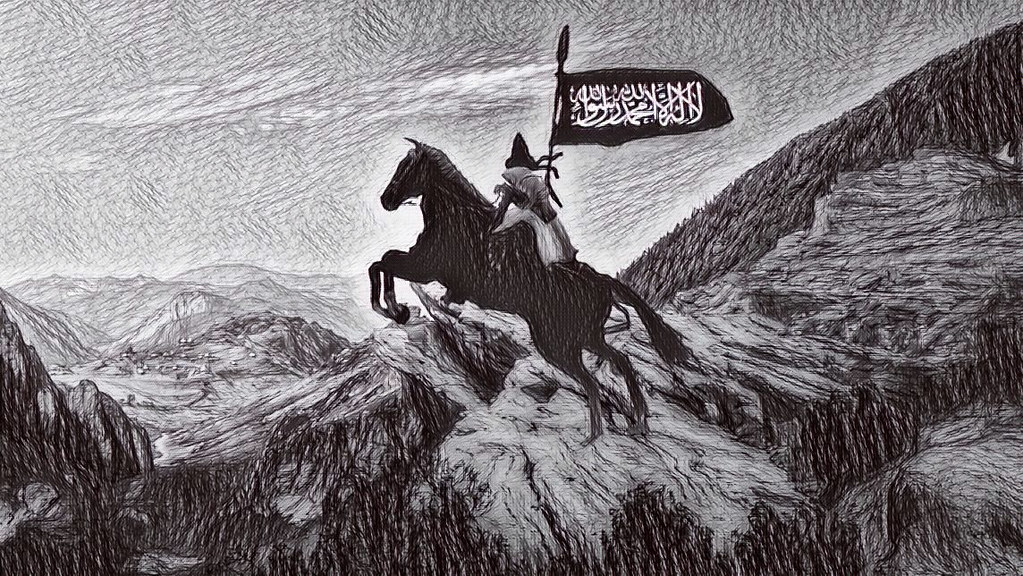



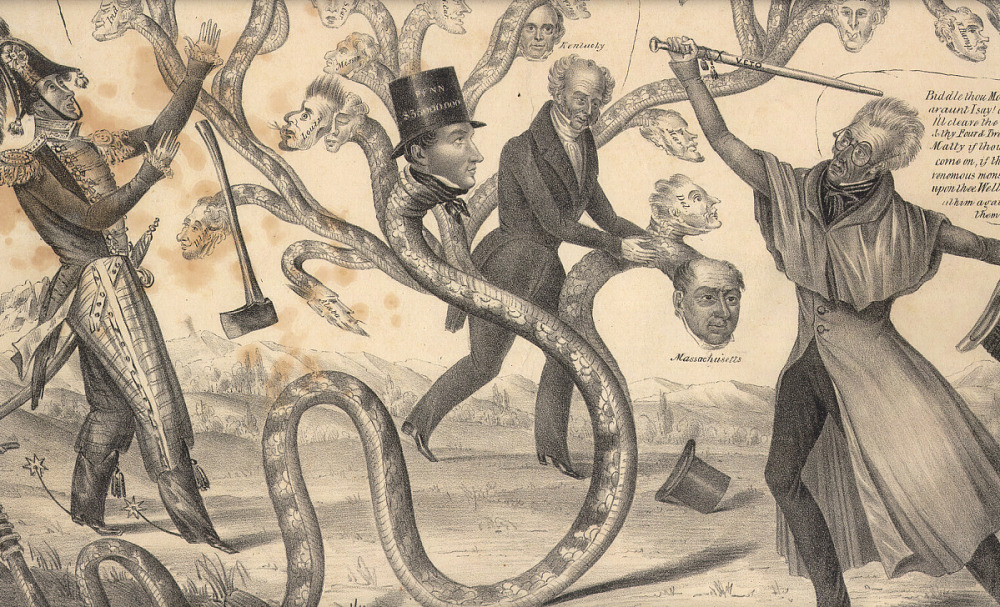





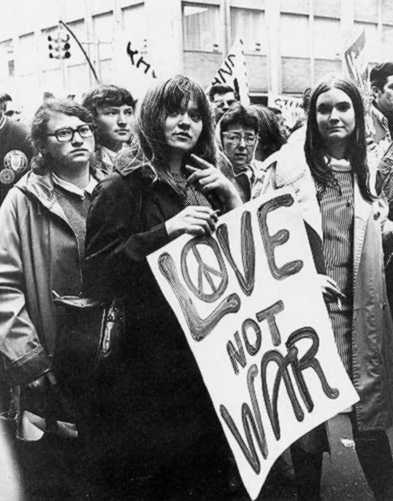


 Matters Blog