New Think

You can deduce from current common ways of speaking that something is wrong with the way people are thinking.

George Orwell invented a type of language called New Speak in his revolutionary novel, 1984. The future society was envisaged as having been transformed into a totalitarian state, in which the individual had few rights and needed to act as instructed by the state at all times. This included which topics could be discussed. Clearly this meant that history and references to individual freedoms of old, was forbidden.

New Think

I am introducing here the brother of New Speak – New Think. The two are very closely linked since we use words to think and speak our thoughts with words. You might say that these words are the bricks with which we build the houses of our thoughts. When new patterns of speech emerge they show us that people are thinking differently.

It bears scrutiny then to investigate whether 2020 has constructed any new thinking patterns. If so, have they taken away the individuals right to think and speak with quite as much freedom as before?

Brief mention should be made of political correctness even though it has crept in over the last decades and is not new. But it now forms an underground of thought censorship by the masses, for the masses. As such it is perfectly protected from claims of being ‘government interference’ and becomes an illusionary ‘high moral ground’.

New You-must-master-a-new-way-to-think

The traditional boundaries of free thinking stop at what we call as ‘freedom of speech’. A verbal ‘blue sky’ does not really exist because it would allow bad people to express bad things. That would offend and moves into the area of anarchy. Perhaps the critical question therefore, is not freedom at all but what is good and what is bad?

It is never easy to define these terms. Do we realise when our good intentions are producing bad results? Do we hear what we are saying and analyse what thinking process made us say these things? We can self sensor and reduce our language to only what we know for certain is true, because we have measured, tested, experienced and listened. Or we can allow a strand of smoke to enter our heads and let it cloud our opinions…what we call our ‘beliefs’. Good intentions but poorly informed ideas are the road to Hell.

The principle matter is that a muddled head is open to suggestion. Of course it’s impossible not to be open to what we are told ( as proved by the advertising industry ) but a muddle mind and mixed up emotions are very welcoming nonsense with open arms. Governments, religions, friends, family are all whispering in our heads. Omitting facts and alternative interpretations are the ultimate form of censorship. When the sensor enters your head and starts constructing the way you think, are you aware of the stranger in your thoughts?

Let us go a little deeper into what we might call ‘distorted thinking’ or thinking that has been twisted in some way.

Firstly let us examine key words. These are words that immediately move you into the supposed ‘moral high ground’ when you use them. We hear these all the time and news readers and politicians will emphasise them. Examples are ‘health’ ‘police’ ‘safety’ ‘justice’ ‘freedom’ ‘right’ and so on. The use of these words are not generally challenged or open to scrutiny. As descriptions of motives or empowerment, they carry the argument a pretty long way, merely by their own ‘unquestionable truth’…even when, lacking any sort of detail, they are flawed.

Such words should demand of us further probing into their real meaning and the implications we draw from them. Does ‘justice’ examine the details in order the bring ‘fairness’ and ‘truth’ into the light?

If you had to write an essay on ‘freedom’ for instance, you had better give yourself plenty of time. When this word is heralded. everyone thinks they know what it means. In reality, it is so broad that it means different things to different people.


The Free World is coloured green – simple really.

New Free World

picture credit Freedom House

Such vague thinki ng will always be there, but sometimes there is no word and a new one has to be invented. The word ‘Brexit’ for instance is used to sum up the political aims of far right, single issue parties. By it’s unquestioned use and introduction into common speech, it gained far greater prominence than it deserved. Why? Because the term is so vague that it embraces different meanings amongst the people. Every special interest group such as farmers or fishermen, want some small part of Brexit to be a magic wand for them.

All the politicians have to do is keep repeating the slogan and ignore the detail.

Brexit means Brexit

These are the arguments of the absurd and bear little rational scrutiny, yet politically they paid off, because of the sense of high moral truth a generalisation infers. In the future the worms will come out and the fishermen will be at logger heads with the government of the day because they each expected different things and were given neither.

You will begin to recognise these key words when they are used because they mean everything and nothing. Take the word, ‘safety’ as an example. Safety means the avoidance of any and all risks…as if that were possible! It’s an abstract concept, yet it is treated as a golden promise.

‘The cabin crew are here for your safety’. Sounds very noble but in reality the cabin crew are here to sell as much crap as they can for company profits. A small part of their training covers what to do when everyone is going to die. The truth sounds considerably less moral high ground than the promise of ‘safety’.

So how come we let such words take over our rational thoughts? Well, It’s hard to argue against being safe. Everyone likes to think they are safe and will be highly indignant towards anyone who explains the risks. The necessity is not to accept promises of being safe, but to examine what is the best means to achieve being as safe as possible. When is an acceptable level of compromise between safety and harm achieved? Risk is all around us and only a fool would choose to give up having an exciting and interesting life, because of it.

New Demand-for-Deceit-Cover

In New Thinking, the objective is everything There is no debate about how to achieve this objective, either in broad or detailed terms. If the captain says you are safe in his boat or plane and at the end of the journey you have arrived safely, then the captain can be applauded and had spoken truthfully. Really? What really occured is that the captain glossed over listing the numerous risks that you take by traveling in his aircraft. He never tells all because this would make him appear unsure or incompetent. When he promises safety to all, he is kidding his passengers and maintaining his perfect record until the day comes when the problem he hoped would never happen, occurs. Then everyone on board is going to have to rely on what he learnt in training and how well he remembers it…something untested. As the North American Indians say, ‘it is easy to be brave from a distance’ and most of the time, we are at a distance, even the experts.

This leads onto the next New Think thought pattern which challenges the old adage that one swallow does not make a summer. In New Think, if a problem happens just once, it could happen again. Usually when a problem is encountered, say thieves breaking into cars in a supermarket car park, the New Thinker will pay no heed to what measures have been put in place to reduce the likelihood of it happening again. That is going into an area of complication that they believe they have no need to consider. They know secretly that if they did, they are entering an area of expertise they may not understand and expose the authority they pretend to have.

The solution in New Think is always extreme… ‘I will never use that car park again’. The hammer comes down on the nut. For Hitler and many societies before him (including the British in the city of York), the Jews were the problem and the hammer Hitler used we all know about. New Think, when delivered eloquently (and Hitler was an eloquent crowd pleaser) will stun into paralysis people’s critical thought patterns. We call it ‘propaganda’ or ‘spin’ and politicians today can spin plates like the Cirque de Soleil.

The New Thinker hopes and expects the listener is too polite to challenge and or ask for factual proof. Any such challenge is met with the wrath of the self righteous and in my experience, that is more scary than a person who knows or realises they are wrong.

Sometimes the generalisation it is generally true but either untrue in the detail as I have described or…wait for it… not even relevant!

An example would be a when woman lying on a beach is approached by a couple walking a dog. The dog sits and empties it’s bowels next to the womans towel. On seeing how upset the woman is, the man states loudly, ‘a dog has to go’. This statement is a true physiological fact, beyond challenge. It makes him feel reasonable and sensitive to his dogs needs. However by considering only how to justify himself over a third party, he effectively puts himself in a place where he can ‘move on’ and ignore the wronged party as a loser. The man’s self justification technique uses a true but blatantly irrelevant statement.

New Thinkers are keen to avoid responsibility. They work under the principle that they are right or can pretend to others that they are and in presenting the ‘proof’ the other party is logically, wrong! Since New Think skillfully avoids the contradictions and pitfalls that complex thinkers consider, New Thinkers rarely, if ever, say anything that they think, is wrong. Most of the time they are being so superficial or irrelevant that they are impossible to verbally challenge. There are certain politicians on the world stage now who employ the technique of ‘not answering the question’ particularly during Prime Ministers question time. Why be so foolish as to expect answers at question time!

This technique of New Think, produces more ‘red herrings’ than a deep sea trawler to distract and deflect listeners. The speaker raises and then explores areas that are not in any dispute. They will end their ‘true to another question but not this one’ ‘answer’, with a flourish of cliches and fist air punches, then sit back down to wait for the imaginary applause.

New Thinking awards the thinker a high self opinion after one unchallenged success after another. Expert thinkers can have the carpet pulled from under their feet when challenged by New Think. They can’t believe the other party is so ignorant and as they scramble for an answer the audience has stopped trusting them. This has given rise to the notion of ‘distrust the expert’. The thrones of the professional ‘experts’ are now occupied by uncrowned New Thinkers. So sure are the ignorant that knowledge is simple to obtain, that the butcher, baker and candlestick maker feel personal entitlement to opinions on most subjects. Do butchers make good surgeons? Probably not but test this with a DIY heart transplant if you doubt.

There is a measured phenomenon that enables a complete beginner to guess and be right. Professors David Dunning and Justin Kruger found that in the first instance a beginner will be highly confident when discussing and drawing conclusions on a complex subject. They are measurably more confident than an expert because experts are aware of the contradictions and elephant traps dug by the hunter known as ‘complexity’. It was found that after the initial burst of confidence the beginner / amateur soon discovers that they are wrong on many counts. Their confidence over time, takes a steep tumble to well below the expert. What harm they have done in that time depends on how much others believed them.

New Thinkers grab a few facts on a subject that interests them and present it as conclusions that have been subject to extensive research, experience and review. In fact what they are presenting is shallow, ill considered and potentially, dangerous. The initial facts may not even be real but imagined, or at least selected because they support the New Thinker’s views.

New Speak Words

New Speak has a special way of making fiction sound like fact. The phrase ‘to be honest’ is used as if the speaker has suddenly departed from fiction into Factland, or has been swept away by a Tsunami of emotion, gaining truth and sincerity in the process. Even words like ‘actually’ are able to make the fake more real. Just by using this word, truth is pretended.

When the New Speaker has no idea what the the facts of the matter are, they will move into the area of hope and expectation. Here, they can present themselves as that ‘jolly good fellow – the optimist’. Since everyone likes an optimist, however self elusory they may be, being hopeful for ‘good things’ is hard to shout down or challenge. For a start, anyone who does not believe an ‘optimist’ must logically be ‘a pessimist’ and we all know how wrong that is.

I suggest that optimist and pessimist are both subject to emotional thinking rather than rational thinking. Surely, outside of those in hope or despair, their exists, ‘the realist’. This person is not likely to be pontificating and making false promises or raising or lowering expectations amongst the naive. The realist will say their piece and disappear into the depths from which they emerged, because understanding reality takes time. Realists are usually experimenters and experts.

Some New Speak comes from faulty logic. Thinking and in particular logic is not necessarily taught in most primary and secondary education. There is some understanding of ’cause and effect’ from science classes but the process of thinking and it’s inevitable falsehoods rarely surface in mainstream education, let alone adulthood. One such example is a syllogism. These are two true statements but a false causal connection between them is assumed. An example might be,

The farmer had a bumper crop of apples this year.

The apples were sprinkled with a holy water from Lourdes brought by the farmers wife after her pilgrimage.

The holy water brought about the bumper crop of apples.

New apples


Armed with this and other kinds of flawed logic, the New Speaker can draw conclusions on all sorts of subjects using facts that are true but have no causal connection. There might well be inferred a connection but usually some simple analysis and testing, will disprove.

The best tool at the disposal of the new Speaker is to ‘totally ignore the question’. This a thinly disguised passive aggression. If it was aggression it would be challenged but omission is rarely challenged. Perhaps he just forgot the question? Perhaps he does not want to go there? – are the thoughts of the sensitive listener. In reality, the question was merely taken as a prompt for the new Speaker to move onto a favourite subject in which to sound correct, rather than get bogged down in analysis. Why would you do that, if your goal overrules your integrity?

When in full flow, a New Speaker, will use stock phrases often completely unconsciously. These phrases are the ‘you know?’ or ‘do you know what I mean’. These are repeated appeals for encouragement and continuation of verbalisation independent of agreement or truth. The listener might be tempted to rejoin, ‘no I don’t know’ or ‘I don’t know what you are talking about?’ Unfortunately the passive listener does not feel empowered to interrupt or rattle the New Speaker’s, well disguised lack of confidence.

‘As I said,’ begins the new speaker, at which point you rejoin, ‘well if you said it, why are you saying it again? I heard you the first time’.

So New Thinking and New Speaking are two sides of the same coin. They are not a new phenomenon, as new things come along all the time. What they are are a ‘temperature guage’ from which rational people can gain a warning.

Words, according to the Biblical story of the Tower of Babel, introduce confusion. This was true in ancient times and remains very much so today. We ignore obfuscation and ‘fakeness’ at our peril. The great babble from the World Wide Web has amplified untruth to the extreme. We have reached the point where people become ready to believe almost anything as fact.

Speak your truth, gentle citizen, and the truth will set you free. Or perhaps that’s not true any more? What do you think? Are you better at thinking than Jesus? Time to declare yourself as the new Messiah then…or just wind you neck in.

New Jesus

The Tunnel at the End of the Light


There used to be a car, in the 1950’s called the Ford Popular, endearingly known as the ‘Ford Pop’.

If the model T industrialised the manufacture or cars, it was still only affordable for the middle classes of America.

But the Ford ‘Pop’ bridged that class divide and provided a ‘people’s car’. Germany had done this in the 1940’s with the Volks Wagon Beetle, but Britain took a while to catch up due to a short ‘intermission’ called the second World War.

The greatest car ever built – Ford Popular 1954

picture credit: carandclassic.co.uk

Light Ford Pop 103e 1954 carandclassic

What do you expect from a people’s car? Certainly it is not going to have a chilled drinks cabinet and cigar lighter. Everything was basic, functional and appealing to the common denominator of public taste, availalbe in black, black or black. It was, naturally, very popular and it transported families in comfort from city to beauty spot in large numbers. If you wanted anything other than a can of baked beans, you had to get a pay rise.

Fast forward to today and you can draw a parallel between the dumbing down from ‘the good life ‘ for a few, to ‘dull and ordinary’ for all. The middle classes in both the UK and USA lost their grip on political dominance, because the workers have come out in larger numbers to vote.

In the last decades of the 20th century, politics was complicated. Whilst you didn’t need a degree in political science to understand what was going on – it helped. The whole process of electing representatives on multiple – often contradictory – manifestos, parliamentary debate, Sovereignty, national priorities, international relationships and above all, law amending and making – was baffling to most. So it was left to the ‘Toffs’ from elite universities to speak down to voters in election campaigns to make promises everyone could understand – even if they were expected to forget them later.

Enter the internet in the 21st Century. Whilst you could write the equivalent length of Nelson’s Column on how this availability of information has changed societies across the world, there must be changes.

The most obvious of these is, in my view, the ‘citizen scientist’. In a stealth move worthy of the Great Harry Houdini, ordinary people who never understood science at school, are suddenly ‘on to it’.

If we  regard science as a way of thinking logically about anything – using the ‘scientific method’ to prove or disprove propositions – then everything is up for change and challenge.

Call a friend?

Light NHS Direct

Suddenly people were empowered to not believe their medical Doctors. You look up your symptoms on the internet and then go and tell your Doctor what the problem is how you want to be cured providing it does not involve vaccination. The UK National Health Service even encourages this by creating NHS call centres. The staff follow algorithms in the same way G.P.’s do – perhaps even quicker and certainly without having to catch another disease in the Waiting Room.

The same process has crept into most other areas of professional expertise; people design their own houses, people cook and bake, people make art, play musical instruments, make astrological predictions, indulge in puppy care and kitten care – you name it people do it – and the walls of Jericho surrounding the professional classes have fallen.

Great, you might think. This is democracy at it’s best. People power!

The problem is the obvious one and why even Socrates, warned against empowering the masses.

The problem is that people do not access and use information, knowledge and wisdom in the way that professionals have been painstakingly trained to do. As always it remains true that, things are more complicated than they seem.

It is easy to reduce areas of knowledge to ten ‘top tips’ – how to build your own house- and make it look easy. Speak to anyone who has built their own house and they will describe the most stressful time of their lives, going over time and over budget and still the roof leaks.

Socrates warned that ordinary people did not have the education to be trusted in such things as – voting. Perhaps this is one reason why women in the UK at the turn of the 19th century were still denied a university education and a vote – why this particular prejudice was suffered for so long.

Even with a university education, young men and women in the twenty first century are finding it hard to get a job. When the Blair government in the UK declared an aim to give a top class education to fifty per cent of young people, the ideal appeared noble. But the reality was that ‘degrees’ became so common that they were no longer the doorway into top jobs.

Worse still, with the introduction of University fees in the UK, young people were enslaved into a life time of paying off a high interest debt – all on the promise of ‘earning more’. And governments too are unlikely to get their ‘pound of flesh’ from the deal. Grants to the few worked better in my view.

In primary schools the children of the first decade of the twenty first century were told how clever they are and one day they might be Prime Minister. It was of course a lie told be people who had only become teachers who took holidays at home.

Only a few people ever become Prime Minister- as if we need telling.

The president of the United States for instance, has been described by psychologists as ‘adolescent’. Although he boasts of a ‘very, very, good education indeed’ – he didn’t listen in school and learnt very little. Add to being academically dumb, other short comings which doubters love to list, then you have a candidate appealing to those who are fed up with being talked down to because they are ‘very, very good people indeed’. Fortunately in America there are plenty of these in the southern states.

Trump uses short phrases to plug home a message easy to understand and remember for the masses;

Make America Great!’ ‘America First!’

Johnson does the same; ‘No Deal Brexit!’ ‘Project Fear!’

Their close advisers are no longer civil servants or even elected politicians. They are media savvy individuals who know how to change how voters and party members think. In the UK now there is not even a deputy Prime Minister the PM can discuss strategy with. Instead their is an unelected ‘close adviser’ to whom the PM remains loyal – at least until Brexit is over – despite protests from his own party back benchers.

But the patients have not completely taken over the Mental Health Institution. There is today a swing back towards trusting the middle class professionals. Self build houses leak, Mr Kipling’s cakes taste better, art is not easy. But particularly at this time of crisis, people have seen the highly trained men and women in the health services, battling away for little personal reward and realise, ‘I could not do that’.

Suddenly, the science of Virology is laid out like a patient etherised upon a table, and no one except the professionals understands.

picture credit newseu.cgtn.com

light Neweu cgtn Virology Lab

Because it’s difficult to ‘do the right thing’, science is emerging as a wise advisor to governments. When Boris Johnson gives press briefings he is flanked by non-elected scientists who give ‘advice’. This appears to be a correct and ethical process until you realise that there as many views on a subject as there are scientists. Scientists often disagree with each other’s ‘version of the facts’. They will say that more studies are needed, larger samples, more vigorous methodologies, new measuring instruments and technologies – innovation and discovery!

(A particularly cynical pundit will suggest that governments are setting up someone to blame, when the strategy is seen to have killed thousands because the government policy was late and or wrong.)

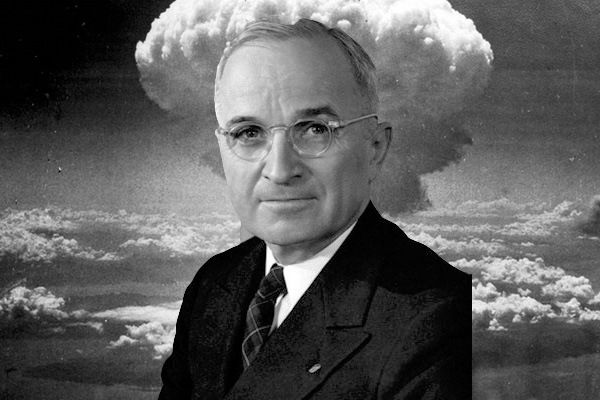
This dark secret of science is not so dark and we should demand to know it. Should President Harry Truman have been persuaded to build the Atomic bomb – ending one war and starting a cold one that sits like a dripping glacier, to the present day?

picture credit: atomicheritage.org

Is that a nuclear weapon or are you just pleased to see me?

Light Harry Truman atomicheritage org

Who voted for the Atomic bomb? Certainly plenty of people protested against it in hindsight but knowledge, once out of Pandora’s Box, never wants to get back in.

Suddenly ‘the people’ see the scientists as doubtful holders of solutions to problems. Science has mucked things up just as often as it has created a better world.

And if you can’t trust the scientists surely you have to trust the politicians? Unfortunately there are as many political view points are there are sea gulls behind a fishing boat and the only thing you can be sure about is the direction of the boat.

So societies trundle into the twentieth century lead on by TV and radio personalities with regional accents – commoners who you can understand. Everything has been reduced to guessing games that requires no skill because the people tried science and it was even more difficult than at school.

If our politicians are also guessing their way along – without scripts, experience and the wrong pick of scientific views – is this the end of the light?

picture credit: author – unfortunately God moved.

Light through clouds

Lock Down

The following essay is an examination of how the theory of one area of social problem solving, is similar to and can inform another.

There are elements in common between those who look after our health and those who try to keep crime off the streets. These are the four strategic similarities;

Problems can be prevented

Problems can be analysed

Causes can be detected

Causes can be treated

Corona virus is not new. SARS and then MARS are two recent examples, but throughout history humans have been literally, plagued by them. Each time they come and go, there are lessons to learn. These will help preparation for the next.

This may involve warehousing hospital supplies for instance. The span of time between outbreaks will help to inform the ‘use by’ dates on perishable items. Typical examples would be testing kits, ventilators, hand sanitiser, personal protective equipment, software and even signage.

South Korea has performed particularly well in dealing with the current corona virus pandemic. It puts this down to four key strategies, which are the same as those above;

Prepare

Test

Trace

Isolate

Having the means to deal with the next outbreak at the very earliest opportunity is essential. Countries that have experienced denial of a problem by it’s leaders, or have lacked equipment or funding (e.g.. for research ) are going to lose more citizens than those countries which have prepared.

The old adage ‘a stitch in time saves nine (stitches)‘ is wisdom from the past that we ignore at our peril.

Any police chief trying to reduce crime will be familiar with the principles of crime prevention. Simple and best value strategies for dealing with say, burglary can save the tax payer vast quantities of money needed to put one burglar behind prison bars. Ten pounds spent on preventing burglaries, might save a one hundred thousand pound court case.

Over the last few decades police have moved from the universal production of posters such as the ‘lock it or lose it!’ campaign and ‘watch out there is a thief about!’ to targeted prevention and detection.

It is clear that sending a crime prevention message that may or may not be highly relevant to a community is wasteful. It also raises an unwarranted anxiety of being a victim of crime within low risk areas of the country.

Instead police started analysing their computers and finding patterns. They were interested in where, when and how a particular crime was occurring – long before they asked the question ‘who was doing it’. This built up intelligence which is invaluable to inform the prevention of crime. For instance, if thieves were breaking into cars in town centre car parks, the analysts identified which car parks were most targeted, which parking spaces were being targeted, what time of day and day of the week etc. This might identify an area in a car park where they was a good escape route and poor lighting, no CCTV coverage and little footfall. All of these could be rectified by car park managers on advice from the police. The public would pay nothing and the car park manager would see a rise in the use of the car park and revenue.

The South Koreans were also good at identifying where corona virus victims were. Instead of fighting what Donald Trump and Boris Johnson called ‘the invisible enemy’, the Koreans analysed information from personal smart phone locations cross referenced to recent entry and exit of foreign countries. With this information they were able to target their testing and identifying ‘hot spots’ where transmission of the virus was likely to happen and or happening. They even used police detectives to trace individuals and their movements.

Police call this ‘detection’. It is the natural follow on from the initial process of finding out as much as possible because the problem is hidden, not invisible.

By targeting resources in this way there are two benefits. The first is that it is cheaper. This may sound callous but in fact cost can be a huge inhibitor to action.

The second advantage of targeting action, is that businesses can carry on, if only in a limited way. One tactic for instance would be for elderly high risk victims to be placed in isolation while low risk younger people to maintain the economy and public services.

Prevention and Detection are really two parts of the same process of ‘reduction’ whether you are considering health or crime. They exist on a spectrum between the two extremes. At each end of the spectrum, detection contains some prevention and prevention contains some detection. As an example, the final result of the criminal justice process is to put an offender in prison. One of the possible outcomes of this is hoped to be preventing that individual ever doing the same thing again. They usually do, but sometimes it works.

picture credit: detroitjournalism.cog

lock down detroitjournalism

It has been suggested that the present pandemic has been dealt with in a manner in which the cure is worse than the disease. The ‘lock down’ approach to entire populations has ramifications that will lead to huge public debt and austerity.

The question has to be asked, ‘is lock down the only way to deal with the pandemic? The answer is no, because the South Koreans didn’t have to go that far.

Their strategy meant that they did not need to lock down their populations, eliminating in part at least, mental and physical health problems resulting from isolation and economic austerity in the future. Although it was clearly not ‘business as usual’ it was a working compromise between the needs of people to maintain health and an income and the need to eradicate the virus as quickly and with the least cost of money and life.

By targeting their treatments to areas of the population in most need, they have provided a model that the rest of the world would do well to study and copy. Lessons learned should already be being digested and fed into the strategy for Covid 20, which we can expect is already hanging in a cave somewhere in the world.

When the Covid 19 strain was first detected in China the world watched. As a top down organised country China had more tools at it’s disposal than democracy’s, but the principles are the same. What the rest of the world might have also taken seriously is asking the question, ‘are we next?’ Governments might have looked to the World Health Organisation for an answer. For many weeks the WHO did not declare a pandemic was happening. What world leaders needed to know was when it would happen i.e. be proactive not reactive.

In the United Kingdom the medical journal The Lancet included an article on how the outbreak in China will become a pandemic. This was in January 2020. In February the country had a chance to prepare. It did not. At the end of March personal protective equipment, ventilators and testing kits are still being ‘rolled out’ – as the government puts it. New cases are doubling every three to four days. The government of course denies being slow in preparing for the pandemic and points to the fifty new hospitals they have built. But hospitals are for the treatment of victims, not preventing people becoming victims. The resources are sent to the results of a pandemic not preventing one.

The vital point here is ‘timing’. There are three possible outcomes from deciding when to take action.

The first is that measures are put in place too early. Ministers in the UK expressed concern that fatigue sets into the population if protective measures are introduced too early. They wanted to time maximum protective measures with maximum victims. There was an assumption that the patience of people to avoid their death or of loved ones, is limited. It could be argued that as more fatalities occur the more concentrated minds become.

The second possibility is that exactly the right moment is chosen. This is ideal but is best judged in retrospect, ‘wise after the event’.

The third possibility is that measures are put in place too late. In this case there will be the highest number of human deaths and the most expenditure of money.

Of these, the first two are proactive and in my view produce the best results.

Reacting to problems is to undertake stitching nine stitches instead of one.

Getting the warnings right, is where you might expect the World Health Organisation is the expert. Viruses are not new and statisticians and virologists can get together and draw up predictive curves. They should be good at this even if each country is different.

The tragedy is that politicians are self selected for their political ideals and personal appeal. They may not have the abilities to assess a situation and give precise direction at the appropriate time. They may not listen to their advisors and or may just use the advice to avert personal responsibility.

These principles of proactive and reactive management and decision making are as true for dealing with crime as for health. They are so universal that they can even be applied to playing a game of football, which is why clubs employ statisticians to analyse games in minute detail, as they progress and after.

There is nothing in life for which we are not equipped. The only real challenge is overcoming our own shortcomings.

Red Ball White Ball

These series of essays have one common theme. They take another view from the conventional one. In life, we encounter complexity and the principle way we deal with this, is to simplify. When this happens however, something is lost and often that thing was the most precious. It is called;

Throwing the baby out with the bath water

Problem solving is one life skill that is invaluable, more so than, dare I say it, algebra. Almost everything we do and our games are problems in need of a solution. If the bath water is cold, mothers remove the baby before throwing the water on to the garden. It may sound obvious but often problems present in confusing ways…too many things are at the same time. That is when the baby ends up in the rhubard patch.

baby_bathwater

A game such as Snooker is a problem solving game. The players are presented with the complex task of putting the red balls into the table pockets. Complexity is introduced by rules. One is that the balls can only be pushed with a stick; you cannot pick them up and put them into the nearest pocket! Then you have to push a coloured ball into a pocket alternately with a red ball, and a scoring system giving values to balls, means that the best player will win prize money and fame. But the most complex skill of all is the use of the white ball. This must be pushed with the stick to hit the other balls and it must always be controlled, so that it comes to rest in anticipation of the next move. Those not familiar with the game take a while to realise that hitting the red balls is not the primary objective, but skilfully placing the white ball as it rebounds off the red or coloured ball. With this skill you  solve the obvious problem and set up for the next problem, within your own hidden game strategy.

red ball white ball pocket

Complete problem solving involves a highly inclusive level of complexity, where consequences are anticipated rather than left to chance. There must be no ‘unintended’ consequences.

Stage illusionists know that the human brain simplifies what it sees in order to interpret what it is seeing. They use the technique of distraction. They know that the audience will watch the hand thrust towards them whilst something not to be seen is done so fast and discretely, that it is not seen. This is classic, red ball, white ball.

Politicians have to solve highly complex problems and apply practical solutions. The first stage of problem solving is to define the problem.

At present the world economy’s are being threatened by a pandemic. That is the problem. People with the disease are a short term problem, whereas the world economy needs to provide work and a livelihood for every citizen of every country. This is a far greater problem in the long term than the present ‘red ball’ events presented to us daily concerning Covid 19.

We are told that the origin of the new virus was from markets in China where bats were being sold. We all believe this. This is the red ball. We think we have seen it go into a pocket. But did the Chinese authorities close down the markets selling wild animals? Why didn’t they after SARS? Could there have been another source of Covid19?

One Chinese lady interviewed declared, ‘This could have happened anywhere’, being defensive over the suggestion that this and previous viruses like SARS, happen in China because of their love for exotic meats. Perhaps she has been told that people in the West also eat bats and rats and cats. That would be her ‘red ball’.

There is an Institute for Virology in Wuhan; the Province where the outbreak is alleged to have started. You might expect that they would be anxious to deny accusations that they let out and or create Covid 19.

Yet if you view the home page on their web site, the top story is about HIV. The top news story is that a delegation from the Ministry of Education of Kenya visited. No red balls present, just a white ball suggesting the aim of the Chinese to develop the untapped resources of Africa.

Was there a terrorist incident involving the release of this virus, as has been the plot in Hollywood films?  Are too many people now living in cities? Have individuals immune defences been reduced through poor diet and lack of sunshine? Is there more than one variety of Covid 19, one strain being more virulent than the other? (The purpose of this would be to increase fear of the virus whilst limiting deaths.)

Could there have been some political placing of the virus in a country to destabilise it more than other countries? Both China and Iran are viewed as threats to peace in the West and Middle East by western politicians.

These and many other possibilities, are unexplored but possible ‘white balls’ that indicate hidden agendas. But we are too engrossed with watching red balls (or red herrings!?) fall neatly into pockets.

Few journalists have asked challenging ‘white ball’ questions on the television screens in the west. What is being presented are ‘red ball’ events such as where the virus is now and in what strength. Which events have been cancelled, how is it going to affect various people in various situations, etc. etc. One red ball after another is being put into a pocket and as quickly as they go more appear on the table. It’s fascinating and distracting.

The real question is ‘what is the white ball doing?’

Who is behind what is going on, is an unspoken question. Any suggestion that the pandemic is a deliberate manipulation is ignored or described as ‘fake’ or ‘conspiracy’. And yet, the most important rational task, is to discover a conspiracy if one exists.

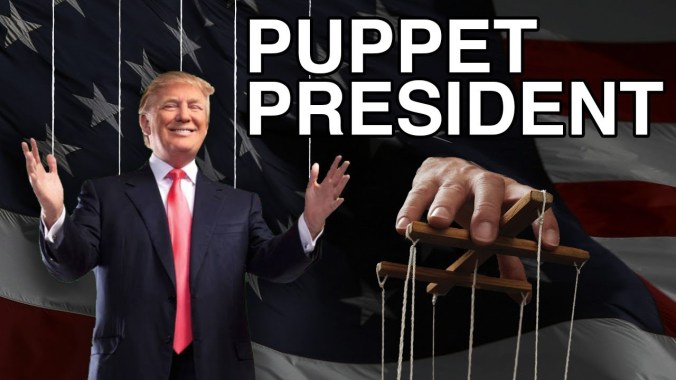
Puppet President

Who is pulling the strings of the puppet president of the United States of America for instance? Why? Because Mr T. started the health emergency by denying one exists and that it will go when the weather gets warmer in April…standard off the cuff remarks made by the uninformed. Behind the curtain a patriotic doctor who started testing for Covid 19 is told to stop, as that is the responsibility of another department. This department came up with a test three weeks later which did not work. By this time the Jennii was already in LA and not to enjoy the surfing. 

We saw the same ‘white ball’ tactics with 9/11. Every day of the year, every hour of the year, fighter jets are on the runway, ready to defend the USA from hostile aircraft entering US air space. But on 9/11 all those jets were off somewhere else on a pre-planned exercise. The guard was down. International conspiracy? The prize for the winner of that game was to up national surveillance and remove individual freedoms for Americans. It is called the National Security Agency and it is saving everyone from terror plots.

Who will gain from the current pandemic and the fall of western economy’s? No individual government gains. In fact they all lose. The only gains will be upping international surveillance and removing individual freedoms.

Specifically, cash will be removed as a system of payment, on the grounds that it ‘spreads viruses’. This has never been true in the past few thousand years but suddenly it is. In place of cash is the card (or RFID implant) and the control this brings to governments to know where it’ s citizens are and whether it wants to allow them to have personal money.

Second is the extinction of small and medium size businesses and the self-employed. Examples might be taxi drivers who own their own cars and certainly low cost airlines. This is in contrast to large and multinational corporations such as Amazon, Microsoft and Google, who act in the interests of the large white ball.

One day this large white ball will put the last ball of the game in the pocket. That will be the black ball worth seven points. If you think things are dark already, then that will be the blackest of black days; the end of personal freedom. Game over.

Don’t Fence Me In

This the title of a wonderful old song sung, I think by Bing Crosby. It’s all about the exploration of the west in nineteenth century North America. After millennia of humans and animals roaming free, cattle ranching introduced ‘ownership’. The Native American Indians didn’t understand it and gave away their lands before they realised they would have to fight and ultimately die for the ‘reservations’ that were left for them.

picture credit; WallpaperWeb.com

Stampede_African_Cape_Buffalo_Herd

It is an paradox that man craves freedom but loves boundaries. Astronauts report on viewing earth from space, that it appears as one planet. There are no political boundaries that we are so used to see on global maps. Boundaries are ultimately arbitrary. They serve only the tribal mentality of ‘them and us’ present in early man and persisting, almost unconsciously, to the present day.

The poet Robert Frost wrote a poem which included the line, good fences make good neighbours. This concept, at one end of the spectrum of possible combinations of freedom and enclosure, works – but only temporarily. Eventually, because of tribalism and greed, a fight breaks out.

When the British realised the rule of India by a distant Queen of England was over, they were faced with the problem of handing over a sub-continent to self rule. A problem because the Muslims and Hindus were at each others’ throats. If the British left there would be a blood bath. So they drew an arbitrary border on a map and created a new country, Pakistan. Like the creation of the Berlin walls, it divided families, created mass migration, a loss of homes and livelihoods and riots and slaughter. Tribalism, whether under religious or any other banner, is never good for all. Today India and Pakistan face each other with tolerant hostility, with a hundred nuclear missiles each, ready to wipe out each other and the rest of us. As an afterthought little Kashmir remains a flashpoint where this could happen. When you draw political maps, you had better know what you are doing for now and the next thousand years.

When the UK made the minority vote decision (only a quarter of the population voted in favour of Brexit ) to leave it’s partners in Europe, it had not considered the effects this would have on Northern Ireland and Scotland. The border in Eire was created centuries before to create a ‘non catholic’ portion of Ireland that could be controlled from England. The political reasons for it’s connection with United Kingdom are changing, and a likely consequence of the UK seeking ‘independence’ is losing Northern Ireland to the Irish and Scotland to the Scots.

Virus’s, and all the malign forces that nature unleashes on humanity; virus’s do not respect political boundaries. It takes two weeks for a virus to travel around the globe. The only way to extinguish a virus is for each person to crawl into their own cave and stay there. They may die or they may survive. In this situation one is not even aware that one’s neighbours, also potentially dying, are on the other side of the wall.

When this current Covid-19 pandemic is over, as it will be, the nations of the world should take stock. They need to seek to understand the lessons that come from such a pandemic, for virus’s are a greater problem than terrorism and extremism and wars and all our man made horrors. In 1919 the second wave of Spanish Flu killed everyone who caught it.

Surely, world leaders must learn that humanity has more to gain from co-operation and tolerance towards all living beings, whether animal or human. There are no boundaries in nature except those created by habitat and when there is enough habitat to go around, everyone is happy. When large populations move to escape political or natural upheavals, these people are ourselves coming in the other direction.

In Europe, the European Parliament and non-governmental organisations like the WHO, have failed to create a strategy to cope with immigration. Countries on the edges of Europe such as Greece and outside such as Lebanon are full to bursting point. Now Greece is shooting warning shots into the sea at immigrant boats.

In the United States, the solution to immigration from Southern American failing states, is of course ‘a wall’. As if we had not learnt from history how the Berlin wall was pulled down and how Palestine was shrunk into walls – good walls rarely make good neighbours.

Mankind craves to be free and this moment in history is a time for humans to come out of their caves and obeyance to tribal rules. Instead of hating and fighting each other, we are in a position to see the greater picture from above, where barriers do not exist. There is only humanity, and the sooner we treat the planet and each other with humanity, the sooner we will lose the feeling of being ‘fenced in’.

The Good Life

There is a remarkable pair of photographs on the BBC website today. They show satellite images of eastern China, Hong Kong and Japan. The images are filtered to show the intensity of air pollution. The January 2020 image shows ‘business as usual’ and the principal cities and urban conurbations are highly coloured from yellow to high risk, red. The February 2020 image shows no coloured areas at all! The air is clean because production in the factories has stopped. Ironic that such a gift to the populations, of sunshine and clean air occurs when millions are in quarantine.

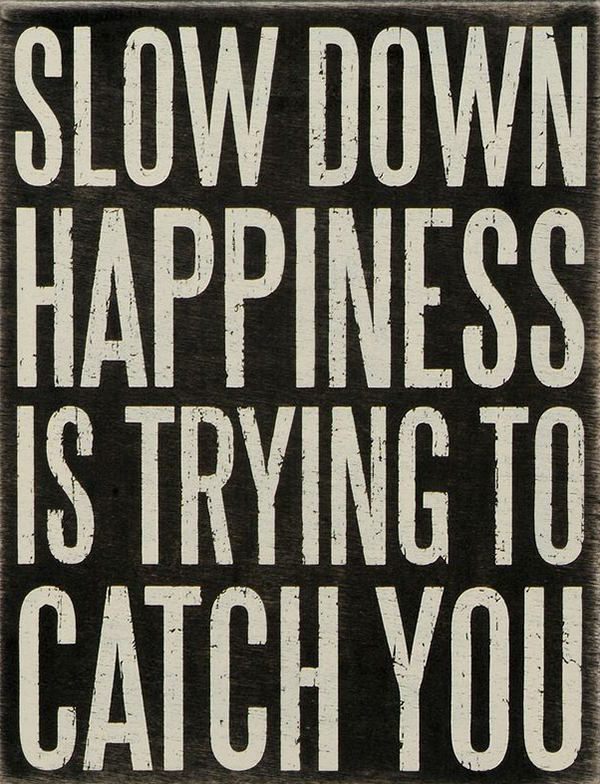
The message we can draw is not how contagious viruses are – we know that. No, the message so plain to see is ‘slow down and stop!’

slow-down poster

The industrial tenets of, ‘more and faster’ for profit and a promise of prosperity for all, are also familiar to us. Humans deserve a good life so the growth of benefits from industrialisation, cannot be denied. Over one hundred and fifty years ago people started to leave the land and live in cities. This process means that now about half the populations of most countries live in cities.

In response industrial production is speeding up, as robots and AI are literally taking over from humans. The only question is; at what point is ‘a good life’ reached?

A casual observer in a modern metropolis, might perceive a collective sadness in the faces of passers by – anxious to reach their individual destinations. If asked if their life is a ‘good life’ – I wonder how they would reply?

picture credit: WithPause.com

Snail credit With Pause

When I was a student in London in the mid-70’s, I took part in a ‘slow walk’. A collection of willing volunteers met at the north end of Hammersmith Bridge and lined up across the wide pavement. We set of in a bunch like marathon runners, only it took us three or four hours to reach the south side of the bridge – a distance of maybe three hundred metres.

Slow walking took discipline at first, but soon became strangely normal. My mind felt completely relaxed. I might as well have been in meditation – in fact, I was.

picture credit: Londr.com

hare and tortoise credit Londnr

That was part of my ‘good life’ when I had time to be fast or slow and chose the latter. There are in the present day, many experiences of ‘slow living’ available as an alternative to the human ‘race’. There is slow food, slow travel, slow cities, slow schools, slow books, slow living and slow money. See www.slowmovement.com and tell your friends!

In 2020 humanity is crossing the threshold where too much – too fast – too wrong – is damaging the planet and as a consequence, ourselves. Whether it is air pollution, sea level rising, food shortages, water shortages – industrialisation is ‘biting back’ the hands that turn the handle.

Sloww-Slow-Living-Synonyms-Infographic

This latest virus Covid 19, is amongst other things, a firm message for humans to ‘slow down and stop!’ Perhaps those confined to a room for two weeks, will draw a positive from the experience. ‘Not doing’ can alter expectations significantly. If ones normal expectations are unrealistic then the distress that comes from failure to satisfy those expectations, will never be encountered. Success or shall we say, contentment, comes from watching a spider cross a floor or a raindrop slide down the window; experiences usually never observed and enjoyed.

We will inevitably all discover that less and slower is more!

Somewhere between the extremes of fast and slow, is where humans can find the ‘good life’ they seek. How close to ‘slow’ do you dare to go?

Agro Soap and Shampoo

What is it with Hotels? I have to admit to having a problem with them, however hard I try explain what I expect and need when booking.

A great big sleeping thing called a BED

q hotel corridor and bed

The clue is in each hotel room. Central to the arrangement of most hotel rooms is a bed and a bed is generally, for sleeping in. And there we have the crux of where I find most hotels get it wrong.

The whole notion that their guests basically just want to comatose, appears to be foreign to them. Because of this fundamental misunderstanding, much of what hotels provide becomes a waste of effort and money for all parties. People who want to sleep and or are asleep, do not require a conference suite, a swimming pool, a spa, a restaurant, a dining room, a cinema, a grand view of the city, an entertainment programme, a stage, a discotheque, wide screen television for sports coverage etc. etc.

We just want a bit of peace, a toothbrush and a razor.

Instead, you get aggravation, a piece of soap and shampoo.

The problem with so called ‘facilities’, is generated in part by the hotel star system, which awards stars not on the quietness of the hotel and politeness of its staff, but on the breadth  and extent of it’s facilities.

I can well imagine there are many families and business travellers who intend to spend days and weeks within the confines of the hotel and need these things, in which case these quests should be directed to hotels which are not focused on providing an environment for guests to sleep.

If I were head of Tourism in the United Nations International Peace on Earth Mission (if they don’t have one they should) I would categorise hotels between places of rest and unrest. I would award ‘bed’ symbols for quietness rather than ‘stars’ for what ends up being sources of disturbance.

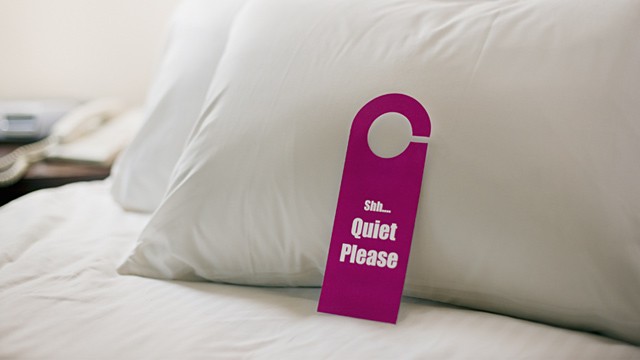
The clue that you don’t have to be Sherlock Holmes to notice

quiet-please

Perhaps it is time to give some examples of what I mean about a hotels lack of sympathy to some guest’s needs and expectations. I think back to earlier last year when I went with friends to a charming town in the Alpujarras in Southern Spain. The hotel where we stayed the night had a central courtyard around which corridors accessed private rooms. The floors and walls of the corridors were tiled which meant that every footstep reverberated ten fold depending on the quality of the steel in toe caps. Even worse, my friends in the morning complained that they had to endure a woman talking for two hours on her mobile phone in the corridor, before they could get to sleep.

Last month, I booked a hotel on line seeking quietness above all other features. After as extensive a search as possible in a holiday town full of hotels and hostals of all descriptions, I decided upon a hotel. When I arrived I discovered it faced a busy main road, a feature no included in the photographs or descriptions. Worse than that, there were only five rooms and these were directly above a restaurant and bar.

When I asked the owner for a quiet room I was told that they were all quiet and if I didn’t want to listen to the traffic I only have to close all the windows. I said I liked fresh air, just to put myself amongst a minority of guests. She informed my that no noise would come from the bar except that tonight there was a Liverpool football game on and it might get noisy.

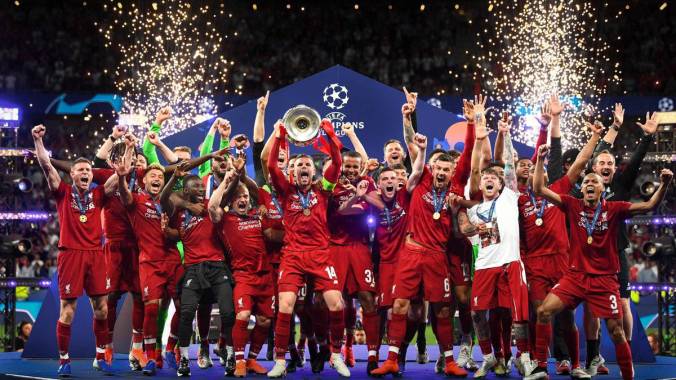
Leeeeeverpoool!

q Liverpool football

Later that evening as the game started, I wandered down to look for the source of the excitement. The door between the boisterous football fans and the corridor to the sleeping guests had been propped open, as if there was no issue at all for those in the restaurant. I had to ask the owner to close the door – which I suspected should be closed under fire regulations in any case. The owner was obliging but I had to wonder why it was necessary for me to ask. What is going on in the heads of people who rent out rooms for people to sleep in?

I abandoned this hotel as quickly as I could and appeared at another in the same town, that I had booked on line. It was the right time and day but the hotel stood adamantly closed.

I telephoned and knocked repeatedly but nothing I could do could help me. So, dragging my suitcase along the paving slabs I set off to find another. I was fortunate to find one open and rang the reception bell. I explained that I was tired and just wanted a quiet room at the back of the hotel.

The male receptionist said this was no problem and lead me key in hand, to a room at the front of the hotel overlooking the road. I was too tired to argue and eager to get an early night under the thick duvet and crisp white sheets. It was probably an hour before the problem began. Somebody started practising the piano in my room. Well, it was so loud it sounded as though they were in my room, or at least in the corridor. I peeked into the corridor expecting to see a smiling child on a piano I had not noticed earlier. Nothing. So I had to dress and bang the reception bell once more. I explained my problem of not being able to sleep. The receptionist said that it was not late in his view and that there was an apartment in the hotel. I reminded him that I had asked for a quiet room and suggested he give me another one. He quickly retorted that the hotel ( which appeared empty of guests ) was full and there was no question of having another room. He tried to compromise by promising that the piano practice would end in half an hour. Here he was giving me a clue, that he knew more about the mysterious piano than he was letting on. I suspected the apartment was occupied by his family, one of whom was learning to play the piano and had been told to practice vigilantly. I reluctantly agreed to listen to the piano for one half of an hour, returned to my room and hid under the bed clothes.

Within a few minutes there was a knock on the door. I dressed again and opened it and there was the receptionist who said that the piano would now stop in a few minutes. He had arranged this reluctantly though for he reminded me that, ‘this is Spain’, meaning that noise of all kinds is acceptable, even in hotels. I said that I knew it was Spain but that this was also a hotel where people were invited to sleep and I had never been in a hotel before where there were apartments with music practise taking place.

Sure enough, the piano quickly stopped and I was able to finally, sleep.

I have to wonder whether I am being unreasonable and have a false expectation of hotels? Am I in a minority of guests whose main priority is not to be woken to the refuse lorry collecting at two in the morning and the recycling lorry collecting at five in the morning?

Obviously I am not alone

quiet-hotel pentagram

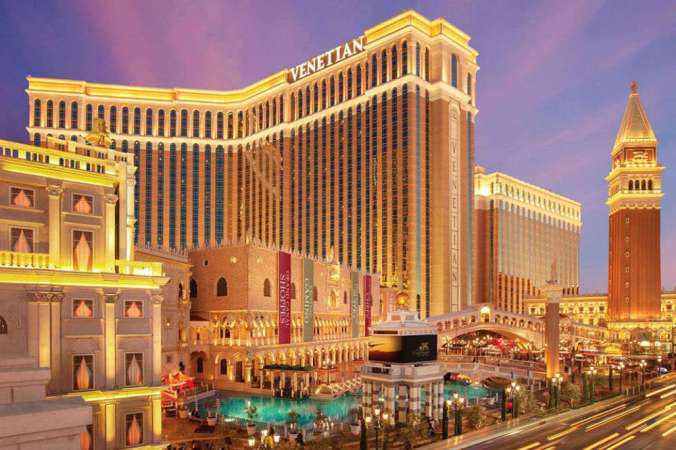
If I am, then I am willing to pay for the privilege of uninterrupted sleep at a five bed hotel. Let the party goers and sports event fans, boogey on in the hotel down the road – if for them a hotel is a mini version of Las Vegas.

A quiet night in the Venetian

q las vegas hotel

I would give those hotels one bed in my scoring system, indeed, if it provided no beds at all, I expect there are many who would not care. Think how much more money hotels could make if guests were never allowed to sleep!

Vote Me!

The day is approaching this December 2019 when the good citizens of the United Kingdom of Great Britain and Northern Ireland will have the opportunity to vote in a general election.

The outcome is being described as the most significant for a generation, so you would expect the process to be fair. Certainly, whoever wins is going to perch on the moral high ground of victory and fight off all criticism for a very long time indeed. Whether they will be entitled to be so smug, I suggest, is open to debate.

You see, I have a problem which is; how democratic is the voting system? My quandary as a voter, is that I approve of some of the policies of most of the parties. It should be explained that in the UK there is a left wing party, Labour and a right wing party, Conservative and Unionist. The middle ground is occupied by the Liberal Democrats and Greens. Other nationalist parties represent Wales and Northern Ireland and Scotland.

In the United States of America, the choice is more polarised between the Democrats and Republicans. Let us take this as an example. What if, as a US citizen, you decided that the choice was too small. Who do you vote for if you want to stop climate change but encourage industry? Who do you vote for if you want the state to pay for health care and a prosperous arms industry?

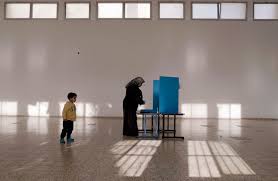
In a Spin About Voting?

Voting in Laundrymat

My point is that with polarised choices, there is no room for ambiguity that emerges from personal political perceptions and priorities. Worse still the politics of voting reduces to personality rather than policies.

Even in the UK, where the choice is greater, the democratic options are more confusing. Many voters now just spoil their ballot papers by writing ‘I don’t agree with any of this.’ They are being asked to vote for a leader they didn’t take part in selecting – unless they were the tiny minority of party members.

They might distrust all the candidates on offer and feel ambiguous about their policies.

Each party writes a manifesto prior to an election stating their political motives and means. This works to an extent but has the problem for some voters that their may be slipped in controversial motives that the voter does not want to happen. For instance, the Conservatives slipped in having a referendum on continued membership of the European Union. Suddenly it became an issue even though the majority did not think it worth consideration.

Worse still, when parties fail to win a majority in elections, coalitions have to be formed. Italy, Spain, possibly the UK next week, have this problem. Two parties may come together for the sake of forming a government at the price of compromise on their manifestos.

The public will have no choice over how these mixed manifestos will be prioritised. Which policies and method will be forgotten or ignored and which prioritised? Coalition manifestos are not published before an election if considered at all. This can lead to unrealistic expectations by voters when coalition governments are formed, as in the Liberal and Conservative Government in this decade. The direction of the ship will be decided by the Captain and officers, not the crew and certainly not the passengers.

No provisional consideration is given to coalition prior to an election as all parties have to perform the pretence that they are going to win even if it is clear to all that they will not.

The dangerous consequence of this for democracy, that occurs all too often, is that a minority party gains disproportionate power by owning the swing votes. This happened in the present Conservative government who allied with the Democratic Ulster Party and much of the muddle of mixed motives over Brexit has resulted.

In recent elections we have seen and or suspected that the over emphasis on the personality of candidates has given leverage to foreign governments and fake or real ‘whistle blowers’ and ‘news vendors’ questioning the reputations and ethical principles of candidates or even parties. Democracy as we know it is easily undermined by misinformation, view the Nazi propaganda news in 1930’s Germany, if you think this is a new phenomena.

Even the date of an election day can be manipulated to support a particular party in a manner which is clearly not in the interest of fairness. In the present UK election the Conservative government chose the day in which the students from Universities will end term and be returning home for Christmas. Informed young voters are not likely to support the Tories even though the election and it’s issues mostly affects their generation.

Young Voters in the USA Choose Not to Vote

  V I Dont Vote Badges.

Even such a consideration as ‘is it raining’ has been measured to be significant on election days. Sending people to village halls to scribble on a piece of paper has to be reviewed as the majority of citizens in the UK rarely turn out to vote. Some living abroad for over 15 years lose their right to vote.

Lone Voter

Voting Lone Voter

These then, are some of the problems for Democracy. Some people say, ‘well that’s the system we have got’ or ‘it’s the best of a bad lot’ but you have to wonder if the country that prides itself in it’s democratic systems is not kidding itself, it’s citizens and the world.

I am not suggesting that Democracy should be replaced with the pedantic and often corrupt systems of power like Communism or Autocracy. I am suggesting that with the aid of computers and the internet, a more democratic process is available to elect representatives. This is my idea.

Firstly, the party system is out. The in-fighting of politicians instead of their countries best interest, is something most voters are tired of.

Instead, all candidates will put themselves up for election as ‘Independents’. Radical, yes, but read on because they can form parties after election, not before.

They will state their personal political views by placing ten stars against a list of important areas of government. This will be shown to voters as something like this ;

Education *

Health **

Defence ***

Transport *

Law and Order **

Business and Industry *

Farming and Fisheries *

Environment    nil stars

Social Housing and Homelessness    nil stars

In this list each aspect of legislation and distribution of taxes is prioritised by the candidate, according to their own personal views. They are not under any party pressure to support policies with which they feel awkward about or strongly disagree. They can be honest; a quality in politicians which many voters express their suspicion about.

The candidate has, say, ten stars with which to indicate how which issues they prioritise and the amount of funding they would give in comparison to others.

Now here’s the clever part. Each citizen is given the chance to indicate their priorities and how strongly they feel funding should be allocated to each on their ballot papers. Instead of one cross or tick for a party – which in the twenty first century has to seen as a crude political choice – each voter has the same number of stars as the candidate.

The last piece of this process would have to be constructed from new but it’s not impossible. What I am envisaging is on-line voting from a phone, personal or public computer. In an age when personal internet banking, shopping, even gambling! – is managed with a high degree of security and reliability, it must be possible to create a secure on-line voting application.

Ten issues are listed either as broad areas for consideration or narrow ones. The voter can either ignore these as being worthy of state support ( such as health care in the USA) or indicate a need for state intervention. The strength of these feelings can be indicated by allocating some of the ten stars used to vote with.

It will be impossible to use up more than ten stars or whatever number is allocated to each citizen, but ten is an easy number for most people. Their choice can be re-adjusted until the voter is ready before selecting the ‘VOTE’ button.

For a population familiar with the internet, voting will be accessible, timely, considered, representative and accurately describing personal views.

The final phase of the voting process is for computers to match exactly the views of voters to those of independent politicians. It is already established what the views of the candidates are and matching a set number of candidates (say 300 ) to the views of the citizen public, will be doable for a computer.

The result will be a selection of representatives who will accept office and be fairly representative of public opinion. Being politicians they will almost certainly form party cliques (birds of a feather flock together) but at least the system by which they obtained power, will have been representative.

This could be a sea change for how populations choose those who represents them. With the emphasis moved to policies and issues rather than personalities and power politics, a higher level of honesty and fairness will be achieved.

We have the technology already to achieve this. We just need the thinkers to describe how it can be done – as I have just done. Vote me!

Lunar Madness – Apollo ll

On the fiftieth anniversary (20th July 1969) of the first lunar mission and landing on the moon – I dedicate this blog to all explorers.

Has it ever occurred to anyone that the name given to the American space programme to reach the moon, was a bit odd? Apollo is the Greek and Roman god associated with the sun – not the moon. Was it used because the mission to send men to the moon was totally male dominated? The mission objective clearly stated, in the words of President John F Kennedy :

I believe that this nation should commit itself to achieving the goal before this decade is out, of landing a man on the moon and returning him safely to the Earth.

Indeed, there were no female astronauts at that time, apparently on account that they were considered not to have the physical strength and willingness to take risks that men do. Ironically, today female astronauts are known to be physically more suited to space travel and averse to risk taking for the benefit of the entire crew.

The First Astronaut – Apollo (about to launch a thunder bolt)

Apollo_of_the_Belvedere

It is also curious that earth’s Moon is not the only moon in the solar system. All the other moon’s are given the names of gods (except for Uranus which has moon named after characters from Shakespeare plays). The word moon is strangely containing two adjacent spheres! But more importantly Moon or Menses has proto-Indo-European linguistic roots and is older than Lunar which is Latin. Moon is closer to menses and month relating to the female cycle.

It being 1969, the male symbolism prevailed. Apollo had a bow and arrow and was the god of archery – if that is sufficient imagery for a the masculine principle seeking and penetrating the feminine circular target.

A British rocket of the 1960’s for launching satellites was named the Black Arrow. An even more curious historical eponymy is that Stevenson’s 1829 railway engine was also named The Rocket. A symbol Sigmund Freud could also have written a chapter about.

Whatever the reason’s for naming the Apollo mission, the shallowness of the venture is evidenced by the fact that fifty years on no nation has repeated it. The reason is clear. There was no material benefit in going to moon – effectively a desert. Instead in the 1960’s there was a ‘cold war’ between the Soviet Union and the United States of America. The Soviets were ahead of the Americans with the launching of the first unmanned and then a manned earth satellite. The ‘land of the free’ was out to prove its technical, economic and political superiority and they did.

The Scientist’s at the time preferred space missions to be unmanned and crammed full of scientific experiments. Robotics and remote communication meant that manned missions were scientifically speaking – a waste of payload.

But the politicians wanted pictures and pictures / film had to contain an all American explorer laying claim the moon by planting the stars and stripes flag.

As an aside, there is a conspiracy theory that the entire Apollo 11 mission was faked. This was achieved by using a Hollywood film studio to recreate a believable lunar landscape on which actors could land and leap about. Personally I expect there was a ‘back up plan’ to the real lunar landing – given that the mission was highly risky. If the American astronauts crash landed then the political fallout would be as damaging as a successful mission, rewarding. So it is highly likely, in my view, that there was a plan to fake the landing if necessary in the National interest. It is these films and images that are referred to by the conspirers as evidence of a fake landing.

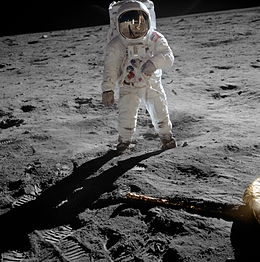
As it turned out, the final descent in the lunar Lander was almost a disaster. There was only another three seconds of fuel in the tank for Buzz Aldrin to land ‘The Eagle’ lunar module.

Buzz Buzz Buzz Busy Busy Busy B

260px-Aldrin_Apollo_11_original

But why did these men risk their lives so publicly and for so little scientific benefit? Clearly as patriots and explorers from a gene pool of risk taking ‘settlers’ – the chosen crew were dedicated to their mission. These were not humans landing on the moon, this was America – The Eagle.

Another great irony was the ‘elephant in the moon’, which was that the destination could hardly be more adverse to human survival. It was known that the Moon was a ball of dust and rock with extreme temperatures and no means to sustain human life. It was and is, more deadly than ‘Death Valley’ in California.

Hardly surprising then that the picture from Apollo missions that brought most gasps from the crew and earth dwellers alike, was the view of the blue planet itself. Seen for the first time from a considerable distance the earth looked both majestic and fragile. A lonely jewel in a forbidding black landscape.

We know today from subsequent unmanned missions to the planets, that the earth remains the only place on which human life can exist without technological reliance. If the reason behind the moon mission was partly to find a suitable ‘life boat’ to use to escape a dying earth – then what we know now gives little hope for the perpetuity of mankind.

Only one of the moons of Uranus will be a suitable place to land when our sun expands and swallows earth in a few billion years time.

For now only Mars appears sufficiently similar to Earth to sustain colonies – but a fragile existence this would be with the need to grow food on a large scale to sustain just a few ‘settlers’. It will be a long while before there is a Mars Mc Donalds and they probably won’t sell burgers.

There is another lesson to learn from history and that is ‘possession’. Traditional declaration of ownership on behalf of a nation by explorers such as Captain James Cook, was the raising of a national flag. No teams of lawyers were necessary historically to defend the rights any indigenous people, who were usually shot if they caused dissent.

Even if no Martians line up to defend Mars from future settlers, there will need to be teams of international and interplanetary lawyers to deem who owns what. Treasures such as mine-able water ice will be precious enough for significant sums of what ever is used for money in the future. If Earthlings continue their war-like ways on other planets, as they do on their precious earth, then there will be a giant step backward for mankind, instead of one forward – a type of lunar madness from whose bourne no man returns.

M – OO – N

Ap – O -11 – O

Hammering in the Screw

Readers of this blog will know that the author is fascinated by the science and art of problem solving. Problem solving is a daily occurrence and yet is rarely taught or even considered as a subject worthy of study.

Problem Solution Success

The brain can acquire an commanding attitude that sometimes dismisses objectifying a problem. Either from previous experience or acquired behaviour – a solution ‘comes to mind’ that is promoted without question. This idea is regarded and defended as the only possible solution and perceived as unquestionably better to any alternative.

Let us take an example from the world of sociology, ethics, law, health and politics. The example I am using is ‘drugs’.

The ‘normal’ response to the problems created by citizens who take drugs, has been for the State to make them illegal.

Avid problem solvers will already have noticed that when the problem has a stack of layers already listed;

Social stability

Economics and Taxation

Ethics and Religion

Law

Health

Politics

– then the solution has to apply at every level of the problem.

It is not difficult to appreciate that the ‘make it illegal’ or ‘bang-em-up’ solution, only addresses one layer of the problems associated with drug taking.

In the 1930’s recession in North America a law against the consumption of alcohol was introduced known as ‘prohibition’. We are probably all familiar with the unintended consequences of this law in handing over the production and supply of alcohol into the hands of criminals. The government lost the taxes associated with the sale of alcohol and little benefit was gained by anyone except the criminal gangs. The law was repealed because it didn’t solve the problem – if there ever was a defined problem!

But even today the Indian States of Bihar, Gujarat, Bagaland are today places where alcohol is banned. Despite this alcohol consumption in India has risen 72.5%* in the last twenty years (*source Wikipedia).

In the United Kingdom in 1971 an act of parliament was passed called the Misuse of Drugs Act. This was heralded as a so called ‘war on drugs’. But because the problem was only considered at one level, the laws have failed to the extent that contemporary analysts are proposing more inclusive solutions to the problem.

Instead of examining these alternative solutions the more general point here is that they need to be wide ranging in their origins and effect. Just taking a narrow attitude such a s ‘law making’ is ineffective.

Therefore a problem solver might examine ‘what is a drug?’ first. In the religion of Islam, a drug is categorised as an ‘intoxicant’ and believers are forbidden to become ‘intoxicated’. This is clever because it does not attempt to list all drugs that are harmful, in the present and future, (as lawyers did in the UK and other Western countries) – it just bans the consequences of any drug. It does not even define the point at which a person becomes ‘intoxicated’. The clerics and interpreters of Sharia law have erred towards ‘zero tolerance’ – and gets a bad press in liberal democracies.

However, it has to be recognised that religious laws can be considerably more effective than  criminal law and overcome the problems associated with criminalising drug addicts.

But even this strand of a solution to drug taking is not completely effective; some Muslims drink alcohol. Therefore a problem solver might attempt to define what degree of success in reducing the consumption of drugs is being aimed at. In a competitive world it is natural to attempt a one hundred per cent success rate, but a reality check is usually needed on what can really be achieved. Is a person ‘intoxicated’ after one beer?

Like all ‘genies’ and malign inventions – once set free they can never be completely put back into the bottle. Perhaps for this reason, in western liberal democracies at least, an increasing level of tolerance is being given to drug use and users.

There is clearly a sliding scale defining drugs, with mild drug taking at one end (coffee, tea, medicines) to hard drug taking at the other (heroine, cocaine, alcohol). Societies assess the positive effects of drugs against the negative such as in the production of medicines. Desired consequences of medicinal drugs are balanced against the side-effects, some of which may be worse than the symptoms of the problem!

Some European countries such as Portugal are treating drug addicts as patients with an illness rather than criminals who will change as a result of punishment. The statistics on the success rates between the two approaches would make interesting comparison. What is of interest for this essay, is how a change of direction and depth in the problem solving process, may be more successful than the previous direction and depth.

Clearly the politicians and law makers (with an knowledge of changing social attitudes) need to be on board with the idea of such changes , as do health and social workers and the criminal justice system.

Any lasting solution has to know what it is trying to achieve and how to measure that goal. It must also take into account how to change and how to control the various strands of the solution involving the multiple agencies within society.

Many people in power like to think they know the solution by some sort of divine gift of seer-ship. This makes them blind to whether the measures they propose will work and by what measure they can be considered effective in their goal.

Reluctance to change is familiar in problem solving and is characterised as a person engaged in digging a hole in the wrong place. When the error is pointed out ‘you won’t find water here mate!’ the digger just digs deeper.

Or when the carpenter only has one tool in the workshop, this tool is used for anything that it can hit. No question is asked whether the metal thing sticking up is a nail or a screw. The problem is a ‘metal thing’ and the solution is the only tool in the workshop.

This type of thinking is clearly insane when viewed analytically – and yet whole societies and national systems of government appear to be digging holes deeper and hitting screws with hammers.

What do you think is the solution?

Problem Solving