What is it with Hotels? I have to admit to having a problem with them, however hard I try explain what I expect and need when booking.
A great big sleeping thing called a BED

The clue is in each hotel room. Central to the arrangement of most hotel rooms is a bed and a bed is generally, for sleeping in. And there we have the crux of where I find most hotels get it wrong.
The whole notion that their guests basically just want to comatose, appears to be foreign to them. Because of this fundamental misunderstanding, much of what hotels provide becomes a waste of effort and money for all parties. People who want to sleep and or are asleep, do not require a conference suite, a swimming pool, a spa, a restaurant, a dining room, a cinema, a grand view of the city, an entertainment programme, a stage, a discotheque, wide screen television for sports coverage etc. etc.
We just want a bit of peace, a toothbrush and a razor.
Instead, you get aggravation, a piece of soap and shampoo.
The problem with so called ‘facilities’, is generated in part by the hotel star system, which awards stars not on the quietness of the hotel and politeness of its staff, but on the breadth and extent of it’s facilities.
I can well imagine there are many families and business travellers who intend to spend days and weeks within the confines of the hotel and need these things, in which case these quests should be directed to hotels which are not focused on providing an environment for guests to sleep.
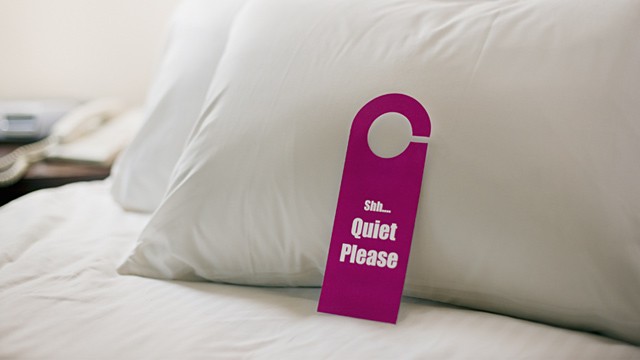
If I were head of Tourism in the United Nations International Peace on Earth Mission (if they don’t have one they should) I would categorise hotels between places of rest and unrest. I would award ‘bed’ symbols for quietness rather than ‘stars’ for what ends up being sources of disturbance.
The clue that you don’t have to be Sherlock Holmes to notice
Perhaps it is time to give some examples of what I mean about a hotels lack of sympathy to some guest’s needs and expectations. I think back to earlier last year when I went with friends to a charming town in the Alpujarras in Southern Spain. The hotel where we stayed the night had a central courtyard around which corridors accessed private rooms. The floors and walls of the corridors were tiled which meant that every footstep reverberated ten fold depending on the quality of the steel in toe caps. Even worse, my friends in the morning complained that they had to endure a woman talking for two hours on her mobile phone in the corridor, before they could get to sleep.
Last month, I booked a hotel on line seeking quietness above all other features. After as extensive a search as possible in a holiday town full of hotels and hostals of all descriptions, I decided upon a hotel. When I arrived I discovered it faced a busy main road, a feature no included in the photographs or descriptions. Worse than that, there were only five rooms and these were directly above a restaurant and bar.
When I asked the owner for a quiet room I was told that they were all quiet and if I didn’t want to listen to the traffic I only have to close all the windows. I said I liked fresh air, just to put myself amongst a minority of guests. She informed my that no noise would come from the bar except that tonight there was a Liverpool football game on and it might get noisy.
Leeeeeverpoool!

Later that evening as the game started, I wandered down to look for the source of the excitement. The door between the boisterous football fans and the corridor to the sleeping guests had been propped open, as if there was no issue at all for those in the restaurant. I had to ask the owner to close the door – which I suspected should be closed under fire regulations in any case. The owner was obliging but I had to wonder why it was necessary for me to ask. What is going on in the heads of people who rent out rooms for people to sleep in?
I abandoned this hotel as quickly as I could and appeared at another in the same town, that I had booked on line. It was the right time and day but the hotel stood adamantly closed.
I telephoned and knocked repeatedly but nothing I could do could help me. So, dragging my suitcase along the paving slabs I set off to find another. I was fortunate to find one open and rang the reception bell. I explained that I was tired and just wanted a quiet room at the back of the hotel.
The male receptionist said this was no problem and lead me key in hand, to a room at the front of the hotel overlooking the road. I was too tired to argue and eager to get an early night under the thick duvet and crisp white sheets. It was probably an hour before the problem began. Somebody started practising the piano in my room. Well, it was so loud it sounded as though they were in my room, or at least in the corridor. I peeked into the corridor expecting to see a smiling child on a piano I had not noticed earlier. Nothing. So I had to dress and bang the reception bell once more. I explained my problem of not being able to sleep. The receptionist said that it was not late in his view and that there was an apartment in the hotel. I reminded him that I had asked for a quiet room and suggested he give me another one. He quickly retorted that the hotel ( which appeared empty of guests ) was full and there was no question of having another room. He tried to compromise by promising that the piano practice would end in half an hour. Here he was giving me a clue, that he knew more about the mysterious piano than he was letting on. I suspected the apartment was occupied by his family, one of whom was learning to play the piano and had been told to practice vigilantly. I reluctantly agreed to listen to the piano for one half of an hour, returned to my room and hid under the bed clothes.
Within a few minutes there was a knock on the door. I dressed again and opened it and there was the receptionist who said that the piano would now stop in a few minutes. He had arranged this reluctantly though for he reminded me that, ‘this is Spain’, meaning that noise of all kinds is acceptable, even in hotels. I said that I knew it was Spain but that this was also a hotel where people were invited to sleep and I had never been in a hotel before where there were apartments with music practise taking place.
Sure enough, the piano quickly stopped and I was able to finally, sleep.
I have to wonder whether I am being unreasonable and have a false expectation of hotels? Am I in a minority of guests whose main priority is not to be woken to the refuse lorry collecting at two in the morning and the recycling lorry collecting at five in the morning?
Obviously I am not alone

If I am, then I am willing to pay for the privilege of uninterrupted sleep at a five bed hotel. Let the party goers and sports event fans, boogey on in the hotel down the road – if for them a hotel is a mini version of Las Vegas.
A quiet night in the Venetian
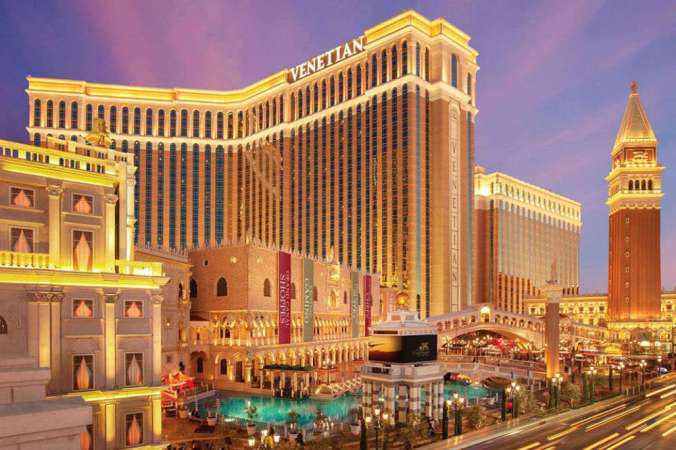
I would give those hotels one bed in my scoring system, indeed, if it provided no beds at all, I expect there are many who would not care. Think how much more money hotels could make if guests were never allowed to sleep!

 .
.