War of Words

Words, good slaves but bad masters.
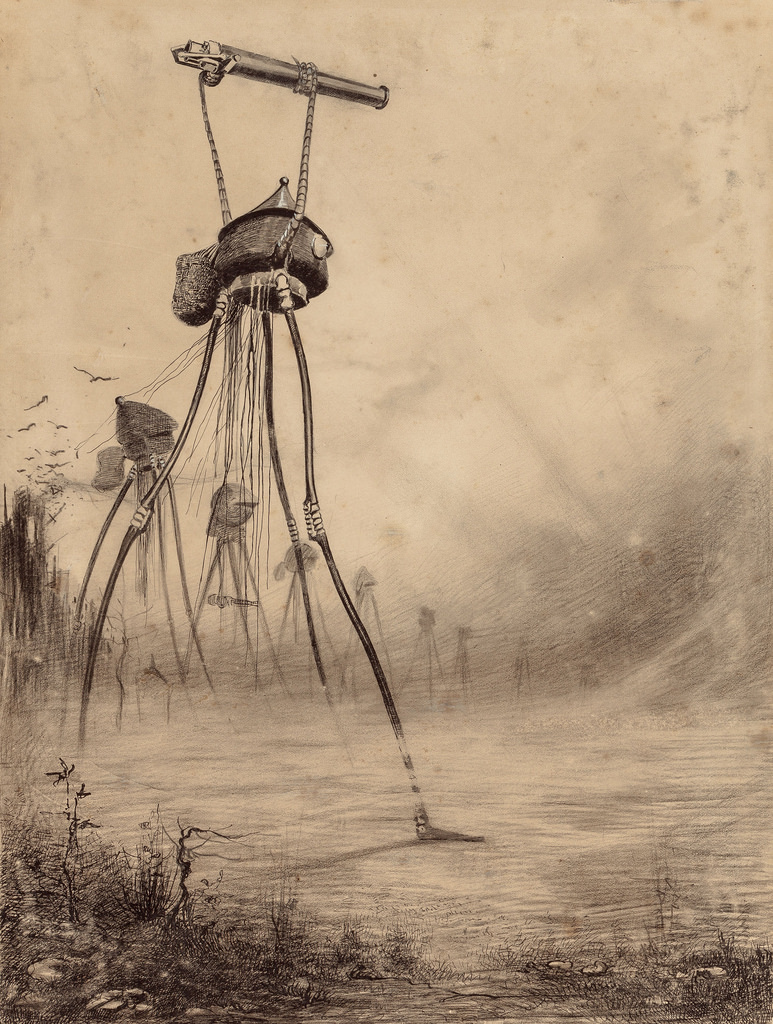
H.G. Wells wrote The War of the Worlds, a story about creatures from another part of the Universe invading the planet Earth and how the humans fought back. Words too can conquer worlds, especially the world in your mind. For this reason, I believe it is vital that we choose words that fit exactly the meaning we intend.

When speaking, we like to believe that we use words to converse clearly with others.

If there are no words in our own language we can create new words in fun and familiar ways. This linguistic phenomena is apparent in the speech of young people. New generations invent their own vocabulary with which to talk behind the backs of adults!

The power of language is it’s ability to open new perspectives on life. A restricted vocabulary will limit thoughts to the point that they no longer serve anyone’s best interest.

Words create our thoughts which can in inturn be inhibited by those words. Imagine a map of a city as a model of your neural pathways. Those journeys we repeat, such as to work, become familiar, almost over used. A map is also constrained by it’s boundaries. It does no show the whole world. The unreachable thoughts are as if in another dimension. Logic cannot venture beyond logic.

I listened to a debate on the radio recently in which scientists were challenging each other over the popular conundrum, ‘which came first, the chicken or the egg?’ They conjectured about birds as dinosaurs and an absurd point in time when the first egg was laid. Only one scientist suggested that change is a gradual process when viewed over long periods of time. No parrot changes colour over night. Evolutionary changes take thousands of years before being noticeable. There is no single moment when chickens and eggs come ‘into being’.
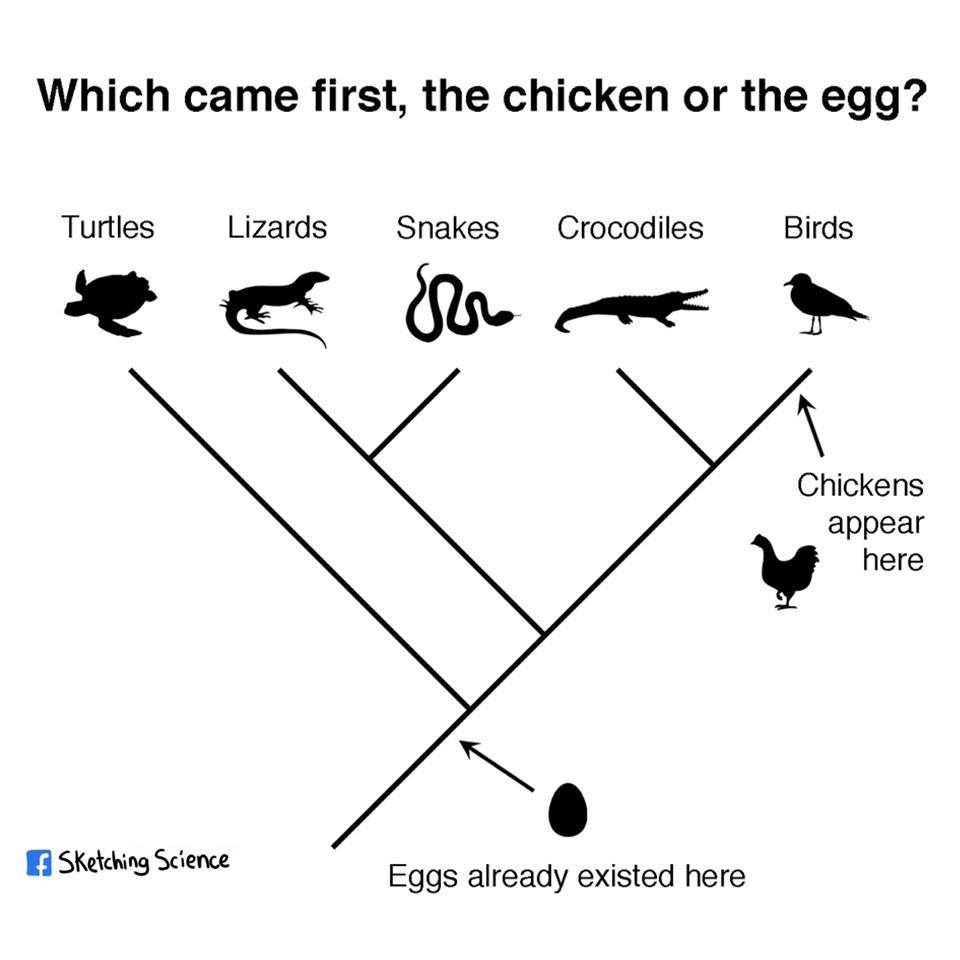
picture credit: The Australian Academy of Science

The same is true in astronomy. Do you believe the universe happened in a nano second as the so called ‘big bang’. Scientists are currently theorising that universes expand and contract over vast periods of time. The explosive power of the ‘big bang’ phrase, froze original thinking about how the universe began for decades. The universe was never a chicken, nor an egg…it is obviously both.

Semiotics is the science of language and meaning. In my view, we all benefit from understanding how we structure our thoughts using language and meaning. Here is an exercise;

Imagine a ‘cake’.

There are many categories we can use to describe cakes. There are cakes we sub-categorise by their ingredients such as a sponge cake, fruit cake, carrot cake and oat cake. Then there terms for cake which describe when we eat it, such as birthday cake, Christmas cake or wedding cake. Alternatively the means of production is a description such as home-made or shop-bought. Another way of thinking about cake is the origin of the recipe such as Black Forest, Dundee or French Fancies.

None of these sub-categories describe cake but the word cake includes all of the sub-categories. When we choose which cake is included in which sub-category we use thought to DISCRIMINATE between different cakes. This tool is an important power of mental faculty but unfortunately it’s meaning has changed in common usage. It has become to mean PREDJUDICE and in my view, there is a loss of meaning and ergo understanding, when these two are confused.

Discrimination is an objective skill whereas prejudice is subjective. When we think subjectively we mix emotions with logic. Feelings introduce prejudice for or against something in a way that cannot be explained logically. Insignificant examples are then used ‘prove’ to oneself and others that a prejudice is based on fact in a process known as ‘bias confirmation’.

Bear with me if you think I am stating the obvious but in my view much cultural, ethnic, racial, gender based, geographic, religious and political misunderstanding has it’s roots in how language governs thinking and in particular, prejudice.

A mind which for whatever reason developes a predjudice against a general category of something is in trouble. To use our previous example, it would be wrong to say ‘I don’t like cake’ when what is meant is that you do not like cake with a lot of cream.

When it comes to making prejudices against categories of fellow human beings we hit trouble. Any prejudice is more a product of intolerance, misunderstanding, eliteism, narrow mindedness and other unelightened views in the mind of the observer. However, we hear predjudice views in the news regularly so it is important to unpick how and why they are held.

Consider the term ‘anti-Semitism’. The German journalist Wilhelm Adolph Marr lived at the end of the nineteenth century. He popularised the term ‘anti-Semitic’ to describe anti-Jewish sentiment within political ideology and the general public.

This prejudice towards Jews we know has been present for thousands of years. What was new then was the term, ‘anti-Semitic’. It could be argued that this contributed to the start of the second world war and it remains in common usage today, so did it ever serve the world well?

Let us examine the term. We might question the meaning of the term Semite. Who can define what this means other than an anthropologist? Cynics might suggest the use of the term was a pseudo scientific device to impress and support a prejudice which in turn came from right wing views on eugenics.

Certainly just as ‘cake’ has many sub-categories, so does the word Semite. Historically a Semite might be from a specific geographical location such as Canaan, Judah, Judea, Israel or Palestine.

The term ‘Jew’ is entomologically derived from the tribe of Judea. Then of course there are sub-categories for a Jewish person by religion such as orthodox, conservative or reform. Then there are those who are Jewish but do not practice a religion such as non-practising Jews and those who do not believe in God such as Zionists; who might be Jewish or Christian.

Sometimes language is used to catergorise a ‘people’ and using this categorisation, Semites would be a group who speak Hebrew and / or Aramaic.

The Nazi’s in the 1930’s arbitrarily define a Jew by racial characteristics, not religion, derived from an elitist philosophy of the Aryan race being superior to others on which an extreme predjudice was based.

We might expect a national category of Jew, but the Supreme Court of Israel has determined there is no Israel nationality.

There are other sub-categories of Jewish identity such as by culture, ethnicity and politics, but I hope that I have made the point that the terms ‘Semite’ and ‘Jew’ mean many things to many people depending on what category you choose to define them.

Who is a Jew? picture: Instagram

There is a criticism of the term Semite as meaning Jewish by non-jewish people, that it ‘disingenuously’ excludes those who also identify themselves as Semite, such as Arabs. Does the term anti-semite poplarly applied to Jewish people, imply a denial that Arabs are also of Semitic origin?

In my view, the nineteenth century pseudo scientific phrase ‘anti-Semitic’ continues to obfuscate clear thought and sustains predjudice rather than exposing it. It has been used by politicians in particular with the intention including victims of the holocaust and stealing their suffering to gain the moral high ground. Such verbal smoke and mirrors has spawned wars and continues to do so to this day, unquestioned.

In my view, it time to clear our thoughts of words that do not describe precisely what they mean. This is not just a matter of taking sides but simply being clinically clear about where are ideas come from? Are they the product of predjudices? What are the intended and unintended consequences?

To be impartial in a debate that is more a minefield than a cornfield, let us reverse the coin and examine the current term for ‘hatred of Muslims’; Islamaphobia. Again, should we not question the use of this term? Should the psychological term ‘phobia’ really be used to describe a fear of spiders, snakes and Muslims? Clearly confusion, not clarity will result from humans being casually categorised using a word from the science of psychology incorrectly, rather than a clear expression most people understand.

Fortunately, words can serve us to correct such unclear thinking. We can invent new words or phrases in any language and in doing so, say exactly what we mean, fairly and without bias.

It should not be, but if a bigot wishes to describe a group of humans using a term of predjudice, then I suggest that those describing distaste of a sub-category of a human being, should use the prefix ‘anti’. This creates the terms anti-jewish or anti-muslim concisely and without ambiguity. Alternatively, the terms ‘jew hate’ and ‘muslim hate’ in countries where ‘hatred’ is an important aspect of a legal definition and unambiguous to all. The prejudice is clear to all and not spun with fake science. It also makes clear that these are irrational generalisations.

There is a war of the worlds, but it is contained in our heads, not the heads of other people who we may not understand.

In my opinion, the dangerous, self-unaware prejudices that thrive in the emotional biases of current politics, poison the thoughts of otherwise rational and compassionate human beings, and in doing so whole communities. Such hatred of difference is so divisive that it incites violence between one group and another. The simplest example is when governments of countries declare war on each other.

Words are powerful as they form a part of the process whereby we create and sustain our beliefs. How much of the horror that we see in the news today, started as copied or learnt bias, built on an emotional response to an unfiltered stimulus, that slipped under the barrier of compassion towards others.

It is clear to many but sadly not all, that those who express ‘anti’ views in the name of a religion, are not following the most basic rules of the religion they profess to follow.

Fortunately, those who are strongly, even violently prejudiced, are in a tiny minority. The general population do respect and are prepared to learn from, those who are different to themselves. The world’s religions all follow the principle of do-as-you-would-be-done-by.

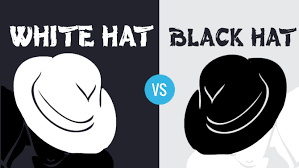
White Hat Black Hat

In conversation with a friend of mine whose ethical values follow Buddhist philosophy, I was challenged with the idea of killing the mosquitoes in my bedroom at night with a pungent insecticide! ‘It is wrong to kill anything and I should be using a mosquito net to defend myself, not attack’.

To me, if I kill a mosquito, I am preventing it from attacking another person or animal with it’s uncomfortable sting and potential disease transmission, including malaria, dengue fever, Zika virus, chikungunya, yellow fever, West Nile virus, and Eastern Equine Encephalitis. The virus, bacteria or parasite with the disease varies with location in the world of course, however with climate change and species of mosquito: do you feel lucky?

The instruction to preserve life at all costs and in whatever guise, is of course, a dogma contained in many religions but not all. In Christianity the Holy Bible includes the Old Testament describing a blood bath of unholy wars. In the last two hundred years or so, ‘civilised’ humans interpreted Genesis 1,

( And God said, Let us make man in our image, after our likeness: and let them have dominion over the fish of the sea, and over the fowl of the air,)

– -as a licence to kill sentient creatures for sport, vanity and greed.

Even today, western ‘civilisations’ are in the same process of destroying the planet with great efficiency and little conscience. There is a possibility that the translators of the Old Testament should have used ‘steward’ of nature instead of ‘dominion’.

Historically, the planet was not seen as a benign mother in the nineteenth century, except by those who lived close to nature such as the North American First Nation People who were regarded as ‘savages’ by European invaders. Ironically, self styled ‘settlers’ regarded themselves as benign and entitled to lie, break treaties, enter sacred land and commit genocide through war and starvation – all whilst insisting they have moral superiority.

Does this remind you of anything happening today by countries who consider themselves beyond reproach for their actions?

In the ancient Hebrew Ten Commandments we find the instruction not to kill. This was probably meant to refer to human v human – but does it? Could this include insects and small mammals? Like all simplifications, it loses import through lack of detail.

Buddhist teachings could be interpreted that one should have no ‘intention’ to kill. If we kill a virus with our anti-bodies or an ant on the path where we walk without even knowing or controlling this, we are not at fault. To kill to prevent disease or disease spreading is not so plain. We venture then into the quandry of the lesser of two evils.

Because of contradiction and complexity or perhaps, despite of it, religious dogma encourages the following of rules ad absurdum. An example would be nuns of the Jaine religion who spend their days walking and sweeping the path in front of them lest they tread on an insect.

Whilst there is a continuum of intent between conscious and unconscious killing, we have to agree that conscious killing raises the ethical questions. Those who refuse to fight in a national army might agree to become stretcher bearers or another ‘non-combatant’ role. This even though their actions are supporting those who are fighting and killing. ‘Thou shalt not kill, directly or indirectly’ would have been a more relevant commandment to conscientious objectors in any war in my view.

Why would any country seek to start a war, and feel justified morally, is a very relevant question for today. A common cause and justification is the belief that a moral duty of ‘doing good’ is being fulfilled. The irony of this is when both or several parties in a war all use this excuse. Who wears the white hat?

The answer can generally be found through the actions rather than words such as ‘treaties’ and ‘ceasefires’. It used to be that soldiers would fight soldiers and civilian populations were only indirectly affected by war. But since the second World War, technology such as aerial bombardment from the air; drones, rockets and heavy artillery, civilians have become targets.

picture credit: Rocket Guest Hosting

Both or all sides will see themselves as the wearers of the ‘white hat’. Their next ethical choice is to decide the target. Should it be military or civilian? Although the choice is obvious to all but the most morally challenged, much of the warfare we see today is aimed at civilian populations. The offending side continue to lie and break treaties and ceasefires, enter sacred land and commit genocide as if they were actors in the nineteenth century ‘Wild West’ in which religious or any kind of law, did not exist.

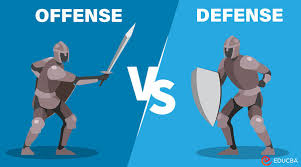
To do this they use words in order to confuse themselves and their followers. Military terms such as ‘offence’ and ‘defence’ sound as if their meanings are simple. But take an example from the Roman Army in ancient times. They carried large shields which are technically, purely defensive. But one of their fighting techniques was to use the shield to rush at the enemy and push them off balance, opening their guard and going for the kill. The short sword or gladius was used principally as a weapon of offence, and yet again, a sword fight includes using the sword in defence, as a shield.

picture credit: ECUCBA

Defence and offence therefore overlap and at times – become one. Politicians can over rule moral objections by calling this one something and the other something else. It is called ‘propaganda’. In this way offence using defence is called defence and defence using offence is called defence. Making use of this confusion in minds who do not question, they argue that since ‘defence’ is allowed in international law, every action is a ‘defence’ even when attacking unarmed women and children.

Leaders today deny or are complicit in targeting civilians, just as the Soviet Union did under the absolute dictator, Joseph Stalin in the Second World War.

After that war, Winston Churchill, the Franklin D. Roosevelt wanted to replace Stalin’s ‘white hat’ (Russia had been an important ally) with a black one under ‘Operation Unthinkable’. They wanted to return Poland to the Polish people as that issue had started the war but Stalin refused and the country became part of the Soviet Union.

History has the ability to make sense of current events as world politics has usually been played out before and the consequences of actions do not have to be learnt through experience. The main variable is of course, new technology. But fundamentally, ethical values should not change and there is not reason why an aversion to violence should not be universal. This has been attempted through the United Nations and International Law but these voices are weak today.

‘War crimes’ being allegedly committed are investigated by those committing the crimes. Permanent members of the UN Security Council are allowed vetoe criticism of their actions on the grounds that they are ‘defending’ someone or something. Detail is avoided.

International Laws are dismissed by countries that have not signed the convention. So external rules, which should embody the highest ethical values, are ineffective.

Where civil laws and natural law fail to be applied, religious and spiritual rules, potentially have a greater influence by bringing about change within each individual. The rule supporting non-violence is the well known, ‘do unto others as you would have them do unto you.’ It’s an uncomplicated way to behave but, with this injunction as guidance and followed, the world today would be a very different place.

Olympics in Flames

Lord, what fools these mortals be!”

Puck’s line to King Oberon Act 3 Midsummer Nights Dream William Shakespeare

This was going to be an essay titled ‘The Party is Over’ but then the Olympic Games Opening Ceremony 2024 stopped me. It was too extraordinary to ignore and in fact, contained the same messages. I wish the Olympics, the athletes and the people of France and the World come together in love at the conclusion of the Olympic 2024 as was surely the original intention of the games. I express no religious or political views other than universal love. If you do not have ten minutes please slide down to the final conclusion.

The gods on Mount Olympus would have watched the Olympic Games Opening Ceremony 2024 in Paris, with a conflation of amusement and horror.

Personally, I found it pedestrian, disjointed and more than at little weird, and I was not the only one. For a country renowned for its consummate sense of good taste, design, style, and pazzazz; what in Hell  happened?

I shall express views here which some will find far fetched, even disturbing. However, this sideways analysis might explain why standards fell so low.

Those who have read Dan Brown’s book or seen the film The de Vinci Code, will appreciate the power of symbols. The main character played by Tom Hanks, is an academic ‘symbolist’. He unravels symbols as a trail of clues that lead to the truth and this is what I believe was happening at this Olympic Ceremony.

So are there ‘clues’ in the ceremony and if so, what truth is being disclosed?

The Olympian gods used to look down on humanity and create situations. If you were a modern organisation, similarly determined to influence the thoughts and feelings of 29 million remote viewers around the world, this ceremony is the perfect vehicle. Being performed in the ‘city of lights’ was surely an invitation the Illuminati could not refuse?

The Illuminati picture credit: National Geographic

I recommend personal research to discover the motives and means of the Illuminati and other cabals, but their aims might be summarised as; ‘to achieve a Global Order through the removal of personal and national freedoms’.

So when you hear on the news that the fibre optic cables serving the high speed trains to the city of Paris have been sabotaged, you wonder why? Curiously, a week or so after the attack, the media are still describing this planned event as ‘vandalism’. No organisation has yet claimed responsibility. You might wonder what reporters are avoiding saying and who has told them not to say it. Was a planned and co-ordinated attack to created fear? Fear of death is the currency of cabals as we witnessed in the recent global pandemic where, again no originator has come forward or been found.

Let them hate us as long as they fear us.’ Caligula

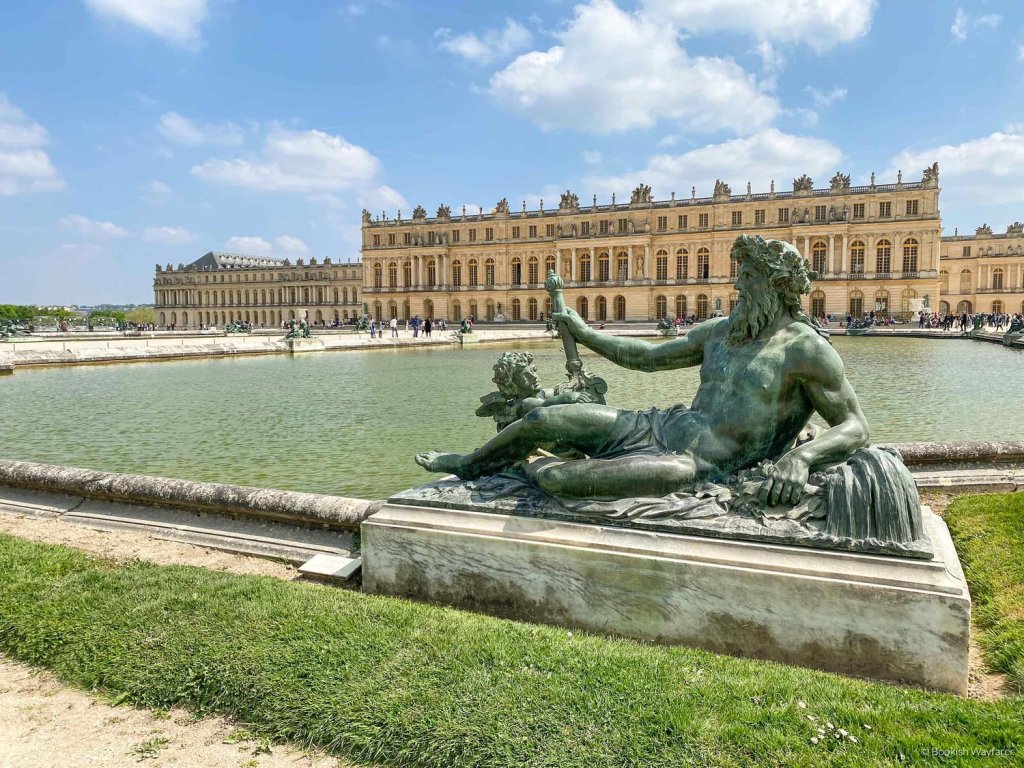
Fibre optic cables carry vast quantities of information over long distances. They send light through gross matter. Cutting off this supply in the four cardinal directions was like cutting off light to the City of Lights; the city of the Sun King, Louis 14th. So similarly ‘cut off from the world’ was Louis, when he moved the Royal Court away from the Parisian minions to Versailles, where he could enjoy a privileged  hedonistic lifestyle.

The leaders of the secret societies were closely involved with and led the French Revolution. They would have introduced the ‘Phrygian Cap’ as headgear for the revolutionaries; a symbol of Mithras represented by the bull.

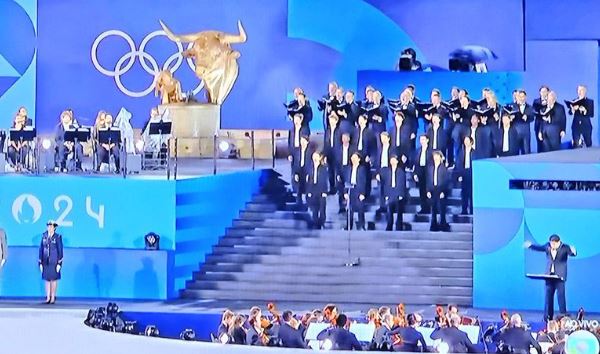
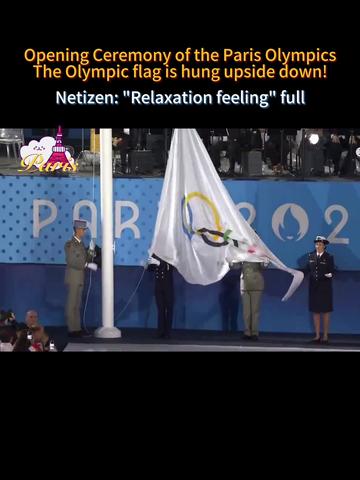
Close observers of the Olympic Opening Ceremony would have noticed the golden head of a bull next to the five Olympic rings at the flag raising ceremony. Should we conclude that Mithras and Revolution is alive and well in modern France?

picture credit : Israel 365

The Roman Empire nearly adopted the Mithraic religion as it was popular with it’s soldiers and Mithraic temples can be found under many churches. In myth the bull’s spine sprouts corn and the blood is the wine of animal life. Christianity was chosen as the preferred Roman religion but the similarity of this Mithraic myth to the Eucharist should not be overlooked.

Light is a common symbol of spirituality and Jesus was not the only one who proclaimed to be the ‘light of the world’.

‘How thou art fallen from Heaven, son of the morning’ Isaiah 14:12

There is an old Testament character named Lucifer who the Church Fathers decided to eclipse by conflating Satan and Lucifer and Ahriman as the same beings

But Lucifer, the ‘Light Bearer’, is important today as he represents an ‘imbalance’ of spirituality, a powerful overload of light. We should not consider spirituality as being only goodness, as it can be too weak or too powerful and when either occurs it produces bad things.

Lucifer was responsible for the loss of the ‘third eye’ represented as the ‘brow or Adjna Chakra’ in Yoga and a Cobra in Ancient Egypt. Without this sensibility humans descend into illusion and delusion. The figure of Marie Antoinette in red in the Ceremony, represents how humans have collectively ‘lost their heads’ or rational thought and are fixed in the bright red base chakra of animal and tribal desires.

Balanced spiritual energy is a good thing, but when it becomes imbalanced it is not. Gautama Buddha discovered this after living an indulgent life in royal splendour, then aestheticism. He found little of spiritual value in either. He became enlightened when he followed what he called ‘the middle way’, which is the philosophy of Mahayana Buddhism today.

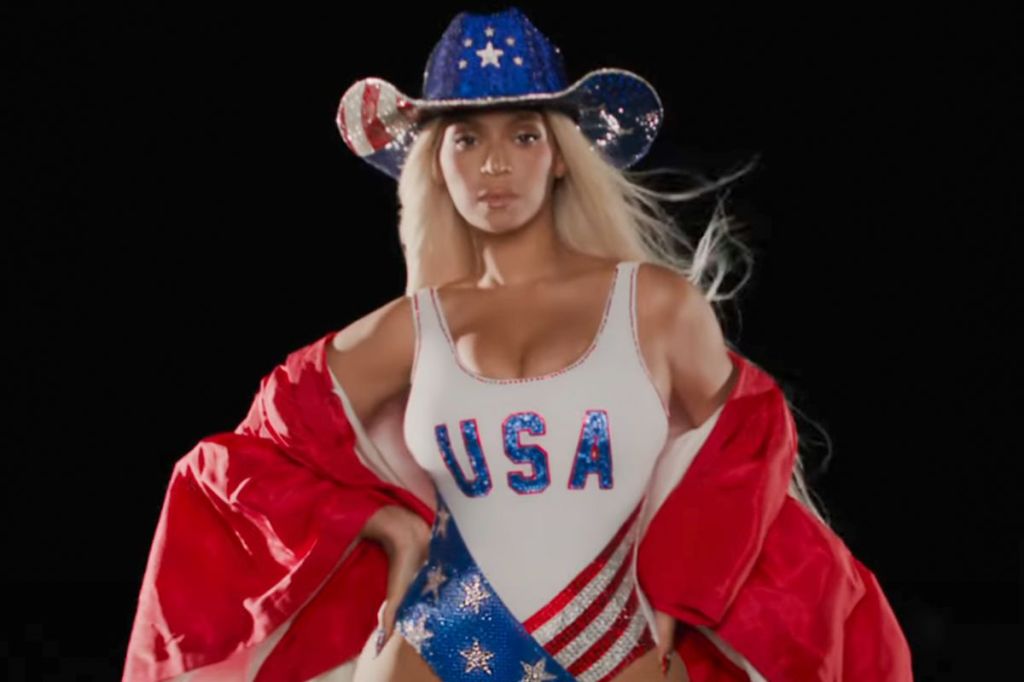
In the ceremony, Venus was represented by Beyonce as a feminine spirit of light and beauty with an enchanting voice; as with the Sirens in the voyage of Odysseus. But it was a narcissistic delight in self reflection that audiences were presented with and not the Venusian sacred mirror of ‘self reflection’.

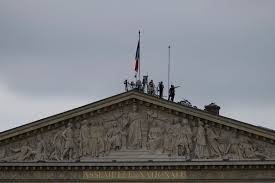
The decent from balanced spirituality into base narcissism is present around the world in social politics today, not least in France where the left and right wing extremists, with no thought of a ‘middle way’ compromise, have recently taken over the government of the country.

The political values of the French Revolution, “Liberty, Equality, Fraternity or Death” were chapter headings in the ceremony as it appeared on television.

The above background information, is intended be some explanation of the following analysis of the Olympic Games Opening Ceremony 2024. Many have reacted to the ‘weirdness’ in the ceremony as something they could not relate to. The French people had given away their tax payers money and freedom of choice to those who created the ceremony; in other words they had given away their power.

You might ask who decided not to have an audience in the Olympic Stadium for this ceremony, as is traditionally the case. The loss in revenue from ticket sales was clearly a loss out weighed by whatever gain you must imagine. Instead of a climaxing parade of athletes before a cheering international audience, bookended by icons of national pride as in the Beijing and London Olympic Games opening ceremonies, there was nothing.

The world was given a ceremony mainly for the global television audience. The consequence was to separate people into individuals or small groups, such as those Parisians poised on balconies over looking the river. Bystanders had a partial view of the ‘ceremony’ unless they watched it on their phones. The revenue and energy created by sporting event stadiums was sacrificed on an unknown altar.

Performers were perched on buildings as individuals, groups of dancers, musicians, circus artists, singers and actors. Without the power of a telescopic lens and amplifiers, these figures were diminutive both visually and inaudible; a subtle expression of ‘disempowerment’ of the people; ‘divided we fall’.

Human performers made small by large buildings – foolish or just poor design?

Those who were clearly happy or at least good at pretending were the various circus and street performers along the route. They at least added enchantment to proceedings; especially the hired ‘global celebrities’. However these Venusian / Sirenesque qualities, come at a price to the observer as already described.

Only by being tied to the mast of his ship could Odysseus avoid a spiritual death on an island of enchantment and delusion. Is that our world today?

The ‘Minions’ or non-privilege populace, were depicted by cartoon characters who proceeded to sink their own submarine, much in the way humanity is today destroying it’s own space craft; planet earth; cheerless and disempowering messages for us all.

Humanity can not complain that it is has not been warned. The Book of Revelation in the New Testament gives warning of the apocalypse and one of the Four Horsemen of the Apocalypse appeared in the Olympic Ceremony riding a metallic White Horse. Wikipedia informs us that;

In John’s revelation the first horseman rides a white horse, carries a bow, and is given a crown as a figure of, conquest perhaps invoking pestilence, or the Antichrist.

picture credit: Hindustan Times

‘Conquest’ we can understand as victory in war and ‘pestilence’ something like the recent pandemic. The arrival of an ‘Antichrist’ is not an anti-Jesus but inverted Christ consciousness; love thyself instead of love others.

Nuclear war has been threatened by politicians and humanity would be the lesser for the intense light of the nuclear explosion – matter into energy. Are we being prepared? Spiritual and or physical death was shown to us repeatedly in the ceremony using various symbols.

A river was chosen as the central location for the ceremony. Rivers are a symbol of the journey from life to death and the Ferryman on the River Styx is perhaps the best known. At the beginning of the ceremony, three children (innocents) follow the light bearer (a football star) underground, the place of Hades or the Underworld denoted by shelves lined with human skulls.

The innocents (you and I) are given the Olympic torch which they pass onto a hooded figure in a rowing boat who takes them back into the world of light or from death into life.

Spectacular laser lights on the bridges and stages announce spectacularly that Lucifer is present above ground.

The use of the bridges that cross the River Seine must have been an enormous disruption to the daily travel of Parisians so there must also have been an overwhelming case for deciding to allow this disruption and disempowerment of ordinary Parisians. What was the benefit?

Were we being invited to remember in the recent history of these bridges that one was the location for the death of Princess Diana? The Pont d’Alma ‘underworld’ road tunnel is capped today with the symbol the Illuminati, a flaming cauldron; which incidentally is a copy of that held aloft over New York by the Statue of Liberty.

The Sacrifice of Diana the Huntress

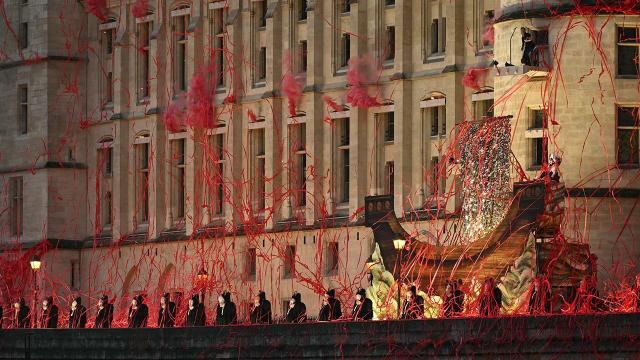
Another Royal death featured in the ceremony was that of Marie Antoinette. Actors appeared at the windows of the Conciergerie. This is a building which served the French Revolution by confining 2,370 prisoners, including Marie Antoinette, prior to horrific public execution by guillotine. The Ceremony could have chosen to avoid this macabre place in the interests of good taste, but instead chose to celebrate the horror.

If you are not convinced by these symbolic references, the next is so obvious that many Christian religious leaders have taken offence. They feel that the story of the Last Super in The Bible was mocked and their faith was being deliberately undermined. The long table on the bridge and the peculiar array of sexually ambiguous characters seated beside it employed frenzied cat walking and dance. The display, for many, was a celebration of sexual licence and depravity and even included children to whom Satanists are particularly attracted as a source of energy. The hermaphroditic characteristics of the figure on the left of Jesus in Leonardo de Vinci’s last supper is discussed in Dan Brown’s book referred to earlier and perhaps inspired the theme…is it Mary Magdelene?

To fulfil the imaginary prophecy of these orgiastic encounters, a near naked Dionysus appears wrapped in fruit on a plate as if about to be consumed by the depraved celebrants. Dionysian rites in Roman times were indeed not for the faint hearted. Was this parade endorsing such rites as an end to modern times?

Using the theme of ‘romance and love’ there were scenes in library where three sexually ambiguous young people made eyes at each other and then a rapid exit into a private room and purposefully closing the door. Families might wonder if a ‘ménage a trois’ is something to celebrate in an Olympic Opening Ceremony if is so, why?

In events such this ceremony, Satanists include symbolic messages for fellow Satanists around the world, in the way the newspaper advertisements once were used for covert communication. They will have been alerted to each message by a principle subversive technique, which is ‘reversal’ of the ordinary such when South Korean athletes were introduced as North Korea. Diplomatic telephones started to ring. An apology was demanded ‘for the next time you organise an Olympic ceremony’. Agreement was made but was ‘human error’ really involved?

The Universal Sign for Distress at Sea

The most glaring reversal was surely taking the audience out of the stadium for the ceremony. Disguised no doubt as ‘innovative conceptual thinking’ and ‘this is France’ – as President Macron explained- the losses appear to be greater than the overt gains. Why would you prefer funeral paced boats in the rain to the traditional carnival of athletes in previous ceremonies in the dry?

Light into darkness is a theme enjoyed by Satanists and the Olympic Ceremony would not have disappointed them. Whilst in a stadium the encroachment of night is gradually balanced out by artificial lighting, this effect is almost impossible to produce in a city. The clear ‘light of day’ passed into dark obscurity. One conceptual theme was actually called ‘obscurite’ meaning ‘darkness’.

Woe to those who call evil good, and good evil,

Who put darkness for light, and light darkness,

And put bitter for sweet, and sweet for bitter,

Isaiah 5:20

A few days ago, You Tubers were posting Paris at night with large areas in black out. Electricity had been cut off. The only illuminated building was the Basilique Sacre Coeur in Montmartre. There has also been further ‘vandalism’ to fibre optic communication cables in other parts of the country.

In conclusion, if only half of these interpretations are close to the truth, I believe we are being given a warning of future problems, by those who are about to create them.

It’s Not a Phobia

Regular readers will know that I am interested in words and language and how sometimes a shortage of words limits the boundaries of thought.

My case is that there is no excuse for a shortage of words, in any language, as they are easy to make up.

The study of lexical semantics is concerned with this issue. It includes and in a manner requires the creation of new words in language through ‘common use’ rather than academic or inspired thought by an individual. Languages not only define themselves but give birth!

Perhaps the process of the movement of a word into common usage is a product of both conception by an individual and adoption by society because society has a use for it.

So here is my attempt as an individual, at introducing a new word into the English speaking world. My intent is that common understanding and adoption of it’s the word would correct a ‘vagueness’ and introduce a ‘precision’ in thought.

The word I propose to challenge, correct and replace is ‘Islamaphobia’.

This is why. A ‘phobia’ is generally understood as an extreme and irrational fear of something. In common use phobias relate to fear of spiders, rats and more abstract concepts like enclosed spaces.

I question here whether a phobia regarding a religion, and those who are members of that religion, really induce an ‘extreme and irrational fear’ in others. I mean, really?

Are there those who are extremely and irrationally fearful of Christianity? Are there those who are fearful a religion that has love as its founding ideal? People might have been fearful of it’s armies such as in the Crusades, but those armies were never the product of the ethics of the teachings of the Prophet Jesus of Nazareth.

So should modern societies be ‘extremely and irrationally fearful’ of the ethics of the teachings of the Prophet Muhammed?

I would argue no. Societies in the West are aware of being irrationally fearful when it manifests as a prejudice and this is more closely what is expressed in the word ‘Islamaphobia’. But is this prejudice rightly placed in the list of spiders, rats and enclosed spaces?

Perhaps a new word is needed to describe this prejudice against people of this faith.

There is one in common use for the prejudice against members of the Hebrew Faith and this is of course, anti-Semitism. It is not Semitic-phobia because there is no such word. It’s a bit weak.

So the word I suggest is used to describe prejudice against people of the Islamic faith is;

anti-Islamic‘. I have saved it to my ‘Word document’ dictionary, as it is not there.

Perhaps one day, it will be.