The Dark Side of Me

The sky is at times full of aeroplanes. Modern culture encourages ‘travel’ and ‘escape’ as a kind of adventure in which we must indulge. Like many wonders gifted to this generation, there comes with it, a compulsion for more and more of everything…like a billionaire who is never satisfied with living like Royalty. Previous generations have left us another type of wealth; hidden in stories which we call ‘fairy tales’.

“Ladies and gentlemen, please make sure your seat backs and tray tables are in their full upright position ready for take off;”

The Frog Prince

In the forest, a selfish princess accidentally drops her golden ball into a well. A frog offers to retrieve it in exchange for her friendship. She agrees but goes back on her word after getting the ball back and runs to her castle. The next day, she is eating with her father when the frog knocks on the door and requests to be let in. The king tells his daughter that she must keep her promise and she reluctantly obeys. The frog sits next to her and eats from her plate, then desires to sleep in the princess’s bed. She is disgusted at the idea of sleeping with the frog, but her father angrily chastises her for loathing someone who helped her in a time of need. She picks up the frog and places him in the corner of her bedroom, but he hops up to her bed and demands to sleep as comfortably as the princess. Furious, she throws the frog against the wall, but as he falls to the floor he has transformed into a handsome prince. He explains that he was cursed by a wicked witch and the spell could only be broken with the princess’s help. The next day, the two go to the prince’s kingdom where they will be married. (text credit: Wikipedia)
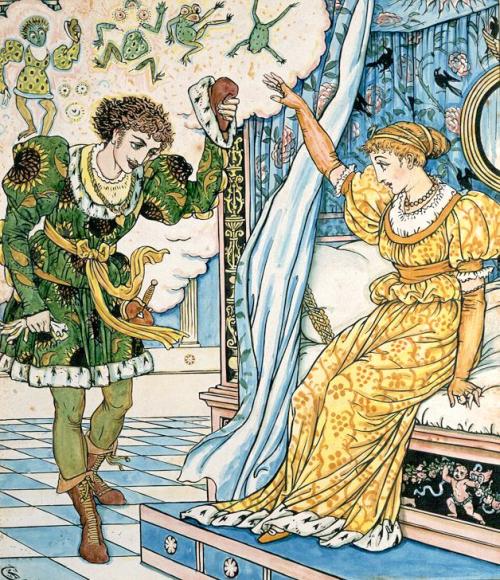
In modern versions, the transformation is triggered by the princess kissing the frog (a motif that apparently first appeared in English translations). In other early versions, it was sufficient for the frog to sleep for three nights on the princess’ pillow. There is more;

The frog prince also has a loyal servant named Henry (or Heinrich) who had three iron bands affixed around his heart to prevent it from breaking from sadness when his master was cursed. When the frog prince reverts to his human form, Henry’s overwhelming happiness causes the bands to break, freeing his heart from its bonds.

The adventure in this tale is the greatest of all – the inner journey. It is told from the point of view of a young princess. She is confronting herself in this story, and her eventual marriage to a prince shows her success in overcoming her unconscious destructive traits; that part of both men and women which Carl Jung called, the dark shadow. Note the contrasting floor tiles in the above illustration symbolising the union of ‘opposites’.

The forest and deep well symbolise that part of the princess’s psyche with which she is not familiar. She possesses a golden ball which symbolises perfection, something we all possess at birth but at some time in our lives will roll down a well.
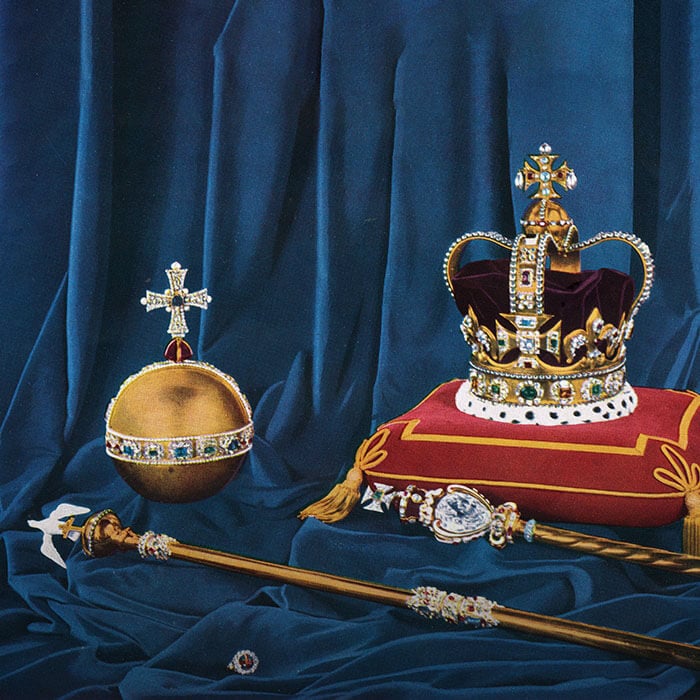
The Royal Orb and Sceptre: picture credit The Royal Mint

We have to experience this traumatic loss and in the story it is the cold, wet, male, instinctual, shadow side of the Princess that undertakes to retrieve her social position and inner perfection – a frog.

Like all psychic work it comes at a price. The princess makes a promise to her male shadow, that she quickly wants to forget. Her wiser and more honourable male animus, represented by the King, forcefully commands her to keep her promise.

The frog is equally insistent, knowing of the final goal of perfection if he can persuade the princess to overcome her inner loathing of her suppressed ‘maleness’.

The prince ‘frog’ is imprisoned in the Princess’s unconscious, a product of prejudice, fear, ignorance, and other self-destructive emotions. Another aspect of the male persona in women is symbolised by the frog’s servant Henry. He is also constricted by ‘supernatural’ powers with the three iron rings around his heart. Three is a symbolic number as in the Trinity meaning ‘wholeness’ or ‘oneness’. The number reoccurs when the frog spends three nights on the princesses pillow – a position suggesting psychic work of transformation through dreams.

The Four Alchemical Humors

In Alchemy, there are four humors representing ‘the chemical systems that regulate human behaviour’. The prince is changed from his false external appearance of being cold and wet to the warm and dry world of the Princess and her palace.

In older versions of the story the Princess throws the frog against the wall of her room in disgust, but the character of the servant and his ‘heart centred’ problem indicates that the coming together of the prince and the princess is from an emotional change leading to love for each other.

Psychologically, this is self understanding and love, and Jung named the process ‘individuation’. The male and female principles achieve perfection in union. (By the way, all gender references in this story can be reversed and the meaning is the same.)

The Princess’s inner work – so accurately described in this ancient tale – is partly why ‘fairy tales’ and ‘myths’ could not be banished from children’s books. Children have a great appetite for and demand these ancient tales. Their unprejudiced minds intuitively recognise the symbols and the true picture of the mind they represent.

They know that as well as walking and eating and drinking and sleeping and all those skills that a new body requires to be learnt – understanding Mind, is just as important.

The tourist planes one might cynically suggest are bursting at the doors with adult children from Neverland who, like J.M. Barrie’s Peter Pan, have never grown up; never moved out of their body into Mind; never kissed a frog.

The Earth’s moon has always symbolised femininity and the mystery hidden in all things feminine. It is ‘tide locked’ with our planet so that one side of her always is hidden. For many years this was referred to as the ‘dark side of the moon’ and as a metaphor for the hidden, the metaphor of ‘darkness’ fits. But in reality, the moon has phases and when she is ‘new’ her shadow faces Earth and we cannot see her. Her reverse side is then full of light and naturally, orbiting probes and satellites from Earth have photographed what is going on there.

When Apollo 8 flew around the moon for the first time and mission control waited nervously for their reappearance, the crew reported hearing haunting sounds. Rationalised as ‘feedback’ from instruments, one might be more curious; as the best scientists have always been.

A Golden Ball from the Moon: credit Meister Drucke

When a partial view of the moon is visible from Earth, the place between shadow and light reveals most detail. Professional and amateur astronomers have recorded seeing unexplainable lights, EAP’s and their shadows on the moon’s surface, buildings and roads and Spaceports with huge cigar shaped craft entering and leaving craters. In previous decades NASA redacted (shadowed) these images from it’s photos, but today there are photographs and video recordings of these phenomena in the public domain, some of which may be real.

The First Men in the Moon: H.G. Wells picture credit the Library of Congress

What is interesting is that the public have been ‘persuaded’ that the notion of extraterrestrial intelligent life is an unbelievable ‘fairy story’. Revealing the truth would cause ‘widespread public unrest’ (disgust at the sight of non-humans). They are therefore not prepared to reveal the truth and hide evidence; a kind of ‘curse’ on modern humans.

We are still in denial that we owe anything to this ‘Frog Prince’ and continue to live spoilt and shallow lives like immature princesses.

When an ‘alien’ frog comes along one day and demands a kiss, we must overcome our collective unconscious fears and invite it onto our pillow. In my view, this will happen in our lifetimes, and cannot remain repressed and hidden. It will be a process of personal and collective social development involving hatred, denial, and anger. Lasting integration and cooperation between species will only happen when there is a higher emotional collective bond between humans – love. The frog is watching and waiting.
“Make sure your seat belt is securely fastened and all carry-on luggage is stowed underneath the seat in front of you or in the overhead bins. Thank you.”

The Dreaming

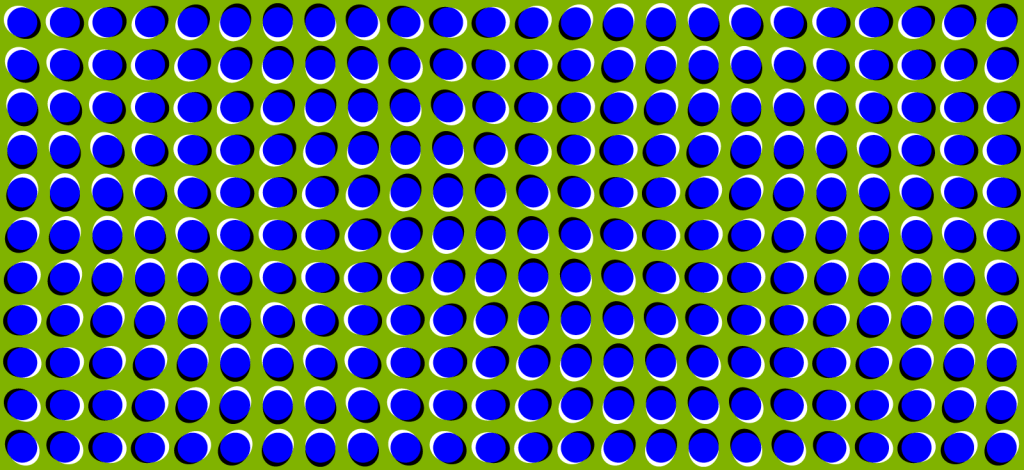
Theatre is a valuable metaphor to help us understand how our perceptions operate. Stories have the unique ablility to press the play, fast forward, rewind and stop buttons, in our heads, for the dimension of time holds no power over imagination. Weirdly our physical ‘reality’ has a similar quality, as the Shakespeare quotation above infers. Our experience of the world is as a stage set, with backdrops, painted scenes, actors and special effects…whizz! bang! hoopla!

Can we deny that there is an illusory quality to our experience of the world, a fakeness that was recognised even four hundred or so, years ago? Elizabethan England was vivified by magic, notably by those who were masters of illusion through magic, poetry and prose, such as John Dee, Francis Bacon and of course, William Shakespeare.

Magic is ‘other worldly’ and sorcerers manipulate what others believe. Our minds have a frailty which is both our power and a weakness. Mind slips in and out of our control. It is called waking and dreaming and the two are interchangeable, morphing at the mere echo sound of cricket’s cough.

Modern psychologists will describe a person who fades out of our contemporary collective theatre of the imagination as psychotic, but are we not all, at times, cretins in the same bowl of soup? Is this not a modern world of illusion, experiencing super-charged storytellers, on-line, in cinemas, in the media, television; spinning a world wide web of illusion.

When we dream at night we experience alternative realities most vividly. Impressions form in our minds that we recognise but in the way we perceive a surreal painting or story. As an ‘Alice in Wonderland’, the whole geometry and order of life is tipped on it’s head, stirred, shaken and rolled out as a disturbing dream.

Such states can control us in our waking and sleeping, but it is possible to step out of the magnetic loop in which we are contained. ‘Lucid dreaming’ is the experience of waking up whilst still dreaming. Physical objects exist such as a light switch, but when flicked the light does not come on. Many drug induced experiences are states of mind that are both illusory and real. The latter are more likely found in indigenous cultures such as the legendary Don Juan in the books of his pupil Carlos Casteneda. Such experiences involve energetic beings and powers way beyond anything we might call ‘physical reality’.

Shaman in traditional communities inherit ‘second sight’ and the means to constructively use drugs, such as ayahuasca and peyote, from their forefathers. There are recognisable separate realities occupied by conscious but disembodied entities, which offer insights not available on You Tube. The encounters by adepts and students are predictable and repeatable, so rationally, are not vague dream impressions.

Much of the work of C.G. Jung explored this area of experience and established the concept of archetypes; powerful entities that resonate as mathematical constants that do not change with time or place.

On the other hand, there is our waking experience in which repeatable rules apply. We are able to manipulate the world and agree with others about our perceptions, even if we may sometimes disagree. In this ‘reality’ we can also repeat experience in the same way that a scientist can repeat an experiment and get the same result. But again, this ‘reality’ is nuanced by an undercurrent of dreaming. We experience ‘day dreams’ where our train of thought occupies our attention in place of our immediate sensual experiences. Children are particularly susceptible to daytime dreaming and much of their play is in their imagination, a world in which they usually reject adult interference!

From these examples we may appreciate that dreaming is not binary; our minds do not switch it on or off. Waking and sleeping are both areas where dreams operate.

In ‘waking’ our egos develope ‘areas of interest’ which are the well trodden paths of our fascinations. Such compulsions are triggers of past memories of excitement and pleasure that control us mostly unconsciously. For instance, when we go to a sports stadium to watch the team we have supported all our lives, we are in our own ‘heaven’. Our senses align with pleasant memories that we wish to re-experience, even as we park our car. If our team loses we experience displeasure, even though our lives have not really been affected; it’s just a dream turned into a nightmare. The faces of the losers tell it all!

So human experience bounces between pleasure seeking and displeasure avoidance. Gamblers enter a deep rut from which it is nearly impossible to escape. The ‘comfortable’ in society are risk averse seek a circular life, as in the classic comedy on UK Television sitcom, ‘Ever Decreasing Circles’.

Those who challenge ‘responsible’ comfort zones are the artists and drug users. Artists ‘create a stir’ by fashioning a form that breaks the rules. Drug users do the same but within very personal boundaries and without guidance as a consequence, which can cause harm and mental illness.

The mind is complex and we should expect to encounter one special trick that it plays on us, whether dreaming or awake. This is ‘projection’ and acts unconsciously. Within our unconscious mind is that which we have little or no control. During our waking state we might project a ‘complex’ from within that part of our mind. This is best expressed by the adage, the ‘pot calling the kettle black’. We criticise a shadow aspect of our character most strongly when we see it in others. It’s an opportunity to self realise and can become less ‘compulsive’ through self reflection and if appropriate, self control.

The autonomic nature of dreams is remarkably similar, projecting as in a film, elements of our own character in the play’s cast.

Whilst a comfortable physical reality is beguiling, it can be experienced too literally and believed too much. We are born into material bodies to overcome the limitation of being purely ‘Mind’ and one might expect such a transition merits a determination not to waste life by just staring out of the window.

After the use of our physical bodies, I believe we will once again return to ‘pure Mind’ or ‘God’. Without a physical body our mind is no longer able to observe the physical world or be informed by the physical senses.

Whilst in a body we are like a person who has learnt to swim in water; which we might experience as an ocean. Without a body we become that swimmer using all their skills learnt by swimming in that physical ocean. Within this ocean are small islands, which remind the swimmer of the physical world but are mere dream impressions and memories; just as in they physical world there are small islands which are not real.

picture credit: Aquabumps

From a Distance

You may say I’m a dreamer
But I’m not the only one
I hope someday you’ll join us
And the world will be as one
John Lennon ‘Imagine’

There is an awareness of the prospect of a ‘New World Order’ in many modern western societies. It is ‘globalism’ by another name and assumes that for the eight billion or so inhabitants of planet earth, ‘one size can fit all’. We clearly see this in the communist countries such as China, where citizen’s rights are subordinate to the rights of society; ‘the lowest common denominator is best for everyone’ philosophy.

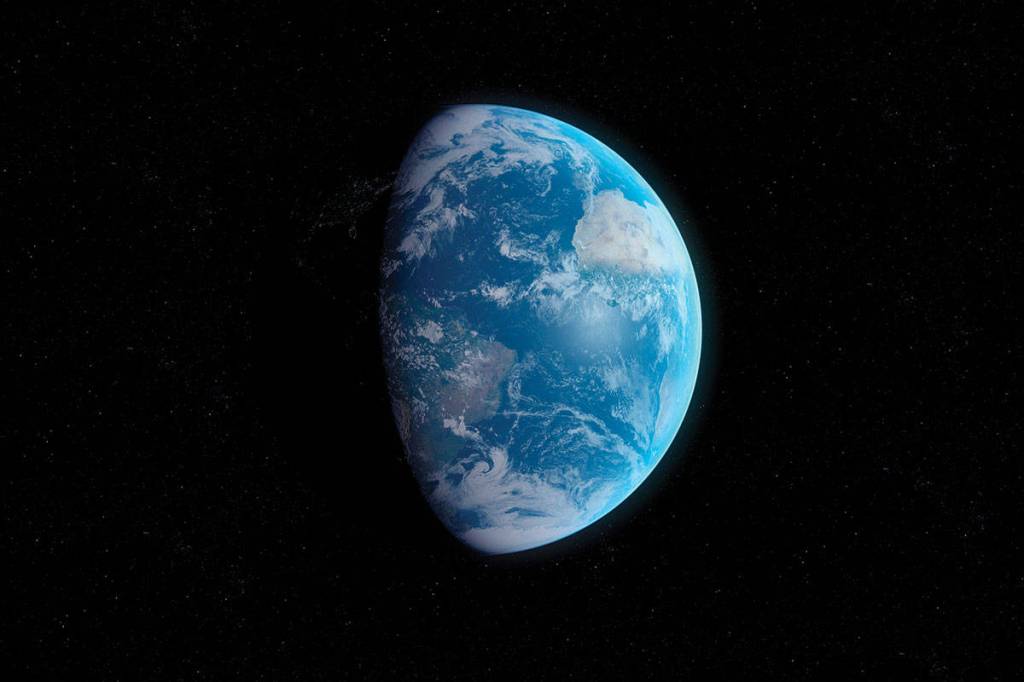
Astronauts in the International Space Station may enjoy a global view over breakfast and be filled with wonder at the planet without political boundaries and cultural differences.

But of course geo-politics is not as simple as the view from space implies. If we were to break down how societies are structured the categories might look like this;

language, religion and ethics, race, class, cultural background, education, wealth, geographic placement, access to technology and food and so the list goes on. Societies are highly complex when viewed through the lens of a microscope.

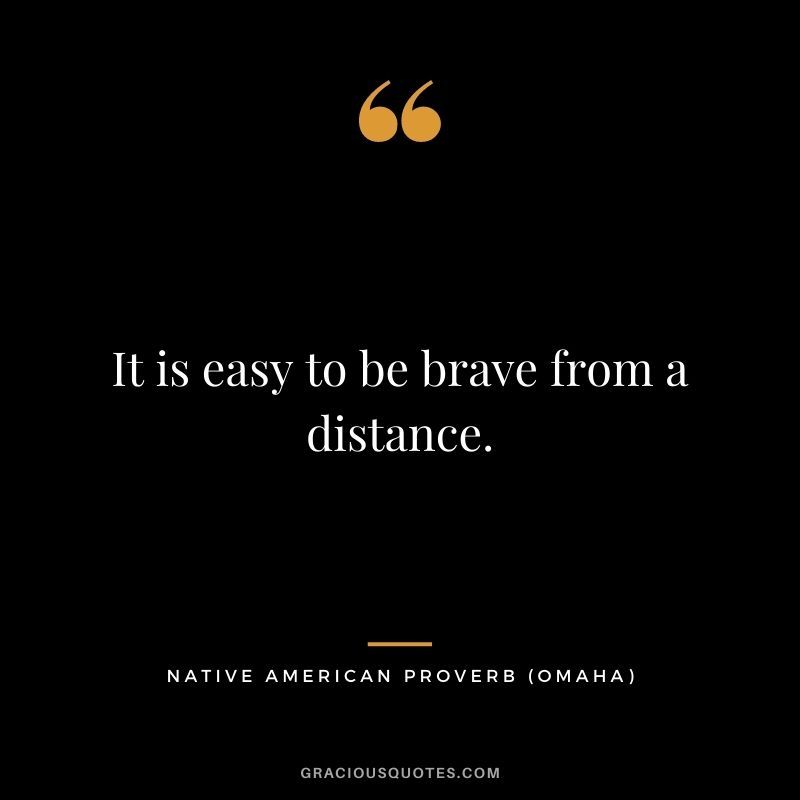
There is an indigenous North American saying that, ‘it is easy to be brave from a distance’.

They should know, for their initiation tasks for young ‘braves’ were daunting to the point of life threatening. When poised to jump into a river from a high cliff, suddenly life looks and feels different from ten minutes ago.

This illusion of safety is becoming dominant in many Western societies in the modern times. Citizens go about their daily tasks in relative comfort because of the security that their State promises. Citizens will never be poised on the edge of a metaphorical cliff – so they believe.

We create a ‘safe distance’ around ourselves; living in a tiny bubble of the known and familiar. It is comforting and provides, what in general systems theory is known as ‘homeostatis’, or

The aim of systems theories is to create homeostasis, or a favorable person–environment fit, in that the individual interacts and responds to her/his environment where interactions and change are contributing to positive growth and development and social functioning.‘ ScienceDirect.com

The whole approach to reassurance given by crew to passengers on an aircraft is based on this principal. In a short briefing it is explained that the aircraft could crash in which case here’s a whistle, otherwise, drinks are available from the trolley.

Airliines pretend flyiing is safe, but if we think critically they could do more. For instance, why are children not given child seats as is the general law for cars? Why are companion and service animals so difficult to cater for? A disabled passenger will have their expensive wheelchaire thrown into the hold and they have to stagger to their seat; if they are lucky with extra legroom – at an additional cost. How quickly passengers embark and disembark, is mostly about money for airlines.

Life in western societies is rather like this problem that airlines have when people have unique expectations and needs. The tendency then is humans are herded like lost sheep and most of the time, we oblidge.

Fortunately, what stops the world from wobbling off it’s axis is a counter force which we call ‘co-operation’. Humans emerged successfully from the ‘natural selection’ disaster movie of prehistory by co-operating with each other. Instead of becoming the lone predator like tigers, they became pack hunters, like wolves.

So here is the good news. If generalisations and lack of detail are the centrifugal forces that tend to pull society apart, then co-operative forces are the centripetal reaction, keeping us all together.

A list of these co-operative forces would be something like this;

...written laws and national constitutions that describe and give rights to citizens, shared wealth and resources such as public services, pensions and private insurance, shared territory such a public spaces and open borders, shared fauna and fauna in natural ecosystems, shared technology and scientific research, shared buildings such as blocks of apartments and entertainment facilities, shared national infrastructure, shared human resources in education, health, armed services, politicians…the list is longer.

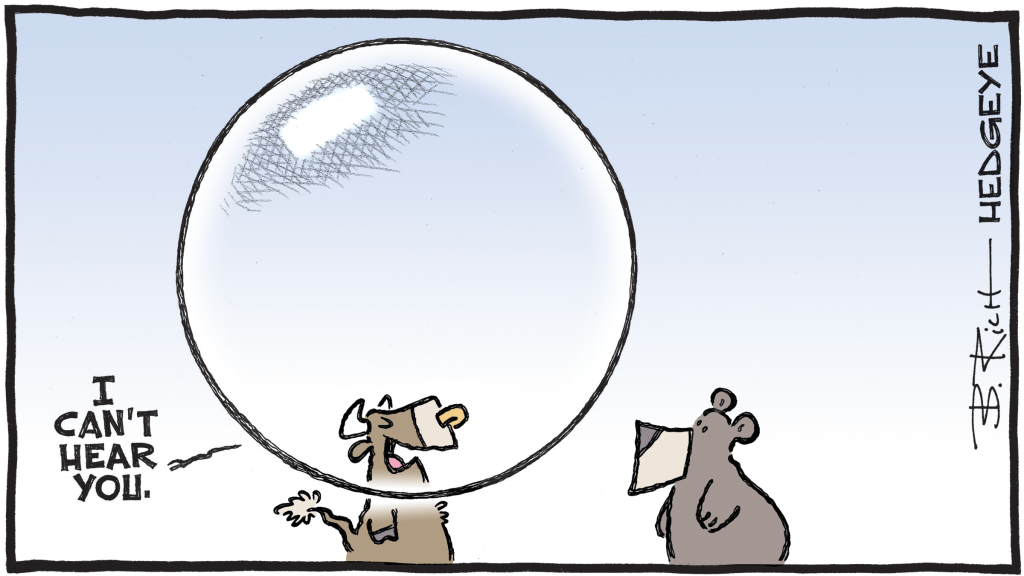
Those enjoying the re-assurance of a Western lifestyle, are aware of other countries where the centrifugal forces are actually pulling societies apart. We know there are wars, famine, plague and natural disasters, criminal and terrorist organisations, happening somewhere else on our shared planet all the time but we chose to do nothing at worst or give to charity at best. We rationalise our choice as ‘someone else’s problem’ because we were lucky enough to have been born in a bubble.

picture credit: Hedgeye

For the few who do take on responsibility for those less ‘fortunate than themselves’ is more they can do. If they have a set of skills applicable to a particular emergency they can join a charity or non-government organisation. Usually and sadly, such as in earthquakes or flooding, help arrives too little too late. Disaster relief warehouses do not exist at every air and sea port in the world. Instead it can take days for supplies to be shipped and taken overland to those as serious risk of harm, instead of hours. Governments and or those who caused the disaster lie about the cause and solutions that are in place such as is happening in Gaza in Palestine at this present time.

In this way disasters can be diverted from public attention; played down because ‘we’ are not the victims. Our lives continue with a good standard of living, fuel in the service stations, government workers in the social services providing education, health and the rest. The shops are open and we go to work.

Or so it appears, because of the illusion with which we are presented and which we choose to believe; we genuinely think we are brave, upright, honest, caring citizens.

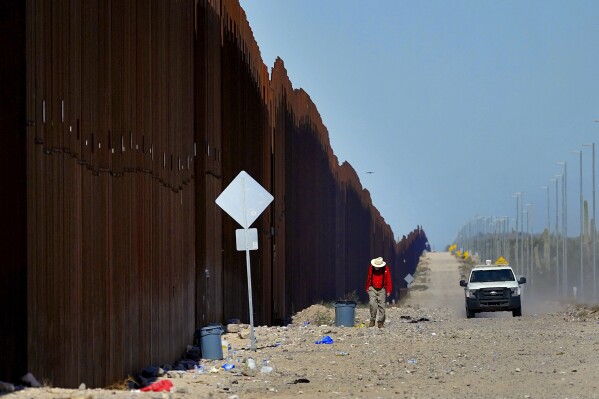
That is until our borders are rushed by people without documents who risk their lives to get help, banks close, world shipping halts, a serious pandemic any other disastrous global event such as, well, global warming…

Arizona Border picture credit: APnews

Then the problem in western countries becomes, ‘how do we keep our way of life?’, because we assume, our lives and standard of living will continue unchanged.

Peace Begets Peace

Most people hate war, especially soldiers, so why does it happen?

The problem is that war is an option of last resort. Ideally, all other options have been explored before war happens, but from then on, politics is ‘extended by other means’, to paraphrase the Prussian General Carl Von Clausevitz. War will persist until it is possible to stop it; a process far harder to achieve than starting it!

Each conflict is a set of unique circumstances and different ways to reach a peace. At worst the war will become one of attrition and it becomes impossible for both sides to continue. Alternatively, political and public support for a war wanes or perhaps an overwhelming third force compels surrender.

You would like to think that ‘how to stop a war’ is taught in military academies, but such executive decisions are more likely made my politicians rather than military leaders and politicians usually have no experience of ‘conflict resolution’ at this scale. Even in wars which have been wars of attrition, the conclusion of war requires considerable diplomatic skill. For if one side is forced into conditions of surrender that are too onerous and dishonourable, the process of recovery becomes excessively hard and national pride will almost certainly wish to seek redress sometime in the future.

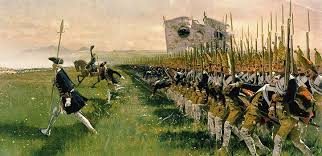
The world might have learnt this lesson at the conclusion of the first world war, which was one of attrition and the intervention of a third party; the USA. The armistice terms demanded by the Allies, were so severe that they left a ticking time bomb, ready to start of the second world war.

picture credit: Family Search

The present war in Ukraine has been described by some as the beginning of the third world war, but there is another view. It could be argued that what is happening in Ukraine since 2004, when Russia annexed parts of Ukraine and later the Crimean peninsula, is an unfinished rumble from the second world war.

In that war, an American General raced against the Russians to roll his tanks into Berlin ; General George Patten. The politicians tolerated his outspoken gaffs, because he was a superb military leader. Patten was of the opinion that the allies should continue to Moscow and finish the war for good.

The politicians ignored his advice and the United States spent the next few decades fighting the influence of communism in what became known as, Mc Carthy era. Countries such as Cuba, China, Russia and Vietnam caused considerable headaches for the American politicians and military; awakening a culture of suspicion of ‘reds under the bed’.

There is an argument that the present war in Ukraine is unfinished communist expansionism in Europe. President Putin justified invading sovereign Ukraine to the Russian people, by stating that his strategic aim is to defend Russia against an expanding NATO threat. The two allies of the second world war were now facing each other; just as General Patten envisaged was needed to end the war.

The technology of war inevitably played it’s part in this conclusion. The use of the Atomic bomb by the USA in the Far East, brought the conflict there to a sudden halt. Communist sympathisers within the Allies, gave the secrets of the atom bomb and the Soviet Union. They speedily test fired an exact copy of the American atomic bomb, shocking the world. This mutual threat has forced an unsteady world peace ever since, dubbed ‘the Cold War’. Despite the efforts of the International Atomic Weapons Agency, set up to prevent the proliferation of nuclear weapons. Nine or so countries now have them and others want it.

It is important to realise that after the fall and fragmentation of the Soviet Union, Ukraine was left with fifteen pressurised water reactors of Russian VVER design and importantly, Soviet era strategic nuclear weapons.

Three of these ex-Soviet countries were persuaded to give up their nuclear weapons in the Budapest Memorandum on Security Assurances. Belarus, Kazakhstan and Ukraine agreed to give up their nuclear weapons between 1993 and 1996. The nuclear powers overseeing this process were the Russian Federation, the United States and the United Kingdom. They agreed not to use military force or economic coercion against these three countries unless for self defence or in accordance with the Charter of the United Nations.

The diplomats and lawyers who wrote the Budapest Memorandum were perhaps, not clear about what constitutes ‘self defence’. Most strategists and tacticions, know that the principle of striking the enemy before they hit you, creates an element of surprise that can bring about an early victory. Putin’s original ‘Special Military Operation’ was exactly this but, unfortunately for him, it didn’t knock out his opponent with the first punch. The surprise was Putin’s.

Putin constantly cites NATO as a growing threat, especially after the fall of Viktor Fedorovych Yanukovych, Ukraine’s president from 2010 to 2014. Yanukovych had promised the Ukrainian people in his election manifesto, that Ukraine would apply to join the European Union or at least set up special trade agreements which would lead to this. But after a phone call from the Kremlin, he renaged on this promise and there were riots in the streets. These were violently suppressed by the government leading to over 100 deaths. Yanukovych fled to Russia and Volodymyr Zelenskyy was elected president on the promise of European integration. Europe responded with indirect support.

Ukraine is a convenient buffer state for NATO because it has arguably, prevented World War III. It has so far, been a narrow escape for all, provided Trump isn’t elected and gives in to the Russians. The USA has not been good the diplomacy of war and should have learnt some important lessons, such as from the war in Vietnam.

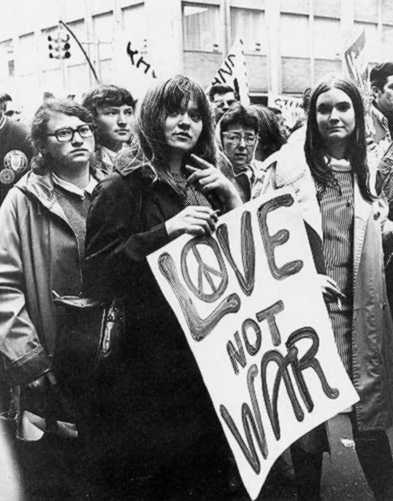
picture credit: Shoeleather History

An indignant generation of young people in the United States rebelled against the war in Vietnam as it was played out graphically on their television screens. Newspaper reporters photographed the horror of war; photographs which stunned Americans and the world alike. Young men angrily burnt their call up papers in front of crowds of anti-war protesters as four successive Presidents presided over an unwinnable war. In a way, the protesters against this and later wars (such as the invasion of Iraq by the US and coalition forces in 2003) stuck their flag in the moral ‘high ground’. War was wrong.

Awakenings of conscience and consciousness happen at the individual level long before parliamentarians hear and reflect the ‘mood of the nation’. If war is going to be rejected as a method of ‘problem solving’, there has to be a global realisation of the immorality and futility of using violence against a fellow human being. It would be idealistic to suggest that this could happen in the near future but perhaps there is, a greater possibility for change than now, than there ever has been.

In my view, change will only happen with the introduction of a ‘third force’ which might be a charismatic world leader from this or another solar system, new technology or a third force with the means to eliminate humans, shared global problems of a catastrophic nature or just a spiritually and / or morally inspired realisation that violence is wrong.

picture credit: Physics World

The reference to ‘another solar system’ may have surprised readers! But the presence of advanced beings on earth is hardly a secret any more. The problem is that they are being characterised as violent and a threat to mankind. The narrative of ‘global security’ by successive U.S administrations, introduced ‘Star Wars’ under the Reagan and a whole new defence wing under Trump called the Space Development Agency. Hollywood has aided and abetted a global fear of invasion of ‘beings from outer space’ who wish humans harm.

The reality as described in Dr. Steven Greer’s film, ‘Close Encounters of a Fifth Kind’, is that highly evolved beings are watching and guiding us until we become peaceful towards each other and them.

Such a change of morals and consciousness is not a vain hope. There have been historical precedents. The crucifixion of one man in Roman Palestine, started a new religion based on love and compassion for all other people, including enemies.

Since then, sadly, religions have done as much to cause war as to prevent it. Countries at war, often claim that ‘God is on their side’ and yet logically, this cannot be true. Humans have free will and with that, responsibility.

The path to a planet where there is no war, is ultimately not in the hands of the politicians, lawyers, military leaders, religious leaders or industry; the arms industry has shown multiple times throughout history, that it is more interested in shares than ploughshares. The only possible novel outcome to being a victim of unrestrained violence, is for individuals to do nothing.

As the famous poster put it; ‘what if there was a war and nobody came?’

Mahatma Gandhi used non-violent protest to the British Raj, because that was how he was as an individual. His passive resistance, proved to be all that was needed to bring down the mighty British Raj in India. Peaceful overwhelming influence is an extraordinary power. When it fails, it makes powerful martyrs but when won, makes lasting peace. There will be a moment in the future for this to take place and until then we must wait.

The World Spinning out of Control

To everything there is an overview and to help understand the drama being played out in Ukraine at the moment, read on;

Tomas Schuman is an Soviet-era secret service agent and has spilled the beans on how the Soviet era strategy to undermine the West. He now describes the Soviet techniques of international subversion openly on You Tube.

He says there are four stages, extended over several decades.

Stage 1: Demoralisation

This takes at least one generation, maybe 15 to 20 years. During this time various completely fake replacements take over established religion, education, law and order and social life in general.

These institutions are replaced with un-elected ‘influencers’ such as the media, secret societies, wealthy individuals and clandestine branches of government.

Labour relations are undermined by taking away the power of trade unions.

Stage 2: Destabilisation

This process is aimed at institutions. ‘Sleepers’ who have been installed in societies institutions such as local government, law, military, industry and commerce and educational hubs, are activated. They move into positions of authority through the perceived lack of law and order e.g. military coup, ‘fake’ election results, single issue protest groups lobbying government and on the streets (Black Lives Matter)(‘statue toppling’)(‘defund the police’). At the same time various antagonistic single issue parties move into power vacuums created by the effects of stage 1. (the Brexit Party in the UK).

Stage 3: Crisis

This process starts when social functions cease to work such as the effects on the free movements of goods and people within the UK and the EU. This includes the issues around the Good Friday Agreement and possibly leading to nationalist politics breaking up the United Kingdom. Poverty and homelessness (e.g. California) forces large numbers of people to seek food aid and other handouts to simply exist. Fake information is fed at an industrial scale to social media sites at carefully selected times e.g. elections and referendums. This and weak government, leads to discontent which can spiral out of control leading to the call for more authoritarian rule and a ‘strong man’ ruler such as seen in the United States when Trump was elected. The result is civil war or invasion of another country e.g. Afghanistan, Lebanon, Syria and now Ukraine.

Stage 4: Normalisation

As a pretence of solving the problems (real and fake) of the first three stages,

it is now possible to justify extreme action to ‘normalise’ society and bring ‘peace’. The tanks move in to a desired country, however ‘normal’ the citizens feel, with the aim of physically taking over the seat of government (e.g. the protesters at the Washington rally who disputed the election results or now Ukraine). Once the leaders of the former government have fled or been jailed, a new ‘puppet’ government can be installed with the aim of ‘restoring law and order’ which of course comes at the price of loss of democratic freedom and human rights.

The USSR may have imploded in on itself but the ‘vision’ of it’s leaders is still deeply ingrained in it’s institutions and leaders. Mr. Putin was after all a KGB officer and would have expertise in and taken part in the above process. Transfer these four stages to ‘predator’ and ‘predated’ countries in Asia (Myanmar now in military rule) Africa (Somalia) the Far East (North Korea) the Middle East (Iran, Iraq, Yemen, Israel) in addition to Europe and the Americas and elements of this Soviet-era method of insurrection ‘government toppling’ are alarmingly aparrent.

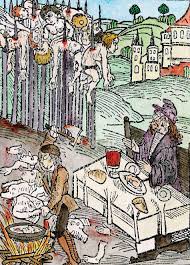
Vladimir the Impaler – picture credit National Geographic

All of the above was my blog written and published at the begining of 2022. Events have moved on and the symptons of this subversion process of natural law and order, remain and gather momentum.

Storms are not catastrophes except when they happen simultaneously and then they are called ‘perfect storms’. On they Oceans they appear as ‘rogue waves’ which can sweep over huge ocean going liners such as the Queen Elizabeth II at great risk to passengers and crew of capsize and sinking.

To sustain this metaphor 2022 has witnessed the sad loss of the real Queen Elizabeth through natural causes and with her passing the end of an era. Her reign included the Second World War of which she was one of the last veterans. In my view that experience raised the social ownership of responsibility, in Britain and around the world. Out of harm usually comes a realisation of the need for change and significantly a socialist prime minister in the UK succeded the Tory Winston Churchill. People realised the need for good housing, food and education and in particular the provision of health care for all.

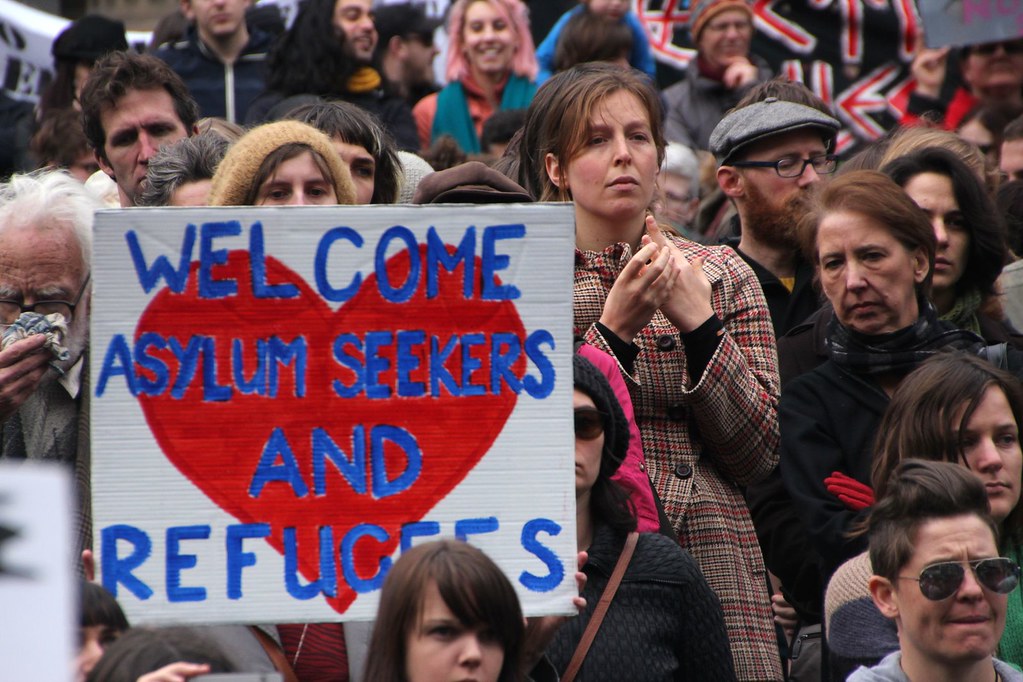
What has happened today is the disappearance of a generation who cherished those social values as being of primary importance to a peaceful and good life for all, not just the rich and privileged. The stabilising influence of high ethical standards was sanctified in the creation of the European Commission in which what were called ‘human rights’ were enshrined not just in religious values but in law. Many who voted for Brexit are surprised and disappointed that the European Union (also created with an eye on peaceful coexistence in Europe) is a seperate organisation to the EC. They now wish to send asylum seekers (80% who are genuine) back home or to a third world country against their wishes and chances of even staying alive.

Should we be surprised that this division amongst left and right in many European countries and the weakening of the ‘centre ground’ has played right into the hands of the ghosts of the USSR – Vladimir Putin.

Was Brexit not only partly engineered by the Russia and her allies, but a green light to start a war in Europe?

Your enemy will always tell you where you are weak.

The rise of autocratic countries as being now a majority of governments in the world, should make us more than worried. When we watch the government clamp downs on free speech and the right to protest in China, Russia and Iran, are we watching European countries in the next decade?

In my view we should be extremely concerned. In summary we can identifiy two storms; the subversion of democracy by Russia and various rogue states such as Iran and North Korea, combined with weakened social values in divided democratic countries such as the UK and the USA.

Into this gathering tsunami is added a third wave which travels around the world largely unseen. It is generated by those who have huge political power through extreme wealth and social privilege. They work in the background by buying media organisations, pharmaceutical companies, industrial conglomerates and arms and municians amongst other diverse service and product providers. No one votes for them and their influence is being swelled by the rising tide enabled by new technology and biological sciences.

But wait! There are at least three storms producing this hurricane, now made even more worrying by the no longer deniable catastrophe of, climate change.

At the risk of having mixed my metaphors it is apparent now to most observers that the ‘minor details’ produced by this storm of all storms such as inflation, migration, poverty, hunger, war, homelessness are not only problems in themselves but indicate a far larger and uncontrolled pattern towards global catastrophe and harm to each and every individual alive today.

The old saying ‘there is no smoke without fire’ has never been more true. The challenge today is to find the fire and put it out. And when that is done, look around and see what is left and work out if those who stepped forward to ‘save us’ were our friends or our enemies.

Did You Enjoy Your Meal?

Do you find that when you eat at home, you must put on some loud music to accompany your meal?

I expect that there are many who cannot face eating without background or foreground music or perhaps television, but your writer does not.

Therefore, for me, it is difficult to go to a restaurant anywhere in the world and enjoy the experience. The problem is that most restaurants seek to please their clients by playing music with apparently, little thought. I can see that their aim is to attract customers and an empty silent restaurant is not going to do that. So they replace the silence and empty tables with music. So when people get hungry and sit down in the restaurant, is this because of or despite of the music ? The restaurant fills up and as the music stays on the people start shouting at each other, just to be heard. The speakers are cleverly placed so that there is no table where the music does not play in their ears.

My question is, are restaurants getting it right?

Let’s imagine that you own a relatively successful restaurant What’s’ your management strategy towards ambient music?

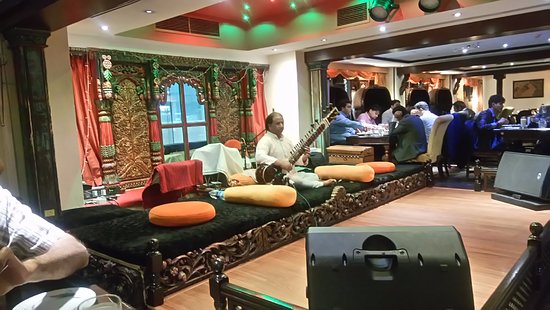
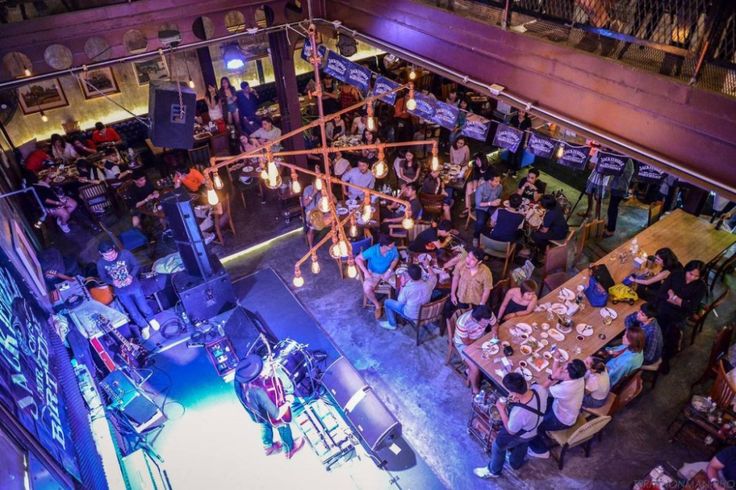
Live, themed music, but look at the size of those speakers!

For starters, how many potential customers walk by your restaurant when they here your musical offering? Is this because they do not like your taste in music? Should they? Who else likes your taste in music? The majority of people? Really? You don’t know? Why not?

Music after all is a very personal thing. Young people are unlikely to want to go to a restaurant playing the classical greats…as are elder people unlikely to want to listen to heavy metal and grunge with their salad. There is no ‘one size fits most’ when it comes to musical taste.

Music cannot only be judged by it’s genre but by the volume that the music is played. There is a type of music intended to be played at a volume just enough to break the silence. In the 20th century this was dubbed ‘musac’ and wafted from ceilings in lifts and shopping centres. Today, there might be ‘ambient music’; a soft mosaic of chords and natural sounds that is so bland that it is hardly noticeable, yet gently calming.

At the other end of the scale there are some people who enjoy and expect music to be loud, and perhaps young people fall into this category, although of course, not all.

So as a manager and owner of a restaurant, how can you attract the maximum number of customers? Do you let the staff play their favourites (as many managers do) or have you understood the need to carefully attract the maximum number of diners.

The decision may not be difficult. If you own a Greek restaurant, do you play Greek music to remind people of their holidays in Greece? It may sound obvious but how often does this happen in your experience?

I once went to an idyllic restaurant on a sandy beach in Kerala, India. The food was delicious but the music was ‘intended’ to please westerners. After suffering ‘Pretty Woman’ by the Whoevers, I handed the waiter my cassette tape of classical Indian music and asked him to play it. The ambiance totally changed. Suddenly I was in India!

If you do not have a natural themed choice of music in your restaurant, how can you know what customers they like? The answer is to ask them. A simple question at the end of their meal about the music instead of ‘did you enjoy your meal?, would be a good start. Alternatively, a questionnaire printed on the place mat / menu enables a more anonymous and comprehensive response. It could include a question on the volume for instance.

A relaxing dining experience?

An obvious consequence to client satisfaction in your dining experience, is to offer some tables where there is deliberately no or very quiet music. This would please those whose taste in music is not ‘mainstream’, as already described. These would be ‘low music’ tables where there are no speakers hanging ominously from above. This particularly makes sense where there is pleasing natural ambient sound such as a river or the sea, birds, or wind in the trees. People need choice and the more people you can attract the more profit, surely?

There is a point where music becomes a contributory factor to noise. This can be defined in decibels, and happens when other sounds in the restaurant are taken into account. People natrually want to talk in restaurants and the level of noise in the restaurant will affect their ability to listen and talk to each other. There is a known effect where people talk above ambient noise levels in order to be heard. As more people talk the louder they have to talk. The effect is ear crunching.

Or perhaps the restuarant music is needed to conceal unwanted sounds. The noise from the kitchen, the TV on the wall, the busy road outside and other local noises that invade your restaurant, might be concealed by music but at a certain point, the music is the only sound in your control as manager. If people are shouting over it they are certainly not listening or enjoying it.

I personally will walk straight passed a restaurants if I do not like their music and or it is too loud. This means I just keep walking, and not because my taste in music is narrow. On the contrary it is very broad, but it is not ‘popular’. I have studied music and can play various musical instruments as well as sing, but given the option for music or not, regrettably my choice would always be the birds in the trees.

Spotted flycatcher Muscicapa striata; picture credit RSPB

The bottom line is, as for most business enterprises; are you offering what people want or what you want to offer to people? Generally, businesses based on personal taste or expectation of the tastes of others to match your own, fail. There is no room for peronsal egos when seeking to serve others. To attract and please people, entrepreneurs in dining or any other business, need to know what people want. Businesses like Mc Donalds and Costa Coffee prospered because they understood this principle and make money.

So, when it comes to musical ambience in the dining experience, what do people want?

The Tunnel at the End of the Light


There used to be a car, in the 1950’s called the Ford Popular, endearingly known as the ‘Ford Pop’.

If the model T industrialised the manufacture or cars, it was still only affordable for the middle classes of America.

But the Ford ‘Pop’ bridged that class divide and provided a ‘people’s car’. Germany had done this in the 1940’s with the Volks Wagon Beetle, but Britain took a while to catch up due to a short ‘intermission’ called the second World War.

The greatest car ever built – Ford Popular 1954

picture credit: carandclassic.co.uk

Light Ford Pop 103e 1954 carandclassic

What do you expect from a people’s car? Certainly it is not going to have a chilled drinks cabinet and cigar lighter. Everything was basic, functional and appealing to the common denominator of public taste, availalbe in black, black or black. It was, naturally, very popular and it transported families in comfort from city to beauty spot in large numbers. If you wanted anything other than a can of baked beans, you had to get a pay rise.

Fast forward to today and you can draw a parallel between the dumbing down from ‘the good life ‘ for a few, to ‘dull and ordinary’ for all. The middle classes in both the UK and USA lost their grip on political dominance, because the workers have come out in larger numbers to vote.

In the last decades of the 20th century, politics was complicated. Whilst you didn’t need a degree in political science to understand what was going on – it helped. The whole process of electing representatives on multiple – often contradictory – manifestos, parliamentary debate, Sovereignty, national priorities, international relationships and above all, law amending and making – was baffling to most. So it was left to the ‘Toffs’ from elite universities to speak down to voters in election campaigns to make promises everyone could understand – even if they were expected to forget them later.

Enter the internet in the 21st Century. Whilst you could write the equivalent length of Nelson’s Column on how this availability of information has changed societies across the world, there must be changes.

The most obvious of these is, in my view, the ‘citizen scientist’. In a stealth move worthy of the Great Harry Houdini, ordinary people who never understood science at school, are suddenly ‘on to it’.

If we  regard science as a way of thinking logically about anything – using the ‘scientific method’ to prove or disprove propositions – then everything is up for change and challenge.

Call a friend?

Light NHS Direct

Suddenly people were empowered to not believe their medical Doctors. You look up your symptoms on the internet and then go and tell your Doctor what the problem is how you want to be cured providing it does not involve vaccination. The UK National Health Service even encourages this by creating NHS call centres. The staff follow algorithms in the same way G.P.’s do – perhaps even quicker and certainly without having to catch another disease in the Waiting Room.

The same process has crept into most other areas of professional expertise; people design their own houses, people cook and bake, people make art, play musical instruments, make astrological predictions, indulge in puppy care and kitten care – you name it people do it – and the walls of Jericho surrounding the professional classes have fallen.

Great, you might think. This is democracy at it’s best. People power!

The problem is the obvious one and why even Socrates, warned against empowering the masses.

The problem is that people do not access and use information, knowledge and wisdom in the way that professionals have been painstakingly trained to do. As always it remains true that, things are more complicated than they seem.

It is easy to reduce areas of knowledge to ten ‘top tips’ – how to build your own house- and make it look easy. Speak to anyone who has built their own house and they will describe the most stressful time of their lives, going over time and over budget and still the roof leaks.

Socrates warned that ordinary people did not have the education to be trusted in such things as – voting. Perhaps this is one reason why women in the UK at the turn of the 19th century were still denied a university education and a vote – why this particular prejudice was suffered for so long.

Even with a university education, young men and women in the twenty first century are finding it hard to get a job. When the Blair government in the UK declared an aim to give a top class education to fifty per cent of young people, the ideal appeared noble. But the reality was that ‘degrees’ became so common that they were no longer the doorway into top jobs.

Worse still, with the introduction of University fees in the UK, young people were enslaved into a life time of paying off a high interest debt – all on the promise of ‘earning more’. And governments too are unlikely to get their ‘pound of flesh’ from the deal. Grants to the few worked better in my view.

In primary schools the children of the first decade of the twenty first century were told how clever they are and one day they might be Prime Minister. It was of course a lie told be people who had only become teachers who took holidays at home.

Only a few people ever become Prime Minister- as if we need telling.

The president of the United States for instance, has been described by psychologists as ‘adolescent’. Although he boasts of a ‘very, very, good education indeed’ – he didn’t listen in school and learnt very little. Add to being academically dumb, other short comings which doubters love to list, then you have a candidate appealing to those who are fed up with being talked down to because they are ‘very, very good people indeed’. Fortunately in America there are plenty of these in the southern states.

Trump uses short phrases to plug home a message easy to understand and remember for the masses;

Make America Great!’ ‘America First!’

Johnson does the same; ‘No Deal Brexit!’ ‘Project Fear!’

Their close advisers are no longer civil servants or even elected politicians. They are media savvy individuals who know how to change how voters and party members think. In the UK now there is not even a deputy Prime Minister the PM can discuss strategy with. Instead their is an unelected ‘close adviser’ to whom the PM remains loyal – at least until Brexit is over – despite protests from his own party back benchers.

But the patients have not completely taken over the Mental Health Institution. There is today a swing back towards trusting the middle class professionals. Self build houses leak, Mr Kipling’s cakes taste better, art is not easy. But particularly at this time of crisis, people have seen the highly trained men and women in the health services, battling away for little personal reward and realise, ‘I could not do that’.

Suddenly, the science of Virology is laid out like a patient etherised upon a table, and no one except the professionals understands.

picture credit newseu.cgtn.com

light Neweu cgtn Virology Lab

Because it’s difficult to ‘do the right thing’, science is emerging as a wise advisor to governments. When Boris Johnson gives press briefings he is flanked by non-elected scientists who give ‘advice’. This appears to be a correct and ethical process until you realise that there as many views on a subject as there are scientists. Scientists often disagree with each other’s ‘version of the facts’. They will say that more studies are needed, larger samples, more vigorous methodologies, new measuring instruments and technologies – innovation and discovery!

(A particularly cynical pundit will suggest that governments are setting up someone to blame, when the strategy is seen to have killed thousands because the government policy was late and or wrong.)

This dark secret of science is not so dark and we should demand to know it. Should President Harry Truman have been persuaded to build the Atomic bomb – ending one war and starting a cold one that sits like a dripping glacier, to the present day?

picture credit: atomicheritage.org

Is that a nuclear weapon or are you just pleased to see me?

Light Harry Truman atomicheritage org

Who voted for the Atomic bomb? Certainly plenty of people protested against it in hindsight but knowledge, once out of Pandora’s Box, never wants to get back in.

Suddenly ‘the people’ see the scientists as doubtful holders of solutions to problems. Science has mucked things up just as often as it has created a better world.

And if you can’t trust the scientists surely you have to trust the politicians? Unfortunately there are as many political view points are there are sea gulls behind a fishing boat and the only thing you can be sure about is the direction of the boat.

So societies trundle into the twentieth century lead on by TV and radio personalities with regional accents – commoners who you can understand. Everything has been reduced to guessing games that requires no skill because the people tried science and it was even more difficult than at school.

If our politicians are also guessing their way along – without scripts, experience and the wrong pick of scientific views – is this the end of the light?

picture credit: author – unfortunately God moved.

Light through clouds

Don’t Fence Me In

This the title of a wonderful old song sung, I think by Bing Crosby. It’s all about the exploration of the west in nineteenth century North America. After millennia of humans and animals roaming free, cattle ranching introduced ‘ownership’. The Native American Indians didn’t understand it and gave away their lands before they realised they would have to fight and ultimately die for the ‘reservations’ that were left for them.

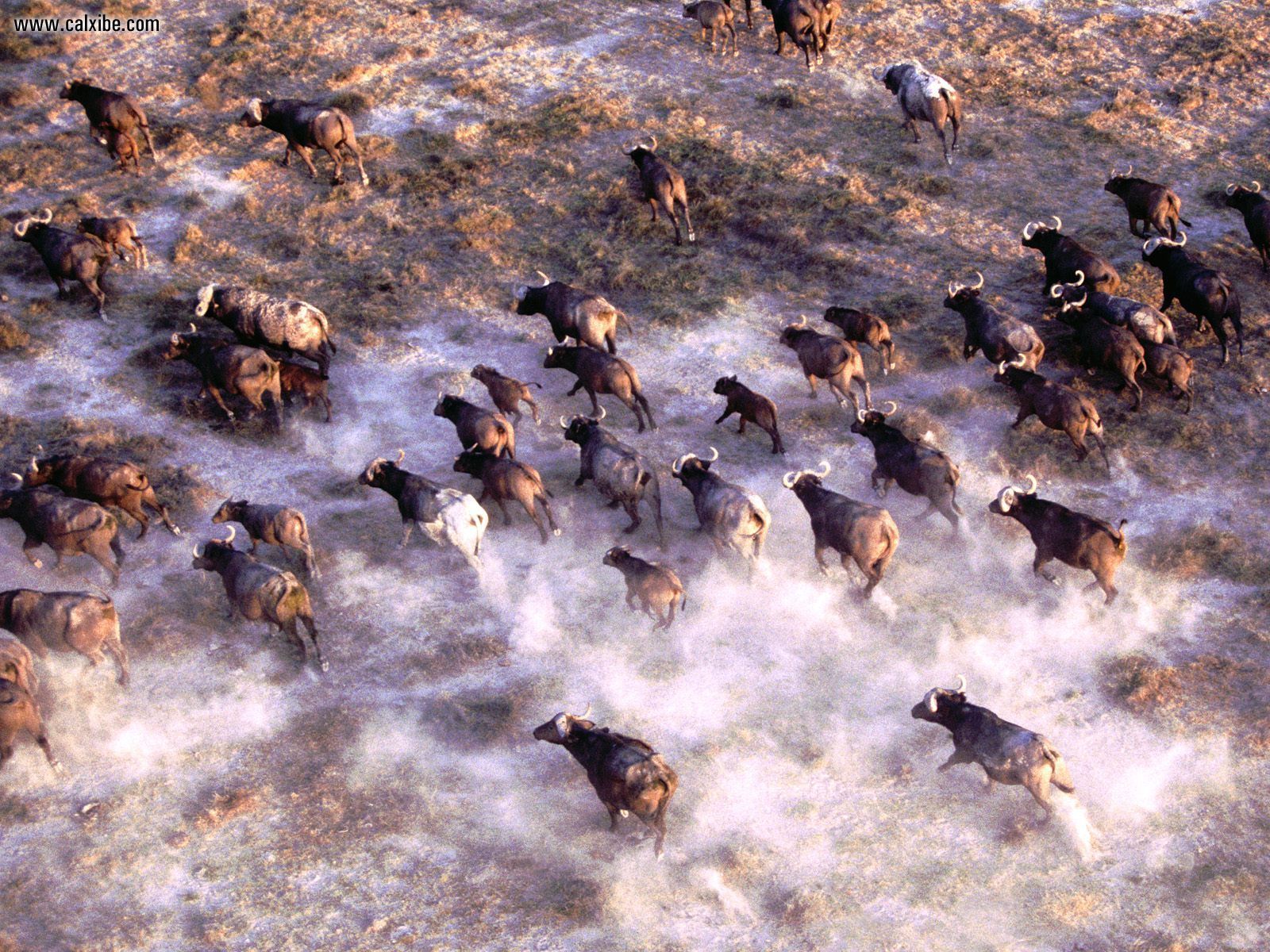
picture credit; WallpaperWeb.com

Stampede_African_Cape_Buffalo_Herd

It is an paradox that man craves freedom but loves boundaries. Astronauts report on viewing earth from space, that it appears as one planet. There are no political boundaries that we are so used to see on global maps. Boundaries are ultimately arbitrary. They serve only the tribal mentality of ‘them and us’ present in early man and persisting, almost unconsciously, to the present day.

The poet Robert Frost wrote a poem which included the line, good fences make good neighbours. This concept, at one end of the spectrum of possible combinations of freedom and enclosure, works – but only temporarily. Eventually, because of tribalism and greed, a fight breaks out.

When the British realised the rule of India by a distant Queen of England was over, they were faced with the problem of handing over a sub-continent to self rule. A problem because the Muslims and Hindus were at each others’ throats. If the British left there would be a blood bath. So they drew an arbitrary border on a map and created a new country, Pakistan. Like the creation of the Berlin walls, it divided families, created mass migration, a loss of homes and livelihoods and riots and slaughter. Tribalism, whether under religious or any other banner, is never good for all. Today India and Pakistan face each other with tolerant hostility, with a hundred nuclear missiles each, ready to wipe out each other and the rest of us. As an afterthought little Kashmir remains a flashpoint where this could happen. When you draw political maps, you had better know what you are doing for now and the next thousand years.

When the UK made the minority vote decision (only a quarter of the population voted in favour of Brexit ) to leave it’s partners in Europe, it had not considered the effects this would have on Northern Ireland and Scotland. The border in Eire was created centuries before to create a ‘non catholic’ portion of Ireland that could be controlled from England. The political reasons for it’s connection with United Kingdom are changing, and a likely consequence of the UK seeking ‘independence’ is losing Northern Ireland to the Irish and Scotland to the Scots.

Virus’s, and all the malign forces that nature unleashes on humanity; virus’s do not respect political boundaries. It takes two weeks for a virus to travel around the globe. The only way to extinguish a virus is for each person to crawl into their own cave and stay there. They may die or they may survive. In this situation one is not even aware that one’s neighbours, also potentially dying, are on the other side of the wall.

When this current Covid-19 pandemic is over, as it will be, the nations of the world should take stock. They need to seek to understand the lessons that come from such a pandemic, for virus’s are a greater problem than terrorism and extremism and wars and all our man made horrors. In 1919 the second wave of Spanish Flu killed everyone who caught it.

Surely, world leaders must learn that humanity has more to gain from co-operation and tolerance towards all living beings, whether animal or human. There are no boundaries in nature except those created by habitat and when there is enough habitat to go around, everyone is happy. When large populations move to escape political or natural upheavals, these people are ourselves coming in the other direction.

In Europe, the European Parliament and non-governmental organisations like the WHO, have failed to create a strategy to cope with immigration. Countries on the edges of Europe such as Greece and outside such as Lebanon are full to bursting point. Now Greece is shooting warning shots into the sea at immigrant boats.

In the United States, the solution to immigration from Southern American failing states, is of course ‘a wall’. As if we had not learnt from history how the Berlin wall was pulled down and how Palestine was shrunk into walls – good walls rarely make good neighbours.

Mankind craves to be free and this moment in history is a time for humans to come out of their caves and obeyance to tribal rules. Instead of hating and fighting each other, we are in a position to see the greater picture from above, where barriers do not exist. There is only humanity, and the sooner we treat the planet and each other with humanity, the sooner we will lose the feeling of being ‘fenced in’.

Agro Soap and Shampoo

What is it with Hotels? I have to admit to having a problem with them, however hard I try explain what I expect and need when booking.

A great big sleeping thing called a BED

q hotel corridor and bed

The clue is in each hotel room. Central to the arrangement of most hotel rooms is a bed and a bed is generally, for sleeping in. And there we have the crux of where I find most hotels get it wrong.

The whole notion that their guests basically just want to comatose, appears to be foreign to them. Because of this fundamental misunderstanding, much of what hotels provide becomes a waste of effort and money for all parties. People who want to sleep and or are asleep, do not require a conference suite, a swimming pool, a spa, a restaurant, a dining room, a cinema, a grand view of the city, an entertainment programme, a stage, a discotheque, wide screen television for sports coverage etc. etc.

We just want a bit of peace, a toothbrush and a razor.

Instead, you get aggravation, a piece of soap and shampoo.

The problem with so called ‘facilities’, is generated in part by the hotel star system, which awards stars not on the quietness of the hotel and politeness of its staff, but on the breadth  and extent of it’s facilities.

I can well imagine there are many families and business travellers who intend to spend days and weeks within the confines of the hotel and need these things, in which case these quests should be directed to hotels which are not focused on providing an environment for guests to sleep.

If I were head of Tourism in the United Nations International Peace on Earth Mission (if they don’t have one they should) I would categorise hotels between places of rest and unrest. I would award ‘bed’ symbols for quietness rather than ‘stars’ for what ends up being sources of disturbance.

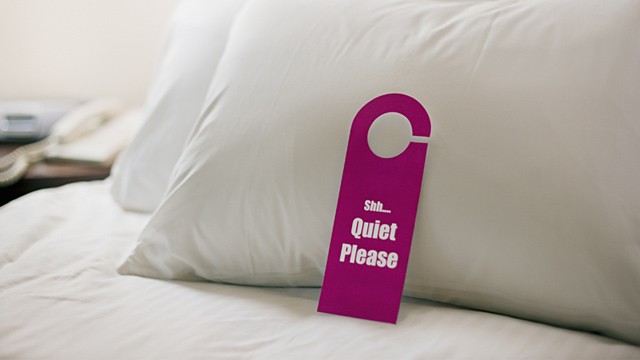
The clue that you don’t have to be Sherlock Holmes to notice

quiet-please

Perhaps it is time to give some examples of what I mean about a hotels lack of sympathy to some guest’s needs and expectations. I think back to earlier last year when I went with friends to a charming town in the Alpujarras in Southern Spain. The hotel where we stayed the night had a central courtyard around which corridors accessed private rooms. The floors and walls of the corridors were tiled which meant that every footstep reverberated ten fold depending on the quality of the steel in toe caps. Even worse, my friends in the morning complained that they had to endure a woman talking for two hours on her mobile phone in the corridor, before they could get to sleep.

Last month, I booked a hotel on line seeking quietness above all other features. After as extensive a search as possible in a holiday town full of hotels and hostals of all descriptions, I decided upon a hotel. When I arrived I discovered it faced a busy main road, a feature no included in the photographs or descriptions. Worse than that, there were only five rooms and these were directly above a restaurant and bar.

When I asked the owner for a quiet room I was told that they were all quiet and if I didn’t want to listen to the traffic I only have to close all the windows. I said I liked fresh air, just to put myself amongst a minority of guests. She informed my that no noise would come from the bar except that tonight there was a Liverpool football game on and it might get noisy.

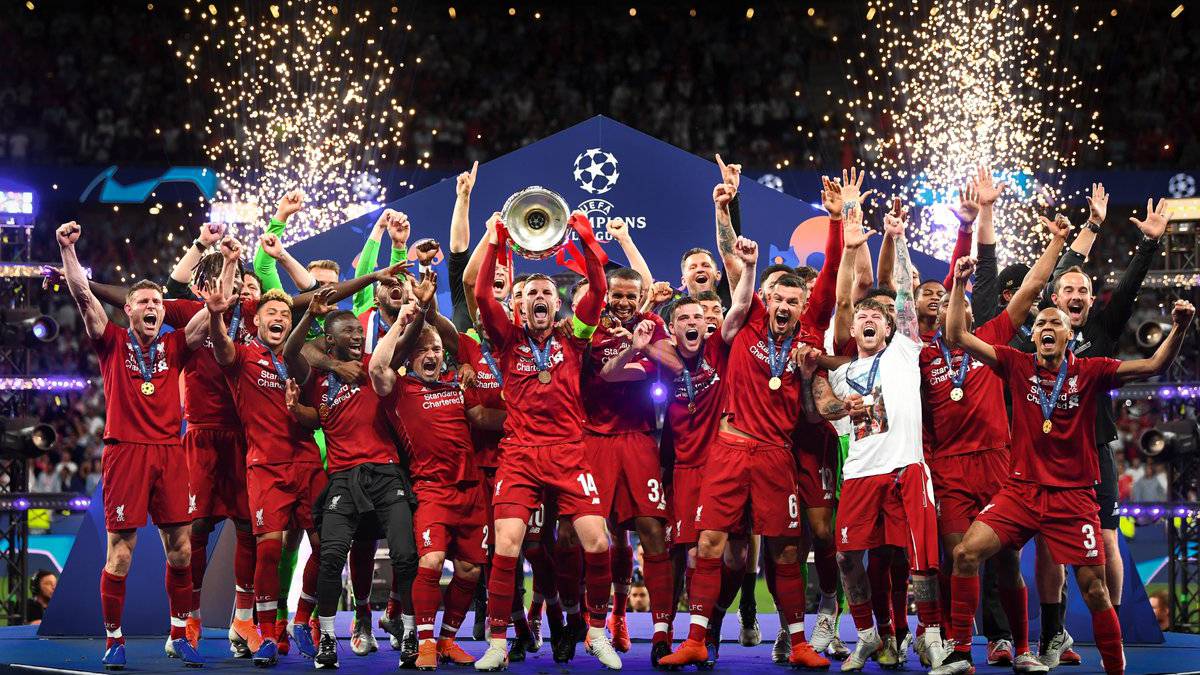
Leeeeeverpoool!

q Liverpool football

Later that evening as the game started, I wandered down to look for the source of the excitement. The door between the boisterous football fans and the corridor to the sleeping guests had been propped open, as if there was no issue at all for those in the restaurant. I had to ask the owner to close the door – which I suspected should be closed under fire regulations in any case. The owner was obliging but I had to wonder why it was necessary for me to ask. What is going on in the heads of people who rent out rooms for people to sleep in?

I abandoned this hotel as quickly as I could and appeared at another in the same town, that I had booked on line. It was the right time and day but the hotel stood adamantly closed.

I telephoned and knocked repeatedly but nothing I could do could help me. So, dragging my suitcase along the paving slabs I set off to find another. I was fortunate to find one open and rang the reception bell. I explained that I was tired and just wanted a quiet room at the back of the hotel.

The male receptionist said this was no problem and lead me key in hand, to a room at the front of the hotel overlooking the road. I was too tired to argue and eager to get an early night under the thick duvet and crisp white sheets. It was probably an hour before the problem began. Somebody started practising the piano in my room. Well, it was so loud it sounded as though they were in my room, or at least in the corridor. I peeked into the corridor expecting to see a smiling child on a piano I had not noticed earlier. Nothing. So I had to dress and bang the reception bell once more. I explained my problem of not being able to sleep. The receptionist said that it was not late in his view and that there was an apartment in the hotel. I reminded him that I had asked for a quiet room and suggested he give me another one. He quickly retorted that the hotel ( which appeared empty of guests ) was full and there was no question of having another room. He tried to compromise by promising that the piano practice would end in half an hour. Here he was giving me a clue, that he knew more about the mysterious piano than he was letting on. I suspected the apartment was occupied by his family, one of whom was learning to play the piano and had been told to practice vigilantly. I reluctantly agreed to listen to the piano for one half of an hour, returned to my room and hid under the bed clothes.

Within a few minutes there was a knock on the door. I dressed again and opened it and there was the receptionist who said that the piano would now stop in a few minutes. He had arranged this reluctantly though for he reminded me that, ‘this is Spain’, meaning that noise of all kinds is acceptable, even in hotels. I said that I knew it was Spain but that this was also a hotel where people were invited to sleep and I had never been in a hotel before where there were apartments with music practise taking place.

Sure enough, the piano quickly stopped and I was able to finally, sleep.

I have to wonder whether I am being unreasonable and have a false expectation of hotels? Am I in a minority of guests whose main priority is not to be woken to the refuse lorry collecting at two in the morning and the recycling lorry collecting at five in the morning?

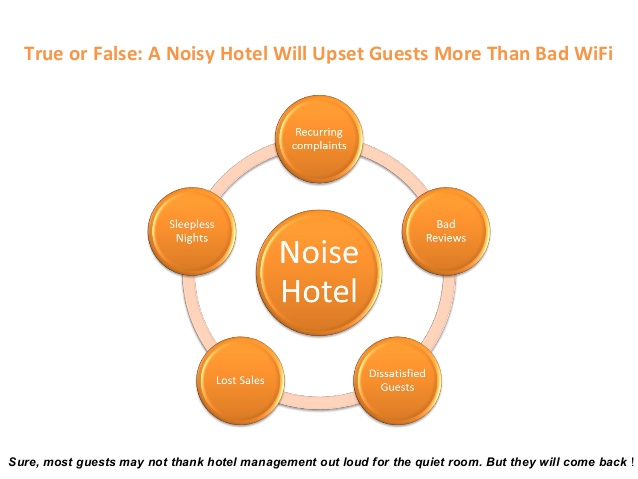
Obviously I am not alone

quiet-hotel pentagram

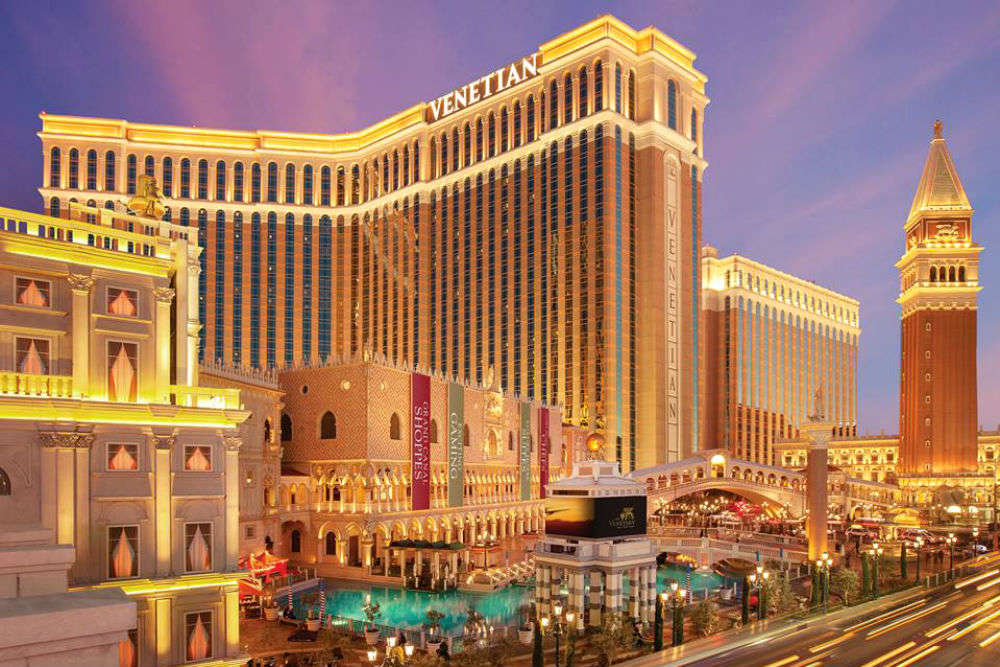
If I am, then I am willing to pay for the privilege of uninterrupted sleep at a five bed hotel. Let the party goers and sports event fans, boogey on in the hotel down the road – if for them a hotel is a mini version of Las Vegas.

A quiet night in the Venetian

q las vegas hotel

I would give those hotels one bed in my scoring system, indeed, if it provided no beds at all, I expect there are many who would not care. Think how much more money hotels could make if guests were never allowed to sleep!

Vote Me!

The day is approaching this December 2019 when the good citizens of the United Kingdom of Great Britain and Northern Ireland will have the opportunity to vote in a general election.

The outcome is being described as the most significant for a generation, so you would expect the process to be fair. Certainly, whoever wins is going to perch on the moral high ground of victory and fight off all criticism for a very long time indeed. Whether they will be entitled to be so smug, I suggest, is open to debate.

You see, I have a problem which is; how democratic is the voting system? My quandary as a voter, is that I approve of some of the policies of most of the parties. It should be explained that in the UK there is a left wing party, Labour and a right wing party, Conservative and Unionist. The middle ground is occupied by the Liberal Democrats and Greens. Other nationalist parties represent Wales and Northern Ireland and Scotland.

In the United States of America, the choice is more polarised between the Democrats and Republicans. Let us take this as an example. What if, as a US citizen, you decided that the choice was too small. Who do you vote for if you want to stop climate change but encourage industry? Who do you vote for if you want the state to pay for health care and a prosperous arms industry?

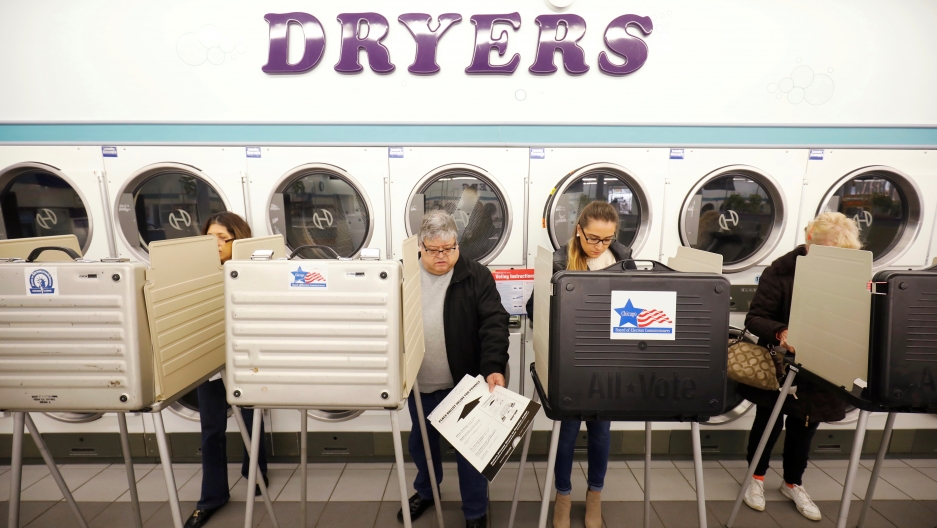
In a Spin About Voting?

Voting in Laundrymat

My point is that with polarised choices, there is no room for ambiguity that emerges from personal political perceptions and priorities. Worse still the politics of voting reduces to personality rather than policies.

Even in the UK, where the choice is greater, the democratic options are more confusing. Many voters now just spoil their ballot papers by writing ‘I don’t agree with any of this.’ They are being asked to vote for a leader they didn’t take part in selecting – unless they were the tiny minority of party members.

They might distrust all the candidates on offer and feel ambiguous about their policies.

Each party writes a manifesto prior to an election stating their political motives and means. This works to an extent but has the problem for some voters that their may be slipped in controversial motives that the voter does not want to happen. For instance, the Conservatives slipped in having a referendum on continued membership of the European Union. Suddenly it became an issue even though the majority did not think it worth consideration.

Worse still, when parties fail to win a majority in elections, coalitions have to be formed. Italy, Spain, possibly the UK next week, have this problem. Two parties may come together for the sake of forming a government at the price of compromise on their manifestos.

The public will have no choice over how these mixed manifestos will be prioritised. Which policies and method will be forgotten or ignored and which prioritised? Coalition manifestos are not published before an election if considered at all. This can lead to unrealistic expectations by voters when coalition governments are formed, as in the Liberal and Conservative Government in this decade. The direction of the ship will be decided by the Captain and officers, not the crew and certainly not the passengers.

No provisional consideration is given to coalition prior to an election as all parties have to perform the pretence that they are going to win even if it is clear to all that they will not.

The dangerous consequence of this for democracy, that occurs all too often, is that a minority party gains disproportionate power by owning the swing votes. This happened in the present Conservative government who allied with the Democratic Ulster Party and much of the muddle of mixed motives over Brexit has resulted.

In recent elections we have seen and or suspected that the over emphasis on the personality of candidates has given leverage to foreign governments and fake or real ‘whistle blowers’ and ‘news vendors’ questioning the reputations and ethical principles of candidates or even parties. Democracy as we know it is easily undermined by misinformation, view the Nazi propaganda news in 1930’s Germany, if you think this is a new phenomena.

Even the date of an election day can be manipulated to support a particular party in a manner which is clearly not in the interest of fairness. In the present UK election the Conservative government chose the day in which the students from Universities will end term and be returning home for Christmas. Informed young voters are not likely to support the Tories even though the election and it’s issues mostly affects their generation.

Young Voters in the USA Choose Not to Vote

  V I Dont Vote Badges.

Even such a consideration as ‘is it raining’ has been measured to be significant on election days. Sending people to village halls to scribble on a piece of paper has to be reviewed as the majority of citizens in the UK rarely turn out to vote. Some living abroad for over 15 years lose their right to vote.

Lone Voter

Voting Lone Voter

These then, are some of the problems for Democracy. Some people say, ‘well that’s the system we have got’ or ‘it’s the best of a bad lot’ but you have to wonder if the country that prides itself in it’s democratic systems is not kidding itself, it’s citizens and the world.

I am not suggesting that Democracy should be replaced with the pedantic and often corrupt systems of power like Communism or Autocracy. I am suggesting that with the aid of computers and the internet, a more democratic process is available to elect representatives. This is my idea.

Firstly, the party system is out. The in-fighting of politicians instead of their countries best interest, is something most voters are tired of.

Instead, all candidates will put themselves up for election as ‘Independents’. Radical, yes, but read on because they can form parties after election, not before.

They will state their personal political views by placing ten stars against a list of important areas of government. This will be shown to voters as something like this ;

Education *

Health **

Defence ***

Transport *

Law and Order **

Business and Industry *

Farming and Fisheries *

Environment    nil stars

Social Housing and Homelessness    nil stars

In this list each aspect of legislation and distribution of taxes is prioritised by the candidate, according to their own personal views. They are not under any party pressure to support policies with which they feel awkward about or strongly disagree. They can be honest; a quality in politicians which many voters express their suspicion about.

The candidate has, say, ten stars with which to indicate how which issues they prioritise and the amount of funding they would give in comparison to others.

Now here’s the clever part. Each citizen is given the chance to indicate their priorities and how strongly they feel funding should be allocated to each on their ballot papers. Instead of one cross or tick for a party – which in the twenty first century has to seen as a crude political choice – each voter has the same number of stars as the candidate.

The last piece of this process would have to be constructed from new but it’s not impossible. What I am envisaging is on-line voting from a phone, personal or public computer. In an age when personal internet banking, shopping, even gambling! – is managed with a high degree of security and reliability, it must be possible to create a secure on-line voting application.

Ten issues are listed either as broad areas for consideration or narrow ones. The voter can either ignore these as being worthy of state support ( such as health care in the USA) or indicate a need for state intervention. The strength of these feelings can be indicated by allocating some of the ten stars used to vote with.

It will be impossible to use up more than ten stars or whatever number is allocated to each citizen, but ten is an easy number for most people. Their choice can be re-adjusted until the voter is ready before selecting the ‘VOTE’ button.

For a population familiar with the internet, voting will be accessible, timely, considered, representative and accurately describing personal views.

The final phase of the voting process is for computers to match exactly the views of voters to those of independent politicians. It is already established what the views of the candidates are and matching a set number of candidates (say 300 ) to the views of the citizen public, will be doable for a computer.

The result will be a selection of representatives who will accept office and be fairly representative of public opinion. Being politicians they will almost certainly form party cliques (birds of a feather flock together) but at least the system by which they obtained power, will have been representative.

This could be a sea change for how populations choose those who represents them. With the emphasis moved to policies and issues rather than personalities and power politics, a higher level of honesty and fairness will be achieved.

We have the technology already to achieve this. We just need the thinkers to describe how it can be done – as I have just done. Vote me!