Father Noel

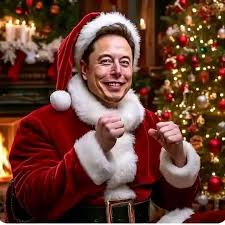
The Man in the Elon Mask

What do you associate with Christmas? A man who masquerades as someone else? A cascade of unwanted gifts? The start of a new era? Time-off to be free?

Well all of these things happen already. The man who hides a knowing smile behind a big bearded mask goes by the name of Elon Musk. He doesn’t declare any deception, but the gifts he brings us might make us question what his motives are. Is Father Noel the bringer of benign presents for the whole world? How is this even possible for one person?

We know arch deception is best done in plain view.

But if you were up to no good would you use a brand name with questionable meaning and associations – X? The ‘X’ comes from the Greek letter Chi, which is the first letter of the Greek word Christós (Ancient Greek: Χριστός, romanized: Khristós, lit. ‘anointed, covered in oil’), which became Christ in English.

So when Xmas comes you suspect Father Noel to smile contentedly to himself. He gifted his son to this world with the name ‘X Æ A-12’. What does the X branding mean? The cross is a symbol of crux i-fiction or the story that Jesus died on the X. The ‘A twelve’ he said in interview, are the twelve archangels. The AE is pronounced ‘ASH’. Is that “ashes to ashes?” Really?

The ancient Swastika purlioned by the Nazis, is still used by far right parties and is banned from public display in many countries for that reason; but it is basically an X. Broken relationships produce ex-lovers, ex-husbands and ex-wives. The films that were too disturbing to show to children used to be given an X certificate. To flee you run for the eXit. Let us face it, X is not nice. So why did Father Noel choose such a negative symbol, as did the Russians scrawl ‘Z’ on their ‘Special Operation’ fighting vehicles in Ukraine?

Imagen: Daniëlle Futselaar (artsource.nl) & IAU / CPS

A personal history of Father Noel, describing his business and political activities is available on Wikipedia. Suffice to say here that he has, and will bring, many gifts to spread around the global Christmas tree. Of particular interest is something in the realm of the angels known as Starlink and is a constellation of low earth orbit satellites. These provide internet access to previously disconnected areas of the planet, but the question has to be asked, who approved this? The USA authorities gave permission to proceed, but other world leaders were not consulted – unless or have just acquiesced in an unreported global plan. Internet access is a two edged sword, it’s darkest edge being ‘control of the masses’. Social media platforms are already known to be causing harm to the sanity of young people. Far from being a ‘fairy Godfather’ the service Starlink provides has already been switched on and off in different parts of the world for political rather than commercial reasons; it happened in Ukraine. And if the argument is that this political tool serves only the good of humanity and will not cause harm, remember the beard and friendly chuckle could be false.

Father Noel is the CEO of an extraordinary number of large, innovative companies. How can one person control so much? In politics, the President or leader of a country, delegates the matters of state to lesser politicians and civil servants.

Against the advice of his wife and in an ‘unelected’ sort of way, Noel has accepted a post in the forthcoming Trump administration. Should we seriously wonder how he can find the time? Who are his deputies and more importantly, who are his bosses? Is he a puppet hiding the machinations of a hidden Cabal set on control of the World’s population?
What were Father’s Noel’s motives for buying ‘Twitter’ at a loss of billions of dollars? Father Noel defends this vehicle for ‘free speech’ people around the globe. All are able to insult each other without risk of retribution. One is reminded of the story in the Old Testament of the ‘Tower of Babel’ where a universal language and subsequent understanding was replaced with global misunderstanding. Free speech without boundaries is, in my view, corrosive, not freedom.

Such concerns may not be spoken in mainstream media but examination of what Noel’s other companies do, all point to the removal of the freedom of the individual under the guise of doing good.

The transition from the internal combustion engine to the electric car supports the ethically ‘green’ agenda. Therefore it is good…yes? No. There are many contradictions about the benefits of electric cars which I explore in a previous blog. The main problem is that electricity from the national grid is principally from fossil fuels and nuclear power, both of which pollute the planet. Further more it is generated centrally and distributed inefficiently across national grids causing massive wastage and high prices.

Electricity is only truly ‘green’ when it is produced locally by carbon neutral sources such as solar panels, wave, wind, geo-thermal, hydro electric etc. Nicola Tesla’s ‘free universal energy’ patent might also be worth bringing out into the sunshine. The inventor of alternating current and many other innovative technologies, deserves naming a company after him producing free energy.

In my view, the closeted reason for electric vehicle production is that driver-less cars have to be powered by electricity. Cynically, we can already see that such electric cars are expensive and limited in number. When there are only electric cars allowed, they will have to be shared in ‘car pools’. Infringement of any national law will result in the removal of a citizen’s access to the government controlled car pools. The individual freedom of ownership and choice of where and when to travel, will be taken away.

Mechanised personal transport began in the early 20th century, mainly for the rich and privileged. It was never an option for the working classes. Now, once again, people are not buying electric cars because they cannot afford them. No Tesla X for you this Christmas!

But Father Noel has worse ‘freedom busting’ surprises in his sack.

Neuralink is described in Wikipedia as; ‘Neuralink aims to integrate the human brain with artificial intelligence (AI) by creating devices that are embedded in the brain. Such technology could enhance memory or allow the devices to communicate with software.’

Just as electric cars are presented as a noble way to ‘save the environment’, so too are brain implants presented as a noble way to overcome neural diseases. This repeated ‘cover story’ or being solely for the public good, should make us look for the problem it really intends to solve.

picture credit: Pinterest

Neuralink should have our frontal corteX’s shivering with apprehension.

Throughout history, personal thoughts have been the last bastion of individual freedom and until now, could never be interfered with or removed. Historically, prisoners in appalling conditions for what ever reason, clung onto their sanity by remaining in charge of their minds, their emotions and in some cases, their religious faith. Whatever kept them free kept them alive.

Father Noel is on record warning that Artificial Intelligence requires strict global control otherwise it will replace humans. As there is no such global co-ordination to erase this problem and it is unlikely ever to be so, the AI genii is already out of the elegant gift box.

At least Father Noel’s lawyers can say that he did warn us.
Artificial Intelligence in robots and our cell phones, is already learning to do things better than humans and scarily well. The origins of digital images, sounds or thoughts can no longer be trusted. AI is already taking over human employment and might ultimately lead to humans dependent on government handouts or ‘universal basic income’. If that happens, personal freedom will be severely dependent on governments and the elites. No play, no pay.

Will the rule of global law be enforced by robots? As much as this question sounds like science fiction, Hollywood has already shown us robot versus human wars.

The Matrix Trilogy builds up to an epic battle between robots and humans, as does brilliantly I Robot, starring Will Smith. But the most chilling of all horrors has to be the original Blade Runner starring Harrison Ford. In a dystopian future, rogue robots have merged with human society for evil purposes and the Blade Runners have to hunt and destroy them. The ending has an unexpected twist. The ‘replicant’ robots become so advanced that they have developed sophisticated emotional intelligence. One female robot learns to love and the protagonist robot shows compassion to Ford’s character and commit suicide rather than kill him.

The question we have to ask ourselves is, how far away is all of this and what can we do to avoid it coming true? Brain implants, driver-less cars and humanoid robots that kill humans are already real.

Democracy rarely questions technological ‘progress’. Innovation is has an impetus of it’s own. It’s a form of ‘soft war’ and we have to ask, ‘against whom?’

Whilst Father Noel is not completely responsible for these developments as other companies and countries are working towards similar objectives, X is and will continue to be a world leader. Like the fabled ‘snake oil’ salesman, what we are being offered is just a bottle containing a liquid which gives little or no benefit.

The salesman tricks us all by offering a noble universal cure to problems; especially problems we did not know existed. We hand over our dollars willingly and as we do, our freedom.

And to remind you of the meaning of X; The ‘X’ comes from the Greek letter Chi, which is the first letter of the Greek word Christós meaning; ‘anointed, covered in oil’.

‘A Merry Christmas to us all; God bless us, everyone!’

Go Electric!

To go or not to go.

When I was in my first year at University I used to have debates with my parents about the harm made by internal combustion engines. Their reply was that if I did not approve of cars why do I ride in them? The answer was of course that at that time there was no alternative; unless you lived in cities. In London I rode my bicycle with a sign on the back saying ‘no noise, no fumes’ for a decade.

Fifty years later I have won my argument. London has introduced ‘low emission zones’ having recognised that the air pollution from vehicles is harmful to the health of it’s inhabitants.

When I retired in Spain I bought a Spanish made electric bicycle. At first it was great but after five years the battery had lost so much of it’s capacity to fully charge that I had to buy a new one. This cost me about a third of what I had paid for the bicycle. Then the computer had a problem and no e-bike specialist knew how to fix it and the BH factory was closed because of the pandemic. When the motor broke I took my bike down to the recycling centre and said goodbye to it. Never has a bicycle caused me so many problems.

Interestingly, many e-car owners are going through the same experience, only worse. They have invested considerably more money in an e-car than the cost of a bicycle and their anxieties must be proportionately larger.

Properganda or Proper Policy?

I will not list all the of the problems they face but here are a few;

*Recharging the batteries; those without a private drive will find it hard or impossible to charge in the street. Already pavements in cities have electric cables running across the pavement from homes to e-cars overnight.

*Recharging is expensive; unless you are recharging at home using your own photo voltaic panels, you will pay for your electricity.

*Mains electricity at home is not green electricity. In Spain mine is mainly produced by nuclear and gas fired power stations. Only 5% of my electricity is from renewable sources.

*Electricity sent to users via a national grid is highly inefficient, losing about 80% of the energy from the original source. Local power production will one day replace this but not yet.

*Electric cars are cheaper to maintain than internal combustion cars but there is not yet the infrastructure and technicians in place to repair broken e-cars.

*Electric cars are heavy and need expensive tyres.

*Electric car tyres put out more particulate matter into the air than diesel cars produce from their exhaust.

*Electric cars are heavy and some multi-storey car parks and car ferries may have to be redesigned.

*Lythium ion batteries have a risk of spontaneously combusting.

*Drivers of electric cars experience ‘distance anxiety’. For longer trips they will have to stop and find a charging point. While these are being increased in number, there is no strategic control over the number of these points and customer demand. Waiting for a recharge is not satisfactory for people in a hurry.

*If there is a traffic jam for any reason, e-car users could find themselves running out of electricity and being powerless (literally) to do anything about it. Apart from planned road closures and random accidents, extreme weather such as freezing blizzards can stop the traffic and cause deaths. Keeping the lights and heater on is not an option for e-car users.

*As one third of a cars energy consumption in it’s lifetime is consumed in it’s production. It makes sense therefore to make cars that last a long time. A diesel engine can do a million miles as often London taxis do before some are sent off to California for an overhaul and new life. The lifetime of new e-cars is unknown but certainly the batteries will the first to be replaced and that raises the question of where new rare earth materials are going to ethically sourced from…the moon?

At present, many e-car users are in the ‘honey-moon’ phase of ownership but already some are questioning whether their choice was really such a good one.

Car producers are also going through the same questioning process. Major companies such as Ford, General Motors, Apple and Volkswagen are applying the brakes.

It is without question that personal transport (outside of cities) is not going to go away. We love our cars and the convenience, privacy and comfort they provide. With the approach of the era of the self drive cars, users will be able to sit back and enjoy the ride…until a pesky teenager deliberately steps out in front of the car (just for a laugh) and forces an emergency stop…or a car jacker on a lonely road at night! Making moral decisions based on appearance of those stopping cars, is still over the horizon for AI. Does it recognise a police officer in uniform?

And then if you are used to driving over the speed limit (as most drivers are except when they approach a clearly signed speed enforcement camera) then you will find your journey times extended as your AI dutifully follows the traffic laws.

In the meantime drivers are left with the internal combustion engine. There are stories of some drivers who bought e-cars dusting off their old diesels and selling the Tesla.

Toyota appear to be the most ‘customer need’ focused car production company and have asked themselves the question; ‘how can we make the internal combustion engine green?’

Toyota Hydrogen Car

One answer is to use hydrogen as a combustible gas using electrolysis to split water into hydrogen and oxygen. I remember watching this being done on a science television programme back in the 1970’s and thinking then – ‘that is the future’. I was not wrong.

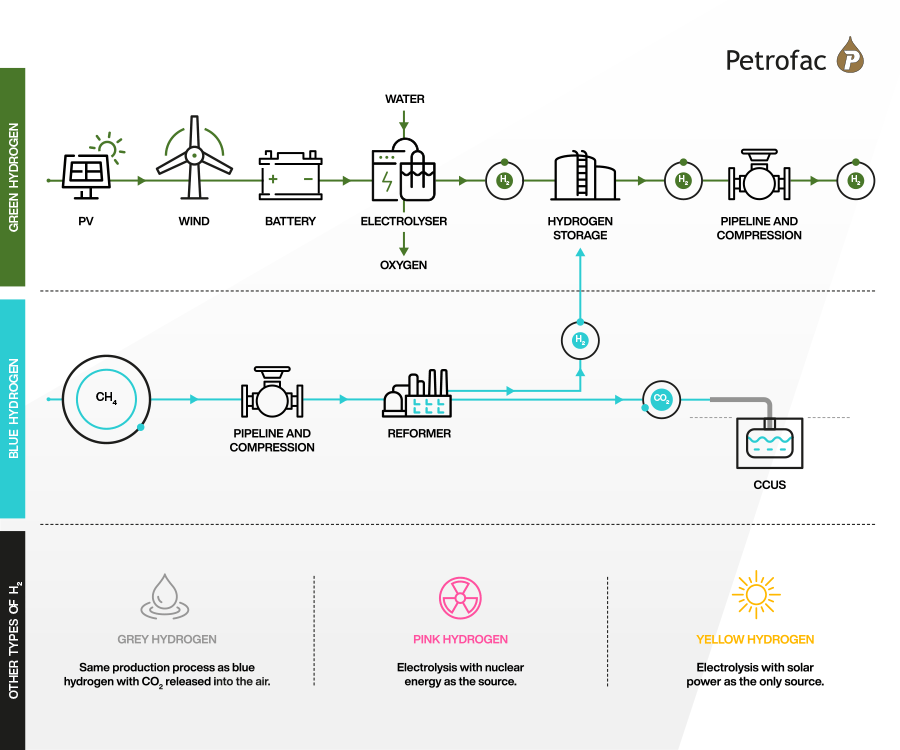
There are nuances regarding how ‘green’ hydrogen production is and the infographic below describes this.

There is another alternative fuel which is ammonia. This is a main component of many fertilisers and is a chemical made of hydrogen and nitrogen (NH3). It can be burnt in a combustion engine as a zero carbon fuel.

This essay has focused on electric cars but clearly heavy transport by train, ship and goods vehicles are substantial polluters are the moment. Hydrogen has always been a preferred route for the development of engines of the future for moving heavy goods around the world.

Science tends to have a momentum of it’s own. New inventions often take the lead in how society uses them and evolves. This new ‘green transport’ debate, raises the questions of how much the government provides subsidies for new enterprises and how important planet sustainability is believed to be by various governments around the world.

If these decisions are devolved to industry leaders it is likely that little will be done as we have observed over the last five decades or so, when ‘global warming’ was first highlighted as an issue. Politicians such as Margaret Thatcher took a very forward looking view as to the health of the planet and the effect of unrestrained industrial production and consumption. Private enterprise so far has followed the policy of ripping the planet apart. Only now is this policy biting back.

Perhaps today, it is down to the individual to vote with their feet. Move into a city, use public transport or a bicycle. Or move to the countryside and fit photo voltaic cells and solar water heaters to your house. Or just do nothing.

It depends how important breathing is to you.

Is AI Conscious and Breathing?

May your spirit live,

Last for millions of years,

You who love Thebes, sitting

with the face to the north wind,

The eyes full of happiness.

from Tut-Ankh-Amun’s Alabaster Glass 1336-1327 BCE

Artificial Intelligence is something this and future generations are going to have to manage. But is intelligence the same as consciousness and if not, what’s the difference?

Anyone who has seen the body of a person who has died, will be aware of the extraordinary change in appearance of the person after consciousness leaves a body. It’s not something that can be described but similarities in nature when an animal dies, gives an impression.

Our problem is that consciousness remains hard for scientists and humanists to measure and describe. There are no instruments and ideas that enable measurements of consciousness to be made, except the ‘on / off ‘ switch.

The only area of human intelligence that approaches this problem in depth, is perhaps spirituality. Being spiritually aware is different to religions, where invisible gods and Gods have to be accepted as a matter of ‘faith’. Not much progress can be made beyond this dogmatic belief. But with spirituality there is a chance of increasing understanding of what is happening when we are ‘awake’ or ‘conscious’. In particular, how this might affect us in the future, if machines also become ‘conscious’?

Nothing is new in this world according to King Solomon, so let us consider how gods and God related to humans in the past. In the ancient Greek and Roman worship, statues of gods were of central importance. The statue of the goddess Athena in the Parthenon for instance, was built so that the spirit that is Athena could enter our physical reality.

“Athena” picture credit: Greek City Times

Spirits are disadvantaged in the physical world because they cannot be ‘anchored’. Human spirits, ergo consciousness, need an organic body to enter in order to be born and interact with physicality using the sense organs of the body. Goddesses such as Athena cannot do that but they can enter a static representation of their form. Roman citizens would have a shrine in one corner of a room where prayers could be offered to minor gods with whom that family has a connection. Moses was enraged by the Israelites who built a golden calf to worship, from which we can deduce that the Taurean statue was real and powerful.

To untangle these confusing ideas we need to try to understand ourselves. From a mystics point of view, consciousness has three levels. The normal human experience is simply being in the physical world in the way that a fish swims through the ocean. The first level beyond this perceptual awareness is becoming conscious as an objective observer. Using the fish analogy, the fish becomes aware of the water.

At the next level the objective observer becomes detached from the experiential phenomena and is aware of thoughts / spirit entities which are not oneself. This an extraordinary concept at first but actually every ‘ghost story’ is merely a description of such a change in consciousness by the observer; albeit momentary in most cases.

The third level is to study and gain an understanding of the thoughts / spirits that occupy those universes / dimensions, beyond and parallel to this physical one. There are many types and these are how the individual characteristics of the gods and goddesses of early pantheon’s came to be understood. Even across cultures, there stand out similarities in the characters of, for instance, Zeus in ancient Greece. With his mountain top palace and plentiful supply of thunder bolts, he was also known as Jupiter to the Romans and Thor in the Norse pantheon.

Modern psychiatrists would describe experiencing consciousness outside of oneself as ‘psychosis’ or ‘madness’, so there is a glass ceiling in this present culture that few pass through.

That way madness lies.

Madness in sentient beings maybe taboo but technology has no such boundaries. Technology can go as far into the abyss as it likes and so the atom bomb was built. Less obviously malevalent are those technologies that bring great benefits, hiding the harm humans can make them cause. An example is modern computers for which there appear to be no limits.

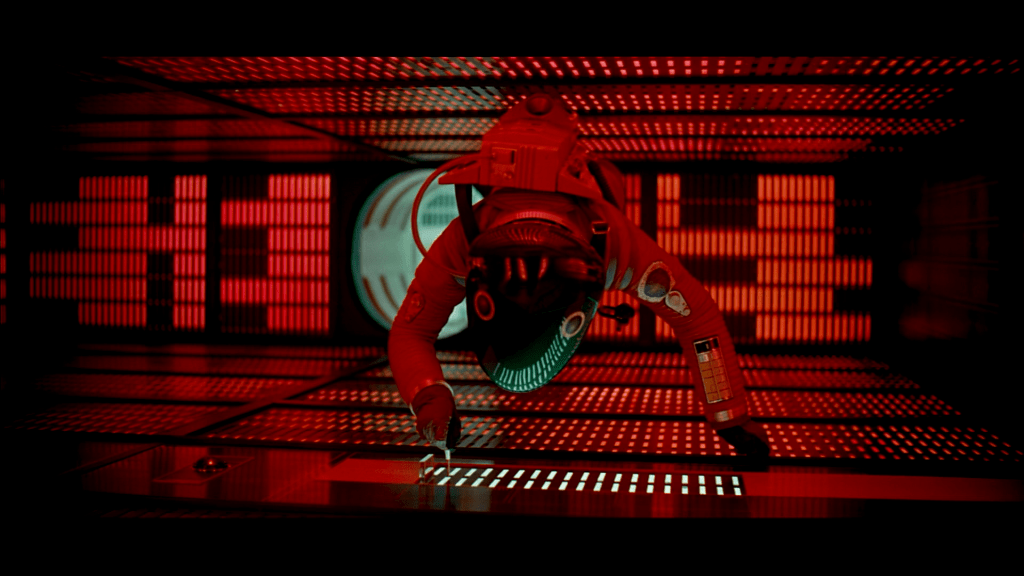
The early computers awakened some ethical thinkers which have fed the imaginations of early science fiction writers. For example, the film ‘2001 Space Odyssey’ explores the horror of a computer named ‘Hal’, taking over from and eliminating, the crew of it’s space ship. Giving a human name to a computer is significant, because it imagines the idea of a computer becoming conscious before does so. We do the same with our pet animals.

Shutting down ‘Hal’ the not-so-friendly and not so-small computer in 2001 Space Odyssey

Unlike in the film, powerful computers are now small enough to be placed into humanoid robots. Worryingly we have turned full circle from the static, stiff representations of the ‘gods’ or ‘spirit’ or ‘thought’ of the ancients and created agile and intelligent robots. These human shaped machines are far more appealing for spirit entities to get inside and take over. Genies are being squeezed back inside the lamp as in the ‘1001 Arabian Nights‘ stories.

‘Be careful what you wish for’ picture credit Arthur Rackham

Science fiction writers such as Isaac Asimov, thought through the ethics of conscious computers and produced three rules;

The first law is that a robot shall not harm a human, or by inaction allow a human to come to harm. The second law is that a robot shall obey any instruction given to it by a human, and the third law is that a robot shall avoid actions or situations that could cause it to come to harm itself.

It is simple for a computer to be intelligent. They can be programmed to beat human chess masters simply because they think through permutations quicker than humans. So ‘artificial intelligence’ is no more than a fast thinking human. It that is not ‘artificial consciousness’.

Isaac Asimov could see that humanoid robots with artificial brains might become conscious. He may not have understood the spiritual process described above, but he did see the possibility and he was right to jump this far ahead in time and possibility. He could see that conscious robots could miraculously (or sinisterly ) adopt ‘free will’ just like humans and this would enable ignore their ethical programming.

Humanoid Robots in ‘I Robot’
picture credit: Film Blitz

The ’cause no harm to humans’ ethic, was also built into the humanoid robots that feature in the science fiction film ‘I Robot‘ starring Will Smith. This film again explores the consequences of intelligent robots overriding their programming. In this case it was made by a ‘mad scientist’ but in reality it could just as easily happen by an evolutionary accident, the way that nature itself ‘steps up’ the functionality of creation. At one time there were no flowers on plants, then suddenly, millions of years ago, they arrived.

All things bright and beautiful, all creatures great and small,

All things wise and wonderful, the lord God made them all.

It is important to understand that humans do not create consciousness. Rather it is alsways present within each individual and it’s influence operates through this tiny flame. Mystics for centuries have known that consciousness is not the ‘me’ within.

~~“The truth was a mirror in the hands of God. It fell, and broke into pieces. Everybody took a piece of it, and they looked at it and thought they had the truth.” Jallal-a-din Rumi Sufi mystic and poet.

It is not our personality ‘egos’ which are works of fiction. The only reality is the consciousness we share with all creatures great and small. This includes all of nature from the rocks to the clouds, as recorded by indigenous peoples such as the native Americans and Australians.

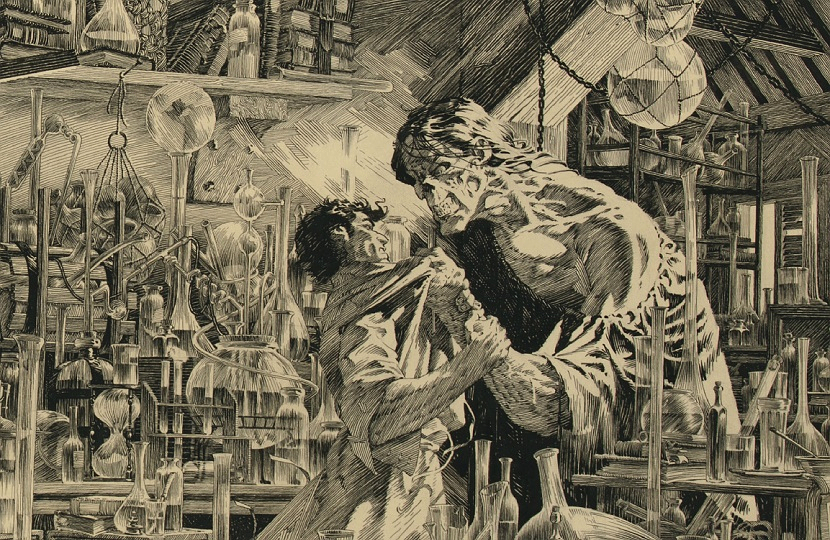
Consciousness is particularly attracted to humanoid forms and this was fearfully reconstructed in the story of Dr. Frankenstein monster by Mary Shelley in 1818.

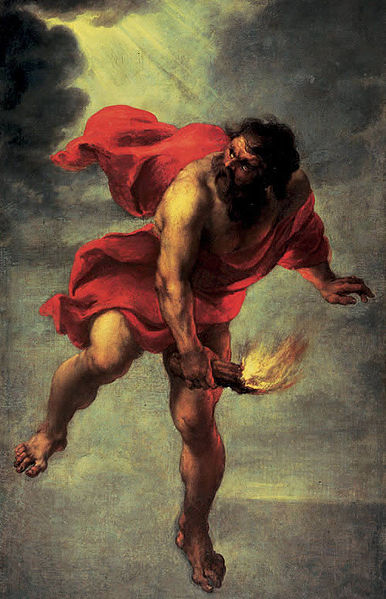
Prophetic writers such as Shelley were only able to imagine what advanced technology could do, as did the ancient writers of the Prometheus myth; the man who stole from the gods at the price of eternal punishment.

Only now are we crossing the red lines that have previously prevented this technology; the sort of knowledge that can make agile humanoid forms carry weapons and mass kill humans in a modern form of eternal punishment.

Stephen Hawkins Picture Credit: US Sun

If we believe there is even a fraction of a chance that such robots may decide to override the ‘protect humans’ instruction, then should we not be concerned in the highest degree?

The high priests of the modern era are no longer the prophets and saints of old; contained within a system of high morals and ethics. Instead our worship is lead by those who invent and explore technology, such as Elon Musk, Bill Gates and Mark Zuckerberg. They are not judged by their good characters and good intentions as historical leaders of humanity usually were.

These technology wizards, have become all powerful because they have become immensely wealthy. Their characters must be judged on their actions and words. Elon Musk has recently expressed his concern about where Artificial Intelligence training is leading mankind and has called for a global moratorium to consider it’s effects.

Key figures in artificial intelligence want training of powerful AI systems to be suspended amid fears of a threat to humanity. They have signed an open letter warning of potential risks, and say the race to develop AI systems is out of control.

source BBC.com Mar 30, 2023

The question we all should be asking is;

‘Robot, do you feel lucky?’

“AI You Can Drive My Car”

(with apologies to Simon and Garfunkel)

There is a revolution happening spearheaded by self-driving electric cars but have the majority of people considered the destination? In the UK there is a target to only sell electric vehicles in car showrooms by 2030. The government’s stated aim is to reduce carbon emissions into the atmosphere and thereby the risk of climate change and global warming. But is stopping killing the planet really their main concern or is there another plan? After all, there have been decades to save the lungs of the world; the Amazon rainforest…

I recently applied for a quotation for a household electricity supply from photovoltaic cells. One of the questions I was asked was, ‘are you going to have an electric car in the future?’ to which I replied ‘no’; which surprised me. I didn’t know I thought that, so I have spent some time to find out why.

I am certainly not convinced by ‘hybrid cars’. Hybrids are by definition, neither likely to be good at one thing or another. I have heard of companies who bought fleets of hybrid cars and then discovered their employees ran them solely on the petrol engines.

We know that one third of the energy a car uses in it’s lifetime, is in it’s construction. This means that converting to electric motors will only ever have an effect on reducing the other two thirds of the energy the car will consume in it’s life. And when electric cars stop for a recharge, how much of the electricity they use has been created without carbon emissions?

A fifty year guarantee and free disposal, would be an interesting strategy for car makers. Owners of ten year old cars in Spain, were written to by the police suggesting that they scrap the car and get a newer ‘more efficient’ model. Demonising petrol and now diesel cars has been government policy in many countries and yet driving more slowly to save fuel and carbon emissions has not.

For instance, when one drives on most European roads at the maximum legal speed you will acquire a line of vehicles behind you waiting to overtake. This despite the increasing costs of fuel and the protests of drivers protesting that they cannot afford it. Perhaps they do not realise that cars travelling substantially over 60mph are consuming up to third more fuel. In the United States of America there a maximum legal speed on highways of 55mph to preserve fuel and increase safety.

There are many options for greener personal transport. This may include driving at reduced speeds, retro fitting emission filters, regular testing and maintenance. My fifteen year old 2.2 litre diesel estate gives me 65mpg. This is better than many ‘state of the art’ hybrid cars. There are diesel engined black cabs built by the London Taxi Company, that have completed one million miles.

It is possible to retro-fit carbon less engines into pre-used cars as a greener option to producing new cars. It’s not something economists will support as making cars makes money, but the pressing immediate need is for reducing global carbon emissions, a direction only governments and the COP meetings have the power to steer our future towards.

The Charge of the Electric Cars

Let us examine the EV (electric vehicle) options currently available and there relative pros and cons.

The first point is that all these vehicles have tyres made of rubber and rubber polymers. These tyres obviously wear out at the same rate as all other tyres. They produce more airborne particulate matter (PM) than either diesel or petrol powered cars according to academic experts on air pollution. We should consider reducing the harmful effects of cars on clean air as well as a cause of climate change. Respiratory problems such as asthma are becoming more common in children in western countries.

Even the plastic used in the construction of a car is a considerable consumer of oil based polymers and not necessarily designed with longevity and ease of re-cycling as benefits in the list of the car’s worth.

When considering emissions we should also note that electricity supplied in national grids is only partly produced by renewable sources (including nuclear) Electricity is still produced by fossil fuel burning power stations. This will gradually improve but the vital question is ‘how quickly?’ The sanctions introduced by both sides in Russian War against Ukraine, is halting the move to stop using fossil fuelled power stations and even more are being built.

Thinking of the causes and effects of this war we should consider rare earth minerals. Ukraine has a significant proportion of these in Europe and China has the greater part of the world’s. The need to set up factories making batteries for EV’s is inevitably contributing to the political uncertainty in the region. After all history shows us that the shortage of resources is one of the most common causes of war.

There are low carbon using and emitting vehicles other than EV’s. Hydrogen fuel cells are a source currently being developed for lorries and trains ( but not domestic cars ) and perhaps this will change in the future.

Compressed gas slowly released into the cylinders of internal combustion engines is a little known option. Buses and taxis in inner cities are ideally suited to this form of power as the emissions from vehicles are just clean air. With local renewable electricity generation powering the pumps that compress the gas, the costs and harmful effects of public transport vehicles could be significantly reduced.

Certainly, all governments need to look more closely at generating electricity locally using photovoltaic (PV) cells. There are existing schemes and proposals which cover such large ‘neutral use’ areas such as car parks, canals, roads and railways with PV cells. Car parks in hot countries require shade as do house roofs and local generation on a large scale could potentially replace the ‘national grid’ concept which is inefficient and subject to damage by storms and strategic security issues.

Also, national grids require sub-stations to reduce the high voltages for domestic use, and lose substantial amounts of electricity during transmission.

Wherever the electricity comes from, it will eventually connect with your electric car at a re-charging point. There are presently two ways to do this. The most practical is in a private garage or driveway at home. Here charging can take place overnight at lower tariffs and ensuring a full charge for the next day. With a range of say, 300 miles per charge, this is the most economic and convenient way to use an EV daily. It can even temporarily power the house in the case of power cuts!

Unfortunately, the majority of householders do not have private parking and private charging. People who live in cities, often have problems parking near to their homes, before even considering parking at a re-charging point. It has been suggested that lamp post might be able to perform this function. However successful a solution is found, the electrical consumption (thousands of watts per vehicle) by used cars overnight, is a demand for which the supply infrastructure is not designed.

Once another tangent. can we expect governments to absorb the loss of tax revenue as fossil fuels become fossils themselves? It seems unlikely and national bureaucrats will refocus their tax collecting efforts to other means, such as taxation by road tolls, replacement tyres and car purchase.

We should always factor in revolutionary and new technology. It is likely that battery technology will produce smaller batteries that charge instantly and require no rare earth minerals; such as ‘capacitor batteries’ that already exist. Or perhaps fuel cells or similar green technologies will take over? What is regrettable is that it has taken this long for battery technology to improve exponentially instead of in small steps. This remembering that electric cars preceded the internal combustion engine and declined as the first choice of motive power at the same time that oil fields were being discovered in California.

Open Your Mouth and Say ‘AI’

(picture credit BBC News)

We live at a similar cross roads today to the car designers of the nineteenth century. Today it is not so much in material but computer technology leading the way forward. The self drive or robot driven vehicle is slowly metaphorically nudging itself onto the highway out of the acceleration lane. Electric vehicles and self drive technology are a marriage made in the AI equivalent to heaven. We can expect the price of such vehicles to decline rapidly as production is switched from heavy ‘gas guzzler’ to lightweight ‘data driver’. We will be sold self drive cars using the golden words and phrases such as ‘safer’, ‘quieter’, ‘cleaner’, ‘cheaper’, ‘easy maintenance’. Gold lame suited sales personnel will persuade you how almost impossible the self drive car will be to steal and or be used in crime by car thieves. ‘Even you husband will not be able to take it madam!’

The dreaded speeding ticket will be a thing of the past. No one will be going anywhere fast; not unless robot drivers are programmed to leap from their vehicles and fight out disputes with laser guns. Could be fun to watch?

And the price of this revolution is; well, most people accept loss of privacy because they reason that they are not criminals and have nothing to hide. This is indeed true, however AI technology is not really for our generation. It is for our children and our children’s children who may well find themselves governed by criminal governments. Such a suggestion may shock the reader but reflect on the fact that there are governments in over half of the world today who are authoritarian. In other words, the lunatics have taken over the asylum. Much of what they do violates the human right to privacy, family life, fair trial etc. and so called ‘free countries’ are powerless to interfere in the rights of completely bonkers sovereign states to abuse completely sane citizens, in extremis.

For the People’s Republic of China the pandemic panic enabled finding out exactly how far compliant populations can be pressed to submit to severe restrictions in freedom and more sinisterly, how to control those who resist and ultimately rebel.

Now look into the future and imagine your gleaming self drive car parked at the front of your house. Yours partly that is as you probably won’t own it. It will be shared because your government tells you there are not enough resources in the world to make and operate cars for everybody. You don’t mind as you like ‘helping others and the planet’ – the latest government windscreen hologram to appear with your annual mechanical test.

As you place your palm on the car window the door magically slides open. You sit down and watch your favourite magazine programme whilst the car’s computer drives you to the government approved shopping centre. The cost of this journey will be instantly deducted from your phone as you step out of the car. You watch it drive away, safe in the knowledge you have booked for it to return to collect you, at it’s convenience, not yours.

When you paid in advance you also agree to download the latest ‘safety’ patches to make you car work more ‘efficiently’ – in other words to avoid problems from recent traffic collisions caused by hackers. Your magazine subscription will appear on the bill too, as will the subscription to use the car heater in the coming months, and the subscription to use the ‘economy’ settings in the car’s computer. You are trying to save money as the running costs are mounting up but , you reason, all these ‘subscriptions’ were previously just part of owning a car. Who would have thought?

Heaven forbid you criticise these subscriptions on social media and AI picks you out up as ‘anti-government’. For the next time you hail ‘your car’ it will refuse to obey your commands such as ‘let me out!’ You will be told that some ‘correction time’ is required. ‘Proceed to the nearest GECC (Government Education and Correction Centre)’ will be your only option to select on the onboard computer screen.

This collection of absurd and completely fictitious scenarios is written purely ‘for entertainment purposes only’ and ‘bears no resemblance to any future use of artificial intelligence by government or proxy government agencies’.

However, it is obvious that governments around the world today are already using the coercive control enabled by AI in such programmes as high quality data gathering and biometric / facial recognition in particular. Why would the Metaverse pay 19 billion dollars for Watts app? Why did Elon buy Twitter?

If populations embrace the new AI lead technologies in everything from cars to toothbrushes without question; citizen’s freedoms will find their place in the city land fill, beside the rusting pile of internal combustion engines.

Happy motoring!

You Will Own Nothing and You Will Be Happy

Quotation from ;The Great Reset by 2030 – World Economic Forum

What do the bad guys usually want? From the Blofeld’s and Goldfingers of our imaginations to the Alexander the Greats and Caesars, we might think the answer is, ‘world domination’.

In our present era, there is indeed smoke in the air warning us of a world conflagration. The word ‘global’ is something we are accustomed to hearing; in a way that would not have been, say one hundred years ago.

Since then, we have had round the world flights and sailing navigation’s and of course two world wars. Now we are told of a global climate emergency. Global is the new National.

Sadly, for we had to wait until the sea was lapping at our toes and the wind spinning away our hats before taking responsibility – if that was achieved at the recent COP 26 in Glasgow. Those living near the sea may be wise to go out and buy aqualungs.

picture credit Bulletin of the Atomic Scientists

Concurrently we have yet another global emergency called the ‘pandemic’. This could also have been better prepared for, as humanity has been fighting virus’s for it’s entire history and has never been so well armed to respond as we are today; even if the common cold has escaped elimination.

And then there is China, and the Chinese Communist Party. When I studied China in school fifty years ago, the Chinese people went around on flocks bicycles and ‘stuff’ was made in Hong Kong. Now the Chinese are the center of the world’s commerce and principle producer of goods. This is driven by low wages, long hours ( ‘search engine ‘ the numbers 669) and economical (though global climate harming ) global traffic and trade. Most Pacific rim nations view the highly capable Chinese military as their principle threat and many human rights organisations lay numerous allegations of inhumanity, at the door of the Chinese leaders.

First Chinese bicycles. Historical artwork of people riding bicycles in Shanghai, China, in 1900. Taken from: Histoire de la Locomation Terrestre, published in Paris in 1936. Credit Science Photo Library

Is all this global Covid, Climate and China just chance or should we be suspecting ‘foul play’ on a scale never conceived of before?

If humanity feels it is being forced into a corner with basic freedoms being taken away, why is this and who is doing it?

In my view the ‘giant at the top of the bean stalk’ is technology. No one ever voted for new technology. A few scientists have had second thoughts on realising how destructive their discoveries are e.g. the A-bomb…but most inventions, like the washing machine, set us free.

For the freedom loving democracies, life, in my view, is about to become a whole lot less free. To understand the means to this end one must only look at China and how it uses technology to control in fine detail, the lives of it’s citizens. CCTV cameras produce images with names and numbers floating above each face in the supermarket or airport concourse. Money as cash has long gone as it cannot be traced. Instead citizens wave their phones at tills in shops and the transaction goes straight to CCP headquarters…just in case they might need it.

picture credit : My London

By the time it reaches Europe and the USA I predict mobile phones will enable our governments to more or less monitor and control our lives. Everything you are and do will go to a special sealed circuit board in your phone. It will be called your ‘Freedom Pass’. Sounds okay doesn’t it, but read on. Interestingly Elon Musk has other plans to insert this techology directly into your brain, something that may be used instead of or as well as mobile phones. Both will of course be presented as benefits to the individual.

‘Everything you are’ means your personal details and bio metrics, consumer profile, money and possessions, travel, education, health and politics.

‘Everything you do’ means your work and leisure, credit and tax records, work skills and placement, travel credits, health status, voting credits.

The first of these should not surprise us as this is what computers do and have been doing since the 1990’s. What we haven’t reached yet is the experience of having our money and assets frozen because we voted for the wrong party ( oh yes, you will use your phone to vote ) or our self drive car restricted to no further than a five mile radius, (known as a withdrawal of travel credits ) because we put up a post on social media criticising the government.

Cleverly your ‘Freedom Pass’ will measure your ‘credits’ not take your ‘freedom’ away. It will just take credits that you were awarded for following government protocols, away. Your fault, not the governments.

If this future shocks and horrors you then there is an alternative, but be warned, it is not for the faint-hearted.

picture credit Maribyrnong City Council

The alternative is to throw your mobile phone into a lake. Some of us lived before mobile phones and before domestic computers and I can assure you, life was fine and dandy. Birds sang, beaches were clean and people made love not war.

If you fancy this lifestyle today it is probably because you are spiritual. I mean by this that for your life is not just about local gossip and watching TV and going to the supermarket – the sort of life style acted out on the TV soaps.

Those who have a deeper vision of what it is to be human and free will probably be either extremely rich ( so that they are part of the Global Government Party ) or spiritual. By spiritual I encompass all religions and those who have a feeling of a Divine presence or if you prefer ‘goodness in life’. For them it is not important if the supermarket refuses to accept payment because their money credit has been taken over by the State. There is an option, an alternative lifestyle that is not ‘Mad Max’.

You will have to leave the cities, where 50% of humanity have already been funneled. Eventually most people will eventually be sent to cities in order to ‘protect the environment’ or ‘preserve a scientific special interest zone’ or some other ‘desirable noble cause’. In reality it is to put the sheep in their pen.

Freedom lovers will vote with their feet and choose to live in small self-sufficient communities in remote locations. The governments will be powerless to stop this because they will not need to. People living ‘off the grid and off the net’ are no threat to what governments are aiming to achieve. However hard you try to grow just corn, there is always a corner or a dip in the field where weeds grow. Governments know this.

picture credit: Educalingo

There will be ‘sheep’ and ‘goats’ in most countries across the globe. The sheep will be tended for their basic needs but under the watchful eye of the sheep dog. The goats will move to the wild lands, too high for sheep, too few in number for the sheep dog to chase.

Perhaps you will see in front of you the stairs that enable believers to climb into the ‘New Earth’ as Dolores Cannon calls it. Your vibrational level will change your perception fundamentally. Dolores uses the metaphor of an aircraft propellor which becomes invisible when it changes frequency of spin.

So even though your are still here , you will not be. What was important in the material world will become inconsequential. As a Tibetan monk once told the Dalai Lama after 18 years of captivity by the Chinese, ‘I was in danger twice. Both times because I came close to not forgiving my captors.’

HS2 Where?

Twenty Reasons Why HS2 Might Not Be the Promised Public Transport Option of the Future

There is a project in England called HS2. It stands for High Speed 2 and is a plan to build a high speed rail route between London and Birmingham and then beyond. The stated justification for it by the government is to move the political centre of gravity away from London and nearer to the Northern and Midland cities; the so called ‘power house’.

These cities have conventionally voted for the socialist or Labour Party and HS2 was originally a Labour government idea in 2009. Why it has not been cancelled by the Tories in my view is that there may be some political gain for the Conservative and Unionist Party in making Westminster ‘closer’ to the North. In the last election these cities did largely swing to vote Conservative for, no doubt, many reasons.

One skill that I believe is essential for politicians is ‘problem solving’. There is a science to this subject and the first question to be asked in solving a problem is; what is the problem? As much as this may seem obvious, it is heart breaking to observe how much money is wasted on national projects that turn out not to solve the problem. I am reminded the airport in Spain that has never opened and you can probably think of some ‘vanity projects’ in your local area. ‘Vanity’ may be one reason those in power do not ask the right questions. Or perhaps it is the Dunning-Kruger Effect…

(The Dunning–Kruger effect is a hypothetical cognitive bias stating that people with low ability at a task overestimate their ability), : source Wikipedia

…that makes politicians believe they understand the problem perfectly and have the perfect solution.

An Idiots Guide to Digging a Hole for Yourself
:
credit Reseachgate net

Another common pitfall for ‘problem solvers’ is the temptation not to apply a new solution when the original one does not work. This is known colloquially as to ‘dig a hole for yourself’. Rather than abandon the first location to dig, the blinkered view and or fear of admitting a mistake and or wasting time, money and effort… compels decision makers to keep applying the original problem solving technique. Feedback is rarely sought, dissenters are ridiculed and rational insight is lost in the rush to jump into the deepest hole ever dug…

The HS2 project in my view is a perfect example of this and even the PM used this metaphor…

Boris Johnson has suggested the only answer to the “hole” enveloping HS2 is “to keep digging”. BBC News 31 January 2020

So far three billion pounds has been spent on demolition and railway infrastructure. To change now would mean wasting all of this money and admitting a mistake. To admit to such things is political suicide, and career politicians need to impress upon their voters that they know what they are doing. This is what we see at the moment.

Personally, I would vote for any politician who is prepared to describe the white elephant under construction as just that. Here is my ‘off the cuff’ list of reasons to abandon the project. I am sure the list could be even longer but it hardly seems necessary. It is not all negative. It contains the precise locations where treasure can be found, should the current hole ever be realised to be just full of air.

Here is my list of strategic reasons to abandon HS2;

1.The people who live in the Midlands and North of England desire most to have better rail links between the East Coast and the West Coast of England and connecting the cities in between.

2. The people who live in the Midlands complain that the existing rail service to London is at full capacity and needs upgrading. This could be achieved quickly and relatively cheaply with additional conventional infrastructure and rolling stock.

3. HS2 is planned to go initially North South, adding a link to London which is contrary to stated intention to move the ‘centre of gravity’ of the country. The word ‘London’ is the clue.

4. The country has borrowed a vast quantity of money during of the Covid -19 pandemic. To reduce this burden ( and presumably vulnerability to any future rise in interest rates) it is proposing to reduce aid to the poorest countries in the world. In doing so it risks losing the ‘world leader’ status it aspires to. One obvious alternative is to admit it can no longer afford to pay for HS2.

5. Since the pandemic, people have become used to communicating using the internet. Moving physically between locations has become less important.

6. Trains are old technology. They have been improved as much as they ever can be and now only new technology should replace it.

7. High speed trains are at their most economic on long distances such as found on the continent of Europe, North America or Australia. As any continental traveller will tell you, the UK major cities are relatively close to each other and journeys short in comparison with countries where high speed trains have been a success.

8. Fast, long distance trains are rivalled by aircraft. In Spain, for instance, internal flights are cheaper and quicker than the extensive high speed rail network.

9. Trains are rivalled by new technology such as the Hyperloop. They are likely to become superseded in the next few decades, just as railways took over from canals. Technology and economics are more sustainable drivers than political policies. New technology by-passes the decision making processes of government. In the era of present rapid ‘advances’ in technology governments must work with new technologies in the way that voters do.

10. A large proportion of ‘clean’ electricity is produced by fossil fuel power stations and nuclear power stations. The first is neither clean nor efficient. The nuclear option is becoming more and more expensive (as decommissioning costs are included) and prone to the dual risks of nuclear accident and the problem of the indefinite safe storage of nuclear waste on planet earth.

11. The costs of major infrastructure projects can be reasonably expected to double by the time they are completed. The original estimate for HS2 in 2005 of 37 billion pounds has already doubled to 78.4 billion pounds by 2015! (according to Institute for Government statistics). At this rate of increase it will have doubled again by 2025 and that is only the estimated cost. There are inevitably going to be delays and unforeseen extra costs. This during predicted future decades of Covid 19 austerity.

12. Europe is joined to one nation by the Channel Rail Tunnel. The United Kingdom is connected to twenty seven countries by the Channel Rail Tunnel – and beyond. The train from Berlin to Manchester appeals to a minority who will either meet virtually, go by air or just not choose to do business in the United Kingdom.

The List Extends into the Tactical Reasons to Abandon HS2

What have the Victorians ever done for us? picture credit Country Life

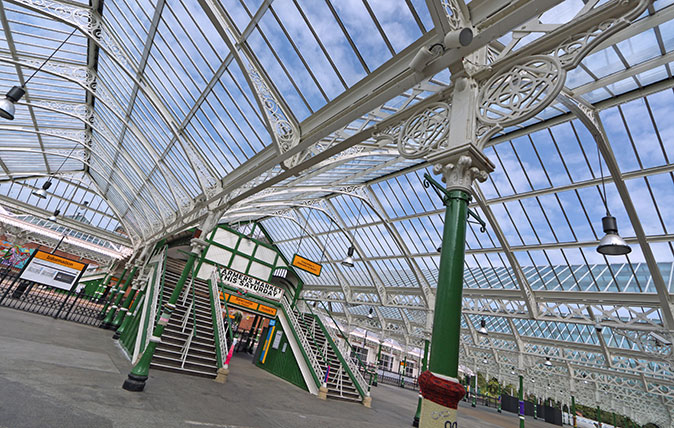
13. When the Victorians built railway stations, they were able to build their palace-like stations in the centre of towns and cities; just where travellers wanted to arrive! Due to high land values and ethical (archaeology, listed buildings, city centre decay, the housing shortage ) concerns around compulsory purchase, this is no longer practical. Most HS2 stations will be built outside the towns and cities they serve. The connecting transport will take away some or all of the time gained (1hour 21 minutes reduced by 29 minutes) by using a high speed train. An example I experienced many decades ago, was in Brisbane. When you arrive in Brisbane rail station you have to stand and wait for a bus or taxi to get you to the centre of Brisbane. I believe a local train has now reduced this problem but the insanity of these slow ‘connections’ remains.

14. Simple analysis of the problem will reveal there are many means to connect the regions of the UK other than high speed trains. The best and perhaps most cost effective of these, is to improve connectivity using the internet. This has the potential to allow passengers to work during their journey on conventional trains. This will make the speed of the train less important.

15. A new train route will cause considerable loss and damage to the countryside and communities through which it is intended to pass. The least of these is the one hundred ancient woodlands which will be destroyed. At a time when the country has been promised it will be more self sufficient in food, farms will be significantly negatively affected.

16. One hundred ancient woodlands, fauna and flora and in areas of outstanding natural beauty and special scientific interest will be permanently harmed or eradicated at a time when the environment is being prioritised, not least because of climate change.

17. Trains are a less safe means of travel than flying and in the future, the hyperloop. The later will be so safe that the prototype has already been trialled over a short distance by it’s designers and backers, personally. Hyperloop is frictionless so will require a fraction of the amount of energy required to propel an ordinary or high speed train.

18. To fit the broader brief of ‘increasing connectivity’ within England, new trains and routes should be started in the North. Phase One HS2, starts in London and therefore does not benefit those in the North unless they want to go to London.

19. The money spent by the Test and Trace and PPE procurement was approximately 57 billion pounds. This is in the same ball park as the current estimated cost of HS2! If HS2 costs reach 106 billion pounds, then this is the same as the cost of running the National Health Service for a year. Politicians have to be asked why not run the NHS for a year with this money?

20. The High Speed train network will not serve the satellite regions of the United Kingdom; known as Northern Ireland, Wales and Scotland. These areas already resent to control of an England-centric government based in the south of England. In my view this may become the straw that breaks the camel’s back and play into the hands of the Nationalist Parties of each country, the first to fall being Scotland followed by Northern Ireland, then Wales and then Yorkshire – Cornwall?!

I have not included any benefits from a High Speed train network in the United Kingdom.

Such as list should always be included in any rational ‘problem solving’ assessment. My problem is, I can’t see any benefits, except some good publicity photos of dolphin-nosed trains and grinning politicians in high visibility jackets.

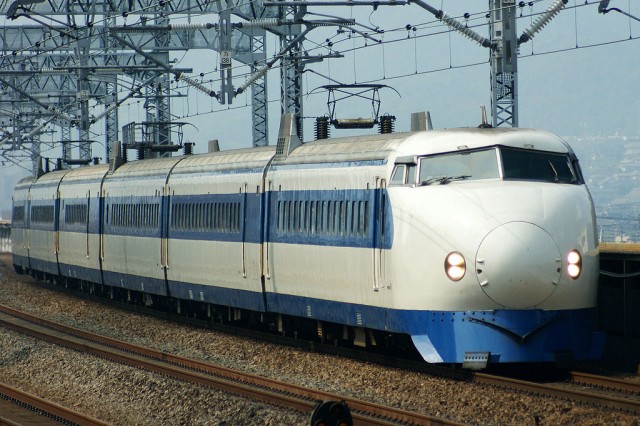
If there ever were benefits, these should have been gleaned after the second world war when the UK’s industrial cities had been demolished. Despite ‘winning’ the war in 1945 the UK was bankrupt. Japan ‘lost’ the war and in the 1970’s built some of the first high speed trains – the famous Skinhansen.

The Right Technology at the Right Time in the Right Place – Shinkansen

Perhaps some would argue that an electric train speeding along the tracks is much greener than the cars on the motorway running parallel. With the proviso that the National Grid is powered by carbon neutral fuel sources, this is true, but certainly by 2040 (as phase 2 is due for completion), cars and lorries are going to be mainly electric or hybrid. Any ‘green’ advantage to all trains is slowly disappearing.

And in the midst of a pandemic and in preparation for the next, is not personal transport going to be preferred to public transport?

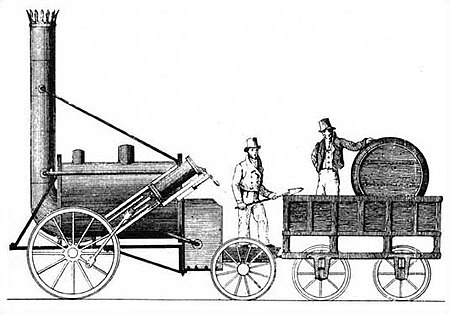
What would Robert Stevenson be thinking if he saw the final phase of his invention being acted out? What would he say about today’s ultra wealthy taking personal travel into the edges of space and is that why he called his invention Rocket?

1829 Rocket – Still the best public transport concept applicable two hundred years later?

Vote Me!

The day is approaching this December 2019 when the good citizens of the United Kingdom of Great Britain and Northern Ireland will have the opportunity to vote in a general election.

The outcome is being described as the most significant for a generation, so you would expect the process to be fair. Certainly, whoever wins is going to perch on the moral high ground of victory and fight off all criticism for a very long time indeed. Whether they will be entitled to be so smug, I suggest, is open to debate.

You see, I have a problem which is; how democratic is the voting system? My quandary as a voter, is that I approve of some of the policies of most of the parties. It should be explained that in the UK there is a left wing party, Labour and a right wing party, Conservative and Unionist. The middle ground is occupied by the Liberal Democrats and Greens. Other nationalist parties represent Wales and Northern Ireland and Scotland.

In the United States of America, the choice is more polarised between the Democrats and Republicans. Let us take this as an example. What if, as a US citizen, you decided that the choice was too small. Who do you vote for if you want to stop climate change but encourage industry? Who do you vote for if you want the state to pay for health care and a prosperous arms industry?

In a Spin About Voting?

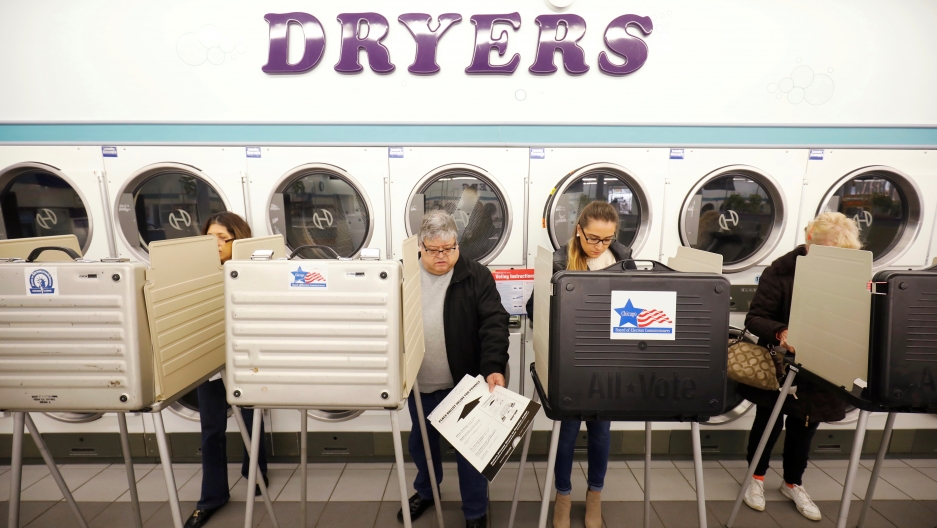
Voting in Laundrymat

My point is that with polarised choices, there is no room for ambiguity that emerges from personal political perceptions and priorities. Worse still the politics of voting reduces to personality rather than policies.

Even in the UK, where the choice is greater, the democratic options are more confusing. Many voters now just spoil their ballot papers by writing ‘I don’t agree with any of this.’ They are being asked to vote for a leader they didn’t take part in selecting – unless they were the tiny minority of party members.

They might distrust all the candidates on offer and feel ambiguous about their policies.

Each party writes a manifesto prior to an election stating their political motives and means. This works to an extent but has the problem for some voters that their may be slipped in controversial motives that the voter does not want to happen. For instance, the Conservatives slipped in having a referendum on continued membership of the European Union. Suddenly it became an issue even though the majority did not think it worth consideration.

Worse still, when parties fail to win a majority in elections, coalitions have to be formed. Italy, Spain, possibly the UK next week, have this problem. Two parties may come together for the sake of forming a government at the price of compromise on their manifestos.

The public will have no choice over how these mixed manifestos will be prioritised. Which policies and method will be forgotten or ignored and which prioritised? Coalition manifestos are not published before an election if considered at all. This can lead to unrealistic expectations by voters when coalition governments are formed, as in the Liberal and Conservative Government in this decade. The direction of the ship will be decided by the Captain and officers, not the crew and certainly not the passengers.

No provisional consideration is given to coalition prior to an election as all parties have to perform the pretence that they are going to win even if it is clear to all that they will not.

The dangerous consequence of this for democracy, that occurs all too often, is that a minority party gains disproportionate power by owning the swing votes. This happened in the present Conservative government who allied with the Democratic Ulster Party and much of the muddle of mixed motives over Brexit has resulted.

In recent elections we have seen and or suspected that the over emphasis on the personality of candidates has given leverage to foreign governments and fake or real ‘whistle blowers’ and ‘news vendors’ questioning the reputations and ethical principles of candidates or even parties. Democracy as we know it is easily undermined by misinformation, view the Nazi propaganda news in 1930’s Germany, if you think this is a new phenomena.

Even the date of an election day can be manipulated to support a particular party in a manner which is clearly not in the interest of fairness. In the present UK election the Conservative government chose the day in which the students from Universities will end term and be returning home for Christmas. Informed young voters are not likely to support the Tories even though the election and it’s issues mostly affects their generation.

Young Voters in the USA Choose Not to Vote

  V I Dont Vote Badges.

Even such a consideration as ‘is it raining’ has been measured to be significant on election days. Sending people to village halls to scribble on a piece of paper has to be reviewed as the majority of citizens in the UK rarely turn out to vote. Some living abroad for over 15 years lose their right to vote.

Lone Voter

Voting Lone Voter

These then, are some of the problems for Democracy. Some people say, ‘well that’s the system we have got’ or ‘it’s the best of a bad lot’ but you have to wonder if the country that prides itself in it’s democratic systems is not kidding itself, it’s citizens and the world.

I am not suggesting that Democracy should be replaced with the pedantic and often corrupt systems of power like Communism or Autocracy. I am suggesting that with the aid of computers and the internet, a more democratic process is available to elect representatives. This is my idea.

Firstly, the party system is out. The in-fighting of politicians instead of their countries best interest, is something most voters are tired of.

Instead, all candidates will put themselves up for election as ‘Independents’. Radical, yes, but read on because they can form parties after election, not before.

They will state their personal political views by placing ten stars against a list of important areas of government. This will be shown to voters as something like this ;

Education *

Health **

Defence ***

Transport *

Law and Order **

Business and Industry *

Farming and Fisheries *

Environment    nil stars

Social Housing and Homelessness    nil stars

In this list each aspect of legislation and distribution of taxes is prioritised by the candidate, according to their own personal views. They are not under any party pressure to support policies with which they feel awkward about or strongly disagree. They can be honest; a quality in politicians which many voters express their suspicion about.

The candidate has, say, ten stars with which to indicate how which issues they prioritise and the amount of funding they would give in comparison to others.

Now here’s the clever part. Each citizen is given the chance to indicate their priorities and how strongly they feel funding should be allocated to each on their ballot papers. Instead of one cross or tick for a party – which in the twenty first century has to seen as a crude political choice – each voter has the same number of stars as the candidate.

The last piece of this process would have to be constructed from new but it’s not impossible. What I am envisaging is on-line voting from a phone, personal or public computer. In an age when personal internet banking, shopping, even gambling! – is managed with a high degree of security and reliability, it must be possible to create a secure on-line voting application.

Ten issues are listed either as broad areas for consideration or narrow ones. The voter can either ignore these as being worthy of state support ( such as health care in the USA) or indicate a need for state intervention. The strength of these feelings can be indicated by allocating some of the ten stars used to vote with.

It will be impossible to use up more than ten stars or whatever number is allocated to each citizen, but ten is an easy number for most people. Their choice can be re-adjusted until the voter is ready before selecting the ‘VOTE’ button.

For a population familiar with the internet, voting will be accessible, timely, considered, representative and accurately describing personal views.

The final phase of the voting process is for computers to match exactly the views of voters to those of independent politicians. It is already established what the views of the candidates are and matching a set number of candidates (say 300 ) to the views of the citizen public, will be doable for a computer.

The result will be a selection of representatives who will accept office and be fairly representative of public opinion. Being politicians they will almost certainly form party cliques (birds of a feather flock together) but at least the system by which they obtained power, will have been representative.

This could be a sea change for how populations choose those who represents them. With the emphasis moved to policies and issues rather than personalities and power politics, a higher level of honesty and fairness will be achieved.

We have the technology already to achieve this. We just need the thinkers to describe how it can be done – as I have just done. Vote me!

Fifty Shades of Green

Since 1990 the world has produced as much carbon dioxide in the atmosphere as in all the previous years. The world has a problem from the unrestrained burning of fossil fuels for average temperatures are rising despite the environmental strategies of government and international agreements.

If you replaced one power station burning fossil fuels everyday until 2100 with 1500 wind turbines you might stop the problem. As this is unlikely to happen, the extinction of current civilisation has begun. New ways of removing carbon from the atmosphere is the only technology that will reverse this process. Technology at present has no such solution.

Why are is technology failing us? Consider the partial solution of transport powered by electricity.

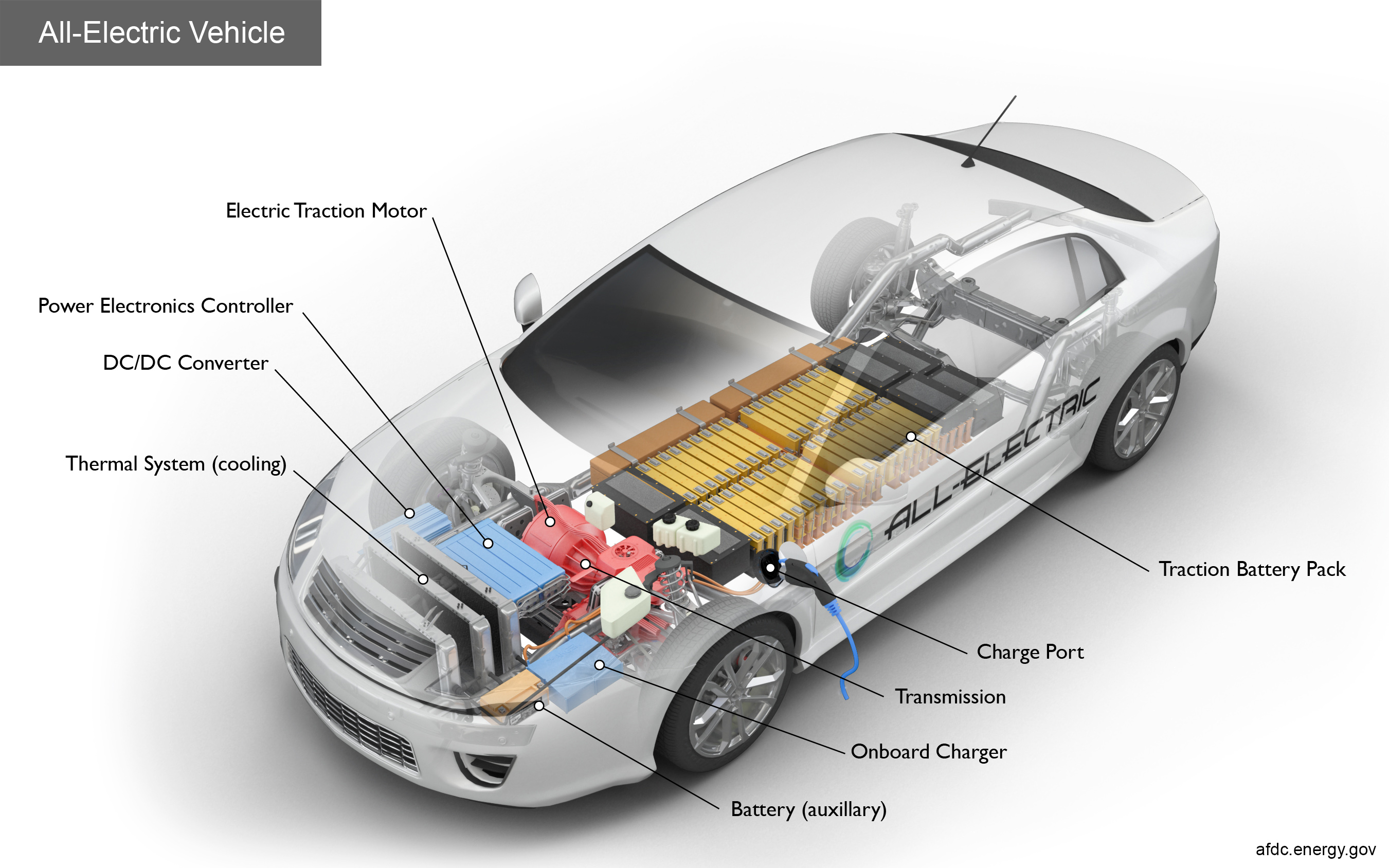
electric car workings

I have to expose the myth that electric vehicles are good for the environment.

This may come as a shock to those who have invested in a hybrid car so reach for a box of tissues as it gets worse.

Perhaps I am being a little harsh on what is a welcome prospect for the future of personal transport but it has to be said. I do not anticipate that the luxury of personal transport is going to go away in the future what ever form it will take. Certainly populations in countries like China, India and Africa feel resentment when those countries who have created the problem require them to forgo the benefits of owning a car.

Efforts to eulogise public transport as the future are futile because people know how good it is to control their own transport. This is not to say that public transport has no place in the future. On the contrary, it should be spearheading the technology that drives vehicles without causing air pollution and greenhouse gases. Sadly in most modern cities it is not. Taxis, buses and trains are still burning fossil fuel in all but the most innovative urban centres.

Decades ago, buses in Amsterdam were running on compressed gas. Cylinders like divers use were positioned under the floor of the bus and charged with compressed air overnight. During the day, the engine turned over using the kinetic energy from the compressed air. The discharge from the exhaust was of course pure air. What happened to this idea, I do not know, but it shows how many technological advances have been left in the urban gutter.

Part of the drive to promote electric vehicles, has been the demonisation of cars using the infernal combustion engine. Whilst these engines are clearly a remnant of the past, they exist and continue to be mass produced. The transition to the new technologies needs to be managed. Most government strategies however, are well intentioned but ineffective.

For instance, in Spain the police write to the owners of cars which are ten years old or above and suggest they get a petrol engine car. Whilst we must admire the green agenda of the government the manner in which it is being promoted is clearly misguided. Firstly, any such agenda should be European wide and not just promoted by one country. The desired outcome should be measured and confirmed as achieving what is intended. Ending the life of any vehicle after just ten years is wasteful because one third of the energy used by a vehicle in its’ lifetime is used in the manufacturing process. So whatever the motive power, cars should be designed to be in use for several decades, if they are to be considered as green.

The impasse that scientists have met when designing batteries for cars is yet another inhibitor to any mass take up of electric motive power. I own an electric bicycle and after four years I had to buy a new battery at about one quarter of the cost of the original bicycle and battery. Present day lithium ion batteries require rare earth elements that will only become more expensive to obtain in the future. Their mining and processing in African states is not environmentally managed. Some electric cars are sold without the batteries as they are provided with the car under a leasehold arrangement. The cost of the battery for my bicycle per mile is about the same as if I had a motor bike and had been buying petrol. I expect electric cars which are touted as being run for a few pence per mile are actually more expensive to run than vehicles running on fossil fuels. Batteries do not last as long as the Duracell bunny would have you believe.

It’s the same lie that is used to promote nuclear power stations as providers of cheap electricity. It is cheap if you discount the astronomical cost of building and decommissioning the power stations, costs which normally governments pay presumably in order to promote the industry and hidden agendas of manufacturing weapon grade uranium. The political games between Iran and North Korea and the USA are a current example of these smoke and mirror politics in which no citizen is the winner.

Faith in the ‘electric car’ as the future of personal transport is misguided for this reason. A car that needs a battery is still being run on fossil fuel, just one step removed. I refer to oil, gas and coal fired power stations that produce the majority of the electricity in most European countries. A car which is plugged into a national grid, is merely acquiring energy made from burning fossil fuels.

If a householder has a contract with an electricity supplier claiming to provide electricity from renewable sources only, then that would be the ideal. But as things stand, local and national governments are in the process of providing charging points right across their respective countries. They fail to see the lesson from the beginning of the twentieth century where electric cars could not compete with the new internal combustion engine when it came to range of travel. It was then and is still, a problem.

As I write this the battery for my bicycle is being charged from the photo voltaic panels attached to my house. Not only dirty electricity but the whole idea of ‘national grids’ is wasteful and expensive. In the future, electricity will be generated locally and stored in ‘gravity batteries’ and similar solutions.

Hybrid electric vehicles are still causing pollution and therefore not a solution for the zero carbon future. Totally electric vehicles being recharged from recharge points in towns is impractical and the hunt for even a parking space is proof of that. Charging by induction when stationary for long periods is possible but waiting times need to be considerable as the process is slow. Roads, car parks and even railway tracks with photo voltaic cells as the road structure and surface will produce electricity locally even when the sun is not shining but charging batteries from these sources is just impractical as already stated.

There is and has been for decades, a better alternative to battery driven vehicles. The hybrid cars being manufactured and subsidised by governments today require a grid of charging points. Should the very large cost of these be paid or subsidised by governments? Who ethically should pay? Those rich enough to be able to afford current electric cars or tax payers who are going to get little or no return.

The question is similar to the quandary faced by consumers in the 1980’s when Video Recorders were appearing in the shops. Which is better, VHS or Betamax? Although the latter was a better quality product, VHS won.

So to all those early adopters looking at battery driven vehicles, I suggest they hold on for the next generation of hydrogen fuel cell powered cars. The energy from these hydrogen is green and relatively very cheap. Used in conjunction with the high torque electric motors like those developed by Tesla and motor racing engineers, these vehicles will provide every comfort and convenience currently enjoyed by the generation who were brought up with fossil fuels.

electric car hydrogen-fuel cell

As has happened many times before with new technology the wrong decisions (for the nation and environment) are made by governments to promote agendas popular with voters instead of just letting the best patent win. So my advice is keep your present car on the road for as long as you can. In five to ten years, new technology will be available at a reasonable price. There will be cars designed to last a whole life with little maintenance. Just don’t expect to be allowed to drive it.

That pleasure will be a thing of the past as well!

The All Seeing I

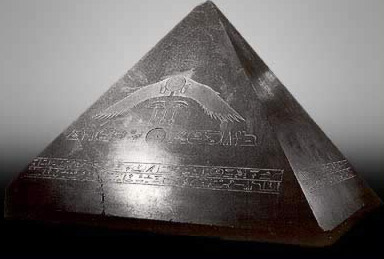
There are quite a number of theories as to why an all seeing eye above a pyramid, appears on the dollar bill.

dollar bill eye

Clearly there are masonic connections with the originators of the United States of America and the original intention. There may have been as many as twenty one signaturees of the American Constitution who were Freemasons.

They largely reflected anti monarchist views and promoted European Enlightenment ideals of liberty and self governance. God was not encapsulated in a ‘religion’ but seen as an entity who largely left humanity to it’s own devices, whilst keeping a benign watch on things.

Also, the ‘eye’ on the dollar bill is clearly disembodied; without the arms and legs. This ideal of the Creator is more akin the gnostic view, than the Christian.

The symbol shows rays coming from the eye in all directions. This is important. Firstly the rays are coming from the eye, not into it. It is therefore akin to the sun and akin to the Ancient Egyptian deity Ra.

Whilst the human eye is perfectly adapted to receive and focus electromagnetic energy in the wavelength of light, modern science does not support the idea that eyes emit light. Yet in Ancient Greece, Plato and Socrates believed the eye was an organ that emitted a ‘fire’ to produce a ‘visual touch’ sensation. This reversal of what is today ‘the norm’ is not as nonsensical as it may seem. In ancient times the physical world was seen more as a system of energies, rather than the solid physical forms of today. Given that perception then it is quite possible that a human can feel with the eyes by emitting energy. We have all probably had the experience of someone watching us from behind or from a distance whom we cannot physically see.

The other symbol is the truncated pyramid above which the eye floats. The pyramid has thirteen courses and this number is repeated in other symbols present. It’s significance to the designers was clearly important and probably has several interpretations. Personally I would view it as a unification of the numbers one and three, one being the Godhead and three the Holy Trinity – in Christian symbolism which the Freemasons were most likely to use. At another level one interpretation I find interesting is by Swaller de Lubicz who said that thirteen is ‘the manifestation of the good or bad generating power’.

Swaller de Lubicz is a renowned investigator of the sacred sites of Ancient Egypt whose theories were unorthodox but very interesting. His book ‘The Temple in Man‘ is recommended.

In the Old Testament of the Bible and Torah, God is just such an energy that passes judgement and destroys that which it does not approve. Although this image of the Creator is at odds with the New Testament, for the Jews and many other societies, God is not just ‘Mr. Nice Guy’.

In science, the physical universe is in a constant process of decay known as ‘entropy’ and creation; with entropy ultimately being the winner. Even our own bodies reflect this state, and one day our bodies will expire, despite constant renewal processes.

So the eye at the top of the pyramid is more likely, in my view, to be an ‘Old Testament’ eye. Whilst man has freewill to make mistakes and good judgements, so does the Creator. Divine intervention does not, in theory, take place however in a contradictory way is does. God permit cities to be destroyed as does man.

The all seeing eye of God is not just protection, as worn by many as a symbol in the Middle East and known as the ‘evil eye’ or more accurately – protection from evil.

So, why a pyramid and why one without a point? Most pyramids are pure representations of the geometric pyramid form. To do otherwise is rare but there is one and it is well known. It is the so called Pyramid of Cheops on the Gaza Plateau in Egypt. This was one of the first to be built and many of the latter pyramids were pale imitations. There has never been a ‘pyramidion‘ stone and it was constructed to have a flat platform at the summit.

pyramidion1

In my personal researches, I have come to the notion that pyramids were constructed to accumulate electromagnetic energy (amongst other reasons). This was done using rock which conducts ions and between anodes and cathodes. In the base of the pyramid are underground water courses associated with the river Nile. These bring in positive ions to the pyramid to be draw upwards through the centre. They were never intended to be emitted from the point of the pyramid as most others do, because other uses of the energies were being made in the chambers.

Suffice to say that I believe most pyramids were constructed to emit a steady stream of electromagnetic energy, from a height and in all directions, to other pyramids. This was a world wide network as evidenced by the presence of ancient pyramids on all the continents, including Antarctica!

A Pyramid and Tesla Tower with similar construction

Pyramid and Tesla Tower

The concept of ‘mobile phone’ masts as a network of transmitters and receivers of information encoded microwaves, is something most a familiar with in the modern world. It should not be so extraordinary to imagine such a network existed in the past using more primitive materials but with sophisticated, intuitive software.

The pyramids were transmitters and receivers between computers. If you wonder how computers existed so long ago, I am of course referring to the human brain, a computer so multi complex that it will be several decades, perhaps never, when it is replicated by scientists.

A form of ‘telepathy’ is plausibly existent between people such as twins or even husbands and wives, who finish each other’s sentences.

The ‘all seeing eye’ or ‘all knowing eye’ is therefore quite plausibly something contained not only in the mind of God but also His construction, humans.

The Ancient Egyptians denoted the Eye of Horus as in the diagram below. There is a convincing connection between this stylised image of the eye and the cross section of the human brain. This includes the pineal gland where our ‘extrasensory perception’ originates and is known as the ‘third eye’ – another illusion to the number three.

eye of horus

The ‘eye’ is also at a poetic level the ‘I’ or feeling of individual identity within the multiverse symbolised by the number 3 or the Trinity. I and 3 is of course code for, 13. The American Constitution protects the political and human rights of the individual and was fundamental to the creation of a free state which the USA has enjoyed for centuries, (at least in it’s imagination, when such issues as slavery are concerned.)

You can see, therefore that the information contained as they say in ‘plain sight’ on such a lowly item as a bank note is the perfect place to maintain a profound cognisance intended by the ‘Founding Fathers’, never to be forgotten.

Every Breath You Take

For about eight years now I have been driving a 2.2 litre diesel estate Toyota. The ‘Top Gear’ television presenters drove a selection of similar cars across Europe to see which went the furthest. Jeremy Clarkson found that his diesel Jag used so little fuel that he ran the air-con and anything else he could to use more fuel. Large cars have space for large fuel tanks, so their range can be phenomenal. Mine will drive from southern Spain to the north coast of Spain without stopping – a journey of 1000km.

Last week I hired an ultra small Toyota Aygo car in the UK; a nice little automatic with a petrol engine. When I came to fill up the tank I was disappointed to find that it had travelled about 45mpg whereas my trustee diesel gives me over 55 mpg.

So why are diesel cars getting such a bad press at the moment? Diesel engines were preferred in 1997 by the European Union as a response to the Tokyo Climate Change Protocol. These engines produce on average 120g of CO2 per km whilst petrol engines reach 200g of CO2 per km. This is because diesel engines cold burn and so use less fuel. These figures do not include the energy used to make and dispose of the vehicle most of which will come from fossil fuels. It makes sense to make cars that last several decades in order to stretch out the environmental impact of production and disposal.

But the problems with just the emissions from internal combustion engines, has been re-defined. Whilst CO2 emissions must continue to be reduced, it has been recognised that the toxic gases and particulates from engines are causing a serious health risk – especially for children.

So when you examine these two types of engines, the toxic gas produced by older diesel cars is Nitrogen Oxide, in various compounds. Petrol cars can reduce this with a catalytic converter whilst diesel cars require particulate filters that are regularly maintained. If they are maintained then the NO gases gases from diesel cars can be reduced by 90%.

Governments have been victims of their own ‘political’ thinking; putting problems into compartments rather than viewing the whole issue and how each aspect of it interconnects.

Complexity challenges even those minds with an expensive private education (i.e. politicians). The lazy solution is to reduce the problem to something people can understand – especially voters.

The bottom line is that neither petrol nor diesel engines should be in use in the 21st century. There should already be ‘electric only’ zones in all urban centres with buses and taxis leading the way.

Cars do not need to be scrapped on account of their motive power source becoming a problem. New zero carbon, zero particulate engines can be retro-fitted – even into fondly maintained ‘classic’ cars. Friends of the Earth believe we need to achieve this in less than a decade, whilst the UK government thinks 2050 acceptable.

When I was a student in London in the 1970’s, I hung a sign under my bicycle saddle with the words;

No Noise, No Fumes’

I didn’t buy a car until I was 30. Was I ahead of my time? No.

Fritchie Early Electric Car

Electric cars had been the brain child of inventors in the 1830s. By 1900, New York City had a fleet of electric taxis. The electric car designed by an American, Oliver Fritchie, could travel 100 miles between charges but it could not compete with the Model T Ford on price or range. The rest, as they say, is history, because in those times governments were oblivious to the consequential problem they were leaving their ancestors – us.

1970’s Electric Car – with only a 40 mile range and apparently you had to stand on the roof.

1974 Electric Car

Today governments spend considerable time and resources in a phoney ‘war’ against terrorism. ‘Phoney’ because conventional troops cannot overcome guerilla tactics – as was proved to be the case in Northern Ireland.

The massive expenditure of public money on this ‘war’ is justified because terrorism grabs the imagination and emotions of voters – by it’s very nature as a font of repeated horrors.

You might be forgiven for wondering which is the greater issue – millions of citizens  (especially the young) dying of lung related diseases caused by internal combustion engines or citizens dying in terrorist related incidents?

When that question is considered statistically – resources should be allocated to each problem in proportion to amount of human misery and suffering it generates. They should not be allocated on the basis of which problem gets most votes and the most media coverage.

Regrettably terrorist acts will generally sell more newspapers than children dying silently in hospitals of lung diseases or adults with heart problems.

Newspapers  inflict the final blow of horror and despair on behalf of the terrorists into the hearts and minds of  victimised populations. Margaret Thatcher knew this and ordered a policy of non-reporting of terror related stories in Northern Ireland.

To his credit, the Mayor of London, Sadiq Khan, has identified the toxic air of his city as a very real and serious contemporary problem. He has made small steps to reduce it – such as charging motorists of the most polluting vehicles to enter the centre of London. The European guidelines on air pollution were exceeded within the first two months in 2018 in London. Is this another reason for the UK to leave Europe? No more awkward tests of the atmosphere in our cities?

When the United Kingdom first became a member of the European Union one of the directives from the European Parliament was for the UK to clean up it’s bathing beaches.

This was duly ignored for the first year. Why should the UK not continue to send it’s children to play on filthy polluted beaches? But the following year the EU reminded the UK of it’s obligation in law. The UK reluctantly (one expects) began to clean up it’s inshore waters; beaches are now awarded Blue Flags for water quality and facilities.

Now in 2019 the River Thames in London has been transformed from a toxic environment in which nothing could live, into a clean river with fish and mammals such as seals – on view from the Houses of Parliament.

So why now should clean air be such an difficult objective for successive governments?

If the problem is short term planning on account of the four year term of office for elected representatives in parliament – then perhaps politicians need to start to deal with the complexity of uniting long term and short term objectives.

The current air pollution problems in the UK are not local – just look at Mombai and Beijing. There has to be consideration – however complex- on how to integrate solutions within complementary European and global strategies and policies.

Clean air has to be one of the most fundamental of human rights. If we cannot wish it on ourselves, how is it likely to ever happen for our long suffering environment?