OK, look out of the window and tell me what you see.
I see some fields and trees and a couple of cows.
Think carefully. Tell me what is the first thing you see.
The fields.
Wrong. The first thing you see when you look out of any window is glass.
This little exchange may sound pedantic but it crudely illustrates how we ignore the way we perceive the world. Sweeping short cuts are made during the process of perception in order to to establish some sort of certainty of what is out there, for our deaf and blind brains.
The next logical step in this line of thought, is to consider how many other things we do not see, whether they be ideas or physical things.
I would argue that there are many more than we believe.
Take technological ‘evolution’. I avoid the word progress because there are examples of new technologies that were a step backwards rather than forward. The release of energy from matter in nuclear fission for instance, creates as many horrors as quick fixes for warfare or the provision of electrical power.
Nobody votes for new technology. One day you are sitting on the sofa eating your dinner when, on the news, they are demonstrating a car that drives itself. Or you are a farmer in nineteenth century England and suddenly you hear you neighbour starting up his new tractor.
These changes to our lives come about as if by stealth. Generally they are considered benign – that is the benefits out weigh the problems. The fact that all new technology is by definition ‘untried’ is something that neither proves nor denies a problem exists, in the present or future. So it is allowed to be produced.
The mobile phone, for instance, has revolutionised many people’s lives. Even children as young as three are given them. And yet there remains a question mark over the emission of microwave energy and the effect it has on young and adult brains. At present the young are thought to be particularly at risk because their brains are developing. Making a phone call in a car for instance, is the same as putting food in a microwave cooker, only it’s not food being cooked – it’s you and your family. Because this background energy has been with us for over a generation, it is not possible to establish a ‘control group’ to measure the development of brains. There are no humans alive now, who have lived without a constant background of microwave energy.
Of course there are checks and balances at work in various committees in Universities where research is done. Also government organisations monitor and grant licences to new technologies. The ethical concerns, the effect on other systems such as the environment, sustainability, disposability, carbon footprint etc. are just a few of the concerns applied to new technological developments.
The problem is not all countries judge new technology in the same way. If there is a political, monetary or social ‘quick gain’ to be made through say, shale gas fracking, then some country somewhere is going to do it.
And if in the eighteenth century what happened on the other side of the world didn’t matter because it was too far away; this century has no choice but to think global.
The trails of diesel exhaust from ships crossing oceans can be seen from space. Imported goods do not arrive without an environmental price tag.
It is as if technology has a mind of it’s own – and in the next few decades it will quite literally– using 5G and the ‘internet of things’.
But without innovative technologies, the planet would not be supporting the present human population. The number of people pre-industrial revolution, was small. England had about four million citizens when horses ploughed fields. Now there are over seventy million.
But new technology is not the only object seen in the window. Remember the glass.

And it might not be a new technology that is about to alter the course of your life fundamentally. There are numerous ‘low balls’ that could change everything tomorrow. For instance there might be a series of powerful solar mass ejections, bombarding earth with cosmic rays so strong that the earth’s protective magnetosphere gives way. Computer systems go down, power grids and machinery of all kinds are cooked.
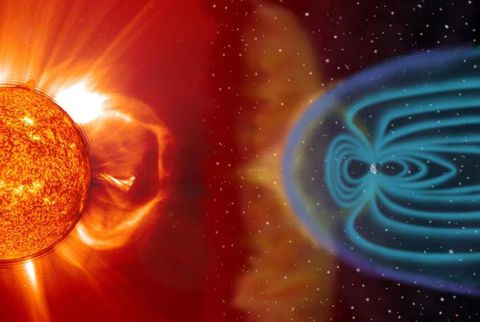
Trusted technologies, reveal that they have been trusted too much. The impossible or ‘once in a thousand year event’, happens. Then mankind realises it had not seen the glass in the window.
The earth is a space craft and like all complex systems they are fine until they break down. Then back up systems have to be activated and emergency plans initiated…if they exist.
In the case of planet earth they do not. A ‘survivalist’ shelter designed for two weeks, two months or even two years, will eventually either be discovered or run out of supplies before the re-population even begins. Mad Max doesn’t even come close to the post apocalypse chaos.
The question for the present generation and for those yet to be born is;
‘what are the blind spots in our modern lifestyle that could leave human population exposed to near elimination and what is the back up plan to each eventuality?’
Governments, committees, industrialists, academics scientific researchers and technological inventors and innovators are our modern day ‘dictators’. You won’t be voting whether to survive disaster or not. Your trusted leaders just won’t have seen it coming because they too were looking through the glass, like Alice.
 Matters Blog