Holy Smoke

And seeing through it!
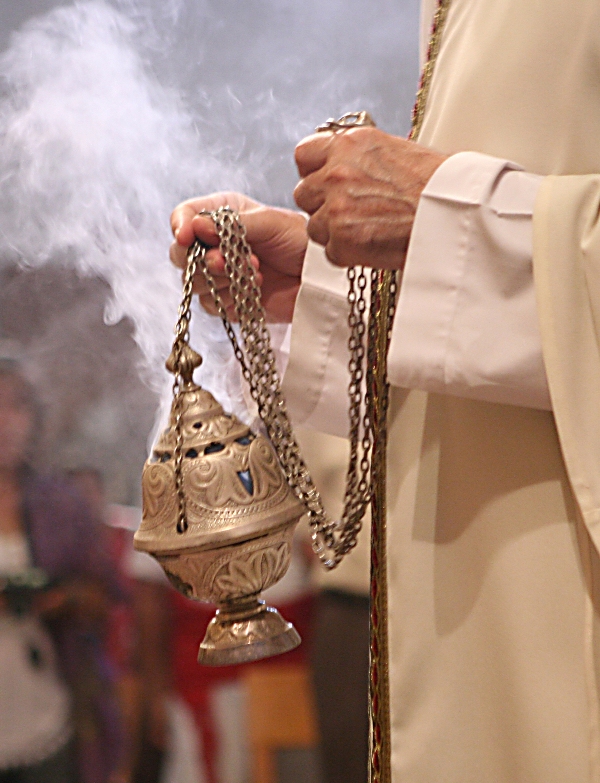
Burning Francinsense
picture credit Wikipedia

At the zenith of the Julian Calendar we have the festivals of ‘Christmas’ and ‘New Year’.

These celebrations carry warm and fond memories for many westerners. We can trace this back to childhood where children become the centre of attention and adults serve them for a few days; they pretend to be Santa Claus.

If, for whatever reason, you wish to influence the minds of adults for life, then you would start with the child because the child has no filters to prevent unconscious programming. The consumer industry that has grown around Christmas and the New Year suggests, very few adults can see through the smoke and mirrors.

Look objectively at these ‘festive times’. We tell stories to children about Santa Claus and a completely disconnected Nativity which they absorb with relish. And even though these are rather thin and bizarre narratives, children believe them.

Did shepherds really watch their flocks during the coldest nights of the year? Surely this nightly routine is only necessary when the sheep are lambing which is not in the winter months. Angelic hosts? Moving stars? Do kings saddle up camels and set off with other kings and no armed guard and courtiers towards a new light in the sky? And why give a babe in swaddling cloths such inappropriate gifts? Surely, a rattle, a soft toy and a blanket are more likely to raise cheeky smile?

This Bible story has the quality of a dream and in my view, for good reason. For just as dreams are constructed using symbols, so are these stories. Modern Jungian psychology is very comfortable with dream interpretation and symbols, as have peoples from around the world and throughout history.

The Roman church does not advertise that the nativity story is laid over identical ancient Egyptian and other traditions in which a child is born on 25th December of a virgin mother.

Isis Nursing Horus
picture credit Isiopolis

It’s interpretation of the gifts are as signs not symbols. They suggest that gold was given to show Jesus was ‘Christ the High Priest‘, in other words giving him power and authority, but a symbolic interpretation carries deeper meaning than signs.

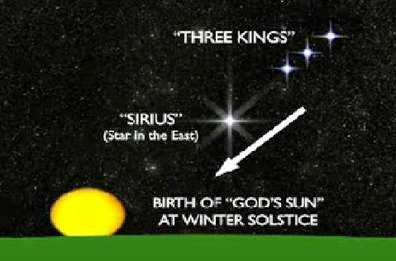
In my view, the symbolic interpretation of the story is related to the winter solstice and a solar god rising and setting (Set being a destroying god from ancient Egypt). At this time the sun effectively dies and is placed in the ‘place of the skull’ or Golgotha. The round stone in front of tomb is closed for three days symbolises the sunrise not moving for three days on the horizon. When the sun moves again on 25th December is resumes it’s daily ascent into heaven.

This is not to say that Jesus the Christ was not a real person, but in my view, Jesus was born in the spring, did not die on the cross and lived his last days as far away from the evil Roman Empire as he could, in the Indian sub-continent, Kashmir.

The Tomb of the Prophet Isa or Jesus the Christ
picture credit Indian Heritage Walks

Surprise to see that there is no Santa Claus in the Bible because his is a symbolic story from another time and place which I have discussed in a previous blog; just as there are no cuddly Easter Rabbits or munchy chocolate eggs at Easter in holy scripture.

Here is a more serious alternative interpretation of the nativity story that might well have been within the teachings of the mystery schools and secret societies.

Consider the three kings as representing the pineal, pituitary and the hypothalamus neuroendrocine glands. These are all within the ‘place of the skull’. We should note that the birth most likely took place in a cave, a symbol of inner consciousness used by Plato, not a stable.

Many believe that much of human experience is ruled by our energy bodies as depicted in Hindu tradition by the chakras. Each month a sacred oil rises in the spine from the solar plexus and the part of the spine we call the sacrum. This is represented as the gift of myrrh from the pituitary gland. The hypothalamus is symbolised by gold, which is a pure, non-tarnishing, noble element, that freely conducts electricity. This charges the oil with golden, solar ions. Lastly the pineal gland secretes frankincense, a precious oil burnt in holy places to symbolise prayers rising into another dimension which becomes visible when the smoke disperses to reveal the source of the light. This was a new light and new consciousness on planet Earth.

I shall move onto the myth of the ‘new year’ in countries around the world which follow the Julian calendar. This was introduced by the dictator perpetuo, Julius Caesar in 45BCE, to replace the ten month Roman calendar. This was a solar calendar for a new sun god, with 365 days and a leap day every four years. It surfaces in the modern names of September, October, November and December (7,8,9,10) and starts on the first day of January.

But this random 1/1 date is not sympathetic with the cycles of nature. At this time, winter is dormant in the natural world. Animals and humans struggle to keep alive. Understanding natural cycles would suggest that the new year should start at the spring equinox when the days lengthen and there is more sun than darkness; a time of renewal and rebirth.

The Roman January god, Janus, had his two views of the world fixed on a melancholy past and an uncertain future. He was not a god of the moment and reality. He was not awake. Yet we celebrate January as the start of the new year, even to this day.

In the Rome influenced west, adults and children stay up until midnight. This hour is known in Wiccan circles as the ‘witching hour’ because at this time, the veils into the human world are opened and spirits may enter unneeded. Spirits are often consumed within an alcoholic drink to start the new year as one means to continue.

The Druid’s magical mistletoe, is used to give protection from such unwanted guests. It’s berries represent sperm and fertility. A future hope or ‘resolution’ is made real by a kiss beneath the mistletoe. It is an evergreen plant, and therefore provides protection throughout the year, even if unkept resolutions do not.
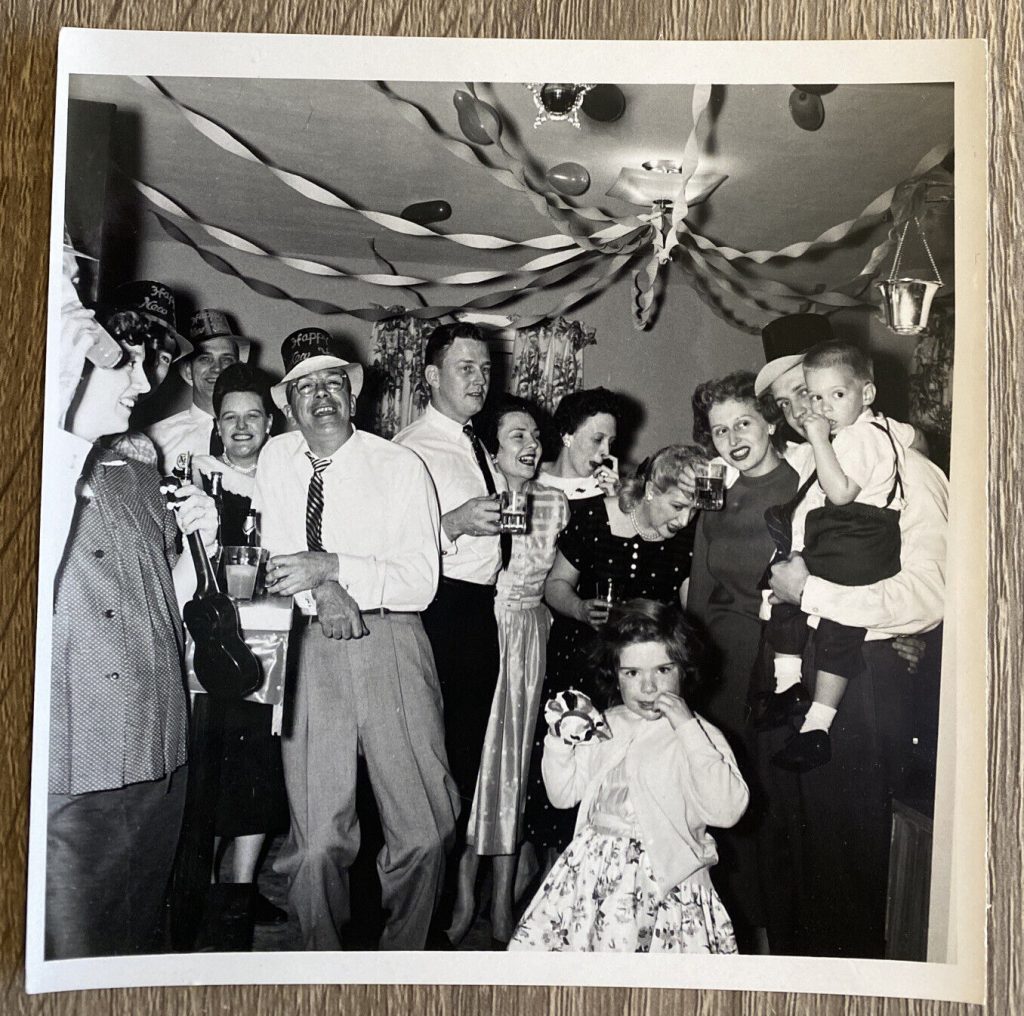
New Year Family Celebration 1950’s Britain

If these interpretations of Christmas and the New Year were explained to the general populace, their ‘programming’ from childhood is likely to resist any questioning; such is the unconscious power of childhood experience. The modern nativity and new year stories occur arbitrarily within the natural cycles. These children stories are unreal but are repeated without question. At the same time, fairy tales and myths (which are real) are described as unreal. This is the looking glass world which Alice ventured into.

In my view, this uncritical retelling of false narratives spills out into popular understanding and even ethics. For instance, exploiting rather than nurturing the natural environment, is a global policy that does not lead to fertile and happy communities. The erosion of natural habitats leading to reduction in the numbers and extinction of many species, I attribute to this dissonance with the natural world. We imagine it will last forever as that suits our modern self pleasing and comfortable way of live, but it will not.

Waking up from a dream is a slow and dizzying process. There are many who are casting aside these children stories that we were coaxed in our innocence with gifts and jollity to believe in. If our outer and inner ‘nature’ is ever truly understood, humans have a chance of being brought back from the abyss of shallow and false beliefs.

Francinsense, Gold and Err

Who Stole Christmas?

PREMISE

The Church Fathers have had considerable ‘editorial control’ over what to put in and what to leave out of the Holy Bible. So much was ommitted and added, so should new ‘adjustments’ not be accepted?

OBSERVATION

In 1872 a scholar named George Smith found something remarkable in clay tablets from Nineveh. He was reading in cuneiform the Epic of Gilgamesh in which is described the great flood, God’s punishment for mankind. The suggestion that the Great Flood described in Genesis was just a retelling from ealier Mesopotamian texts, shook Victorian society. They gave Mr. Smith a hard time, as if he was the problem.

Today there is considerable proof that many of the stories in the Old and New Testaments have been subject to editing. We accept that the dates for the Christmas and Easter festivals are not in the Bible. They have been made up. The date for the birth of the Christ child was decided to be December 25th but why?

The Infant Horus: picture credit World History Encyclopedia

Previous gods had been born on this date. There was Horus (Ancient Egypt), Mithra (Persian), Krishna, Zarathustra (Iran), Hercules, Babylonian god Bal (Nimrod), Heracles, Dionysus (Greek), Thammuz (Babylonian) Hermes (Greek) Adonis (Phoenician) and others. All were born of virgins.

If such a clear plagarism of ancient gods is disturbing, there is a logical explanation based on astronomy. December 22nd is when the sun disc halts its annual progression northwards along the horizon. It then pauses for three days and rises anew on December 25th. This natural phenomenon supports neatly the story of a solar god being born; not dying and miraculously resurrecting but being born at least. Perhaps the birth of Jesus does not fit the story and date of how the ancient gods had been born.

If we investigate the ‘blasphemous’ notion that the Christ child was not born at Christmas then we should be able to find another meaningful astronomical date in the solar year relating to birth. After all, should a Christian festival be based on the Pagan festivals and superstition? The church fathers did, we should remember, hate and demonise Paganism, although Pagans did no worse than love nature and each other.

SUGGESTION

I suggest that the birth of Jesus was in the springtime; the lambing season, when shepherds watched their flocks by night. Consider afresh, the Christian nativity narrative.

The three Kings or Magi seeking Jesus were astrologers. So excited by and certain of their prediction were they, that they set off to find him, I argue, in the spring. They ventured eastwards towards the star Sirius, which rises in the east in March in the northern hemisphere. With their learning they probably knew of the goddess ISHTAR from Babylonia who represented Sirius and was associated with fertility, love and war. Another clue for us today is that in the English language is the word Easter which breaks down into two words; EAST STAR. It also is remarkably similar to the word ISHTAR.

If we dig deeper into pre-Christian gods, we find that in Ancient Egypt the star Sirius was represented by the goddess SOPDET meaning ‘skilled woman’. She was important because her appearance signalled the inundation of Nile and the beginning of their new year. She was sometimes portrayed as a large dog.

picure credit: Tarot Aotearoa

Sopdet was associated with ISIS who was the wife of OSIRIS. Their son HORUS just happened to be born on 25th December; a holy family uncannily resembling a later one. They watch over us even to this day as Sirius (ISIS) in the constellation Canis Minor and her husband OSIRIS, the constellation ORION.

These curious facts add up to support the possibility that the Nativity occurred in the spring and the death and resurrection of Jesus the Christ in mid-winter. Certainly, Bible scholars are unable to qoute verses that deny this, as is anyone to confirm it. The Christian practice of using the festivals and stories of the hated Pagan gods, appears to be the only reason for Christmas and Easter being where they are today.

We cannot deny the association in popular modern culture of ISHTAR and Easter. As a nature godess, she is depicted with with hares and rabbits (famed for their procreative success) and eggs (product of the female hormone Oestrogen). Eggs and Rabbits were omitted from the Holy Bible and yet survive as symbols of birth happening at the time of the great initiator, Aries. Perhaps, some archetypes are too strong to supress.

ENDING

At this time of Easter, instead of celebrating the joys of spring, Christians mourn. Then, in midwinter they celebrate birth.

One wonders whether these important festivals, reversed for the wrong reasons, have unknowingly undermined the modern world? Knowing the basics of life and death, ending and beginning, should support rather than undermine what it is to be a human, whose life is dependent on natural cycles.

I cannot expect anyone to agree with my view but for me, this fundamental reversal of ancient truths has led to our misunderstand and abuse not only of nature, but ourselves.

The mystic Hildegard of Bingham wrote ‘wisdom awakens to wetness and greeness and flowing waters. Wisdom says I am the rain coming from the dew that causes the grasses to laugh with the joy of life’.

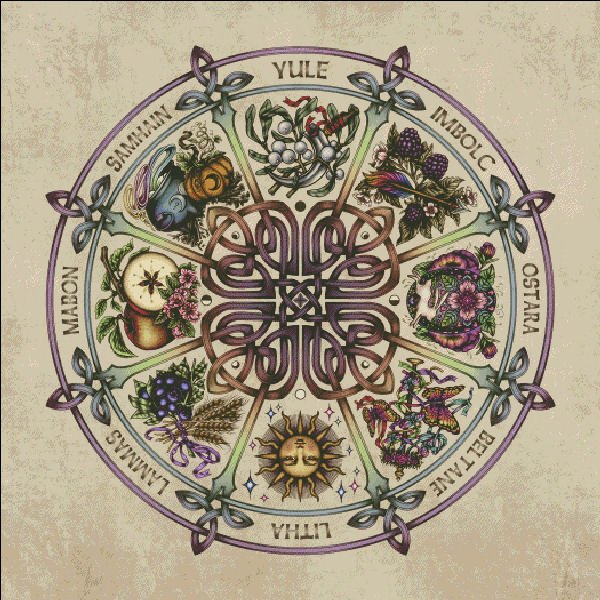
Pagan Wheel of the Year: picture credit Friends of the Forest

Happy Christmas!

Truth Against the World

or “Duw y Digon” ; an ancient Welsh Druid Motto

Swinside Stone Circle picture credit: Wikipedia

The first authority over our personal truth that we encounter is within the family. Losing power to others is an experience that we mainly survive, but should this loss influence us beyond childhood?

Most social organisation, whether it be for religion, employment, education, health, defence or politics, consists of submitting to the will of others; what is termed ‘the greater good’.

It’s a system that Western societies inherited from their forefathers. Consequently, most forms of government rely on the obsequence of the masses; the most extreme example being communism where the interest of the State trumps individual rights.

Even in democracies, the majority is granted authority over the minority; however small the difference. The assumed ‘unchallengeable constant’ is, that all people have the same intelligence, education achievement and wisdom. Socrates was at odds with such a premise two millennia ago!

The question is not whether to submit to authority or not. Someone, somewhere will have a hold over you. The question is not then, how clever are they? The challenge for all of us is not to give away all of our freedom but just to ‘render to Caesar what is Caesar’s’ (Matthew 22:21).

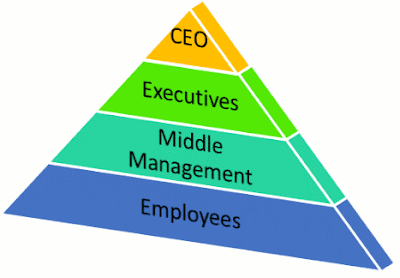
Authority manifests itself in social systems most commonly as a pyramid shaped hierarchy. In politics there will be an ‘overlord’ such as a President or Prime Minister, Chancellor or Chairman or Monarch.

Below the ‘head of government’ there are layers of middle ranking politicians. Unelected bureaucrats disseminate and legislate the strategies of the politicians. The general population occupy the lower part of the pyramid believing they are represented by those above and give away their power.

The military use an undemocratic system of organisation. There is a self organising ‘pyramid of power’. The organisation discourages individuals from thinking for themselves, requiring unquestioning obedience to orders from those higher in rank.

Take this ‘pyramid organisation’ model and transfer it to other social organisations and we see control by a minority of leaders;

Religions – Popes, Priests, Rabbis, Imams, Shaman

Companies – Managing Directors, CEO’s, Owners and Oligarchs

Education – Ministers of State, Head Teachers, Professors, Chancellors

Health – Ministers of State, Hospital managers, General and Specialist practitioners.

There have been exceptions to this ‘hierarchy of merit’. Google, for instance, practised an egalitarian approach to management for a while. At meetings, no individual oversaw proceedings. Each had a theoretical ‘equal say’. What happened in reality was that the person with the strongest personality and loudest voice controlled the meeting, rather than the person or persons with the best ideas.

So far we have considered how hierarchical organisations function. Now let us view the issue from another angle. Is it not the case that there have been in history, two types of leaders; good ones and bad ones?

This may sound trite, but it is an important distinction!

High ranking politicians for example, make promises about what they will do in government if elected. Few discuss the means by which they will achieve this objective. In this way, ‘making America great again’ fails to include a description of what greatness is, how it is going to be achieved and who is going to benefit. It even fails to describe what is meant by ‘America’. Does that include Canada, Greenland, Mexico and South America? Or does it just mean U.S. (us)? Such vague leadership is historically the breeding ground of disappointment at best and catastrophe at worst.

We know in Europe there have been good monarchs and bad monarchs. The last good monarch in England is said to have been King John of England (1166 – 1216). He was persuaded to give his royal power to his Barons. ‘Good King Wenceslas’ was good but European Kings and Queens were too often flawed by greed, anger, adultery, criminality such as murder, drug dependency, jealousy, war warmongering, excess tax demands, madness, religious dogma and bigotry, black magic and worse.

Good and bad are of course not always simple to define. In modern times political ideologies have split voters between the right and left. This is true in both the United States of America and an increasing number of European countries.

To summarise; in democracies people they to vote for who they regard as good leaders. The definition of ‘good leaders’ is unlikely to be agreed upon!

A creative thinker might desire moving power away from this divided collective schizophrenia.

A stabilising element of this unstable social organisation, is truth. For millennia, humans have obeyed whatever ‘truth’ those to whom they have given their personal power. They have been obliged to trust those who claim to be their superiors but in fact they are just acting out their weaknesses and lies! Hans Christian Anderson’s literary folk tale entitled ‘The Emperor’s New Clothes’ mocks the absurdity of delusional leaders and describes the masses failing to speak the truth to power.

Eventually, authority without truth, declines and falls. The Roman Empire is one of the best examples of this. So is there benign alternative to the many shades of autocracy?

In the North American indigenous tribes there was an interesting alternative form of leadership and wise counsel. People of the tribe would sit in a circle to debate important decisions on equal terms. To prevent them all speaking at once, a single feather was handed around in turn and whoever held the feather was permitted to say their truth without interruption. This was called ‘goose leadership’ after the manner of geese in flight that take turns to hold the point position at the front of the flocks V formation.

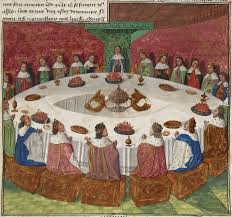
The legendary King of Britain, King Arthur, declined autocratic rule. He changed his throne into a round table for himself and his knights. In doing so he showed he was prepared to listen to others. Debate was valued for the truth of others, independent of their rank. Perhaps this was Arthur’s metaphorical sword of truth, ‘Excalibur’; released from stone hard systems of government.

As the internet today spreads it’s influence around the globe (another Round Table), disparate individuals try to speak their truth, honestly without fear or favour; so called ‘free speech’.

Humans of all races, have more in common than differences and thrive when not divided by powerful ruling minorities. Even the languages that once divided, are now being instantly translated by artificial intelligence. The ‘wisdom of the crowd’ is the ability of large groups of people to come to a benign consensus of how life is best lived.

A recent survey was made in the United Kingdom asking young people for their favourite word in 2024. It was not ‘artificial intelligence’, but ‘kindness’. The fact that the coming generation have this truth already in their hearts is good news for the population of the world in 2025…and world leaders would be wise to graffiti this word across their round tables.