
When there are libraries of books on religious, philosophical and spiritual knowledge, how ironic that three, two letter words may say it all.
One of the ‘philosophies’ of the highest natural wisdom is, in my view, Zen Buddhism. It is one of the few that embraces this counter intuitive notion of ‘being so’… of meals without menus.
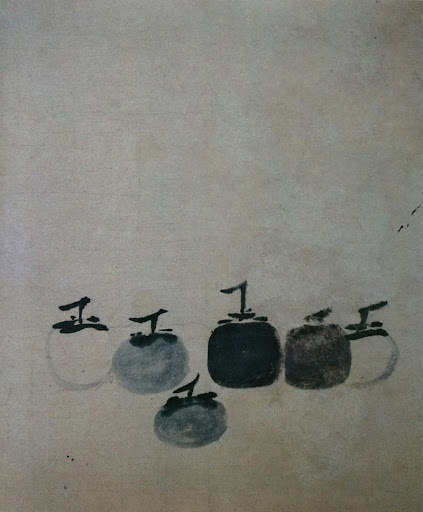
For example, the Zen saying ‘the bamboo is both long and short’ is not trying to be obscure or ironic. It just means what it says. It introduces the idea of ‘not trying’ to be in the apparent dualistic world of contrasts. Without contrast, the dualists argue, we would have no ability to understand through discernment. In Zen this assumption of a need to understand does not exist. Why should it?
The realisation of the ‘enlightened being’ as one who has mastered the monkey mind is found in many spiritual paths. But most religions do not suggest their followers believe in emptying the mind in order to realise it’s richness. Odd paradoxes like this deny the certainty that followers of religious dogma crave.
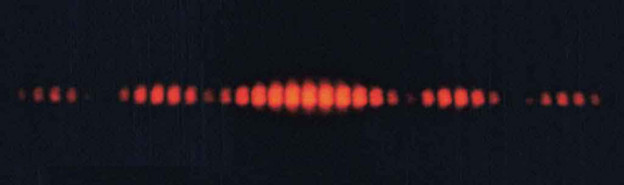
Today, nothing is certain in theoretical physics. Quantum physics is famous for the ‘double slit experiment’ where light either has wavelike characteristics OR particle-like characteristics. This is known as the wave particle duality and was hinted at even as far back as the 17th century by the broad thinking scientist, Isaac Newton. Light has two contrasting qualities just like long and short bamboo.
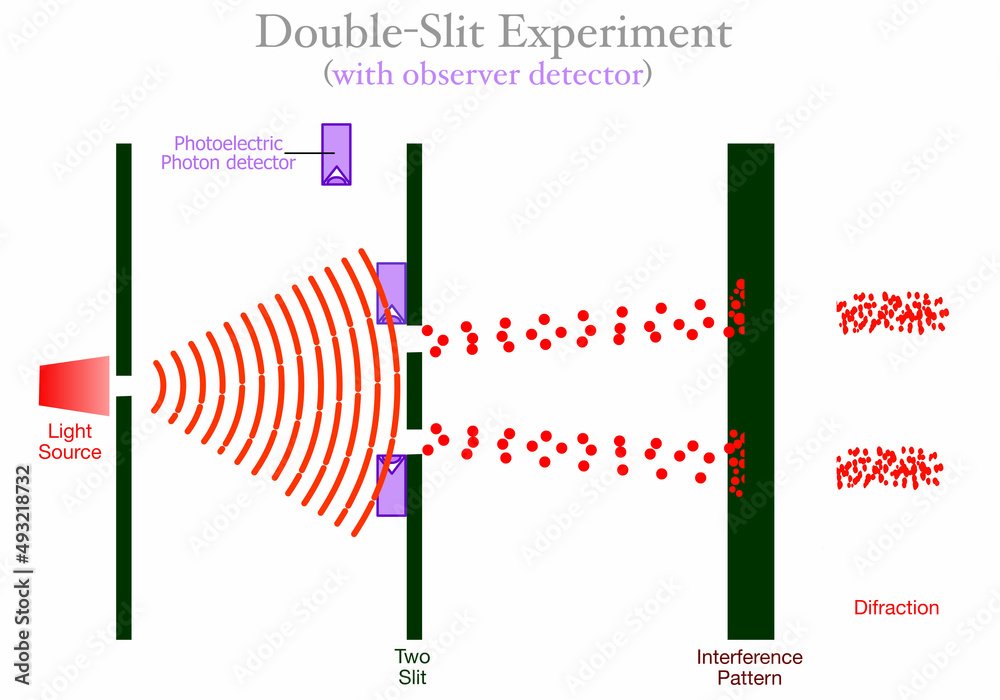
picture credit: Science Forums
When our perception is based on logical possibility, we are only capable of creating a ‘reality’ that fits our personal belief system.
The world that humans inhabit is largely of their own making. Difference exists where there is a sense of general agreement in a tribe or society of how things are. It is only by realising how what we make is what we see, that perceived ‘reality’ is revealed as deeply shallow to the point of illusory.
Religions rely on prayer as a method of manifesting desired outcomes. Since these are general ‘good outcomes’ in a moral sense, the believer is optimistic that their prayers might well come about. In the event that they do, this is recorded (an in extreme cases as a miracle) while the reality of prayer is that the desired outcome rarely comes about. People often ask how a good God can let bad things happen.
The reason for this is a matter of debate but there is an alternative to the more view that prayer is a ‘wish list’. This is described by Jesus in the quotation at the end of this essay; ‘Let it be so now…’ Jesus is saying that the outcome of prayer is instantaneous. The devotee will create the desired outcome instantly a prayer is offered using creative imagination. Should you pray for yourself or others? If you desire to save your own life through prayer it might be answered straight away, but otherwise fulfilling your selfish desires will come with a price tag known as karma.
Mystics such as Jesus the Christ and Buddha knew that ‘desire’ whether in prayer or other form, is an obstacle to pure living. For instance, Gautama Buddha realised that even desire for nothing is still a desire. He abandoned his experiment with aestheticism and returned to a normal or ‘middle way.’ Only as an observer with no bias, no story, no karma, can one see impartially, all the bamboo in all of it’s variety.
This Zen concept of ‘not doing’ is difficult for modern thinkers. Throughout history people have strived to do ‘better things’ and often achieved the opposite. ‘Civilisation’ is not the linear path of continual improvement. Most civilisations eventually decline and fall. Nature exists without the centralised political control that human societies have become dependent upon.
As in Zen, the act of thinking turns out to be just as ‘out of control’ as not thinking. The space between past and future, left brain and right brain, science and art, chaos and civilisation, certainty and uncertainty, thinking and not thinking are, in my view, the perfect places for the observer to be; ‘just so’ and ‘in the now’.
‘It is so’ is not dependent on imagination (art) or calculation (science) but the counter intuitive processes and complexity that are beyond understanding. Light bends, gravity bends even time bends. We live in an Alice in Wonderland universe which obeys few of the rules we impose upon it.
The phrase “stranger and stranger” encapsulates Alice’s bewildering experiences in Wonderland, where she constantly grapples with her changing identity and the bizarre world around her. In her journey into her own mind (the rabbit hole) Alice is creating a world which is complex and unexplainable. One moment she is tall and the next short.
The late Itzhoz Bentov understood this weirdness in nature and human consciousness and believed that ‘human consciousness is not a passive observer of reality, it is an active participant in its construction – not in the poetic sense that you create you own narrative but in the real physical sense that the state of consciousness of an observer measurably interferes with the behaviour of the systems it interacts with.’
The predilection in modern societies and religions for perfection in all things, are dangerous because the ‘control’ and ‘certainty’ (for instance in the development of Artificial Intelligence) is uncertain. Expectations are imaginary, appearing on our social media streams as ‘fake’ or ‘real’ by the power of computer-generated imagery and speech.
Perhaps this present time is now ripe for a new form of consciousness, not based on entitled expectations but on the realisation that ‘it’ already is so, and when it is not our thoughts can and will always make ‘it be so’ in an instant.
 Matters Blog