There used to be a car, in the 1950’s called the Ford Popular, endearingly known as the ‘Ford Pop’.
If the model T industrialised the manufacture or cars, it was still only affordable for the middle classes of America.
But the Ford ‘Pop’ bridged that class divide and provided a ‘people’s car’. Germany had done this in the 1940’s with the Volks Wagon Beetle, but Britain took a while to catch up due to a short ‘intermission’ called the second World War.
The greatest car ever built – Ford Popular 1954
picture credit: carandclassic.co.uk

What do you expect from a people’s car? Certainly it is not going to have a chilled drinks cabinet and cigar lighter. Everything was basic, functional and appealing to the common denominator of public taste, availalbe in black, black or black. It was, naturally, very popular and it transported families in comfort from city to beauty spot in large numbers. If you wanted anything other than a can of baked beans, you had to get a pay rise.
Fast forward to today and you can draw a parallel between the dumbing down from ‘the good life ‘ for a few, to ‘dull and ordinary’ for all. The middle classes in both the UK and USA lost their grip on political dominance, because the workers have come out in larger numbers to vote.
In the last decades of the 20th century, politics was complicated. Whilst you didn’t need a degree in political science to understand what was going on – it helped. The whole process of electing representatives on multiple – often contradictory – manifestos, parliamentary debate, Sovereignty, national priorities, international relationships and above all, law amending and making – was baffling to most. So it was left to the ‘Toffs’ from elite universities to speak down to voters in election campaigns to make promises everyone could understand – even if they were expected to forget them later.
Enter the internet in the 21st Century. Whilst you could write the equivalent length of Nelson’s Column on how this availability of information has changed societies across the world, there must be changes.
The most obvious of these is, in my view, the ‘citizen scientist’. In a stealth move worthy of the Great Harry Houdini, ordinary people who never understood science at school, are suddenly ‘on to it’.
If we regard science as a way of thinking logically about anything – using the ‘scientific method’ to prove or disprove propositions – then everything is up for change and challenge.
Call a friend?

Suddenly people were empowered to not believe their medical Doctors. You look up your symptoms on the internet and then go and tell your Doctor what the problem is how you want to be cured providing it does not involve vaccination. The UK National Health Service even encourages this by creating NHS call centres. The staff follow algorithms in the same way G.P.’s do – perhaps even quicker and certainly without having to catch another disease in the Waiting Room.
The same process has crept into most other areas of professional expertise; people design their own houses, people cook and bake, people make art, play musical instruments, make astrological predictions, indulge in puppy care and kitten care – you name it people do it – and the walls of Jericho surrounding the professional classes have fallen.
Great, you might think. This is democracy at it’s best. People power!
The problem is the obvious one and why even Socrates, warned against empowering the masses.
The problem is that people do not access and use information, knowledge and wisdom in the way that professionals have been painstakingly trained to do. As always it remains true that, things are more complicated than they seem.
It is easy to reduce areas of knowledge to ten ‘top tips’ – how to build your own house- and make it look easy. Speak to anyone who has built their own house and they will describe the most stressful time of their lives, going over time and over budget and still the roof leaks.
Socrates warned that ordinary people did not have the education to be trusted in such things as – voting. Perhaps this is one reason why women in the UK at the turn of the 19th century were still denied a university education and a vote – why this particular prejudice was suffered for so long.
Even with a university education, young men and women in the twenty first century are finding it hard to get a job. When the Blair government in the UK declared an aim to give a top class education to fifty per cent of young people, the ideal appeared noble. But the reality was that ‘degrees’ became so common that they were no longer the doorway into top jobs.
Worse still, with the introduction of University fees in the UK, young people were enslaved into a life time of paying off a high interest debt – all on the promise of ‘earning more’. And governments too are unlikely to get their ‘pound of flesh’ from the deal. Grants to the few worked better in my view.
In primary schools the children of the first decade of the twenty first century were told how clever they are and one day they might be Prime Minister. It was of course a lie told be people who had only become teachers who took holidays at home.
Only a few people ever become Prime Minister- as if we need telling.
The president of the United States for instance, has been described by psychologists as ‘adolescent’. Although he boasts of a ‘very, very, good education indeed’ – he didn’t listen in school and learnt very little. Add to being academically dumb, other short comings which doubters love to list, then you have a candidate appealing to those who are fed up with being talked down to because they are ‘very, very good people indeed’. Fortunately in America there are plenty of these in the southern states.
Trump uses short phrases to plug home a message easy to understand and remember for the masses;
‘Make America Great!’ ‘America First!’
Johnson does the same; ‘No Deal Brexit!’ ‘Project Fear!’
Their close advisers are no longer civil servants or even elected politicians. They are media savvy individuals who know how to change how voters and party members think. In the UK now there is not even a deputy Prime Minister the PM can discuss strategy with. Instead their is an unelected ‘close adviser’ to whom the PM remains loyal – at least until Brexit is over – despite protests from his own party back benchers.
But the patients have not completely taken over the Mental Health Institution. There is today a swing back towards trusting the middle class professionals. Self build houses leak, Mr Kipling’s cakes taste better, art is not easy. But particularly at this time of crisis, people have seen the highly trained men and women in the health services, battling away for little personal reward and realise, ‘I could not do that’.
Suddenly, the science of Virology is laid out like a patient etherised upon a table, and no one except the professionals understands.
picture credit newseu.cgtn.com

Because it’s difficult to ‘do the right thing’, science is emerging as a wise advisor to governments. When Boris Johnson gives press briefings he is flanked by non-elected scientists who give ‘advice’. This appears to be a correct and ethical process until you realise that there as many views on a subject as there are scientists. Scientists often disagree with each other’s ‘version of the facts’. They will say that more studies are needed, larger samples, more vigorous methodologies, new measuring instruments and technologies – innovation and discovery!
(A particularly cynical pundit will suggest that governments are setting up someone to blame, when the strategy is seen to have killed thousands because the government policy was late and or wrong.)
This dark secret of science is not so dark and we should demand to know it. Should President Harry Truman have been persuaded to build the Atomic bomb – ending one war and starting a cold one that sits like a dripping glacier, to the present day?
picture credit: atomicheritage.org
Is that a nuclear weapon or are you just pleased to see me?
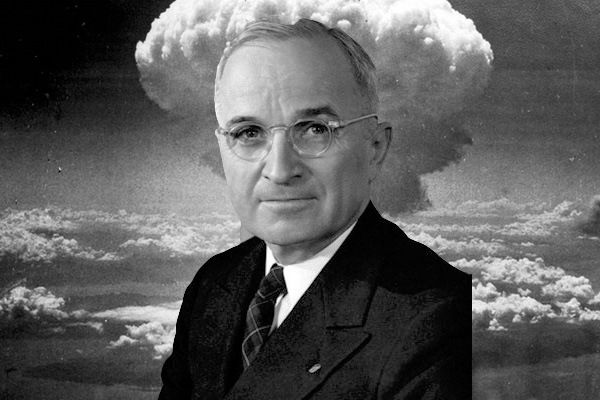
Who voted for the Atomic bomb? Certainly plenty of people protested against it in hindsight but knowledge, once out of Pandora’s Box, never wants to get back in.
Suddenly ‘the people’ see the scientists as doubtful holders of solutions to problems. Science has mucked things up just as often as it has created a better world.
And if you can’t trust the scientists surely you have to trust the politicians? Unfortunately there are as many political view points are there are sea gulls behind a fishing boat and the only thing you can be sure about is the direction of the boat.
So societies trundle into the twentieth century lead on by TV and radio personalities with regional accents – commoners who you can understand. Everything has been reduced to guessing games that requires no skill because the people tried science and it was even more difficult than at school.
If our politicians are also guessing their way along – without scripts, experience and the wrong pick of scientific views – is this the end of the light?
picture credit: author – unfortunately God moved.

 Matters Blog