Like many I have often thought about the ‘ego’ and how it fits in with a contemporary search for spiritual enlightenment.
Ego is a term originating from Sigmund Freud and has a technical meaning in psychoanalysis which I shall not include in this essay as there are plenty of psychology books for those interested in a clinical version of the idea.
It’s common usage in English today is to mean that a person is vain and has an unjustified high opinion of themselves, however when we use the word to understand ourselves or ‘what makes us tick’, it has a more constructive purpose.
Ego is Latin for ‘I’ and this sense of ‘I’ works to develope our feelings all through life. I is the observer who perceives through the five physical senses. But this very act of ‘perception’ includes unconscious filtering, predjudices and biases to support what we believe. If this process is unconscious, how sure can we be about the ‘I’ personality we build up through life? How authentic to truth are we?
Whatever ‘I’ is, we can be certain that it rules a great deal of our conscious behaviour; in fact – almost everything.
This is where ‘spirituality’ may start to appeal to a person; to fill this uncertainty and distrust of a fake ‘persona’, accompanied by a suspicion that there must be something beyond personality. The ego is unlikely to admit there is a higher intelligence to it but on surrender of egotistic desires a person can expand their consciousness beyond the everyday.
There are three words which come together to form this expanded version of who we might be; ‘body’ ‘soul’ and ‘spirit’.
It is simple to understand that we are in a body. This was one of the first learning hurdles we had as a baby even though ‘being just a body’ is another of nature’s illusions. You can lose your legs in an accident and still be the same person.
Soul and spirit have various definitions which I shall not explore here. Let us merely propose that beyond our body and senses, there is more that is not within the experience of being me, even if it is mysterious!
In many cultures and traditions the spiritual journey aims to reach an alternative to ego called ‘enlightenment’. Many spiritual leaders claim to have abandoned their egoistic desires and become enlightened. The past remembers such people as prophets and saints but enlightened people are alive today, even if they do not realise it themselves! Perhaps the most beguiling such teacher on the internet is Eckhart Tolle who is candid about his transition into a non-ego driven life and gives gentle and amusing lectures to modern audiences. He does not couch his teaching within terms of any religion unless there is a need to use a specific word or idea. The core of his advice is transferring self guidance away from the ego to the higher self while letting life just happen without needing to control it for desires.
There was a famous Sufi who was stopped by a friend in the street by calling out his name. The Sufi replied, ‘he has gone and I hope he never comes back!’ Dying whilst alive is not part of doctrine in many religions, preferring instead to promise reward after physical death.
In ancient cultures around the world such as Egypt, temples were built mainly for the purpose of placing initiates into a non-egoic state. From here they would leave the body and after three days, just as sun, moon or distant star light fills the chamber, return as a resurrected being. The gnostic Jesus of Nazareth referred to this as being ‘born again’.
One might wonder then what part the ego has in the spiritual quest. Well, clearly the process is not as simple as just abandoning ego.
The truth is that the ego has a particularly strong hold over us, something that it is easy to underestimate. The process of ‘dying’ is anathema to the ego and it will do almost anything to stay alive. Being ‘frightened of dying’ is common for the general population and understandable. We have a choice. Either to be haunted by The Grim Reaper all your life or ‘die before you die’.
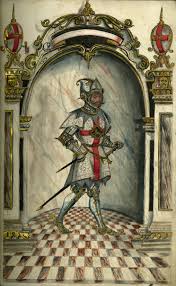
The Japanese Samurai in Feudal Japan were spiritually trained as well as being fearless warriors. They entered fights in which they were very likely to be killed for the simple reason that they had overcome the fear of death. What did it matter? The Templar knights in twelth century Europe went through a similar initiation process and were likewise, fearless warriors.
A Templar Knight picture credit Middle Temple
So when a person in modern times takes up the spiritual path and accepts that the final destination is an abandonment of ‘I’ and everything, the ego opens it’s playbook of dirty tricks. It will not give up without a fight to the death.
The most blatant of these is to transfer the feeling of ‘I’-ness into a new, highly spiritual ‘I’ personality.
When the ego is transferred to spirituality in this way, all hell can be let loose!
I once stood at a London rail station with some friends. We looked across the concourse to a large group of African Muslims dressed from head to toe in white robes. They were clearly performing the spiritual journey of the Hajj, bound for Mecca. The pilgrims strict dress code to wear white for humility and yet this group clearly ignored the spirit of the dress code. Their robes were over sized and flowing and their headgear voluminous so as to draw attention solely to project their imaginary high status.
The extremist armed groups of all faiths and political persuasions in modern times are twice as deadly and ruthless precisely because their egoistic sense of being ‘right’ holds power over others. The fact their their evil actions are the opposite of the religion their profess blinds them in a way that only the ego knows how to do.
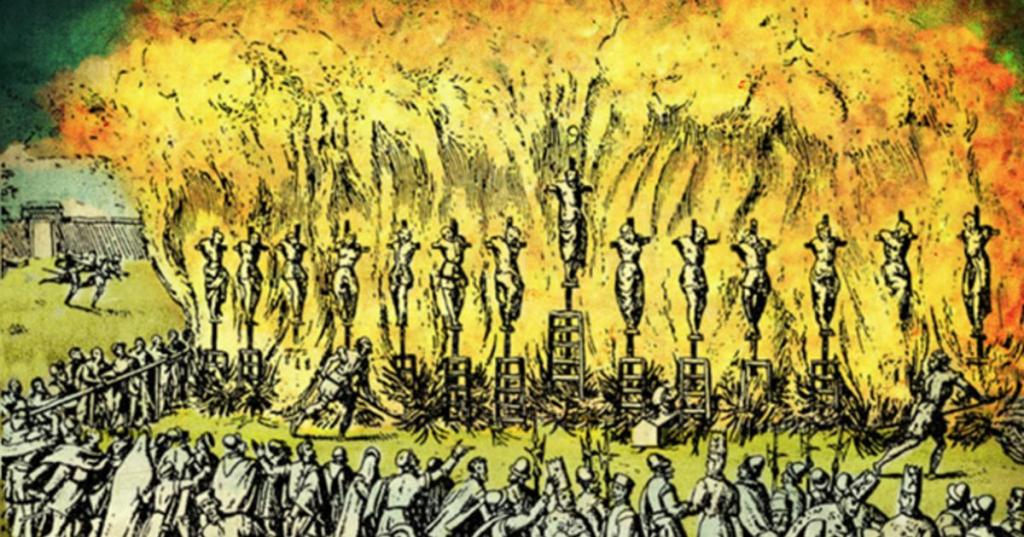
The Spanish Inquisition operated what we might call today a ‘death squad’ against all the Christian principles of compassion and love, for over three hundred and fifty years.
picture credit: Ancient Origins
Even peaceful looking cross legged gurus and self style ‘god men’ in India and other with strong spiritual traditions, may secretly hide the fact that they have simply adopted the appearance of being spiritual for a variety of non-spiritual reasons. These might range from obtaining money and property, sexual exploitation of naïve followers, illusions of self importance and power over others.
Their conman techniques include dressing up elaborately clothing, hypnotic music, chanting and dance, illusory tricks such as surgery without incision, strict regimes of ritual, unquestioning obedience, removal of individuals from family and friends, shaming and praise and a thousand other deceits and conceits. It is the pyschology of the cult which promises a way to overcome personal egotistic desires but replaces them with the egotistic desires of the guru.
When ‘abandoning ego’ we are as vulnerable as a crab without a shell and great care is needed to value the role of the ego as something that keeps us going in a difficult even dangerous world. Ego is not something to be abandoned without something more real and more reliable to replace it. It is after all, the motor that gets us up in the morning and sustains us however frail and feint we may feel.
Perhaps the middle way is not to abandon egoistic ‘desires’ but to come to terms with them in such a way that our ego does not pull our higher self along like a dog on a lead. The path to perfection is to separate our consciousness from the ego as described in gnostic teachings. In this state, the ego must do as it is told be the highest benefit of oneself and others.
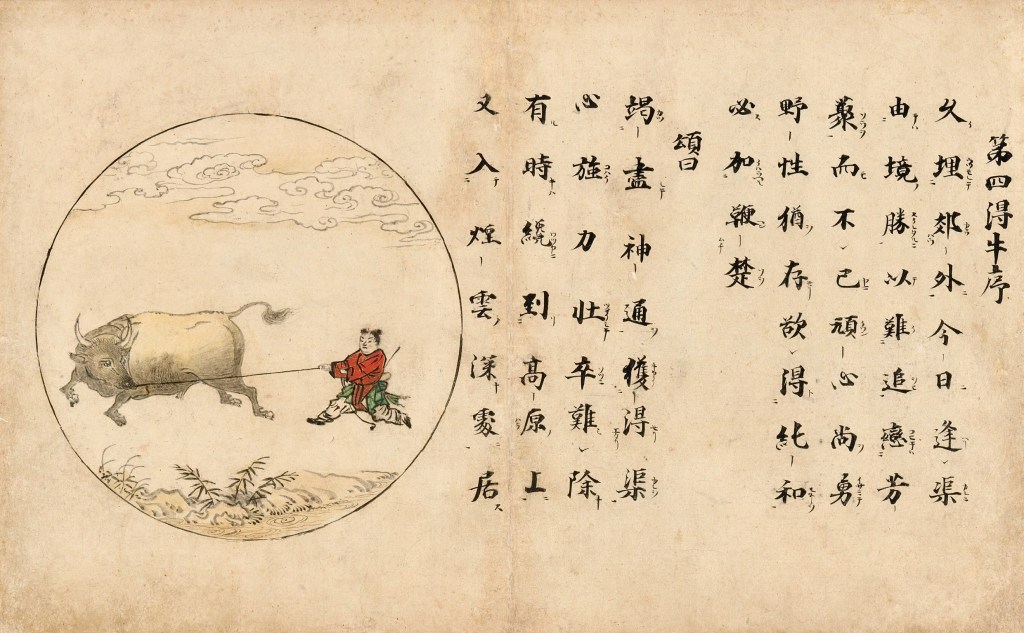
There are a series of paintings in Zen Buddhism which describe this process, one part of which is called ‘taming the bull’ where the bull is our ego.
Taming the Bull picture credit: thedawnwithin.com
The whip and rope are necessary,
Else he might stray off down some dusty road.
Being well trained, he becomes naturally gentle,
Then, unfettered, he obeys his master.
From “Zen Flesh, Zen Bones” by Paul Reps
The rider of the bull is then, that part of ourselves that has become separate and yet still connected to ego or ‘I’ ness. A connection to spirit without destroying the grounding ego gives us, is achieved through strict objectivity in attention and awareness, just as in the expression, ‘in the world but not of it.’
This enables our state of being to move into the ‘higher-self’ or ‘infinite consciousness’; our eternal and infinite connection with ‘all that is and ever shall be’ . It is attained not by the ‘achievements’ that we are encouraged to aim for by society, but by removal of our ‘imitation self’ or ‘personality’. Surrender, non-attachment and the knowledge of forgetting, are just three tools from the wisdom schools of the past which steered seekers of self knowledge long before the modern schools of psychoanalysis and psychiatry.
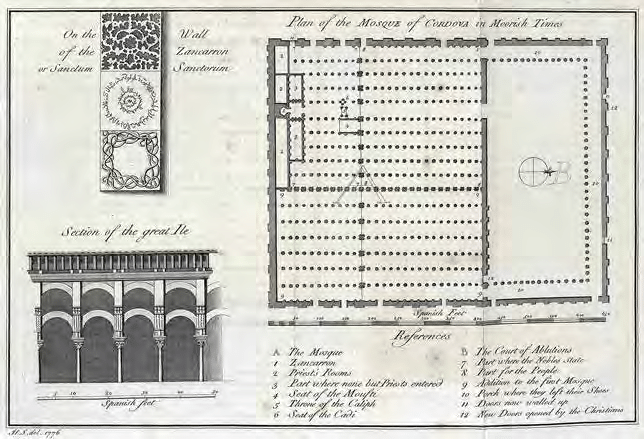
My first visit to the mosque in Cordoba got me into trouble with the security guard. It was winter and I entered wearing my hat. I was approached and told to remove my headgear. I considered this rather odd as covering one’s head is mandatory in a mosque. But then when you look at the guide book it calls the mosque a cathedral for the reason that there is indeed a cathedral that was dropped as if lowered from outer space, through the ancient roof of the mosque.
As soon as the guard was out of sight, I replaced my hat. Hats on or hats off, women hats on, men hats off, in my heretical view, is a product of imagining unreasonable rules by those who do not know. On that note, the following essay may also appear to be conjecture to which I would humbly request that the reader suspends disbelief. There is much being discovered from our ancient past at this time and buildings such as the Mezquita in Cordoba are perfect places to go and experience for oneself.
If one were to construct a holy building, meaning not just for shelter, it would have to embody both matter and energy. But some energies are beyond scope of scientist’s instruments. There is plenty of evidence of manipulation of energy by and through buildings in the past.
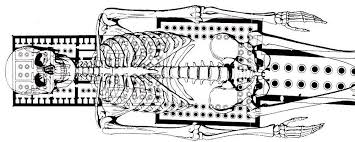
We need not look far for examples. The ancient Egyptian sacred buildings, such as the Osirion Temple at Abydos or the Temple of Luxor, copied the sacred proportions of the human body. The energetic and physical functions of the building were designed to be proportionate to and reflected the energetic and physical functions of the body. Much of the work of the French Egyptologist R.A. Schwaller de Lubitcz gives many examples as in this illustration. The legs are the two lines of columns at the temple entrance working through to the head which is the altar and initiation chambers.
With this understood at least as a possibility, I would like to use the Mezquita in Cordoba in Southern Spain as example of a ‘living’ building energised by spirit.
It is to be found in the old town of Cordoba beside the River Guadalquivir; a waterway that was once navigable to the Atlantic Ocean.
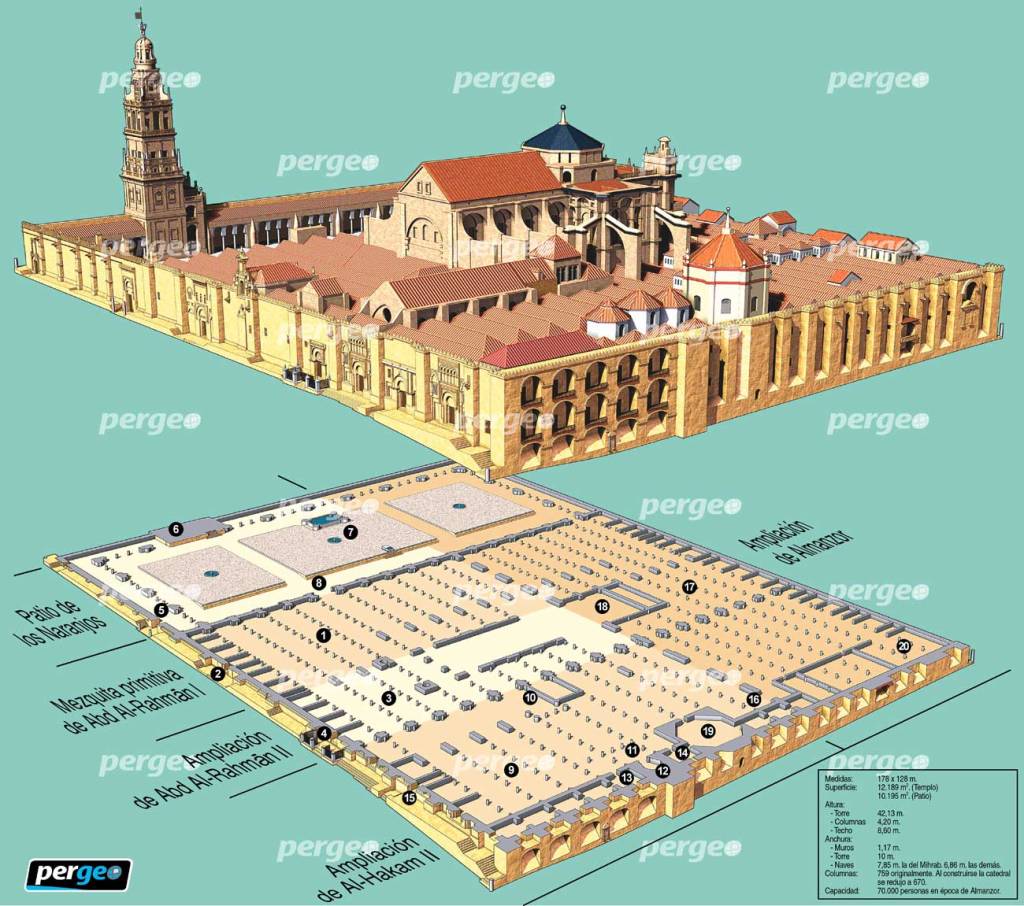
This grand building was built in Al-andalus in Southern Spain between 784 – 987 B.C.E. It was expanded at various times, to accommodate growing congregations. It’s functional layout is similar to a modern industrial building allowing it to grow. In 1236 under the King of Castille and Leon Ferdinand III, the city of Cordoba was captured. The mosque was repurposed as a cathedral.
The Mezquita garden is a landscaped courtyard with fountains and a cistern, presumably once for ritual ablution before prayers. The planting is principally standard sized trees in a regular pattern resembling an orchard rather than a forest. This theme mirrors the rectangular grid of the mosque’s structure. A rectangular grid of columns supports double arches and a high roof.
This then is a brief description of the of the mosque as it appears materially. Now let us move on to consider ‘energy’.
picture credit: Lions in the Piazza
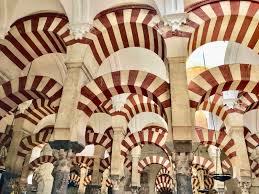
The first thing you notice when entering the mosque are the red and white arches supported by marble columns, recycled from Roman and Visigoth buildings. These columns do not reach the desired height of the roof so a higher arch sits on top of the lower arch. This is an unusual engineering solution but there is a possible explanation that these columns were selected for another reason than for practically. They were made by the Romans from various types of stone but principally polished marble, jasper, porphyry and granite.
All of these stones contain quartz to varying degrees and from the energetic viewpoint, this is significant. Quartz is piezoelectric mineral, meaning that when compressed, the geometric structure of the atoms squeezes out positive and negative electrons producing a voltage across the stone. The voltage is proportionate to the amount of weight on the pillar, hence one might conjecture, the unusual second arch above the first. Structurally, the second arch has no other purpose than to add height and weight, evident because these arches are only used in one direction of the grid where the weight of the roof is supported. This device of increasing weight to increase the electric potential of columns is evident in much sacred architecture. At the Gobleki Tepe temple in Turkey, standing stones are T-shaped, at Stonehenge in England they have lintels and the pyramids of Egypt compress pink granite lined chambers. The ancient Egyptian temples such as Luxor contain an excessive number of columns to support the roof. All around the world and throughout time, sacred buildings are structurally over designed which is in my view is to produce electric potential.
Electricity works closely with magnetism, for instance inducing magnetic fields when an element such as iron moves through an electrified copper coil as in a simple electric generator. We are familiar with electromagnetism but not the as yet undiscovered organic force known as Chi or Prana in the east and Ether or Orgone in the West. It is this as yet unscientifically proven energy that is connected with the spiritual effects it has on the human body and soul.
So to the return the Mezquita, do these arches remind you of horse shoe magnets? Indeed, the typical shape of the arches in Islamic architecture is called a ‘horseshoe arch’. If an arch and it’s two columns are electrically charged, then one column will be positive and the other negative.The grid plan supports this hypothesis, as it connects these opposite electric poles in series, in the manner that batteries are connected to produce more amps at the same voltage. One can go even further if we include the fact that human bodies also contain an electric charge which in a mosque are again aligned during communal prayer. Could males be separated from females not for religious and cultural reasons, but to configure human experience?
Do the red and white patterns in the arches physically mirror the anodes and cathodes in the whole design at least symbolically? If human electricity or bioelectricity sounds beyond scienctific acceptance then the work of Sally Adee confirms we are indeed walking light bulbs!
Any person who has attended an event where a large number of people congregate such as a football match, know that the ‘atmosphere’ during that occasion is not experienced by those who are physically removed from the event and watching on television.
When large numbers of people congregate they are capable of producing powerful sounds. At a football match, the compression waves from the chanting and cheering is capable of boiling one pint of water; a small amount in terms of heat but definitely an effect. So one might wonder whether the compression waves in air from sacred chanting and music is sufficient to produce a piezoelectric effect in stone?
Consider a human body which is constantly vibrating at certain frequencies. Through resonance each person is able to resonate with others during in prayer and meditation. When this is performed as a ritual performance in a sacred building, the context amplifies the effect on each individual. In this way worshippers of any religion have their frequency raised which they experience as an uplifting of spirit in a heart centred rather than a head centred way. Although there is hardly room in this essay, I should also suggest there is the whole subject of healing that has taken place at sacred times and places, sometimes at the level of miracles.
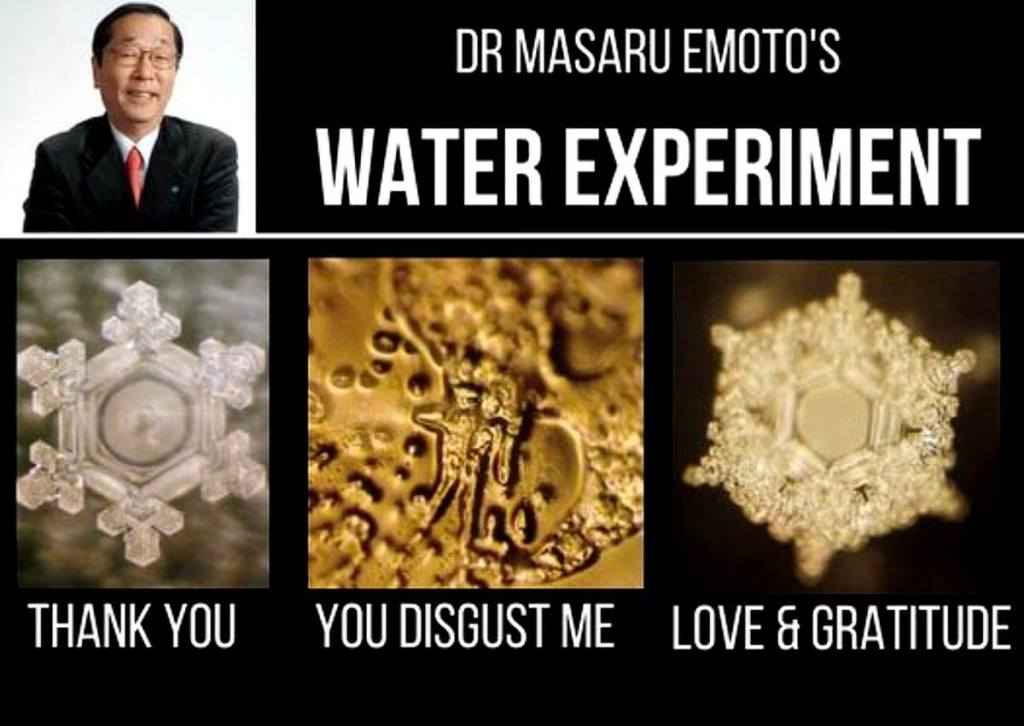
Consider the original plan and physical location of the Mezquita. It is aligned so that the congregation face Mecca in a south easterly direction; 100 degrees and 5 million yards away. Consider the thought that the prayers of the faithful, were directed into the flowing waters of the river Quadalquivir. A controversial scientist of today, Masaru Emoto discovered experimentally, that water records words and thought as changes in it’s molecular structure. Such resonances through prayer of love and beauty may well have been intentional?
Picture credit: Venerable Master Chin Kung
As well as sound we should consider every type of wave in the electromagnetic spectrum. At a lower frequency than visible light are radio waves which in themselves are strongly connected to crystals. The early radio receivers needed no battery, just a quartz crystal, an aerial and electrical earth. An operator could listen to the waves of an radio broadcast using headphones. Conversely, a slice of a quartz or galena (lead sulphide) crystal, works as a microphone in response to sound waves and sends a modulated signal through insulated copper wires. This shows that even a tiny pressure from sound in air produces a response in crystals. A forest of columns containing crystal in a mosque is therefore something not to be underestimated in it’s effects on the human energy field and through that, perception.
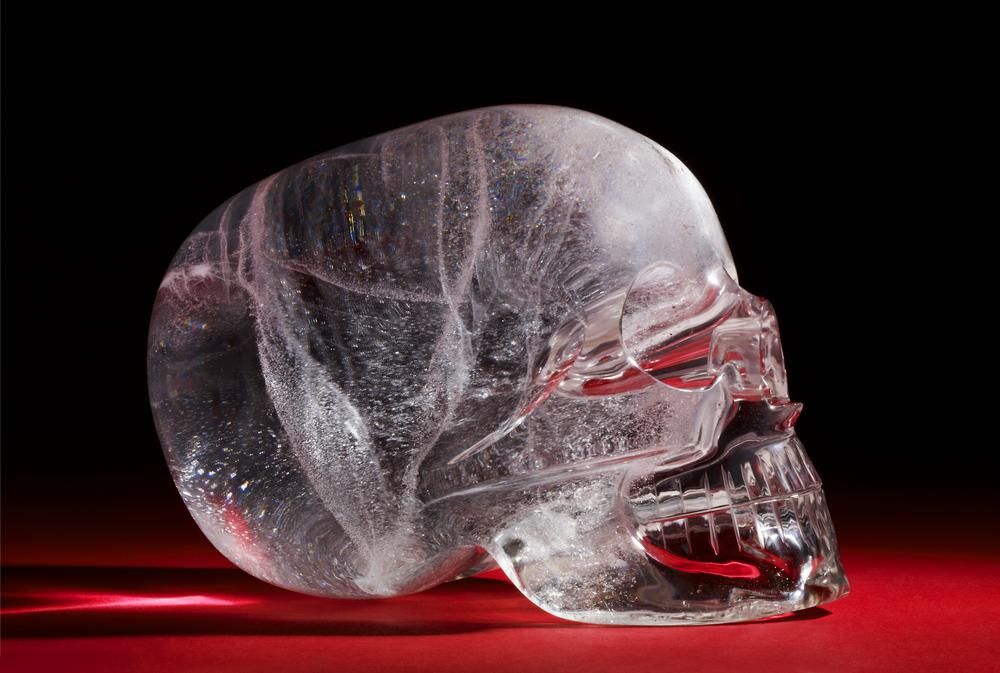
Let us look far away for an example as this effect is not as far fetched as it may at first appear. There are in existence thirteen quartz crystals carved into the shape of human skulls.
One such skull is on view in the British Museum in London, England. I have been to view it and found it exhibited on a sultry landing in a stair well. It had been removed from the Aztec gallery on the grounds that some marks from modern instruments had been found on it when viewed under a microscope. The conclusion was made that the skull was made in the same moment of history as these instruments. In my view this is false logic as any object can be altered at any time in history. Work at a moment in an objects existence does not suggest when it was made . It’s the same false logic from archaeologists who find a skeleton in a dolmen and assume the dolmen was made for that burial.
If we can accept that we do not know the age of these crystal skulls then they could be any age including from the Younger Dryas event and even pre-deluvian times.
To quote Daryl Anka from You Tube Twin Flame – the Forbidden Connection;
In Atlantean times the council of 13 would sit in a circle around the master skull and they would sing; they would chant to it. The idea of Tibetan chants is a hand me down of a memory of the idea of using vibrational resonance through chanting to release information from the skull.
In other words, the quartz crystal not only act as ‘microphones’ absorbing sound energy containing information and converting it, but also ‘speakers’, emitting information.
Could granite columns act in the same way when stimulated by the collective chanting and energetic vibration of a congregation? Quartz crystal is silicon dioxide or (SiO2) and silicon is used in the memory of modern computers as a chip. It works by using billions of microscopic switches called transistors on a silicon base to control electrical current, processing data as binary 1’s and 0’s, functioning as tiny logic gates that perform calculations and execute commands.
Whilst granite columns are clearly not computers, could they work in a similar way to store information for later release to following generations?
I shall quote Daryl Anka again from the same video;
The arrangement of the atoms within the crystals is a representation of information storage in terms of how light courses through the crystal…sound can release the idea of information by hitting the right note and pattern / chord key…and it can actually release the information by vibrating the molecular matrix so as to allow the information to come out.
So the key energy in this arrangement is sound and if you consider sacred buildings around the world, sound is an important feature of worship whether it be bells, organ pipes, chanting, choirs, congregations singing and intoning.
The Mezquita in Cordoba during a storm
A largely unknown and curious example of this are the gargoyles featured on Gothic churches and fashioned as devilish creatures with open mouths. These functioned not only to scare evil entities but to channel rain water but contained within some are precisely carved resonant chambers. These ‘squeeze’ the sound of bells and project it in an amplified form for long distances. Salisbury cathedral in England is an example and the scientific principle used is a Helmholtz resonator.
A Helmholtz resonator is an acoustic device, like an empty bottle, that resonates at a specific low frequency, acting as a mass-spring system where air in a neck (mass) oscillates against the compressible air in a cavity (spring). It’s used to analyse sound (by isolating specific pitches) or control noise (like in mufflers or rooms) by absorbing certain frequencies. The resonant frequency depends on the cavity’s volume, neck length, and neck area.
Source Google AI
Returning to Cordoba and the Mezquita, we know that custom for Muslim prayer is first to perform an ablution. This is not only to remove physical dirt but spiritual dirt in the form of conscious entities known as Jinn in Islam or Archons by gnostics. These can be detached from one’s energetic body by washing and sacred incantations such as the call-to-prayer, prayer and recitation.
Imagine then the possibility that sacred sounds in whatever form are absorbed and emitted by a place of worship and meditation, in the way of a simple microphone and speaker. If one can suspend judgment a little further, then consider this extract from ‘Crystals and Stones’ on You Tube by Bashar,
…crystals – the chamber (in which they are built) resonate in such a way as to imbue to you whatever information they have stored in their molecular matrix that you are open to receiving.
The reference to ‘open to receiving’ is important, as we know that people are not necessarily aware of the effects of unseen energies upon their mind, spirit and body. For instance, the earth emits a sound at the frequency of 7.83hz known as the Shumanresonance and experiments have shown that this creates an Alpha wave state in the human brain.
AI Google gives this concise description of this state of mind. Compare it as you read, the state of mind of congregations at prayer,
Alpha waves are brainwave patterns (8-12 Hz) common during relaxed wakefulness, like daydreaming or meditating, acting as a bridge between focused (beta) and drowsy (theta/delta) states, promoting calmness, creativity, and efficient information processing by inhibiting distractions and enhancing mental clarity…
If quartz in granite columns is recording sound vibrations from nature and humans in sacred buildings, then this information, this memory, is present from the previous days, weeks, months and even years. Are our ancestors talking to us and if this were true, then would you not also record your culture’s information, knowledge and wisdom in some indestructible for those who come after you?
When science has the instruments to measure and interpret information contained in crystal bearing stone such as the red granite lining the inner chambers in the Pyramid of Ku fu, then we may understand the purpose of using such particular stone, because at present we do not.
My experience when dowsing, is that sacred buildings such as the Mezquita in Cordoba are highly energetic. The intention in it’s choice of building materials and construction was in my view, to imbue a received meditative state of mind and feeling of closeness to Allah in those who enter the mosque. There is no need even for worship to be taking place to have this experience for the stone pillars emanate an form ofq bio-electromagnetic energy which is an as yet, undiscovered energy to which humans naturally resonate in their own bio-electric field or shall we say, chakras.
I should include another important source of energy in sacred buildings which is from the earth on which they sit. It is significant that worshippers in a mosque stand in regular lines. They have removed their footwear, not only for cleanliness but also to make sure they are electrically earthed. Some more sensitive souls carry metal tipped walking sticks for this same reason for a build up of energy requires controlled discharge. Beneath the mosque are tellurgic currents associated with water; remembering the mosque is sited next to a significant overground river.
Whilst dowsing in the courtyard gardens, I found a spiralling spring under the present cistern and fountains. Such currents will certainly extend into the mosque itself and connect with the bases of the granite columns.
This energy can rise in a spiral around the columns as depicted in Freemasonry as symbolic columns named Boaz and Jachin. These formed a ‘portal’ into the Temple of Sol-om-on, a ‘third space’ between sun and moon or masculine and feminine in which was to be found completeness.
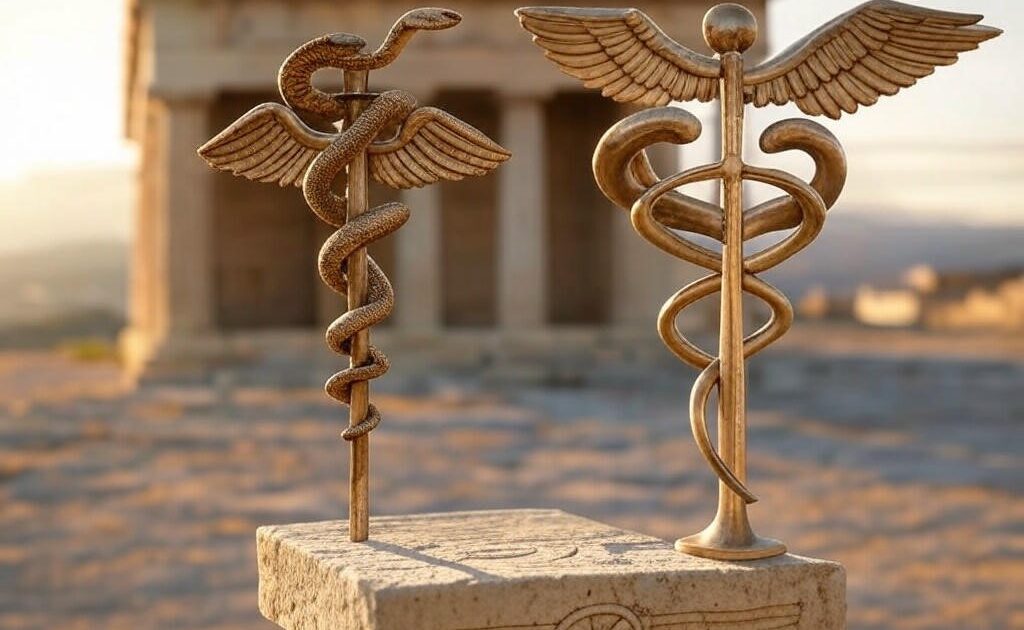
The Healing Rod of Asclepius picture credit: Greek City Times
It is a fact known to the Knights Templar and Freemasons who inherited the practice from the Ancient Egyptians, that most sacred buildings around the world are placed over global, regional and local nodes of tellurgic current. It should also be noted when considering the properties of granite that it can be naturally magnetic when containing magnetite or ilmenite. The darker or metallic coloured granites exhibit this property most and there are many such columns in the Mezquita.
Many sacred buildings connect visually with ‘heaven’ or the sky by means of a tower or spire. A minaret was added to the Cordoba mosque in 958 BCE. Such high structures were built not only for the call to prayer by the muezzin, but to connect the entire complex with positive and negative ions in the atmosphere, notably moist thunder clouds or the hot dry air of summer. Most dramatically, lightning seeks high buildings to discharge into the earth. This effect was utilised by the ancient Egyptians when they built pyramid topped granite obelisks some of which have been relocated to European cities such as Paris, Rome, London and Washington DC. The city of Washington has an interesting street plan likely to be designed by the Freemasons within which the ‘Washington Monument‘ plays a key role.
Such macro views resemble in a fractal pattern, the layout of micro circuit boards and transistors. Modern science is catching up with ancient science but at micro scale as in quantum mechanics. The statue of a god in the Greek or Egyptian Temple which gods found irresistable to enter, is today known as Artificial Intelligence and is already equally potent.
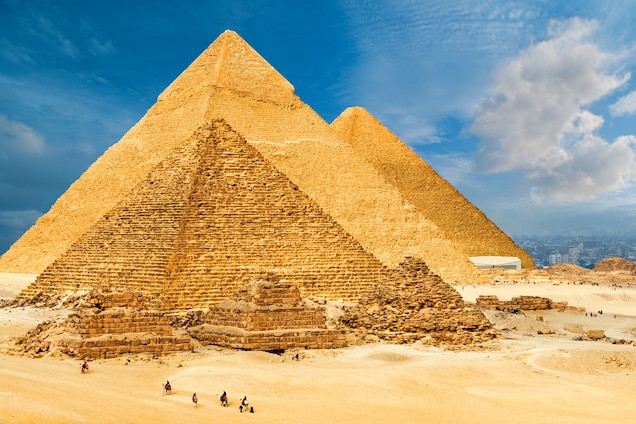
The pyramid’s geometry both discharges and collects energy from the atmosphere and the heavenly bodies particularly at certain astronomical alignments with the sun and constellations. The pavement surrounding the Great Pyramid of Kufu in Giza is said to have a surface of fulgurite a stone produced by the action of lightning striking the earth.
To ‘reverse engineer’ the energetic qualities of buildings from our past is an inconclusive enterprise. It is hard to convince others as present day knowledge does not consider the energetic characteristics of buildings in any depth. The task of convincing others is left to people who are sensitive and responsive to changes through feeling qualities in their body, mind, emotions and intuitions when entering sacred buildings and places.
It appears to me that we are metaphorically trying to extract the sword of truth Excalibur from the stone of ignorance. Never the less, I do believe that there are many minds open to the suggestion that buildings have a powerful influence upon us and if one of two of the ideas here presented make your gargoyles resonate; listen.
Gaining knowledge from the past and present buildings are a gift to us that we would be foolish to ignore, for when the sword is finally extracted it might well make kings of us all.
‘To be conscious in this world is a prerequisite to be conscious in others.’
In recent years many people have ‘awoken’ to spirituality. Perhaps this from a rejection of religious dogma and the availability of spiritual ideas via the internet.
But what it appears to me is often missing in this spiritual revival is an emphasis on materiality. This may sound contradictory but read on.
In many spiritual traditions, one of the first realisations for the aspirant is how important the physical world is. The physical does not cancel out the spiritual and visa versa. From a non-dualistic perspective, the two are complementary, not mutually exclusive.
So before heading down the yellow brick road on one spiritual path or another my personal advice would be to take time to embrace everything practical and become healthy, wealthy and wise in the process. Controversially, I will say that to aspire to physical poverty as do many monastic traditions, is to aspire to spiritual poverty, as in the Hermetic law of ‘as above, so below.’
For me, aestheticism is a poor role model for those seeking enlightenment. Nevertheless, monasteries and nunneries in many countries are occupied by people who avoid being ‘in the world’ presumably in the belief that this puts them ‘on a path to enlightenment’. In practical terms, it is substituting difficulty with institutional routines. The intention to ‘be spiritual’ is sometime the root cause of never finding spiritual meaning in life.
In the Zen Buddhist stories from the East, a young person enters a monastery with an expectation to become spiritually enlightened, perhaps in the first few months or a year or two! Spotting this, the Zen teacher sets them to work in the monastery kitchen. When the meals are over and before the preparation of the next, the novice is given a broom and told to start sweeping. This carries on for years. If the aspirant’s ego gives in after years of being excluded from the spiritual rituals and routines of the monastery, they are appointed Abbot. The teaching was and is, learnt in the kitchen and dusty hallways, not the temple.
The Zen Master Dogen, wrote a practical manual entitled ‘How to Cook Your Life’. It drew parallel lessons between cooking in the monastery and spiritual training. It is available from Shambhala Publications.
It is easy to take physicality for granted, but this three dimensional ‘reality’ is a place where spiritual beings are sent to learn faster and more profoundly than it is possible in other dimensions. This process is known by Christian gnostics as ‘the Creator self knowing’. Certainly, physicality is not a life of ease. Whilst there is beauty and happiness, there is also ugliness and despair.
We would do well not envy the lifestyles of the wealthy and powerful in society who appear to have an easier life than those who have little money or power.
The love of money, as is said, does not bring happiness. Often we see that the poor have a much better chance of growing spiritually than the rich. Possessions are supposed to be bad for spirituality but the benefit is more in your attitude towards possessions and how this is reflected in yourself. Dressing up as a spiritual person, does not make you one. The best philosophy is to be in, but not of, this hologram of physical illusions.
For a person living in our time in a ‘developed’ country, what could be a rewarding spiritual path? As a perhaps unexpected metaphor, consider the ‘boot camp’ style of military training. This starts with the aim of breaking down the ego of the recruits with repeated humiliation. Only after weeks of physical and mental ‘beasting’ is the pressure reduced and replaced with constructive learning. This focuses on polishing boots, pressing uniforms, and keeping personal space clean and orderly, to a level of almost impossible perfection. The point is clearly not the physical tasks but mental resilience in order to excel in an endless cycle physical challenges. What is life if it is not a similar tumble drier of trials?
Members of Royal families face similar challenges, but in contrast to most of us, in an environment of opulence and wealth. Royal children are brought up to serve their nation within the parameters of strict protocols, not personal desire. In return, their every physical need is gratified by servants. Running the bath and cleaning up after the Corgis, royals do not learn. Here, ironically, having few or no physical challenges can be as spiritually disruptive as having too many.
A similar regime of service combined with wealth, governs the lives of high ranking officials in industry, government, and even religious orders. Wealth and power, can become an enormous distraction and many fall from office and spiritual grace through selfish greed.
So what of the ordinary human being who is not wealthy or powerful?
We might start with two aspects of our lives. Consider the physical body and the environment in which the body lives.
The human body is a miraculous and superb creation. You are only given one per lifetime so in my view it is important to treat it with the deepest respect. Jumping from aeroplanes and bridges for excitement is in my view disrespectful to your most sacred gift. Surely, we should be treating our body as if it were a prize race horse?
‘Horse Race’ picture credit: Museo Nacional
For the same reason, every aspect of the physical world is important to the spiritual aspirant. Simply put, every life lesson learnt in a human body, is a lesson that can be applied to the astral or spiritual body.
At the present time there are many ‘spiritual advisors’ advocating moving from this present three dimensional ‘reality’ into a fourth dimension or ‘new Earth’. Dolores Cannon had many insights on this process when she was alive. It is held that those not ready for this transition will not notice any change, and those who are prepared will move quietly ‘on’.
If this is possible and if this is what they want I wish them well. However, personally I regard the greatest challenges and rewards to be firmly here on Earth. Changing the scenery in a theatre does not change the characters or the plot.
In my view, having a deep respect for nature is probably the most important spiritual quality for individuals and human collectives at this time. To watch forests and animals and precious ecosystems be destroyed to support human ignorance and greed is heartbreaking. Similarly, war against one’s brothers and sisters on earth is anathema to spirituality.
We occupy the human learning fields in the present time. To leave this full-on learning environment at the time of it’s greatest need, is to leave an unpaid debt to future generations. I suggest that if we cannot master the fine balancing act between physicality and spirituality, we should at least give our children a chance to do so. Nature rebuilds eco-systems without help from humans, it is all a matter of how much damage has been caused and will an ethical case be made for protecting nature whilst it recovers?
To stroke an elephant or watch a lion sleeping in a tree are both physical and spiritual blessings; one gives life to the other.
Western science has many new discoveries to make. The key to unlock the unknown is the simple question; ‘what do we not understand?’
For example; ‘we do not understand energy that is not electromagnetic.’
Such energies must exist as biological energetic processes called ‘life’, have no explanation. We do not have to look far into history and the present day to find indicators of knowledge of another type of energy. In ancient India it was called Prana, in Ancient China – Chi and in Ancient Japan -Ki. In the West it was named ‘Orgone’ by Wilhelm Reich.
This biological energy is commonly linked to healing such as Acupuncture and Reiki but it’s uses are more varied than that.
If we start with the human body, we have evidence that the Ancient Egyptians regarded the body as a receiver of energy from the sun as shown in this image.
The Ankh is a symbol of life and is being held up to absorb the solar rays. Today we are familiar with aerials receiving radio and television in a similar manner.
This biological energy is mapped as pervading the entire human body by Acupuncture practionitioners. The cause of the healing was not understood beyond the concept of ‘Chi’ energy, but the effects were, and it is so effective, it is still in use today.
If we follow the idea of the solar energy as associated with a biological energy from the Cosmos, then the seven planets of ancient times, also affect life on earth through their energetic characteristics. In ancient Greece they were deified as minor gods or archetypes, whose influence as precise ‘qualities’, pervaded every aspect of individual and collective behaviour on Earth. Today we call this astrology.
The energy from the planets affects each of the seven life energy nexuses in the human body known in ancient India as Chakras. Our consciousness as human beings is firmly linked with the ‘heavens’ in this way; obeying the Hermetic principle of ‘as above so below, as below so above.’
The Ancient Chinese combined heaven and humans with the planet earth, represented by the pictogram similar to the capital letter E. The evidence for ‘Ki’ is greatest in the form of the ancient structures built all around the globe.
There is increasing interest in the ‘energetic’ characteristics of megastructures such as pyramids, temples, churches and cathedrals, earthworks, roads, earthworks, hill figures, artificial cave networks and megaliths. All across the ancient world these structures were intricately aligned with and connected to this subtle energy associated with the movements of the sun, moon and the planets, earth and water. Modern water diviners are sensitive to the energy associated with underground water and can tell the water’s volume, depth and speed accurately.
Pyramids are found on every continent of the world (including Antarctica) and it is likely they were connected as a global network to balance and share this subtle energy globally; including sharing information. The present ‘world wide web’ is an analogous modern version of the same form and function.
Examination of the physiology and anatomy of the earth shows that this subtle ‘earth energy’ is associated locally with faults and fissures, springs and wells, water falls which were recognised by local indigenous tribes and cultures as ‘sacred’ with supernatural powers.
They were places where the physical third dimension met other dimensions and acted as ‘portals’ for other entities to interact with humans. In ancient times this was more common as humans were conscious of these subtleties and gods such as Athena would appear in human form to give advice, as recorded in ancient Greek legends. These entities overlap with the experience of so called ‘extra terrestrials’ today; more likely inter-dimensional intelligences who have never left planet Earth.
There was and is a mechanical reality to the generation, manipulation and storage of this subtle energetic system. Pyramids, barrows, dolmens and stone circles are a few of the centres of power used to interconnect and store energy for many purposes such as healing and initiation. The burials that took place at the end of civilisations have been incorrectly focused upon by modern archaeologists. If evidence is needed consider relatively modern Gothic cathedrals which were built for the living, not the dead.
This subtle energy was recorded by the psychiatrist Wilhelm Reich and he named it ‘orgone’. He saw that it accumulated in the human body and was discharged in the orgasm. Orgone is attracted to orgone and does not dissipate like heat energy. Nature can be seen to operate in the same cycle of build-up and discharge. The most familiar would be the accumulation of negative and positive ions in the earth and atmosphere, and the electrostatic discharge of lightning.
The ancient megastructures worked in harmony with nature in this way to regulate the natural flow of energy through the landscape in the same way as a capacitor and resistor in an electric circuit.
Weight and the pressure it creates was known by ancient builders to amplify this subtle energy. In a similar manner, quartz and other crystals build up and discharge piezo-electricity when compressed. The lintels over the uprights at Stone Henge and the T-shape upright stones at Gobleki Tepe in Turkey, performed this function as do the pyramids. It is clear that temples in Ancient Egypt, Greece and Italy have too many columns just to support the roof. Their precise orientation to the magnetic flux of the planet, matching proportions with the golden mean and phi geometry of human body, indicate a primary function of sacred edifices as centres for healing, heightened awareness and initiation.
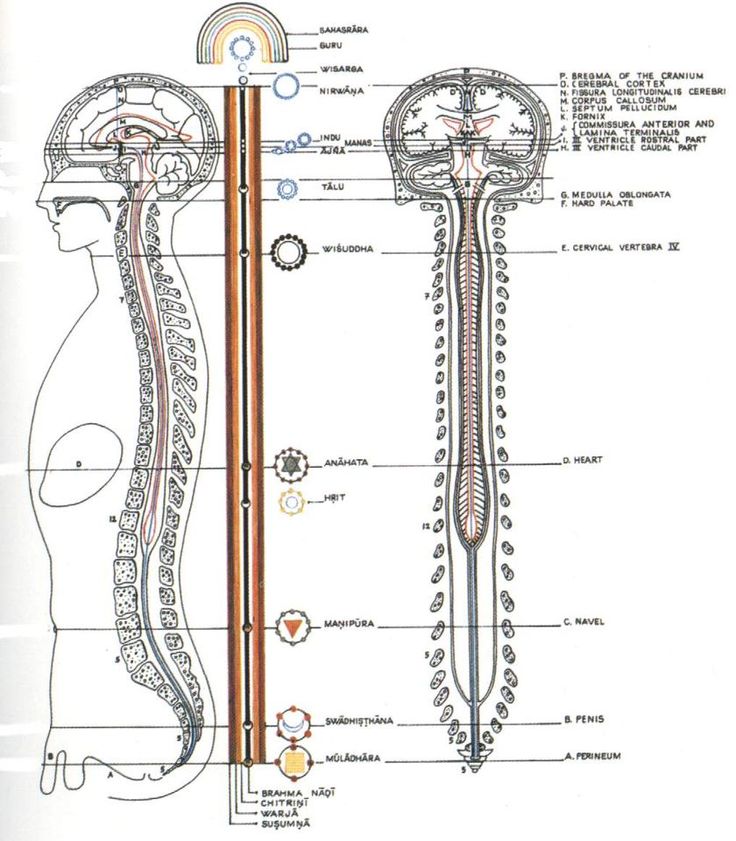
Finally, to experience this energy within one’s own body, there is a Yogic principle known as ‘kundalini’. This is depicted as a snake (or modern static wave form energy ) and is associated with the spinal column; also in wave form. In my view, the subtle energy which the Yogis call ‘prana’ is in a constant state of build up and discharge, before, throughout and after one’s life. There is no single ‘awakening’ moment when the Kundalini rises up the spine as is sometimes described. Rather the motion of the snake is as seen in nature as a perpetual ascension through the energetic nexuses (chakras). The accumulation purges and cleanses each chakra in turn until discharged naturally in sexual union or used for the process of ‘enlightenment’. For this reason and purpose, many mystics were and are, celibate.
The importance of subtlety of this primal ‘life energy’ awaits formal ‘discovery’ and scientific experimentation and explanation. We can be sure at this moment in history that human beings have forgotten what was once known and drove much of human spiritual evolution for thousands of years.
In my view, now is a good time to re-discover what we have lost, particularly as modern archaeology unearths new evidence almost daily. All that is necessary for archaeologists to advance their theories to another level, and replace ‘grave robbery’ with an understanding of esoteric energy; known once as key to the general advancement of human spirituality, but long ago forgotten.
When we look at the art of ancient times it is striking how the world is represented in two dimensions. From the beautiful court scenes from Mogul India, Japanese and Chinese evocations of nature, the wall paintings of Egypt and Mayan and Aztec relief sculptures of Central America.
At the same time and for too long, the world was conceived as a flat plain. If you travelled too far you would fall off. It’s an understandable world view, yet the believers in this theory never questioned how deeply a well could be dug before a hole appeared.
This perceptual paradigm was founded in a vague adherence to the dominion of the Divine Male. The Old Testament God was a man – naturally. Animals marched into Noah’s perfectly measured Ark, 2×2 and cells have been splitting that way ever since.
Roman armies marched in two step time and in battles formed orderly squares allowing all round defence.
Sacred buildings were rigidly formal and measured, such as the Parthenon in Ancient Athens. The Ancient Egyptians were equally inspired by formal and exact right angled geometry.
This male principal permeated the theory of design and practice and in doing so formed a reliable and solid ground work for our modern era.
When I became a student of architecture the tutors ask us on our first day what we would bring to architecture. Somewhat naively and immodestly I said I would bring the curve back to architecture. Even headlights on cars in the 1970’s, headlamps on cars were changing from being round to square.
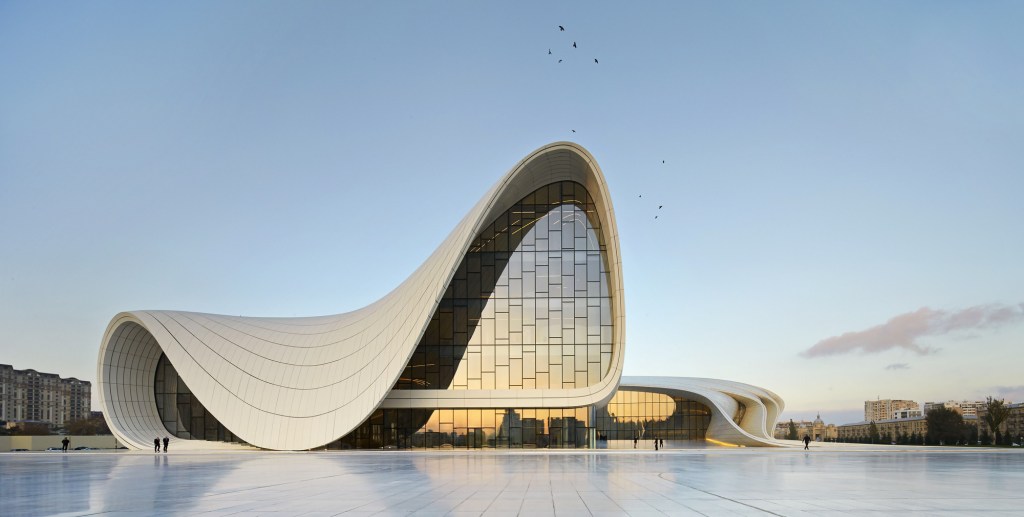
I had a feeling of a ‘brave new world’ which indeed has happened even if I had to let the brilliant Iraqi architect Zaha Hadid, steal my thunderbolts.
picture credit: Arch Daily
As a boy I used to cycle down to the south coast of England where the land meets the sea in tall chalk cliffs. Creeping along the grass to perch on the precipice to look down at the black pebble beaches far below, I was like a seer peeping over the edge of a flat world, into a third dimension.
Whether we see it or not, we are also now creeping warily into a fourth dimension represented by the principal of the ‘sacred feminine’.
This has nothing to with ‘Votes for Women’, a movement that swelled at the beginning of the nineteenth century perhaps as a natural protest against the male principled dominance of society since for ever. The First world war was perhaps, the last breath of that male principal. It briefly stopped the feminine protests and sent women to factories to build the instruments of war, but the corner had been turned. Women drove buses and ambulances and had tasted freedom from domesticity.
Mothers watched their sons march into the sunset, over the horizon and would never forgive the folly of the male Generals and politicians.
If you hold a ball in front of a child and ask, ‘where does this ball begin?’ the child will look at you as if you only have half a brain and explain that a ball has no beginning.
The question is a Koan and like all koans, challenges the rational, logical and formal pathways of thought.
Many dogmatic religious thinkers hold to the notion that the world could possibly end and proponents of this will present you with a date. Presently it is 13th August 2025 ‘according to Nostradamus’ and this date will, no doubt, pass without incident just as did the Christian Calendar’s year 2000 BCE.
Learning about the sacred feminine is a ‘learning curve’ upon which we still struggle, like young penguins sliding ungracefully up the steep slopes of an iceberg.
Ask an Astrophysicist when the Universe began and they will generally reply based on the so called ‘Big Bang’ theory. Yet the question is as absurd as guessing when and how the Universe will end. Anticipating the common sense of children observing the universe, I would expect they will say it never began and will never end.
That is the beauty of the child’s mind. It still retains the influence of the Divine Mother, before it is sent to the (male) military styled regime of education.
Yet I feel the influence of the Divine Feminine is more influential in modern Western societies than ever before. Parliaments and Judge’s benches are becoming equally filled with women as men.
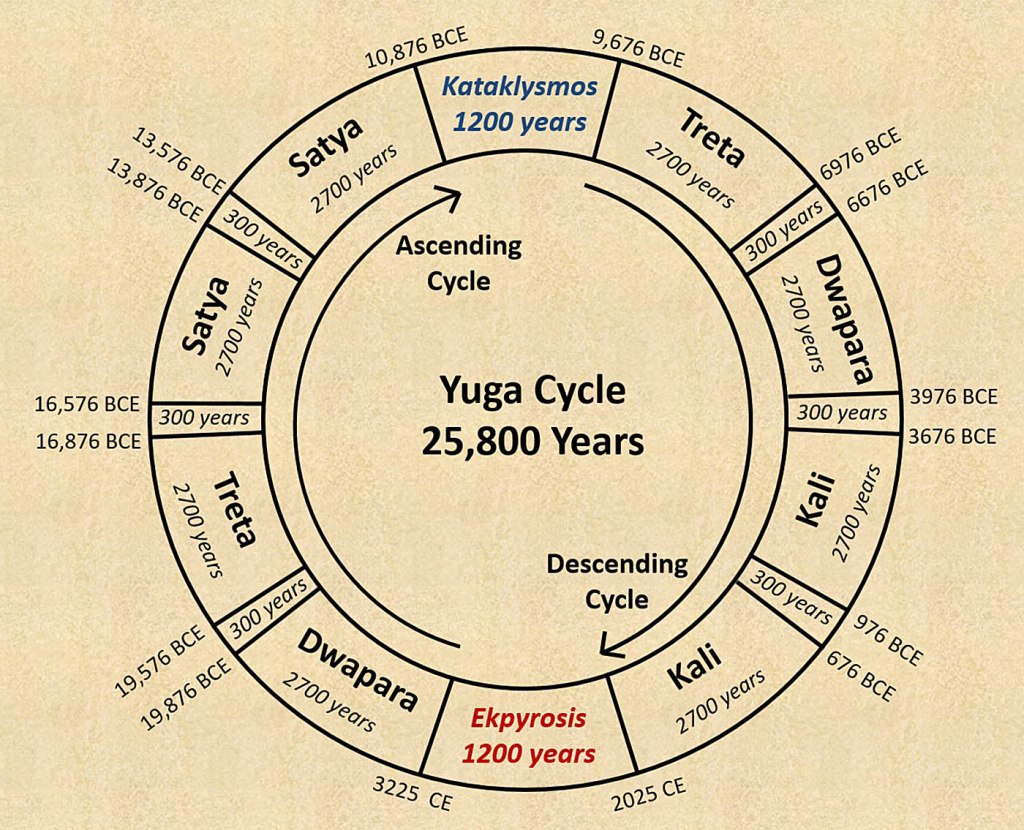
From Ancient India we are given the map of the idea of the cyclic Yugas; eras circling around 25,000 years in which the world is alternately destructive and creative.
picture credit: Ancient Inquiries
In the view of many, the Age if Aquarius is happening now and introducing the Feminine Principal into all areas of life and knowledge. Exceptions abound of course, as the process is gradual and takes two steps back for each three forward.
The benefit for humankind will be to realise when the pendulum is suspended equally between the two Divine Genders. Modern Feminism becomes flawed when and if it tips the balance too far and unnaturally dominates the male principal.
In Ancient times there are a limited number of symbols that appear in wall paintings and petroglyphs literally, around the world. One of them is the spiral. This remains one of the most easy to comprehend illustrations of an idea that defies logic; infinity. A spiral apparently starts from nowhere and disappears into nowhere.
If something were an mass moving through a void, it would need a circular motion combined with a constant, weak tangental vector, nudging it ever off a circular orbit out of sight.
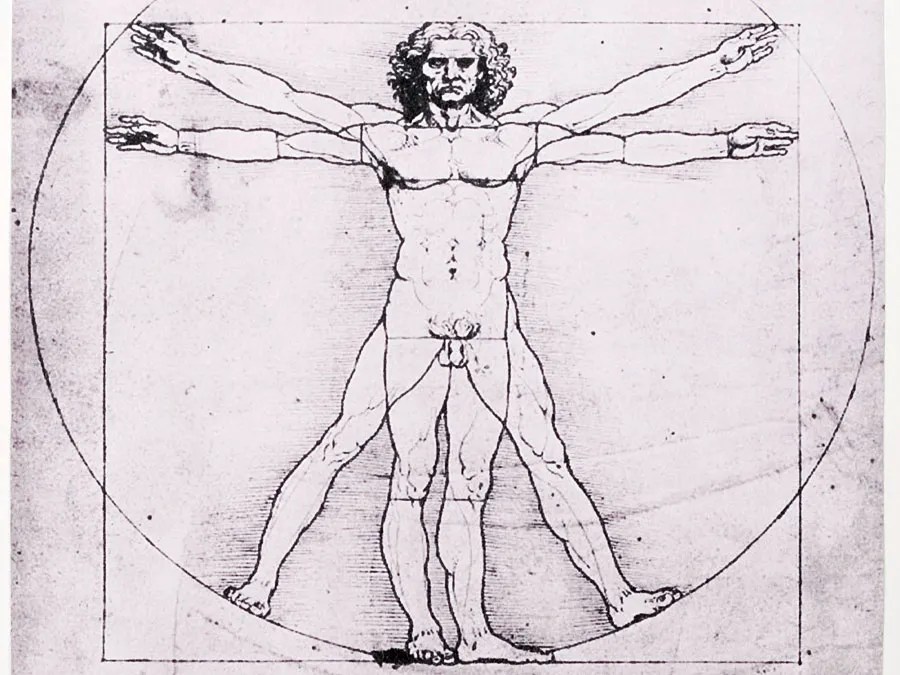
For a time in history, philosophers were perplexed with the puzzle in geometry of ‘squaring the circle’; famously illustrated by Leonardo de Vinci in his depiction of the ‘Vitruvian Man‘.
picture credit: Britannica
Yet in my view the spiral is a better symbolic representation of that state in matter and spirit, where the feminine is truly in harmony with the male.
In every aspect of nature, from the principals of the growth of the fractal tree and sea shores, to the spiralling movements of the moons, planets, stars, galaxies and universes, we can measure in observation the wonder of creation by two complementary Divine potter’s hands; one male, one female.
Humans were made from clay on the spinning potter’s wheel and the principal known as the anima mundi, is the final result of Divine genius – the Soul of the Whirled.
Listening to a science programme on the Radio just now, I heard a amazing fact about Michael Faraday, the great early 19th century scientist. Apparently he was an ardent believer in God as well as a scientist. Unlike his contemporarys, he did not believe in molecular theory and the concept of the ‘atom’, which came from the ancient Greeks. He instead said that matter is where ‘lines of force meet’.
The other great scientist from whom much understanding of electricity today came, was Nicola Tesla in the late 19th century. One of his most famous sayings is; “If you want to find the secrets of the universe, think in terms of energy, frequency and vibration.”
These are not lightweight scientists. Most of our modern technology we owe to these two men.
The idea of ‘lines of force meeting’ immediately suggests the concept the ‘hologram’ although they were not known in Faraday’s time. Several beams or ‘layers’ of energetic force containing information that the human brain interprets as ‘an object’ is precisely what a hologram is. It is a huge leap but one made succinctly by Michael Talbot in his book, ‘The Holographic Universe’, to suggest that everything that we perceive as matter is a hologram.
Mystics have been saying for centuries that matter consists mainly of ‘nothing’ and modern physics now also states this as true. Some scientists are even questioning whether the electron, proton and neutron are just energy. This combined with the observations by astrophysicists that the Universe consists of 94% so called ‘dark matter’ suggests that we know little about what we sense to be most real, matter.
If one thinks of the ‘table of elements’ as a good proof of matter, then Faraday’s theory of there only being ‘lines of force’ does not contradict the possibility of chemical ‘elements’. Elements might simply be unique combinations of ‘lines of force’ which harmonise to produce the illusion of a ‘solid’.
Sound provides a more tangible analogy as it too is energy with fixed frequency and vibration coming together as single notes, or harmonic layers that produce unique chords when in combination.
But our brains are taught only to interpret the electrical signals from our five senses. From childhood we learn to see these patterns as a solid ‘reality’ but like all illusions, sometimes we miss notice the illusionists slight of hand and mastery of distraction.
For example, we might all have seen something in a flash which a few micro seconds later turns out to be not what we thought. It might be a leaf being blown across the road which a driver sees as a mouse or bird for a brief moment. Or a child’s kite flying high above that a walker mistake for a hovering bird of prey; even for a split second.
Such moments are ‘discontinuities’. The Ancient Celts understood this and certain places, such as the hills of Southern England known as the Downs, were described as ‘thin’, meaning localities where the boundary between ‘solid reality’ and ‘parallel dimensions’ create experiences of the metaphysical (beyond matter) realm. A church going shepherd, in the 19th century is said to have seen a vision of Jesus above these hills in the sky, which would probably have been forgotten by now had not many in the local village seen the same vision and the newspaper article from the time still framed on a wall in Firle Church.
My point is simply that, if we can accept the suggestion that the Universe is simply ‘energy, frequency and vibration’ many of the ‘anomalies’ that modern science cannot explain, suddenly become easier to understand and even, accept as true.
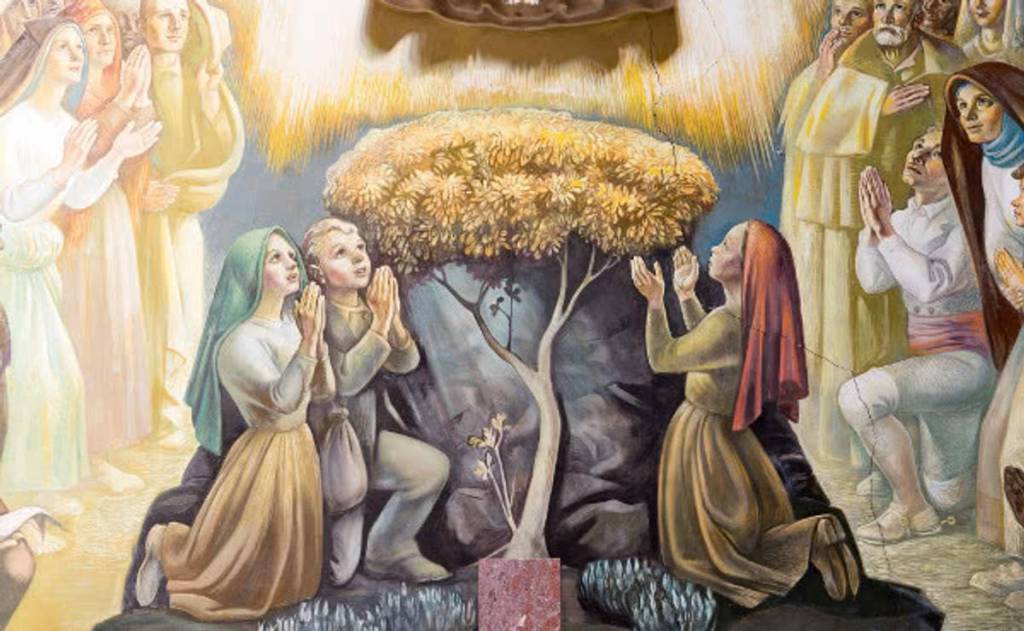
We do not all have to become mystics to believe and practise this. What a shepherd can see we can all see. So can we all see what children saw in the village of Fatima in Portugal in 1917 – a vision of ‘Our Lady of Fatima’ – as did hundreds of the inhabitants of Fatima on several occasions.
Santa Hosemaria in Fatima, Portugal picture credit: Opus Dei
I was sitting in the waiting room this afternoon whilst my car was being serviced. I had been meditating, and it was with a single point of attention that I was eating an apple when the garage mechanic burst into the room. The conversation went like this;
‘You are eating sweets.’
‘No I am not.’
‘You are eating a sweet apple.’
‘Yes.’
We probably exchange brief moments of an imagined reality with others, more often than we think. The phenomena of what is called as ‘telepathy’ which I would suggest is more subtle that ‘reading the thoughts in others’.
In my view, two people can experience the same ‘energetic patterns’ at the same time. In the above example this was the feeling experience of ‘sweetness’ observed in a split second by two non-connected but open minds. The mechanic had not seen the apple, only received the feeling of ‘sweetness’.
Mothers will probably have had many examples of understanding a child’s needs without conversation; even and especially when the infant has not yet learnt to speak.
A mother and child are indeed a wonderful metaphor for the scientific understanding that Faraday believed, that everything is merely ‘lines of force’ meeting; something natural philosophers term ‘love’. Following this reasoning I would argue that this is why when humans follow (without expectation of reward), their highest excitement, then they will create the energetic Universe that will provide them with their highest reward. Most people’s highest excitement is simply known as love and with this vibration was and is created, the Universe – and is why it is said that; ‘God is love’.
‘There is little that cannot be explained in a few sentences;
sentences that may take a life time to understand.’
What is consciousness? Where is consiousness? Who is conscious of what?
The conscious ‘me’ is clearly gifted a material body but is my body me? Clearly not, but there is evidence that the opposite is true. People have clinically died and remained fully conscious outside of the body. To explain this phenomena, consciousness must exist in another medium and that we call ‘spirit’ or loosely in scientific terms, ‘energy’. What type of energy we will come to.
The concept of spirit outside of matter, is central to many world religions. The Christian priest will attend a person dying or conduct an exorcism and a Tibetan Buddhist will say prayers over a cadaver for several days. Curiously, religious representatives do not attend births. Perhaps this is because there is no agreed moment in gestation when spirit enters the foetus but certainly it does.
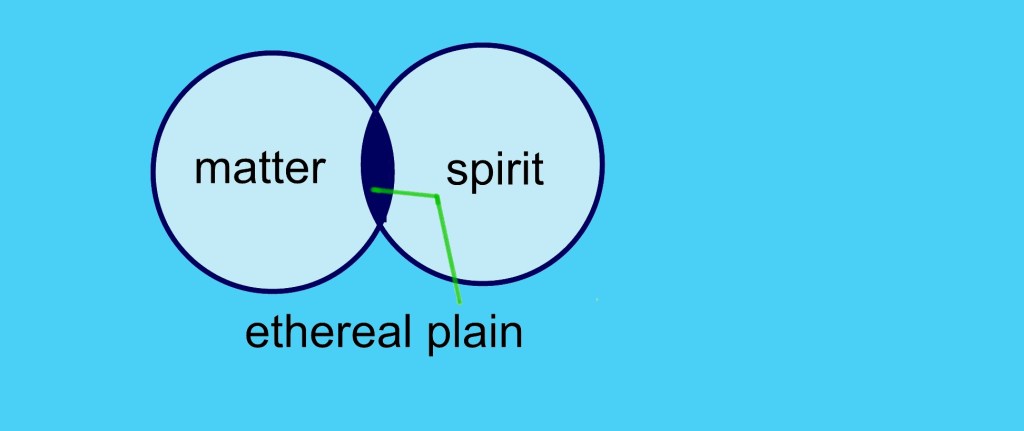
In this Ven diagram, is a simple representation of how matter and spirit lock together and what they share in common. Where matter and spirit overlap is a particular energy which modern science has not yet been able to detect and measure, but which has been described extensively across time and cultures as, ether Chi, Qi, Prana, Orgone, Vril, or when in the earth, the tellurgic current.
This invisible energy creates a portal, a zone where there is connection between both matter and spirit, which I shall term ‘ether’. The stronger the ether, the easier it is for consciousness to move between matter and spirit. There is no scientific proof for this other than that humanity throughout history has devoted vast amounts of time and resources to achieve just this effect in it’s magnificent structures and modes of worship.
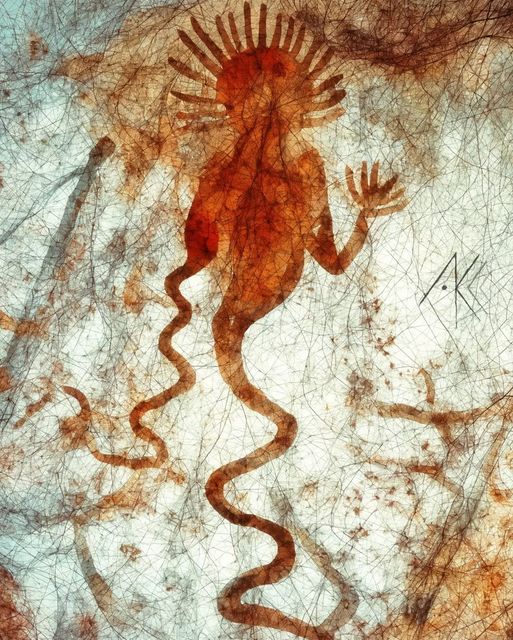
Depiction of Spirit Entity at Altimira, Spain
Forty thousand years ago homo sapiens sapiens conducted Shamanic rituals in cave dwellings. They created their connection with the spirit world by painting on rock walls. Through these superbly representative paintings, spirit was able to enter the cave and infuse each sentient being with it’s presence. There is also a theory that important star constellations were also represented in these paintings. Cave dwellers would have developed a close relationship with star patterns and apparent movement of the night sky when viewing from the mouth of the cave; itself a domed observatory.
Chi is present in all nature and certain places and times amplify it’s power. This can stimulate ‘extra sensory perception’ in humans and a gateway into our material realm for non-corporeal beings. To this end, throughout history, most civilisations have used and enhanced Chi by building sacred buildings and using their unique qualities as ‘places of power’, to use a phrase from the Toltec Shaman, Don Juan in Carlos Castenada‘s books.
In Ancient Greece, elegant statues of gods were placed in Temples to invite the god to be present in the statue. When the monotheistic religions arrived such ‘idol worship’ was forbidden. This fear is a sure sign of how powerful early churches realised living gods occupying statues to be.
Ancient people’s, who today we would call a, seer, prophet, priest, magician, mason, water-diviner or Oracle, helped in the construction of sacred edifices of all kinds. Temples, obelisks, pyramids, causeways, megaliths, dolmens, wells or hill figures and many others can be found today all over the globe, often unseen or unrealised. Many modern authors have studied global alignments of such sacred monuments based on sacred geometry, alignments, distance and time.
Chi is accumulated and or channelled through these structures. Whilst later burials often occurred in or near them, their main function was generally ceremonial and as places of initiation. To amplify the Chi very similar techniques were used based on geometry, astral alignments and tellurgic currents; all of which have the combined effect of accumulating and focusing Chi on the human heart, right brain and pineal and pituitary glands.
Many historical and current researchers have documented and explain aspects of this sacred knowledge. Unfortunately, left brain biased archaeologists usually support only those theories based on matter, historical records and anthropology, without reference to the living spirit that was once sacred to ancient cultures.
My point in this essay is that by introducing the concept of an invisible but omni-present spirit into our understanding of the past, the relationship between our sensory experiences and our right brained, feeling based consciousness, becomes clear.
The more Chi is present both within and without of a human being, the more easily such a person can slip through the mirror into a world beyond. Consider Alice’s famous journey into the mirror and the inverted playing card world of dreams; where right is wrong and wrong is right. Never trust a flamingo.
Less flippantly we might examine how personal direction of thought is directed outward using personal power or Chi. It is the means through which prayer is sent; through the ethereal veil to ‘God’ or Universal ‘Mind’. Alice created her Wonderland by going within or ‘down the rabbit hole’.
Finally, we should appreciate spirit is able to pass through the veil towards humanity, boosted by Chi. A highly experienced ‘Dowser’ or ‘Water Diviner’ in Scotland for instance, describes grave yards as being places of concentrations of earth energy or Chi. This connects the earthly grave with the spirit world to which our consciousness is always connected. The common story of ‘ghosts’ inhabiting graveyards is a good example of the ‘twilight zone’ occupied by all sorts including the disembodied. The particularly time of year for this veil to thin is of course, ‘The Day of the Dead’ in Mexico and ‘All Hallows Eve’ in Christianity. The displays in shop windows of evil ecrutements for children is not something properly understood in my view.
Examples of portals for the spirit, exist in very old houses, natural features such as caverns, springs, geological features such as magmatic intrusions and dikes, towns and cities like Jerusalem.
What happens in such sacred sites and countries connects through grids and alignments to other countries and even around the world. For much of recorded history, the Holy Land played out a spiritual discourse, such as those narrated in the Old Testament and New. This global effect was so strong that the Crusades set out to ‘take’ Jerusalem for Christianity and suppress to the ‘infidel’. The history of these brutal Medieval wars is well known and yet continues to play out, often with the same disregard for the sanctity of life.
One might wonder what it is about this particular part of the globe that makes it a spiritually significant region for the monotheistic religions.
When the prophet Jesus the Christ is described in the Bible as ‘walking on water’, like many biblical narratives it has multiple meanings; some for the initiated and some not. Between the earthly and spiritual planes is what I have described as an ‘etheric’ plane. Ether similar or identical to Chi; it’s exact nature still defined by effect rather than cause.
It is said that Jesus ‘walked on water’ is a metaphor for the transition from the material into the etheric plane. The water represents ether and the body of Christ is his astral, not his physical body. Like much of spirituality, such things can be experienced and mastered during life; so as to ‘store treasure in Heaven’.
One of the functions of this ability to transcend our material bodies is to enable communication of the highest kind between spirit and mortals. Earth has been visited and given benign advice by angels and prophets many times in it’s history and these form the basis of mystery schools and mysticism but unfortunately much of the glory of such knowledge has historically and to this day, fallen victim of the self interest of religious leaders.
A left brain thought bias in the West leads many to consider only logically constructed thoughts, and yet some of the most important decisions we make in our lives originate in the right side of our brains. How we think is as important as what we think.
Finally, one must acknowledge that in the material world and it’s spiritual equivalent, there are tendencies to descend into chaos as well as to rise to perfection. The spirits that facilitate this amongst mankind are the angels and demons respectively. Through their benign and harmful machinations, human life has evolved into it’s present state of scientific materialism and atheism.
What is happening in this present time of uncertainty and human suffering is in my view, a product of ignoring the possibility and presence of non-material realms and those places and times that invite personal and collective ascension.
Words have both sound and meaning and it is these aspects of words that I shall explore in this essay. My case shall be that there is a subtle and hidden level of meaning contained in the abscence of words as well within words; a fact we tend to ignore in our conventional Western tradition.
A child, when it is born, has no words in it’s head. It has not heard human language and it’s world is without word. It is an obvious yet obscure fact that every human infant is capable of learning any spoken language. It listens, and then one miraculous day – ‘da da’ – it speaks.
From that moment on this organic computer learns what we call an ‘operating system’ based on a language; amazingly, any language. This is all very marvellous and yet in the future our language inhibits meaning, rather than expands it.
At a certain stage in life, we might reflect and realise how words dominate our perception. We have become slaves to both the external and internal chatter of ‘things’. Words run away with themselves in our heads and much of the time we might wonder who we are and who is in charge.
Slavery of the body by another is a very old problem but slavery of the mind is even older. Early philosophers like Socrates, were sent to prison and even forced to commit suicide on account of their desire to cut through the prison bars of language and thought.
Religious and philosophical minds have, at various moments in history, produced a key to unlock the chains that hold us enslaved. In the West, this was done by encoding ritual using a language people did not understand.
In Catholicism this was the Latin language spoken by bilingual priests. Sadly, in recent times church elders have allowed religious incantations to be delivered in the vernacular. The congregation, who previously had been held rather in awe and suspense by the mystery of Mass, suddenly had this balloon popped and replaced by the humdrumness of ‘understanding’. Mystery was unwrapped like presents on Christmas day.
The ghost of Christmas Present
Only those with a deeper calling, such as Christian monks and nuns, are told to move their consciousness away from the meaning of the incantations and ‘just say the words with your mouth’ and ‘keep your consciousness on the presence of God.’ The mystical revelation was that words deceive by reducing mystery to common ‘understanding’. No one explained this to the uninitiated.
In contrast, Islam has not fallen into this trap and in most countries the original words of Divine Revelation are spoken in the original Arabic. Vast swathes of the Qur’an are learnt and recited, without necessarily knowing their meaning, by non-Arabic speakers. When spoken aloud the sound is as important as the meaning as the sounds of the holy words and phrases, even single letters, transmit a power from the Divine.
Exceptionally Mustafa Kemal Ata turk, President of Turkey in the 1920’s and 1930’s, ordered the Quran to be translated into Turkish as part of his ‘modernisation’ political philosophy. Nothing, as they say, is sacred.
Let us pause for a moment and consider the leap of faith that is being suggested here. Behind stories, myths and legends there was always a sacred understanding transmitted from generation to generation. For instance, the mystery of the ‘white stag’ that skips over the horizon or pales into the mist, so evading the hunter, is a mystery that captures and teases with a sense of rapture and bafflement.
This is ‘not knowing’ and has a value that has been largely ignored by ‘rational’ thinkers in the West.
The modern film ‘The Deer Hunter’ 1978 picks up on this theme of and man’s insignificance when compared to the mysteries of Nature. Amidst the heavy hammers of industrialisation, depicted poetically in the opening sequences of a steel works in Western Pennsylvania the central character ‘Mike’ proposes a hunting trip to his friends.
“You know what those are? Those are sun dogs… It means a blessing on the hunter sent by the Great Wolf to his children… It’s an old Indian thing.”
It is hard normally, to sustain this sense of mystery in life, as we reduce it to ‘catch phrases’ and cliché in conversation. We talk to much and our words rattle around other people’s heads like toy trains on a table top track.
Personally, I have always enjoyed travelling in non-English speaking countries and not understanding a word anyone is saying. Instead of grabbing a phrase book to attempt to understand the hubble and bubble of random conversations, I smell the unusual air and absorb the colour of exotic flowers. In essence, the mind can and should be permitted to stand still and pause. There is benefit, if not buying vegetables in a market, from concentrating on the profound reality of consciousness without words; what we might call ‘being aliveness’.
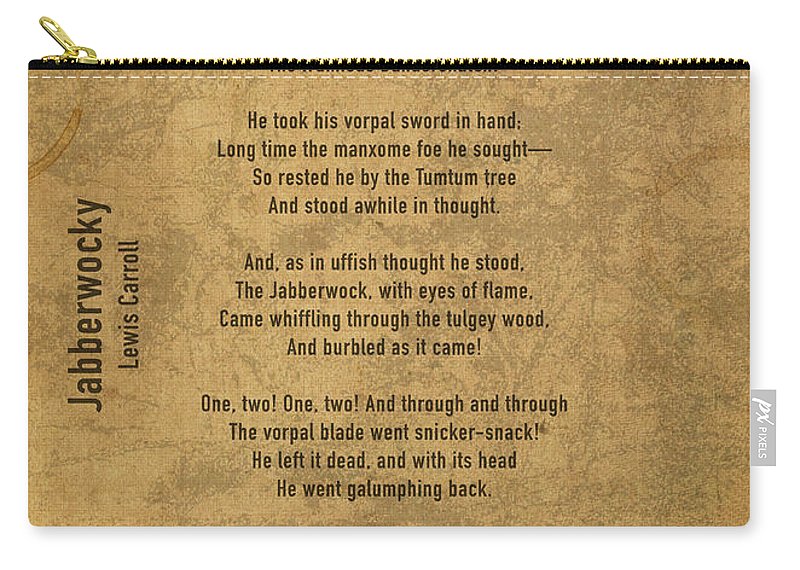
Lewis Carroll, is one of the great nonsense poets in the English language and has guided children and adults into the land of ‘not thinking’ for over a hundred years. ‘Beware the Jabberwocky’ is neither useful nor profound information, without mask or disguise. This sense of the absurd is like a door into the ‘not normal’, a place children love and adults avoid.
It would be wrong to be completely dismissive about words. In poetry and other sublimely expressive forms of language, they can explore and reveal areas of ourselves that are beyond thought, emotions and intuition. Initiation ceremonies into mystery schools are designed to bring about a consciousness that is completely without explanation by language; otherwise books would have replaced all knowledge and experience.
Unfortunately, in the roundabout of real and virtual worlds that we experience today, words come to us in a repetitive form. Anyone who has started to learn a language other than their mother tongue, will understand what it feels like to talk like a child to another adult. We converse like fools and (not wanting to insult the intelligence of animals), like ‘talking animals’.
If we are to search beyond the meaning of words, as far as our human soul will allow, then words perform a function most purely as sound; with or without a perceived meaning. This sound is the most fundamental form of creativity and inevitably appears in multiple opening verses of Genesis in the Bible that begin with, ‘And God said…’. In English these words have meaning but in the original Aramaic their would also be a magical power to the expression, just as magicians incant ‘spells’…Abracadabra! Words have the quality of spells and are learnt by a process dependent on ‘spelling’.
Pure sounds have an effect upon the human energetic system, in a most fundamental way, which is why the music we listen to is so important; as creative energy devoid of meaning. Destructive music such as Heavy Metal, attacks our ethereal essence and can lead to mental and physical illness, should we allow it. The Ancient Chinese respected ‘harmonious’ music for this very reason and viewed the opposite as a signature of decadence in decline in the State.
At the other extreme, music of a spiritual nature elevates our mood and perception in an experiential way. Various mystical traditions around the world, such as Sufism within Islam, embrace these ethereal qualities of music with ecstatic chanting.
There is a tradition in Yoga called Mantra Yoga which uses the repetition of sounds either silently or aloud to stimulate the human subtle energy system known as the ‘chakra’ and at the same time, stop the internal babble of the ordinary mind.
The Universe (of which we are a microcosm) is a cloud of sound as well as electromagnetic energy. Even the planets of our solar system vibrate at a different frequencies to one another and this mysterious concert has been recorded by modern astrophysicists. It is akin to the ‘music’ heard by mystics in trance as a constant hum or combination of harmonious overtones. Pythagoras proposed that the Sun, Moon and planets all emit their own unique hum based on their orbital revolution, and that the quality of life on Earth reflects the tenor of celestial sounds which are imperceptible to the human ear. This truth has often been represented allegorically in Western art as ‘choirs of angels’ playing musical instruments such as the harp and trumpet.
Perhaps the greatest example of the decadence that words can bring is contained in the Biblical story of the building of the Tower of Babel in Genesis. Here the Divine restraint from advancement of civilisation was used to confuse mankind with multiple languages instead of just one. The English language translates the word ‘babble’ as to ‘talk rapidly and continuously in a foolish, excited, or incomprehensible way’. Turn on your television sets today and discover that nothing has changed since this Biblical event! The world spins and makes us giddy, words fail us, we argue and fight, and all fall down.
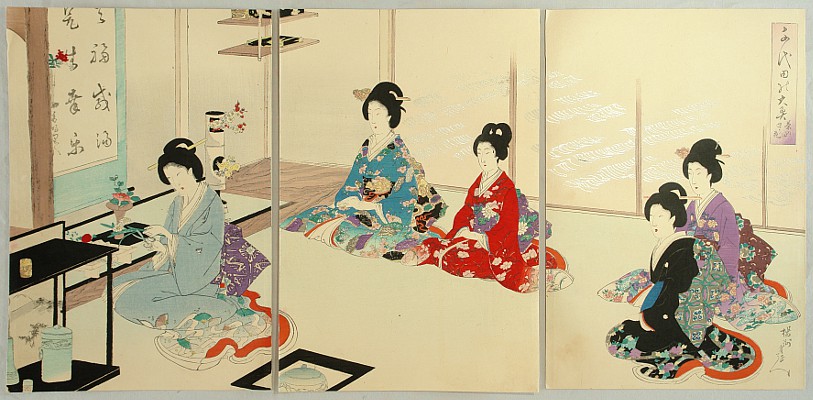
In the Eastern philosophies, you will find a great emphasis on non-verbal communication. Much of the Japanese tea ceremonies are conducted in silence and participants are taught to ‘know’ how to conduct the ceremony without the interruption of words. A Japanese friend of mine was late for her tea ceremony class and found herself standing outside the room in which the class was taking place. She knew she would be judged on knowing exactly when to open the door and enter the room.
‘Those who know do not speak. Those who speak do not know.’ Lao Tsu












 Matters Blog