
If Democracy were a mental disorder each, and every country could be diagnosed as to where on the democracy spectrum their governmental policies lie. There are some countries who pay lip service to democratic rules and some who follow procedures to the letter. In between are the majority of countries and it’s a mix.
Democracy rules largely in the West, plus countries historically colonised by the West, and informs western self image that it’s political ways are superior to the rest of the world.
It is not easy to view objectively how this form of government operates in Europe and the United States of America. For instance in modern day Switzerland, the most important political decisions are decided directly by citizens through referendums. These may take place several times a year, swiftly and efficiently without fuss or interference. Citizens feel empowered because they are being included in important ‘course corrections’ of government. There is no pressure on a government to follow a manifesto on which they were elected; an expectation that fails to understand that sometimes the super tanker needs to change speed and direction when an iceberg moves into it’s path.
The ancient Greeks were of course the originators of ‘government by the people for the people’. The Platonic City was restricted in size by the number of citizens in a circular crowd who could hear an orator in their midst; a number calculated exactly to 5040.

This is called Direct Democracy, enabling individuals direct connection with those with the power to decide policy and law. In many ways it makes the most sense as each citizen has at least 1/5040 th influence on the destiny of their city state. In this way their loyalty to their nation would be expected to be very strong. They after all, are partly responsible for the consequences of the flaws and laws that effect their lives.
What inevitably usurped this system was the increase in the size of city States.
With increasing populations in large urbanisations, the Romans in particular gave citizens the right to vote for someone to represent their views, a Senator.
This is better in theory than in practice, for having given away their power to a third party, every citizen becomes disconnected to government. Senators may decide or be corrupted or bribed so as not to represent the views of those who elected them.
What contributed to the eventual downfall of the Western and Eastern Roman Empires were the Caesar’s who assumed control of all the power of the state, dictators. As well as fiddling the taxes and trade, Nero fiddled as Rome went up in flames.
At this point power has been completely removed from the influence of the general population and assumed by an individual acting in self interest, not the interest of the country and it’s citizens.
Again we have seen the rise of such dictators in governments in Western Europe and the United States of America in modern times.

So at the ‘dictator’ end of the democratic spectrum, there is no government of the people by the people. Politics has been reduced to one personality and a carefully vetted ‘hangers on’ who are absolutely loyal to the dictator.
These may be civilians who have gained power through wealth and influence in areas other than politics. Clearly this does not suit them in any way to a career in politics but that does not stop them for the reasons that entrepreneurs are natural risk takers and self believers. Failure in policy is unlikely to affect their lifestyle and they do not feel responsible for the well being of others, so they advise and influence in politics through a process of making mistakes.
The United States of America and the United Nations have a policy known as Democracy and Governance. The intention is to bring democracy to the countries of the world under autocratic rule. For the USA the Middle Eastern countries have been high on the list for DG transformation because of the natural resources and geographical location of countries such as Algeria, Libya, Egypt, Iraq, Iran, Syria, Lebanon, Oman, Saudi Arabia and others.
One of the first wars with Arab countries between the USA proxy in the region, Israel, was the Arab Israeli wars in 1948 and 1967.
The problem with promoting democracy in it’s many forms in the Middle Eastern Arab countries is cultural difference. Whilst the West may not like or approve of autocratic military leaders such as one time Libyan leader Muammar Ghaddafi or past Iraqi leader Saddam Hussein, life without unpleasant self styled ‘revolutionary’ leaders like them has proved far worse for the citizens of those countries.
It is likely that the present ‘regime change’ in Iran will have similar unintended consequences for the ordinary citizens of Iran.
The consequences of ‘regime change’ in the United States of America at this time are impossible to predict. The once dependable institutions were intended benignly, to protect the constitutional rights of the individual citizen. These rights have slowly usurped democratic institutions set up to prevent autocratic rule, such as Supreme Court.
I write this with a partly wry smile knowing what comes next as far as democracy and freedom is concerned, in any country anywhere in the world. The future is already in the news in a story about a company called Anthropic.
Anthropic is described as a ‘safety and research company that’s working to build reliable, interpretable and steerable AI systems.’
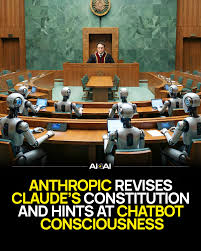
It is currently in dispute with the government of the United States of America which wants full access to it’s systems for use in warfare without control by humans. Anthropic is refusing on grounds of this being unlawful and morally indefensible.
For as any child will tell you, a robot that has supreme power over humans is a bad idea. The 2004 film ‘I Robot’ was science fiction twenty years ago and reality today, if you call a drone a robot. Unless there is a ‘kill switch’ which is easily accessible to humans built into every autonomous device and humanoid, we are designing our own guillotines and artificial Robespierre’s.
At our present point in history we have choice to carry on fighting each other for whatever imagined reason…or stop.
To do this successfully will require an intention to give back power to the individual citizen, as in the original concept of democracy in Ancient Greece.
In serious legal trials this principle is still of vital importance and present as the jury of twelve citizens. The jury ensures that a diversity of view points consider the facts of a case without prejudice to the defendant and then a unanimous vote is required for conviction. Debate is encouraged and can take weeks but has been proven to be the most fair system yet devised in legal cases.
When government by the people is dismissed and an autocrat with strong personal views and belief takes over power, right minded citizens are reduced to nodding dogs.
Woof!
 Matters Blog