War of Words

Words, good slaves but bad masters.
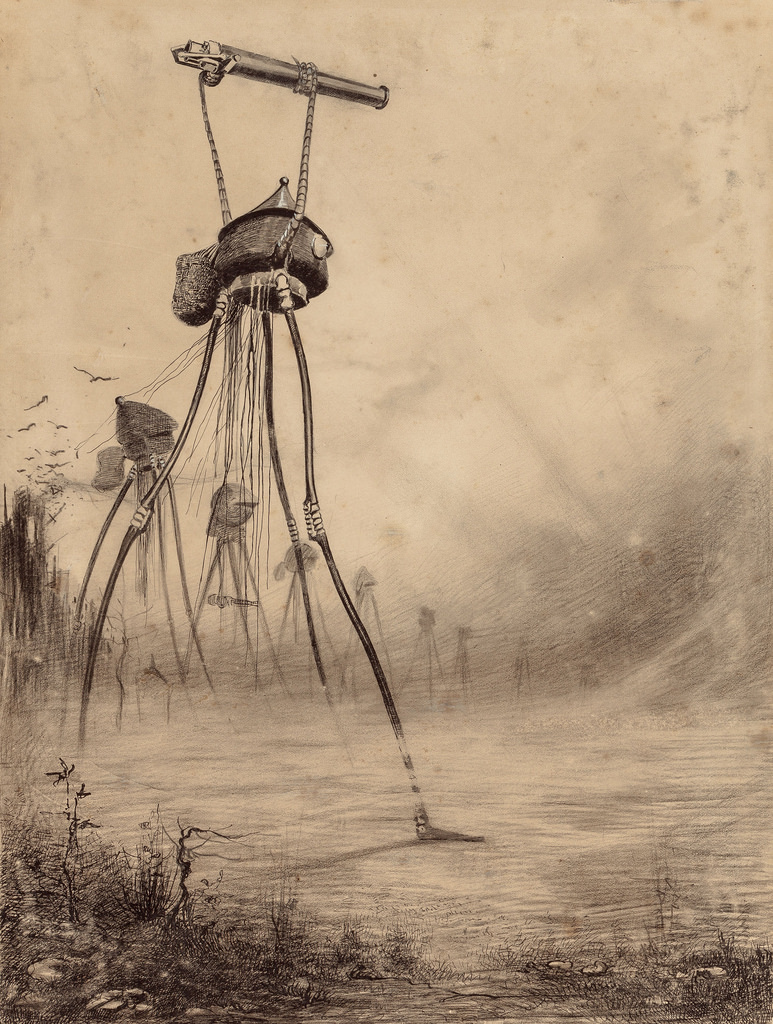
H.G. Wells wrote The War of the Worlds, a story about creatures from another part of the Universe invading the planet Earth and how the humans fought back. Words too can conquer worlds, especially the world in your mind. For this reason, I believe it is vital that we choose words that fit exactly the meaning we intend.

When speaking, we like to believe that we use words to converse clearly with others.

If there are no words in our own language we can create new words in fun and familiar ways. This linguistic phenomena is apparent in the speech of young people. New generations invent their own vocabulary with which to talk behind the backs of adults!

The power of language is it’s ability to open new perspectives on life. A restricted vocabulary will limit thoughts to the point that they no longer serve anyone’s best interest.

Words create our thoughts which can in inturn be inhibited by those words. Imagine a map of a city as a model of your neural pathways. Those journeys we repeat, such as to work, become familiar, almost over used. A map is also constrained by it’s boundaries. It does no show the whole world. The unreachable thoughts are as if in another dimension. Logic cannot venture beyond logic.

I listened to a debate on the radio recently in which scientists were challenging each other over the popular conundrum, ‘which came first, the chicken or the egg?’ They conjectured about birds as dinosaurs and an absurd point in time when the first egg was laid. Only one scientist suggested that change is a gradual process when viewed over long periods of time. No parrot changes colour over night. Evolutionary changes take thousands of years before being noticeable. There is no single moment when chickens and eggs come ‘into being’.
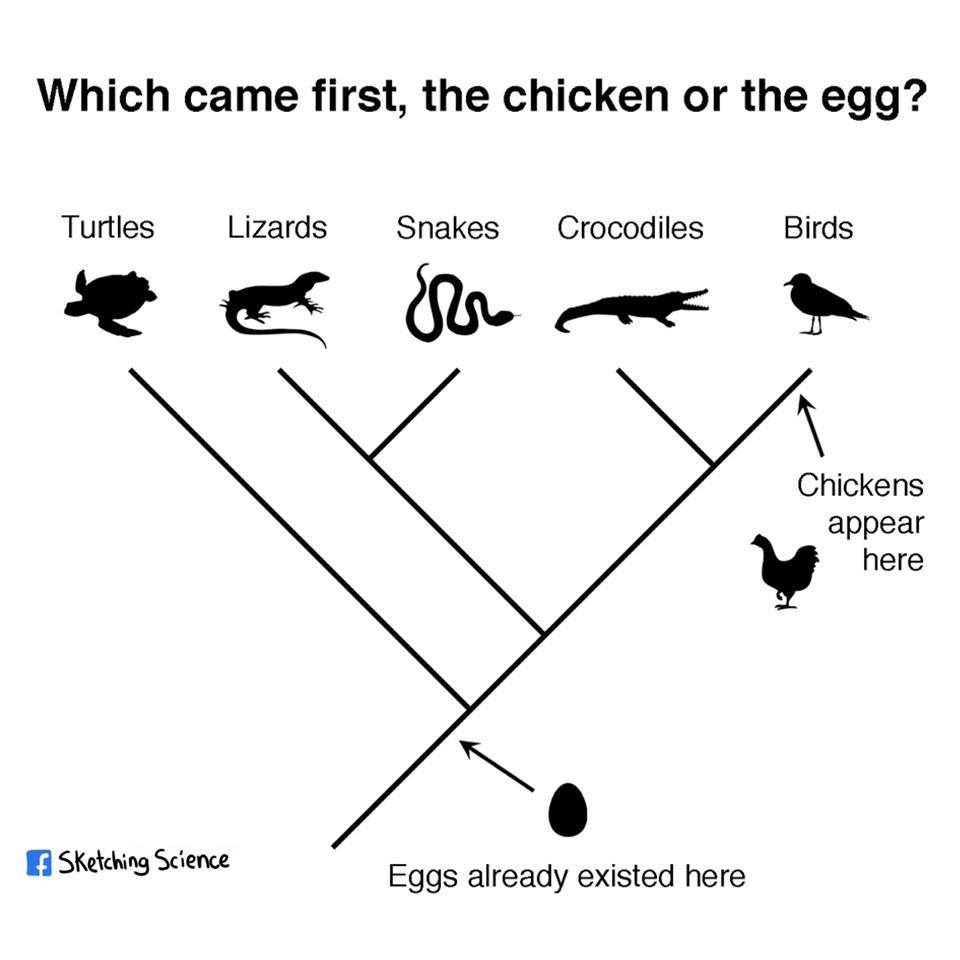
picture credit: The Australian Academy of Science

The same is true in astronomy. Do you believe the universe happened in a nano second as the so called ‘big bang’. Scientists are currently theorising that universes expand and contract over vast periods of time. The explosive power of the ‘big bang’ phrase, froze original thinking about how the universe began for decades. The universe was never a chicken, nor an egg…it is obviously both.

Semiotics is the science of language and meaning. In my view, we all benefit from understanding how we structure our thoughts using language and meaning. Here is an exercise;

Imagine a ‘cake’.

There are many categories we can use to describe cakes. There are cakes we sub-categorise by their ingredients such as a sponge cake, fruit cake, carrot cake and oat cake. Then there terms for cake which describe when we eat it, such as birthday cake, Christmas cake or wedding cake. Alternatively the means of production is a description such as home-made or shop-bought. Another way of thinking about cake is the origin of the recipe such as Black Forest, Dundee or French Fancies.

None of these sub-categories describe cake but the word cake includes all of the sub-categories. When we choose which cake is included in which sub-category we use thought to DISCRIMINATE between different cakes. This tool is an important power of mental faculty but unfortunately it’s meaning has changed in common usage. It has become to mean PREDJUDICE and in my view, there is a loss of meaning and ergo understanding, when these two are confused.

Discrimination is an objective skill whereas prejudice is subjective. When we think subjectively we mix emotions with logic. Feelings introduce prejudice for or against something in a way that cannot be explained logically. Insignificant examples are then used ‘prove’ to oneself and others that a prejudice is based on fact in a process known as ‘bias confirmation’.

Bear with me if you think I am stating the obvious but in my view much cultural, ethnic, racial, gender based, geographic, religious and political misunderstanding has it’s roots in how language governs thinking and in particular, prejudice.

A mind which for whatever reason developes a predjudice against a general category of something is in trouble. To use our previous example, it would be wrong to say ‘I don’t like cake’ when what is meant is that you do not like cake with a lot of cream.

When it comes to making prejudices against categories of fellow human beings we hit trouble. Any prejudice is more a product of intolerance, misunderstanding, eliteism, narrow mindedness and other unelightened views in the mind of the observer. However, we hear predjudice views in the news regularly so it is important to unpick how and why they are held.

Consider the term ‘anti-Semitism’. The German journalist Wilhelm Adolph Marr lived at the end of the nineteenth century. He popularised the term ‘anti-Semitic’ to describe anti-Jewish sentiment within political ideology and the general public.

This prejudice towards Jews we know has been present for thousands of years. What was new then was the term, ‘anti-Semitic’. It could be argued that this contributed to the start of the second world war and it remains in common usage today, so did it ever serve the world well?

Let us examine the term. We might question the meaning of the term Semite. Who can define what this means other than an anthropologist? Cynics might suggest the use of the term was a pseudo scientific device to impress and support a prejudice which in turn came from right wing views on eugenics.

Certainly just as ‘cake’ has many sub-categories, so does the word Semite. Historically a Semite might be from a specific geographical location such as Canaan, Judah, Judea, Israel or Palestine.

The term ‘Jew’ is entomologically derived from the tribe of Judea. Then of course there are sub-categories for a Jewish person by religion such as orthodox, conservative or reform. Then there are those who are Jewish but do not practice a religion such as non-practising Jews and those who do not believe in God such as Zionists; who might be Jewish or Christian.

Sometimes language is used to catergorise a ‘people’ and using this categorisation, Semites would be a group who speak Hebrew and / or Aramaic.

The Nazi’s in the 1930’s arbitrarily define a Jew by racial characteristics, not religion, derived from an elitist philosophy of the Aryan race being superior to others on which an extreme predjudice was based.

We might expect a national category of Jew, but the Supreme Court of Israel has determined there is no Israel nationality.

There are other sub-categories of Jewish identity such as by culture, ethnicity and politics, but I hope that I have made the point that the terms ‘Semite’ and ‘Jew’ mean many things to many people depending on what category you choose to define them.

Who is a Jew? picture: Instagram

There is a criticism of the term Semite as meaning Jewish by non-jewish people, that it ‘disingenuously’ excludes those who also identify themselves as Semite, such as Arabs. Does the term anti-semite poplarly applied to Jewish people, imply a denial that Arabs are also of Semitic origin?

In my view, the nineteenth century pseudo scientific phrase ‘anti-Semitic’ continues to obfuscate clear thought and sustains predjudice rather than exposing it. It has been used by politicians in particular with the intention including victims of the holocaust and stealing their suffering to gain the moral high ground. Such verbal smoke and mirrors has spawned wars and continues to do so to this day, unquestioned.

In my view, it time to clear our thoughts of words that do not describe precisely what they mean. This is not just a matter of taking sides but simply being clinically clear about where are ideas come from? Are they the product of predjudices? What are the intended and unintended consequences?

To be impartial in a debate that is more a minefield than a cornfield, let us reverse the coin and examine the current term for ‘hatred of Muslims’; Islamaphobia. Again, should we not question the use of this term? Should the psychological term ‘phobia’ really be used to describe a fear of spiders, snakes and Muslims? Clearly confusion, not clarity will result from humans being casually categorised using a word from the science of psychology incorrectly, rather than a clear expression most people understand.

Fortunately, words can serve us to correct such unclear thinking. We can invent new words or phrases in any language and in doing so, say exactly what we mean, fairly and without bias.

It should not be, but if a bigot wishes to describe a group of humans using a term of predjudice, then I suggest that those describing distaste of a sub-category of a human being, should use the prefix ‘anti’. This creates the terms anti-jewish or anti-muslim concisely and without ambiguity. Alternatively, the terms ‘jew hate’ and ‘muslim hate’ in countries where ‘hatred’ is an important aspect of a legal definition and unambiguous to all. The prejudice is clear to all and not spun with fake science. It also makes clear that these are irrational generalisations.

There is a war of the worlds, but it is contained in our heads, not the heads of other people who we may not understand.

In my opinion, the dangerous, self-unaware prejudices that thrive in the emotional biases of current politics, poison the thoughts of otherwise rational and compassionate human beings, and in doing so whole communities. Such hatred of difference is so divisive that it incites violence between one group and another. The simplest example is when governments of countries declare war on each other.

Words are powerful as they form a part of the process whereby we create and sustain our beliefs. How much of the horror that we see in the news today, started as copied or learnt bias, built on an emotional response to an unfiltered stimulus, that slipped under the barrier of compassion towards others.

It is clear to many but sadly not all, that those who express ‘anti’ views in the name of a religion, are not following the most basic rules of the religion they profess to follow.

Fortunately, those who are strongly, even violently prejudiced, are in a tiny minority. The general population do respect and are prepared to learn from, those who are different to themselves. The world’s religions all follow the principle of do-as-you-would-be-done-by.

Whirled Without End

The beginning of now

When we look at the art of ancient times it is striking how the world is represented in two dimensions. From the beautiful court scenes from Mogul India, Japanese and Chinese evocations of nature, the wall paintings of Egypt and Mayan and Aztec relief sculptures of Central America.

At the same time and for too long, the world was conceived as a flat plain. If you travelled too far you would fall off. It’s an understandable world view, yet the believers in this theory never questioned how deeply a well could be dug before a hole appeared.

This perceptual paradigm was founded in a vague adherence to the dominion of the Divine Male. The Old Testament God was a man – naturally. Animals marched into Noah’s perfectly measured Ark, 2×2 and cells have been splitting that way ever since.

Roman armies marched in two step time and in battles formed orderly squares allowing all round defence.

Sacred buildings were rigidly formal and measured, such as the Parthenon in Ancient Athens. The Ancient Egyptians were equally inspired by formal and exact right angled geometry.

This male principal permeated the theory of design and practice and in doing so formed a reliable and solid ground work for our modern era.

When I became a student of architecture the tutors ask us on our first day what we would bring to architecture. Somewhat naively and immodestly I said I would bring the curve back to architecture. Even headlights on cars in the 1970’s, headlamps on cars were changing from being round to square.

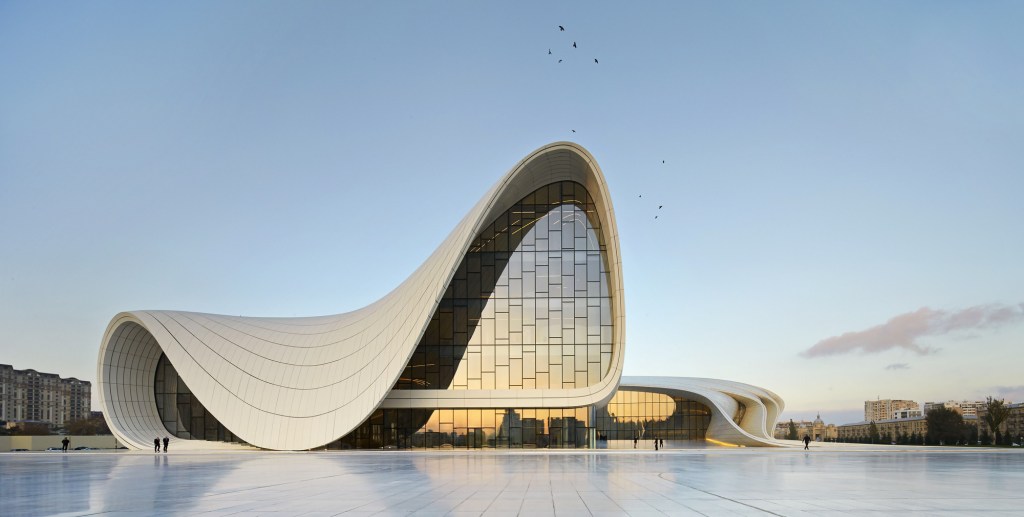
I had a feeling of a ‘brave new world’ which indeed has happened even if I had to let the brilliant Iraqi architect Zaha Hadid, steal my thunderbolts.

picture credit: Arch Daily

As a boy I used to cycle down to the south coast of England where the land meets the sea in tall chalk cliffs. Creeping along the grass to perch on the precipice to look down at the black pebble beaches far below, I was like a seer peeping over the edge of a flat world, into a third dimension.

Whether we see it or not, we are also now creeping warily into a fourth dimension represented by the principal of the ‘sacred feminine’.

This has nothing to with ‘Votes for Women’, a movement that swelled at the beginning of the nineteenth century perhaps as a natural protest against the male principled dominance of society since for ever. The First world war was perhaps, the last breath of that male principal. It briefly stopped the feminine protests and sent women to factories to build the instruments of war, but the corner had been turned. Women drove buses and ambulances and had tasted freedom from domesticity.

Mothers watched their sons march into the sunset, over the horizon and would never forgive the folly of the male Generals and politicians.

If you hold a ball in front of a child and ask, ‘where does this ball begin?’ the child will look at you as if you only have half a brain and explain that a ball has no beginning.

The question is a Koan and like all koans, challenges the rational, logical and formal pathways of thought.

Many dogmatic religious thinkers hold to the notion that the world could possibly end and proponents of this will present you with a date. Presently it is 13th August 2025 ‘according to Nostradamus’ and this date will, no doubt, pass without incident just as did the Christian Calendar’s year 2000 BCE.

Learning about the sacred feminine is a ‘learning curve’ upon which we still struggle, like young penguins sliding ungracefully up the steep slopes of an iceberg.

Ask an Astrophysicist when the Universe began and they will generally reply based on the so called ‘Big Bang’ theory. Yet the question is as absurd as guessing when and how the Universe will end. Anticipating the common sense of children observing the universe, I would expect they will say it never began and will never end.

That is the beauty of the child’s mind. It still retains the influence of the Divine Mother, before it is sent to the (male) military styled regime of education.

Yet I feel the influence of the Divine Feminine is more influential in modern Western societies than ever before. Parliaments and Judge’s benches are becoming equally filled with women as men.

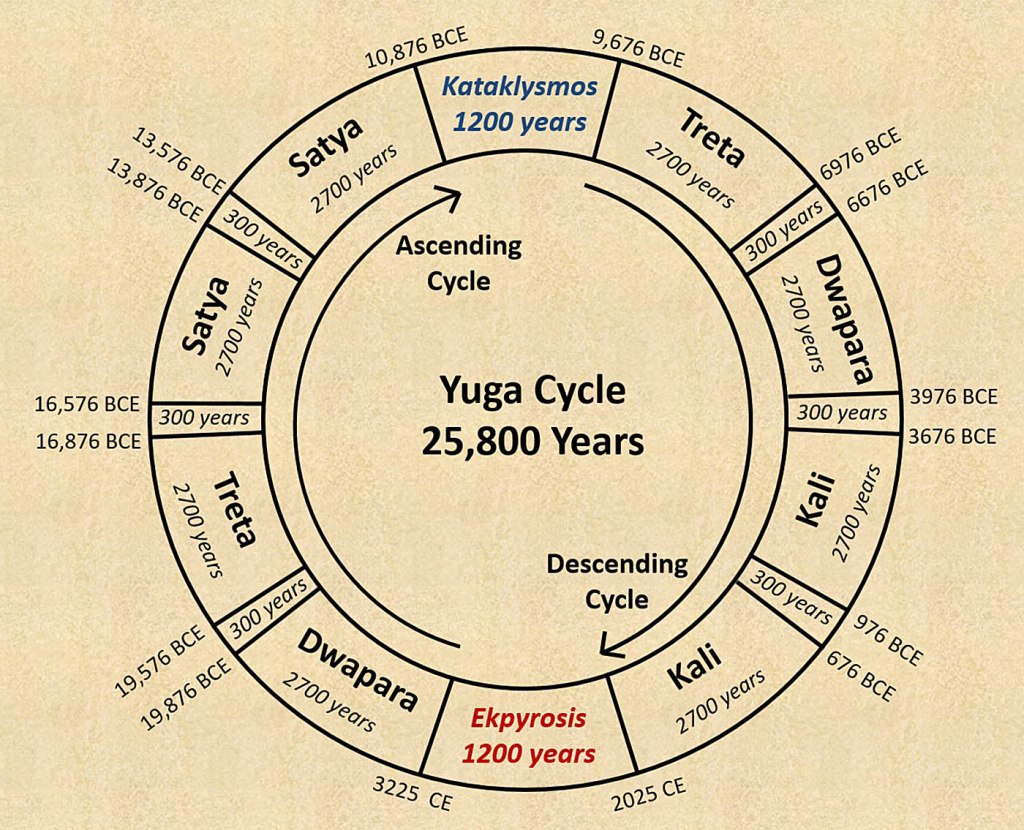
From Ancient India we are given the map of the idea of the cyclic Yugas; eras circling around 25,000 years in which the world is alternately destructive and creative.

picture credit: Ancient Inquiries

In the view of many, the Age if Aquarius is happening now and introducing the Feminine Principal into all areas of life and knowledge. Exceptions abound of course, as the process is gradual and takes two steps back for each three forward.

The benefit for humankind will be to realise when the pendulum is suspended equally between the two Divine Genders. Modern Feminism becomes flawed when and if it tips the balance too far and unnaturally dominates the male principal.

In Ancient times there are a limited number of symbols that appear in wall paintings and petroglyphs literally, around the world. One of them is the spiral. This remains one of the most easy to comprehend illustrations of an idea that defies logic; infinity. A spiral apparently starts from nowhere and disappears into nowhere.

If something were an mass moving through a void, it would need a circular motion combined with a constant, weak tangental vector, nudging it ever off a circular orbit out of sight.

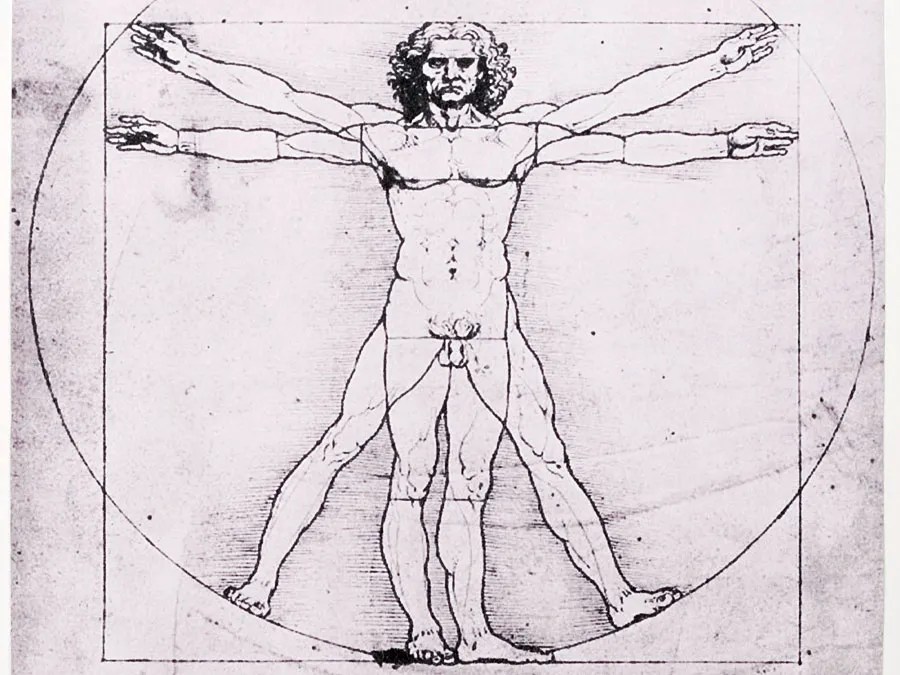
For a time in history, philosophers were perplexed with the puzzle in geometry of ‘squaring the circle’; famously illustrated by Leonardo de Vinci in his depiction of the ‘Vitruvian Man‘.

picture credit: Britannica

Yet in my view the spiral is a better symbolic representation of that state in matter and spirit, where the feminine is truly in harmony with the male.

In every aspect of nature, from the principals of the growth of the fractal tree and sea shores, to the spiralling movements of the moons, planets, stars, galaxies and universes, we can measure in observation the wonder of creation by two complementary Divine potter’s hands; one male, one female.

Humans were made from clay on the spinning potter’s wheel and the principal known as the anima mundi, is the final result of Divine genius – the Soul of the Whirled.

Francinsense, Gold and Err

Who Stole Christmas?

PREMISE

The Church Fathers have had considerable ‘editorial control’ over what to put in and what to leave out of the Holy Bible. So much was ommitted and added, so should new ‘adjustments’ not be accepted?

OBSERVATION

In 1872 a scholar named George Smith found something remarkable in clay tablets from Nineveh. He was reading in cuneiform the Epic of Gilgamesh in which is described the great flood, God’s punishment for mankind. The suggestion that the Great Flood described in Genesis was just a retelling from ealier Mesopotamian texts, shook Victorian society. They gave Mr. Smith a hard time, as if he was the problem.

Today there is considerable proof that many of the stories in the Old and New Testaments have been subject to editing. We accept that the dates for the Christmas and Easter festivals are not in the Bible. They have been made up. The date for the birth of the Christ child was decided to be December 25th but why?

The Infant Horus: picture credit World History Encyclopedia

Previous gods had been born on this date. There was Horus (Ancient Egypt), Mithra (Persian), Krishna, Zarathustra (Iran), Hercules, Babylonian god Bal (Nimrod), Heracles, Dionysus (Greek), Thammuz (Babylonian) Hermes (Greek) Adonis (Phoenician) and others. All were born of virgins.

If such a clear plagarism of ancient gods is disturbing, there is a logical explanation based on astronomy. December 22nd is when the sun disc halts its annual progression northwards along the horizon. It then pauses for three days and rises anew on December 25th. This natural phenomenon supports neatly the story of a solar god being born; not dying and miraculously resurrecting but being born at least. Perhaps the birth of Jesus does not fit the story and date of how the ancient gods had been born.

If we investigate the ‘blasphemous’ notion that the Christ child was not born at Christmas then we should be able to find another meaningful astronomical date in the solar year relating to birth. After all, should a Christian festival be based on the Pagan festivals and superstition? The church fathers did, we should remember, hate and demonise Paganism, although Pagans did no worse than love nature and each other.

SUGGESTION

I suggest that the birth of Jesus was in the springtime; the lambing season, when shepherds watched their flocks by night. Consider afresh, the Christian nativity narrative.

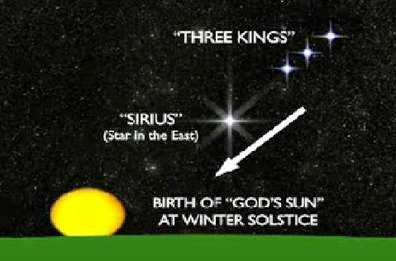
The three Kings or Magi seeking Jesus were astrologers. So excited by and certain of their prediction were they, that they set off to find him, I argue, in the spring. They ventured eastwards towards the star Sirius, which rises in the east in March in the northern hemisphere. With their learning they probably knew of the goddess ISHTAR from Babylonia who represented Sirius and was associated with fertility, love and war. Another clue for us today is that in the English language is the word Easter which breaks down into two words; EAST STAR. It also is remarkably similar to the word ISHTAR.

If we dig deeper into pre-Christian gods, we find that in Ancient Egypt the star Sirius was represented by the goddess SOPDET meaning ‘skilled woman’. She was important because her appearance signalled the inundation of Nile and the beginning of their new year. She was sometimes portrayed as a large dog.

picure credit: Tarot Aotearoa

Sopdet was associated with ISIS who was the wife of OSIRIS. Their son HORUS just happened to be born on 25th December; a holy family uncannily resembling a later one. They watch over us even to this day as Sirius (ISIS) in the constellation Canis Minor and her husband OSIRIS, the constellation ORION.

These curious facts add up to support the possibility that the Nativity occurred in the spring and the death and resurrection of Jesus the Christ in mid-winter. Certainly, Bible scholars are unable to qoute verses that deny this, as is anyone to confirm it. The Christian practice of using the festivals and stories of the hated Pagan gods, appears to be the only reason for Christmas and Easter being where they are today.

We cannot deny the association in popular modern culture of ISHTAR and Easter. As a nature godess, she is depicted with with hares and rabbits (famed for their procreative success) and eggs (product of the female hormone Oestrogen). Eggs and Rabbits were omitted from the Holy Bible and yet survive as symbols of birth happening at the time of the great initiator, Aries. Perhaps, some archetypes are too strong to supress.

ENDING

At this time of Easter, instead of celebrating the joys of spring, Christians mourn. Then, in midwinter they celebrate birth.

One wonders whether these important festivals, reversed for the wrong reasons, have unknowingly undermined the modern world? Knowing the basics of life and death, ending and beginning, should support rather than undermine what it is to be a human, whose life is dependent on natural cycles.

I cannot expect anyone to agree with my view but for me, this fundamental reversal of ancient truths has led to our misunderstand and abuse not only of nature, but ourselves.

The mystic Hildegard of Bingham wrote ‘wisdom awakens to wetness and greeness and flowing waters. Wisdom says I am the rain coming from the dew that causes the grasses to laugh with the joy of life’.

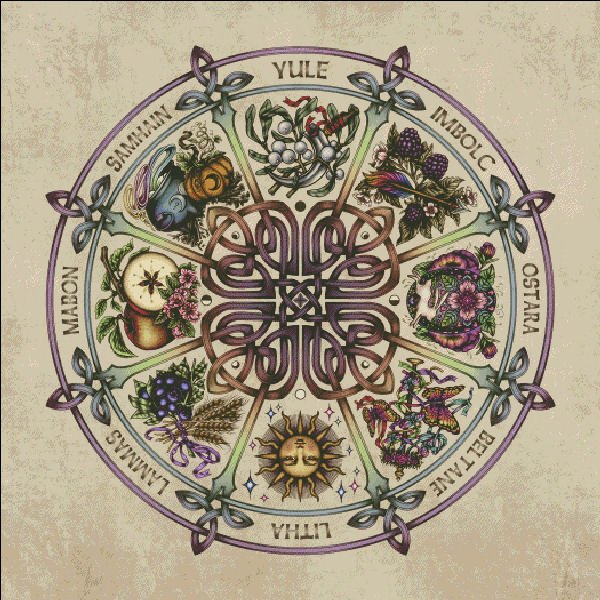
Pagan Wheel of the Year: picture credit Friends of the Forest

Happy Christmas!

The Empires Strike

For centuries, Europe was dominated by Empire building around the world. In the Twentieth Century the Empires, such as the British Empire, finally broke down and gave autonomous sovereign states their freedom back. It might have appeared that the age of ’empire building’ was over, but that is far from the case.

In the Twenty First century it is clear that Empires are back. Key to the once powerful British Empire had been the Navy and control of the seas around the world. Today the vulnerable global ‘key points’ are canals and pinch points in shipping lanes. The Houthis in Southern Yemen potentially control the infamous Straits of Hormuz; gateway to the Red Sea and Suez Canal. They will stop attacking Israeli shipping, they say, when Israel stops attacking Gaza. Neither the British, USA or Israel have tested this, preferring to extend the genocide in Gaza and attack Yemen, than take the Houthis at their word.

One of the strategic reasons for the establishment of a pro-Western State in the Middle East in 1948 (Israel) was, and still is, control of the Suez Canal. In 1956 the British, French and Israelis sought to gain control of the Suez Canal when Egypt nationalised it, moving their tanks from the Gaza Strip into Egypt. In my view, this imperative has never gone away.

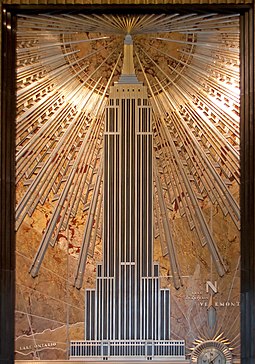
The Empire State Building, New York

MAGA? America is already ‘great’. It consists of a continent joined by an isthmus at Panama; again, a critical shipping route. The republic of the United States of America has a ruling president who wants to expand it’s 50 State Empire northwards and south. ‘Look at this arbitrary line between the USA and Canada,’ mocks Donald Trump, as if it means nothing just because it is straight. If it was meaningless, then Canada could claim the USA, as perhaps could Mexico and Denmark, but because of international law and common sense, they do not.

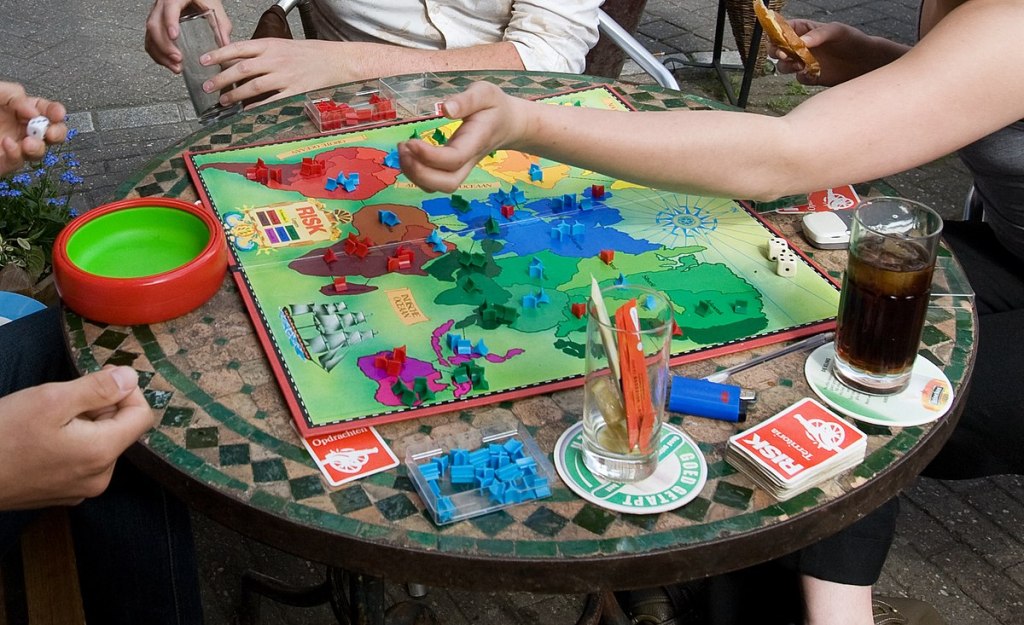
Putin wants the old Union of Soviet Socialist Republics back and China the island of Taiwan. Should then the British march back into India and Pakistan?

Should the French re-take French speaking Algeria?

Should Japan be given back it’s ‘Imperial’ territories in mainland China?

Should Italy claim back it’s Empire around the Mediterranean?

The list of historical reversals is absurd to all but the greedy and unpopular politicians who seek to stay in power indefinitely by empire building. Opponents are fed to the lions.

Today, Gibbon’s ‘The Fall of the Roman Empire’ is a critical read for the Trumps and Putins and Shi Jinpings of this world.

It is available in eight volumes and was read by a famous world statesman when he was twenty years old; Winston Churchill.

Now he knew a thing or two about world statesmanship and his preference for ‘jaw jaw instead of war war’.